 JAZZPROFILES lives in the music 1,002 Jazz Artists fully Profiled!
 Stan Getz
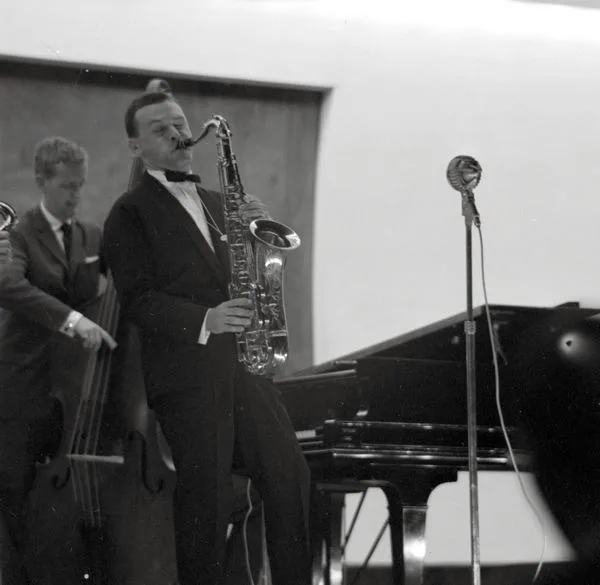
Stan Getz performing at the Concert Hall in Helsingborg, Sweden, September 7, 1958 Public Domain (PD-Sweden-photo) — Wikimedia Commons — https://commons.wikimedia.org/wiki/File:Stan_Getz_in_Helsingborg,_Sweden_1958_(02).jpg
.jpg)
Stanley Getz was born February 2, 1927, in Philadelphia, Pennsylvania, to Alexander and Goldie Gayetski, whose family had shortened its name from Gayetski to Getz after emigrating from London to escape antisemitic pogroms in Ukraine. The family moved to the Bronx during the Depression, where Getz received a harmonica at twelve and his first saxophone, a $35 alto, at thirteen. He practiced for hours a day, took roughly six months of formal lessons from Bronx teacher Bill Shiner, and by 1941 had won a spot in the All-City High School Orchestra of New York, earning free tutoring from New York Philharmonic bassoonist Simon Kovar. He never formally studied harmony or theory.
At sixteen, Getz left James Monroe High School to join trombonist Jack Teagarden's band, and Teagarden became his legal guardian given his age. Over the next several years he passed through the bands of Nat King Cole, Lionel Hampton, Jimmy Dorsey, and Benny Goodman, and briefly worked for Stan Kenton before quitting after Kenton dismissed his primary influence, Lester Young, as too simple. From 1947 to 1949 Getz was a featured soloist in Woody Herman's Second Herd, where he, Zoot Sims, Serge Chaloff, and Herbie Steward made up the saxophone section nicknamed "The Four Brothers." His eight-bar solo on "Early Autumn," recorded with the Herman band on December 27, 1947, became a hit the following year and made Getz, at twenty, one of the most recognized tenor voices in jazz.
Getz launched his own career in 1950, hiring pianist Horace Silver's Hartford trio for touring work after discovering Silver at a club date, though the association ended in 1952 when Getz, deep in heroin addiction, failed to pay the band. In 1952 he scored a hit single with "Moonlight in Vermont," recorded with guitarist Johnny Smith, and signed with producer Norman Granz's Clef and Norgran labels (folded into Verve by 1956). The mid-1950s brought a run of important quartet and quintet dates: 1953's Diz and Getz with Dizzy Gillespie, Oscar Peterson, Herb Ellis, Ray Brown, and Max Roach; the earlier quartet sides with guitarist Jimmy Raney and pianist Duke Jordan later compiled as Stan Getz Plays; and 1955's West Coast Jazz, cut in Hollywood with Conte Candoli, pianist Lou Levy, bassist Leroy Vinnegar, and drummer Shelly Manne. The addiction that shadowed this period surfaced publicly in 1954, when Getz held up a Seattle drugstore for narcotics and attempted suicide after his arrest. He married singer Beverly Byrne in 1946 (three children, divorced 1956) and later married Monica Silfverskiöld, daughter of a Swedish physician, who became both his manager and, for years, his steadying influence.
Seeking distance from the American drug scene, Getz moved his family to Copenhagen in 1958, working steadily around Scandinavia, including a February 16, 1958 Chicago session with Chet Baker issued as Stan Meets Chet. Returning to the United States in 1961, he recorded what he would later call his own favorite among his records: Focus, a suite of Eddie Sauter string arrangements set against Getz's improvising, cut at Webster Hall in New York with pianist Steve Kuhn and drummer Roy Haynes and released on Verve in early 1962. Critics have since ranked it among the era's most fully realized fusions of jazz and orchestral writing.
Later in 1962 Getz teamed with guitarist Charlie Byrd, freshly returned from a State Department tour of Brazil, for Jazz Samba, whose hit single "Desafinado" ignited the American bossa nova craze and won Getz a Grammy. He followed it the same year with Big Band Bossa Nova, arranged and conducted by Gary McFarland with Jim Hall and Hank Jones in the band, and in early 1963 with Jazz Samba Encore!, featuring Brazilian guitarist Luiz Bonfá and pianist/composer Antonio Carlos Jobim. The peak came in March 1963, when Getz, Jobim, guitarist João Gilberto, and Gilberto's wife Astrud recorded Getz/Gilberto for Verve; released in 1964, it produced the crossover hit "The Girl from Ipanema" and became the first non-American record to win the Grammy for Album of the Year, alongside three additional Grammys. Astrud Gilberto and her family later disputed Getz and producer Creed Taylor's account of how she came to sing on the session, alleging it was constructed to deny her rightful royalties. Getz documented the same period further with the October 1964 Carnegie Hall concert Getz/Gilberto #2, which added vibraphonist Gary Burton, and with the club recording Getz Au Go Go.
Getz spent the early 1970s leading a European quartet built around organist Eddy Louiss, guitarist René Thomas, and drummer Bernard Lubat, documented on the 1971 live album Dynasty, while pursuing more modern settings with American players: 1967's Sweet Rain, a quartet date with a 25-year-old Chick Corea on piano alongside Ron Carter and Grady Tate, and 1972's Captain Marvel, recorded with Corea, Stanley Clarke, Airto Moreira, and Tony Williams but held back by Columbia until 1975. His personal life grew turbulent again in the early 1980s: relapses into addiction led to two separate arrests over illegal firearms in the presence of his family, a 1981 divorce filing from Monica that the couple briefly reconciled before it finalized later in the decade, and a court-ordered course of treatment. He nonetheless kept working, teaching as an artist-in-residence at the Stanford Jazz Workshop through 1988, entering the DownBeat Jazz Hall of Fame in 1986, and in 1988 recording the saxophone solo on Huey Lewis and the News's "Small World," a minor pop hit. Diagnosed with cancer in 1987, Getz continued to perform and record: the 1987 Copenhagen concerts at the Jazzhus Montmartre yielded the albums Anniversary! and Serenity, the latter earning him a posthumous Grammy for Best Jazz Instrumental Solo on "I Remember You." His final engagement, a March 1991 stand at the Montmartre with pianist Kenny Barron, was recorded as he battled the liver cancer that would kill him; despite severe pain that cut his final set short, he insisted on completing the run, later released as People Time. Stan Getz died June 6, 1991, in Malibu, California, at age sixty-four; his ashes were scattered from his saxophone case off the coast near Marina del Rey.
Getz built his reputation on what critics and fans came to call simply "The Sound": a warm, breathy, vibrato-light tenor tone drawn directly from his idol Lester Young, applied with a melodic fluency and harmonic sophistication that made him equally at home in bebop-tempo blowing sessions, orchestral third-stream writing, and the gentler rhythms of bossa nova. That combination let him move across settings that stylistically had little in common (the Woody Herman big band, Eddie Sauter's string charts on Focus, Charlie Byrd's classical guitar, Chick Corea's more modern postbop harmony) without ever sounding like a visitor in any of them, and it made him the improviser most responsible for bossa nova's mainstream American breakthrough in the early 1960s. He was not, by most accounts, an easy colleague; drummer and longtime associate Zoot Sims once summed him up as a study in contradictions, an unpredictable temperament that ran alongside decades of documented struggles with heroin and alcohol. Musically, though, his influence on generations of tenor players who prized tone and lyricism over sheer power was direct and lasting, and he remained a working, evolving improviser into his final months, playing through terminal illness rather than stopping.
- Diz and Getz (1955, Norgran) - A December 1953 studio meeting with Dizzy Gillespie, backed by Oscar Peterson, Herb Ellis, Ray Brown, and Max Roach. Spotify - Diz And Getz
- Focus (1962, Verve) - Getz's own favorite among his records: a suite of Eddie Sauter string arrangements built around his improvising, widely regarded as one of jazz's most successful marriages with orchestral writing. Spotify - Focus Listen
- Jazz Samba (1962, Verve) - With guitarist Charlie Byrd; the album and its single "Desafinado" launched the American bossa nova craze and won Getz his first Grammy. Spotify - Jazz Samba Listen
- Getz/Gilberto (1964, Verve) - With João Gilberto, Astrud Gilberto, and Antonio Carlos Jobim; the source of "The Girl from Ipanema" and the first non-American recording to win the Grammy for Album of the Year. Spotify - Getz/Gilberto
- Sweet Rain (1967, Verve) - A quartet date introducing the 25-year-old Chick Corea on piano alongside Ron Carter and Grady Tate. Spotify - Sweet Rain Listen
- Captain Marvel (rec. 1972, rel. 1975, Columbia) - A fusion-inflected quintet reunion with Chick Corea, Stanley Clarke, Airto Moreira, and Tony Williams. Spotify - Captain Marvel Listen
- Serenity (1991, EmArcy) - Drawn from a July 1987 Copenhagen concert with Kenny Barron; its version of "I Remember You" won Getz a posthumous Grammy for Best Jazz Instrumental Solo. Spotify - Serenity Listen
- People Time (1992, Gitanes Jazz/Verve) - Getz's final recording, a duo set with pianist Kenny Barron taped at Copenhagen's Jazzhus Montmartre in March 1991 while Getz was terminally ill. Spotify - People Time Listen
Stan Getz: Full Discography
Identity confirmed via the live Discogs API: artist ID 30486, realname Stanley Gayetzsky, born/died dates matching (February 2, 1927, Philadelphia; June 6, 1991, Malibu). Discogs credits Getz across 4,445 total release entries once every reissue, foreign pressing, compilation and unofficial release is counted, a body of work far too large to itemize. The table below curates his essential leader/co-leader catalog across bebop, cool jazz, the bossa nova years and his fusion-adjacent later period, plus a representative set of his most historically significant sideman and co-star dates; it does not attempt to list all 4,445 credited releases.
As Leader / Co-Leader
| Album Title | Recording Date(s) | Release Date | Label | Catalog Number | Format(s) | Personnel | Role | Reissue History | Spotify | Buy | Notes |
|---|---|---|---|---|---|---|---|---|---|---|---|
| Stan Getz Plays | Recorded December 12 & 29, 1952, New York City | 1955 | Norgran Records | MGN 1042 | Vinyl, LP, Album | Stan Getz (tenor sax), Jimmy Raney (guitar), Duke Jordan (piano), Bill Crow (bass), Frank Isola (drums) | Leader | Compiles two earlier 10" Roost/Norgran sessions | — | — | Norman Granz supervised and wrote the liner notes; an early document of Getz's mid-1950s working quartet |
| West Coast Jazz | Recorded August 10-19, 1955, Radio Recorders, Hollywood | 1955 | Norgran Records | MG N-1032 | Vinyl, LP, Album | Stan Getz (tenor sax), Conte Candoli (trumpet), Lou Levy (piano), Leroy Vinnegar (bass), Shelly Manne (drums) | Leader | None found | — | — | Title is an in-joke: Getz and his sidemen were East Coast players, not exponents of the laid-back West Coast style the title implies |
| Diz and Getz | Recorded December 9, 1953, Los Angeles, and May 25, 1954, New York | 1955 | Norgran Records | MGN-1050 | Vinyl, LP, Album | Stan Getz (tenor sax), Dizzy Gillespie (trumpet), Oscar Peterson (piano), Herb Ellis (guitar), Ray Brown (bass), Max Roach (drums) | Co-leader (with Dizzy Gillespie) | None found | — | — | Norman Granz-supervised bebop summit pairing two of the music's leading soloists |
| Moonlight in Vermont | Recorded 1952-1954, New York City | 1956 | Roost Records | LP 2211 | Vinyl, LP, Album, Mono | Johnny Smith (guitar), Stan Getz and Zoot Sims (tenor sax), Paul Quinichette (tenor sax), Sanford Gold (piano), Eddie Safranski/Arnold Fishkin (bass), Don Lamond (drums) | Featured (billed to the Johnny Smith Quintet featuring Stan Getz) | Compiled from earlier 10" releases; multiple later reissues | — | — | The title track's earlier 1952 single made the charts and is frequently counted among Getz's signature early recordings, though the LP itself is a Johnny Smith date |
| The Steamer | Recorded November 24, 1957, Hollywood | 1959 | Verve Records | MG V-8294 | Vinyl, LP, Album | Stan Getz (tenor sax), Lou Levy (piano), Leroy Vinnegar (bass), Stan Levey (drums) | Leader | None found | — | — | A quartet studio date from the same California period as West Coast Jazz |
| Stan Meets Chet | Recorded February 16, 1958, Chicago | 1958 | Verve Records | MG V-8263 | Vinyl, LP, Album | Stan Getz, Chet Baker (trumpet), Jodie Christian (piano), Victor Sproles (bass), Marshall Thompson (drums) | Co-leader (with Chet Baker) | None found | — | — | Recorded during Getz's Scandinavian years on a rare US visit; the two horns are reported to have had a genuinely tense rapport |
| Focus | Recorded July 14, 28 & September/October 1961, Webster Hall, New York City | 1962 | Verve Records | V6-8412 | Vinyl, LP, Album | Stan Getz (tenor sax), Eddie Sauter (arranger/composer), Steve Kuhn (piano), John Neves (bass), Roy Haynes (drums), string orchestra conducted by Hershy Kay | Leader | Multiple CD reissues | Spotify - Focus | — | Getz called this his favorite among his own records; a suite of orchestral writing built specifically around his improvising, not a soloist-plus-strings date |
| Jazz Samba | Recorded February 13, 1962, Pierce Hall, All Souls Unitarian Church, Washington, D.C. | 1962 | Verve Records | V6-8432 | Vinyl, LP, Album | Stan Getz (tenor sax), Charlie Byrd (guitar), Keter Betts (bass), Buddy Deppenschmidt & Bill Reichenbach (drums) | Co-leader (with Charlie Byrd) | Numerous reissues; also paired with Big Band Bossa Nova on a 2013 compilation | Spotify - Jazz Samba | — | Its single "Desafinado" launched the American bossa nova craze and won Getz his first Grammy |
| Big Band Bossa Nova | Recorded August 27-28, 1962, New York City | 1962 | Verve Records | V6-8494 | Vinyl, LP, Album | Stan Getz (tenor sax), Gary McFarland (arranger/conductor), Jim Hall (guitar), Hank Jones (piano), Clark Terry & Doc Severinsen (trumpet), Tony Studd (trombone) | Leader | Reissued paired with Jazz Samba, 2013 | — | — | A quicker-turnaround follow-up to Jazz Samba, arranged for a larger ensemble by Gary McFarland |
| Jazz Samba Encore! | Recorded February 8, 9 & 27, 1963, New York City | 1963 | Verve Records | V6-8523 | Vinyl, LP, Album | Stan Getz (tenor sax), Luiz Bonfá (guitar), Antonio Carlos Jobim (piano/guitar), Maria Toledo (vocals) | Co-leader (with Luiz Bonfá) | None found | — | — | A more intimate, harmonically darker sequel to Jazz Samba, featuring Jobim as a sideman before his own star turn on Getz/Gilberto |
| Getz/Gilberto | Recorded March 18-19, 1963, New York City | 1964 | Verve Records | V-8545 | Vinyl, LP, Album | Stan Getz (tenor sax), João Gilberto (guitar, vocals), Astrud Gilberto (vocals), Antonio Carlos Jobim (piano) | Co-leader (with João Gilberto) | Numerous reissues, including a 2014 UK vinyl edition; expanded CD editions add session outtakes | — | — | Source of "The Girl from Ipanema"; won Album of the Year and Best Instrumental Jazz Performance at the 1965 Grammys, the first non-American album to win Album of the Year |
| Getz/Gilberto #2 | Recorded live October 9, 1964, Carnegie Hall, New York City | 1966 | Verve Records | V/8623 | Vinyl, LP, Album | Stan Getz (tenor sax), João Gilberto (guitar, vocals), Gary Burton (vibraphone), Gene Cherico/Keter Betts (bass), Hélcio Milito/Joe Hunt (drums) | Co-leader (with João Gilberto) | None found | — | — | Concert billed under multiple artist orderings on different pressings |
| Nobody Else But Me | Recorded March 4, 1964, Van Gelder Studio, Englewood Cliffs, NJ | 1994 | Verve Records | 314 521 660-2 | CD, Album | Stan Getz (tenor sax), Gary Burton (vibraphone), Gene Cherico (bass), Joe Hunt (drums) | Leader | First release, 30 years after recording | — | — | Verve shelved the session to keep promoting the bossa nova brand; released only after Getz's death |
| Sweet Rain | Recorded March 30, 1967, Van Gelder Studio, Englewood Cliffs, NJ | 1967 | Verve Records | V-8693 | Vinyl, LP, Album | Stan Getz (tenor sax), Chick Corea (piano), Ron Carter (bass), Grady Tate (drums) | Leader | CD reissue | Spotify - Sweet Rain | — | Introduced the 25-year-old Chick Corea to Getz's audience three years before Corea's own Return to Forever |
| Captain Marvel | Recorded March 3, 1972, A&R Studios, New York City | 1975 | Columbia | PC 32706 | Vinyl, LP, Album | Stan Getz (tenor sax), Chick Corea (electric piano), Stanley Clarke (bass), Airto Moreira (percussion), Tony Williams (drums) | Leader | None found | Spotify - Captain Marvel | — | Recorded in 1972 but held by Columbia for three years before release; reunited Getz with Corea in an electric, fusion-inflected quintet |
| Anniversary! | Recorded live July 6, 1987, Jazzhus Montmartre, Copenhagen | 1989 | EmArcy | 838 769-2 | CD, Album | Stan Getz (tenor sax), Kenny Barron (piano), Rufus Reid (bass), Victor Lewis (drums) | Leader | None found | — | — | Originally produced for Danish Radio broadcast to mark Getz's 60th birthday year; drawn from the same Montmartre engagement as Serenity |
| Serenity | Recorded live July 6, 1987, Jazzhus Montmartre, Copenhagen | 1991 | EmArcy | 838 770-2 | CD, Album | Stan Getz (tenor sax), Kenny Barron (piano), Rufus Reid (bass), Victor Lewis (drums) | Leader | None found | Spotify - Serenity | — | Its version of "I Remember You" won Getz a posthumous Grammy for Best Jazz Instrumental Solo |
| People Time | Recorded live March 3-6, 1991, Jazzhus Montmartre, Copenhagen | 1992 | Gitanes Jazz/Verve | P2-10823 | CD, Album | Stan Getz (tenor sax), Kenny Barron (piano) | Co-leader (with Kenny Barron) | Expanded 7-CD box, People Time: The Complete Recordings, released 2009 | Spotify - People Time | — | Getz's final recording, made while he was terminally ill with liver cancer; he died three months later |
As Sideman (selected major credits)
| Year | Project (Leader) | Title | Label | Catalog | Role | Notes |
|---|---|---|---|---|---|---|
| 1947 | Woody Herman and His Second Herd | "Early Autumn" / "Keeper of the Flame" | Capitol Records | 57-616 | Tenor saxophone (featured soloist) | Recorded December 27, 1947; Getz's eight-bar solo, alongside section-mates Zoot Sims, Serge Chaloff and Herbie Steward (the "Four Brothers"), made him a name at twenty when the single became a 1948 hit |
| 1958 | Jazz at the Philharmonic (Norman Granz) | various JATP concert recordings | Verve | Tenor saxophone | Getz appeared periodically in Granz's touring JATP package alongside artists including Oscar Peterson and Dizzy Gillespie | |
| 1988 | Huey Lewis and the News | Small World | Chrysalis | Tenor saxophone (solo, "Small World, Part Two") | A late-career pop crossover session; the track became a minor hit single |
Getz's Discogs sideman log, spread across 4,445 total credited entries once every foreign pressing, reissue and compilation is counted, also documents extensive session and touring work with Woody Herman's Second Herd beyond the "Four Brothers" singles, appearances backing Norman Granz's Jazz at the Philharmonic package tours through the 1950s, and later guest and all-star studio dates from the 1970s and 1980s; these are not itemized exhaustively here.
- João Gilberto, Astrud Gilberto, and Antonio Carlos Jobim - the Brazilian core of the bossa nova period, 1963-1964, above all Getz/Gilberto.
- Charlie Byrd - guitarist and co-leader of 1962's Jazz Samba, the record that started the American bossa nova craze.
- Chick Corea - pianist on 1967's Sweet Rain and the 1972 sessions issued as Captain Marvel, both pivotal to Getz's more modern late-1960s/1970s sound.
- Dizzy Gillespie - co-leader of 1953's Diz and Getz, backed by Oscar Peterson's trio.
- Kenny Barron - pianist for Getz's final decade of performing, including Anniversary!, Serenity, and the farewell duo recording People Time (1991).
- Woody Herman - bandleader who gave Getz his first national exposure as one of the Second Herd's "Four Brothers" saxophonists, 1947-1949.
- Creed Taylor - producer of Getz's key Verve dates of the 1960s, including Jazz Samba, Focus, and Getz/Gilberto.