 JAZZPROFILES lives in the music 1,572 Jazz Artists fully Profiled!
 Sirone
Last updated September 26, 2026
Listen on Spotify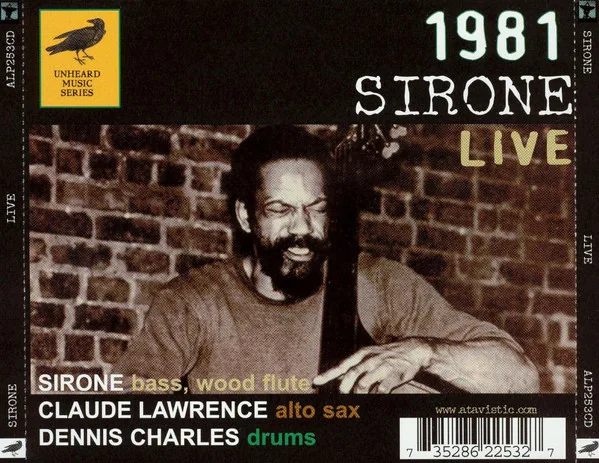
Sirone at the double bass, from the sleeve of his own live album *Live* (recorded at The Public Theater, New York, November 7, 1980; issued 1981 on his Serious Music label, reissued 2005 by Atavistic as ALP253CD in the Unheard Music Series). Sleeve photograph by Kazunori Sugiyama. The image reproduced here is the Atavistic CD back cover, which carries the same photograph in better reproduction than the original LP sleeve. Album cover art (not a CC-licensed artist photo) used as the only available image showing the artist. No free or public-domain photograph of Sirone exists: a namespace-6 Wikimedia Commons search on five separate bare queries ("Sirone," "Sirone bassist," "Sirone Jones bass," "Norris Jones bassist," "Revolutionary Ensemble jazz") returns only the Italian municipality of Sirone in Lombardy, an unrelated US Army Corps of Engineers photographer named Norris Jones, and British touring-car photographs. The English Wikipedia article "Sirone (musician)" carries no image at all (checked via the images API, which returns only an interface icon), the German article "Sirone (Musiker)" likewise, and Wikidata item Q188150 has no P18 image property. There is therefore no locally hosted fair-use file to reject in this case, but the check was run. — Discogs release 1152143 (Sirone, Live, Atavistic ALP253CD, 2005) — https://www.discogs.com/release/1152143
Norris Jones, who took the name Sirone, was born in Atlanta on September 28, 1940. He started on trombone as a boy and moved to the bass at seventeen, keeping the horn player's sense of line and breath that later listeners heard in his phrasing. Late in the 1950s and into the early 1960s he worked around Atlanta in a band called The Group, whose saxophonist was a local contemporary named George Adams. The paying work was rhythm and blues, and Sirone took session dates behind singers including Sam Cooke and Smokey Robinson before he had recorded a note of jazz.
In 1966 Marion Brown telephoned from New York and Sirone moved north. Within months he was on record, and within two years he had played on most of the important small-label documents of the second free-jazz wave. With pianist Dave Burrell he co-founded a working unit called the Untraditional Jazz Improvisational Team, filled out by saxophonist Byard Lancaster and drummer Bobby Kapp. He recorded Noah Howard's At Judson Hall on October 19, 1966, Brown's Why Not four days later, and Brown's Impulse! date Three for Shepp on December 1, 1966. Gato Barbieri's In Search of the Mystery followed on March 15, 1967, then Burrell's own sessions of February 6 and September 9, 1968, Sonny Sharrock's Black Woman that October, and Pharoah Sanders's Izipho Zam on January 14, 1969. He also worked with Albert Ayler, Archie Shepp, Sun Ra, Sunny Murray, and, in the last stretch of the saxophonist's life, with John Coltrane, an association that left no recording behind.
Late in 1970, over a table at Liberty House on Bleecker Street, Sirone and violinist Leroy Jenkins worked out the group that made both their reputations. The Revolutionary Ensemble was founded in 1971 with drummer Frank Clayton, who was quickly replaced by Jerome Cooper, and it operated as a cooperative with no designated leader for six years. Its five records are a compact history of what a string-heavy trio could do outside the conventional rhythm-section hierarchy: Vietnam, taped at the Washington Square Methodist Church that everyone called the Peace Church and released by ESP-Disk in 1972; Manhattan Cycles, recorded live on the last day of 1972 and built on an extended composition by Wadada Leo Smith; The Psyche, put out on the group's own RE Records; The People's Republic, cut December 4 to 6, 1975 at Kendun Recorders in Burbank for A&M's Horizon imprint; and Revolutionary Ensemble, taped at Moosham Castle in Austria on August 18, 1977 for Enja. The Horizon album was the closest the trio came to a major label, and it did not go smoothly. Sirone later recounted that when Herb Alpert played an excerpt for Quincy Jones, Jones reacted badly and said he had been conned, that what he was hearing was not jazz. Sirone's answer was that Jones had missed the point: everybody can sing, whether or not you like the voices. The group broke up in 1977.
The same decade kept him busy elsewhere. He played on Clifford Thornton's Communications Network in 1972, on the Jazz Composer's Orchestra's Plays Numatik Swing Band, composed and conducted by Roswell Rudd, and on Jenkins's own large commissioned score For Players Only, recorded for JCOA in 1975. He made two albums with Dewey Redman for Impulse!, The Ear of the Behearer (June 8 and 9, 1973) and Coincide (September 9 and 10, 1974), doubling on wood flute for the first. Then came Cecil Taylor. Sirone first recorded with him at Town Hall on November 4, 1973, the concert issued as Spring of Two Blue-J's, and in 1978 became the bassist in the Cecil Taylor Unit sextet alongside Jimmy Lyons, Raphé Malik, Ramsey Ameen and Ronald Shannon Jackson. That band recorded twice in April 1978 at Columbia's 30th Street studio, producing The Cecil Taylor Unit and 3 Phasis, then documented itself twice more on a European tour: at a radio concert in Kirchzarten in the Black Forest on June 3, 1978, and at the Liederhalle in Stuttgart eleven days later, the second issued by hat Hut as One Too Many Salty Swift and Not Goodbye.
His own leader catalog started late and stayed small. Artistry, recorded July 5, 1978 at Generation Sound in New York and released the following year on the tiny Of The Cosmos label, is a chamber quartet with no drum kit: flutist James Newton, cellist Muneer Bernard Fennell and Famoudou Don Moye on percussion, with all four compositions by Sirone and liner notes by Stanley Crouch. Live caught a trio with alto saxophonist Claude Lawrence and drummer Dennis Charles at the Public Theater on November 7, 1980, and came out in 1981 on Serious Music, the label and publishing company Sirone ran himself; Atavistic reissued it in 2005 in its Unheard Music Series. Between them sits Life Rays, recorded February 4 and 5, 1982 at Barigozzi Studios in Milan with vibraphonist Walt Dickerson and drummer Andrew Cyrille, and released by Soul Note with a Nat Hentoff liner essay. It was Dickerson's last record.
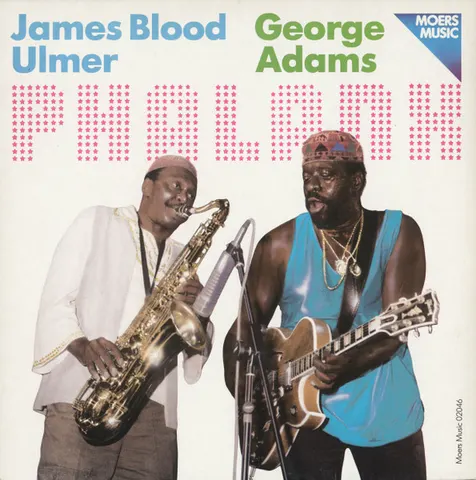
The 1980s put him in the middle of two very different bands. Phalanx had been running since 1985 as a quartet co-led by guitarist James Blood Ulmer and George Adams, with Amin Ali on electric bass and Grant Calvin Weston on drums. In late 1986 or early 1987 that rhythm section was replaced wholesale by Sirone and Rashied Ali, and the reconstituted group made both of its studio albums for the Japanese label DIW, Original Phalanx (February 13 and 14, 1987) and In Touch (February 27 and 29, 1988). Sirone wrote four of the band's pieces, "Free Spirit" and "Angel Love" among them. The other band was violinist Billy Bang's, and it led to a run of Silkheart sessions at A&R Recording in New York in April 1988 with Charles Gayle: Always Born on the 10th and 11th, then Homeless and Spirits Before on the 13th and 14th, three albums that reintroduced Gayle to the record-buying world after two decades of near silence. That March, Sirone had already cut Bang's Valve No. 10 in Milan with Frank Lowe on tenor and Dennis Charles on drums. In September 1986 he had been one of two bassists, with Fred Hopkins, in The Group, a six-piece with Marion Brown, Bang and Andrew Cyrille whose only concert recording surfaced on NoBusiness in 2012. In August 1988 he played on George Adams's Blue Note ballad album Nightingale.
From 1989 Sirone lived in Berlin, where he led a quartet called Concord with saxophonist Ben Abarbanel-Wolff and violinist Ulli Bartel; that group made Sirone's Concord in June 2003, his first album under his own name in more than twenty years. He worked in theater and film, appearing in Garin Nugroho's 2008 Teak Leaves at the Temple, and was a practicing Buddhist. The last decade brought him back into view in New York as well. The Revolutionary Ensemble reformed in 2004 and recorded And Now... at Systems Two in Brooklyn on June 18 of that year for Pi Recordings, with two later concerts, Warsaw in May 2005 and Genoa that November, issued by Mutable Music after Jenkins's death. In November 2004 he and Bang co-led the Sirone Bang Ensemble, with Gayle on saxophones and a young Tyshawn Sorey on drums, at CBGB's Gallery for the album Configuration. Six months earlier he had taken one of four bass chairs, next to William Parker, Henry Grimes and Alan Silva, in Parker's bass quartet at the Vision Festival, recorded as Requiem. His last sessions were a 2008 trio at the Brecht Forum with Oluyemi Thomas and Michael Wimberly and another in Brooklyn that June with Sabir Mateen and Andrew Barker, both released after his death. He passed away in Berlin on October 21, 2009, at sixty-nine.
Sirone came to the bass from the trombone, and the two habits that most distinguished him both trace back to that: a singing, horn-like line in the upper register, often bowed, and an unusual willingness to state ideas rather than support them. Commentators have consistently placed his attack between two models, Charles Mingus's very physical way of making the sound of fingers against string audible, and Jimmy Garrison's flamenco-style strumming. What he added was a trembling high-register tone that meshed with Leroy Jenkins's violin, which is why the Revolutionary Ensemble worked as a texture rather than as a violin trio with accompaniment. Gary Giddins, writing about The People's Republic, described a "redwood-heavy bass" and singled out the arco technique; the Penguin Guide to Jazz Recordings judged his own playing the revelation of the 1981 Live album, and AllMusic gave that record five stars and Artistry four and a half. He was also a composer, writing all four pieces on Artistry, most of Sirone's Concord, and material for both Phalanx and the Revolutionary Ensemble. He was impatient with the label attached to the music he made: free, in his account, had been abused into a synonym for noise, and the discipline of the Revolutionary Ensemble was his standing answer to that.
- Vietnam (recorded 1972; released 1972, Revolutionary Ensemble, ESP-Disk) - The trio's debut, taped at the Peace Church in Greenwich Village, and the record that established what three strings and a drum kit could do without a leader. Spotify - Vietnam Listen
- The People's Republic (recorded December 1975; released 1976, Revolutionary Ensemble, A&M/Horizon) - The group's only major-label album and the usual entry point to its catalog. Not confirmed on Spotify.
- Artistry (recorded July 5, 1978; released 1979, Of The Cosmos) - His first album as a leader, a chamber quartet with James Newton, Muneer Bernard Fennell and Don Moye, all four pieces his own. Not confirmed on Spotify.
- Live (recorded November 7, 1980; released 1981, Serious Music) - A trio with Claude Lawrence and Dennis Charles at the Public Theater, self-released and reissued by Atavistic in 2005; the clearest recorded case for his bass playing. Not confirmed on Spotify.
- 3 Phasis (recorded April 1978; released 1979, Cecil Taylor, New World) - One of two studio albums from the 1978 Cecil Taylor Unit sextet, the most demanding band Sirone ever held down. Spotify - 3 Phasis
- Life Rays (recorded February 1982; released 1982, Walt Dickerson / Sirone / Andrew Cyrille, Soul Note) - A co-led trio with vibraphone and drums, and the last record vibraphonist Walt Dickerson made. Spotify - Life Rays
- Original Phalanx (recorded February 1987; released 1987, Phalanx, DIW) - The first of two albums by the quartet with James Blood Ulmer, George Adams and Rashied Ali; Sirone wrote two of its pieces. Not confirmed on Spotify.
- And Now... (recorded June 18, 2004; released 2004, Revolutionary Ensemble, Pi Recordings) - The reunion album, twenty-seven years after the trio broke up and three years before Leroy Jenkins died. Spotify - And Now... Listen
Sirone: Full Discography
Identity confirmed via the live Discogs API. Sirone is carried there under two linked entities: artist 297037 ("Sirone," realname Norris Jones, born September 28, 1940 in Atlanta, died October 21, 2009 in Berlin) and artist 417149 ("Norris Jones," same profile text, same birth and death dates), each listed as an alias of the other. Between them Discogs credits him on 100 releases: 75 under "Sirone" (7 in a "Main"/leader role, 58 sideman "Appearance" credits, 4 track-level credits, 6 unofficial pressings) and a further 25 under "Norris Jones," all of them sideman, compilation or unofficial credits from the 1962 to 1972 period plus later reissues. His name variations across the two entities include "Sirone (Norris Jones)," "Sirone aka Norris Jones," "Sirone Jones," "Norris 'Sirone' Jones" and "Norris Jones (Sirone)."
Sixteen group entities are attached to the "Norris Jones" entity, and the leader and co-leader catalog is split across several of them rather than sitting on either personal page: The Revolutionary Ensemble (932956, 11 releases), Sirone Bang Ensemble (2213343), Sirone Sextet (2275569), The Group (21) (3039987), Phalanx (4) (915919), The Cecil Taylor Unit (317894), The Charles Gayle Trio (125977), Charles Gayle Quartet (694955), The Jazz Composer's Orchestra (309383), Marion Brown Quartet (362813), Billy Bang Quartet (1046593), Gato Barbieri Quartet (2270738), William Parker Bass Quartet (2590085), Tony Oxley Quintet (1071313), Tetrade Quartet (4607615) and Noah Howard Septet (5031061). The two tables below merge all of these. The leader table is complete for his commercially issued leader, co-leader and cooperative-band releases; the sideman table is a selection of his most significant credits, not an itemization of all 58.
The Buy column is always a dash: no affiliate program is set up for this site yet.
As Leader / Co-Leader (including the Revolutionary Ensemble, a leaderless cooperative he co-founded)
| Album Title | Recording Date(s) | Release Date | Label | Catalog Number | Format(s) | Personnel | Role | Reissue History | Spotify | Buy | Notes |
|---|---|---|---|---|---|---|---|---|---|---|---|
| Vietnam 1 & 2 (At The Peace Church) | Recorded 1972, Washington Square Methodist Church ("the Peace Church"), New York | 1972 | ESP-Disk' | ESP 3007 | Vinyl, LP, Album, Stereo/Quadraphonic | Leroy Jenkins (violin), Sirone (bass), Jerome Cooper (percussion); all music composed and arranged by the group | Co-leader (Revolutionary Ensemble) | Later CD editions on ESP-Disk' | Spotify - Vietnam | — | The trio's debut; Sirone brought the tape to ESP founder Bernard Stollman himself. Penguin Guide 3 stars |
| Manhattan Cycles | Recorded live December 31, 1972 | 1973 | India Navigation | IN 1023 | Vinyl, LP, Album | Leroy Jenkins (violin, viola), Sirone (bass), Jerome Cooper (drums, bugle, flute, tape, metal hoops); composition by Wadada Leo Smith | Co-leader (Revolutionary Ensemble) | Multiple sleeve variants; later CD | Not confirmed on Spotify | — | A single extended Leo Smith composition across two LP sides |
| The Psyche | Not specified in Discogs data (issued 1975) | 1975 | RE: Records (the group's own label) | RE 3117 | Vinyl, LP, Album | Leroy Jenkins (violin, viola), Sirone (bass), Jerome Cooper (drums, piano) | Co-leader (Revolutionary Ensemble) | CD reissue, 2004 (Mutable) | Spotify - The Psyche | — | Self-released; three tracks ("Invasion," "Hu-man," "Collegno") |
| The People's Republic | Recorded December 4-6, 1975, Kendun Recorders, Burbank, California | 1976 | Horizon (A&M) | SP-708 | Vinyl, LP, Album | Leroy Jenkins, Sirone, Jerome Cooper; produced by Ed Michel, engineered by Baker Bigsby, liner notes by Peter Occhiogrosso | Co-leader (Revolutionary Ensemble) | None found | Not confirmed on Spotify | — | The trio's only major-label album; the record whose playback reportedly drew a hostile reaction from Quincy Jones |
| Revolutionary Ensemble | Recorded live August 18, 1977, Moosham Castle, Austria | 1977 | Enja Records | enja 3003 | Vinyl, LP, Album | Leroy Jenkins (violin, kalimba, voice, flute), Sirone (bass, flute), Jerome Cooper (drums, piano, balafon, chirimia, flute); produced by Horst Weber and Matthias Winckelmann | Co-leader (Revolutionary Ensemble) | None found | Not confirmed on Spotify | — | Sirone wrote the opening "Clear Spring"; the group's last record before the 1977 breakup |
| Artistry | Recorded July 5, 1978, Generation Sound, New York City | 1979 | Of The Cosmos | OTC 801 | Vinyl, LP, Album | Sirone (double bass, all compositions), James Newton (flute), Muneer B. Fennell (cello), Famoudou Don Moye (percussion); liner notes by Stanley Crouch, cover photo by Gösta Peterson | Leader | Reissued on vinyl by Moved-By-Sound, 2022 and 2023 (MBS-3, remastered) | Not confirmed on Spotify | — | His first album as a leader; AllMusic 4.5 stars |
| Live | Recorded live November 7, 1980, The Public Theater, New York City | 1981 | Serious Music (Sirone's own label) | 1000 | Vinyl, LP, Album | Sirone (bass, wood flute, trombone), Claude Lawrence (alto saxophone), Dennis Charles (drums); produced by Sirone and Kazunori Sugiyama | Leader | Reissued on CD 2005 by Atavistic (ALP253CD), Unheard Music Series, mastered at Airwave Studios, Chicago | Not confirmed on Spotify | — | AllMusic 5 stars; the Penguin Guide singles out the bass playing |
| Life Rays | Recorded February 4-5, 1982, Barigozzi Studios, Milan | 1982 | Soul Note | SN 1028 | Vinyl, LP, Album | Walt Dickerson (vibraphone, all compositions), Sirone (bass), Andrew Cyrille (drums); liner notes by Nat Hentoff | Co-leader (billed Walt Dickerson / Sirone / Andrew Cyrille) | CD reissue on Soul Note | Spotify - Life Rays | — | Walt Dickerson's final release |
| Live In Berlin, Ballhaus 1987 | Recorded at the Ballhaus, Berlin; the release title says 1987 but the sleeve notes say "late 1981" | 2011 | Sagittarius A-Star | Sagittarius A-Star 13 | Vinyl, LP, Limited Edition (180g, 200 copies) | Sirone (bass), Thomas Borgmann (soprano saxophone), Nick Steinhaus (alto saxophone), Jacques Nobili (trombone), Jason Hwang (violin), Anthony Brown (drums) | Leader (Sirone Sextet) | None found | Not confirmed on Spotify | — | Posthumous archival release; the recording year is internally contradictory on the release itself and is not resolved here. Opens with two parts of his own "Illusions of Reality" |
| Sirone's Concord | Recorded, mixed and mastered June 10 and 24, 2003, Das Tonstudio 24, Berlin | 2003 | Not Two Records | MW 751-2 | CD, Album | Sirone (double bass, all compositions), Ben Abarbanel-Wolff (saxophone), Ulli Bartel (violin), Maurice de Martin (drums); liner notes by Andrzej Grabowski | Leader | None found | Not confirmed on Spotify | — | His first album under his own name in over twenty years; the working Berlin group Concord |
| Configuration | Recorded November 9, 2004, CBGB's Gallery, 313 Bowery, New York City | 2005 | Silkheart | SHCD 155 | CD, Album | Sirone (bass), Billy Bang (violin), Charles Gayle (alto and tenor saxophone), Tyshawn Sorey (drums); compositions by Sirone and Bang; liner notes by Andrey Henkin | Co-leader (Sirone Bang Ensemble) | None found | Not confirmed on Spotify | — | Discogs group entity 2213343; the only release under this billing |
| And Now... | Recorded June 18, 2004, Systems Two, Brooklyn, New York | October 2004 | Pi Recordings | PI13 | CD, Album | Leroy Jenkins (violin, harmonica, bells), Sirone (acoustic bass), Jerome Cooper (multi-dimensional drums, balafon, chirimia, keyboards); all compositions by the group; liner notes by all three | Co-leader (Revolutionary Ensemble) | None found | Spotify - And Now... | — | The reunion album, twenty-seven years after the breakup |
| Boiler | All Ear Trio with Sirone recorded February 2005, Vang Studios; trio-only material July 2006 | 2007 | Ninth World Music | NWM 038 CD | CD, Album | Sirone (bass), John Tchicai (alto and tenor saxophone, bass clarinet, vocals), Thomas Agergaard (tenor and soprano saxophone, flute), Peter Ole Jørgensen (drums, balafon, percussion) | Co-leader (billed The All Ear Trio with Sirone) | None found | Not confirmed on Spotify | — | Danish session; Wikipedia dates the release to 2008, Discogs to 2007 |
| Beyond The Boundary Of Time | Recorded in concert May 25, 2005, Warsaw, Poland | 2008 | Mutable Music | 17532-2 | CD, Album, Digipak | Leroy Jenkins (violin), Sirone (bass), Jerome Cooper (drums, balafon, chirimia, Yamaha PSR 1500); cover art by Frederick Brown | Co-leader (Revolutionary Ensemble) | None found | Spotify - Beyond the Boundary of Time | — | Dedicated to Leroy Jenkins (1932-2007), who had died before release |
| Beneath Tones Floor | Recorded 2008 at the Brecht Forum, New York City | 2010 | NoBusiness Records | NBCD 20 | CD, Album | Oluyemi Thomas (bass clarinet, flute, soprano saxophone, musette, percussion), Sirone (bass), Michael Wimberly (drums, percussion); compositions by all three | Co-leader | None found | Not confirmed on Spotify | — | Issued after his death |
| Counterparts | Recorded live November 25, 2005, Teatro Gustavo Modena, Genoa, Italy | 2012 | Mutable Music | 17549-2 | CDr, Album | Leroy Jenkins (violin), Sirone (bass), Jerome Cooper (drums, balafon, chirimia, keyboards); mastered by Tom Hamilton | Co-leader (Revolutionary Ensemble) | None found | Spotify - Counterparts - Live | — | The trio's last recording, issued seven years after the concert. Track 5 is misspelled on the release: it should read "Berlin Erfahrung" |
| Infinite Flowers | Recorded June 30, 2008, Brooklyn, New York | June 2013 | Sagittarius A-Star | SAS #39 | Vinyl, LP (clear glow orange) | Sabir Mateen (tenor saxophone), Sirone (bass), Andrew Barker (drums); published by Serious Music, BMI | Co-leader | None found | Not confirmed on Spotify | — | Two long tracks, "Infinite" and "Flowers"; issued posthumously |
As Sideman (selected major credits)
| Year | Project (Leader) | Title | Label | Catalog | Role | Notes |
|---|---|---|---|---|---|---|
| 1966 | Noah Howard | At Judson Hall | ESP-Disk' | ESP 1064 | Bass | Recorded at Judson Hall, New York, October 19, 1966; released 1968 |
| 1966 | Marion Brown Quartet | Why Not | ESP-Disk' | 1040 | Bass | Recorded October 23, 1966, New York; released 1968 |
| 1966 | Marion Brown | Three for Shepp | Impulse! | AS-9139 / A-9139 | Bass | Recorded December 1, 1966; gatefold sleeve; the Impulse! date named for Archie Shepp |
| 1967 | Gato Barbieri Quartet | In Search of the Mystery | ESP-Disk' | ESP 1049 | Bass | Recorded March 15, 1967, New York |
| 1968 | Sonny Sharrock | Black Woman | Vortex | 2014 | Bass | Both sessions October 1968, A&R Recording and Apostolic Studios, New York; released 1969 |
| 1968 | Dave Burrell | High Won-High Two | Arista / Freedom | AL 1906 | Double bass | Recorded February 6 and September 9, 1968, New York, with Sunny Murray and Bobby Kapp on drums and Pharoah Sanders on tambourine; not issued until 1976. The single-LP High Two (Freedom PA-6077, 1977) draws on the same two dates |
| 1969 | Pharoah Sanders | Izipho Zam (My Gifts) | Strata-East | SES-19733 | Bass | Recorded January 14, 1969, TownSound Studios, Englewood, New Jersey; held back until 1973 |
| 1969 | Noah Howard | The Black Ark | Freedom | Catalog not confirmed | Bass | Reissued repeatedly, including a 2023 ezz-thetics edition |
| 1972 | Clifford Thornton | Communications Network | Third World | LP 12272 | Bass | Two dates: January 22, 1972 (ABC Stage City, New York) and April 17, 1972 (Festival of African American Music); Jerome Cooper on percussion, Jayne Cortez reading |
| 1973 | The Jazz Composer's Orchestra, composed and conducted by Roswell Rudd | Plays Numatik Swing Band | JCOA Records | LP 1007 | Bass | Material written 1971 and first played by the JCOA at the New York Public Theater |
| 1973 | Dewey Redman | The Ear of the Behearer | Impulse! / ABC | AS-9250 | Bass, wood flute | Recorded June 8 and 9, 1973, Generation Sound, New York |
| 1973 | Cecil Taylor Unit | Spring of Two Blue-J's | Unit Core Records | 30551 | Bass | Second set of a Town Hall concert, New York, November 4, 1973, dedicated to Ben Webster; issued 1974. Sirone's first recording with Cecil Taylor |
| 1974 | Dewey Redman | Coincide | Impulse! / ABC | ASD-9300 | Bass | Recorded September 9 and 10, 1974, Generation Sound, New York; issued 1975 |
| 1975 | Leroy Jenkins, The Jazz Composer's Orchestra | For Players Only | JCOA Records | JCOA 1010 | Bass | Jenkins's large commissioned score, recorded January 30, 1975 |
| 1975 | Dane Belany | Motivations | Sahara Records | Catalog not confirmed | Bass | |
| 1978 | Cecil Taylor | The Cecil Taylor Unit | New World Records | NW 201 | Bass | Recorded April 1978, Columbia Recording Studios, 30th Street, New York, by the sextet with Jimmy Lyons, Raphé Malik, Ramsey Ameen and Ronald Shannon Jackson |
| 1978 | Cecil Taylor | 3 Phasis | New World Records | NW 303 | Bass | Same April 1978 sessions as The Cecil Taylor Unit; issued 1979 |
| 1978 | Cecil Taylor | Live in the Black Forest | MPS / Pausa | 7053 (US Pausa pressing) | Bass | SWF radio concert, Kirchzarten, Black Forest, West Germany, June 3, 1978; issued 1979 |
| 1978 | Cecil Taylor Unit | One Too Many Salty Swift and Not Goodbye | Hat Hut Records | hat Hut TWO (3R02) | Bass | Recorded by Süddeutscher Rundfunk at the Liederhalle/Mozartsaal, Stuttgart, June 14, 1978; issued 1980 |
| 1986 | The Group (Ahmed Abdullah, Marion Brown, Billy Bang, Sirone, Fred Hopkins, Andrew Cyrille) | Live | NoBusiness Records | NBCD50 | Bass (one of two) | Recorded September 13, 1986, Jazz Center of New York, 380 Lafayette Street; not issued until 2012 |
| 1987 | Phalanx | Original Phalanx | DIW | DIW-8013 | Bass, composer | Recorded at Sound Ideas, New York, February 13 and 14, 1987, mixed live to two-track digital, with James Blood Ulmer, George Adams and Rashied Ali. Sirone wrote "Free Spirit" and "Angel Love." Reissued on CD 1994 (32DIW 801CD) with the track "A Smile" restored |
| 1988 | Billy Bang Quartet | Valve No. 10 | Soul Note | 121186-2 | Bass | Recorded March 8 and 9, 1988, Barigozzi Studio, Milan, with Frank Lowe on tenor and Dennis Charles on percussion; issued 1991 |
| 1988 | Charles Gayle Quartet | Always Born | Silkheart | SHCD 115 | Bass, co-composer | Recorded April 10 and 11, 1988, A&R Recording, New York, with John Tchicai and Reggie Nicholson; Sirone has a writing credit |
| 1988 | Charles Gayle Trio | Homeless | Silkheart | SHCD 116 | Bass | Recorded digitally April 13 and 14, 1988, A&R Recording, New York, with David Pleasant; issued 1989. CD carries two more titles than the LP |
| 1988 | Charles Gayle Trio | Spirits Before | Silkheart | SHCD 117 | Bass | The other album from the April 13-14, 1988 sessions; issued 1989 |
| 1988 | George Adams | Nightingale | Blue Note | B1-91984 | Bass | Recorded at A&R Recording, New York, August 19 and 20, 1988, with Hugh Lawson and Victor Lewis; a ballad program, issued 1989 |
| 1987-88 | Phalanx | In Touch | DIW | DIW-826 | Bass, composer | Recorded at A&R Recording, New York, February 27 and 29, 1988; Ulmer doubles on flute and Adams adds soprano saxophone. AllMusic rated it four stars, the band's best-reviewed record |
| 1993 | Cecil Taylor Ensemble | Always a Pleasure | FMP | Catalog not confirmed | Bass | Berlin; issued 1996 |
| 2003 | Charles Gayle | Shout! | Clean Feed | CF033CD | Double bass | Recorded May 23, 2003, Xangrilá Studios, Lisbon, with Gerald Cleaver; issued 2005 |
| 2004 | William Parker Bass Quartet featuring Charles Gayle | Requiem | Splasc(H) Records | CDH 885.2 | Bass (one of four) | Recorded live at the Ninth Vision Festival, May 31, 2004; the other bassists are Parker, Henry Grimes and Alan Silva; issued 2006 |
| 2004 | Kali Z. Fasteau | Making Waves | Flying Note | Catalog not confirmed | Contrabass, co-composer | |
| 1962-70 | Albert Ayler | Holy Ghost: Rare & Unissued Recordings (1962-70) | Revenant | Box set | Bass (on part of the set) | Nine-disc archival box, 2004 |
| 2008 | Tetrade Quartet (Guerino Mazzola) | Liquid Bridges | Springer Verlag | Catalog not confirmed | Bass | Issued 2009, the year of his death |
| Various | Tony Oxley Quintet | Angular Apron | Corbett vs. Dempsey | Catalog not confirmed | Bass | Archival release, 2024 |
Excluded and unresolved credits
- Anthony Hamilton, Ain't Nobody Worryin' (2005). Discogs credits "Norris Jones, guitar" on one track to artist 417149. This is the wrong Norris Jones: Discogs 773882 ("Norris Jones (2)," realname Samuel Jones) is a guitarist who toured with D'Angelo. Not included.
- Jerry Butler, "It's Too Late" (1962). Discogs gives artist 417149 a "Written-By" credit. It is plausible given Sirone's documented R&B session period, but nothing outside Discogs corroborates it, and the credit is a songwriting one rather than a playing one. Not included.
- Dave Lindholm, Sissi (1987), Sillalla (1990), Lähes 50 (2002); Peter Gordon, Leningrad Xpress (1990). These appear in the release list for artist 297037, but fetching the main releases returns no credit for either Sirone entity at release or track level. Not included pending better evidence.
- Leroy Jenkins and Jerome Cooper - co-founders with him of the Revolutionary Ensemble, 1971 to 1977 and again from 2004; five studio and live albums in the first run, three more from the reunion.
- Cecil Taylor - bandleader, first at Town Hall in November 1973 and then throughout the 1978 Cecil Taylor Unit sextet with Jimmy Lyons, Raphé Malik, Ramsey Ameen and Ronald Shannon Jackson, which produced four albums in a single year.
- Marion Brown - the saxophonist whose 1966 phone call brought him to New York; three albums together (Why Not, Three for Shepp, and The Group's 1986 concert).
- Dave Burrell - co-founder with him of the Untraditional Jazz Improvisational Team in 1966 and his employer on the February and September 1968 sessions issued as High Won-High Two.
- James Blood Ulmer, George Adams and Rashied Ali - his bandmates in Phalanx from late 1986 or early 1987; he and Ali replaced Amin Ali and Grant Calvin Weston, and the four made Original Phalanx and In Touch. He and Adams had played together in Atlanta thirty years earlier, and Sirone played bass on Adams's Nightingale in 1988.
- Billy Bang - violinist and his longest-running late partner: Valve No. 10 (1988), The Group (1986), and the co-led Sirone Bang Ensemble that recorded Configuration in 2004.
- Charles Gayle - bassist on the three Silkheart albums recorded in April 1988 (Always Born, Homeless, Spirits Before) that reintroduced Gayle, and again on Shout! (2003) and in the Sirone Bang Ensemble.
- Dewey Redman - two Impulse! albums, The Ear of the Behearer (1973) and Coincide (1974).
- Walt Dickerson and Andrew Cyrille - co-leaders of the 1982 Soul Note trio date Life Rays.
- William Parker, Henry Grimes and Alan Silva - the other three bassists in Parker's bass quartet at the 2004 Vision Festival, released as Requiem.
- Frank Lowe and Dennis Charles - his bandmates in the Billy Bang Quartet on Valve No. 10, recorded in Milan in March 1988; Charles had also been the drummer on Sirone's own Live in 1980.
- Pharoah Sanders, Sonny Sharrock, Noah Howard, Gato Barbieri, Archie Shepp, Albert Ayler and Sun Ra - the New York avant-garde he recorded and worked with between 1966 and 1970.
- Ben Abarbanel-Wolff, Ulli Bartel and Maurice de Martin - his Berlin quartet Concord, documented on Sirone's Concord (2003).
- Giancarlo Barigozzi (recording engineer) - credited as recording engineer on Life Rays (Soul Note SN 1028, 1982), per Discogs.
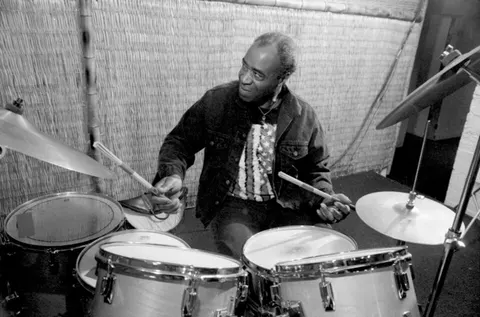
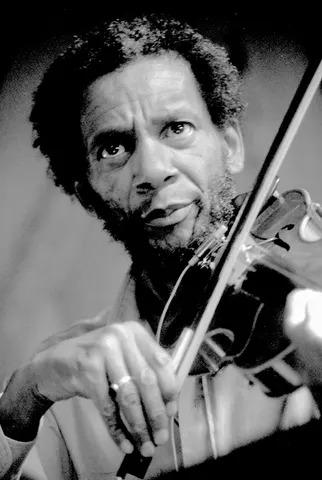
More Free Jazz Artists
See all 269 Free Jazz artists →More American Jazz Artists
See all 567 American artists →- Spotify artist page
- Spotify: Revolutionary Ensemble
- Discogs: Sirone
- Discogs: Norris Jones (the same musician, second Discogs entity)
- Wikipedia: Sirone (musician)
- Wikipedia: Revolutionary Ensemble
- Wikipedia: Artistry (album)
- Wikipedia: Live (Sirone album)
- Wikipedia: Sirone's Concord
- Wikipedia: The People's Republic (album)
- Wikipedia: Vietnam (Revolutionary Ensemble album)
- Wikipedia: Manhattan Cycles
- Wikipedia: Revolutionary Ensemble (album)
- Wikipedia: Beneath Tones Floor
- Wikipedia: Life Rays
- Wikipedia: Cecil Taylor Unit
- Discogs: Sirone, artist 297037
- Discogs: Norris Jones, artist 417149
- Burning Ambulance: Sirone (April 8, 2022)
- No Treble: RIP Sirone (October 24, 2009)
- NPR, A Blog Supreme: Sirone, "Revolutionary" Bassist, Dies
- Streams of Expression: A Tribute to Sirone (October 2009)
- Peace & Rhythm: Norris Jones aka Sirone, Sept 28, 1940 to Oct 21, 2009
- Wikidata: Sirone (Q188150)