 JAZZPROFILES lives in the music 2,555 Jazz Artists fully Profiled!
Ronnie Scott
Last updated November 10, 2026
Listen on Spotify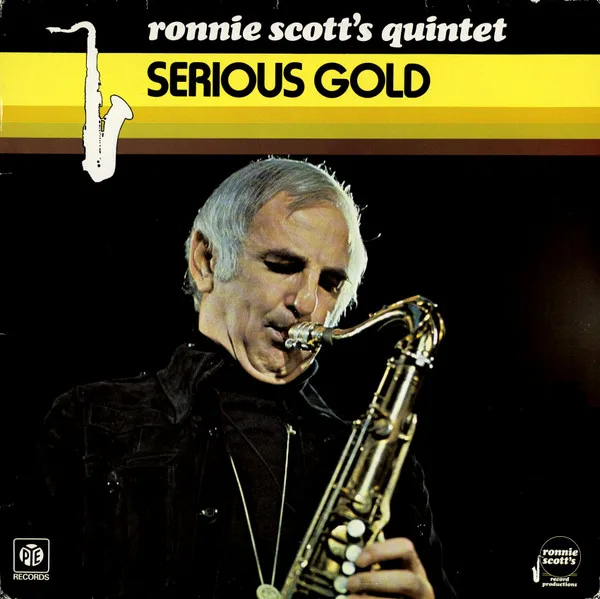
Ronnie Scott playing tenor saxophone on the cover of Serious Gold (Ronnie Scott's Quintet, Pye Records NSPL 18542, 1977) Album cover art (not a CC-licensed artist photo), used as the only available image showing the artist — Discogs release page for Pye NSPL 18542 - https://www.discogs.com/release/609434
Ronnie Scott was born Ronald Schatt on January 28, 1927, in Aldgate in London's East End, into a Jewish family; his father, Joseph Schatt, was of Russian descent. He went to the Central Foundation Boys' School and was playing in small jazz clubs by sixteen, having tried a cornet and a soprano saxophone before settling on the tenor. He toured with the trumpeter Johnny Claes in 1944 and 1945 and joined Ted Heath's band in 1946, the year he also appeared as a band member in the film George in Civvy Street. Like many British players of his generation he worked on the Cunard liner Queen Mary between 1946 and about 1950, a job that let him hear bebop in New York clubs, and he became one of the first British musicians shaped by Charlie Parker. He also got to know the arranger Tadd Dameron, who was then working in Britain for Heath.
From late 1948 to 1950 he was part of Club Eleven, a musicians' cooperative band and club in London run with the alto saxophonist Johnny Dankworth that is usually described as Britain's first club devoted to modern jazz. His earliest records, among them "Boppin' at Esquire" and "Idabop" (recorded January 13, 1948, and issued that May under the name the Esquire Five), were made for the small Esquire label, which went on to issue his Boptet sides of 1949 to 1952 and his quintet and orchestra records of the mid-1950s. After a spell in Jack Parnell's orchestra in 1952 he began leading his own bands in 1953: a nine-piece group and a quintet that, through 1956, included the tenor saxophonist Pete King, the pianist and drummer Victor Feldman, the trumpeter Hank Shaw and the drummer Phil Seamen. A short-lived big band followed in 1955. On February 18, 1956, his orchestra with the drummer Tony Crombie played the National Jazz Federation's "Jazz Scene 1956" concert at the Royal Festival Hall, and in January 1957 his sextet recorded Presenting the Ronnie Scott Sextet for Philips.
In 1957 he and the tenor saxophonist Tubby Hayes formed the Jazz Couriers, a two-tenor quintet that opened at the new Flamingo Club in Wardour Street, Soho, on April 7, 1957. The National Jazz Federation chose the group to play the opening sets when the Dave Brubeck Quartet made its first British tour in February 1958. The Couriers made four albums for Tempo and Carlton, including the live In Concert, recorded at the Dominion Theatre on February 16, 1958, and broke up in August 1959. Scott and King, the group's manager, then borrowed the money to open Ronnie Scott's Jazz Club in a basement at 39 Gerrard Street on October 30, 1959. Business picked up when the club began booking American tenor players: Zoot Sims played a residency in November 1961, and Johnny Griffin, Lee Konitz, Sonny Rollins, Sonny Stitt, Dexter Gordon, Rahsaan Roland Kirk, Stan Getz and Ben Webster followed in the years after. In 1965 the club moved to 47 Frith Street, while the old room carried on as the Old Place, a venue for younger British players, until its lease ran out in 1967. Scott acted as master of ceremonies and was noted for his jokes and one-liners; Jimi Hendrix gave his last public performance there in 1970.
He kept playing through all of it. His quartet with the pianist Stan Tracey ran from 1960 to 1967, and live sets from the club's first room, taped in 1963 to 1965, were released long afterwards, among them a May 1964 night with Sonny Stitt issued in 1997 as The Night Has a Thousand Eyes. From 1967 to 1969 he sat in the saxophone section of the Kenny Clarke and Francy Boland big band, which toured Europe, and he is credited on that band's records from Handle with Care (recorded in Cologne in January 1963) onward. Alongside it he led his own bands, among them one with John Surman and Kenny Wheeler that recorded Live at Ronnie Scott's at the club on October 25 and 26, 1968, billed as Ronnie Scott and the Band. A trio with the keyboard player Mike Carr and the drummer Bobby Gien worked from 1971 to 1975, and his later quintets often featured the pianist John Critchinson and the drummer Martin Drew. His session credits include the tenor solo on the Beatles' "Lady Madonna" (overdubbed on February 6, 1968), a solo on Roy Budd's score for the film Fear Is the Key (1972), and the tenor part on Phil Collins's "I Missed Again" (1981). He was made an Officer of the Order of the British Empire in the 1981 New Year Honours. The club's own label, Ronnie Scott's Jazz House, founded in 1978, issued his later quintet records, but he recorded only occasionally in his last decades.
Scott suffered from depression. He passed away in London on December 23, 1996, at 69, from an accidental overdose of barbiturates prescribed by his dentist while he was recovering from tooth-implant surgery; the Westminster coroner's inquest in February 1997 recorded a verdict of death by misadventure. Pete King ran the club for nine more years and sold it in June 2005 to the theatre impresario Sally Greene, with the philanthropist Michael Watt. As of November 2026 it still operates at 47 Frith Street. His widow, Mary Scott, and her daughter Rebecca wrote a memoir, A Fine Kind of Madness: Ronnie Scott Remembered (1999), and he told his own story with Mike Hennessey in Some of My Best Friends Are Blues.
Scott was a bebop-rooted tenor saxophonist whose sound, in the words of AllMusic's biographer, was lyrical but harmonically complex, and he belonged to the first British generation that took its cue from Charlie Parker rather than from the swing bands. He co-led the two-tenor Jazz Couriers with Tubby Hayes and worked through the 1960s in a quartet with the pianist Stan Tracey. Charles Mingus said in 1961 that Scott, like Zoot Sims, came closer to the blues feeling than most white players, and Sims was the first American guest the club booked. His late-1960s band, with John Surman and Kenny Wheeler in it, drew in younger British players, and from the 1970s he led trios and quintets built around his regular rhythm sections. His influence on British jazz rests as much on the room he built as on his records: for more than six decades the Soho club has been where visiting American players and young British musicians shared a bandstand.
- Presenting the Ronnie Scott Sextet (1957, Philips) - A sextet LP recorded in London on January 9 and 10, 1957, with the trumpeter Jimmy Deuchar, the alto saxophonist Derek Humble, the pianists Norman Stenfalt and Stan Tracey, the bassist Kenny Napper and Phil Seamen on drums.
- The Jazz Couriers (1958, Tempo) - The first album by his two-tenor quintet with Tubby Hayes, recorded in August 1957 with the pianist Terry Shannon.
- In Concert (1958, Tempo) - The Jazz Couriers live at the Dominion Theatre, London, on February 16, 1958, including "Some of My Best Friends Are Blues."
- The Last Word (1959, Tempo) - Recorded on June 26 and July 3, 1959, in the group's final months, with Kenny Napper on bass and Phil Seamen on drums.
- The Night Is Scott and You're So Swingable (1966, Fontana) - Quartet sides with Stan Tracey from November 1965 and a July 1964 session with Ernest Ranglin on guitar and strings on four tracks.
- Live at Ronnie Scott's (1968, CBS) - His band of 1968, billed as Ronnie Scott and the Band, live at the club on October 25 and 26, 1968, with John Surman, Kenny Wheeler, Ray Warleigh and Gordon Beck.
- Serious Gold (1977, Pye) - A studio quintet date with the guitarist Louis Stewart and the pianist John Taylor, on which Scott also plays soprano saxophone on two pieces.
- The Night Has a Thousand Eyes (1997, Ronnie Scott's Jazz House) - Three extended pieces with Sonny Stitt, taped live at the Gerrard Street club on May 8 and 29, 1964 and released after Scott's death.
Ronnie Scott: Full Discography
Discogs artist ID 272669 ("Ronnie Scott," real name Ronald Schatt, born January 28, 1927, in London, died December 23, 1996, in London) lists the British tenor saxophonist; a separate entry, Ronnie Scott (4), is a songwriter and producer and is not the same person. Discogs files much of his own work under entities named for his bands: the Jazz Couriers (artist ID 2272354), the Ronnie Scott Quartet (5708456), Quintet (479242), Sextet (2164112), Trio (2164114), Orchestra (2674685), Boptet (4038463) and Jazz Group (4116301), among others. These were checked and are folded into the tables below. The leader table is a curated selection of 17 releases rather than every single, EP and reissue; the sideman table is a representative set of his best-documented credits.
As Leader / Co-Leader
| Album Title | Recording Date(s) | Release Date | Label | Catalog Number | Format(s) | Personnel | Role | Reissue History | Spotify | Buy | Notes |
|---|---|---|---|---|---|---|---|---|---|---|---|
| Boppin' at Esquire / Idabop | January 13, 1948, London | May 1948 | Esquire | 10-002 | Shellac, 10-inch, 78 RPM single | Ronnie Scott (tenor saxophone), Ralph Sharon (piano), Pete Chilver (guitar), Jack Fallon (bass), Carlo Krahmer (drums) | Featured tenor saxophonist (billed to the Esquire Five) | Both sides reissued on Great Scott! (Esquire, 1977); a release titled Boppin' at Esquire followed on Indigo in 2000; see Discogs master 3779402 | — | — | Wikipedia lists this as a Scott release; Discogs bills the single to the Esquire Five. |
| Great Scott! Ronnie Scott Studio Recordings Volume 1 | January 13, 1948; February 28, April 21 and October 13, 1951, London | 1977 | Esquire | ESQ 303 | Vinyl, LP | Ronnie Scott (tenor saxophone) with Ralph Sharon, Tommy Pollard, Victor Feldman and Ronnie Ball (piano); Jack Fallon, Lennie Bush and Pete Blannin (bass); Carlo Krahmer, Tony Crombie and Tony Kinsey (drums); Pete Chilver (guitar); Jimmy Deuchar (trumpet) and Spike Robinson (alto saxophone) on four tracks | Leader | Compilation of four early Esquire sessions; see Discogs master 1872654 | — | — | Sixteen tracks, grouped by session date. |
| At the Royal Festival Hall | February 18, 1956, Royal Festival Hall, London | June 1956 | Decca | LF 1261 | Vinyl, LP, 10-inch, Album | Ronnie Scott and Pete King (tenor saxophone), Derek Humble (alto saxophone), Benny Green (baritone saxophone), Jimmy Deuchar and Les Condon (trumpet), Ken Wray (trombone, bass trumpet), Stan Tracey (piano), Lennie Bush (bass), Tony Crombie (drums) | Leader (billed to the Ronnie Scott Orchestra and Tony Crombie) | Tracks included on the Acrobat anthology Soho Blues (2013) | — | — | Recorded at the National Jazz Federation's "Jazz Scene 1956" concert; six tracks. |
| Ronnie Scott Blows with the Dizzy Reece Quartet | Not confirmed | November 1956 | Tempo | EXA 45 | Vinyl, 7-inch, EP | Ronnie Scott (tenor saxophone), Dizzy Reece (trumpet), Terry Shannon (piano), Lennie Bush (bass), Phil Seamen (drums) | Leader (billed with the Dizzy Reece Quartet) | Both tracks included on Soho Blues (2013) | — | — | Two tracks: "Scrapple from the Apple" and "Out of Nowhere." |
| Presenting the Ronnie Scott Sextet | January 9 and 10, 1957, London | 1957 | Philips | BBL 7153 | Vinyl, LP | Ronnie Scott (tenor saxophone), Jimmy Deuchar (trumpet), Derek Humble (alto saxophone), Norman Stenfalt (piano; Stan Tracey on "Bass House," "You Leave Me Breathless" and "Squeeze Me"), Kenny Napper (bass), Phil Seamen (drums) | Leader | Included on Soho Blues (2013); see Discogs master 569678 | — | — | Twelve tracks. |
| The Jazz Couriers | August 8 and 15, 1957, London | 1958 | Tempo | TAP 15 | Vinyl, LP, Album, Mono | Ronnie Scott (tenor saxophone), Tubby Hayes (tenor saxophone, vibraphone), Terry Shannon (piano), Phil Bates (bass), Bill Eyden (drums), Jimmy Deuchar (trumpet, two tracks) | Co-leader (billed with Tubby Hayes) | See Discogs master 614945 | — | — | The cover reads either "The Jazz Couriers" or "Tubby Hayes and the Jazz Couriers," depending on the pressing. |
| In Concert | February 16, 1958, Dominion Theatre, London | 1958 | Tempo | TAP 22 | Vinyl, LP, Album, Mono | Ronnie Scott and Tubby Hayes (tenor saxophone; Hayes also vibraphone), Terry Shannon (piano), Phil Bates (bass), Bill Eyden (drums) | Co-leader (billed with Tubby Hayes) | See Discogs master 398301 | — | — | Seven tracks, including "Some of My Best Friends Are Blues." |
| The Last Word | June 26 and July 3, 1959 | 1959 | Tempo | TAP 26 | Vinyl, LP, Album, Mono | Ronnie Scott and Tubby Hayes (tenor saxophone; Hayes also vibraphone), Terry Shannon (piano), Kenny Napper (bass), Phil Seamen (drums) | Co-leader (billed with Tubby Hayes) | Issued in the United States as The Message from Britain; see Discogs master 529309 | — | — | Seven tracks. |
| The Couriers of Jazz! | Not confirmed | December 1959 | Carlton | LP12-116 | Vinyl, LP, Album, Mono | Ronnie Scott and Tubby Hayes (tenor saxophone; Hayes also vibraphone), Terry Shannon (piano), Jeff Clyne (bass), Bill Eyden (drums) | Co-leader (billed with Tubby Hayes) | See Discogs master 569677 | — | — | Release date as given on Discogs; liner notes by Ralph J. Gleason. |
| The Night Is Scott and You're So Swingable | July 3, 1964 and November 11, 1965 | 1966 | Fontana | TL5332 | Vinyl, LP, Album, Mono | Ronnie Scott (tenor saxophone); on the 1965 tracks Stan Tracey (piano), Rick Laird (bass), Bill Eyden (drums); on the 1964 tracks Ernest Ranglin (guitar), Lennie Bush (bass), Tony Crombie (drums) and strings | Leader | Also issued as Fontana 687 375 TL; see Discogs master 1766335 | — | — | The cover reads "Ronnie Scott with Strings and Orchestra"; the labels read "with Strings and Quartet." A sticker on some copies credits Richard Rodney Bennett as arranger of the four string tracks. |
| Live at Ronnie Scott's | October 25 and 26, 1968, Ronnie Scott's Club, London | 1968 | CBS | 52661 | Vinyl, LP | Ronnie Scott (tenor saxophone), Kenny Wheeler (trumpet, flugelhorn), Chris Pyne (trombone), Ray Warleigh (alto saxophone, flute), John Surman (baritone and soprano saxophone), Gordon Beck (piano, organ), Ron Mathewson (bass), Kenny Clare and Tony Oxley (drums) | Leader (billed as Ronnie Scott and the Band) | Reissued on CD by Sony BMG in 2007; see Discogs master 715492 | — | — | Seven tracks, including "King Pete" and "Macumba." |
| Scott at Ronnie's | August 3 and 4, 1973, Ronnie Scott's Club, London | 1974 | RCA Victor | LPL1 5056 | Vinyl, LP, Stereo | Ronnie Scott (tenor saxophone), Mike Carr (electric organ), Bobby Gien (drums), Loughty Amao (congas) | Leader (billed to the Ronnie Scott Trio) | Not confirmed | — | — | Four long tracks; liner notes by Dave Gelly. |
| Serious Gold | Not confirmed | October 18, 1977 | Pye Records (Ronnie Scott's Record Productions) | NSPL 18542 | Vinyl, LP, Album | Ronnie Scott (tenor and soprano saxophone), John Taylor (piano), Louis Stewart (guitar), Ron Mathewson (bass), Martin Drew (drums) | Leader (billed to Ronnie Scott's Quintet) | See Discogs master 1151601 | — | — | Scott plays soprano on "Lazy Afternoon" and "Hey-Oke Suite Ballad"; produced by Pete King. |
| Never Pat a Burning Dog | October and November 1990, Ronnie Scott's Club, London | 1991 | Ronnie Scott's Jazz House | JHR 012 | Vinyl, LP, Album | Ronnie Scott (tenor saxophone), Dick Pearce (trumpet), John Critchinson (piano), Ron Mathewson (bass), Martin Drew (drums) | Leader (billed to Ronnie Scott's Quintet) | Reissued in 2001 on a combined release with When I Want Your Opinion, I'll Give It to You (Ronnie Scott's Jazz House); see Discogs master 1070222 | — | — | Six tracks, recorded live. |
| When I Want Your Opinion, I'll Give It to You | December 8, 1963 to April 2, 1965, Ronnie Scott's Club (Gerrard Street), London | 1997 | Ronnie Scott's Jazz House | JHAS 610 | CD, Album | Ronnie Scott (tenor saxophone), Stan Tracey (piano), Malcolm Cecil and Rick Laird (bass), Jackie Dougan, Ronnie Stephenson and Chris Karan (drums), Ernest Ranglin (guitar, first track only) | Leader | See Discogs release 8103405 | — | — | Live club recordings from an archive series, taped on a portable machine and noise-reduced for CD. |
| The Night Has a Thousand Eyes | May 8 and 29, 1964, Ronnie Scott's Club (Gerrard Street), London | 1997 | Ronnie Scott's Jazz House | JHAS 614 | CD, Album | Ronnie Scott and Sonny Stitt (tenor saxophone), Stan Tracey (piano), Malcolm Cecil (bass), Jackie Dougan (drums, title track), Ronnie Stephenson (drums, tracks 3 and 4) | Co-leader (billed with Sonny Stitt) | See Discogs release 469002 | — | — | Four tracks; the three long pieces run from about 18 to 29 minutes. |
| Soho Blues: The Ronnie Scott Anthology 1956-62 | 1956 to 1962 | 2013 | Acrobat | ADDCD3092 | Two-CD compilation | Ronnie Scott with the Orchestra, the Dizzy Reece Quartet, the Sextet, the Ronnie Scott/Jimmy Deuchar Quintet and other groups | Leader (compilation) | See Discogs release 14020717 | — | — | Thirty-one tracks, including the Royal Festival Hall, Dizzy Reece and sextet sessions. |
As Sideman (selected major credits)
| Year | Project (Leader) | Title | Label | Catalog | Role | Notes |
|---|---|---|---|---|---|---|
| 1958 | Victor Feldman | Suite Sixteen | Contemporary | C 3541 | Tenor saxophone (five tracks) | Recorded in London in August and September 1955; Scott plays on the tracks from the September 21 session. |
| 1962 | Zoot Sims | Zoot at Ronnie Scott's | Fontana | STFL 588 | Tenor saxophone (guest tracks) | Recorded live at the Gerrard Street club, November 13 to 15, 1961, during Sims's residency; Scott is credited on "The Haunted Jazz Club," and "Desperation" is billed to the Ronnie Scott/Jimmy Deuchar Quintet. |
| 1963 | Clarke-Boland Big Band | Handle with Care | Atlantic | SD 1404 | Tenor saxophone; soloist on "Sonor" and "Speedy Reeds" | Recorded in Cologne, January 25 and 26, 1963. |
| 1965 | Chris Barber's Soul Band featuring Ronnie Scott and Brian Auger | "Morning Train" / "Finishing Straight" (single) | Columbia | DB 7461 | Featured saxophonist | The B-side is credited to the Chris Barber Band. |
| 1965 (DVD 2008) | Wes Montgomery All-Stars with Johnny Griffin, Ronnie Scott and Martial Solal | Live in Hamburg 1965 (DVD) | JazzShots | 2869089 | Tenor saxophone (first five performances) | Television broadcast from Hamburg on April 28, 1965, with Johnny Griffin and Hans Koller also on tenor. |
| 1965 to 1971 | Kenny Clarke and Francy Boland (Clarke-Boland Big Band) | Now Hear Our Meanin' (1965), Sax No End and Out of the Folk Bag (1967), Latin Kaleidoscope and All Smiles (1968), All Blues, Faces, Fellini 712 and More Smiles (1969), Off Limits (1970) | Columbia, SABA, MPS, Polydor | Various | Tenor saxophone | Scott was a member of the band from 1967 to 1969; the albums are those listed on Wikipedia as including him, and catalog numbers are not itemized. |
| 1968 | Mark Murphy | Midnight Mood | SABA | SB 15 151 ST | Tenor saxophone | Recorded in Cologne, December 18, 1967. |
| 1968 | The Beatles | "Lady Madonna" (single) | Parlophone | R 5675 | Tenor saxophone solo (uncredited) | Single released March 15, 1968; the horn parts were overdubbed on February 6, 1968. |
| 1971 | Stan Getz and Francy Boland (with the Clarke-Boland Big Band) | Change of Scenes | Verve | 2304 034 | Tenor saxophone; soloist on "Touchstone" | Recorded in Cologne, June 14, 1971. |
| 1972 | Roy Budd | Fear Is the Key (original motion picture soundtrack) | Pye | NSPL 18398 | Saxophone solo on "The Car Chase" | Soundtrack to the 1972 film. |
| 1975 | Carmen McRae and the Clarke-Boland Big Band | November Girl | Black Lion | BLP 30172 | Reeds (as credited) | Recorded in London on November 3, 1970, and issued in 1975. |
| 1977 | The Pablo All-Stars Jam (Oscar Peterson, Joe Pass, Clark Terry, Milt Jackson and others) | Montreux '77 | Pablo Live | 2308 210 | Tenor saxophone | Live at the Montreux Jazz Festival, July 14, 1977; produced by Norman Granz. |
| 1981 | Phil Collins | Face Value | Virgin | V2185 | Tenor saxophone solo on "I Missed Again" | Track credit only. |
- Pete King - tenor saxophonist and manager of the Jazz Couriers, Scott's partner in opening the club in 1959 and its manager for almost fifty years; a member of Scott's orchestra of the 1950s.
- Tubby Hayes - co-leader of the Jazz Couriers (1957 to 1959); the two shared tenor duties on four albums.
- Stan Tracey - pianist in Scott's quartet from 1960 to 1967 and the club's house pianist in the same years.
- Johnny Dankworth - fellow founder of Club Eleven (1948 to 1950).
- Victor Feldman, Hank Shaw, Phil Seamen, Jimmy Deuchar, Derek Humble, Tony Crombie - players in his nine-piece band, orchestra and sextet of the 1950s; Feldman's Suite Sixteen (recorded 1955) features Scott on tenor.
- Kenny Clarke, Francy Boland and Johnny Griffin - leaders and saxophone colleague in the Clarke-Boland Big Band, in which Scott played in the late 1960s.
- John Surman and Kenny Wheeler - members of his 1968 band on Live at Ronnie Scott's.
- Mike Carr, Bobby Gien - keyboard and drums in his early-1970s trio.
- John Critchinson, Martin Drew, Ron Mathewson, Dick Pearce - members of his quintets of the late 1970s and 1990.
- Ernest Ranglin - the club's house guitarist in 1964 and 1965.
- Sonny Stitt - tenor partner on the 1964 live recordings issued as The Night Has a Thousand Eyes.
- Zoot Sims - the first American guest at the club; Zoot at Ronnie Scott's was recorded live there in November 1961, and Scott plays on two of its tracks.
- Wes Montgomery - Scott was one of three tenor saxophonists, with Johnny Griffin and Hans Koller, in the all-star group on the leader's April 28, 1965, Hamburg television broadcast.
- Chris Barber and Brian Auger - Scott was billed with them on a 1965 Columbia single by Barber's Soul Band, "Morning Train."
- Ella Fitzgerald, Blossom Dearie, Buddy Rich, Sarah Vaughan - among the visiting artists whose live albums were recorded at the club.
- Oscar Peterson, Joe Pass, Clark Terry, Milt Jackson - fellow members of the Pablo All-Stars jam at Montreux in July 1977.
More Bebop Artists
See all 246 Bebop artists →More British Jazz Artists
See all 43 British artists →- Wikipedia: Ronnie Scott
- Wikipedia: Ronnie Scott's Jazz Club
- Wikipedia: The Jazz Couriers
- Wikipedia: Pete King (saxophonist)
- Wikipedia: Lady Madonna
- AllMusic: Ronnie Scott
- Discogs: Ronnie Scott (artist 272669)
- MusicBrainz: Ronnie Scott
- Ronnie Scott's Jazz Club: official site
- JazzProfiles.com: Ella Fitzgerald
- JazzProfiles.com: Johnny Griffin