 JAZZPROFILES lives in the music 1,146 Jazz Artists fully Profiled!
 Ryo Fukui
Last updated September 5, 2026
Listen on Spotify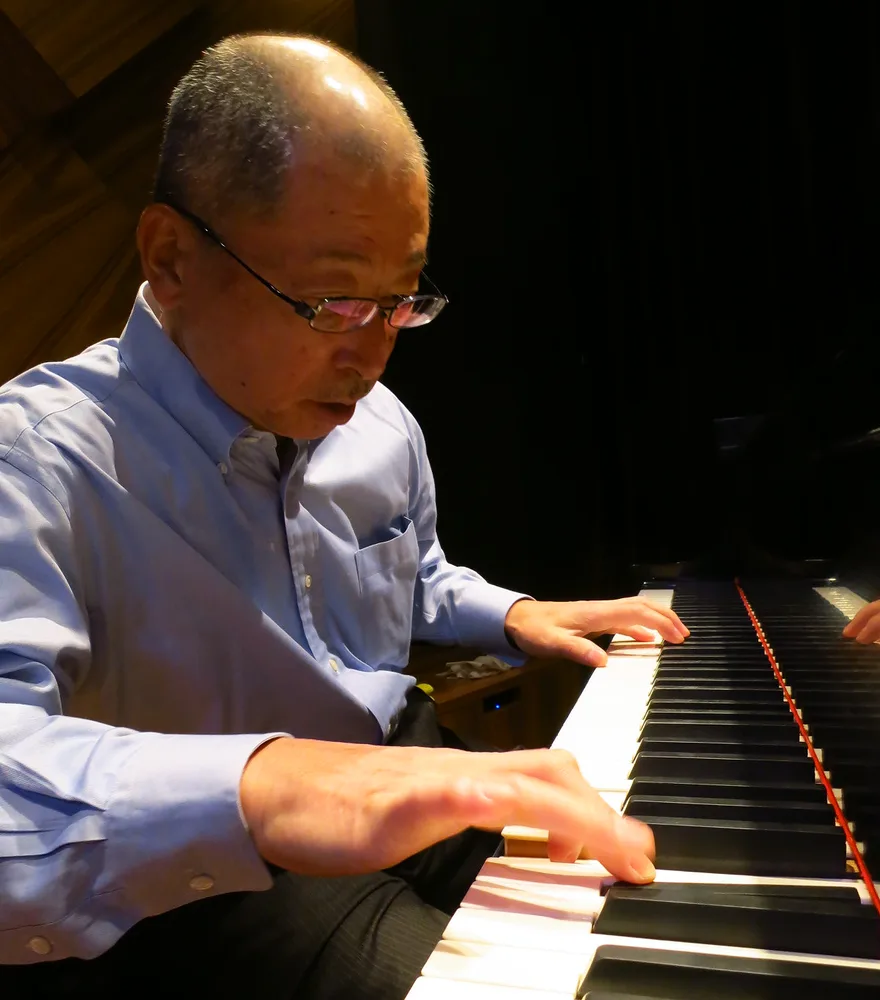
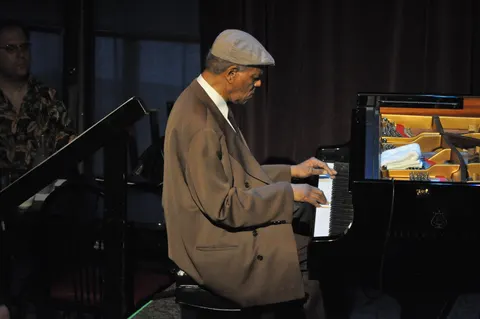
Ryo Fukui at the piano. CC BY-SA 4.0 — Wikimedia Commons — https://commons.wikimedia.org/wiki/File:Ryo_Fukui.png

Ryo Fukui grew up nowhere near a conservatory. He picked up the accordion at 18, and it wasn't until 1970, at age 22, that he taught himself piano, working it out by ear against records by Bill Evans, McCoy Tyner, and Bud Powell. No formal training, no teacher, just a turntable and stubbornness. He moved to Tokyo not long after, where he crossed paths occasionally with saxophonist Hidehiko Matsumoto, an established figure on the Japanese jazz scene, who gave the self-taught pianist encouragement and guidance.
Six years later, on July 7, 1976, he walked into Yamaha Hall in Sapporo with a trio, bassist Satoshi Denpo and drummer Yoshinori Fukui, and recorded Scenery. It barely registered in the US at the time, released into a jazz market that had mostly moved on. Decades later, it's one of the records the whole Japanese jazz reissue boom points back to, and "Early Summer" in particular gets cited constantly as the track that hooks new listeners. He followed it a year later with Mellow Dream (1977), same trio, same Yamaha Hall, this time mixed at AOI Studios in Tokyo.
In 1992, well into his own career, Fukui met American pianist Barry Harris on a trip to the US. Harris became his mentor, sharpening his bebop vocabulary and technique in a way self-teaching off records never could. Fukui was 44 at the time, already a bandleader with two records behind him, still willing to be a student. Harris kept dedicating performances of "Fukai Aijo" to Fukui's memory for years afterward, right up until Harris's own passing in 2021.
The rest of the catalog is small but sharply drawn. My Favorite Tune (recorded June 4-5, 1994, released the following year) is a solo piano session, pressed privately in a run of just 1,000 copies and sold mostly at his own gigs. Ryo Fukui In New York (recorded February 1999 at Avatar Recording Studios) put him in a trio with two American players, bassist Lisle Atkinson and drummer Leroy Williams, cutting standards on their own turf.
In 1995, Fukui and his wife Yasuko opened Slowboat, a jazz club in Sapporo. It became a room where local players and touring musicians crossed paths, the kind of listening bar culture that's shaped Japan's jazz audience for decades. His final album, A Letter from Slowboat (2015), was recorded live there, trio with bassist Takumi Awaya and drummer Ittetsu Takemura.
Fukui was awarded the Sapporo Culture Encouragement Prize in 2012, recognition from the city that had been his home base the entire time. He passed away on March 15, 2016, from lymphoma, at 67. Yasuko still runs Slowboat.
His records didn't slow down after that. Scenery in particular has kept climbing: a half-speed-mastered vinyl reissue from We Release Jazz, released May 25, 2020, is now one of the most wanted pressings in the whole reissue scene, with 3,700-plus collectors keeping it on their want list and copies already sitting in nearly 13,000 collections on Discogs alone.
Fukui's playing is rooted entirely in self-directed study of Bill Evans, McCoy Tyner, and Bud Powell records, absorbed by ear rather than through formal training, which gives his early trio work (Scenery, Mellow Dream) a lyrical, melodic clarity that has made it a touchstone of the Japanese jazz reissue movement decades after its original, largely unnoticed release. His later encounter with Barry Harris in 1992 sharpened his bebop technique specifically, adding a harder, more vocabulary-driven bebop edge to work from My Favorite Tune onward that sits alongside, rather than replacing, his original self-taught lyricism.
Reviewers reach for the same two names Fukui himself named: Bill Evans, for the left-hand comping and bouncy swing feel that runs through Scenery, and McCoy Tyner, whose quartal, modal harmony surfaces most clearly on "Early Summer." Reception hasn't been uniformly reverent — one retrospective review argues the album is closer to a gifted student's close study of his idols than an original voice, with "Early Summer" singled out as the one track where he breaks from that mold. That split view is worth knowing alongside the reissue-era consensus that made Scenery a cornerstone record.
- Scenery (1976, Trio Records) - His debut, recorded at Yamaha Hall, Sapporo; "Early Summer" is the most-cited track and a cornerstone of the Japanese jazz reissue revival. Spotify - Scenery Listen · Buy
- Mellow Dream (1977, Trio Records) - The same trio a year later. Spotify - Mellow Dream Listen · Buy
- My Favorite Tune (1995, Sapporo Jazz Create) - A privately-pressed solo piano session, sold mostly at his own gigs, now a genuine rarity. Spotify - My Favorite Tune Listen · Buy
- A Letter From Slowboat (2015, Sapporo Jazz Create) - His final album, recorded live at the club he and his wife opened. Spotify - A Letter From Slowboat Listen · Buy
Ryo Fukui: Full Discography
As Leader
| Album Title | Recording Date(s) | Release Date | Label | Catalog Number | Format(s) | Personnel | Role | Notes | Listen | Buy |
|---|---|---|---|---|---|---|---|---|---|---|
| Scenery | July 7, 1976 (per Wikipedia and Everything Is Noise; Discogs gives Sept 7, 1976), Yamaha Hall, Sapporo | 1976 | Nadja (Trio Records imprint) | PA-7148 | Vinyl, LP, Album, Stereo | Ryo Fukui (piano, producer), Satoshi Denpo (bass), Yoshinori Fukui (drums); engineer Kunio Arai; liner notes Masataka Ito / Teruo Isono | Leader | Debut album. Manufactured/distributed by Trio Records, Tokyo, per release notes. Became a cornerstone of the Japanese jazz reissue revival; "Early Summer" is the most-cited track. Half-speed-mastered vinyl reissue via We Release Jazz released May 25, 2020 (not 2018, as had been stated on the public profile previously). | Spotify | Amazon |
| Mellow Dream | Aug 17-18, 1977, Yamaha Hall, Sapporo (mixed Sept 12, 1977, AOI Studios, Tokyo) | 1977 | Trio Records | PA-7182 | Vinyl, LP, Album | Ryo Fukui (piano), Satoshi Denpo (bass), Yoshinori Fukui (drums); producer Masataka Ito; recorded/mixed by Masayoshi Okawa | Leader | Same trio as "Scenery." Tracklist includes "Horizon" and "My Funny Valentine" | Spotify | Amazon |
| My Favorite Tune | June 4-5, 1994 | 1995 (per Wikipedia; Discogs master year field shows 1994) | Sapporo Jazz Create | SJC-9401 | CD, Album | Ryo Fukui (piano, soloist), solo piano recording; photography Aaron Johanson / Norio Saito | Leader | Private-press solo piano session. Per his widow Yasuko, only 1,000 copies were pressed, sold mostly at his own concerts and locally; genuine rarity today | Spotify | Amazon |
| Ryo Fukui In New York | Feb 1999, Avatar Recording Studios, New York City | 1999 | Sapporo Jazz Create | SJC-9901 | CD, Album | Ryo Fukui (piano), Lisle Atkinson (bass), Leroy Williams (drums); mastered by Allan Tucker; recording engineer Jim Anderson | Leader | Recorded on his sidemen's home turf in NYC. Tracklist of standards: "Hot House," "All The Things You Are," "Bouncing With Bud," among others | Spotify | Amazon |
| A Letter From Slowboat | Live, at Slowboat, Sapporo | 2015 | Sapporo Jazz Create | SJC-1501 | CD, Album | Ryo Fukui (piano), Takumi Awaya (bass), Ittetsu Takemura (drums) | Leader | Final album, recorded live at the club he and wife Yasuko opened in 1995. Tracklist includes "Stella By Starlight" and "Chasin' The Bird" | Spotify | Amazon |
| Scenery Of Japanese Jazz: Best Of Ryo Fukui | N/A (compilation) | 2022 | Solid Records | UVWA-2056 / CDSOL-1981 | CD, Compilation | Compiles tracks from Scenery, Mellow Dream, My Favorite Tune, A Letter From Slowboat | Leader (posthumous compilation) | Released as a limited-period title, available through March 31, 2022 | Spotify | Amazon |
| Ryo Fukui Trio At The Slowboat 2004 | Live, 2004, at Slowboat, Sapporo | 2025 | Deep Jazz Reality / HMV Record Shop | HRLP367/368 | Vinyl, LP | Ryo Fukui (piano), Benisuke Sakai (bass), Yoshihito Eto (drums) | Leader (posthumous archival release) | Previously unreleased 2004 live recording, issued 9 years after his passing. Tracklist includes "Relaxin' At Camarillo" and "Come Sunday" | Spotify | Amazon |
Confirmed Track Appearances (his own material, reused on later compilations)
| Year | Compilation | Track(s) Credited to Fukui | Role Confirmed | Listen | Buy |
|---|---|---|---|---|---|
| 2009 | Music For Narita Airport (compiled by Shuya Okino / Kyoto Jazz Massive) | "Horizon" | Piano, Written-By (checked in extraartists, confirms this is our subject) |
not found | Amazon |
| 2010 | Groovy Indeed! Trio Records 1971-1981 | "Horizon," "Early Summer" | Listed as track artist, matches his own Mellow Dream/Scenery tracks | Spotify | Amazon (UK) |
| 2020 | Scenery Of Japanese Jazz | Tracks drawn from his own catalog | Same pattern as above | Spotify | Amazon |
Producer Credit
| Year | Release | Role | Listen | Buy |
|---|---|---|---|---|
| 2011 | Scenery (reissue) | Producer, credited alongside his original 1976 producer credit on the same master (509654) | Spotify | Amazon (CD) |
Unresolved / Excluded
Roughly 50 "Appearance" credits on Discogs artist ID 1767665 (1969-1987) were excluded as likely belonging to a different, unrelated "Ryo Fukui" merged into the same artist page — see ryo-fukui_notes.md for the full identity-collision writeup.
- Hidehiko Matsumoto - established Japanese jazz saxophonist who crossed paths with Fukui in Tokyo in the early 1970s and gave the self-taught pianist encouragement and guidance, before Scenery.
- Satoshi Denpo and Yoshinori Fukui - bass and drums on his first two albums, Scenery (1976) and Mellow Dream (1977).
- Barry Harris - American bebop pianist who became his mentor after they met in 1992, sharpening his bebop vocabulary and technique.
- Lisle Atkinson and Leroy Williams - American bassist and drummer on Ryo Fukui In New York (1999).
- Benisuke Sakai and Yoshihito Eto - bass and drums on a 2004 live trio set at Slowboat, released posthumously in 2025 as Ryo Fukui Trio At The Slowboat 2004.
- Takumi Awaya and Ittetsu Takemura - bass and drums on his final album, A Letter From Slowboat (2015).
- Yasuko Fukui - his wife and co-founder of Slowboat, the Sapporo jazz club they opened together in 1995; still runs it today.
More Bebop Artists
See all 134 Bebop artists →More Japanese Jazz Artists
See all 70 Japanese artists →- Spotify artist page
- Slowboat (Sapporo jazz club founded by Fukui and Yasuko)
- We Release Jazz: Scenery reissue
- Wikipedia: Ryo Fukui
- Wikipedia: Scenery (Ryo Fukui album)
- Discogs: Ryo Fukui
- Discogs API research pass in this project (
discography-full.md), artist ID 1767665 - A Scene In Retrospect: Ryo Fukui - "Scenery" (Everything Is Noise)
- Album Review: Ryo Fukui - Scenery (1976) (Destinations Unknown Jazz)
- Ehud Asherie profile, JazzProfiles.com - source of the Barry Harris connection
- Wikimedia Commons: File:Ryo Fukui.png