 JAZZPROFILES lives in the music 1,002 Jazz Artists fully Profiled!
 Kenny Clarke
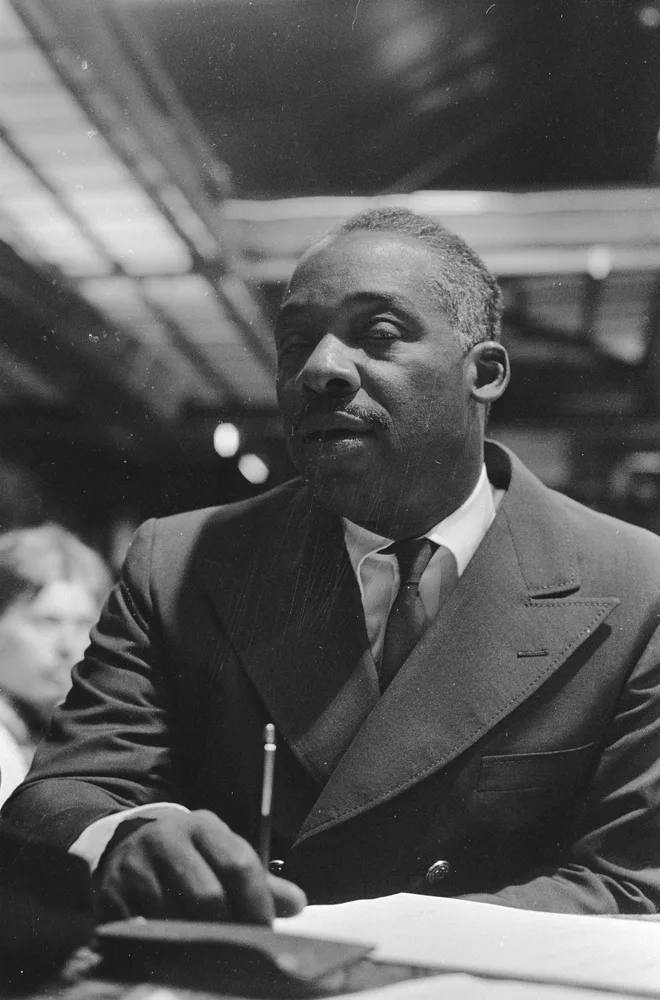
Kenny Clarke performing at the International Jazz Festival, Loosdrecht, Netherlands, August 7, 1971 CC0 (Public Domain Dedication) — Wikimedia Commons (Nationaal Archief / Anefo, photographer W. Punt) — https://commons.wikimedia.org/wiki/File:Finale_Internationaal_Jazz_Festival_Loosdrecht,_drummer_Kenny_Clarke,_Bestanddeelnr_924-7968.jpg

Kenneth Clarke Spearman was born January 9, 1914, in Pittsburgh, Pennsylvania. He studied vibraphone, piano, and trombone alongside drums while still in school, and broke into the profession as a teenager, working with trumpeter Roy Eldridge in 1935 and with the Jeter-Pillars band before joining Edgar Hayes' big band in 1937, with whom he made his recording debut and toured Europe. He went on to play in the orchestras of Claude Hopkins (1939) and Teddy Hill (1940-41); by Clarke's own account, it was Dizzy Gillespie, a fellow member of Hill's band, who recommended him for the job.
In 1941, Hill, by then managing Minton's Playhouse in Harlem, hired Clarke for the club's house band alongside pianist Thelonious Monk, trumpeter Joe Guy, and bassist Nick Fenton. The after-hours jam sessions there, with Gillespie and Charlie Parker among the frequent participants, became the incubator for what would be called bebop, and it was during this period that Clarke worked out the rhythmic vocabulary that reshaped jazz drumming: shifting the basic pulse from the bass drum to the ride cymbal and reserving the bass drum for irregular accents. The sound of a rimshot followed by one of those dropped accents earned him the nickname "Klook-Mop," later shortened to "Klook." He also became a composer during these years, co-writing two pieces that became jazz standards: "Salt Peanuts" with Gillespie and "Epistrophy" with Monk, both copyrighted in 1941.
After military service, Clarke rejoined Gillespie, recording small-group sides for Savoy in May 1946 ("Oop Bop Sh'Bam," "That's Earl, Brother") and, as a member of Gillespie's big band, the 1947 RCA Victor sessions that paired the band with conga player Chano Pozo on "Cubana Be," "Cubana Bop," and "Manteca," landmark recordings in the fusion of Afro-Cuban rhythm with bebop. He left Gillespie's band for a stretch to work with Tadd Dameron, Sonny Stitt, and Fats Navarro and to lead his own group, the 52nd Street Boys, before rejoining Gillespie in December 1947. Around this time, shortly after his military discharge, Clarke converted to Islam and adopted the name Liaquat Ali Salaam, under which he recorded at least one session, though he continued to perform and record as Kenny Clarke for the rest of his career.
Clarke was a founding member of what became the Modern Jazz Quartet, incorporated on January 14, 1952, growing out of the rhythm section of Gillespie's own big band with pianist John Lewis, vibraphonist Milt Jackson, and bassist Percy Heath. He is the drummer on the group's earliest Prestige recordings, cut in December 1952 and June 1953 and issued as the 10-inch LP The Modern Jazz Quartet, and on John Lewis's "Django," recorded in December 1954. Clarke quit the group in January 1955, at the close of an engagement at Birdland, later explaining that he "wouldn't be able to play the drums my way again after four or five years of playing eighteenth-century drawing-room jazz." Connie Kay replaced him the following night. Freed from the Quartet's tightly arranged book, Clarke spent 1955 and 1956 as one of the busiest freelance drummers in New York while also leading his own Savoy dates, including Bohemia After Dark (1955), which holds the earliest recordings of Julian "Cannonball" Adderley and his brother Nat Adderley, and Klook's Clique (1956). In between, in April 1954, he had also been the drummer on Miles Davis's Walkin' sessions for Prestige, recordings widely credited with helping crystallize the harder-edged, blues-rooted style that came to be called hard bop.
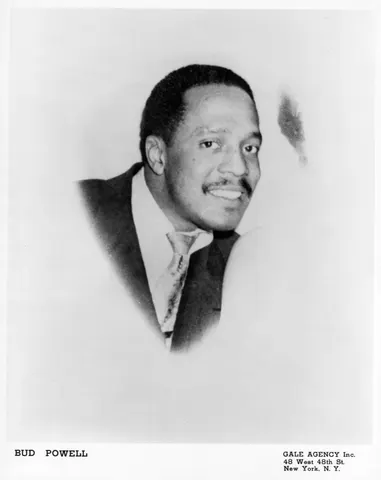
In September 1956, Clarke relocated permanently to Paris, where he became a fixture of the city's jazz scene as a session and house drummer, working with visiting American stars and expatriates alike. From late 1959 he co-led a trio billed as "The Three Bosses" with pianist Bud Powell at Paris clubs including the Blue Note and Club Saint-Germain. In 1961, Clarke and Belgian pianist Francy Boland formed a big band that grew from a sextet into a full orchestra combining American expatriates with leading European musicians; billed variously as the Clarke-Boland Big Band and the Kenny Clarke-Francy Boland Big Band, it recorded its debut album, Jazz Is Universal, in Cologne in December 1961 and remained active through the 1960s and into the 1970s, notably fielding two drummers, with British drummer Kenny Clare playing alongside Clarke. Other than occasional visits home, Clarke worked in France for the rest of his life and was regarded as a central figure of the European jazz scene.
Clarke was named an NEA Jazz Master in 1983. He passed away on January 26, 1985, at his home in Montreuil, a Paris suburb, at age 71, and was inducted into the DownBeat Hall of Fame in 1988.
Clarke's central innovation, moving jazz drumming's basic timekeeping from the bass drum to the ride cymbal and reserving the bass drum for irregular, syncopated accents, became the foundation of modern jazz drumming and was extended by nearly every drummer who followed him, including several who passed through the Minton's Playhouse scene he helped define. Where some of his bebop-era peers pushed toward increasingly explosive drumming, Clarke's own playing stayed comparatively understated and conversational, prized for its musicality and reliability as much as for its innovations. He was equally at home driving a small combo and anchoring a big band, a versatility borne out by his final decade and a half fronting the Clarke-Boland Big Band, where he shared the drum chair with a second player, Kenny Clare. He was also a credited composer, co-writing "Salt Peanuts" and "Epistrophy," both of which remain part of the core bebop repertoire.
- The Modern Jazz Quartet (1953, Prestige) - The debut recording of the group Clarke co-founded with Milt Jackson, John Lewis, and Percy Heath, cut in December 1952 and June 1953.
- Walkin' (rec. 1954, rel. 1957, Prestige) - As a sideman: Miles Davis's pivotal session, widely cited as a catalyst for hard bop. Spotify - Walkin' (Remastered 2025)
- Bohemia After Dark (1955, Savoy) - Clarke's own Savoy leader date, notable as the recording debut of Cannonball Adderley and his brother Nat Adderley. Spotify - Bohemia After Dark Listen
- Klook's Clique (1956, Savoy) - A leader quintet date with Donald Byrd, John LaPorta, and Ronnie Ball. Spotify - Klook's Clique (Mono Version) Listen
- Opus de Jazz (rec. 1955, rel. 1956, Savoy) - A co-led quintet session with Milt Jackson, Frank Wess, and Hank Jones.
- Jazz Is Universal (1962, Atlantic) - The debut album of the Clarke-Boland Big Band, co-led with pianist Francy Boland. Spotify - Jazz Is Universal Listen
- Manteca / Cubana Be, Cubana Bop (1947, RCA Victor) - As a sideman: Dizzy Gillespie's big band recordings with conga player Chano Pozo, a landmark fusion of Afro-Cuban rhythm and bebop.
Kenny Clarke: Full Discography
Identity confirmed via the live Discogs API, artist ID 228917 ("Kenny Clarke," realname Kenneth Clarke Spearman, born/died dates and alias "Liaquat Ali Salaam" all matching). Discogs credits this ID with 2,478 releases (130 in a "Main"/leader-or-co-leader role, 2,135 sideman "Appearance" credits, 141 track-level "TrackAppearance" credits, and 69 unofficial releases), spanning original sessions from the late 1930s through 1985 plus a large volume of reissues and compilations bearing his name; a further roughly 100 releases are credited to the separate Clarke-Boland Big Band entity (artist ID 62066), which he co-led. Clarke was primarily a sideman and bandleader-by-committee (the Modern Jazz Quartet, the Clarke-Boland Big Band) rather than a prolific solo leader in the mold of a small-combo bandleader; given the scale of his credited catalog, the tables below are a curated selection of his most significant and best-documented leader/co-leader recordings plus a representative set of landmark sideman dates, not an exhaustive listing of either.
As Leader / Co-Leader
| Album Title | Recording Date(s) | Release Date | Label | Catalog Number | Format(s) | Personnel | Role | Reissue History | Spotify | Buy | Notes |
|---|---|---|---|---|---|---|---|---|---|---|---|
| The Modern Jazz Quartet | Recorded December 22, 1952 & June 25, 1953, NYC | 1953 | Prestige | PRLP 160 | Vinyl, LP, 10" | Kenny Clarke (drums), Milt Jackson (vibraphone), John Lewis (piano), Percy Heath (bass) | Co-leader (founding member) | Sessions later folded into the 1956 compilation LP Django alongside 1954-55 tracks recorded after Clarke's departure | — | — | The Modern Jazz Quartet's debut recording; Clarke's last MJQ studio date was December 1954 |
| Kenny Clarke | Not specified in Discogs data | 1955 | Savoy Records | MG 12006 | Vinyl, LP, Album, Mono | Kenny Clarke (drums, leader), Milt Jackson (piano, vibraphone), Frank Wess (tenor sax), Frank Morgan (alto sax), Walter Benton (tenor sax), Charlie Fowlkes (baritone sax), Henry Coker (trombone), Gerald Wiggins (piano), Percy Heath / Eddie Jones (bass); arranged by Ernie Wilkins | Leader | None found | — | — | |
| Kenny Clarke & Ernie Wilkins | Not specified in Discogs data | 1955 | Savoy Records | MG 12007 | Vinyl, LP, Album, Mono | Kenny Clarke (drums, leader), Ernie Wilkins (alto/tenor sax), Cecil Payne (baritone sax), George Barrow (tenor sax), Eddie Bert (trombone), Hank Jones (piano), Wendell Marshall (bass) | Co-leader (with Ernie Wilkins) | None found | — | — | |
| Bohemia After Dark | Recorded June 28 & July 14, 1955, Van Gelder Studio, Hackensack NJ | September 1955 | Savoy Records | MG-12017 | Vinyl, LP, Album, Mono | Kenny Clarke (drums, leader), Cannonball Adderley (alto sax), Nat Adderley (cornet), Donald Byrd (trumpet), Jerome Richardson (tenor sax, flute), Horace Silver / Hank Jones (piano), Paul Chambers (bass) | Leader | Reissued 1957 and as an expanded 2013 compilation | Spotify - Bohemia After Dark | — | The recording debut of Julian "Cannonball" Adderley and Nat Adderley; the title track and album are named for Café Bohemia in Greenwich Village |
| Volume 2 | Not specified in Discogs data | 1955 | Savoy Records | MG-15053 | Vinyl, LP, 10" | Kenny Clarke (drums, leader), Milt Jackson (piano), Frank Wess (tenor sax, flute), Henry Coker (trombone), Charlie Fowlkes (baritone sax), Eddie Jones (bass) | Leader | None found | — | — | |
| Opus de Jazz | Recorded 1955 | 1956 | Savoy Records | MG 12036 | Vinyl, LP, Album, Mono | Milt Jackson (vibraphone), Frank Wess (flute), Hank Jones (piano), Eddie Jones (bass), Kenny Clarke (drums) | Co-leader (joint billing with Milt Jackson) | Repressed 1956; later CD reissues | — | — | Includes "Opus de Funk"; also issued in part as a 1955 7" single (Savoy 45-4500) |
| Klook's Clique | Recorded February 6, 1956, Van Gelder Studio, Hackensack NJ | 1956 | Savoy Records | MG 12065 | Vinyl, LP, Album, Mono | Kenny Clarke (drums, leader), Donald Byrd (trumpet), John LaPorta (alto sax), Ronnie Ball (piano), Wendell Marshall (bass) | Leader | None found | Spotify - Klook's Clique (Mono Version) | — | |
| Jazz Is Universal | Recorded December 13, 1961, Cologne, West Germany | 1962 | Atlantic | 1401 | Vinyl, LP, Album, Mono | Kenny Clarke (drums, co-leader), Francy Boland (piano, arranger, co-leader), Sahib Shihab (baritone sax, flute), Derek Humble (alto sax), Karl Drewo / Zoot Sims (tenor sax), Benny Bailey / Jimmy Deuchar / Maffy Falay / Roger Guérin (trumpet), Nat Peck / Åke Persson (trombone), Jimmy Woode (bass) | Co-leader (with Francy Boland) | None found | — | — | Debut album of the Kenny Clarke-Francy Boland Big Band |
| Handle With Care | Not specified in Discogs data | October 1963 | Atlantic | SD 1404 | Vinyl, LP, Album, Stereo | Kenny Clarke-Francy Boland Big Band (personnel not itemized in the Discogs release data consulted) | Co-leader (with Francy Boland) | None found | — | — | |
| Sax No End | Not specified in Discogs data | 1967 | SABA | SB 15 138 ST | Vinyl, LP, Album | Kenny Clarke-Francy Boland Big Band (personnel not itemized in the Discogs release data consulted) | Co-leader (with Francy Boland) | None found | — | — | |
| All Smiles | Not specified in Discogs data | 1969 | MPS Records | 15214 ST | Vinyl, LP, Album, Stereo | Kenny Clarke-Francy Boland Big Band (personnel not itemized in the Discogs release data consulted) | Co-leader (with Francy Boland) | None found | — | — |
As Sideman (selected major credits)
| Year | Project (Leader) | Title | Label | Catalog | Role | Notes |
|---|---|---|---|---|---|---|
| 1937-38 | Edgar Hayes Big Band | (recording debut, various sides) | Decca | Drums | Clarke's first recordings; also toured Europe with this band | |
| 1946 | Dizzy Gillespie | "Oop Bop Sh'Bam" / "That's Earl, Brother" | Musicraft | Drums | Small-group session, May 1946 | |
| 1947 | Dizzy Gillespie And His Orchestra (feat. Chano Pozo) | "Cubana Be" / "Cubana Bop" / "Manteca" | RCA Victor | (78 rpm singles; catalog varies by pressing/reissue) | Drums | Landmark fusion of Afro-Cuban rhythm and bebop, widely reissued on later compilations |
| 1952-1954 | Modern Jazz Quartet | Early Prestige sessions, incl. "Django" (rec. Dec. 1954) | Prestige | PRLP 160 / PRLP 170 | Drums (founding member) | See "As Leader/Co-Leader" table above; his last studio date with the group |
| 1954 | Miles Davis | Walkin' | Prestige | PRLP 7076 | Drums | Recorded April 3 & 29, 1954; released 1957; a foundational hard-bop record |
| 1959-1962 | Bud Powell ("The Three Bosses") | Live dates, Club Saint-Germain and Le Blue Note, Paris | (various; largely undocumented on studio releases) | Drums | Working trio billing, not a single studio album; partially documented on later archival/live releases such as Bud in Paris (1975, Xanadu) | |
| 1962-1972 | Kenny Clarke-Francy Boland Big Band | Numerous studio and live albums | Atlantic, SABA, MPS Records, and others | Drums (co-leader) | See "As Leader/Co-Leader" table above for a representative sample; Clarke shared the drum chair with Kenny Clare |
Clarke's Discogs sideman log (2,135 "Appearance" credits plus 141 track-level credits, spanning the late 1930s through 1985 and a large volume of posthumous compilation appearances) also documents work with Charlie Parker, Sonny Rollins, Bud Powell, Coleman Hawkins, Lester Young, Stan Getz, Zoot Sims, Dexter Gordon, Art Farmer, Horace Silver, Nat Adderley, Hank Mobley, Oscar Peterson, Ray Brown, Thad Jones, Oscar Pettiford, and Paul Chambers, recorded in the United States and, from 1956 onward, in France, among many more not itemized exhaustively here.
- Dizzy Gillespie - Clarke's employer through much of the mid-to-late 1940s, in both combo and big-band settings; the two co-wrote "Salt Peanuts" in 1941.
- Thelonious Monk - Minton's Playhouse house-band colleague from 1941; the two co-wrote "Epistrophy" the same year.
- Milt Jackson, John Lewis, Percy Heath - founding co-members of the Modern Jazz Quartet, 1952-1955.
- Miles Davis - drummer on Davis's 1954 Walkin' sessions for Prestige.
- Bud Powell - co-led the Paris trio billed as "The Three Bosses," at clubs including the Blue Note and Club Saint-Germain, from late 1959 into the early 1960s.
- Francy Boland - Belgian pianist with whom Clarke co-led the Clarke-Boland Big Band from 1961 into the 1970s.
- Cannonball Adderley and Nat Adderley - made their recording debuts on Clarke's own 1955 Savoy leader date, Bohemia After Dark.
- Wikipedia: Kenny Clarke
- Wikipedia: Modern Jazz Quartet
- Wikipedia: Clarke-Boland Big Band
- Wikipedia: Salt Peanuts
- Wikipedia: Epistrophy
- Wikipedia: Walkin'
- Wikipedia: Bohemia After Dark
- Wikipedia: Klook's Clique
- Wikipedia: Jazz Is Universal
- Discogs: Kenny Clarke (artist 228917)
- AllMusic: Kenny Clarke biography
- National Endowment for the Arts: NEA Jazz Masters - Kenny Clarke
- DownBeat: Hall of Fame archive