 JAZZPROFILES lives in the music 2,555 Jazz Artists fully Profiled!
Gérard Badini
Last updated November 14, 2026
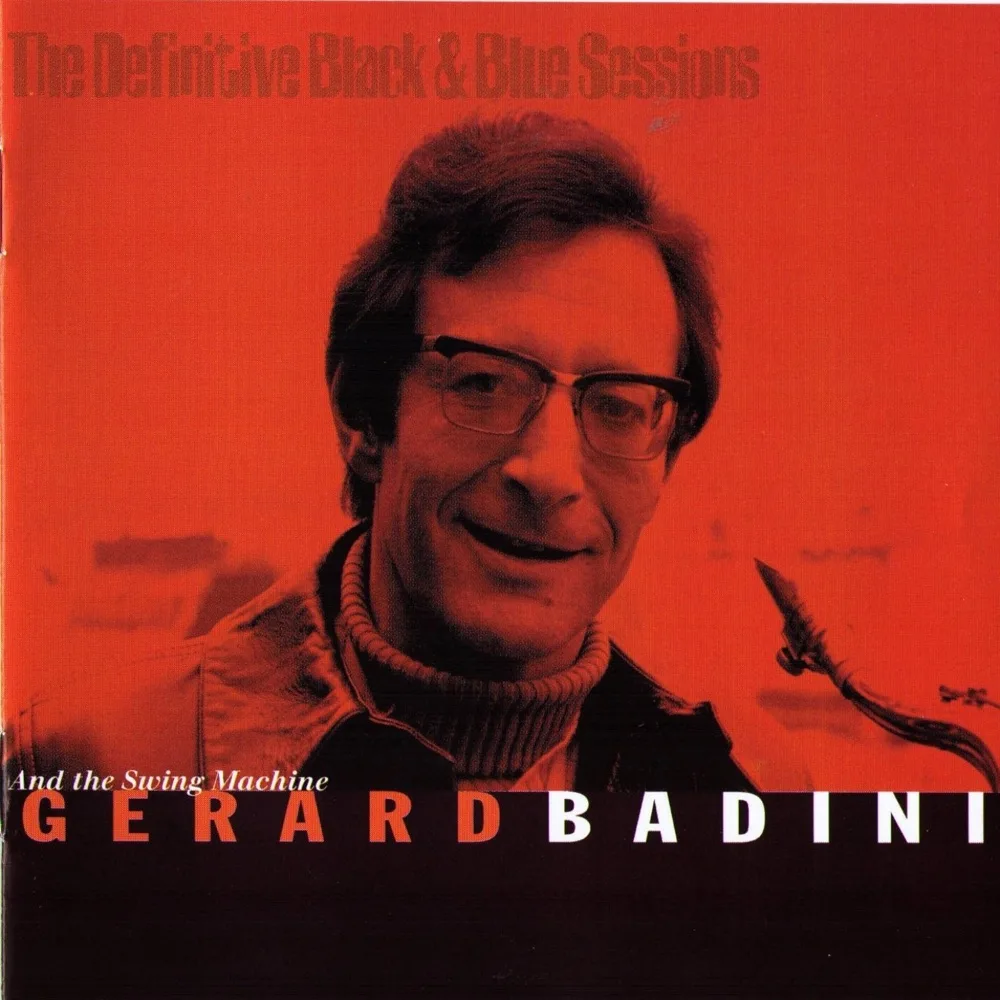
Gérard Badini on the cover of And the Swing Machine (Black & Blue, 2003), the CD reissue in the Definitive Black & Blue Sessions series of his 1974 Swing Machine album. The cover is a close photograph of a man in glasses with a saxophone, printed with the name Gerard Badini. Standard copyright, all rights reserved, held by the label or rights holder. This is not a Creative Commons or public-domain image; it is an album cover shown as an honestly disclosed editorial identification image. — Apple Music - https://music.apple.com/fr/album/and-the-swing-machine-the-definitive-black-blue-sessions/280811077
Gérard Badini, known as "Mr. Swing," was a French tenor saxophonist, clarinettist and bandleader who worked in French swing and mainstream jazz from 1952 into the 2000s. He was born on April 16, 1931 in the 10th arrondissement of Paris, and his father was an opera singer. AllMusic describes him as self-taught: he began as a classical singer, took up the clarinet in 1950, and made his professional debut in 1952 at the Sporting Club in Monte Carlo as clarinettist in the New Orleans-style orchestra of Michel Attenoux.
His son Jérôme Badini told France Musique that the band had won a public-radio contest whose prize was a spot opening for Sidney Bechet, which led to a tour with the American clarinettist and soprano saxophonist. In 1954 he made a longer tour with Bechet's group. In those early years he also played New Orleans-style jazz with Jimmy Archey, Lil Armstrong, Bill Coleman and Peanuts Holland. In 1955 he formed a trio with the pianist Claude Bolling, a partnership that lasted more than twenty years, and he toured the world with Jack Diéval's orchestra. From 1958 he played mainly tenor saxophone, working with Bolling, with the trumpeter Roger Guérin and with Geo Daly.
In the 1960s he worked with the Swedish singer Alice Babs on an album that also involved Duke Ellington, and with Jean-Claude Naude, Cat Anderson, Paul Gonsalves, Jef Gilson and François Guin. From 1968 he played in Guin's band Les Swingers, which appeared at the Montreux Jazz Festival in 1970 and toured Africa. In 1973 he founded his own group, the Swing Machine. Its first Black & Blue album was recorded in December 1973 and February 1974, and in 1975 he made records with the former Ellington drummer Sam Woodyard, the pianist Raymond Fol and the bassist Michel Gaudry. In February and March 1975 he recorded live in Geneva at the Popcorn jazz club with the organist and pianist Milt Buckner, the bassist Jimmy Woode and Woodyard, and in 1976 the drummer Sonny Payne joined him. He toured Europe with the singer Helen Humes in 1974.
From 1977 to 1979 Badini lived in New York, where he played with Roy Eldridge, Major Holley, Oliver Jackson, Dick Katz, Clark Terry, Gerald Wiggins and Reggie Workman and led his own quartet. His son later said that American musicians took him in, and Le Monde wrote that he won genuine recognition in the United States. Back in France he formed a new Swing Machine with the pianist Alain Jean-Marie, the bassist Michel Gaudry and the drummer Philippe Combelle, and recorded French Cooking for Vogue in April 1980.
On February 14, 1984 he launched the Super Swing Machine at the Paris club New Morning, an 18-piece big band that went on to play major European festivals, including Montreux and Nice, and appeared on television. Its albums include Mr. Swing Is Still Alive, recorded in December 1985 and issued in 1987, Mister Swing Meets Claude Debussy (1991), a set built on Debussy's piano music, a 1994 album titled Swingin' Marilyn, Certains Leeb Jazz (1997) with the singer and entertainer Michel Leeb, and a new French Cooking in 2003. In 2006 came Scriabin's Groove, a set of Alexander Scriabin piano pieces in jazz arrangements, with the pianist Igor Tchetuev and production by Jérôme Badini. On the 2003 and 2006 albums the credits list him as conductor rather than as a player. He received the Grand Prix du Jazz of the SACEM in 1992 and the Prix Boris Vian of the Académie du Jazz in 1993.
Badini lived in Deauville in his later years. He passed away there on October 25, 2025, at the age of 94. Radio France and Le Monde reported his death, and TSF Jazz noted that he had accompanied his idol Duke Ellington.
Badini was a swing player first. AllMusic calls his approach straight-ahead swing, notes that he was a Benny Goodman man on clarinet, and adds that he could solo capably, with a sense of adventure inside well-tested stylistic limits, on both tenor saxophone and clarinet. TSF Jazz called Duke Ellington his idol, and the repertoire on his records bears that out: "It Don't Mean a Thing," "Stomp, Look and Listen" and "Take the 'A' Train" appear on his 1975 albums, next to his own pieces such as "Sam Woodyard Is Back in Town" and "Fingers Poppin' at the Popcorn." His roots were in New Orleans-style bands, and from 1958, when he moved mainly to the tenor saxophone, he worked in the wider swing and mainstream world around Claude Bolling and the Ellington alumni who visited Paris.
The nickname Mr. Swing stuck for good reason: his son Jérôme said his father could be summed up in two words, swing and sound, and recalled being taught that one note should be able to say everything. The listening at home was not limited to jazz. Jérôme Badini remembered hearing Ravel, Debussy and Stravinsky with him, and that taste shows in the classical projects of the Super Swing Machine, whose 1991 and 2006 albums turn Debussy and Scriabin piano pieces into big-band arrangements. As a bandleader he worked with arrangers and soloists from the French big-band scene, among them the trumpeter and arranger François Biensan on his 1980s and 1990s records, and with American veterans from the Ellington orbit, including Sam Woodyard, Cat Anderson and Paul Gonsalves.
- Gerard Badini and the Swing Machine (1974, Black & Blue 33.060) - the first Swing Machine record, made in Paris on December 17, 1973 and February 10, 1974 with the trumpeter Xavier Chambon, the pianist Marc Hemmeler, the bassist Jack Sewing and the drummers Bobby Durham and Michel Denis; the 2003 CD edition is titled And the Swing Machine. Apple Music - And the Swing Machine Listen
- The Swing Machine (1975, Blue Star 80.701) - recorded on May 30, 1975 with the pianist Raymond Fol, the bassist Michel Gaudry and the Ellington alumnus Sam Woodyard on drums, and later reissued in the Jazz in Paris series. Apple Music - The Swing Machine Listen
- A Night at the Popcorn (Riverboat 900.280-81; CD reissue Black & Blue BB 966.2, 2003) - a live set from the Popcorn jazz club in Geneva, recorded on February 28 and March 1, 1975, with Milt Buckner, Jimmy Woode and Sam Woodyard. Apple Music - A Night at the Popcorn Listen
- French Cooking (1980, Vogue 502607) - the rebuilt Swing Machine with Alain Jean-Marie, Michel Gaudry and Philippe Combelle, recorded at the Sidney Bechet studio in Paris on April 23 and 24, 1980.
- Mr. Swing Is Still Alive (1987, Arpej 12387) - the first Super Swing Machine album, recorded in December 1985, with a four-movement suite that gives the album its title.
- Mister Swing Meets Claude Debussy (1991, Mantra 064) - the big band in arrangements of Debussy's Children's Corner and other piano pieces, recorded in Paris on February 18 and 19, 1991. Apple Music - Mister Swing Meets Claude Debussy Listen
- Scriabin's Groove (2006, Super Bad Trax SBT 1) - six Scriabin piano pieces in jazz settings, each heard in the pianist Igor Tchetuev's solo version and in a big-band arrangement. Apple Music - Scriabin's Groove Listen
- Helen Humes, Sneakin' Around (1975, Black & Blue 33.083) - Badini is the tenor saxophonist on the singer's Paris session of March 16, 1974, with Gerald Wiggins, Major Holley and Ed Thigpen.
Gérard Badini: Full Discography
French tenor saxophonist, clarinettist and bandleader, born April 16, 1931 in Paris, died October 25, 2025. On Discogs he is artist 447129, and several of his groups are filed there as separate artists (Gérard Badini Swing Machine, Gérard Badini Super Swing Machine, Gérard Badini Et Son Quartet and Gérard Badini Et Les Swingers). His own catalogue is short and centres on the Swing Machine quartet records of the 1970s and the Super Swing Machine big-band albums from 1987. The tables below list those records, the albums he shared with other leaders, and the sideman credits that were checked against the individual release records. Dozens of further appearances on Discogs, mostly with Michel Attenoux, Claude Bolling and François Guin's Les Swingers, are not itemized.
As Leader
| Album Title | Release Date | Label | Catalog Number | Personnel | Role | Reissue History | Listen | Buy | Notes |
|---|---|---|---|---|---|---|---|---|---|
| Making Whoopee (EP) | 1958 | Pretoria | 45 J. 3001 | Gérard Badini (clarinet), Géo Daly (vibraphone, uncredited) | Leader (billed Gérard Badini et les Swingers) | Not confirmed | — | — | 7-inch EP with "Making Whoopee," "Clarinologie" and "The Blues Done Come Back." |
| Gerard Badini and the Swing Machine | 1974 | Black & Blue | 33.060 | Gérard Badini (tenor saxophone), Xavier Chambon (trumpet), Marc Hemmeler (piano), Jack Sewing (bass), Bobby Durham and Michel Denis (drums) | Leader (billed Gérard Badini Swing Machine) | Reissued on CD in 2003 as And the Swing Machine (Black & Blue BB 974.2), with ten tracks | Apple Music (2003 CD reissue) | — | Recorded December 17, 1973 (three tracks) and February 10, 1974 (three tracks). |
| The Swing Machine | 1975 | Blue Star | 80.701 | Gérard Badini (tenor saxophone), Raymond Fol (piano, celesta on one track), Michel Gaudry (bass), Sam Woodyard (drums) | Leader | Reissued as Jazz in Paris: The Swing Machine (Decca Records France, 2002) | Apple Music (2002 reissue) | — | Recorded May 30, 1975. The original sleeve and labels read "House of Jazz Vol. 1, The Swing Machine." |
| French Cooking | 1980 | Vogue | 502607 | Gérard Badini (tenor saxophone, African drum on one track), Alain Jean-Marie (piano), Michel Gaudry (bass), Philippe Combelle (drums, African percussion on one track) | Leader (billed Gérard Badini Swing Machine) | Not confirmed | — | — | LP with three long tracks, "French Cooking," "Bluesy Baby" and "A Night in Ouagadougou." Recorded at the Sidney Bechet studio on April 23 and 24, 1980. A different record from the 2003 album of the same name. |
| The Swing Machine Vol. 2 | 1981 | Blue Star (also Barclay and Movieplay) | 17.2945/1 | Billed to Gérard Badini, Raymond Fol, Michel Gaudry and Sonny Payne; instruments not credited | Leader | The Discogs master for the record dates it 1981; the original issue date is not confirmed | — | — | Seven tracks including "Cornet Chop Suey," "Gaudryoles" and "Bad Blues." |
| Mr. Swing Is Still Alive | 1987 | Arpej | 12387 | Gérard Badini (tenor and alto saxophones, conductor) leading the Super Swing Machine, with François Biensan, Christian Martinez, Eric Mula, François Chassagnite and Philippe Slominski (trumpets), Marc Steckar, Michel Camicas, Daniel Landreat, Jacques Erard, Jean-Louis Damant and William Treve (trombones), Claude Tissendier, Jean Estéve, André Villeger, Eric Barret and François Debricon (saxophones, clarinet), Alain Bernard (piano), Pierre Boussaguet (bass), François Laudet (drums), Vincent Cordelette (percussion) | Leader (billed Gérard Badini Super Swing Machine) | Not confirmed | — | — | Recorded December 19 and 20, 1985 at Studio Grand Pavois. Includes a four-movement suite named after the album. French Wikipedia dates the album 1985. |
| Mister Swing Meets Claude Debussy | 1991 | Mantra | 064 | Gérard Badini (conductor, arranger) leading the Super Swing Machine, with François Biensan, Bernard Marchais, Christian Martinez, Louis Vezant and Tony Russo (trumpets, flugelhorns), Marc Steckar, Gilles Salommez, Jean-Christophe Vilain and Pascal Koscher (trombones), Michel Goldberg, Hervé Meschinet, Carl Schlosser, Sylvain Beuf and Gilles Miton (saxophones, clarinets, flutes), Philippe Milanta and Hervé Sellin (piano), Christophe Le Van (bass), François Laudet (drums) | Leader (billed Gérard Badini Super Swing Machine) | A second CD edition of 1991 appears on streaming services | Apple Music | — | Big-band arrangements of Debussy's piano music, including the Children's Corner suite. Recorded February 18 and 19, 1991 at Studio Davout, Paris. Arrangements by Badini, Biensan and Sellin. |
| Swingin' Marilyn | 1994 | Nocturne | NTCD 311 | Not confirmed | Leader (billed Gérard Badini Swing Machine) | Not confirmed | — | — | Eight tracks, among them "That Old Black Magic," "I'm Thru with Love," "A Fine Romance" and "My Heart Belongs to Daddy." |
| French Cooking | 2003 | Nocturne | NTCD 335 | Gérard Badini (conductor, executive producer) leading the Super Swing Machine, with Erick Poirier, Fabien Mary, Franck Delpeut, Sacha Bourguignon and Sylvain Gontard (trumpets), Jean-François Quellec, Jerry Edwards, Michaél Joussein and Pascal Koscher (trombones), Carl Schlosser, Dominique Mandin, Philippe Chagne, Stéphane Chausse and Thomas Savy (saxophones), Pierre Christophe (piano), Brahim Haiouani (bass), Robert Méniére (drums) | Leader (billed Gérard Badini Super Swing Machine) | Appears on streaming services with a Super Bad Trax release date | Apple Music | — | Thirteen tracks on the Discogs record, including "Fricassée de Poulette à la Royale" and "To Duke with Love." Cover illustration by Cabu. |
| Scriabin's Groove | 2006 | Super Bad Trax | SBT 1 | Gérard Badini (conductor), leading the Super Swing Machine, with Igor Tchetuev (piano, tracks 2, 4, 6, 8, 10 and 12), Pierre Christophe (piano), André Villeger, Michel Pastre, Olivier Zanot, Claudio De Queiroz and Philippe Chagne (saxophones), Brice Moscardini, Franck Delpeut, Franck Guichard and Sylvain Gontard (trumpets, flugelhorns), Jean-Claude Onesta, Jerry Edwards, Michaél Joussein and Pascal Koscher (trombones), Brahim Haiouani (bass), Robert Méniére (drums) | Leader (billed Gérard Badini Super Swing Machine featuring Igor Tchetuev) | A second streaming release carries a later date | Apple Music | — | Six Scriabin piano pieces, each played solo by Tchetuev and then in a big-band arrangement; produced by Jérôme Badini, orchestrations by Stan Lafferiére. |
| Love Me or Leave Me (EP) | Not confirmed | Rallye Jeunesse | RJ 1 | Gérard Badini (leader) and quartet; other members not credited | Leader (billed Gérard Badini et son quartet) | Not confirmed | — | — | 7-inch EP with "Love Me or Leave Me," "Satin Doll," "Willow Weep for Me" and "It Don't Mean a Thing." |
As Co-Leader and Featured Artist
| Album Title | Release Date | Label | Catalog Number | Personnel | Role | Reissue History | Listen | Buy | Notes |
|---|---|---|---|---|---|---|---|---|---|
| A Night at the Popcorn | Not confirmed | Riverboat | 900.280-81 | Milt Buckner (organ and vocals on sides A and B, piano on sides C and D), Gérard Badini (tenor saxophone, sides C and D), Jimmy Woode (bass, sides C and D), Panama Francis (drums, sides A and B), Sam Woodyard (drums, sides C and D) | Co-leader (billed Milt Buckner, Gérard Badini, Jimmy Woode, Panama Francis and Sam Woodyard) | Reissued on CD as A Night at the Popcorn (Black & Blue BB 966.2, 2003), billed to Badini | Apple Music (2003 CD reissue) | — | Double LP recorded live at the Popcorn jazz club in Geneva on February 28 (sides A and B) and March 1, 1975 (sides C and D). The CD reissue lists ten tracks, among them "Fingers Poppin' at the Popcorn" and "Blues for Marcelle." |
| Texas Sound | 1992 | Timing Show | 770292-2 | Carl Schlosser Quartet featuring Gérard Badini; individual credits not listed | Featured artist | Not confirmed | — | — | Recorded live at the Jazz Club Lionel Hampton, Paris, and opens with "Blow Gerard Blow." |
| Certains Leeb Jazz | 1997 | Dreyfus Jazz | FDM 36586-2 | Michel Leeb (vocals) with the big band of Gérard Badini (conductor), including François Biensan, Christian Martinez, Louis Vezant and Tony Russo (trumpets), Marc Steckar and Pascal Koscher (trombones), Sylvain Beuf, Carl Schlosser and Michel Goldberg (saxophones), Philippe Milanta (piano), Christophe Le Van (bass), François Laudet (drums) | Conductor, band leader (billed Michel Leeb avec le Big Band de Gérard Badini) | Not confirmed | — | — | Thirteen standards including "The Lady Is a Tramp," "Autumn in New York" and "Fly Me to the Moon." |
| What Did I Do to Be So Black and Blue | 2002 | Millenium Jazz Records | 940 574 2 | Gérard Badini, Gilles Thibaut, Claude Gousset and Colette Magny are listed as artists; individual credits not given | Co-billed artist | Not confirmed | — | — | Twenty tracks including "C Jam Blues," "High Society," "Bugle Call Rag" and "C'est si bon." |
As Sideman (selected credits)
| Year | Project (Leader) | Title | Label | Catalog | Role | Notes |
|---|---|---|---|---|---|---|
| 1954 | Sidney Bechet | St Louis Blues | Not confirmed | Not confirmed | Clarinet (not confirmed) | Listed on French Wikipedia and in the German and Dutch Wikipedia discographies; the release was not checked. |
| 1956 | Claude Bolling | Les Succés de Duke Ellington | Le Club Français du Disque | 69 | Clarinet | Arrangements by Bolling. Also credited: Roger Guérin (trumpet), Pierre Michelot (bass) and Arthur Motta (drums). |
| 1966 | Alice Babs with Duke Ellington | Serenade to Sweden | Not confirmed | Not confirmed | Not confirmed | French Wikipedia names this album among the records he made with Ellington and Babs; the release was not checked. |
| 1969 | Paul Gonsalves, with François Guin Et Les Swingers and The Four Bones | Paul Gonzalves, François Guin Avec Les Swingers Et Les Four Bones | Riviera | 521.137 | Tenor saxophone | Recorded at Studio Hoche, Paris, on November 17, 1969; Discogs dates the release 1970. Music direction and arrangements by François Guin. Includes "The World Is Sad and Blue." |
| 1974 | Helen Humes | Sneakin' Around | Black & Blue | 33.083 | Tenor saxophone | Recorded at Barclay studio on March 16, 1974 with Gerald Wiggins (piano), Major Holley (bass) and Ed Thigpen (drums); Discogs dates the release 1975. |
| 1976 | Lionel Hampton | Ring Dem Vibes | Blue Star | 80.706 | Tenor saxophone (tracks 1, 5 and 7) | With Michel Attenoux (alto saxophone), Raymond Fol (piano), Michel Gaudry (bass), Sam Woodyard (drums), Claude Gousset (trombone) and Billy Mackel (guitar). Reissued by Gitanes Jazz Productions in 2000. |
| 1977 | Cat Anderson | Cat Speaks | Black & Blue | 33.113 | Tenor saxophone, clarinet | With Raymond Fol (piano), Michel Gaudry (bass) and Sam Woodyard (drums). |
| Not confirmed | Claude Bolling and Le Show Biz Band | Swing Session | Cy Records | CY 3003 | Tenor saxophone | Big-band LP with Jean-Louis Chautemps (tenor saxophone) and François Guin (trombone) in the ranks. Discogs lists it under 1977, AllMusic under 1973. |
| 1980 | Marcel Zanini | Joue et chante Marcel Zanini | Free Bird | FLY 16 | Tenor saxophone | With Sam Woodyard (drums), Marc Hemmeler (piano), Jack Gregg (bass), Claude Gousset (trombone, arranger) and Xavier Chambon (trumpet). |
- Michel Attenoux - bandleader of the New Orleans-style orchestra in which Badini made his professional debut on clarinet in 1952 and with which he first toured behind Sidney Bechet.
- Sidney Bechet - the opening act on a tour after the radio contest, and a longer European tour with Bechet's group in 1954.
- Claude Bolling - pianist; they formed a trio in 1955 and worked together for more than twenty years. Badini plays clarinet on Bolling's Les Succés de Duke Ellington (Le Club Français du Disque, 1956) and tenor saxophone on the Show Biz Band's Swing Session (Cy Records).
- Duke Ellington - his idol, with whom he worked in the 1960s on an album with the singer Alice Babs.
- Roger Guérin - trumpeter; worked with Badini in the late 1950s and is on the 1956 Bolling Ellington album.
- François Guin - trombonist and bandleader; Badini played in his band Les Swingers from 1968, and is the tenor saxophonist on the 1969 session with Paul Gonsalves.
- Jef Gilson - pianist and bandleader with whom he worked in the 1960s.
- Paul Gonsalves - Ellington tenor saxophonist; they recorded together in Paris on November 17, 1969 for an album with Guin's Les Swingers and The Four Bones (Riviera 521.137), which includes "The World Is Sad and Blue."
- Sam Woodyard, Raymond Fol and Michel Gaudry - drummer, pianist and bassist of the 1975 Swing Machine recordings; Gaudry stayed on in the group's 1979 line-up.
- Sonny Payne - drummer who worked with the Swing Machine in 1976.
- Milt Buckner and Jimmy Woode - organist and bassist on the Geneva live recording of 1975.
- Helen Humes - singer; Badini toured Europe with her in 1974 and is the tenor saxophonist on Sneakin' Around.
- Lionel Hampton - tenor saxophonist on three tracks of Ring Dem Vibes (Blue Star, 1976).
- Cat Anderson - Ellington trumpeter; Badini plays tenor saxophone and clarinet on Cat Speaks (Black & Blue, 1977).
- Roy Eldridge, Clark Terry and Reggie Workman - among the American musicians he played with in New York from 1977 to 1979.
- Major Holley, Oliver Jackson, Dick Katz and Gerald Wiggins - the other New York partners named in his Wikipedia biography; Wiggins and Holley are on the 1974 Humes session.
- Alain Jean-Marie and Philippe Combelle - pianist and drummer in the Swing Machine of 1979 and 1980.
- Marcel Zanini - saxophonist and singer; Badini plays tenor saxophone on Joue et chante Marcel Zanini (Free Bird, 1980).
- Michel Leeb - singer and entertainer; Certains Leeb Jazz (Dreyfus Jazz, 1997) was made with Badini's big band.
- Jérôme Badini - his son, a saxophonist and France Musique producer, who produced Scriabin's Groove and spoke about his father's career after his death.
- François Chassagnite - trumpeter in the Super Swing Machine on Mr. Swing Is Still Alive (Arpej, 1987).

More Swing Artists
See all 273 Swing artists →More French Jazz Artists
See all 170 French artists →- Discogs: Gérard Badini
- AllMusic: Gérard Badini
- MusicBrainz: Gérard Badini
- Apple Music: Gérard Badini
- Wikipedia (English): Gérard Badini
- Wikipedia (French): Gérard Badini
- Wikidata: Gérard Badini
- BnF catalogue: Gérard Badini
- France Musique: Disparition du saxophoniste et chef Gérard Badini, "Mr Swing"
- Gérard Badini on JazzProfiles.com
- Wikipedia (English): Gérard Badini
- Wikipedia (French): Gérard Badini
- Wikipedia (German): Gérard Badini
- Wikipedia (Dutch): Gérard Badini
- Wikidata: Gérard Badini (Q943150)
- AllMusic: Gérard Badini, biography by Eugene Chadbourne
- France Musique: Disparition du saxophoniste et chef Gérard Badini, "Mr Swing" (October 27, 2025)
- TSF Jazz: Gérard Badini a rejoint Duke Ellington
- Le Monde: Gérard Badini, saxophoniste et figure majeure du jazz européen, est mort (October 29, 2025)
- Discogs: Gérard Badini, artist 447129
- Discogs: Gerard Badini And The Swing Machine, Black & Blue 33.060
- Discogs: The Swing Machine, Blue Star 80.701
- Discogs: French Cooking, Vogue 502607
- Discogs: Mr. Swing Is Still Alive, Arpej 12387
- MusicBrainz: Gérard Badini
- André Clergeat and Barry Kernfeld, "Gérard Badini," The New Grove Dictionary of Jazz, 2nd edition