 JAZZPROFILES lives in the music 1,572 Jazz Artists fully Profiled!
 Erez Bar-Noy
Last updated September 8, 2026
Listen on Spotify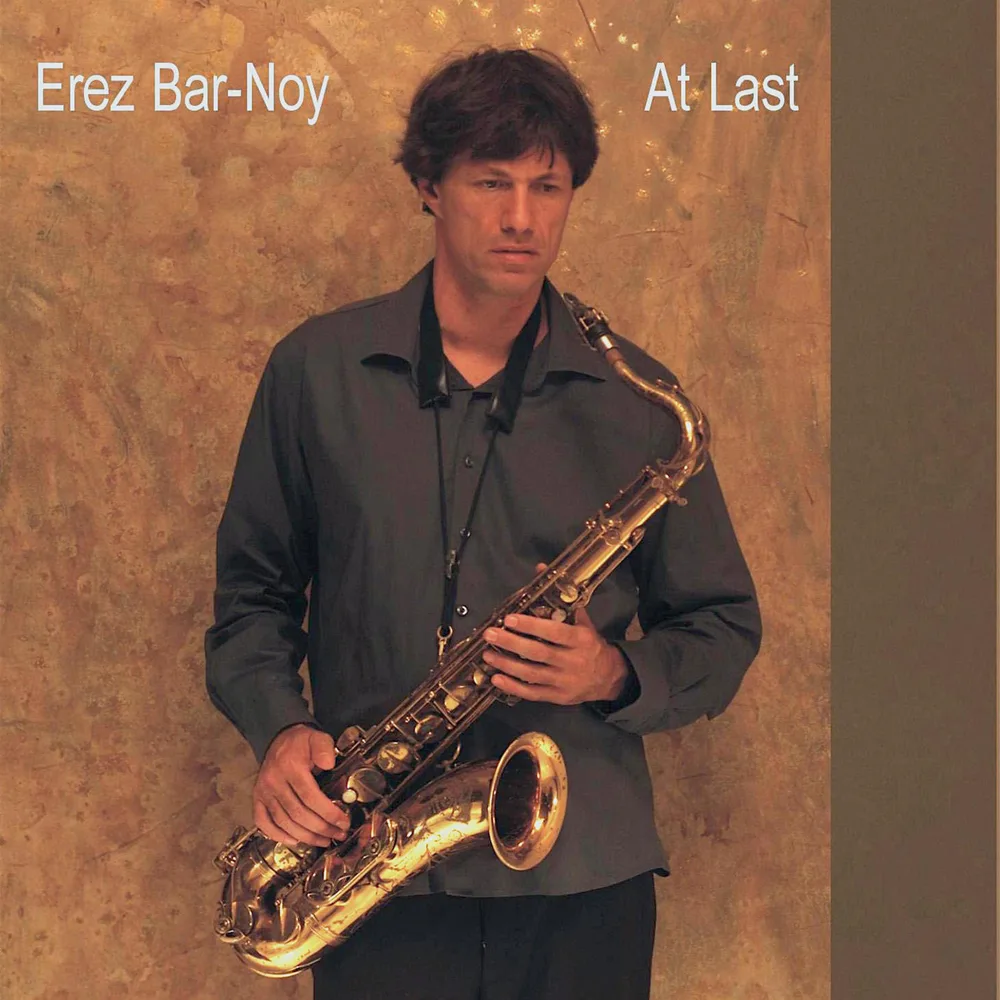
Erez Bar-Noy with his tenor saxophone, on the front cover of his only album, *At Last* (2009). Album cover art (not a CC-licensed artist photo). Used under the album-cover fallback rule as the only available image showing the artist. Photographer not credited on any source consulted. — Apple Music artwork for At Last by Erez Bar Noy (album 1460944225) — https://music.apple.com/us/album/at-last/1460944225
Erez Bar-Noy was born in Be'er Sheva on March 17, 1966 and grew up in Givatayim, in a household with no musicians in it. Music reached him early anyway: he said the Israeli rock band Kaveret took hold of him in second grade, though he played nothing at the time. He did not pick up an instrument until he was 22, and the trigger was a radio broadcast. Dani Carpel ran a John Coltrane marathon on Galei Tzahal, Bar-Noy heard it, and he bought a saxophone. Twenty-two is late by any conservatory's standards, and he built a thirty-year career on top of that late start.
His first teacher was Stu Cohen, the Israeli multi-instrumentalist who produced Arik Einstein's first album. Bar-Noy's account of him is the line he repeated in interviews for the rest of his life: Stu, he said, awakened in him an enormous love for jazz, believed in him and pushed him forward. Cohen's own verdict came after the second lesson, when he told his student he thought he would become a musician because he had the madness for it. From there Bar-Noy went to the Rimon School of Music, studying with the saxophonists Amikam Kimelman and Mamlo Giatnopoulos, and at 26 he moved to New York. He enrolled at Mannes College and then at The New School, where his teachers included Billy Harper and George Garzone. He described the shock of the New York practice-room economy plainly: thousands of saxophonists, most of them playing better than he was, and nothing to do about it but practise and go to sessions. He came home in 1997, a decision he attributed to his father's cancer diagnosis, his marriage and the birth of his son, and to not wanting to raise the boy anywhere but Israel.
From 1997 he worked the Israeli circuit at the head of his own groups, in quartet and sextet formats, and appeared at the country's main jazz events: the Red Sea Jazz Festival in Eilat, the Tel Aviv Jazz Festival, the Jazz Films festival in Tel Aviv and the Shuni festival. He shared bandstands with the American trumpeter Randy Brecker and the tenor saxophonist Abraham Burton, whose Israeli visits produced what one Israeli listing called an unforgettable dialogue between the two horns. On June 9, 2014 he played Beit Avi Chai in Jerusalem with the pianist Omri Mor in "Jazz in Hebrew," an evening of his own arrangements of Mordechai Ze'eira songs curated by Barak Weiss. He also worked abroad: on November 18, 2017 he played the EverJazz club in Yekaterinburg with the Russian ASK Trio, and on March 23, 2018 he brought the Israel Conservatory Jazz Quartet to the University of Pennsylvania for a masterclass and a concert at Rose Recital Hall.
He recorded one album. At Last came out in April 2009, nine tracks and about 56 minutes, and it is the only leader date he made. By his own account he had not written seriously until 2007, when he started assembling material for it, and what came out surprised him: after years in New York chasing an American idiom, the tunes had Israeli roots showing through. Two of the titles say so outright, "Emek Israel" and "Beit Yanay," and they sit next to "Skylark," "Minor Mishap," "Three Little Words" and "That's All." His position on the mixture was that Israeli material should be allowed to come through the playing honestly rather than be bolted on as fusion.
The teaching is the larger half of the record. Bar-Noy taught theory, improvisation and saxophone and directed ensembles across Israel: he ran the jazz department at the Ironi Alef High School for the Arts in Tel Aviv, and taught at Rimon, at the Mizmor school of music, at the Thelma Yellin High School of the Arts, at MATAN and in masterclasses around the country. From 2009 to 2019 he directed the Center for Jazz Studies at the Israel Conservatory of Music in Tel Aviv, the Stricker Street department founded in 2001 by Amit Golan, and with it the joint academic track with The New School in New York, which remains the only formal Israel-to-New School route of its kind. He was categorical about how young the work should start, teaching from age 12 upward and refusing to soften the material for children. Among the players who came through him are the baritone saxophonist Eden Bareket, who names him first in the list of Conservatory teachers he studied with, and the pianist Hila Kulik, whom he taught from her high-school years and with whom he played a duo that turned out to be his last stage partnership.
Bar-Noy died suddenly on August 7, 2021, at 55. Writing in Haaretz a week later, Ben Shalev headlined his appreciation with the flat claim that local jazz is hard to imagine without him, and called the Conservatory department Bar-Noy had run the most important jazz training ground in the country. Amikam Kimelman, his old Rimon teacher, called the loss enormous for Israeli jazz and for music education. Two memorials followed in 2022. On May 12 the Israeli Jazz Society marked International Jazz Day at Tel Aviv's old railway station with an "Alto Summit" in his memory, three alto players (Hagai Amir, Eyal Hai and Alon Farber) with Kulik on piano. On June 1 the Pannonica Jazz Association filled the Tel Aviv Museum of Art: Yuval Cohen and his brother Avishai Cohen on trumpet with Barak Mori, Shai Maestro and Ziv Ravitz playing Herbie Hancock's "Dolphin Dance"; a reconstituted Erez Barnoy Sextet with Hagai Amir, Asaf Harris, Jonathan Voltzok, Yonatan Riklis and Alon Binyamini playing his tune "Concepts"; Kulik alone at the piano with a piece she had written called "Erez"; and Voltzok's big band closing the night with Alon Oleartchik. Kulik's 2023 album More Than a Change is dedicated to him and carries one of his compositions, "Are You Too Barnoy."
Bar-Noy came to the horn through Coltrane on the radio and trained inside the New York mainstream, and the tenor sound he brought back is out of that lineage: hard-swinging, blues-anchored, more interested in line than in effect. What separates him from the many Israeli players who made the same New York trip is what he did with the material once he was home. He arrived at composition late, at 41, and found that the songs his mother had had on the radio in Givatayim were still in his ear, which is why his one album puts "Emek Israel" and "Beit Yanay" alongside a Hoagy Carmichael ballad and a Tommy Flanagan blues without announcing a fusion, and why he spent an evening at Beit Avi Chai rewriting Mordechai Ze'eira for a jazz group rather than writing a Middle Eastern suite. He was explicit that he wanted the Israeli element to be audible without being decorative. His influence, though, is transmitted mostly through other people's playing: three decades of Israeli saxophonists, and a good share of the country's rhythm sections, learned improvisation from him at Ironi Alef, Thelma Yellin, Rimon or Stricker Street, and the players who turned out for his memorial are the argument.
- At Last (2009, self-released) - His only album as a leader, issued in April 2009 and the record every quartet and sextet booking of his last decade drew on. Nine tracks: five apparent originals, "Emek Israel" and "Beit Yanay" among them, against "Skylark," "Minor Mishap," "Three Little Words" and "That's All." Apple Music - At Last Listen
- Blame It on the Bebop (2008, no label), with Jazz 'n Roll - Tenor chair in an eight-piece Israeli band putting pop and rock songs (Björk, Nirvana, The Police, Metallica) through swing and big-band arrangements. His only confirmed sideman recording.
- More Than a Change (2023, One Trick Dog Records), Hila Kulik - Recorded in New York in September 2021, six weeks after his death, dedicated to him in the gatefold, and including his composition "Are You Too Barnoy" with Alexander Levin on tenor. Bar-Noy does not play on it.
Erez Bar-Noy: Full Discography
Erez Bar-Noy's recorded catalogue is very small, and the gap between his standing in Israeli jazz and his output on record is the single most striking thing about it. He led one album, At Last (2009). He has one confirmed sideman credit, the 2008 Jazz 'n Roll album Blame It on the Bebop. One of his compositions was recorded after his death, on Hila Kulik's More Than a Change (2023), an album dedicated to his memory. Nothing else has been confirmed. This file is comprehensive rather than curated: it is his whole documented catalogue.
Credits are verified against Discogs artist 5974669 ("Erez Bar Noy", real name given as "Erez Bar-Noy", profile field "Israeli saxophone player and teacher 17.3.1966 - 7.8.2021"). Discogs is incomplete for this artist: it does not list At Last at all, which is the one release he actually led. Anyone treating the Discogs page as his discography would conclude he never made a record. At Last is verified instead against Apple Music (album 1460944225), Spotify, Amazon Music, Hebrew Wikipedia and multiple Israeli concert listings. See erez-bar-noy_notes.md.
As Leader
| Album Title | Recording Date(s) | Release Date | Label | Catalog Number | Format(s) | Personnel | Role | Reissue History | Spotify | Buy | Notes |
|---|---|---|---|---|---|---|---|---|---|---|---|
| At Last | Not confirmed. He has said he began writing the material in 2007, which brackets the sessions to 2007-2009. | April 23, 2009 (Apple Music / Amazon). Hebrew Wikipedia gives 2009. | Self-released. No label is named on any source consulted; the digital distribution carries the DistroKid placeholder line "℗ 2019 1256841 Records DK", i.e. a 2019 re-upload of the 2009 album, not a label signing. | None | Originally CD; digital (streaming and download) from 2019 | Not confirmed. No source consulted publishes the album's personnel. His documented working quartets are Hod Moshonov (piano), Assaf Hakimi (double bass), Yonatan Oleiski (drums); and, in a later configuration, Hila Kulik (piano), Almog Sharvit (double bass), Itai Morchi (drums). Neither line-up is confirmed as the recording band. | Tenor saxophone, leader, composer, arranger | Digital reissue 2019 via DistroKid | Spotify artist page: Erez Bar Noy. The album's own Spotify URI could not be recovered (the Spotify API returned a quota error and the web player did not expose the album href); Apple Music is given instead. | — | Nine tracks, about 56 minutes, in this running order: "Emek Israel," "My Flower," "Captain Marshall," "Skylark," "Minor Mishap," "Beit Yanay," "Three Little Words," "That's All," "Sofi's Blues." Four are standards not by him: "Skylark" (Hoagy Carmichael / Johnny Mercer), "Minor Mishap" (Tommy Flanagan), "Three Little Words" (Bert Kalmar / Harry Ruby) and "That's All" (Bob Haymes / Alan Brandt). The other five correspond to no standard and are presumed his own, but no source consulted publishes composer credits, so this is inference. Not on Discogs. |
As Sideman
| Year | Project (Leader) | Title | Label | Catalog | Role | Notes |
|---|---|---|---|---|---|---|
| 2008 | Jazz 'n Roll (collective band, no named leader) | Blame It on the Bebop | Not On Label | none | Tenor saxophone | CD, Israel. Discogs release 10782444, genre Jazz, styles Swing / Vocal / Fusion. Twelve pop and rock songs rearranged for a jazz band: "Blame It on the Boogie," "Walking on the Moon," "Virtual Insanity" (spelled "Inssanity" on the release), "Jeremy," "Straight Up," "Human Behavior," "Nothing Else Matters," "Nobody's Wife," "What's Up," "Don't Call Me Baby," "Torn," "Smells Like Teen Spirit" (spelled "Smell Like Teen Spirit"). Full band: Ella Tadmor (vocals), Hagai Amir (alto saxophone), Erez Bar Noy (tenor saxophone), Idan Walish (trombone), Gay Daviv (trumpet), Omer Rizi (piano), Shai Vardi (bass), Asaf Dagan (drums). |
Posthumous recording of a Bar-Noy composition
| Year | Project (Leader) | Title | Label | Catalog | Role | Notes |
|---|---|---|---|---|---|---|
| 2023 | Hila Kulik | More Than a Change | One Trick Dog Records | none | Composer (track 8, "Are You Too Barnoy"). He does not play on the record. | CD, gatefold, released May 7, 2023. Discogs release 28017570, styles Post Bop. Recorded September 22 and 23, 2021 at Sear Sound, New York, six weeks after Bar-Noy's death; mixed and mastered at Ex Machina Soundworks, Brooklyn. The gatefold carries a dedication to him. Band: Hila Kulik (piano, Fender Rhodes, vocals, producer), Wayne Tucker (trumpet, producer), Antonio Hart (alto saxophone), Alexander Levin (tenor saxophone), Itai Kriss (flute), Corey Wallace (trombone), Tamir Shmerling (acoustic bass), Dani Danor (drums). "Are You Too Barnoy" features Alexander Levin on tenor. Discogs files this credit under Bar-Noy's artist page with the role "Appearance," which is misleading: it is a writing credit, not a performance. |
Not found / negative results
These were searched for and not found, and are recorded so the next person does not repeat the work:
- No second leader album. Hebrew Wikipedia's discography section lists At Last and nothing else, and every Israeli obituary and appreciation of him written in August 2021 says he released one album. The Haaretz appreciation makes a point of it.
- No live or festival recording released commercially. He is documented at the Red Sea Jazz Festival, the Tel Aviv Jazz Festival, the Jazz Films festival, the Shuni festival, Beit Avi Chai (June 9, 2014), EverJazz Yekaterinburg (November 18, 2017) and the University of Pennsylvania (March 23, 2018). None of these produced a release found in this search.
- No recording of the Mordechai Ze'eira arrangements. The Beit Avi Chai "Jazz in Hebrew" programme of June 9, 2014, with Omri Mor on piano, covered "Hayu Leilot," "Layla," "Shnei Shoshanim" and "Nigun Atik" in Bar-Noy's arrangements. No recording of it has been located.
- "Concepts." His sextet's tune, played by the reconstituted Erez Barnoy Sextet at the Tel Aviv Museum memorial on June 1, 2022. Not on At Last and not otherwise released, so far as this search found.
- No recording with Randy Brecker, Abraham Burton or Mulgrew Miller. All three are named in Israeli and Russian listings as musicians he shared stages with. No recorded evidence of any of it was found, and no such claim is made in the profile.
- erezbarnoy.com is dead. The domain no longer resolves (checked August 31, 2026). Hebrew Wikipedia's external-links section already points at an Internet Archive capture rather than the live site. A capture of the site would be the most likely place to find At Last's personnel and composer credits.
Sources
- Discogs artist: Erez Bar Noy (5974669)
- Discogs: Jazz 'n Roll, Blame It on the Bebop (2008)
- Discogs: Hila Kulik, More Than a Change (2023)
- Apple Music: At Last (album 1460944225)
- Spotify: Erez Bar Noy
- Amazon Music: At Last
- Hebrew Wikipedia: ארז ברנוי
- Habama.co.il: Erez Bar Noy Quartet (Kulik / Sharvit / Morchi line-up)
- Beit Avi Chai: "Jazz in Hebrew / Nigun Atik," June 9, 2014
- Stu Cohen - his first saxophone teacher and the man he credited with turning him toward jazz.
- Amikam Kimelman and Mamlo Giatnopoulos - his saxophone teachers at the Rimon School of Music. Kimelman, later Rimon's director, spoke about him after his death; Giatnopoulos played in the veterans' ensemble at the Tel Aviv Museum memorial.
- Billy Harper and George Garzone - his teachers at The New School in New York in the early 1990s.
- Randy Brecker and Abraham Burton - American players he shared bandstands with in Israel; the Burton meetings are the ones Israeli listings single out.
- Hila Kulik - pianist, his student from her high-school years, his quartet pianist and finally his duo partner. She played solo at his memorial and dedicated her 2023 album to him.
- Omri Mor - pianist on the "Jazz in Hebrew" Mordechai Ze'eira programme at Beit Avi Chai, June 9, 2014.
- Amit Golan and Yuval Cohen - fellow Israel Conservatory jazz faculty. Golan founded the department in 2001 and Bar-Noy ran it from 2009, the year before Golan's death.
- Hagai Amir - alto saxophonist. Alongside Bar-Noy in Jazz 'n Roll on Blame It on the Bebop (2008), and a player in both 2022 memorial concerts.
- Hod Moshonov, Assaf Hakimi, Yonatan Oleiski and, in a later configuration, Almog Sharvit and Itai Morchi - the pianists, bassists and drummers documented in his working quartets.
- Barak Weiss - curator of the Beit Avi Chai "Jazz in Hebrew" series, who commissioned the Ze'eira arrangements.
More Mainstream Jazz Artists
See all 351 Mainstream Jazz artists →More Israeli Jazz Artists
See all 228 Israeli artists →- Spotify artist page
- Apple Music artist page
- Discogs
- Wikidata: Erez Bar Noy (Q108001776)
- Israel Conservatory of Music, Tel Aviv: The Center for Jazz Studies
- Hebrew Wikipedia: ארז ברנוי
- Wikidata: Erez Bar Noy (Q108001776)
- Ben Shalev, "It is hard to imagine local jazz without Erez Barnoy," Haaretz, August 14, 2021
- Yossi Charsonski, "The saxophonist and jazz musician Erez Bar-Noy is gone," YosMusic, August 8, 2021
- Yossi Charsonski, "This is how Erez Barnoy is remembered," YosMusic, June 4, 2022
- Ami Friedman, "At 55: the musician Erez Barnoy has passed away," Israel Hayom, August 8, 2021
- Dudu Cohen, "It is in his blood," Beit Avi Chai, 2014 (interview)
- Beit Avi Chai: "Jazz in Hebrew / Nigun Atik," June 9, 2014
- Slipped Disc: "Israel mourns jazz influencer, 55," August 2021
- HotJazz.co.il: Erez Bar-Noy artist page
- Habama.co.il: Erez Bar Noy Quartet
- University of Pennsylvania Department of Music: Erez Bar-Noy and the Israel Conservatory Jazz Quartet, March 23, 2018
- EverJazz, Yekaterinburg: Erez Bar Noy and ASK Trio, November 18, 2017
- International Jazz Day: "Alto Summit - Remembering Erez Barnoy," May 12, 2022
- Lydia Liebman Promotions: Eden Bareket biography
- Discogs artist: Erez Bar Noy (5974669)
- Discogs: Jazz 'n Roll, Blame It on the Bebop (2008)
- Discogs: Hila Kulik, More Than a Change (One Trick Dog Records, 2023)
- Apple Music: At Last (release date and copyright line)
- Wikimedia Commons: File:Remembering Erez Barnoy Tel Aviv Museum.jpg
