JAZZPROFILES lives in the music 2,555 Jazz Artists fully Profiled!
Don Shirley
Last updated November 4, 2026
Listen on Spotify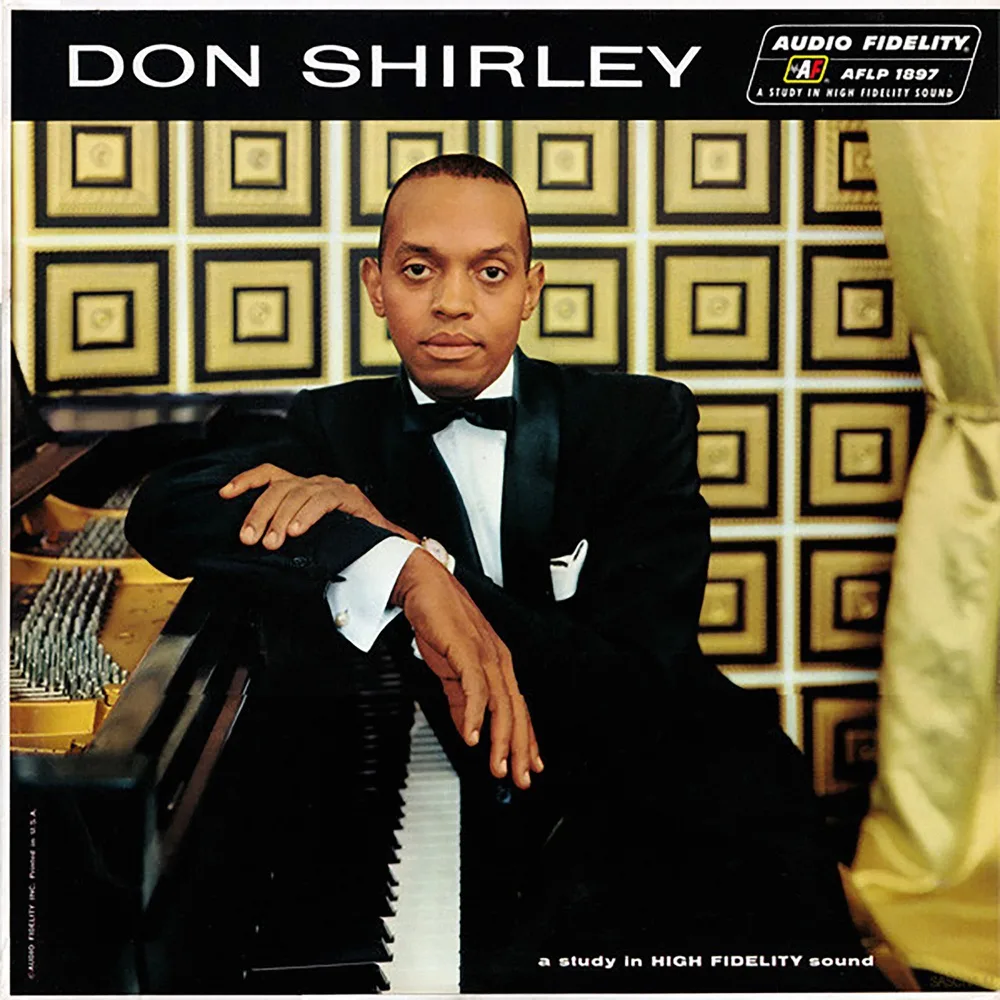
Don Shirley at the piano, on the cover of his album *Don Shirley* (Audio Fidelity AFLP 1897, 1959), also listed as *Piano*. Album cover art (not a CC-licensed artist photo), used as the only available image showing the artist. Copyright is held by the label and the cover photographer, credited on Discogs as Bob Witt. No Creative Commons or public-domain photograph of Don Shirley was located; Wikimedia Commons has no photo of him, and the only files there under his name show an unrelated person. The photo on his English Wikipedia article is a non-free press image. — Apple Music artwork for the album, 600 x 600 pixels, https://is1-ssl.mzstatic.com/image/thumb/Music124/v4/d3/20/7f/d3207f5b-67c3-9f38-f682-33547467f4bf/193483717562.jpg/600x600bb.jpg. Saved locally as portrait.jpg.

Donald Walbridge Shirley was born in Pensacola, Florida, on January 29, 1927, the son of Jamaican immigrants: Stella Gertrude Shirley, a teacher, and Edwin S. Shirley, an Episcopal priest. His record label later advertised him as Jamaican-born, which is why Kingston is sometimes given as his birthplace in older sources; it is wrong. He started piano at the age of two and was playing the organ by three. After brief stays at Virginia State University and Prairie View College he studied with Conrad Bernier and Thaddeus Jones at the Catholic University of America in Washington, D.C., and took a bachelor's degree in music there in 1953. Two honorary doctorates later made him "Dr. Shirley." Some early biographies say he studied at the Leningrad Conservatory; his cellist Jüri Täht and his nephew Edwin both deny it, and Edwin said the label invented European training to make a Black musician from a Black school acceptable to audiences who would otherwise have ignored him.
His concert career began young. In 1945, at 18, he played Tchaikovsky's B-flat minor piano concerto with the Boston Symphony Orchestra, and a year later the London Philharmonic Orchestra performed one of his compositions. He was a finalist for the Rhodes Scholarship in 1949 and was invited that year to play at the Port-au-Prince bicentennial exposition in Haiti, where the president and the archbishop asked for a second performance the following week. Discouraged by how few doors were open to Black classical pianists, he put the piano aside for a time, studied psychology at the University of Chicago and worked as a psychologist, with a grant to study the relationship between music and juvenile crime. In a small club he quietly tested how audiences responded to variations in sound, using students planted in the room to record their reactions.
Music pulled him back. At Arthur Fiedler's invitation he appeared with the Boston Pops in Chicago in June 1954, and in 1955 he performed with the NBC Symphony at the Carnegie Hall premiere of Duke Ellington's Piano Concerto. He also appeared on television on Arthur Godfrey and His Friends. His first album as a leader, Tonal Expressions, came out on Cadence Records in 1955 and reached No. 14 on Billboard's best-selling pop albums chart. The bassist Richard Davis, who played on the first Cadence LPs, moved to New York with Shirley in 1954 and worked with him until 1956. Through the late 1950s and 1960s Shirley recorded many albums for Cadence, setting standards, show tunes, folk songs and spirituals in a classical style with jazz harmony and rhythm. In 1961 his single "Water Boy" reached No. 40 on the Billboard Hot 100 and stayed on the chart for 14 weeks. At Basin Street East in New York, Duke Ellington heard him play, and the two became friends.
The group that carried his name for most of those years was the Don Shirley Trio, built around piano, cello and double bass. Discogs lists its regular members as Shirley, the bassist Ken Fricker and the Estonian cellist Jüri Täht. Shirley and Fricker had already recorded together on Don Shirley with Two Basses, which paired Fricker with a second bassist, Jimmy Bond. After the Cadence years he made albums for Columbia, including Water Boy (1965), The Gospel According to Don Shirley and Don Shirley in Concert (both 1969), and for Atlantic, where The Don Shirley Point of View appeared in 1972. In the concert hall he played Tchaikovsky's first piano concerto with the Detroit Symphony in late 1968, worked with the Chicago Symphony and the National Symphony Orchestra, and appeared as soloist at La Scala in Milan in a program of George Gershwin's music. As a composer he wrote organ symphonies, piano concertos, a cello concerto, three string quartets, a one-act opera, a symphonic poem based on James Joyce's Finnegans Wake, and a set of variations on Offenbach's Orpheus in the Underworld. Igor Stravinsky was among his admirers.
During the 1960s Shirley toured the United States, including the Deep South, believing his performances could change minds. For his first tour, in 1962, he hired Tony "Lip" Vallelonga, a New York nightclub bouncer, as driver and bodyguard. That story was dramatized in the 2018 film Green Book, named for the travel guide for Black motorists in the segregated United States, with Mahershala Ali playing Shirley. The film won the Academy Award for Best Picture at the 91st Academy Awards in 2019, and Ali won Best Supporting Actor. It also drew objections from Shirley's family. The film shows him estranged from his relatives and from other Black Americans; his surviving family says he was involved in the Civil Rights Movement, marched at Selma in 1965, knew other Black artists and leaders, and stayed in touch with his three brothers. His brother Maurice said Shirley never regarded Vallelonga as a friend but as an employee, his chauffeur. Against that, audio from the 2010 documentary Lost Bohemia has Shirley saying he trusted Vallelonga implicitly and that the two never had an employer and employee relationship, and Vallelonga's son Nick, the film's co-writer, said Shirley had approved what went into the script and had told him not to speak to other people. Jüri Täht was surprised to see a version of himself, a Russian character named Oleg, in a film about his employer, since he is an Estonian whose family had fled the Soviet Union. The author David Hajdu, who knew Shirley in the 1990s, wrote that the man he met was far more earthy, mercurial and exacting than the character on screen. According to Edwin Shirley III, Mahershala Ali phoned him to apologize and said he had not known there were close relatives he could have consulted.
Don Shirley passed away on April 6, 2013, at the age of 86, of heart disease.
Shirley's records set pop standards, show tunes, folk songs and spirituals in the language of a concert pianist: full chordal textures, classical-style variation and development, and a jazz sense of harmony and swing. The piano-cello-bass trio gave the music a chamber quality that few jazz groups of the period had, and the Cadence albums mix solo piano, duo with bass and trio. He sat between categories and the industry never settled where to file him. AllMusic lists him under mainstream jazz, cool and chamber jazz, with spirituals, gospel and standards as further styles. The closest jazz labels are Crossover Jazz, Chamber Jazz and Third Stream, but much of his career lay outside jazz: concerto performances with major orchestras, concert-hall compositions, religious and gospel records, and a pop chart single. The author David Hajdu, who knew him, described him as exacting and intolerant of imperfection in music.
- Tonal Expressions (1955, Cadence) - His first album as a leader and a Billboard top-15 pop album, with Richard Davis on bass.
- Don Shirley with Two Basses (1957, Cadence) - Piano with the bassists Ken Fricker and Jimmy Bond, the format that led to his piano, cello and bass trio.
- Don Shirley (1959, Audio Fidelity) - A piano album for the hi-fi label Audio Fidelity (AFLP 1897), also listed as Piano, with standards including "Satin Doll," "The Nearness of You" and "Happy Talk." Spotify - "Happy Talk" Listen
- Don Shirley Trio (1961, Cadence) - The piano, cello and bass trio on record. Spotify - "Blue Skies" Listen
- Water Boy (1965, Columbia) - The title song had been his No. 40 hit single four years earlier. Spotify - "Water Boy" Listen
- The Gospel According to Don Shirley (1969, Columbia) - Spirituals and gospel pieces, including "He's Got the Whole World in His Hands" and "Trilogy." Spotify - "Trilogy" Listen
- The Don Shirley Point of View (1972, Atlantic) - His Atlantic album, which includes "Bridge over Troubled Water." Spotify - "The Warning" Listen
- Green Book (Original Motion Picture Soundtrack) (2018, Milan) - Kris Bowers's score alongside period songs and one Shirley piano recording. Spotify - Green Book Listen
Don Shirley: Full Discography
Discogs artist: Don Shirley (606895) · Group: Don Shirley Trio (1179420) · Real name Donald Walbridge Shirley · Born January 29, 1927, Pensacola, Florida
Shirley led every album below; he is not known as a sideman. Years follow English Wikipedia's discography; some other listings date a few releases a year earlier or later. Track links are to individual songs rather than albums, and the other Listen cells are blank because a verified link was not found.
Leader: Albums
| Album | Year | Label | Personnel & Notes | Charts | Listen | Buy |
|---|---|---|---|---|---|---|
| Tonal Expressions | 1955 | Cadence (CLP 1001) | His first album as a leader. Richard Davis (bass); liner notes by Al "Jazzbo" Collins; includes "I Cover the Waterfront," "The Man I Love" and "My Funny Valentine" | No. 14 Billboard best-selling pop albums | — | — |
| Piano Perspectives | 1956 | Cadence (CLP 1004) | Richard Davis (bass); includes "Love for Sale," "How High the Moon" and "Lullaby of Birdland" | — | — | — |
| Orpheus in the Underworld | 1956 | Cadence (CLP-1009) | Piano variations on Offenbach's opera; the tracks are numbered bands rather than titled songs; cover photograph by Maurice Seymour | — | — | — |
| Improvisations by the Don Shirley Duo | 1956 | Cadence (CLP 1015) | Duo recording, listed as Don Shirley Duo and as Improvisations; also dated 1957 in some listings | — | — | — |
| Don Shirley with Two Basses | 1957 | Cadence (CLP 3008) | Ken Fricker and Jimmy Bond (bass); opens with a Porgy and Bess suite and includes "Body and Soul" and "September Song" | — | — | — |
| Don Shirley Solos | 1957 | Cadence (CLP 3007) | Solo piano; includes "Laura," "Little Girl Blue" and "April in Paris" | — | — | — |
| Don Shirley | 1959 | Audio Fidelity (AFLP 1897) | Also listed as Piano. Produced by Sidney Frey; cover photograph by Bob Witt; includes "Satin Doll," "The Nearness of You," "Blues for Basses" and "Happy Talk" | — | Spotify - "Happy Talk" | — |
| Don Shirley Plays Love Songs | 1960 | Cadence (CLP 3034) | Includes "Tenderly," "What Is There to Say" and "I'm in the Mood for Love" | — | — | — |
| Don Shirley Plays Gershwin | 1960 | Cadence (CLP 3032) | Richard Davis (bass) on all but the opening Porgy and Bess suite; includes "The Man I Love" and "They Can't Take That Away from Me" | — | — | — |
| Don Shirley Plays Standards | 1960 | Cadence (CLP 3033) | Includes "April in Paris," "Over the Rainbow" and "Little Girl Blue" | — | — | — |
| Don Shirley Plays Birdland Lullabies | 1960 | Cadence (CLP 3035) | Includes "Lullaby of Birdland," "Makin' Whoopee" and "How High the Moon" | — | — | — |
| Don Shirley Plays Show Tunes | 1960 | Cadence (CLP 3036) | Includes "My Funny Valentine," "Love for Sale" and "September Song" | — | — | — |
| Don Shirley Trio | 1961 | Cadence (CLP 3046) | The piano, cello and bass trio; regular members per Discogs were Shirley, Ken Fricker (bass) and Jüri Täht (cello). Includes "Water Boy," "Blue Skies" and "Tribute to Billie Holiday" | — | Spotify - "Blue Skies" | — |
| Piano Arrangements of Spirituals | 1962 | Cadence (CLP 3049) | Solo piano settings of spirituals including "Swing Low Sweet Chariot" and "Go Down Moses"; listed in some sources as Piano Arrangements of Famous Spirituals | — | — | — |
| Pianist Extraordinary | 1962 | Cadence (CLP 3048) | Includes "How Deep Is the Ocean," "Lady Be Good" and "Mack the Knife" | — | — | — |
| Don Shirley Presents Martha Flowers | 1962 | Cadence (CLP 3055) | Shirley accompanies the soprano Martha Flowers; side two is a Porgy and Bess suite | — | — | — |
| Drown in My Own Tears | 1962 | Cadence (CLP 25057) | Includes the title song, "Stand By Me," "Georgia on My Mind" and "At Last" | — | — | — |
| Water Boy | 1965 | Columbia (CL 2396 mono, CS 9196 stereo) | Credited to the Don Shirley Trio | — | Spotify - "Water Boy" (compilation copy) | — |
| The Gospel According to Don Shirley | 1969 | Columbia (CS 9723) | Spirituals and gospel pieces, including "Trilogy," "Blowin' in the Wind" and "He's Got the Whole World in His Hands" | — | Spotify - "Trilogy" | — |
| Don Shirley in Concert | 1969 | Columbia (CS 9684) | Credited to the Don Shirley Trio; listed as In Concert. Includes "Water Boy" and "Happy Talk" | — | — | — |
| The Don Shirley Point of View | 1972 | Atlantic (SD 1605) | Includes "The Warning," "Bridge over Troubled Water," "Alfie" and a Gershwin medley | — | Spotify - "The Warning" | — |
| Home with Donald Shirley | 2001 | label and catalog number not confirmed | Listed in Wikipedia's discography | — | — | — |
Compilations and reissues
| Release | Year | Label | Notes | Listen | Buy |
|---|---|---|---|---|---|
| Golden Classics | 1997 | Collectables | Compilation | — | — |
| Pianist Extraordinary / Piano Arrangements of Famous Spirituals | 1999 | Collectables | Two albums on two CDs | — | — |
| Solos / With Two Basses | 1999 | Collectables | Two albums on two CDs | — | — |
| Orpheus in the Underworld / Improvisations | 1999 | Collectables | Two albums on two CDs | — | — |
| Plays Birdland Lullabies / Plays Show Tunes | 2000 | Collectables | Two albums on two CDs | — | — |
| Don Shirley: Plays Love Songs / Trio | 1999 | Collectables | Two albums on two CDs | — | — |
| Water Boy + The Gospel According To | 2003 | Sony Music Custom Marketing Group | Two Columbia albums on one CD | — | — |
| Plays Gershwin / Plays Standards | 2005 | Collectables | Two albums on one CD | — | — |
| Don Shirley's Best | 2010 | Cadence | Compilation: includes "Water Boy," "Drown in My Own Tears," "Georgia on My Mind" and "Stand By Me" | Spotify - "Water Boy" | — |
| Concert Series, Volumes 1 to 7 | 1980 | Picc-A-Dilly | Seven LPs in a numbered series | — | — |
| The Best of Don Shirley | 2019 | label not confirmed | Compilation | — | — |
Singles
| Single | Year | Label | Notes |
|---|---|---|---|
| "Water Boy" / "Freedom (I'm on My Way)" | 1961 | Cadence (1392) | Reached No. 40 on the Billboard Hot 100 and stayed on the chart for 14 weeks |
| "Stand By Me" / "Amen" | 1962 | Cadence (1420) | Both songs also appear on Drown in My Own Tears |
Film
| Year | Project | Role | Notes |
|---|---|---|---|
| 2018 | Green Book (Original Motion Picture Soundtrack), Milan | Subject of the film; one Shirley piano recording on the album | Score by Kris Bowers; Spotify |
- Richard Davis - bassist on his first Cadence LPs, Tonal Expressions and Piano Perspectives; moved to New York with Shirley in 1954 and worked with him until 1956.
- Ken Fricker - bassist in the Don Shirley Trio and on Don Shirley with Two Basses.
- Jüri Täht - cellist in the Don Shirley Trio; the real-life counterpart of the character Oleg in Green Book.
- Jimmy Bond - second bassist on Don Shirley with Two Basses.
- Duke Ellington - friend of Shirley after hearing him at Basin Street East; Shirley played at the 1955 Carnegie Hall premiere of the Piano Concerto.
- Arthur Fiedler and the Boston Pops - invited Shirley to appear with the orchestra in Chicago in June 1954.
- Martha Flowers - the soprano on Don Shirley Presents Martha Flowers (1962).
- Tony Vallelonga - his driver and bodyguard on the 1962 tour; the other half of the story told in Green Book.
- Kris Bowers - composed the Green Book score, taught Mahershala Ali basic piano and stood in for close-ups of the hands at the keyboard.
- Mahershala Ali - played Shirley on screen and won an Oscar for the role.