 JAZZPROFILES lives in the music 3,006 Jazz Artists fully Profiled!
Chick Webb
Last updated November 8, 2026
Listen on Spotify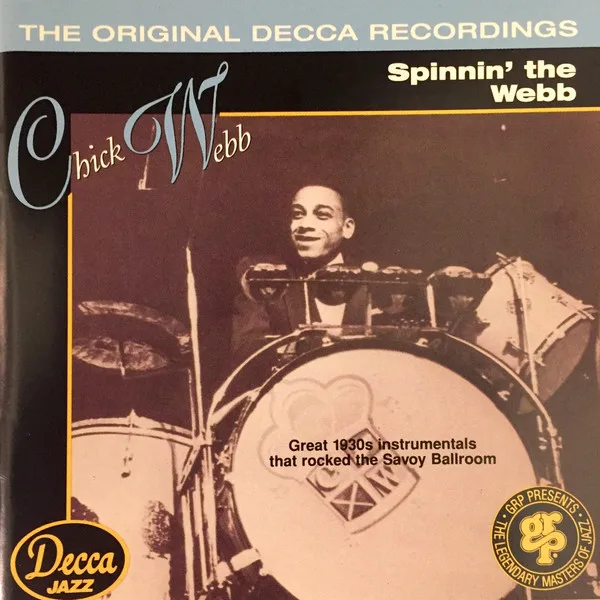
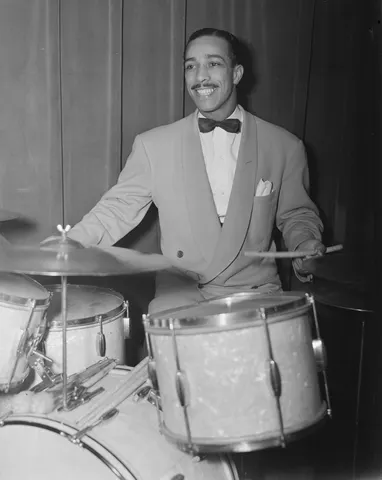
Chick Webb at his drum kit, as pictured on the cover of the compilation *Spinnin' the Webb: The Original Decca Recordings* (GRP / Decca Jazz, 1994) Album cover art (not a CC-licensed artist photo) — used as the only available image showing the artist — Discogs release page for the album cover — https://www.discogs.com/release/7685452
William Henry "Chick" Webb was born on February 10, 1905, in Baltimore, Maryland, the son of William H. and Marie Webb, with three sisters (reference works disagree about the year, and 1905 is the one most of them use). As an infant he fell down the stairs at home and crushed several vertebrae; the injury progressed into spinal tuberculosis (Pott's disease), which left him with a badly curved spine and short stature for life. A doctor suggested that playing an instrument might loosen his bones, he sold newspapers to save for a set of drums, and he was working as a professional by age 11. At 17 he moved to New York City, and by 1926 he was leading his own band in Harlem; the drummer Tommy Benford gave him lessons when he first arrived. Early members of the band included the alto saxophonists Benny Carter and Johnny Hodges, and Carter arranged and played on the orchestra's session of March 30, 1931, which produced "Soft and Sweet" and "Heebie Jeebies."
In 1931 the band became the house orchestra at the Savoy Ballroom on Lenox Avenue, and it stayed closely tied to that room through the rest of the decade. Webb could not read music; he memorized every arrangement and conducted from a platform at the center of the bandstand, playing a kit with custom pedals, goose-neck cymbal holders and a 28-inch bass drum. In 1934 the saxophonist and arranger Edgar Sampson joined and began supplying the band's signature pieces, among them "Stompin' at the Savoy" (recorded for Columbia on May 18, 1934, under the name Chick Webb's Savoy Orchestra, and a top-ten hit that year), "Don't Be That Way" and "Blue Lou." From that autumn the orchestra recorded for Decca. Its sections in the mid-1930s included trumpeters Taft Jordan and Mario Bauzá, trombonist Sandy Williams, reed players Pete Clark and Wayman Carver, pianist Tommy Fulford, and guitarist John Trueheart.
In 1935 Webb began featuring a teenaged Ella Fitzgerald as the band's vocalist, and her first U.S.-released record, "Love and Kisses," was cut with the orchestra on June 12, 1935. The band's Savoy reputation rested on its battles with rival orchestras: it faced Benny Goodman's orchestra there in 1937 and was declared the winner, and in 1938 it met the Count Basie band, a contest that was again scored for Webb but that musicians argued over for decades. On May 2, 1938, the orchestra recorded "A-Tisket, A-Tasket," Fitzgerald's reworking of a nursery rhyme with the arranger Van Alexander; it reached number one, stayed there for ten weeks of a nineteen-week chart run, and entered the Grammy Hall of Fame in 1986. The follow-up "I Found My Yellow Basket" (recorded October 6, 1938) reached number three. Late that year the band became the first Black band hired at the Park Central Hotel. The alto saxophonist and singer Louis Jordan, in the section from late 1936 into 1938, was another future bandleader to pass through.
Webb's health began to fail in November 1938, but he kept touring so that his musicians could stay employed, and he sometimes passed out from exhaustion after sets. He had a major operation at Johns Hopkins Hospital in Baltimore in 1939. His last recording session took place on April 21, 1939, and he passed away on June 16, 1939, in Baltimore, of tuberculosis of the spine. He was buried at Arbutus Memorial Park in Arbutus, Baltimore County. A benefit drew about 7,500 people to Baltimore on February 12, 1940, among them Fitzgerald, his widow Sally and the heavyweight champion Joe Louis. The orchestra was renamed Ella Fitzgerald and Her Famous Orchestra and kept working under her until it broke up in 1942.
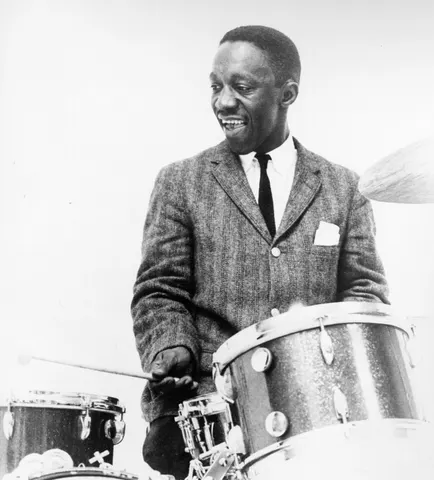
Webb was a small, frail man who played with unusual force, and his drumming was the engine of his orchestra: a hard-driving, precise swing built around a large bass drum and constant dance-floor pressure. The band had few star soloists, but its discipline, the arrangements of Edgar Sampson and later Van Alexander, and a rhythm section that stayed together for years made it a standard that other swing bands measured themselves against, and it regularly won its Savoy contests. Younger drummers named him as a model: Buddy Rich called him "the daddy of them all," Gene Krupa credited him with raising the profile of drummers and paving the way for drummer-led bands like his own, and Art Blakey and Duke Ellington both said he influenced their music. His thundering solos are often cited as the groundwork for Rich and Louie Bellson. He is a member of the Percussive Arts Society Hall of Fame, and Stephanie Stein Crease's 2023 biography Rhythm Man (Oxford University Press) is a recent biography.
- Stompin' at the Savoy (1934, Columbia) - Edgar Sampson's showpiece, recorded May 18, 1934 under the name Chick Webb's Savoy Orchestra; a top-ten hit and the band's calling card at the ballroom it names.
- Don't Be That Way (1934, Decca) - Another Sampson original from his first year with the band, coupled with "It's Over Because We're Through."
- (If You Can't Sing It) You'll Have to Swing It (1936, Decca) - A film-song swing number with Ella Fitzgerald, backed with "Vote for Mister Rhythm," from the period when her vocals made the band a record and radio draw.
- Clap Hands! Here Comes Charlie! (1937, Decca) - Recorded March 24, 1937, paired with "You Showed Me the Way," and a staple of his later repertoire.
- A-Tisket, A-Tasket (1938, Decca) - The Fitzgerald nursery-rhyme hit, recorded May 2, 1938 and issued with "Liza" on the other side; number one for ten weeks and a Grammy Hall of Fame recording.
- Undecided (1939, Decca) - Recorded February 17, 1939 with Fitzgerald, one of the last big sides before his final illness; the flip side is "In the Groove at the Grove."
- Spinnin' the Webb: The Original Decca Recordings (1994, GRP) - A one-disc survey of the Decca instrumentals and vocal hits, from "Dog Bottom" and "Don't Be That Way" onward. Spotify - Spinnin' The Webb Listen
- The Complete Chick Webb & Ella Fitzgerald Decca Sessions (1934-1941) (2013, Mosaic) - An eight-disc set of the orchestra's Decca dates and of Fitzgerald's own Savoy Eight and Famous Orchestra sessions, with session dates and full personnel.
Chick Webb: Full Discography
Discogs artist ID 294491 ("Chick Webb," born February 10, 1905, in Baltimore, Maryland, died June 16, 1939, in Baltimore) was read in full through Discogs data, along with the entries that hold his band credits: Chick Webb And His Orchestra (artist ID 342796, about 660 entries), Chick Webb And His Little Chicks (376385) and Chick Webb's Savoy Orchestra (3801988). Webb worked almost entirely as a bandleader and made his records as 78 rpm singles between 1931 and 1939; nearly everything on the long-playing and compact-disc side is a posthumous compilation of those sides, so there is no sideman table. The table below is a curated selection of 17 landmark releases rather than an exhaustive list: the principal 78s with their recording dates, then the compilations that matter most. Catalog numbers are those of the first or best-documented US pressing. Where sources disagree on a recording date, or no date could be confirmed, the Notes column says so. His vocalist from 1935, Ella Fitzgerald, also recorded under her own name with members of his orchestra; those Savoy Eight and Famous Orchestra sessions are covered in her discography.
As Leader / Co-Leader
| Album Title | Recording Date(s) | Release Date | Label | Catalog Number | Format(s) | Personnel | Role | Reissue History | Spotify | Buy | Notes |
|---|---|---|---|---|---|---|---|---|---|---|---|
| Soft and Sweet / Heebie Jeebies | March 30, 1931, New York | 1931 | Vocalion | 1607 | Shellac, 10", 78 RPM | Chick Webb (drums, leader), Benny Carter (alto saxophone, clarinet, arranger), Hilton Jefferson (alto saxophone, clarinet), Elmer Williams (tenor saxophone, clarinet), Louis Hunt, Shelton Hemphill, Louis Bacon (trumpets), Jimmy Harrison (trombone), Don Kirkpatrick (piano), John Trueheart (guitar), Elmer James (tuba) | Leader | Reissued on later compilations, including the 1992 Hep CD Rhythm Man (HEP CD 1023) | — | — | Personnel is that credited for the session in the 2013 Mosaic set. |
| Stompin' at the Savoy / Why Should I Beg for Love | May 18, 1934, New York | 1934 | Columbia | 2926-D | Shellac, 10", 78 RPM | Chick Webb (drums, leader) and his orchestra; Edgar Sampson composer and arranger | Leader (billed as Chick Webb's Savoy Orchestra) | Also issued on Vocalion 3246 (1936) as Chick Webb And His Orchestra; reissued on the 1967 Columbia LP The Immortal Chick Webb / Stompin' at the Savoy | — | — | Top-ten hit in 1934. Full session personnel not confirmed. |
| Don't Be That Way / It's Over Because We're Through | November 19, 1934, New York | 1934 | Decca | 483 | Shellac, 10", 78 RPM | Chick Webb (drums, leader), Mario Bauzá, Bobby Stark, Taft Jordan (trumpets), Sandy Williams, Claude Jones (trombones), Edgar Sampson, Pete Clark (alto saxophones), Wayman Carver (tenor saxophone, flute), Joe Steele (piano), John Trueheart (guitar), John Kirby (bass) | Leader | Reissued in the Chick Webb Memorial Album (Decca 138), on the 1994 GRP Spinnin' the Webb and in the 2013 Mosaic set | — | — | Date from Discogs and the 2006 Proper box set; the Mosaic set's notes give September 19, 1934. Personnel as credited in the Mosaic set for those 1934 sessions. |
| Love and Kisses / Are You Here to Stay? | June 12, 1935, New York | 1935 | Decca | 494 | Shellac, 10", 78 RPM | Chick Webb (drums, leader), Ella Fitzgerald (vocals), Mario Bauzá, Bobby Stark, Taft Jordan (trumpets), Sandy Williams, Fernando Arbello (trombones), Edgar Sampson, Pete Clark (alto saxophones), Wayman Carver (tenor saxophone), Joe Steele (piano), John Trueheart (guitar), John Kirby (bass) | Leader | Reissued in the 2013 Mosaic set and on many Ella Fitzgerald compilations | — | — | First U.S.-released recording of Fitzgerald. Personnel is that credited for the session in the Mosaic set. |
| (If You Can't Sing It) You'll Have to Swing It / Vote for Mister Rhythm | 1936, New York (exact date not confirmed) | 1936 | Decca | 1032 | Shellac, 10", 78 RPM | Chick Webb (drums, leader) and his orchestra with Ella Fitzgerald (vocals) | Leader | Reissued in the 2013 Mosaic set | — | — | Film songs: "You'll Have to Swing It" is from the Paramount picture Rhythm on the Range, "Vote for Mister Rhythm" from The Big Broadcast of 1937. |
| Clap Hands! Here Comes Charlie! / You Showed Me the Way | March 24, 1937, New York | 1937 | Decca | 1220 | Shellac, 10", 78 RPM | Chick Webb (drums, leader), Mario Bauzá, Bobby Stark, Taft Jordan (trumpets), Sandy Williams, Nat Story (trombones), Louis Jordan, Pete Clark (alto saxophones), Teddy McRae, Wayman Carver (tenor saxophones), Tommy Fulford (piano), John Trueheart (guitar), Beverly Peer (bass) | Leader | Reissued in the Chick Webb Memorial Album (Decca 138) and in the 2013 Mosaic set | — | — | Personnel is that credited for the March 24, 1937 session in the Mosaic set. |
| The Dipsy Doodle / Midnite in a Madhouse | December 17, 1937, New York | December 1937 | Decca | 1587 | Shellac, 10", 78 RPM | Chick Webb (drums, leader) and his orchestra | Leader | Reissued in the 2013 Mosaic set | — | — | Full session personnel not itemized here. |
| A-Tisket, A-Tasket / Liza (All the Clouds'll Roll Away) | May 2, 1938 ("A-Tisket, A-Tasket") and May 3, 1938 ("Liza"), Decca Studios, New York | June 1938 | Decca | 1840 | Shellac, 10", 78 RPM | Chick Webb (drums, leader), Ella Fitzgerald (vocals), Mario Bauzá, Taft Jordan, Bobby Stark (trumpets), Sandy Williams, Nat Story, George Matthews (trombones), Louis Jordan, Garvin Bushell (alto saxophones), Teddy McRae, Wayman Carver (tenor saxophones), Tommy Fulford (piano), Bobby Johnson (guitar), Beverly Peer (bass) | Leader | In the Chick Webb Memorial Album (Decca 138); reissued in the 2013 Mosaic set | — | — | Number one for ten weeks, 19 weeks on the chart; inducted into the Grammy Hall of Fame in 1986. Personnel per Discogs credits, which list the players as uncredited on the label. |
| I Found My Yellow Basket / Ella | October 6, 1938 ("I Found My Yellow Basket") and June 9, 1938 ("Ella"), New York | 1938 | Decca | 2148 | Shellac, 10", 78 RPM | Chick Webb (drums, leader), Ella Fitzgerald (vocals) with the orchestra | Leader | Reissued in the 2013 Mosaic set | — | — | Follow-up to "A-Tisket, A-Tasket"; full session personnel not itemized here. |
| Undecided / In the Groove at the Grove | February 17, 1939, Decca Studios, New York | 1939 | Decca | 2323 | Shellac, 10", 78 RPM | Chick Webb (drums, leader), Ella Fitzgerald (vocals) with the orchestra | Leader | Also in the Chick Webb Memorial Album (Decca 138); reissued in the 2013 Mosaic set | — | — | One of his last sessions; his final recording date was April 21, 1939. |
| Chick Webb Memorial Album | Not confirmed (compiles 1934 to 1939 Decca sides) | Not confirmed | Decca | 138 | Shellac, 10", 78 RPM, album set | Chick Webb and his orchestra, with Ella Fitzgerald | Leader | Eight sides including "Don't Be That Way," "Clap Hands! Here Comes Charlie," "A-Tisket, A-Tasket" and "Undecided" | — | — | Posthumous memorial set; the Discogs entry carries no release year. |
| The Immortal Chick Webb / Stompin' at the Savoy | December 20, 1933 to 1936 (sides recorded on several dates) | 1967 | Columbia (Jazz Archive Series) | CL 2639 | Vinyl, LP, Compilation, Mono | Chick Webb and his orchestra, with Taft Jordan, Ella Fitzgerald, Sandy Williams, Elmer Williams, Pete Clark and Teddy Wilson credited on the sleeve, arrangements by Edgar Sampson | Leader | Compiles sides first issued on Columbia, Okeh, Melotone and Brunswick 78s | — | — | Includes the original 1934 "Stompin' at the Savoy." |
| Rhythm Man | 1931 to 1934 | 1992 | Hep Records | HEP CD 1023 | CD, Compilation | Chick Webb and his orchestra | Leader | Not applicable | — | — | Presented by the label as Webb's complete recorded work for 1931 to 1934. |
| Spinnin' the Webb: The Original Decca Recordings | Not itemized (sides recorded on several dates from 1929) | 1994 | GRP (Decca Jazz) | GRD-635 | CD, Compilation | Chick Webb and his orchestra | Leader | Not applicable | Spotify - Spinnin' The Webb | — | One-disc survey of the Decca instrumentals; begins with the 1929 "Dog Bottom" and "Jungle Mamma." |
| Swingsation: Ella Fitzgerald with Chick Webb | 1934 to 1939 | 1998 | GRP | GRD-9921 | CD, Compilation | Chick Webb and his orchestra with Ella Fitzgerald | Leader (with Ella Fitzgerald) | Reissued digitally on November 23, 2018 | Spotify - Swingsation: Ella Fitzgerald With Chick Webb | — | The Spotify listing is the 2018 digital edition. |
| Stomping at the Savoy | December 20, 1933 to 1939 (radio and studio dates) | 2006 | Proper Records | PROPERBOX 97 | CD, 4 discs, Compilation, Box set | Chick Webb and his orchestra with Ella Fitzgerald | Leader | Not applicable | — | — | Four-disc survey with a dated session list. |
| The Complete Chick Webb & Ella Fitzgerald Decca Sessions (1934-1941) | June 14, 1929 to October 28, 1941, mostly New York | October 8, 2013 | Mosaic Records | MD8-252 | CD, 8 discs, Box set, Limited edition (5,000 numbered sets) | Chick Webb (drums, celesta, bells) and his orchestra; Ella Fitzgerald (vocals); later sessions under Fitzgerald's name | Leader (with Ella Fitzgerald) | Not applicable | — | — | 187 tracks with recording dates and personnel; includes two 1929 Jungle Band sides on which Webb plays drums. Webb's last session in it is April 21, 1939. |
- Ella Fitzgerald - vocalist with the orchestra from 1935; "A-Tisket, A-Tasket" (1938) was their biggest hit, and she led the band after his death until 1942.
- Edgar Sampson - alto saxophonist and arranger who joined in 1934 and wrote "Stompin' at the Savoy," "Don't Be That Way" and "Blue Lou" for the band; he left in 1936.
- Van Alexander - arranger who sold arrangements to Webb in the mid-1930s and worked with Fitzgerald on "A-Tisket, A-Tasket."
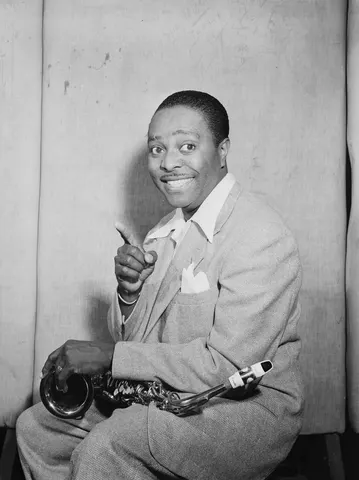
- Louis Jordan - alto saxophonist and occasional vocalist in the orchestra from late 1936 to 1938, before forming his own group.
- Benny Carter, Johnny Hodges - alto saxophonists listed among the early members; Carter arranged and played on the March 30, 1931 session.
- Taft Jordan, Mario Bauzá, Bobby Stark - the trumpet section on the 1934 to 1938 Decca dates, with Jordan also singing on some sides.
- Sandy Williams, Nat Story, George Matthews - trombonists across the Decca years.
- Wayman Carver, Teddy McRae, Pete Clark, Garvin Bushell, Hilton Jefferson - reed players on various dates between 1931 and 1939; Carver also played flute.
- John Trueheart, Tommy Fulford, Beverly Peer, Bobby Johnson - guitar, piano, bass and guitar, the core of the rhythm section behind his drumming.
- Charles Linton - male vocalist on several mid-1930s sides alongside Fitzgerald.
- Cab Calloway - who grew up in Baltimore and, according to his own profile, was informally mentored by Webb in his early years.
- Art Blakey - drummer who, according to his own profile, served for a stretch as Webb's valet while studying his technique.
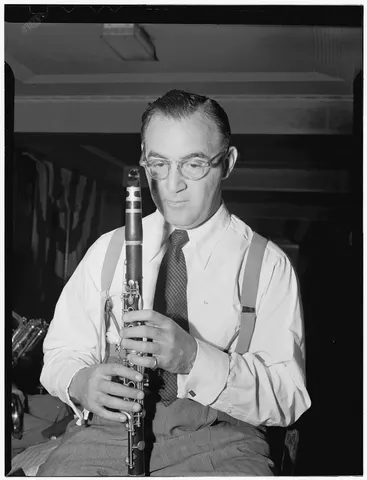
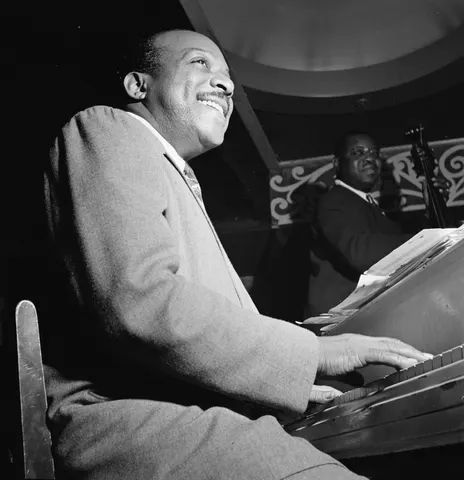
- Benny Goodman, Count Basie - rival bandleaders in the Savoy contests of 1937 and 1938.
- Duke Ellington - fellow bandleader who said Webb influenced his music.
- Skippy Williams - tenor saxophonist whose own profile lists Webb among the leaders he worked with, though no dated sessions are documented.
More Big Band Artists
See all 371 Big Band artists →More American Jazz Artists
See all 876 American artists →- Wikipedia: Chick Webb
- Britannica: Chick Webb
- Wikipedia: Savoy Ballroom
- Wikipedia: Stompin' at the Savoy
- Wikipedia: A-Tisket, A-Tasket
- Wikipedia: Edgar Sampson
- Wikipedia: Van Alexander
- Percussive Arts Society Hall of Fame: William "Chick" Webb
- Discogs: Chick Webb (artist 294491)
- Discogs: Chick Webb And His Orchestra (artist 342796)
- Discogs: The Complete Chick Webb & Ella Fitzgerald Decca Sessions (Mosaic MD8-252)
- Discogs: A-Tisket A-Tasket / Liza (Decca 1840)
- MusicBrainz: Chick Webb
- JazzProfiles.com: Louis Jordan
- JazzProfiles.com: Cab Calloway
- JazzProfiles.com: Art Blakey
- JazzProfiles.com: Skippy Williams
- JazzProfiles.com: J.C. Heard