 JAZZPROFILES lives in the music 2,303 Jazz Artists fully Profiled!
Louis Jordan
Last updated November 6, 2026
Listen on Spotify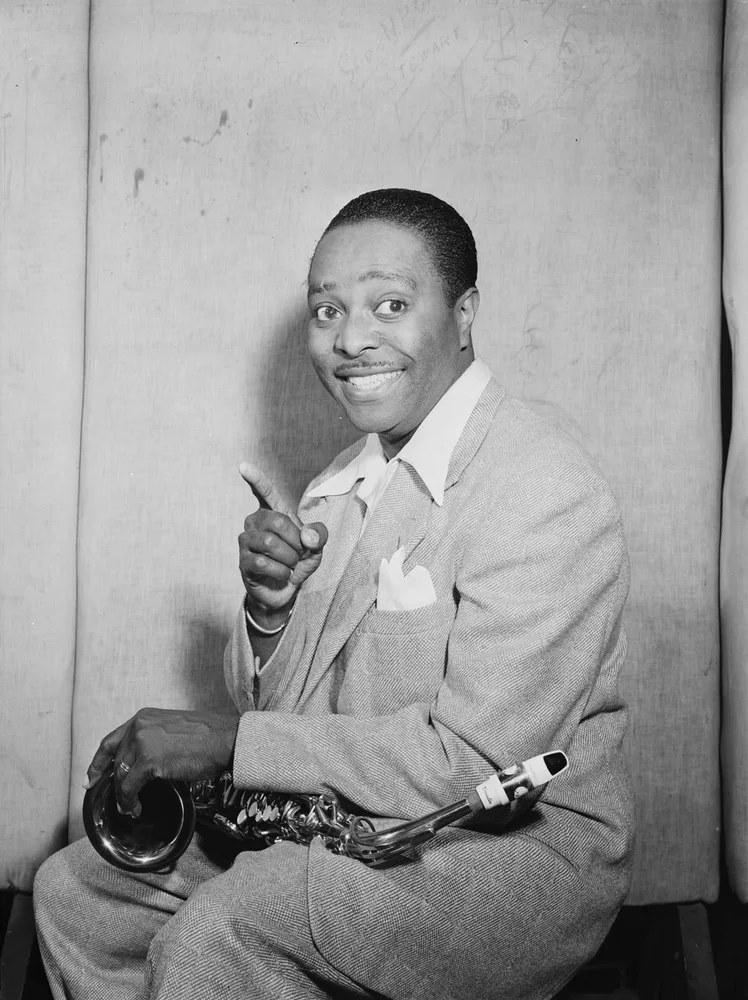
Louis Jordan with his alto saxophone, Paramount Theater (probably), New York, circa July 1946 Public domain. The photographer, William P. Gottlieb, wished his collection at the Library of Congress to enter the public domain, which it did on February 16, 2010. — Wikimedia Commons - https://commons.wikimedia.org/wiki/File:Louis_Jordan,_New_York,_N.Y.,_ca._July_1946_(William_P._Gottlieb_04721).jpg - photo by William P. Gottlieb, Library of Congress Music Division, digital ID gottlieb.04721

Louis Thomas Jordan was born in Brinkley, Arkansas, on July 8, 1908. His father, James Aaron Jordan, taught music and led the Brinkley Brass Band and the Rabbit Foot Minstrels. Louis started on clarinet at seven, moved on to saxophone, and in his teens joined the Rabbit Foot Minstrels himself before studying music at Arkansas Baptist College. By the late 1920s he was working professionally, and in the early 1930s he was playing in Philadelphia and New York with the trumpeter Charlie Gaines. On December 21, 1932, Gaines's group, with Jordan on alto saxophone and clarinet, backed Louis Armstrong on a Victor date in Camden, New Jersey, that produced a medley of Armstrong's hits. In 1934 he recorded with Clarence Williams, and he spent time in Stuff Smith's orchestra.
From late 1936 until mid-1938 he played alto saxophone and sang in Chick Webb's orchestra, the Harlem band that spent much of that period accompanying Ella Fitzgerald. Jordan was mainly a section player there, with little solo space, though he sang on a few Decca sides, including "Rusty Hinge" (1937). When he left Webb in 1938 he had a different idea in mind: a small group that kept the swing band's drive and added entertainment. He began with a nine-piece band, cut it to a sextet for a residency at the Elks Rendezvous club on Lenox Avenue in Harlem, and made his first Decca recordings in December 1938 under the Elks Rendezvous Band name. By 1939 he was billed as Louis Jordan and His Tympany Five, a name he kept no matter how many players were on the stand.
The breakthrough came in 1942, after Jordan and the band moved to Los Angeles and he began making Soundies, the three-minute films shown on coin-operated movie jukeboxes. Between 1942 and 1951 he placed more than fifty records on the rhythm and blues chart, and eighteen of them reached No. 1. The run included "What's the Use of Getting Sober," "Ration Blues," "G.I. Jive" (also a No. 1 pop record in 1944), "Is You Is or Is You Ain't (Ma' Baby)," "Caldonia," "Buzz Me," "Choo Choo Ch'Boogie," "Ain't Nobody Here but Us Chickens," "Let the Good Times Roll," "Beans and Corn Bread," "Saturday Night Fish Fry" and "Blue Light Boogie." Many of his Decca records were produced by Milt Gabler. He also recorded heavily for Armed Forces Radio and the V-Disc program during the war, appeared in 14 Soundies, played a specialty spot in the Hollywood features Follow the Boys and Swing Parade of 1946, and starred in the musical short Caldonia (1945) and three feature films built around his band: Beware (1946), Reet, Petite and Gone (1947) and Look-Out Sister (1947).
Decca paired him with some of its biggest stars. "My Baby Said Yes (Yip Yip de Hootie)" and "Your Socks Don't Match" were duets with Bing Crosby, recorded in Los Angeles on July 26, 1944. With Ella Fitzgerald he made "Stone Cold Dead in the Market" (recorded October 1945, a No. 1 R&B record in 1946), "Baby, It's Cold Outside" (1949) and "I'll Never Be Free" (1950). In August 1950 he recorded "Life Is So Peculiar" and "You Rascal You" with Louis Armstrong. A big band he assembled in 1951 lost money and was gone by the end of the year, and in 1952 he went back to a Tympany Five.
The hits stopped as rock and roll took over the market. After his Decca contract ended in 1954 he recorded for Aladdin, then for RCA's X and Vik labels in 1955, then for Mercury. The Mercury album Somebody Up There Digs Me (recorded October 22 and 23, 1956, in New York) re-cut his hits with arrangements by Quincy Jones and a studio band that included Budd Johnson, Sam Taylor, Jimmy Cleveland, Ernie Royal and the guitarist Mickey Baker. Man, We're Wailin' followed in 1958. In 1962 he toured England with Chris Barber's band, and the two recorded together. In the early 1960s he recorded for Ray Charles's Tangerine label, including the 1964 album Hallelujah... Louis Jordan Is Back!, and on November 6, 1973, he recorded I Believe in Music in Paris for the French Black & Blue label with a quintet. He passed away from a heart attack in Los Angeles on February 4, 1975, and is buried at Mt. Olive Catholic Cemetery in St. Louis.
Recognition came mostly after his death. He was inducted into the Blues Hall of Fame in 1983 and the Rock and Roll Hall of Fame in 1987, where he is described as an early influence. The Recording Academy gave him a Lifetime Achievement Award in 2018, and several of his records are in the Grammy Hall of Fame. Five Guys Named Moe, a stage musical built on his songs, opened in London's West End in 1990, won the Laurence Olivier Award for Best Entertainment, and reached Broadway in 1992. In 1999 B.B. King recorded an entire album of his songs, Let the Good Times Roll: The Music of Louis Jordan.
Most of what made Jordan famous was not jazz in the narrow sense, and it is stated plainly here. His Decca hits were jump blues and rhythm and blues, comic story songs about food, drink, money and women, delivered in a shouted, call-and-response style for a broad audience of Black and white listeners, and many of the later Aladdin, X, Vik and Mercury sides chased the rock and roll market. He was also a novelty act and a film personality, and the Tympany Five's records were built around his vocals and humor as much as around the band.
The jazz side is documented and real. He came up as a swing-era reed player, worked in Chick Webb's band, and recorded with Louis Armstrong and Ella Fitzgerald. His small group combined riffs in the manner of Count Basie's band with a boogie-woogie shuffle, with short, hot solos on alto saxophone, an electric guitar added in 1945, and occasional organ from the pianist in the rhythm section. The writer Scott Yanow calls him essentially a swing stylist rather than a honking R&B saxophonist, and Chris Barber, who toured with him in 1962, said history had boxed Jordan in as a comedy vocalist when he was a superb singer and an alto player who seemed to sing and play at the same moment.
His influence ran in two directions. Chuck Berry said he modeled his approach on Jordan's, and Bill Haley, Little Richard and James Brown are among others who pointed to him. Ray Charles and B.B. King recorded his material and acknowledged him as a model. Among jazz players, Sonny Rollins took up the alto saxophone at eleven after hearing him, and Hank Crawford named him among his early models.
- Let the Good Times Roll: The Anthology 1938-1953 (1999, MCA/Decca) - A two-disc survey of his Decca years, from the first Elks Rendezvous sides to the early 1950s. Spotify - The Anthology 1938-1953 Listen
- "Is You Is or Is You Ain't (Ma' Baby)" (1944, Decca 8659) - His signature wartime record, a hit on the R&B, pop and country charts at once, which he also performed in Follow the Boys.
- "Caldonia" (1945, Decca 8670) - A No. 1 R&B record and a pop top ten, and the title of the 1945 short film that launched his feature-film series.
- "Choo Choo Ch'Boogie" (1946, Decca 23610) - A No. 1 R&B hit and the best known of his shuffle-rhythm story songs.
- "Stone Cold Dead in the Market (He Had It Coming)" with Ella Fitzgerald (1946, Decca 23546) - A calypso-flavored duet that went to No. 1 on the R&B chart and No. 7 on the pop chart.
- "Saturday Night Fish Fry" (1949 to 1950, Decca 24725) - A two-part, two-sided hit with an early electric guitar riff, cited by the Rock and Roll Hall of Fame as an early example of rap and possibly the first rock and roll record.
- Somebody Up There Digs Me (1957, Mercury) - His hits re-cut in 1956 with Quincy Jones arrangements and a New York jazz and R&B studio band. Spotify - Somebody Up There Digs Me Listen
- Man, We're Wailin' (1958, Mercury) - A small-band date with organ and guitar that includes "The Jamf," which AllMusic singles out as a showcase for his alto playing. Spotify - Man, We're Wailin' Listen
Louis Jordan: Full Discography
Discogs artist: Louis Jordan (253475), with a second Discogs entry for his band, Louis Jordan and His Tympany Five (320597) · Born July 8, 1908, Brinkley, Arkansas
Jordan was a singles artist. His career peaked in the era of the 78 rpm record, when each release carried two sides and the long-playing album had not yet taken over, so his original albums are few, and most of them date from after his Decca years. This file covers his original albums, the Decca singles that reached the Billboard charts, the main reissues and collections, his stage-musical legacy, films, and a selection of his work as a sideman. It is selective, not exhaustive: Wikipedia lists about 125 singles between 1939 and 1968.
Leader: Albums
| Album | Year | Label | Personnel & Notes | Charts | Listen | Buy |
|---|---|---|---|---|---|---|
| Somebody Up There Digs Me | 1957 | Mercury (MG 20242) | Recorded October 22 and 23, 1956, in New York. New arrangements of his Decca hits by Quincy Jones. Jordan (alto saxophone, vocals), Budd Johnson (tenor and baritone saxophones), Sam Taylor (tenor saxophone), Jimmy Cleveland (trombone), Ernie Royal (trumpet), Mickey Baker (guitar), Ernie Hayes (piano), Wendell Marshall (bass), Charlie Persip (drums). Includes "Caldonia," "Choo Choo Ch'Boogie" and "Let the Good Times Roll." | Spotify | — | |
| Man, We're Wailin' | 1958 | Mercury (MG 20331) | Jordan with a small band: Irving Ashby (guitar), Jackie Davis (electric organ), Billy Hadnott (bass), Marvin Oliver (drums), Austin Powell (saxophone), Dottie Smith (vocals). Includes "Saturday Night Fish Fry," "The Nearness of You," "Sweet Lorraine" and "The Jamf." | Spotify | — | |
| Hallelujah... Louis Jordan Is Back! | 1964 | Tangerine (TRC-1503) | His album for Ray Charles's label. Includes "Hardhead," "What'd I Say," "Cole Slaw," "Don't Send Me Flowers When I'm in the Graveyard" and "You're My Mule." Also issued in the United Kingdom on His Master's Voice (CLP 1809). | — | — | |
| One Sided Love, Then Sakatumi | 1968 | Pzazz (LP 321) | An 11-track album for a small label, issued late in his recording career. | — | — | |
| I Believe in Music | 1973 | Black & Blue (33.059) | Recorded November 6, 1973, at Studio Barclay in Paris. Jordan (alto saxophone, vocals), Duke Burrell (piano), Irv Cox (tenor saxophone), John Duke (bass), Archie Taylor (drums). Remakes of "Caldonia," "Is You Is or Is You Ain't My Baby" and "Saturday Night Fish Fry," plus the Mac Davis title song. Reissued on CD (Black & Blue BB 876, 1996). | — | — | |
| Live Jive | 1994 | A Touch of Magic (4) | A live album, listed by Wikipedia as a 1994 release. | — | — |
With Chris Barber
Recorded during Jordan's 1962 tour of Britain and issued later.
| Album | Year | Label | Personnel & Notes | Charts | Listen | Buy |
|---|---|---|---|---|---|---|
| The Best of Both Worlds (Chris Barber's Jazz Band with Louis Jordan and Edmond Hall) | 1964 | World Record Club (T 368) | Jordan sings on "I'm Gonna Move to the Outskirts of Town," "Dardanella," "No Chance Blues" and "Wrap Your Troubles in Dreams." Barber (trombone), Pat Halcox (trumpet), Ian Wheeler (clarinet), Edmond Hall (clarinet on "Dardanella," "There'll Be Some Changes Made" and "Jamaica March"), Eddie Smith (banjo), Dick Smith (bass), Graham Burbidge (drums). | — | — | |
| Louis Jordan Swings! (Louis Jordan with the Chris Barber Band) | 1976 | Black Lion (BLP 30175) | Recorded 1962. Jordan on alto saxophone and vocals on nine of the eleven tracks, with Barber, Halcox, Wheeler, Smith, Smith and Burbidge. Includes "Black and Tan Fantasy," "Jazz Lips" and "Back Home Again in Indiana." | — | — |
Decca singles that reached the charts
Peak positions on the Billboard rhythm and blues, pop and country charts, as listed by Wikipedia. Each Decca number carries two sides, and a side that did not chart on its own is not listed. Most of these recordings are collected on the 1999 anthology, on Spotify.
| Year | Title | Label and number | R&B | Pop | Country | Notes |
|---|---|---|---|---|---|---|
| 1942 | "I'm Gonna Leave You on the Outskirts of Town" | Decca 8638 | 3 | |||
| 1942 | "What's the Use of Getting Sober (When You're Gonna Get Drunk Again)" | Decca 8645 | 1 | |||
| 1943 | "The Chicks I Pick Are Slender and Tender and Tall" | Decca 8645 | 10 | |||
| 1943 | "Five Guys Named Moe" | Decca 8653 | 3 | |||
| 1943 | "That'll Just 'Bout Knock Me Out" | Decca 8653 | 8 | |||
| 1943 | "Ration Blues" | Decca 8654 | 1 | 11 | 1 | |
| 1944 | "Deacon Jones" | Decca 8654 | 7 | |||
| 1944 | "G.I. Jive" | Decca 8659 | 1 | 1 | ||
| 1944 | "Is You Is or Is You Ain't (Ma' Baby)" | Decca 8659 | 3 | 2 | 1 | |
| 1945 | "Mop! Mop!" | Decca 8668 | 1 | |||
| 1945 | "You Can't Get That No More" | Decca 8668 | 2 | 11 | ||
| 1945 | "Caldonia" | Decca 8670 | 1 | 6 | ||
| 1945 | "Somebody Done Changed the Lock on My Door" | Decca 8670 | 3 | |||
| 1945 | "My Baby Said Yes (Yip, Yip de Hootie)" | Decca 23417 | 14 | Duet with Bing Crosby, billed to Crosby and Jordan | ||
| 1946 | "Buzz Me" | Decca 18734 | 1 | 9 | ||
| 1946 | "Don't Worry 'Bout That Mule" | Decca 18734 | 1 | |||
| 1946 | "Salt Pork, West Virginia" | Decca 18762 | 2 | |||
| 1946 | "Reconversion Blues" | Decca 18762 | 2 | |||
| 1946 | "Beware" | Decca 18818 | 2 | 20 | ||
| 1946 | "Don't Let the Sun Catch You Cryin'" | Decca 18818 | 3 | |||
| 1946 | "Stone Cold Dead in the Market (He Had It Coming)" | Decca 23546 | 1 | 7 | Duet with Ella Fitzgerald; the A side | |
| 1946 | "Petootie Pie" | Decca 23546 | 3 | Duet with Ella Fitzgerald; the B side | ||
| 1946 | "Choo Choo Ch'Boogie" | Decca 23610 | 1 | 7 | ||
| 1946 | "That Chick's Too Young to Fry" | Decca 23610 | 3 | |||
| 1946 | "Ain't That Just Like a Woman (They'll Do It Every Time)" | Decca 23669 | 1 | 17 | ||
| 1946 | "Ain't Nobody Here but Us Chickens" | Decca 23741 | 1 | 6 | ||
| 1946 | "Let the Good Times Roll" | Decca 23741 | 2 | |||
| 1947 | "Texas and Pacific" | Decca 23810 | 1 | 20 | ||
| 1947 | "I Like 'Em Fat Like That" | Decca 23810 | 5 | |||
| 1947 | "Open the Door, Richard!" | Decca 23841 | 2 | 6 | ||
| 1947 | "Jack, You're Dead" | Decca 23901 | 1 | 21 | ||
| 1947 | "I Know What You're Puttin' Down" | Decca 23901 | 3 | |||
| 1947 | "Boogie Woogie Blue Plate" | Decca 24104 | 1 | 21 | ||
| 1947 | "Look Out" | Decca 24155 | 5 | |||
| 1947 | "Early in the Mornin'" | Decca 24155 | 3 | |||
| 1948 | "Barnyard Boogie" | Decca 24300 | 2 | |||
| 1948 | "How Long Must I Wait for You" | Decca 24300 | 9 | |||
| 1948 | "Reet, Petite and Gone" | Decca 24381 | 4 | |||
| 1948 | "Run Joe" | Decca 24448 | 1 | 23 | ||
| 1948 | "All for the Love of Lil" | Decca 24448 | 13 | |||
| 1948 | "Don't Burn the Candle at Both Ends" | Decca 24483 | 4 | |||
| 1948 | "We Can't Agree" | Decca 24483 | 14 | |||
| 1948 | "Daddy-O" | Decca 24502 | 7 | Billed with the singer Martha Davis | ||
| 1948 | "Pettin' and Pokin'" | Decca 24527 | 5 | |||
| 1949 | "Roamin' Blues" | Decca 24571 | 10 | |||
| 1949 | "You Broke Your Promise" | Decca 24587 | 3 | |||
| 1949 | "Cole Slaw (Sorghum Switch)" | Decca 24633 | 7 | |||
| 1949 | "Every Man to His Own Profession" | Decca 24633 | 10 | |||
| 1949 | "Baby, It's Cold Outside" | Decca 24644 | 6 | 9 | Duet with Ella Fitzgerald | |
| 1949 | "Beans and Corn Bread" | Decca 24673 | 1 | |||
| 1949/1950 | "Saturday Night Fish Fry (Pts. 1 & 2)" | Decca 24725 | 1 | 21 | ||
| 1950 | "School Days" | Decca 24815 | 5 | |||
| 1950 | "Blue Light Boogie (Pts. 1 & 2)" | Decca 27114 | 1 | |||
| 1950 | "I'll Never Be Free" | Decca 27200 | 7 | Duet with Ella Fitzgerald | ||
| 1950 | "Tamburitza Boogie" | Decca 27203 | 10 | |||
| 1951 | "Lemonade" | Decca 27324 | 6 | |||
| 1951 | "Tear Drops from My Eyes" | Decca 27428 | 4 | |||
| 1951 | "Weak Minded Blues" | Decca 27547 | 5 | |||
| 1963 | "Hardhead" | Tangerine 930 | 128 | Peaked below the Hot 100; Tangerine was Ray Charles's label |
Collections and reissues (selected)
| Title | Year | Label | Notes | Listen | Buy |
|---|---|---|---|---|---|
| The Best of Louis Jordan | 1975 | MCA (MCA2-4079) | Two-LP survey of the Decca hits; CD reissue in 1989. | — | — |
| Five Guys Named Moe (Original Decca Recordings, Vol. 2) | 1992 | MCA (MCAD-10503) | 18 tracks. | — | — |
| Let the Good Times Roll: The Complete Decca Recordings 1938-1954 | 1992 | Bear Family (BCD 15557) | Nine-disc box set, 215 tracks. | — | — |
| One Guy Named Louis: The Complete Aladdin Sessions | 1992 | Capitol Jazz (CDP 7 96804 2) | The 21 sides he recorded for Aladdin in 1954. | — | — |
| Louis Jordan on Film 1942-1948 | 1996 | Krazy Kat (KKCD-17) | Soundtrack material from his films and Soundies. | — | — |
| Let the Good Times Roll: The Anthology 1938-1953 | 1999 | MCA/Decca (2-11907) | Two discs, 46 tracks, from the Elks Rendezvous sides to the early 1950s. | Spotify | — |
| Jivin' with Jordan | 2002 | Proper (PROPERBOX 47) | Four-CD set, 106 tracks. | — | — |
| Number Ones | 2005 | Geffen / Universal (B0002789-02) | 18 tracks. | — | — |
| The Aladdin, "X" and Vik Recordings 1953-1955 | 2006 | Rev-Ola (CRBAND-2) | His Aladdin, X and Vik sides. | — | — |
| Roc Doc! Louis Jordan on Mercury 1956-1957 | 2008 | Rev-Ola (CRREV-244) | The Mercury remakes and singles. | — | — |
| The Rock 'n' Roll Years 1955-58 | 2011 | Jasmine (JASCD-151) | 57 tracks from the X, Vik and Mercury period. | — | — |
Stage musical
| Title | Year | Label | Notes | Listen | Buy |
|---|---|---|---|---|---|
| Five Guys Named Moe (Original London Cast Recording) | 1991 | First Night (88561-1104-2) | A recording of the stage musical built on Jordan's songs, performed by the cast, not by Jordan. The show opened in London in 1990, won the Laurence Olivier Award for Best Entertainment, and reached Broadway in 1992. | Spotify | — |
Films
Jordan appeared in 14 Soundies from 1942 onward, along with the following films.
| Year | Film | Notes |
|---|---|---|
| 1944 | Follow the Boys | Specialty spot in the Hollywood wartime revue. |
| 1944 | Meet Miss Bobby Socks | The Tympany Five perform "Deacon Jones." |
| 1945 | Caldonia | Musical short; its success led to the Astor Pictures features. |
| 1946 | Beware | Feature film starring Jordan and his band. |
| 1946 | Swing Parade of 1946 | Specialty spot in a Hollywood feature. |
| 1947 | Reet, Petite and Gone | Feature film starring Jordan and his band. |
| 1947 | Look-Out Sister | Feature film starring Jordan and his band. |
Sideman and guest credits (selected)
| Year | Project (Leader) | Title | Label | Catalog | Role | Notes |
|---|---|---|---|---|---|---|
| 1932 | Louis Armstrong, backed by Charlie Gaines's group | Medley of Armstrong hits (two parts) | Victor | — | Alto saxophone, clarinet | Recorded in Camden, New Jersey, on December 21, 1932. Reissued on 1932-1933 (Classics 529) and High Society 1932-1933 (Joker SM 3752). |
| 1934 | Clarence Williams and His Orchestra | Including "I Can't Dance (I've Got Ants in My Pants)" | — | — | Band member; one of three singers on that title | Two sessions in 1934. |
| 1937 | Chick Webb and His Orchestra | "Rusty Hinge" / "Cryin' Mood" | Decca | 1273 | Vocals on "Rusty Hinge" | From his 1936 to 1938 stay in the Webb band. |
| 1937 | Chick Webb and His Orchestra, with Ella Fitzgerald | "There's Frost on the Moon" / "Love Marches On" | Decca, reissued on Brunswick | Decca 1114; Brunswick 02381 | Alto saxophone (uncredited) | "There's Frost on the Moon" was recorded on January 15, 1937, in New York. |
The Discogs entry for the Jungle Band, a 1929 pickup group, also lists Jordan among its members.
Tributes
B.B. King recorded Let the Good Times Roll: The Music of Louis Jordan in 1999, with Hank Crawford, David "Fathead" Newman, Dr. John, Earl Palmer and Marcus Belgrave. Jordan does not appear on it.
- Chick Webb - drummer and bandleader whose orchestra Jordan joined from late 1936 to 1938 as alto saxophonist and occasional singer, working alongside Ella Fitzgerald.
- Ella Fitzgerald - Webb band colleague and Decca duet partner on "Stone Cold Dead in the Market" (1946), "Baby, It's Cold Outside" (1949) and "I'll Never Be Free" (1950). The October 1945 "Stone Cold Dead in the Market" session also credits Aaron Izenhall (trumpet), Josh Jackson (tenor saxophone), Wild Bill Davis (piano), Carl Hogan (guitar), Jesse Simpkins (bass) and Eddie Byrd (drums).
- Louis Armstrong - backed by a Charlie Gaines group with Jordan in 1932, and his duet partner on the two sides of Decca 27212, "Life Is So Peculiar" and "You Rascal You" (1950).
- Bing Crosby - duet partner on "My Baby Said Yes (Yip Yip de Hootie)" and "Your Socks Don't Match" (Decca 23417, 1944), with Eddie Roane (trumpet), Arnold Thomas (piano), Al Morgan (bass) and Slick Jones (drums) in the band.
- Milt Gabler - Decca producer of many of his records, and a co-writer credit on "Choo Choo Ch'Boogie." Gabler later played Jordan's music for Bill Haley.
- Bill Doggett and Wild Bill Davis - pianists in the Tympany Five, with Doggett occasionally doubling on organ and sharing writing credit on several of the band's sides. The guitarists Carl Hogan and Bill Jennings, the bassist Dallas Bartley and the drummer Chris Columbus also passed through the group.
- Quincy Jones - arranger of Somebody Up There Digs Me (1956), with Budd Johnson, Sam Taylor, Jimmy Cleveland, Ernie Royal, Mickey Baker, Ernie Hayes, Wendell Marshall and Charlie Persip.
- Chris Barber - British trombonist and bandleader whose band toured with Jordan in 1962 and recorded with him, with Pat Halcox (trumpet), Ian Wheeler (clarinet, alto saxophone), Eddie Smith (banjo), Dick Smith (bass) and Graham Burbidge (drums). The clarinetist Edmond Hall joins on some tracks of The Best of Both Worlds.
- Ray Charles - covered "Don't Let the Sun Catch You Crying" and "Early in the Morning," and signed Jordan to his Tangerine label.
- Jon Hendricks - credited as writer of several Jordan sides in the early 1950s, including "I Want You to Be My Baby" (1953).
- B.B. King - recorded the 1999 tribute album Let the Good Times Roll: The Music of Louis Jordan with Hank Crawford, David "Fathead" Newman, Dr. John, Earl Palmer and Marcus Belgrave.
- Duke Burrell, Irv Cox, John Duke and Archie Taylor - the piano, tenor saxophone, bass and drums of the quintet on I Believe in Music, recorded in Paris on November 6, 1973.
More Jump Blues Artists
See all 7 Jump Blues artists →More American Jazz Artists
See all 820 American artists →- Spotify artist page
- Official website
- Rock and Roll Hall of Fame
- Discogs
- His profile on jazzprofiles.com
- r/CrossoverJazz
- Wikipedia: Louis Jordan
- Wikipedia: Louis Jordan discography
- Wikipedia: Baby, It's Cold Outside
- Wikipedia: Five Guys Named Moe
- Wikipedia: Sonny Rollins
- AllMusic: Louis Jordan biography by Bill Dahl
- Britannica: Louis Jordan
- The Syncopated Times: Louis Jordan, Profiles in Jazz, by Scott Yanow
- Rock and Roll Hall of Fame: Louis Jordan
- Recording Academy: 2018 Lifetime Achievement Award honorees
- Discogs: Louis Jordan
- Discogs: Louis Jordan and His Tympany Five