 JAZZPROFILES lives in the music 1,002 Jazz Artists fully Profiled!
 Ben Webster
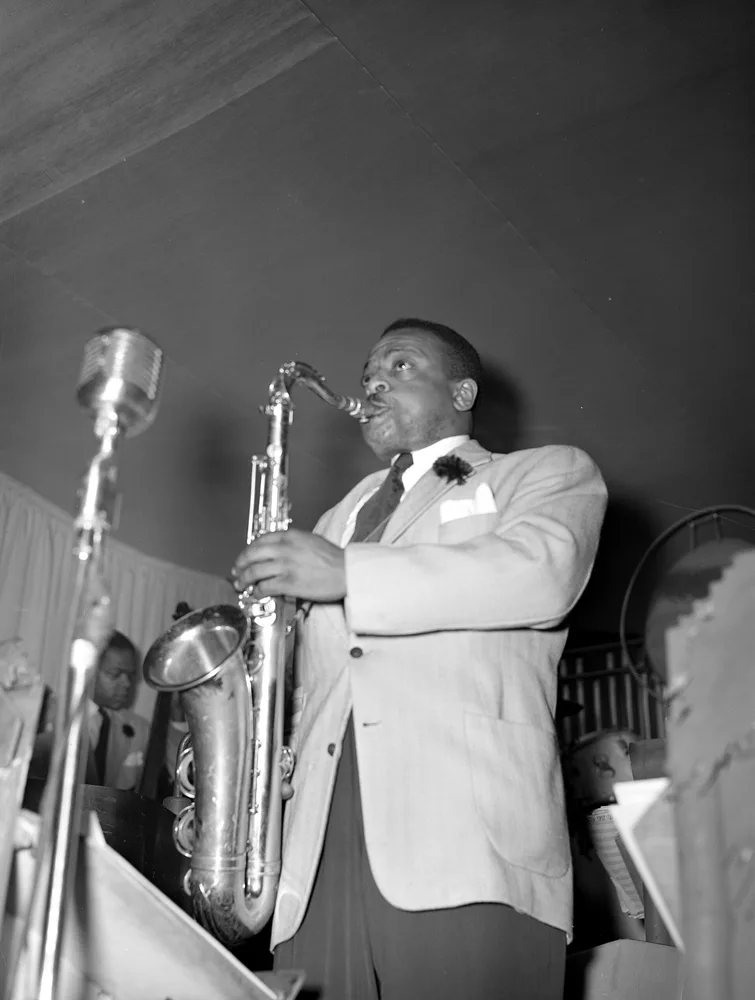
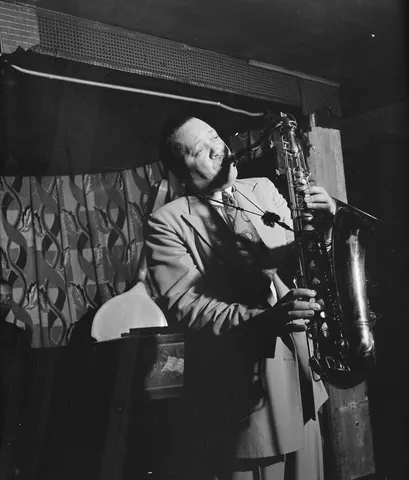
Ben Webster in New York City, April 1943, photographed by Gordon Parks while performing as tenor saxophonist with the Duke Ellington Orchestra at the Hurricane club Public Domain (U.S. government work, Farm Security Administration/Office of War Information collection) — Wikimedia Commons — https://commons.wikimedia.org/wiki/File:Ben_Webster.jpg (original held by the Library of Congress, Prints and Photographs Division, digital ID fsa.8d13235)

Benjamin Francis Webster was born March 27, 1909, in Kansas City, Missouri. He took violin lessons as a child, learned rudimentary blues piano from his neighbor Pete Johnson, and got his first pointers on saxophone from Budd Johnson. As a teenager he played alongside Lester Young in the Young Family Band, made his recording debut with Blanche Calloway, and by 1932 was a featured soloist on a classic session with Bennie Moten's Kansas City Orchestra alongside Count Basie, Hot Lips Page, and Walter Page. Through the rest of the 1930s he worked in a succession of touring bands: Jap Allen, Andy Kirk, Fletcher Henderson (1934), Benny Carter, Willie Bryant, Cab Calloway, and a short-lived big band led by Teddy Wilson.
After brief stints in 1935 and 1936, Webster joined the Duke Ellington Orchestra in 1940 and became its first major tenor saxophone soloist. Over the next three years he appeared on some of the band's most celebrated recordings, including "Cotton Tail," on which he both took a landmark solo and arranged the saxophone ensemble passage, and "All Too Soon." He counted Ellington's alto star Johnny Hodges as a major influence during this period, and grew close to bassist Jimmy Blanton and arranger Billy Strayhorn. Webster's volatile temperament made him difficult company for the rest of the band, and he left in 1943 (by one account after slapping Ellington), returning only briefly in 1948 and 1949. Recordings from his Ellington years are widely available on compilations such as The Blanton-Webster Band.
Webster spent the later 1940s working New York's 52nd Street, recording steadily as both leader and sideman with musicians including Raymond Scott, John Kirby, Sid Catlett, Bill DeArango, Jay McShann, and Jimmy Witherspoon. In the 1950s he toured with Norman Granz's Jazz at the Philharmonic package and became a mainstay of Granz's Verve/Norgran studio dates. His 1953 session with the Oscar Peterson Trio, released as The Consummate Artistry of Ben Webster and later reissued as King of the Tenors, launched a decade of prolific leader recordings for Granz, including Music for Loving (1955), a 1956 quartet session with pianist Art Tatum (released 1958 as The Art Tatum-Ben Webster Quartet), Soulville (1957, again with Peterson), and Coleman Hawkins Encounters Ben Webster (recorded December 16, 1957), which paired him with fellow tenor giant Coleman Hawkins, a friend since their Kansas City days. On December 8, 1957, Webster appeared in the landmark CBS television broadcast The Sound of Jazz, playing behind Billie Holiday and Lester Young on "Fine and Mellow" alongside Hawkins, Count Basie, and Gerry Mulligan.
In the late 1950s Webster formed a quintet with Mulligan that played regularly at the Renaissance club in Los Angeles, backing blues singer Jimmy Witherspoon on a live Hi-Fi Jazz recording before Webster and Mulligan cut Gerry Mulligan Meets Ben Webster for Verve in 1959. The following years brought The Warm Moods (1961, Reprise, with strings), BBB & Co. (1962, Prestige Swingville, with Benny Carter and Barney Bigard), Soulmates (1963, Riverside, with pianist Joe Zawinul and cornetist Thad Jones), and See You at the Fair (1964, Impulse!, with pianists Hank Jones and Roger Kellaway), his final American studio recording.
In late 1964 Webster moved to Europe, where his style, out of fashion in the United States, was still celebrated. He lived in London and Scandinavia, then spent three years in Amsterdam, before settling permanently in Copenhagen in 1969. He worked steadily with local and expatriate musicians, recording live sessions such as Stormy Weather (taped January 30, 1965, at Copenhagen's Café Montmartre with pianist Kenny Drew, bassist Niels-Henning Ørsted Pedersen, and drummer Alex Riel) and later dates with Dutch pianist Tete Montoliu and Spanish-Catalan players. In 1971 he reunited with the Ellington Orchestra for shows at Copenhagen's Tivoli Gardens and recorded in France with pianist Earl Hines, in a session that also included Don Byas, Roy Eldridge, Stuff Smith, and Kenny Clarke. He also appeared as a saxophonist in a Copenhagen nightclub scene in the 1970 Danish film Quiet Days in Clichy.
Webster suffered a stroke in Amsterdam in September 1973, shortly after performing in Leiden, and died on September 20 at age 64. His body was cremated in Copenhagen, and his ashes were buried in the city's Assistens Cemetery. He had played the same saxophone since 1938 and left instructions that it never be played again; it is now held by the Institute of Jazz Studies at Rutgers University. Arranger Billy Moore Jr. and the trustee of Webster's estate established the Ben Webster Foundation shortly before his passing to secure his royalties and support jazz in Denmark; confirmed by royal seal in 1976, the foundation still awards an annual Ben Webster Prize to a young musician.
Webster was considered one of the "big three" swing-era tenor saxophonists alongside Coleman Hawkins, his earliest and strongest influence, and Lester Young. He built a style of striking contrasts: a tough, raspy tone punctuated by his own distinctive growls on up-tempo stomps, set against warm, breathy, intensely sentimental phrasing on ballads. Critics have noted that his time in the Ellington Orchestra alongside Johnny Hodges pulled his conception further from Hawkins's model toward something more personal and vocal-like. His late-career ballad playing in particular became his signature and drew a new generation of admirers even as his hard-swinging style fell out of critical fashion in the modernist 1950s. His tone and phrasing went on to influence later tenor players including Archie Shepp, Lew Tabackin, Scott Hamilton, and Bennie Wallace.
- Soulville (1958, Verve) - A quartet date with the Oscar Peterson Trio (Peterson, Herb Ellis, Ray Brown) that remains one of Webster's most celebrated leader sessions. Spotify - Soulville Listen
- King of the Tenors (rec. 1953, rel. 1957, Verve) - Webster's Norgran breakthrough with the Oscar Peterson Trio, Benny Carter, and Harry "Sweets" Edison, originally issued as The Consummate Artistry of Ben Webster. Spotify - King Of The Tenors Listen
- The Art Tatum-Ben Webster Quartet (rec. 1956, rel. 1958, Verve) - A single studio meeting with pianist Art Tatum, bassist Red Callender, and drummer Bill Douglass. Spotify - The Art Tatum-Ben Webster Quartet Listen
- Coleman Hawkins Encounters Ben Webster (rec. 1957, rel. 1959, Verve) - The two reigning swing tenor titans, backed by the Oscar Peterson Trio. Spotify - Coleman Hawkins Encounters Ben Webster Listen
- Gerry Mulligan Meets Ben Webster (rec. 1959, rel. 1960, Verve) - Grew out of the two saxophonists' working quintet at the Renaissance club in Los Angeles. Spotify - Gerry Mulligan Meets Ben Webster Listen
- Soulmates (1963, Riverside) - A song-based quintet date with pianist Joe Zawinul, then still emerging, and cornetist Thad Jones.
- See You at the Fair (1964, Impulse!) - Webster's final American studio recording, cut at Van Gelder Studio with Hank Jones and Roger Kellaway sharing piano duties. Spotify - See You At The Fair Listen
- The Blanton-Webster Band (1940-1942 recordings, RCA Bluebird) - As a sideman: the Duke Ellington Orchestra's celebrated early-1940s output, including Webster's "Cotton Tail" solo, compiled on this widely available reissue.
Ben Webster: Full Discography
Identity confirmed via the live Discogs API - artist ID 257115 ("Ben Webster," realname Benjamin Francis Webster, birth/death dates and Kansas City/Amsterdam locations matching). Discogs credits Webster on roughly 2,600 releases (leader dates, sideman appearances, and a very large number of reissues and compilations spanning nine decades), far too many to itemize exhaustively. The table below curates his most significant and widely cited leader/co-leader releases - roughly two dozen studio and live albums recorded between 1953 and 1973 - plus a representative set of major sideman credits, drawn from Discogs, Wikipedia's Ben Webster discography, and AllMusic.
As Leader / Co-Leader
| Album Title | Recording Date(s) | Release Date | Label | Catalog Number | Format(s) | Personnel | Role | Reissue History | Spotify | Buy | Notes |
|---|---|---|---|---|---|---|---|---|---|---|---|
| The Consummate Artistry of Ben Webster | Recorded 1953 | 1954 | Norgran Records | MGN 1001 | Vinyl, LP, Album, Mono | Ben Webster (tenor sax), Benny Carter (alto sax), Harry Edison (trumpet), Oscar Peterson (piano), Barney Kessel / Herb Ellis (guitar), Ray Brown (bass), Alvin Stoller / J.C. Heard (drums) | Leader | Reissued 1957 on Verve as King of the Tenors (MGV-8020) | Spotify - King Of The Tenors | — | Webster's first major leader session for Norman Granz, backed by the Oscar Peterson Trio plus guests |
| Music for Loving (Ben Webster With Strings) | Recorded 1955 | 1955 | Norgran Records | MGN-1018 | Vinyl, LP, Mono | Ben Webster (tenor sax), Teddy Wilson / Billy Strayhorn (piano), Ray Brown / George Duvivier / Wendell Marshall (bass), Jo Jones / Louis Bellson (drums), strings/woodwinds conducted by Strayhorn and Ralph Burns | Leader | None found | — | — | Not found on Spotify by direct search; a ballad-oriented date with orchestral backing |
| The Art Tatum-Ben Webster Quartet | Recorded September 11, 1956 | 1958 | Verve Records | MGV-8220 | Vinyl, LP, Album, Mono | Ben Webster (tenor sax), Art Tatum (piano), Red Callender (bass), Bill Douglass (drums) | Co-leader (with Art Tatum) | Reissued 1975 by Pablo as part of The Tatum Group Masterpieces, Volume Eight | Spotify - The Art Tatum-Ben Webster Quartet | — | Webster's only studio meeting with pianist Art Tatum |
| Soulville | Recorded 1957 | 1958 | Verve Records | MG V-8274 | Vinyl, LP, Album, Mono | Ben Webster (tenor sax), Oscar Peterson (piano), Herb Ellis (guitar), Ray Brown (bass), Stan Levey (drums) | Leader | Reissued in various Verve compilations | Spotify - Soulville | — | One of Webster's most acclaimed leader dates |
| Coleman Hawkins Encounters Ben Webster | Recorded December 16, 1957 | 1959 | Verve Records | MG V-8327 | Vinyl, LP, Album | Ben Webster and Coleman Hawkins (tenor sax), Oscar Peterson (piano), Herb Ellis (guitar), Ray Brown (bass), Alvin Stoller (drums) | Co-leader (with Coleman Hawkins) | Later reissued in expanded/complete-session editions | Spotify - Coleman Hawkins Encounters Ben Webster | — | Pairing of two of the "big three" swing tenor saxophonists |
| Ben Webster and Associates | Recorded 1959 | 1959 | Verve Records | MG V-8318 | Vinyl, LP, Album | Ben Webster, Budd Johnson, and Coleman Hawkins (tenor sax), Roy Eldridge (trumpet), Jimmy Jones (piano), Les Spann (guitar), Ray Brown (bass), Jo Jones (drums) | Leader | None found | — | — | Not found on Spotify by direct search; a three-tenor frontline session |
| Ben Webster Meets Oscar Peterson | Recorded November 6, 1959 | 1960 | Verve Records | MG V-8349 | Vinyl, LP, Album, Mono | Ben Webster (tenor sax), Oscar Peterson (piano), Ray Brown (bass), Ed Thigpen (drums) | Co-leader (with Oscar Peterson) | Reissued in multiple Verve compilations | Spotify - Ben Webster Meets Oscar Peterson | — | |
| Gerry Mulligan Meets Ben Webster | Recorded November 3 & December 2, 1959 | 1960 | Verve Records | MG V-8343 | Vinyl, LP, Album, Mono | Ben Webster (tenor sax), Gerry Mulligan (baritone sax), Jimmy Rowles (piano), Leroy Vinnegar (bass), Mel Lewis (drums) | Co-leader (with Gerry Mulligan) | Reissued 1997 as The Complete Gerry Mulligan Meets Ben Webster Sessions | Spotify - Gerry Mulligan Meets Ben Webster | — | Grew out of the pair's 1959 residency at the Renaissance club in Los Angeles |
| The Warm Moods | Recorded 1961 | 1961 | Reprise Records | R-2001 | Vinyl, LP, Mono, Album | Ben Webster (tenor sax) with a string orchestra; full personnel not detailed in Discogs's release data | Leader | None found | — | — | A ballad album with string-orchestra backing; personnel beyond Webster not confirmed |
| BBB & Co. | Recorded 1962 | 1962 | Prestige Swingville | SVLP 2032 | Vinyl, LP, Album, Mono | Ben Webster (tenor sax), Benny Carter (alto sax, trumpet), Barney Bigard (clarinet), Jimmy Rowles (piano), Dave Barbour (guitar), Leroy Vinnegar (bass), Mel Lewis (drums), Shorty Sherock (trumpet) | Co-leader (with Benny Carter and Barney Bigard) | None found | — | — | |
| Soulmates | Recorded September 20 & October 14, 1963 | 1963 | Riverside Records | RM 476 | Vinyl, LP, Album, Mono | Ben Webster (tenor sax), Joe Zawinul (piano), Thad Jones (cornet), Richard Davis / Sam Jones (bass), "Philly" Joe Jones (drums) | Co-leader (with Joe Zawinul) | None found | — | — | Liner notes by pianist Bill Evans |
| See You at the Fair | Recorded March 11 & 25, 1964, Van Gelder Studio, Englewood Cliffs NJ | 1964 | Impulse! | AS-65 | Vinyl, LP, Album, Stereo, Gatefold | Ben Webster (tenor sax), Hank Jones / Roger Kellaway (piano), Richard Davis (bass), Osie Johnson (drums) | Leader | None found | Spotify - See You At The Fair | — | Webster's final American studio recording before relocating to Europe |
| Stormy Weather | Recorded live January 30, 1965, Café Montmartre, Copenhagen | 1988 (expanded reissue) | Black Lion Records | BLP 60108 | Vinyl, LP, Compilation | Ben Webster (tenor sax), Kenny Drew (piano), Niels-Henning Ørsted Pedersen (bass), Alex Riel (drums) | Leader | Expanded from the original 1974 live LP Saturday Night at the Montmartre | Spotify - Stormy Weather | — | Documents Webster's Copenhagen quartet in his first months living in Europe |
| Gentle Ben | Recorded 1972 | 1973 | Ensayo | ENY-301 | Vinyl, LP | Ben Webster (tenor sax), Tete Montoliu (piano), Eric Peter (bass), Peer Wyboris (drums) | Leader | Reissued as Did You Call? (Nessa, 1978) | — | — | Recorded with Catalan pianist Tete Montoliu's trio |
| My Man: Live at Montmartre 1973 | Recorded live 1973, Café Montmartre, Copenhagen | 1973 | SteepleChase | SCS-1008 | Vinyl, LP | Ben Webster (tenor sax), Ole Kock Hansen (piano), Bo Stief (bass), Alex Riel (drums) | Leader | None found | — | — | Among Webster's last recordings, made the year of his death |
As Sideman (selected major credits)
| Year | Project (Leader) | Title | Label | Catalog | Role | Notes |
|---|---|---|---|---|---|---|
| 1940-1942 | Duke Ellington And His Orchestra | The Blanton-Webster Band (compilation) | RCA Bluebird | 5659-1-RB | Tenor Saxophone | Compiles Webster's tenure as the orchestra's first major tenor soloist, including his "Cotton Tail" solo and sax-ensemble arrangement |
| 1957 | CBS television special (various leaders) | The Sound of Jazz | CBS / Columbia | Tenor Saxophone | Live December 8, 1957 broadcast; backed Billie Holiday and Lester Young on "Fine and Mellow" alongside Coleman Hawkins and Gerry Mulligan | |
| 1959 | Jimmy Witherspoon, with Gerry Mulligan | At the Renaissance | HiFi Jazz | Tenor Saxophone | Live recording from Webster and Mulligan's residency at the Renaissance club, Los Angeles | |
| 1965 | Lionel Hampton | You Better Know It!!! | Impulse! | A-56 | Tenor Saxophone | |
| 1971 | Earl Hines | (Paris studio session, issued in France as Hines's Tune) | Tenor Saxophone | With Don Byas, Roy Eldridge, Stuff Smith, Kenny Clarke, and Jimmy Woode |
Webster's Discogs sideman log also documents extensive further work with Fletcher Henderson, Cab Calloway, Teddy Wilson, Benny Carter, Andy Kirk, Jay McShann, Billie Holiday, Johnny Hodges, Count Basie, Buddy Rich, Illinois Jacquet, and dozens of other leaders across the 1930s through the 1970s, plus the many Jazz at the Philharmonic tour recordings produced by Norman Granz - not itemized exhaustively here.
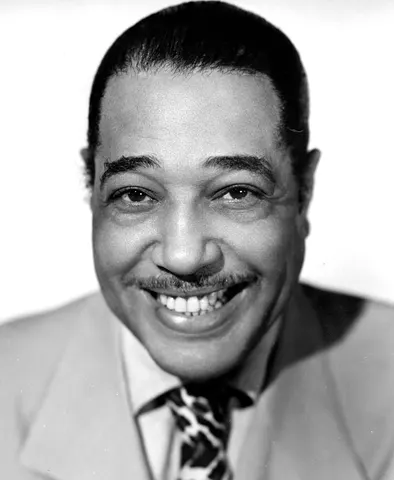
- Duke Ellington - Webster was the orchestra's first major tenor soloist, 1940-1943, with a brief return in 1948-1949 and a 1971 reunion at Copenhagen's Tivoli Gardens.
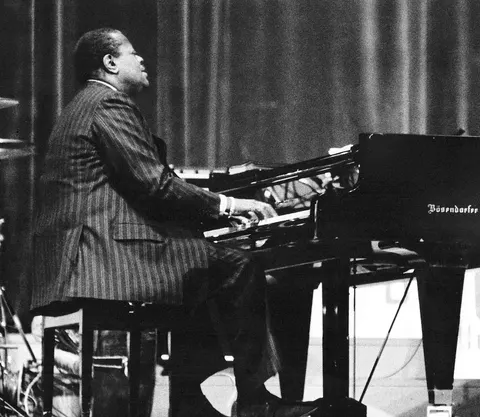
- Oscar Peterson - recurring pianist across Webster's 1950s Verve/Norgran leader dates, including King of the Tenors, Soulville, Ben Webster Meets Oscar Peterson, and Coleman Hawkins Encounters Ben Webster.
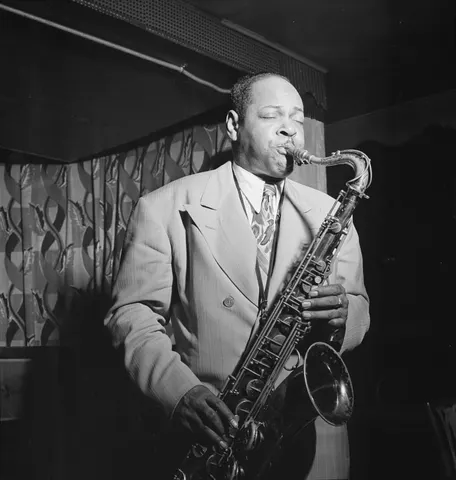
- Coleman Hawkins - fellow "big three" swing tenor and friend since their Kansas City days; co-billed on Coleman Hawkins Encounters Ben Webster (1957) and shared the frontline (with Budd Johnson) on Ben Webster and Associates (1959).
- Gerry Mulligan - co-led a working quintet at the Renaissance club in Los Angeles in 1959, then the studio album Gerry Mulligan Meets Ben Webster.
- Teddy Wilson - member of Wilson's short-lived big band in the late 1930s.
- Fletcher Henderson and Cab Calloway - among the touring bandleaders Webster worked for during the 1930s.
- Thad Jones, Hank Jones, and Roger Kellaway - sidemen on Webster's mid-1960s leader dates Soulmates and See You at the Fair.
- Kenny Clarke - drummer on a 1971 Earl Hines-led session recorded in France that also featured Don Byas, Roy Eldridge, and Stuff Smith.
- Lester Young - a boyhood bandmate in the Young Family Band in Kansas City, later reunited on the 1957 CBS broadcast The Sound of Jazz.
- Art Tatum - recorded a single acclaimed studio quartet session with the pianist in 1956.
- Wikipedia: Ben Webster
- Discogs: Ben Webster (artist 257115)
- AllMusic: Ben Webster biography
- Wikipedia: The Sound of Jazz
- Wikipedia: Soulville (Ben Webster album)
- Wikipedia: King of the Tenors
- Wikipedia: The Art Tatum - Ben Webster Quartet
- Wikipedia: Coleman Hawkins Encounters Ben Webster
- Wikipedia: Gerry Mulligan Meets Ben Webster
- Wikipedia: Soulmates (Ben Webster and Joe Zawinul album)
- Wikipedia: See You at the Fair