 JAZZPROFILES lives in the music 1,002 Jazz Artists fully Profiled!
 Javier Girotto
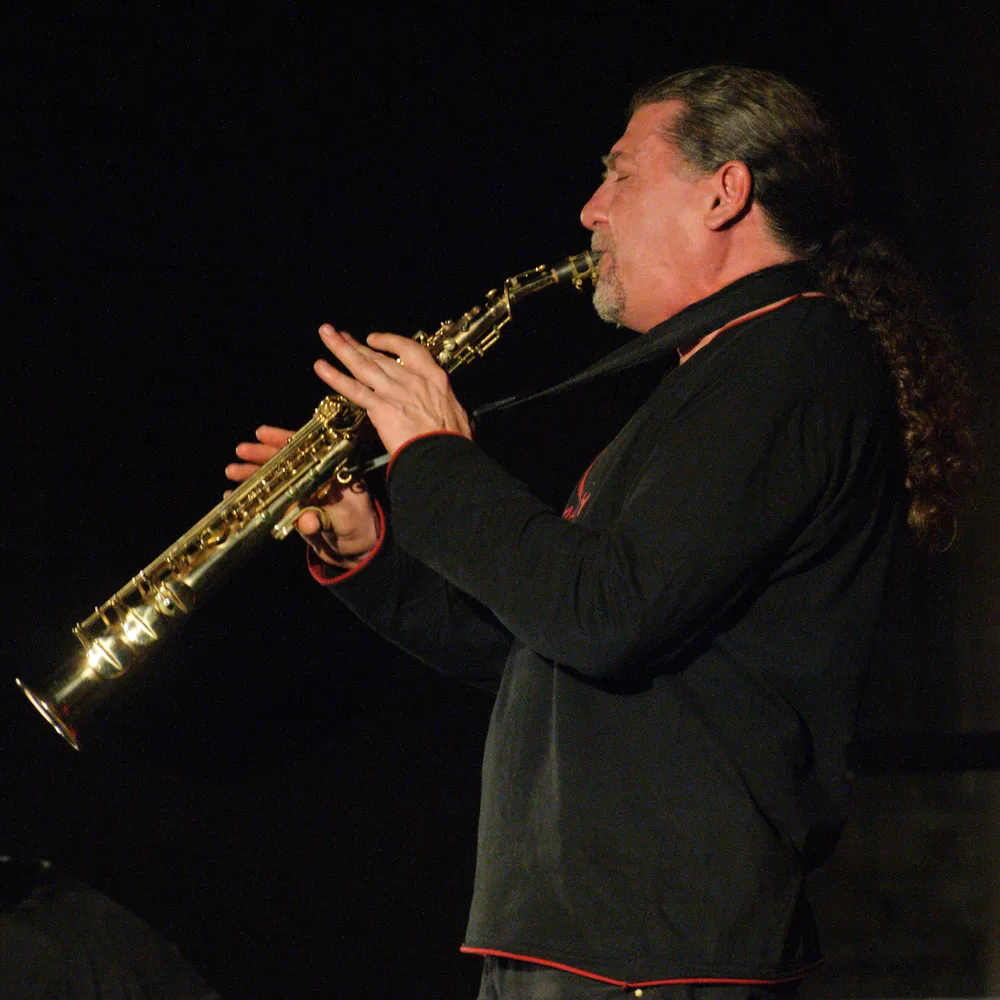
Javier Girotto playing soprano saxophone at the Palatia Jazz concert with Ralph Towner in the Gedächtniskirche, Speyer, Germany, June 8, 2012 CC BY-SA 4.0 — Wikimedia Commons, photograph by Jens Vajen — https://commons.wikimedia.org/wiki/File:Javier_Girotto_beim_Palatia_Jazz_Konzert_mit_Ralph_Towner_in_der_Ged%C3%A4chtniskirche_in_Speyer_am_8._Juni_2012_.jpg (file itself: https://upload.wikimedia.org/wikipedia/commons/6/6a/Javier_Girotto_beim_Palatia_Jazz_Konzert_mit_Ralph_Towner_in_der_Ged%C3%A4chtniskirche_in_Speyer_am_8._Juni_2012_.jpg)


Javier Edgardo Girotto was born in Córdoba, Argentina, on April 17, 1965, into a family where the instruments were already in the house. His maternal grandfather, A. L. Caroli, directed a marching band, played flugelhorn in a symphony orchestra and bandoneon in a tango orchestra, and took the boy to rehearsals. Girotto started on snare drum at eight, moved to the E flat clarinet in the Infanto Juvenil de Córdoba band and the band of Villa del Rosario, then to the B flat instrument, and from there to alto saxophone. He went to Buenos Aires looking for someone who could teach him jazz and found nobody, so he came home, started his own jazz-minded groups, and paid for them by working in the cuarteto dance bands that dominated provincial Argentine popular music. At sixteen he enrolled at the Conservatorio Provincial de Córdoba; there was no saxophone chair, so he took the clarinet and flute courses instead and completed the intermediate diploma in both. Alongside the conservatory he played in Vertiente, a mix of fusion and Argentine folk music, in Jazz 440, and in the quartets of Enzo Piccioni and Juan Ciallella.
At nineteen he won a scholarship to the Berklee College of Music, which was also what got him the visa. He stayed four years and graduated in Professional Music cum magna laude, studying composition and arranging alongside saxophone and improvisation with Joseph Viola, George Garzone, Hal Crook and Jerry Bergonzi, and learning the working side of the job on bandstands with Danilo Pérez, Bob Moses and Herb Pomeroy. The pull toward Europe had been there before Boston: his first plan at sixteen had been to emigrate to France, where his friends had gone.
He arrived in Italy at twenty-five to settle family business in Puglia, which was also the route to the Italian citizenship he holds, and the visit turned permanent. In Rome he alternated commercial Latin work with jazz groups of his own. The first was Tercer Mundo, a Latin jazz sextet of piano, bass, percussion, drums, trumpet and saxophone that he built with the Cuban drummer Horacio "El Negro" Hernández. Next came Six Sax, a saxophone quartet with bass and drums: Rosario Giuliani and Tony Germani on alto, Gianni Savelli on tenor, Girotto on baritone, Marco Siniscalco on bass and Pietro Iodice on drums. Their album Homenaje, issued by Via Veneto Jazz in 1995 with Bob Mintzer and Randy Brecker as guests, was the first record with his name on it.
Aires Tango, the group he is still best known for, dates from 1994: Girotto on soprano and baritone, Alessandro Gwis on piano, Marco Siniscalco on bass and Michele Rabbia on drums and percussion. The band has run for more than thirty years and a dozen albums, from Malvinas (Equipe, 1996, taped in Rome on July 26 and 27, 1995) through Madres (1997), Poemas (recorded at Millesuoni Studio in Rome in January 1999), Cronologia del 900 (2000), Origenes (2001), the double live En Vivo (cut at Rome's La Palma Club on April 24, 25 and 26, 2002) and Escenas Argentinas (Rome, June 13 to 15, 2004) to Trentamila Cuori (2006), 10/15 (2009) and 30 (2024). Aniversario, recorded in Sofia on May 24, 25 and 26, 2002, set the quartet against the Bulgarian Symphony Orchestra in arrangements by Paolo Silvestri. Duende, taped at the Artesuono studio near Udine on September 21, 22 and 23, 2015, added Ralph Towner as a full member rather than a guest: the odd-numbered pieces are Towner's and feature him, the even-numbered ones are Girotto's and are played by the quartet alone.
The rest of the catalogue is built out of small, specific formats. In 1999 he assembled Cordoba Reunion with three musicians from his own city, the pianist Gerardo Di Giusto, the percussionist Minino Garay and the bassist Carlos "El Tero" Buschini, to work through the milonga, chacarera, zamba and candombe rhythms that predate tango; their first album, recorded in September 2000 for Radio Svizzera Italiana and issued by Philology as Argentina Jazz, has Mercedes Sosa as guest singer. From 2000 he ran two duos at once. With the bandoneonist Daniele Di Bonaventura he made Visions, a programme of Enrico Rava compositions cut in a single day at Campiglione di Fermo on June 25, 2000, followed by Recordando Piazzolla (2002) and Recordando Gardel (2004), the latter with the Roma Sinfonietta under Fausto Anzelmo. With the accordionist Luciano Biondini he made El Cacerolazo (Fermo, March 8, 2002), Terra Madre for Enja (Spoleto, November 13 and 14, 2004) and Iguazù (2011), all of it original material and much freer in shape. A third duo, with the Argentine pianist Natalio Mangalavite, produced Colibrì in 2003 and then grew a third member: the singer Peppe Servillo joined for the G.S.M. Trio, whose records are L'amico di Córdoba (2003), Fútbol (2009), Parientes (2015) and L'anno che verrà (2021).
Two records put him in front of American rhythm sections. New York Sessions, taped at Sear Sound in New York on May 10 and 11, 2004 and released by CAM in 2006, is a quartet of Girotto's own compositions with Edward Simon on piano, Ben Street on bass and Jeff Ballard on drums. Sea Inside, recorded at the Hypnocampos studio in Naples between February 5 and 8, 2007 and issued by Itinera, is a genuinely co-led quartet billed to four names: Girotto, the Neapolitan pianist Francesco Nastro, the bassist Avishai Cohen and the drummer Roberto Gatto. Nastro wrote six of the nine pieces, including the opening "Song for Avishai"; Cohen contributed "Ann's Tune," Gatto "B Song" and Girotto the closing "El Pibe de Oro." Girotto plays soprano on seven tracks, baritone on one and the Andean moceño flute on Cohen's tune. He and Nastro carried the partnership on as a duo on Passione (CAM Jazz, 2012).
Alongside his own bands he has been one of the most-called reed players in Italian jazz. He held the horn chair in Roberto Gatto's groups across 7# (RCA Victor, 1997), Sing Sing Sing (1999) and Deep (2003); joined Enrico Rava's piano-less quartet, a Chet Baker and Gerry Mulligan homage, for Full of Life (recorded November 11 and 12, 2002 with Ares Tavolazzi and Fabrizio Sferra); supplied what Rita Marcotulli has called the Argentine voice in her ensembles, from The Woman Next Door (recorded at the Studio Gil Evans in Amiens in 1997) through Koinè and Variazioni su tema; and took the baritone chair on Gianluca Petrella's debut X-Ray (September 2001). He is on Paolo Damiani's Al Tempo Che Farà, recorded at the Auditorium of Santa Cecilia in Perugia in February 2007 beside Gianluigi Trovesi, Danilo Rea and Bebo Ferra, and in the Giovanni Tommaso Quartet on Walking in My Shadow (2023). Since 2008 he has co-led Latin Mood with the trumpeter Fabrizio Bosso, a working quintet whose Sol appeared on Blue Note in 2009 and which was still recording in 2025. Big bands have used him as a soloist and composer: Argentina: Escenas en Big Band with the Parco della Musica Jazz Orchestra in 2007, in his own pieces arranged by Luigi Giannatempo, then a Dutch tour with the Jazz Orchestra of the Concertgebouw in December 2008 and a "jazz tango" project with the WDR Big Band in Cologne in August 2010 alongside Gary Burton and the bandoneonist Marcelo Nisinman.
He taught in the jazz department of the Conservatorio Santa Cecilia in Rome from 2009 to 2011, has given seminars at the conservatories of Pesaro, Lecce, Salerno, Como, Turin, Lima and Córdoba, and is on the faculty of the Saint Louis College of Music in Rome. In 2011 he started his own label, JG Records, with Alrededores de la Ausencia, recorded entirely in Argentina with Córdoba musicians he had known since before Berklee. From November 2016 he lost the use of his left hand to focal dystonia, the movement disorder that ends careers among wind and string players; he could not play properly for a year and a half and came back in May 2018, touring Argentina and Uruguay and cutting Tango Nuevo Revisited for ACT that September, a trio reading of Astor Piazzolla and Gerry Mulligan with Gianni Iorio on bandoneon and Alessandro Gwis on piano. The work since has kept the same shape: solo saxophone on Escenas en Solo, a duo with the accordionist Vince Abbracciante on Santuario (2021), and Colyseus with the Alma Saxophone Quartet in 2023.
Girotto is a specialist rather than a doubler, and he says so plainly: he plays soprano and baritone, sold his clarinet, and keeps the Andean flutes (quena, moceño, siku) as a third colour rather than a fourth instrument, because he wanted one recognisable voice instead of a wide range. The tone is dry and vocal, with a baritone that stays light and mobile in the register where most players get heavy, and a soprano that leans on the long declamatory line rather than on speed. He came to jazz through melody rather than harmony, by way of a record by the Italian altoist Massimo Urbani and then Bill Evans, and he did not seriously study the saxophone masters until he was twenty-four, which he regards as lucky because it left him nothing to imitate; the sound he admits to chasing is Jan Garbarek's. The other decisive figure is Piazzolla, whose bandoneon phrasing sits underneath the way Girotto shapes a melody. He has described improvising as an act of imitation of a singer, and specifically of a tango or folk singer, which explains why the solos on his own records tend to be long-breathed and rhetorical instead of harmonically busy. His relationship to Argentine material is not decorative and was not automatic: he told Jazz'halo that he came to detest folk music and tango while he lived among them, spent his Berklee years fully inside the American jazz language, and only found the Argentine repertoire again as nostalgia once he was in Europe, at which point he found the emotion that pure improvised music had not given him. Reviewing Duende for All About Jazz, Neri Pollastri drew the distinction the record itself is built on: Towner's pieces are lyrical and chiselled, Girotto's are more monolithic but intensely dramatic, carried by the pull of his own solos. Tango and Latin American folk forms are the largest single strand in his catalogue, through Aires Tango, Cordoba Reunion, the Di Bonaventura duo and the Piazzolla and Gardel projects, but they run in parallel with straight jazz work as a sideman rather than replacing it, and he has kept a foot in the classical repertoire too, improvising on Ravel and Debussy in duo with the concert pianist Michele Campanella.
- Sea Inside (2007, Itinera) - A co-led quartet with Francesco Nastro, Avishai Cohen and Roberto Gatto, cut over four days in Naples, and the record where Girotto's soprano is set against a working American rhythm section rather than a tango group. Spotify - Sea Inside Listen
- Terra Madre (2005, Enja) - The second Biondini duo, and the one that took the partnership abroad: two instruments, all original music, and the freest playing on any of his records. Spotify - Terra Madre Listen
- New York Sessions (2006, CAM) - His own compositions played by Edward Simon, Ben Street and Jeff Ballard, taped at Sear Sound in two days in May 2004. Spotify - New York Sessions Listen
- Duende (2016, CAM Jazz) - Aires Tango's twelfth album, with Ralph Towner writing and playing on the odd-numbered tracks and the quartet alone on the even ones. Spotify - Duende Listen
- Aniversario (2002, C.A.M. Jazz) - Aires Tango recorded in Sofia with the Bulgarian Symphony Orchestra in Paolo Silvestri's arrangements, the most ambitious thing the band attempted. Spotify - Aniversario Listen
- Tango Nuevo Revisited (2019, ACT) - The comeback record after eighteen months lost to focal dystonia: baritone, bandoneon and piano on Piazzolla, plus two Gerry Mulligan pieces. Spotify - Tango Nuevo Revisited Listen
- Malvinas (1996, Equipe) - Aires Tango's first album, seven of its ten pieces by Girotto, and the statement of what the band was going to be. Spotify - Malvinas Listen
- Full of Life (2003, C.A.M. Jazz) - As a sideman: Enrico Rava's piano-less quartet paying homage to Chet Baker and Mulligan, with Girotto's baritone in the Mulligan chair. Spotify - Full of Life
- Deep (2003, C.A.M. Jazz) - As a sideman: the Roberto Gatto Quintet with Gianluca Petrella's trombone opposite Girotto's saxophones, all of it Gatto's writing. Spotify - Deep
Javier Girotto: Full Discography
Identity confirmed via the live Discogs API: artist ID 695585, real name "Javier Edgardo Girotto," profile text "Argentine jazz saxophonist, born 17 April 1965 in Córdoba, Argentine," with javiergirotto.com on the entry and group memberships that match the documented career (Aires Tango, Six Sax, Cordoba Reunion, Roberto Gatto Quintet, Javier Girotto Trio, Fabrizio Bosso & Javier Girotto "Latin Mood," Kaleidoscopic Arabesque, Madre Tierra, Stefania Tallini Quintet, Giovanni Tommaso Quartet, Uomini in Frac, Kombo, Cerkno Trijo, Le Irregolari).
That ID carries 174 entries, 55 of them tagged as leader credits and 24 of them master rather than release records; every master used below was resolved through its main_release and the returned title checked against the title asked for. Girotto's leader and co-led output runs past forty titles, so the first table is a curated selection of the most significant rather than an exhaustive list, and the sideman table is a representative set. Every row was read at release level: coarse role tags were not used to characterise anyone's playing.
A note on completeness. Discogs is thinner on this artist than on most: several records that exist on Spotify and on his own JG Records imprint have no Discogs entry at all, among them Araucanos (2013), Escenas en Solo (2021), Como Jugando... (2021), Cordobés (2022), Winas Tardis (2023) and Aires Tango's 30 (2024). Where a detail could not be confirmed it is said to be unconfirmed rather than guessed.
As Leader / Co-Leader
| Album Title | Recording Date(s) | Release Date | Label | Catalog Number | Format(s) | Personnel | Role | Reissue History | Spotify | Buy | Notes |
|---|---|---|---|---|---|---|---|---|---|---|---|
| Homenaje | Not stated on the release | 1995 | Via Veneto Jazz | VVJ 009 | CD (Italy) | Six Sax: Rosario Giuliani and Tony Germani (alto saxophone), Gianni Savelli (tenor saxophone), Javier Girotto (baritone saxophone), Marco Siniscalco (bass), Pietro Iodice (drums); guests Bob Mintzer and Randy Brecker | Group member (Six Sax) | None found | Spotify - Homenaje | — | Girotto's first album. The Discogs release carries no credit block at all: the personnel above comes from his own curriculum vitae, the Discogs Six Sax group entry and Italian Wikipedia, which agree. German Wikipedia and All About Jazz give a different alto pair, Paolo Recchia and Daniele Tittarelli, which does not match the other three sources |
| Grandes Amigos | Recorded live at Al Quadrato Music Hall, Aprilia, March 1, 1996 | 1996 | Equipe | EQ96J002 | CD (Italy) | Javier Girotto (baritone and sopranino saxophone, siku, quena), Antonello Salis (piano, accordion), Michele Rabbia (percussion) | Co-leader | None found | Spotify - Grandes amigos | — | Six pieces, five of them by Girotto; the opening "Improvizacion" is credited jointly to all three |
| Malvinas | Recorded in Rome, July 26 and 27, 1995 | 1996 | Equipe | EQ96J004 | CD (Italy) | Aires Tango: Javier Girotto (soprano and baritone saxophone), Alessandro Gwis (piano), Marco Siniscalco (bass), Michele Rabbia (percussion) | Group member (Aires Tango) | None found | Spotify - Malvinas | — | The band's debut. Girotto wrote six of the ten pieces, Gwis two, Siniscalco and Rabbia one each. The Discogs credit block holds only engineering and photography credits, so the instrument allocation comes from the band's standing lineup |
| Madres | Not stated on the release | 1997 | Via Veneto Jazz | VVJ 017 | CD (Italy) | Aires Tango: Javier Girotto (alto and baritone saxophone, clarinet), Alessandro Gwis (piano), Marco Siniscalco (bass), Michele Rabbia (percussion), Antonello Salis (accordion), with Marcello Sirignano and Ruben Chaviano (violin), Silvia Cioffi (viola), Giuseppe Tortora (cello) | Group member (Aires Tango) | None found | Spotify - Madres | — | Eleven pieces, closing on Gardel's "El Día Que Me Quieras." Resolved from master 2405431 to release 15852442 |
| Poemas | Recorded at Millesuoni Studio, Rome, January 1999 | 1999 | Via Veneto Jazz | VVJ 022 | CD (Italy) | Aires Tango (no credit block on the release; standing lineup of Girotto, Gwis, Siniscalco and Rabbia) | Group member (Aires Tango) | None found | Spotify - Poemas | — | Resolved from master 2405416 to release 18381487 |
| Visions (Javier Girotto Plays Rava) | Recorded at Campiglione di Fermo, June 25, 2000 | 2000 | Philology | W 175.2 | CD (Italy) | Javier Girotto (soprano and baritone saxophone, bass clarinet, Bolivian flute), Daniele Di Bonaventura (bandoneon); produced by Paolo Piangiarelli | Leader | None found | Spotify - Visions | — | Nine Enrico Rava compositions plus one Girotto original, played in duo two years before he joined Rava's band |
| Cronologia del 900 | Not stated on the release | 2000 | Il Manifesto | CD 060 | CD (Italy) | Aires Tango: Javier Girotto (soprano and baritone saxophone, quena, composer), Alessandro Gwis (piano), Marco Siniscalco (electric bass), Michele Rabbia (drums) | Group member (Aires Tango) | None found | Spotify - Cronologia del 900 | — | Thirteen pieces, all by Girotto. Issued in Il Manifesto's "i jazz" series |
| Origenes | Not stated on the release | 2001 | Il Manifesto | CD 080 | CD, Album, digipak (Italy) | Javier Girotto and Aires Tango (the release credits Girotto only as composer; standing quartet lineup) | Leader with group | None found | Spotify - Origenes | — | Thirteen tracks, four of them short interludes, revisiting material from Malvinas and Madres |
| El Cacerolazo | Recorded at Bob Studio, Fermo, March 8, 2002 | 2002 | Philology | W 231.2 | CD (Italy) | Javier Girotto (soprano and baritone saxophone, flute, bass clarinet), Luciano Biondini (Victoria AC420V accordion); produced by Paolo Piangiarelli | Co-leader | None found | Spotify - El Cacerolazo | — | Fourteen pieces cut in a single day: Girotto wrote eleven, Biondini three (tracks 2, 7 and 11). Resolved from master 3153696 to release 17399527 |
| En Vivo | Recorded at La Palma Club, Rome, April 24, 25 and 26, 2002 | June 14, 2002 | C.A.M. Jazz | CAMJ 7753-2 | 2 x CD (Italy) | Aires Tango: Javier Girotto (soprano saxophone, bass clarinet, baritone saxophone, sicus and mohseño panpipes), Alessandro Gwis (piano, keyboards), Marco Siniscalco (electric bass), Michele Rabbia (percussion) | Group member (Aires Tango) | None found | Spotify - En Vivo (Live) | — | Two sets, 61:25 and 51:22 |
| Aniversario | Recorded in Sofia, May 24, 25 and 26, 2002 | September 6, 2002 | C.A.M. Jazz | CAMJ 7754-2 | CD (Italy) | Aires Tango (Girotto on saxophones and composer, Gwis piano, Siniscalco electric bass, Rabbia percussion) with the Bulgarian Symphony Orchestra; Paolo Silvestri (arranger, conductor); Girotto also wrote the liner notes | Group member (Aires Tango) | None found | Spotify - Aniversario | — | Ten pieces, total time 59:10 |
| Colibrì | Not stated on the release | 2003 | Ill Millennio | CDJ 0164 | CD (Italy) | Natalio Mangalavite (piano, keyboards, vocals, arranger), Javier Girotto (soprano and baritone saxophone, bass clarinet); both credited as composers | Co-leader | Reissued digitally in 2017 | Spotify - Colibrì | — | Twelve pieces. Billed on Discogs to Mangalavite first |
| L'amico di Córdoba | Not stated on the release | 2003 | Il Manifesto | cd126 | CD (Italy) | Peppe Servillo (voice), Javier Girotto (saxophones, flutes), Natalio Mangalavite (piano) | Co-leader (G.S.M. Trio) | Digital reissue 2015 | Spotify - L'amico di Cordoba | — | Fourteen songs with words by Peppe Servillo and music by Girotto. The release carries no instrument credits; roles are from the trio's standing format |
| Escenas Argentinas | Recorded in Rome, June 13, 14 and 15, 2004 | September 14, 2004 | C.A.M. Jazz | CAMJ 7766-2 | CD (Italy) | Javier Girotto (soprano and baritone saxophone, quena, Andean mohoseño flute, arranger, composer), Alessandro Gwis (piano, keyboards), Marco Siniscalco (bass, electric bass), Michele Rabbia (percussion), Raul "El Cuervo" Scebba (percussion, tracks 2, 5, 9, 11, 12) | Leader with group | None found | Spotify - Escenas Argentinas | — | Thirteen pieces |
| Recordando Gardel | Not stated on the release | 2004 | Via Veneto Jazz | VVJ 050 | CD (Italy) | Javier Girotto (soprano and baritone saxophone), Daniele Di Bonaventura (bandoneon), Roma Sinfonietta conducted by Fausto Anzelmo | Co-leader | None found | — | — | Eleven pieces. No Spotify release was found for this title |
| Terra Madre | Recorded at Urumita Studio, Spoleto, November 13 and 14, 2004; mixed at Sound Studio, Zerkall, Germany | 2005 | Enja Records | ENJ-9463 2 | CD, digipak (Germany) | Javier Girotto (soprano and baritone saxophone, moxeño flute), Luciano Biondini (accordion); produced by Matthias Winckelmann, mixed by Walter Quintus | Co-leader | Reissued digitally in the Enja Heritage Collection | Spotify - Terra Madre | — | Twelve pieces, all original. His first record for a German label, and the release that took the duo across Europe. The sleeve notes that Girotto appears courtesy of CAM Jazz |
| Trentamila Cuori | Not stated on the release | 2006 | Il Manifesto | CD 166 | CD (Italy) | Javier Girotto with Aires Tango (no credit block on the release) | Leader with group | None found | Spotify - Trentamila Cuori | — | Thirteen tracks. The title is a football reference, part of a run of Girotto records on that theme |
| Nahuel | Recorded at Studio Sorriso, Bari, February 9 to 11, 2006 | 2006 | Il Manifesto | CD 176 | CD (Italy) | Javier Girotto (soprano and baritone saxophone, quena, moceño, producer), Vertere String Quartet: Giuseppe Amatulli and Ida Ninni (violin), Domenico Mastro (viola), Giovanna Buccarella (cello); arrangements by Luigi Giannatempo (tracks 1 to 9) and Pino Iodice (track 10) | Leader | None found | Spotify - Nahuel | — | Nine Girotto originals plus one Astor Piazzolla piece (track 3) |
| New York Sessions | Recorded at Sear Sound Studio, New York, May 10 and 11, 2004 | 2006 | CAM | CAMJ 7776-2 | CD (Italy) | Javier Girotto (soprano and baritone saxophone, composer), Edward Simon (piano), Ben Street (bass), Jeff Ballard (drums); engineered by Steve Mazur | Leader | None found | Spotify - New York Sessions | — | Eleven pieces, all Girotto's, and the only record he made with an American rhythm section of this rank |
| Sea Inside | Recorded by Piero De Asmundis and Giuseppe Libischi at Hypnocampos Studio, Naples, February 5 to 8, 2007 | July 1, 2007 | Itinera | ITN 008 | CD, Album (Italy) | Javier Girotto (soprano saxophone on 1 to 4, 6, 7 and 9; baritone saxophone on 8; moceño on 5), Francesco Nastro (piano, all tracks), Avishai Cohen (bass, all tracks), Roberto Gatto (drums, all tracks); executive producer Onofrio Piccolo; mixed and mastered by Piero De Asmundis | Co-leader (billed as a four-name quartet) | None found | Spotify - Sea Inside | — | Nine pieces: six by Nastro, one each by Cohen ("Ann's Tune"), Gatto ("B Song") and Girotto ("El Pibe de Oro"). The opener is Nastro's "Song for Avishai." The Cohen here is the Israeli bassist, Discogs artist 304734, not the trumpeter of the same name |
| Argentina: Escenas en Big Band | Not stated on the release | 2007 | Parco della Musica Records | MPR 004CD | CD, digipak (Italy) | Javier Girotto with the PMJO Parco della Musica Jazz Orchestra; arrangements by Luigi Giannatempo | Leader with orchestra | None found | — | — | Nine pieces, all Girotto originals. The release carries no credit block, so the individual orchestra personnel is unconfirmed. No Spotify release was found |
| SUIX | Not stated on the release | 2008 | Parco della Musica Records | MPR 010CD | CD (Italy) | Javier Girotto (soprano and baritone saxophone, quena, moxeño flute), Atem Sax Quartet: David Brutti (soprano), Matteo Villa (alto), Davide Bartelucci (tenor), Massimo Valentini (baritone) | Leader | None found | Spotify - Suix | — | Thirteen pieces written and arranged by Girotto for saxophone quintet. A second album with the same group, Araucanos, followed in 2013 on his own label and has no Discogs entry |
| Javier Girotto, Luciano Biondini & Paolo Silvestri Ensemble | Not stated on the release | 2009 | Giotto Music | LM 115 | CD (Italy) | Javier Girotto (soprano and baritone saxophone), Luciano Biondini (bandoneon), Marco Siniscalco (electric bass), with Marco Moro (flute), Mario Arcari (oboe, English horn), Guido Bombardieri and Mosè Chiavoni (clarinets), Alessio Pisani (bassoon), Giovanni Hoffer (horn), Gianpiero Lo Bello (trumpet), Luca Begonia (trombone); Paolo Silvestri (music director, arranger) | Co-leader | None found | Spotify - Girotto, Biondini & Silvestri Ensemble | — | Ten pieces. The chamber-ensemble continuation of the orchestral Aniversario project |
| Fútbol | Not stated on the release | 2009 | Il Manifesto | Cd 194 | CD (Italy) | Peppe Servillo (vocals), Javier Girotto (soprano and baritone saxophone, bass clarinet, moxeño flute, vocals, producer), Natalio Mangalavite (piano, keyboards, vocals); Toni Servillo (voice, track 10) and Fausto Mesolella (producer and realisation, track 10) | Co-leader (G.S.M. Trio) | Digital reissue 2015 | Spotify - Futbol | — | Thirteen tracks. The two guest credits on track 10 carry explicit track restrictions on a release where other credits do not, so they are cameos rather than album-wide roles |
| 10/15 | Not stated on the release | 2009 | EGEA Music / Parco della Musica Records | MPR 019 CD | CD (Italy) | Javier Girotto and Aires Tango (the release credits Girotto only as composer) | Leader with group | None found | Spotify - 10/15 | — | Thirteen pieces. The title marks the band's tenth album and fifteenth year |
| Kaleidoscopic Arabesque | Recorded at Accademia del Suono Studio, Milan, and the church of Pieve Vecchia di Manerba, Brescia | 2010 | Dasè Soundlab | DSL I CD005 | CD (Italy) | Bebo Ferra (classical and steel-string acoustic guitar, voice), Javier Girotto (soprano and baritone saxophone, moxeño, quena, sicus, bass clarinet, horn arrangements), with the Kaleidoscopic Arabesque ensemble; liner notes by Ralph Towner in English and Paolo Fresu in Italian | Co-leader | None found | Spotify - Kaleidoscopic Arabesque | — | Eleven pieces |
| Pangea: Dalle Dolomiti alle Ande | Recorded live at the Piccolo Teatro Carambolage, Bolzano, March 3, 2008 | 2010 | Caligola | 2128 | CD (Italy) | Javier Girotto (soprano saxophone, quena, moceño) with Sax Four Fun: Stefano Menato (soprano and alto), Hans Tutzer (alto), Fiorenzo Zeni (tenor), Giorgio Beberi (baritone) | Leader | None found | Spotify - Pangea (Live) | — | Twelve pieces for saxophone quintet, live |
| Alrededores de la Ausencia | Recorded in Argentina; exact dates not listed | 2011 | JG Records | Not listed on the release | CD (Italy) | Javier Girotto with Córdoba musicians; the release carries no credit block | Leader | None found | Spotify - Alrededores de la Ausencia | — | The first release on his own label, cut entirely in Argentina with friends from before Berklee. Personnel unconfirmed |
| Iguazù | CD recorded March 14 and 15, 2011; DVD filmed live in Vinnytsia, Ukraine, September 2007 | October 11, 2011 | Note Sonanti | NS-CD 1003 | CD + DVD (Italy) | Javier Girotto (soprano and baritone saxophone), Luciano Biondini (accordion) | Co-leader | None found | Spotify - Iguazú | — | Ten pieces on the CD, four more on the DVD; Girotto wrote ten of the fourteen, Biondini four |
| Passione | Not stated on the release | 2012 | C.A.M. Jazz | CAMJ 7852-2 | CD (Italy) | Javier Girotto (soprano and baritone saxophone, quena), Francesco Nastro (piano) | Co-leader | None found | Spotify - Passione | — | Eleven pieces, 55:29. The duo continuation of the Sea Inside partnership |
| Musique sans Frontières | Not stated on the release | 2014 | C.A.M. Jazz | CAMJ 7880-2 | CD, Album (Italy) | Michele Campanella (piano), Javier Girotto (soprano and baritone saxophone); liner notes by Brian Morton; produced by Ermanno Basso for Kepach Music | Co-leader | None found | Spotify - Musique Sans Frontieres | — | A duo with a classical concert pianist who does not improvise: Debussy on tracks 2 to 12, Ravel on 1 and 13 to 15, with Girotto improvising over them |
| Duende | Recorded and mixed at Artesuono Recording Studio, Cavalicco (Udine), September 21, 22 and 23, 2015 | 2016 | C.A.M. Jazz | CAMJ 7898-2 | CD (Italy) | Javier Girotto (soprano saxophone), Alessandro Gwis (piano, sampler, electronics), Marco Siniscalco (electric bass), Michele Rabbia (drums, percussion), Ralph Towner (classical guitar); engineered by Stefano Amerio; produced by Ermanno Basso | Leader with group and guest | None found | Spotify - Duende | — | Twelve pieces alternating by composer: Towner wrote and plays on 1, 3, 5, 7, 9 and 11; Girotto wrote 2, 4, 6, 8, 10 and 12, which the quartet plays alone |
| Il Sogno di una Cosa | Not stated on the release | 2016 | Caligola | Not listed | CD (Italy) | Javier Girotto, Massimo De Mattia, Bruno Cesselli, Zlatko Kaučič | Co-leader | None found | Spotify - Il sogno di una cosa (Live) | — | A live quartet date with three Friulian and Slovenian improvisers. Instrument allocations are not in the Discogs credit block |
| Unshot Movies | Recorded and mixed at Artesuono Recording Studio, Cavalicco (Udine), March 7 and 8, 2016 | March 17, 2017 | C.A.M. Jazz | CAMJ 7911-2 | CD (Italy) | Javier Girotto (soprano and baritone saxophone), Jon Balke (piano), Furio Di Castri (bass), Patrice Heral (drums, live electronics); liner notes by Brian Morton; engineered by Stefano Amerio | Co-leader | None found | Spotify - Unshot Movies | — | Twelve pieces |
| Estándars | Not stated on the release | 2017 | Abeat Records | Not listed | CD (Italy) | Javier Girotto (saxophones), Natalio Mangalavite (piano) | Co-leader | None found | Spotify - Estándars | — | The duo's standards programme, fourteen years after Colibrì |
| Tango Nuevo Revisited | Recorded September 14 and 15, 2018 | 2019 | ACT | ACT 9878-2 | CD, tri-fold digipak (Germany) | Javier Girotto Trio: Javier Girotto (baritone saxophone, leader), Gianni Iorio (bandoneon), Alessandro Gwis (piano, electronics); produced by Siegfried E. Loch; recorded by Stefano Quarta | Leader | None found | Spotify - Tango Nuevo Revisited | — | Ten pieces: eight by Piazzolla, two by Gerry Mulligan (tracks 6 and 7). His first record after eighteen months lost to focal dystonia, and his only one for ACT. Resolved from master 2120761 to release 15808867 |
| Santuario | Not stated on the release | 2021 | Dodicilune | Not listed | CD (Italy) | Javier Girotto (saxophones), Vince Abbracciante (accordion) | Co-leader | None found | Spotify - Santuario | — | A third long-form accordion duo, after Biondini and Abbracciante's predecessors |
| Colyseus | Not stated on the release | June 30, 2023 | Parco della Musica Records | MPR161CD | CD (Italy) | Javier Girotto (soprano and sopranino saxophone), Alma Saxophone Quartet: Simone Bellagamba (soprano), Andrea Piccione (alto), Francesco Desideri (tenor), Andrea Leonardi (baritone) | Leader | None found | Spotify - Colyseus | — | Eleven pieces, the third of his saxophone-ensemble projects after SUIX and Pangea |
As Sideman (selected major credits)
| Year | Project (Leader) | Title | Label | Catalog | Role | Notes |
|---|---|---|---|---|---|---|
| 1993 | Pippo Matino | Bassa Tensione | Via Veneto Jazz | Not listed | Saxophone | One of his earliest Italian sessions; the release carries no instrument credit for him |
| 1997 | Roberto Gatto | 7# | RCA Victor | 7432151096-2 | Baritone and alto saxophone, bass clarinet, flute | With Fabio Zeppetella, Dario Deidda, Bernardino Penazzi (cello) and the voices of Chiara Civello and Peppe Servillo. Resolved from master 748555 to release 6161733 |
| 1998 | Rita Marcotulli | The Woman Next Door | Label Bleu | LBLC 6601 | Soprano and baritone saxophone, quena | Recorded at the Studio Gil Evans in Amiens in 1997, a 27-name cast including Enrico Rava, Stefano Di Battista, Aldo Romano, Michel Benita and Roberto Gatto |
| 1999 | Roberto Gatto Quintet | Sing Sing Sing | Via Veneto Jazz | VVJ 019 | Bass clarinet, tenor and soprano saxophone | With Stefano Bollani on piano, Gianluca Petrella on trombone and Michel Benita on double bass |
| 2001 | Gianluca Petrella | X-Ray | AUAND | AU0001 | Baritone saxophone throughout; quena and soprano saxophone on track 11 | Recorded September 10 to 12, 2001. The trombonist's debut, with Paul Rogers on five-string double bass and Francesco Sotgiu on drums. The track restriction applies only to the second instrument row |
| 2002 | Rita Marcotulli | Koinè | Storie di Note | SDN023 | Saxophone on tracks 1 and 11; pipe flute on 6 | Recorded at Studio Elettra, Calvi dell'Umbria. A 32-credit release on which nearly every player carries a track restriction, including Anders Jormin, Palle Danielsson, Jon Christensen, Andy Sheppard and Lena Willemark. Resolved from master 1142455 to release 9905694 |
| 2003 | Enrico Rava | Full of Life | C.A.M. Jazz | CAMJ 7759-2 | Baritone and soprano saxophone | Recorded at Artesuono, Cavalicco, November 11 and 12, 2002. The piano-less quartet with Ares Tavolazzi and Fabrizio Sferra, conceived as a homage to Chet Baker and Gerry Mulligan. Resolved from master 819010 to release 2853137 |
| 2003 | Roberto Gatto Quintet | Deep | C.A.M. Jazz | CAMJ 7760-2 | Soprano and baritone saxophone | Recorded in Calvi dell'Umbria, February 24 to 26, 2003, with Dado Moroni, Rosario Bonaccorso and Gianluca Petrella; all nine pieces written and arranged by Gatto |
| 2004 | Cordoba Reunion | Argentina Jazz | Philology | W 717.2 | Saxophone | Recorded September 11, 12 and 13, 2000, mixed January 2001, co-produced with Radio Svizzera Italiana. Girotto with Gerardo Di Giusto (piano), Carlos Buschini (bass), Minino Garay (percussion); Mercedes Sosa and Nicolás "Colacho" Brizuela appear as guests. Resolved from master 2484145 to release 21923839 |
| 2007 | Paolo Damiani | Al Tempo Che Farà | EGEA | SCA 135 | Flute, soprano and baritone saxophone | Recorded at the Auditorium of Santa Cecilia, Perugia, February 2007, with Gianluigi Trovesi, Danilo Rea, Bebo Ferra, Walter Paoli and Diana Torto |
| 2007 | Rita Marcotulli and Javier Girotto | I Concerti del Quirinale di Radio3 | Rai Trade | RTQ 0007 | Saxophones | Recorded in the Pauline Chapel of the Quirinale Palace, Rome, on Sunday December 1, 2002 and issued five years later; 54:03 |
| 2009 | Fabrizio Bosso & Javier Girotto "Latin Mood" | Sol | Blue Note | TOCJ-66500 | Soprano and baritone saxophone, percussion | Recorded May 13 and 14, 2008. The quintet is Bosso (trumpet, flugelhorn), Girotto, Natalio Mangalavite (piano, keyboards, vocals), Luca Bulgarelli (electric bass) and Lorenzo Tucci (drums), with Bruno Marcozzi on percussion; Marco Siniscalco plays electric bass on 2, 5 and 8 and Raul Midón sings on 2. The Japanese edition adds two bonus tracks with Midón. Resolved from master 1750001 to release 15418646 |
| 2010 | Enten Eller & Javier Girotto | Ecuba | Splasc(H) Records | CDH 2532.2 | Soprano saxophone, quena | Recorded March 12, 2010 and mixed April 6 at Pollaio Studio, Ronco Biellese, with Maurizio Brunod (guitar, loops), Giovanni Maier (double bass) and Massimo Barbiero (drums, percussion). Girotto is co-billed on the sleeve rather than listed as a guest |
| 2011 | Rita Marcotulli, Javier Girotto, Luciano Biondini | Variazioni su Tema | Sardmusic | SARDCD0016 | Soprano and baritone saxophone | Recorded at Elettra Studio, Calvi dell'Umbria; twelve pieces, 58:01 |
| 2011 | Fabrizio Bosso & Javier Girotto "Latin Mood" | Vamos | Schema | RW 143 CD | Saxophones | Eleven tracks. The release carries no credit block, so instrument allocations are unconfirmed |
| 2012 | Cordoba Reunion | Sin Lugar a Dudas | Abeat Records | AB JZ 100 | Saxophone | The group's second album, with Gerardo Di Giusto, Carlos Buschini and Gabriel Garay on drums |
| 2012 | Peppe Servillo, Fabrizio Bosso, Rita Marcotulli, Javier Girotto | Memorie di Adriano: Canzoni del Clan Celentano | Pro Music Lab | Not listed | Saxophones | A Celentano songbook project, also issued as a CD, DVD and box special edition, with Furio Di Castri and Mattia Barbieri |
| 2014 | Luca Aquino | Rock 4.0 | Musica Jazz | MJCD 1281 | Flute, soprano and baritone saxophone on tracks 4, 10, 11, 12 and 14 | Issued with Musica Jazz no. 7/2014. Other credits on the release carry their own track restrictions, so this one is a genuine partial appearance rather than a data gap |
| 2014 | Enten Eller | Pietas | Splasc(H) Records | CD HP 550.2 | Soprano saxophone and flute, credited as special guest | Recorded live on March 19, 2014 at the 34th Open Jazz Festival in Bollengo, with Alberto Mandarini added on trumpet. The guest tag is explicit but no credit anywhere on this release carries a track restriction, so the extent of his playing cannot be graded from the release data |
| 2015 | Rosario Bonaccorso | Viaggiando | Via Veneto Jazz | Not listed | Saxophones | With Roberto Taufic and Fabrizio Bosso |
| 2023 | Giovanni Tommaso Quartet | Walking in My Shadow | Parco della Musica Records | MPR159CD | Soprano and baritone saxophone, moceño, quena | With Rita Marcotulli (piano) and Alessandro Paternesi (drums), reworking Tommaso's own compositions |
| 2025 | Peppe Servillo, Javier Girotto, Fabrizio Bosso, Rita Marcotulli | Pensieri e Parole: Canzoni di Lucio Battisti | Parco della Musica Records | Not listed | Saxophones | With Furio Di Castri and Mattia Barbieri, the same group as the Celentano project thirteen years earlier |
- Alessandro Gwis, Marco Siniscalco and Michele Rabbia - the other three quarters of Aires Tango since 1994, and the longest continuous band relationship of his career.
- Luciano Biondini - accordion duo partner since 2000 across El Cacerolazo (2002), Terra Madre (2005) and Iguazù (2011), plus the trio with Paolo Silvestri's ensemble and a shared record with Rita Marcotulli.
- Daniele Di Bonaventura - bandoneon duo partner on Visions (2000), Recordando Piazzolla (2002) and Recordando Gardel (2004).
- Roberto Gatto - a quarter-century association: the drummer's quintet on 7# (1997), Sing Sing Sing (1999) and Deep (2003), and a co-leader on Sea Inside (2007).
- Avishai Cohen - bass on the co-led Sea Inside quartet, playing on all nine tracks and writing "Ann's Tune."
- Francesco Nastro - the Neapolitan pianist who wrote six of the nine pieces on Sea Inside and then made the duo record Passione (2012) with him.
- Enrico Rava - Girotto joined the trumpeter's piano-less quartet in 2002 and recorded Full of Life; he had already devoted a whole duo album, Visions, to Rava's compositions.
- Rita Marcotulli - on her records from The Woman Next Door (1998) through Koinè, the 2007 Quirinale concert issued by Rai Trade, Variazioni su tema (2011) and the Celentano project Memorie di Adriano (2012).
- Fabrizio Bosso - co-leader of the Latin Mood quintet since 2008, with Natalio Mangalavite, Luca Bulgarelli, Lorenzo Tucci and Bruno Marcozzi: Sol (Blue Note, 2009), Vamos (2011) and Desde Cuando (2025).
- Natalio Mangalavite - fellow Argentine pianist, duo partner on Colibrì (2003) and Estándars (2017), and the third voice of the G.S.M. Trio.
- Peppe Servillo - the singer of the G.S.M. Trio, for whose four albums Servillo wrote the words and Girotto the music.
- Antonello Salis - piano and accordion on the live trio record Grandes Amigos (Aprilia, March 1, 1996) with Michele Rabbia.
- Ralph Towner - toured South America with him in late 2012 and joined Aires Tango for Duende (2016).
- Gianluca Petrella - front line partner in the Gatto quintet and on the trombonist's own X-Ray (2001).
- Ben Street and Jeff Ballard - the New York rhythm section, with Edward Simon, on New York Sessions (2006).
- Rosario Giuliani - alto saxophone in Six Sax, the Roman saxophone band whose Homenaje (1995) was Girotto's first album.
- Gerardo Di Giusto, Minino Garay and Carlos Buschini - the other three Córdoba musicians in Cordoba Reunion, formed in 1999.
- Michele Campanella - the classical pianist with whom he recorded Musique sans Frontières (2014) and Vers la Grande Porte de Kiev (2018), improvising on Debussy, Ravel, Mussorgsky and Stravinsky.
- Paolo Damiani - reeds in the bassist's ensemble on Al Tempo Che Farà (2007) alongside Gianluigi Trovesi and Danilo Rea.
- Giovanni Tommaso - saxophones in the bassist's quartet on Walking in My Shadow (2023) with Rita Marcotulli and Alessandro Paternesi.
- Wikipedia (Italian): Javier Girotto
- Wikipedia (German): Javier Girotto
- Discogs: Javier Girotto (artist 695585)
- AllMusic: Javier Girotto
- All About Jazz: Javier Girotto, biography
- All About Jazz: "Javier Girotto Aires Tango with Ralph Towner: Duende," review by Neri Pollastri
- Jazz'halo: "Javier Girotto, interview with the saxophonist from Cordoba (Argentina) who lives in Italy"
- Javier Girotto: biography, official site
- Curriculum vitae filed with the Conservatorio di Musica "S. Giacomantonio" di Cosenza, protocol 0005506 of May 15, 2023
- Saint Louis College of Music, Rome: Javier Girotto, faculty page