 JAZZPROFILES lives in the music 1,572 Jazz Artists fully Profiled!
 Toshinori Kondo
Last updated August 30, 2026
Listen on Spotify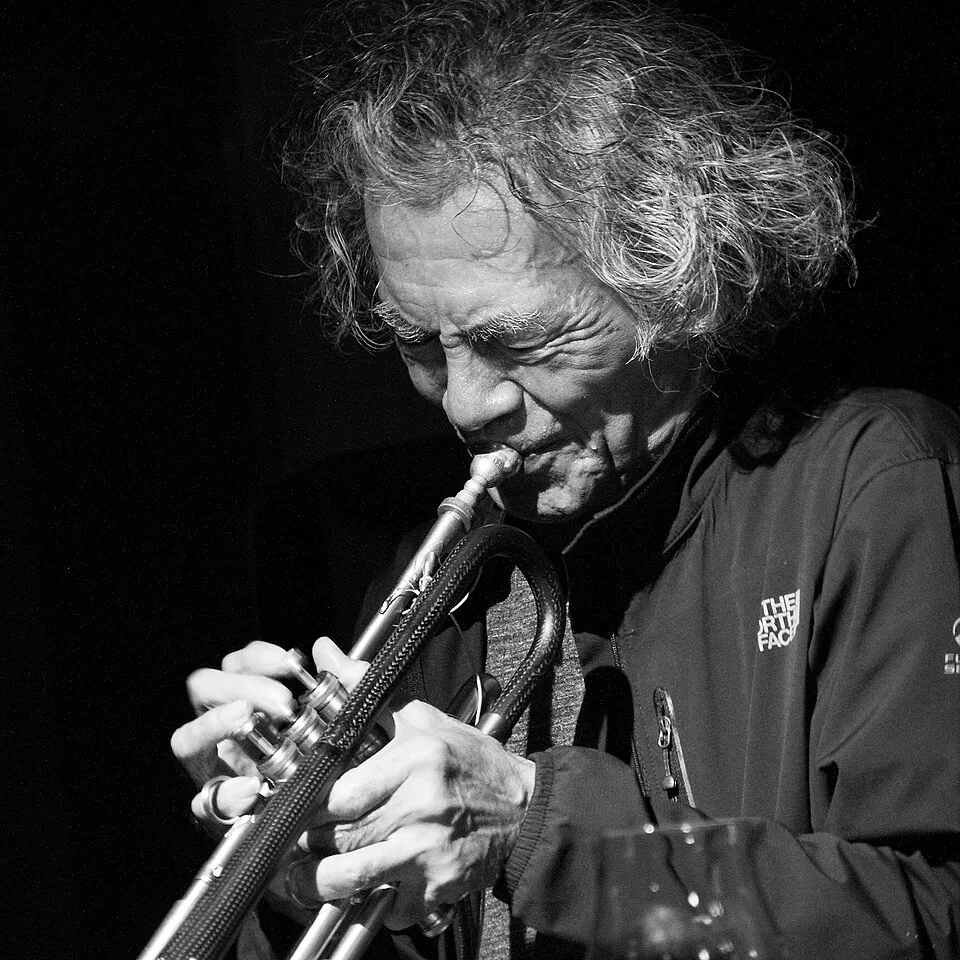
Toshinori Kondo in concert at Club W71, Weikersheim, Germany, August 2017. Creative Commons Attribution-ShareAlike 4.0 (CC BY-SA 4.0). The Commons file licence field reads cc-by-sa-4.0. The caption in final-blog.md names the specific licence per the 2026-07-25 standing rule. — Wikimedia Commons, File:Toshinori Kondo W71 2017 03.jpg. The original is 3456 x 3456 at 4,267,893 bytes. The embedded and saved image is the 960px Commons thumbnail at https://upload.wikimedia.org/wikipedia/commons/thumb/1/15/Toshinori_Kondo_W71_2017_03.jpg/960px-Toshinori_Kondo_W71_2017_03.jpg (257,398 bytes, roughly 0.25MB, verified by HTTP HEAD). Saved locally as portrait.jpg, not hotlinked. Commons file page: https://commons.wikimedia.org/wiki/File:Toshinori_Kondo_W71_2017_03.jpg.
Toshinori Kondo (近藤等則) was born on December 15, 1948 in Imabari, on the island of Shikoku. He entered Kyoto University in 1967, where he met the percussionist Toshiyuki Tsuchitori, and left in 1972. Rather than finish the degree he joined pianist Yosuke Yamashita's group, at that point one of the most uncompromising bands in Japanese free jazz.
His first recorded credit is not a jazz record at all. In 1976 he appeared on an album by the singer Maki Asakawa, the beginning of a working relationship that would outlast every band he joined; nine of her releases carry his name, more than any other artist in his catalog.
In 1978 Kondo moved to New York and became part of the downtown improvised-music scene at the moment it was forming. Within two years he had recorded with John Zorn, Eugene Chadbourne, Tom Cora, Polly Bradfield, Andrea Centazzo and Henry Kaiser. His first album under his own name, Fuigo From A Different Dimension, appeared on Bellows in 1979, crediting him with trumpet, alto horn, mutes, the compositions, the production and the sleeve design.
He then repeated the exercise in Europe. Between 1980 and 1983 he recorded with John Russell and Roger Turner, with Tristan Honsinger, Steve Beresford and David Toop on Imitation Of Life for Y Records, in duo with the drummer Paul Lovens, with Peter Kowald and Sabu Toyozumi, and alongside Derek Bailey and Evan Parker across both volumes of the Metalanguage Festival recordings. Few Japanese musicians of his generation moved through both the American and European free scenes as completely.
1984 was his pivot year. He returned to Japan and founded IMA, an electric band that ran the trumpet through effects units over funk and electronics and found a genuine commercial audience, producing Taihen (1985), Cerezo Rosa (1986) and 337 (1987). In the same year he played trumpet on three tracks of Herbie Hancock's Sound-System, released on Columbia on August 20, 1984, in a guest cast that included Wayne Shorter, Henry Kaiser and the kora player Foday Musa Suso. The album won Hancock the Grammy for Best R&B Instrumental Performance, his second consecutive award after Future Shock. Its producer was Bill Laswell, who would become one of Kondo's most frequent collaborators fifteen years later. Kondo also recorded with Ryuichi Sakamoto on Ongaku Zukan and worked with Kazumi Watanabe during this period.
The amplified trumpet stayed with him permanently, and not only in commercial settings. In 1994 he joined Peter Brötzmann, William Parker and Hamid Drake in the Die Like a Dog Quartet, a group built around the music and memory of Albert Ayler, and remained with it until 2011. In 1996 he made Ki-Oku (記憶) with DJ Krush, released on August 8 by Sony Music Entertainment Japan, setting trumpet against turntables and sampler. From 1999 he recorded repeatedly with Laswell and Eraldo Bernocchi on the Charged and Re-charged records, and in 2001 released Life Space Death with Laswell, featuring the Dalai Lama.
The final phase of his career took the horn outdoors. Under the title Blow the Earth, Kondo performed solo on amplified trumpet in landscapes: the Negev Desert, Machu Picchu, the Himalayas, Alaska, India, and sites across Japan including the Kurushima Strait beside the town where he was born. The performances date from the 1990s, and the recordings were issued as a series of albums from 2008 onward. In 2002 he organised an International Peace Festival in Hiroshima after speaking with the Dalai Lama, and in 2011 he played the Concert for Fukushima at Wels alongside Brötzmann's Chicago Tentet, Otomo Yoshihide, Michiyo Yagi and Akira Sakata.
He worked without pause to the end. During 2020 he recorded and released six volumes of solo material under the heading Beyond Corona, along with Born of the Blue Planet, Back to Space, Aozora and Santouka, all on his own imprint. He passed away on the night of Saturday, October 17, 2020, at home in Kawasaki, aged 71. No cause was made public. His sons reported that he had been looking forward to a live-painting collaboration with the artist Seitaro Kuroda in Osaka, scheduled for that same day.
Archival and collaborative releases have continued to appear since, including Complete Link with Brötzmann and Sabu Toyozumi on NoBusiness Records in 2024. Discogs credits him on 386 releases, 122 of them as leader.
Kondo's defining decision was to treat the trumpet as an instrument with no settled role. He came up through the most demanding end of Japanese free jazz, established himself in two separate international improvised-music scenes on their own terms, and then, at the point where that reputation was secure, plugged the horn into effects units and started making funk records. Purists read the move as a defection. It is better understood as continuous with everything else he did: each time a context started to define him, he left it.
The amplified trumpet is his signature sound. Once he adopted it in the mid-1980s, he carried it through every setting, from IMA's dance floors to Brötzmann's free jazz to solo performances on mountainsides, which is what makes the catalog cohere despite its apparent scattering.
The late Blow the Earth work reframes the whole career. Playing alone into a desert or out over a strait removes the two things improvised music normally depends on, other musicians and a room, and leaves only the sound of the horn against open space. For a player who spent thirty years responding to other people, choosing to spend his last two decades responding to landscape is a deliberate and legible artistic statement.
- Fuigo From A Different Dimension (1979, Bellows) - His first album under his own name, made in the New York downtown years. Trumpet, alto horn, mutes, compositions, production and sleeve, all his. YouTube search Listen · Buy
- Taihen (1985, IMA) - The electric band at full strength, and the record that split his audience. Spotify - Taihen Listen
- Sound-System (1984, Herbie Hancock, Columbia) - Kondo on trumpet across three tracks of a Grammy-winning album produced by Bill Laswell. Spotify search Listen
- Die Like A Dog (1994, with Brötzmann, Parker and Drake) - The Albert Ayler homage that became a seventeen-year band. YouTube search
- Ki-Oku (1996, with DJ Krush) - Trumpet against turntables, and still one of the most convincing meetings of Japanese jazz and hip-hop. Not available on streaming. YouTube search Listen
- Charged (1999, with Bill Laswell and Eraldo Bernocchi) - The start of the long Laswell partnership. Spotify - Charged Listen · Buy
- Berlin Solo Live 1995 at Tacheles (released 2018) - Kondo entirely alone, indoors, before the outdoor work began. Spotify - Berlin Solo Live 1995 Listen · Buy
- Blow the Earth (India) (2019) - The project that occupied his last two decades. Spotify - Blow the Earth (India) Listen · Buy
- Born of the Blue Planet (2020) - From the final year. Spotify - Born of The Blue Planet Listen
Toshinori Kondo: Full Discography
Discogs artist ID 143942, 近藤等則 (Kondō Toshinori), born December 15, 1948 in Imabari, Ehime, Japan; passed away October 17, 2020 in Kawasaki, Kanagawa. Discogs credits this artist ID with 386 total releases across all roles: 172 Appearance, 122 Main, 62 TrackAppearance, 19 UnofficialRelease, 10 Producer, 1 Mixed by.
As Leader and Co-Leader: New York and Europe, 1978-1987
| Album | Year | Label | Personnel and notes | Listen | Buy |
|---|---|---|---|---|---|
| Moose and Salmon | 1978 | With Henry Kaiser and John Oswald. Earliest Main credit | YouTube search | Amazon | |
| Fuigo From A Different Dimension | 1979 | Bellows | First album under his own name. Credited trumpet, alto horn, mutes, music by, producer and sleeve design. This release is the identity anchor for the whole discography | YouTube search | Amazon |
| Possibilities Of The Color Plastic | 1979 | Bellows | Duo with Eugene Chadbourne | YouTube search | Amazon |
| Environment For Sextet | 1979 | With John Zorn, Andrea Centazzo, Eugene Chadbourne, Tom Cora and Polly Bradfield. The downtown New York cast in one place | YouTube search | Amazon | |
| Protocol | 1979 | Henry Kaiser / Andrea Centazzo / Toshinori Kondo | YouTube search | Amazon | |
| Artless Sky | 1980 | Caw Records | With John Russell and Roger Turner | YouTube search | Amazon |
| Imitation Of Life | 1981 | Y Records | Tristan Honsinger / Steve Beresford / Toshinori Kondo / David Toop | YouTube search | Amazon |
| The Last Supper | 1981 | Po Torch Records | Duo with drummer Paul Lovens | YouTube search | Amazon |
| Metalanguage Festival 1980, Vol. 1: The Social Set | 1981 | With Greg Goodman, Henry Kaiser, Evan Parker and the Rova Saxophone Quartet | YouTube search | Amazon | |
| Metalanguage Festival 1980, Vol. 2: The Science Set | 1981 | With Derek Bailey, Evan Parker, Henry Kaiser, Larry Ochs, Jon Raskin, Greg Goodman and Andrew Voigt | YouTube search | Amazon | |
| Moose + | 1982 | Music Gallery Editions | With Henry Kaiser and John Oswald | YouTube search | Amazon |
| Death Is Our Eternal Friend (死は永遠の親友) | 1983 | With Paul Lovens and Paul Lytton | YouTube search | Amazon | |
| What Are You Talking About? | 1983 | Tristan Honsinger / Toshinori Kondo / Peter Kowald / Sabu Toyozumi | YouTube search | Amazon | |
| This, That And The Other | 1987 | Duo with Tristan Honsinger | YouTube search | Amazon |
As Leader: IMA and the electric years, 1985-1997
| Album | Year | Label | Notes | Listen | Buy |
|---|---|---|---|---|---|
| Taihen (大変) | 1985 | Jaro Medien | The IMA band. Trumpet through effects over funk and electronics. Reissued 1999 and as 大変+2 remaster in 2017 with Bill Laswell | Spotify (1999 issue) / Spotify (2017 remaster) | Amazon |
| China Boogie | 1985 | YouTube search | Amazon | ||
| Cerezo Rosa | 1986 | Jaro Medien | YouTube search | Amazon | |
| 337 | 1987 | YouTube search | Amazon | ||
| Club New Light | 1993 | Moon Records | YouTube search | Amazon | |
| Touchstone | 1993 | YouTube search | Amazon | ||
| Panta Rhei | 1994 | Racing Club International | Subtitled An Alchaic Comedy In Chaos | YouTube search | Amazon |
| Israel | 1995 | Calling | YouTube search | Amazon | |
| Tokyo Shadow (東京Shadow) | 1995 | Polystar | YouTube search | Amazon | |
| Ki-Oku (記憶) | 1996 | Sony Music Entertainment Japan | With DJ Krush. Released August 8, 1996. Trumpet against turntables and sampler. Not on Spotify | YouTube search | Amazon |
| Kobe 17.01.95 | 1996 | Primitive | Titled for the date of the Great Hanshin earthquake | YouTube search | Amazon |
| Variations Of The Theme: The Divine Comedy (神曲) | 1997 | YouTube search | Amazon |
As Leader and Co-Leader: Laswell, Die Like a Dog, and the 2000s
| Album | Year | Label | Notes | Listen | Buy |
|---|---|---|---|---|---|
| Die Like A Dog (Fragments Of Music, Life And Death Of Albert Ayler) | 1994 | Die Like a Dog Quartet: Peter Brötzmann, Toshinori Kondo, William Parker, Hamid Drake. The group ran 1994 to 2011 | YouTube search | Amazon | |
| Aida's Call | 1999 | Starlight Furniture Co. | Kaoru Abe / Motoharu Yoshizawa / Toshinori Kondo / Derek Bailey | YouTube search | Amazon |
| Charged | 1999 | Toshinori Kondo, Eraldo Bernocchi, Bill Laswell | Spotify | Amazon | |
| Jazz Bunker | 2000 | Golden Years Of New Jazz | Han Bennink / Eugene Chadbourne / Toshinori Kondo | Spotify | Amazon |
| Re-charged #1 | 2000 | Apollo | With Bernocchi and Laswell | YouTube search | Amazon |
| Re-charged #2 and #3 | 2001 | Apollo | With Bernocchi and Laswell | YouTube search | Amazon |
| Life Space Death | 2001 | Toshinori Kondo and Bill Laswell featuring His Holiness the Dalai Lama | YouTube search | Amazon | |
| Charged (Live) | 2002 | Spotify | Amazon | ||
| Nerve Tripper | 2002 | DIW | YouTube search | Amazon | |
| Fukyo | 2005 | Tzadik | On John Zorn's label | YouTube search | Amazon |
| Silent Melodies | 2007 | Off | Spotify | Amazon | |
| Hairy Bones | 2009 | Brötzmann / Kondo / Massimo Pupillo / Paal Nilssen-Love | YouTube search | Amazon | |
| MTT | 2011 | Incus | Min Tanaka, Toshi Tsuchitori, Toshinori Kondo. Reunites him with the percussionist he met at Kyoto University | YouTube search | Amazon |
| Quiet Shout | 2012 | Last Waltz | With Hideo Yamaki | YouTube search | Amazon |
| Concert For Fukushima Wels 2011 | 2013 | Trost / PanRec | Peter Brötzmann Chicago Tentet plus Otomo Yoshihide, Michiyo Yagi, Toshinori Kondo and Akira Sakata | YouTube search | Amazon |
Blow the Earth
Solo amplified trumpet performed outdoors into landscapes. The performances date from the 1990s; the album series began appearing in 2008 and continued for the rest of his life. Reported locations include the Negev Desert, Machu Picchu, the Himalayas, Alaska, India and sites across Japan including the Kurushima Strait.
| Album | Year | Label | Listen | Buy |
|---|---|---|---|---|
| Blow The Earth In Japan: "Ibuki" - The First Year, 2007 Summer through 2008 Spring | 2008 | Blow The Earth | YouTube search | Amazon |
| Blow The Earth In Japan: "Blow The Snow Moon" - Dewa-Sanzan, 2008 Winter | 2008 | Blow The Earth | YouTube search | Amazon |
| Blow The Earth In Japan: "Utsuroi" - The 2nd Year | 2009 | Blow The Earth | YouTube search | Amazon |
| Blow The Earth In Japan: The Kurushima Strait (来島海峡) | 2009 | self-released | YouTube search | Amazon |
| Blow The Earth In Japan 2009 | 2015 | Toshinori Kondo Recordings | YouTube search | Amazon |
| Blow The Earth In Japan 2011 (震動) | 2015 | Toshinori Kondo Recordings | YouTube search | Amazon |
| Blow The Earth In Israel (地球を吹く In Israel) | 2015 | Toshinori Kondo Recordings | YouTube search | Amazon |
| Blow The Earth In Andes, Part I | 2015 | Toshinori Kondo Recordings | YouTube search | Amazon |
| Blow The Earth In Himalaya & Alaska | 2015 | Toshinori Kondo Recordings | YouTube search | Amazon |
| Blow The Earth (India) | 2019 | Spotify | Amazon |
As Leader: the self-released late period, 2014-2020
From 2014 Kondo issued most of his work on his own Toshinori Kondo Recordings imprint. Selected entries:
| Album | Year | Listen | Buy |
|---|---|---|---|
| Deeply Dreamed (深く夢見て) | 2014 | YouTube search | Amazon |
| Space Pilgrimage (宇宙巡礼) | 2014 | YouTube search | Amazon |
| The War Fairy Tales (戦争童話集) | 2014 | YouTube search | Amazon |
| Zone Zero (行方不明) | 2015 | YouTube search | Amazon |
| You Don't Know What Love Is (Toshinori Kondo Plays Standards) | 2015 | YouTube search | Amazon |
| Dream Space (夢宙) | 2016 | Spotify | Amazon |
| Live At Hot Buttered Club | 2016 | YouTube search | Amazon |
| Berlin Solo Live 1995 At Tacheles | 2018 | Spotify | Amazon |
| Lips & Wind (唇に風) | 2018 | YouTube search | Amazon |
| Loves Fuji (喇叭富士) | 2018 | Spotify | Amazon |
| Resonating Lives | 2018 | YouTube search | Amazon |
| Five Elements (五大) | 2019 | YouTube search | Amazon |
The final year, 2020
Everything below was released in the year he passed away.
| Album | Listen | Buy |
|---|---|---|
| Beyond Corona Volumes One, Two, Three, Four (dedicated to Kansai Yamamoto), Five, and VI (with Kakuei and Flying Earth) | YouTube search | Amazon |
| Born Of The Blue Planet (Toshinori Kondo Plays Melodies) | Spotify | Amazon |
| Back To Space | Spotify | Amazon |
| Aozora (青空) | Spotify | Amazon |
| Santouka (山頭火を吹く) | YouTube search | Amazon |
| Tokyo Meeting 1984 | YouTube search | Amazon |
Posthumous releases, 2021-2024
Archival and collaborative material has continued to appear since 2020, much of it through Bill Laswell's self-released Tokyo Rotation series.
| Album | Year | Notes | Listen | Buy |
|---|---|---|---|---|
| 1973 Live Concert Tokyo | 2021 | With Toshi Tsuchitori. Predates his recording debut by five years | YouTube search | Amazon |
| Inkstick Session | 2021 | Ryuichi Sakamoto, Bill Laswell, Carlos Alomar, Toshinori Kondo, Hideo Yamaki | YouTube search | Amazon |
| Live Concert Tokyo 1974 | 2022 | With Kazutoki Umezu and Toshi Tsuchitori | YouTube search | Amazon |
| Electric Trumpet | 2022 | YouTube search | Amazon | |
| Eternal Triangle | 2022 | With Massimo Pupillo and Tony Buck | Spotify | Amazon |
| 1993 -East West Days- | 2023 | Bridge / Warner Music Japan | YouTube search | Amazon |
| Breath Versus Beats | 2023 | Simon Berz, Toshinori Kondo, Bill Laswell | Spotify | Amazon |
| Complete Link | 2024 | Peter Brötzmann / Toshinori Kondo / Sabu Toyozumi, NoBusiness Records | YouTube search | Amazon |
As Sideman: Selected Appearances
Scope note, stated plainly: Discogs credits Kondo with 172 Appearance and 62 TrackAppearance entries. After de-duplicating by artist and title and setting aside various-artists compilations, that is 164 distinct works by named artists. The table below is a selection of the most significant; the complete de-duplicated 164-entry list is preserved in _process/_appearances_full.txt, so nothing has been silently dropped. Distribution by decade: 12 in the 1970s, 37 in the 1980s, 26 in the 1990s, 31 in the 2000s, 33 in the 2010s, 23 in the 2020s, 2 undated.
| Artist | Album | Year | Notes | Listen |
|---|---|---|---|---|
| Maki Asakawa (浅川マキ) | 灯ともし頃 | 1976 | Kondo's earliest credit of any kind, two years before he left for New York | YouTube search |
| Maki Asakawa | One | 1980 | YouTube search | |
| Maki Asakawa | Cat Nap | 1982 | YouTube search | |
| Herbie Hancock | Sound-System | 1984 | Columbia, released August 20, 1984. Kondo on trumpet across three tracks, alongside Wayne Shorter, Henry Kaiser and Foday Musa Suso. Produced by Bill Laswell. Won the Grammy for Best R&B Instrumental Performance, Hancock's second in a row after Future Shock | Spotify search |
| Ryuichi Sakamoto | Ongaku Zukan (音楽図鑑) | 1984 | YouTube search | |
| Maki Asakawa | 幻の男たち Live 1984 | 1986 | YouTube search | |
| Maki Asakawa | 夜のカーニバル | 1989 | YouTube search | |
| DJ Krush | Holonic 'The Self Megamix' | 1997 | YouTube search | |
| Sugizo | Pray For Mother Earth | 2011 | Avex Trax | YouTube search |
| DJ Krush | Cosmic Yard | 2018 | YouTube search |
Most frequent collaborators
Ranked by distinct shared works from the de-duplicated appearance list: Maki Asakawa 9, Eugene Chadbourne 7, Method Of Defiance 7, Peter Kowald 3, Ryuichi Sakamoto 3, Herbie Hancock 2, Tristan Honsinger 2, Hideo Yamaki 2, DJ Krush 2, DJ Spooky 2, Sugizo 2. Credits billed to his own groups (Toshinori Kondo & IMA, Die Like a Dog Quartet, Free Electro) are counted separately in the source data and are covered in the leader tables above.
Other groups credited to this artist ID
Die Like a Dog Quartet, Toshinori Kondo & IMA, Phantom City, Charged, Autonomous Zone, Globe Unity Orchestra, Method Of Defiance, Peter Brötzmann Group, Brötzmann Clarinet Project, Fred Anderson Quartet, ICP Orchestra, Hairy Bones, Free Electro, KGD Project, Tibetan Blue Air Liquid Band, Peter Kuhn Quintet, Evolution Ensemble Unity, Jam Rice Sextet, Tokyo Rotation, Picnic, The Peter Brötzmann Tentet, Flying Earth, Mad World Music.
Die Like a Dog Quartet (1994-2011): Peter Brötzmann (reeds), Toshinori Kondo (trumpet), William Parker (bass), Hamid Drake (drums).
IMA (founded 1984): Kondo's electric band, trumpet through effects over funk and electronics.
Hairy Bones (2009): Brötzmann, Kondo, Massimo Pupillo, Paal Nilssen-Love.
The Laswell axis: Bill Laswell and Eraldo Bernocchi on Charged and Re-charged #1-3; Laswell alone on Life Space Death; later the Tokyo Rotation series with Laswell, DJ Krush and Hideo Yamaki. The connection originates with Laswell's production of Hancock's Sound-System in 1984.
New York, 1978-1982: John Zorn, Eugene Chadbourne, Tom Cora, Polly Bradfield, Andrea Centazzo, Henry Kaiser, John Oswald.
Europe, 1980-1983: Derek Bailey, Evan Parker, Paul Lovens, Paul Lytton, Han Bennink, Peter Kowald, Tristan Honsinger, Steve Beresford, David Toop, John Russell, Roger Turner.
Longest-running collaborator: the singer Maki Asakawa (浅川マキ), nine distinct releases from 1976 onward.
Other groups credited to this artist ID: Phantom City, Globe Unity Orchestra, ICP Orchestra, Method Of Defiance, Peter Brötzmann Group, The Peter Brötzmann Tentet, Tibetan Blue Air Liquid Band, Free Electro, Flying Earth, Evolution Ensemble Unity, Tokyo Rotation.
More Avant-Garde Jazz Artists
See all 343 Avant-Garde Jazz artists →More Japanese Jazz Artists
See all 70 Japanese artists →- Toshinori Kondo on JazzProfiles.com
- r/JapaneseJazz
- Spotify artist page
- Discogs artist page
- Wikipedia
- Discogs API, artist 143942 (profile, groups and the complete 386-release credit list across 4 paginated requests), and release 1885940 (Fuigo From A Different Dimension) for the instrument-level identity verification
- Spotify Web API for all listening links
- Wikipedia: Toshinori Kondo; Ki-Oku; Sound-System (album)
- The Free Jazz Collective and NPR obituaries, October 2020
- Wikimedia Commons file metadata for photo licensing (see
media.md)