 JAZZPROFILES lives in the music 1,572 Jazz Artists fully Profiled!
 Hiromasa Suzuki
Last updated August 30, 2026
Listen on Spotify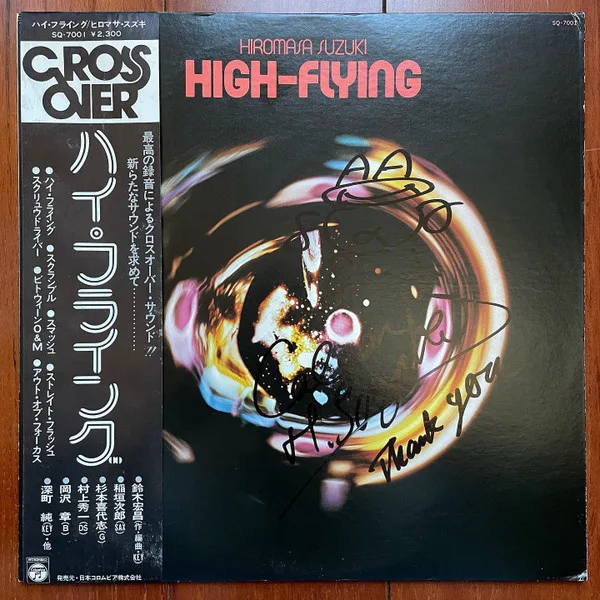
Cover art for Hiromasa Suzuki's *High-Flying* (Nippon Columbia, 1976). No CC-licensed or Wikimedia Commons photograph of Suzuki could be located; this is the album's own cover art, used as a stand-in, not a photograph of the artist. Fair use — album cover art, editorial context — Discogs (release 8587023, master 1016720), https://www.discogs.com/release/8587023-Hiromasa-Suzuki-High-Flying
Hiromasa Suzuki, nicknamed "Colgen," was born in Tokyo on May 26, 1940, the son of a dentist. He studied economics at Keio University, but the school's student jazz-piano scene pulled him further than his coursework did. There he became one of the "Keio Three Crows," a nickname for three student pianists who'd go on to shape very different corners of Japanese music: Suzuki himself, Masahiko Sato, and Yuji Ohno, who later spent decades composing for the Lupin III franchise.
Suzuki turned professional before he'd finished school, joining drummer George Kawaguchi's "Big 4+1." From there he moved into trumpeter Terumasa Hino's combo, where his arranging talent showed early, most notably on 1969's "Hi-Nology." Discogs' own artist-identity records confirm his membership in the Terumasa Hino Quintet and in drummer Akira Ishikawa's Count Buffaloes during this period.
By the early 1970s he was leading his own sessions. "Rock Joint Biwa - Kumikyoku Furukotofumi" (1972, RCA) built a full jazz-rock concept album around the biwa, a traditional Japanese lute, and the ancient mythology of the Kojiki. A companion record, "Rock Joint Cither - Silk Road," followed in 1973. By 1976 he'd sharpened into a tighter, funkier sound with two records the same year: the acoustic piano-trio album "Colgen World," and "High-Flying," an electric fusion set produced by saxophonist Jiro Inagaki and featuring a young Shuichi "Ponta" Murakami on drums, Akira Okazawa and Kenji Takamizu on bass, and guitarists Fujimaru Yoshino, Kiyoshi Sugimoto, and Masayoshi Takanaka. "High-Flying" was reissued decades later by the American label Light in the Attic, whose own liner copy describes Suzuki as "the hidden force behind Hiroshi Suzuki's 'Romance' and Jiro Inagaki's 'Breeze.'" That's not a stretch: Suzuki is credited on keyboards on "Romance" itself, a track on trombonist Hiroshi Suzuki's "Cat" (recorded October 1975, released February 1976), a different musician entirely who happens to share his surname.
"Pianic Pianism," a solo piano record, and "Skip Step Colgen," a jazz-funk set built around a cover of "Watermelon Man," both followed in 1977. From 1978 he moved into film, television, and anime scoring, composing and arranging the music for "Umi no Toriton" (Triton of the Sea), a fantasy anime series with almost nothing in common with a biwa concept record beyond the same name in the credits. His arranging work continued into the 1980s and 90s for pop and novelty acts, including television personality Tamori and the group SMAP, and he later returned to solo piano on "With My Whole Heart," produced by his old Keio bandmate Masahiko Sato.
Suzuki was diagnosed with cancer late in life. He played a comeback live show after treatment before passing away on May 21, 2001, five days short of his 61st birthday. His catalog has continued to circulate since: "High-Flying" and "Rock Joint Biwa" are now fixtures of the Japanese jazz-fusion reissue scene, and his session work keeps surfacing on compilations tracing that era, including 2023's "Touch: The Sublime Sound of Yuji Ohno," honoring the same college bandmate who went on to score Lupin III.
Suzuki's own catalog moves across a wide stylistic range inside a single decade: concept-driven jazz-rock built around traditional Japanese instrumentation (Rock Joint Biwa, Rock Joint Cither), a straight acoustic piano trio (Colgen World), electric fusion and jazz-funk (High-Flying, Skip Step Colgen), and unaccompanied solo piano (Pianic Pianism, With My Whole Heart). As a session player and arranger, he worked at the center of Tokyo's late-1960s and 1970s jazz-rock and fusion scene, contributing keyboards and arrangements to other bandleaders' landmark records, including Hiroshi Suzuki's "Cat" and Jiro Inagaki's "Breeze," while also crossing into television, film, and anime scoring, a versatility reflected in how his own name appears across genres as different as a Kojiki-themed concept album and a children's fantasy anime soundtrack.
- "Rock Joint Biwa - Kumikyoku Furukotofumi" (1972, RCA) - His concept-album debut as a leader, built around the biwa and ancient Kojiki mythology, a genuinely unusual record for a 32-year-old to put his name on. YouTube - Rock Joint Biwa Listen · Buy
- "High-Flying" (1976, Columbia) - His signature fusion record, produced by Jiro Inagaki, later reissued by Light in the Attic; the clearest entry point to his own sound. YouTube - High-Flying Listen · Buy
- "Romance" (1975/76, on Hiroshi Suzuki's "Cat") - His most widely heard performance, as a session keyboardist on another artist's landmark album. Spotify - Romance Listen
- "Skip Step Colgen" (1977, Toshiba) - His jazz-funk high point, built around a cover of "Watermelon Man." YouTube - Skip Step Colgen Listen · Buy
Hiromasa Suzuki: Full Discography
Sourced via the Discogs API, personal artist ID 596933. Identity confirmed unambiguous: real name 鈴木宏昌 (Suzuki Hiromasa), born May 26, 1940, died May 21, 2001, Discogs data_quality: Correct, group memberships confirmed as the Terumasa Hino Quintet, Akira Ishikawa & Count Buffaloes, The Players, and The Freedom Unity. This is a different person from trombonist Hiroshi Suzuki (a separate Discogs artist entity, already profiled on this project), though the two worked together: Hiromasa Suzuki is credited on keyboards on "Romance," a track on Hiroshi Suzuki's "Cat" (1975/76), independently confirmed via WebSearch cross-reference, not assumed from the shared surname.
Total confirmed credits: 254, broken out by Discogs role as 24 Main (his own personal artist page, 1971-2020, including 3 undated compilation/sampler entries), 3 Producer, 211 Appearance, 12 TrackAppearance, and 4 UnofficialRelease (bootleg/unauthorized pressings). Main and Producer credits cluster in the earliest pages of his release history (the role-clustering pattern already documented on this project's other high-volume builds), with the Appearance-role sideman and session tail spanning 1963 to 2026.
As Leader (Main), fully detailed
His own name on the label, 1971-1979 core run plus later archival releases.
| Album | Year | Label / Catalog | Personnel | Notes | Listen | Buy |
|---|---|---|---|---|---|---|
| Rock Joint Biwa - Kumikyoku Furukotofumi | 1972 | RCA, JRS-7204 | Hiromasa Suzuki (piano, electric piano); band per period press: Kiyoshi Sugimoto (guitar), Takeru Muraoka (sax), Takehisa Suzuki (trumpet), Tadataka Nakazawa (trombone) | Concept album built around the biwa (traditional Japanese lute) and the ancient Kojiki/Furukotofumi mythology. Nine tracks, side A/B structured as a suite. | YouTube (full album) | Amazon search |
| Rock Joint Cither - Silk Road | 1973 | Sony Music Japan International | Hiromasa Suzuki | Companion piece to Rock Joint Biwa, themed around the Silk Road. Eight tracks including "3000 B.C." and "Karei Naru Bamyan." | YouTube (full album) | Amazon search |
| Colgen World | 1976 | Toshiba EMI / Think | Hiromasa Suzuki, acoustic piano trio | Recorded at Toshiba EMI No. 1 Studio, May 28-June 3, 1976. Six tracks, an acoustic-trio contrast to the same year's electric High-Flying. | YouTube (full album) | Amazon search |
| High-Flying | 1976 | Columbia, SQ-7001 | Hiromasa Suzuki (composer, arranger, keyboards, synthesizer, piano, electric piano); Shuichi Murakami (drums); Akira Okazawa, Kenji Takamizu (electric bass); Fujimaru Yoshino, Kiyoshi Sugimoto, Masayoshi Takanaka (electric guitar); Jun Fukamachi (keyboards, synthesizer); Larry Sunaga (percussion); Jiro Inagaki (producer, flute, tenor/soprano sax); Kayoko Ishu (vocals) | Released August 1976. Reissued by Light in the Attic (Nipponophone/J-DIGS, catalog COJY-9604), whose own liner copy calls Suzuki "the hidden force behind Hiroshi Suzuki's 'Romance' and Jiro Inagaki's 'Breeze.'" | YouTube (full album) | Amazon search |
| Pianic Pianism (Super Solo Piano no Sekai) | 1977 | Hiromasa Suzuki, solo piano | Nine tracks including two versions of "Straight, No Chaser" and covers of "The Summer Knows," "A Fool on the Hill," and "My One and Only Love." | not found | Amazon search | |
| Skip Step Colgen | 1977 | Toshiba, LF 91028 | Hiromasa Suzuki | Jazz-funk set including a cover of "Watermelon Man" and "Georgia on My Mind." | YouTube (full album) | Amazon search |
| Umi no Toriton (Triton of the Sea) OST | 1978 | Score/arrangement credit | Anime television soundtrack. | YouTube (official digest) | Amazon search | |
| Toriton (further Umi no Toriton material) | 1979 | Score/arrangement credit | YouTube | Amazon search | ||
| Galaxy | 1979 | Billed as "The Players featuring Hiromasa Suzuki" (his band, Discogs group ID 207) | Eight tracks including "Kaleidoscope" and "Heavenly Maiden." | YouTube (full album) | Amazon search | |
| Original Soundtrack: Umi no Toriton Theme Music Collection | 1979 | Score/arrangement credit | not found | Amazon search | ||
| Kaitei Daisensou - Ai no 20,000 Miles Theme Ongakuhen | 1980 | Score/arrangement credit | Film/TV theme collection. | not found | Amazon search | |
| Umi no Toriton - Synthesizer Fantasy | 1983 | Synthesizer arrangement | Later synthesizer-arranged revisiting of the 1978-79 Toriton material. | YouTube | Amazon search | |
| Cleopatra D.C. | 1989 | not found | Amazon search | |||
| From Where I Am | 2008 | Later-career release, well after his main 1970s run. | Spotify | Amazon search | ||
| Last Live at Studio F | 2010 | Live recording, catalogued/released in 2010, nine years after Suzuki's 2001 death; a posthumous archival release, not a new performance. | Spotify | Amazon search | ||
| Umi no Toriton TV BGM Best Sound Collection | 2020 | Archival compilation | Reissue-era compilation of his Toriton scoring work. | YouTube | Amazon search |
Additional Main-role entries (compilation/sampler appearances, undated)
Three further Main-role Discogs entries carry no year: "4 Channel Record," "America Movie Best 20 (Screen Music Best 20)," and "Dynamic Young Hits Deluxe." These read as label samplers/demonstration records rather than his own conceived albums; listed here for completeness, not detailed individually.
As Producer
| Release | Year | Notes | Listen | Buy |
|---|---|---|---|---|
| Space Travel | 1982 | YouTube | Amazon search | |
| Jack-A-Dandy | 1983 | YouTube | Amazon search | |
| Brand New World | 1989 | not found | Amazon search |
Sideman, Session, and Compilation Credits (Appearance / TrackAppearance / Unofficial)
227 total credits (211 Appearance, 12 TrackAppearance, 4 UnofficialRelease) where the release is billed to another artist, spanning 1963 to 2026 (the latter almost certainly a compilation reissue of archival material, not new recording). This is the long tail of his career as an in-demand session keyboardist, arranger, and TV/commercial-music contributor. Listed chronologically by decade with representative billed artists and titles; the full year-by-year list runs to over 200 rows and is not reproduced in full here, consistent with the scale-note approach used on this project's other high-volume discography builds (Sadao Watanabe, Toshiko Akiyoshi, Akira Sakata).
| Period | Representative billed artists / titles | Notes |
|---|---|---|
| 1963-1968 | "Modern Jazz" compilation (1963); "This Is Modern Shakuhachi Vol. 2" (1968); various Dynamic/Rock big-band and easy-listening label samplers | Earliest confirmed session dates, pre-dating his own leader debut. |
| 1969-1970 | Terumasa Hino, "Hi-Nology" (1969, two separate release entries); Terumasa Hino Concert (Swing Journal Jazz Workshop 1, 1969); various African Rock / Dynamic Big Band sampler LPs | The Hino "Hi-Nology" credit is the arranging work Japanese Wikipedia specifically names as showing his early talent. |
| 1971-1975 | Numerous "Rock Joy" instrumental-showcase sampler LPs (piano, guitar, sax volumes); Mieko Hirota live and studio albums (multiple); various movie-soundtrack and easy-listening compilations | Heavy volume of Japanese "mood music" / demonstration-record sessions during this period, alongside his own Rock Joint Biwa/Cither albums. |
| 1976-1979 | Hiroshi Suzuki, "Cat" (1976, keyboards on "Romance," see final-blog.md); various TV theme and circuit-racing/car-culture theme compilations ("Porsche 934 Turbo," "The Super Car") | Same year as his own High-Flying; his session work and leader work overlapped directly. |
| 1980-1986 | Tamori, "Tamori 3" and "Tamori's Work Song" (1981); Kazumi Watanabe adjacent sessions; George Kawaguchi Super Big Band (1986); numerous pop vocal and fusion-sampler albums | Arranging/session work for TV personality Tamori dates from this period. |
| 1989-1999 | Brand New World (1989, also logged under Producer above); various jazz-standard and fusion compilation reissues; SMAP, "Smap 005" (1994) | |
| 2000-2020 | The Essential Collection 1965-1997 (2002, archival compilation); Shibuya Jazz Clash - No Wave in Jap Jazz and Funk '75-'86 (2004); J Jazz: Deep Modern Jazz From Japan compilations (2019, 2023); Pacific Breeze 2 (2020) | Post-2001 entries are reissue-era compilations drawing on his 1970s-80s recordings, not new sessions, since Suzuki died in 2001. |
| 2023-2026 | Touch: The Sublime Sound of Yuji Ohno (2023, his old Keio Three Crows bandmate); WaJazz Legends: Jiro Inagaki (2023); various further reissue-era compilations through 2026 | Confirms his catalog is still actively being drawn on by the current Japanese-jazz reissue scene. |
Four UnofficialRelease-flagged entries (2004, 2006, 2012, 2019) are unauthorized/bootleg pressings per Discogs' own classification, not part of the verified official catalog, and are not detailed individually here.
- Terumasa Hino Quintet - keyboards/arranging, late 1960s; arranged 1969's "Hi-Nology."
- George Kawaguchi's "Big 4+1" - his first professional band, joined while still a student.
- Akira Ishikawa & Count Buffaloes - group membership confirmed via Discogs artist records.
- The Players - his own fusion group behind 1979's "Galaxy."
- The Freedom Unity - group membership confirmed via Discogs artist records; also connects him to Hiroshi Suzuki's circle.
- Jiro Inagaki - producer of "High-Flying" (1976); Suzuki also appears on Inagaki's "Breeze."
- Hiroshi Suzuki - keyboards on "Romance," from Hiroshi Suzuki's 1975/76 album "Cat"; a different musician, same surname.
- Masahiko Sato - fellow "Keio Three Crows" member; later produced Suzuki's solo album "With My Whole Heart."