 JAZZPROFILES lives in the music 2,555 Jazz Artists fully Profiled!
Bernard Peiffer
Last updated November 14, 2026
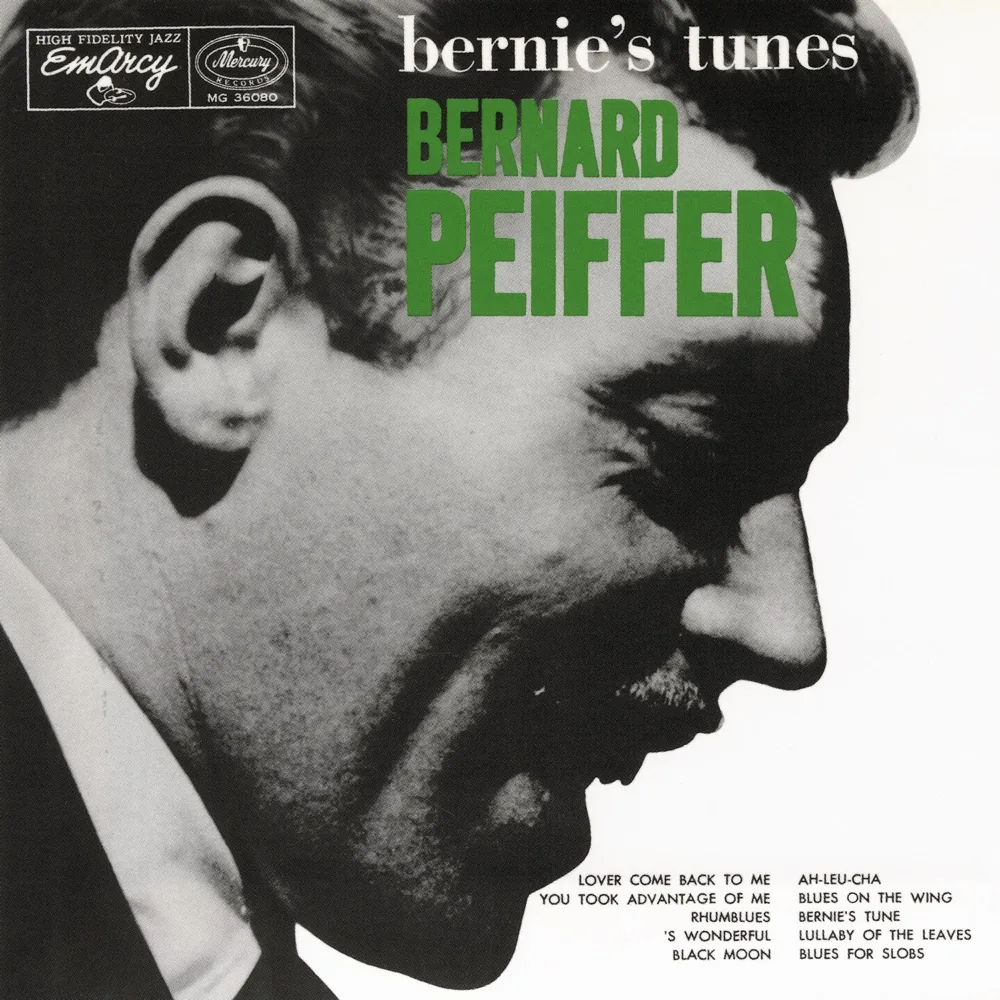
Bernard Peiffer on the cover of *Bernie's Tunes* (EmArcy MG 36080, 1956), a large black and white profile photograph of the pianist. Standard copyright, all rights reserved, held by the record label. This is not a Creative Commons or public-domain image; it is an album cover shown as an honestly disclosed editorial identification image. — Apple Music artwork for the album, https://music.apple.com/us/album/bernies-tunes/1807638336
Bernard Peiffer (pronounced "pay-FAIR") was born on October 23, 1922, in Épinal, in the Vosges in north-eastern France. He was a pianist, composer and teacher who made his name in Paris, Nice and Monte Carlo in the 1940s and early 1950s and spent the last twenty-two years of his life in Philadelphia. His father, a former army man, played the violin and loved chamber music, and an uncle, Georges Peiffer, was a composer and church organist. He began piano and harmony at nine with Pierre Maire, a pupil of Nadia Boulanger, and astonished older students by playing back long stretches of classical pieces by ear. He went on studying through his teens at the École Normale in Paris, the Marseille Conservatoire and the Paris Conservatoire, where he won the first prize in piano.
Drawn to the freedom of improvising and to the playing of Fats Waller and Art Tatum, he made his professional debut in 1943, at twenty, with the alto saxophonist André Ekyan, and soon afterwards was working with Django Reinhardt at the Bœuf sur le Toit in Paris; he later credited Reinhardt with teaching him the music business. After he saw a friend shot by the Gestapo in a Paris street he joined the Resistance, was captured, and spent more than a year in prison. Out of the army in 1946, he returned to music with concerts for the Hot Club de France at the Salle Pleyel, picked up again with Reinhardt, and toured with Hubert Rostaing and with Jacques Hélian's orchestra.
In February 1948 he played at the festival in Nice, often described as the first jazz festival, and his playing so impressed the Ellington alumnus Rex Stewart that Stewart hired him for a tour and recordings. Records for the Swing and Blue Star labels followed: behind the tenor saxophonist Don Byas and the trumpeter Bill Coleman in January 1949, with the saxophonist James Moody in July 1949, and with the alto saxophonist Hubert Fol's Be-Bop Minstrels and the drummer Kenny Clarke in October 1949, alongside sides under his own name. By 1949 he was a national name. He won a Jazz Hot magazine prize, led a quintet at the Club Saint-Germain and at the Ringside, wrote music for films, including Jacques Becker's Rendez-vous de juillet (1949) and Jean-Pierre Melville's Quand tu liras cette lettre (1953), and in 1953 won the Grand Prix du Disque, a prize French Wikipedia credits to the Académie Charles-Cros. Visiting Americans heard him in the clubs of Paris, Monte Carlo and Nice, among them Oscar Peterson, Lionel Hampton and Hazel Scott, and the American critic Barry Ulanov wrote in Metronome in 1953 that nobody he had heard matched Peiffer's skills as an improviser or his knowledge of the instrument.
On December 20, 1954, he left France for the United States and settled in Philadelphia, where his wife Corine and their baby daughter Rebecca soon joined him. His American career began well: he played at Carnegie Hall, Birdland, the Composer Room, the Academy of Music and the Newport Festival, appeared on television and radio, and made about seven albums, among them Bernie's Tunes for EmArcy, recorded in New York in May 1956 with the guitarist Joe Puma, the bassists Oscar Pettiford and Chuck Andrus, and the drummer Ed Thigpen. The critic Leonard Feather wrote that he could not recall a jazz pianist other than Art Tatum blessed with such mastery. Against that stood poor management and promotion, long gaps in his work and trouble with record companies. The death of his daughter Pascale, born in 1956, at the age of two lies behind his piece "Poem for a Lonely Child"; his son Stephan was born in 1962.
His last commercially issued album appeared in 1965. After kidney surgery at the end of that decade he performed less and taught more, mostly in the Philadelphia area, leading a trio with the bassist Al Stauffer and, in different years, the drummers Jim Paxson and Billy Jones, giving college concerts, and travelling to Los Angeles for engagements at Donte's in September 1970. In 1974 he played the solo piano night of the Newport-New York Festival at Carnegie Hall. He kept teaching and performing around Philadelphia until his kidney trouble worsened, and he passed away on September 7, 1976, at the age of 53. His students included Uri Caine, Annie Gosfield, Sumi Tonooka, Tom Lawton and Don Glanden. Glanden and Stephan Peiffer later assembled about sixty-seven reels of solo, duo and trio tapes made around Philadelphia between 1970 and 1975 into the solo album Formidable...! (2005).
His claim to be counted among French jazz musicians rests on his birth in Épinal and on the eleven years from his 1943 debut to his departure in 1954, when his reputation was made in Paris and on the Riviera; the American half of his career, from 1954 to 1976, was spent in Philadelphia.
Peiffer came to jazz from a full classical training, and the two sides stayed visible: he improvised a prelude and fugue on George Shearing's "Lullaby of Birdland" as a closing number at concerts, and recorded it in 1965 beside a "Hommage à J.S. Bach". He was shaped by Fats Waller and Art Tatum, and critics kept returning to Tatum when they described his speed and command of the keyboard; the tribute piece "Requiem (For Art Tatum)" is on The Astounding Bernard Peiffer (1958). His composition "Black Moon", on Bernie's Tunes, is built on Schoenberg's twelve-tone system, which Don Glanden describes as one of the first introductions of atonal improvisation to a jazz audience. Victor Schermer, reviewing the solo tapes, found his playing transparent in its articulation of ideas and impossible to pin to one label. Leonard Feather, Barry Ulanov, Nat Hentoff and Burt Korall all wrote about him in notes or reviews. As a teacher in Philadelphia he passed these habits on to Uri Caine and other pianists.
- Le Most (1954, EmArcy) - an EP with Bobby Jaspar and Bib Monville on tenor saxophone, Roger Guérin on trumpet and tuba, Jean-Marie Ingrand on bass and Jean-Baptiste "Mac Kac" Reilles on drums; its title echoes his nickname, "Le Most".
- Bernie's Tunes (1956, EmArcy) - his American debut for the label, recorded in New York in May 1956 with Joe Puma, Oscar Pettiford, Chuck Andrus and Ed Thigpen, and including "Black Moon". Apple Music - Bernie's Tunes Listen
- The Astounding Bernard Peiffer (1958, Decca) - the trio album with Ernie Furtado on bass and Johnny Cresci on drums, with notes by Barry Ulanov and the "Requiem (For Art Tatum)".
- Modern Jazz for People Who Like Original Music (1960, Laurie) - a trio set with Gus Nemeth and Jerry Segal that includes "Poem for a Lonely Child" and "Tired Blues".
- The Pied Peiffer of the Piano (1960, Decca) - standards with Nemeth and Segal, with a variations treatment of "Willow Weep for Me".
- Prelude, Fugue and Trio on "Lullaby of Birdland" (1965, Polydor) - recorded in Philadelphia in November and December 1965 with Gus Nemeth on bass and Johnny Coates on vibraphone, with Peiffer also on harpsichord.
- Formidable...! (2005, Manege Productions) - solo piano from Philadelphia concerts and club dates of 1970 to 1975, compiled from his family's tapes. Apple Music - Formidable...! Listen
- Liza / Yesterday (1949, Swing) - a 78 with Don Byas, Bill Coleman, Jean Bouchéty and Roger Paraboschi recorded on January 5, 1949, a good sample of his Paris sideman work.
Bernard Peiffer: Full Discography
French jazz pianist and composer, born October 23, 1922 in Épinal, died September 7, 1976 in Philadelphia. Discogs artist 442986 (https://www.discogs.com/artist/442986). Related Discogs entities checked: The Bernard Peiffer Trio (565715) and Bernard Peiffer And His Saint-Germain-des-Prés Orchestra (902342); their records are included below.
The first table lists records under his own name or his trio. The second is a selection of sideman credits from his Paris years, not an exhaustive list. Years follow Discogs and English Wikipedia; where another source gives a different year, the Notes cell says so. Catalogue numbers and personnel are given only where a Discogs release record or another source shows them, and "Not confirmed" marks what could not be verified.
Leader and trio releases
| Album | Year | Label | Personnel | Notes | Listen | Buy |
|---|---|---|---|---|---|---|
| That Good Old Fats / Bernie's Blues (78 rpm single) | 1947 | Swing | Bernard Peiffer (piano); other musicians not confirmed | Catalogue number not confirmed. MusicBrainz dates it 1946. | — | — |
| Garni Blues / Lullaby for a Be-Bop Baby (78 rpm single) | 1949 | Swing | Bernard Peiffer (piano); other musicians not confirmed | Catalogue number not confirmed. MusicBrainz dates it 1948. | — | — |
| Paris-Monte-Carlo / Bagdad Boogie (78 rpm single) | 1949 | Swing | Bernard Peiffer (piano) and André Persianny (name as billed); other musicians not confirmed | Billed to both names. Catalogue number not confirmed. | — | — |
| Algo Bueno / Round 'Bout Midnight (78 rpm single) | 1950 | Swing | Bernard Peiffer (piano); other musicians not confirmed | Catalogue number not confirmed. MusicBrainz dates it 1949. | — | — |
| Jeepers Creepers / Tired Blues (single, Bernard Peiffer Trio) | 1952 | Blue Star | Bernard Peiffer (piano); trio members not confirmed | Catalogue number not confirmed. | — | — |
| Prélude / Toccata (single) | 1953 | Blue Star N° 8003 | Bernard Peiffer (piano, solo) | Improvisations; "Toccata" was recorded on March 3, 1952 in Paris. Produced by Eddie Barclay. | — | — |
| Bernard Peiffer et son trio (10-inch LP) | 1954 | Blue Star N° 6808 | Bernard Peiffer (piano) with his trio; members not confirmed | In the Blue Star Piano-Jazz series. French Wikipedia lists a 1954 issue on Norgran. | — | — |
| Le Most (EP) | 1954 | EmArcy EP-1-6062 | Bernard Peiffer (piano), Bobby Jaspar and Bib Monville (tenor saxophone), Roger Guérin (trumpet, tuba), Jean-Marie Ingrand (bass), Jean-Baptiste "Mac Kac" Reilles (drums) | Year follows Discogs and English Wikipedia; French Wikipedia lists a 1955 EmArcy album of the same title. | — | — |
| I Want to Be Happy (Bernard Peiffer and His Saint-Germain-des-Prés Orchestra, 10-inch LP) | Not confirmed | Blue Star BLP 6842 | Bernard Peiffer (piano) and orchestra; members not confirmed | Eight tracks including "Paris je t'aime", "Who Is Me", "Frozen Feet" and "Strip Tease". Discogs lists it under 1955 on the artist page but gives no year on the release. Cover by Kokkinis, photograph by Jean-Pierre Leloir. | — | — |
| Bernie's Tunes | 1956 | EmArcy MG 36080 | Bernard Peiffer (piano), Joe Puma (guitar), Oscar Pettiford (bass, side A), Chuck Andrus (bass, side B), Ed Thigpen (drums, side B) | Ten tracks including "Black Moon", "Ah-Leu-Cha" and "Bernie's Tune". Recorded in New York in May 1956. The side A drummer is not credited on Discogs. | Apple Music | — |
| Piano et rythmes | 1957 | Barclay 84.008 | Bernard Peiffer (piano, uncredited), Jean-Marie Ingrand (bass, uncredited), Roger Paraboschi (drums, uncredited) | Fourteen standards. Photography by Herman Leonard, sleeve notes by André Francis. | — | — |
| Piano a la mood | 1958 | Brunswick LAT 8262 | Bernard Peiffer (piano); accompanists not confirmed | Twelve tracks. Sleeve notes by Nat Hentoff, photography by Roy Pinney. French Wikipedia gives 1958 with no label. | — | — |
| The Astounding Bernard Peiffer: Presenting the Bernard Peiffer Trio | 1958 | Decca DL 8626 | Bernard Peiffer (piano), Ernie Furtado (bass), Johnny Cresci (drums) | Ten tracks including "Pied Peiffer" and "Requiem (For Art Tatum)". Liner notes by Barry Ulanov. | — | — |
| Modern Jazz for People Who Like Original Music | 1960 | Laurie Records LLP 1006 | Bernard Peiffer (piano), Gus Nemeth (bass), Jerry Segal (drums) | Six tracks including "Poem for a Lonely Child", "Tired Blues" and "Strip Tease". English Wikipedia and Discogs give 1960; French Wikipedia gives 1959. | — | — |
| The Pied Peiffer of the Piano | 1960 | Decca DL 9218 | Bernard Peiffer (piano), Gus Nemeth (bass), Jerry Segal (drums) | Eight standards. Liner notes by Burt Korall. French Wikipedia lists a Decca album of this title under 1958. | — | — |
| Bernard Peiffer Plays Cole Porter's Can-Can | 1960 | Laurie Records LLP 1008 | Bernard Peiffer (piano), Chris White and Jerry Segal (named in the release notes, instruments not stated) | Eight tracks from the film version of Cole Porter's Can-Can. | — | — |
| Prelude, Fugue and Trio on "Lullaby of Birdland" (labelled Bernard Peiffer Trio) | 1965 | International Polydor Production 623 210 | Bernard Peiffer (piano, harpsichord), Gus Nemeth (bass), Johnny Coates (vibraphone) | Recorded at Cameo Parkway Studios, Philadelphia, on November 16 and 18 and December 1, 1965. Tracks include "Hommage à J.S. Bach" and "A Taste of Honey". English Wikipedia gives 1965 as the year of his last commercial album; Discogs dates this pressing 1966. | — | — |
| La Vie en rose (compilation) | 2001 | Gitanes 013 980-2 (as cited in a liner-note reference) | Bernard Peiffer (piano) and various accompanists | Part of a French-jazz reissue series. Discogs and Apple Music list it as 2001 and the liner notes cited by All About Jazz are dated 2002. | — | — |
| Plays Standards (The Bernard Peiffer Trio, compilation) | 2002 | Decca France (per Apple Music) | Bernard Peiffer (piano) with trio; members not confirmed | Reissue of trio recordings. French Wikipedia lists a 2003 EmArcy release of the same title. | Apple Music | — |
| Formidable...! | 2005 | Manege Productions | Bernard Peiffer (piano, solo) | Posthumous solo album from Philadelphia tapes of 1970 to 1975, compiled by Don Glanden and Stephan Peiffer; two All About Jazz pieces date it 2006. Includes "Poem for a Lonely Child", "'Round Midnight", "All the Things You Are" and "Black Moon". | Apple Music | — |
| Improvision (compilation) | 2012 | Universal / EmArcy | Bernard Peiffer (piano) | Reissue compilation from the French catalogue. | — | — |
Sideman credits (selection)
| Year | Project (leader) | Title | Label | Catalog | Role | Notes |
|---|---|---|---|---|---|---|
| 1948 | Rex Stewart | 1948-1949 (Classics compilation, 2001) | Classics | CLASSICS 1164 | Piano (tracks 1 to 4) | With Rex Stewart (cornet), Vernon Story (tenor saxophone) and Ted Curry (drums). Recording dates for the four tracks are not confirmed. |
| 1949 | Bill Coleman and Don Byas | "Liza" / "Yesterday" (78 rpm) | Swing | SW. 300 | Piano | With Don Byas (tenor saxophone), Bill Coleman (trumpet on side A), Jean Bouchéty (bass) and Roger Paraboschi (drums). Recorded January 5, 1949. |
| 1949 | James Moody Quintet | "Oh! Well" / "Convulsions" (78 rpm) | Blue Star | B.S. N° 130 | Piano | With James Moody (tenor saxophone), Nat Peck (trombone), Lucien Simoens (bass) and Richie Frost (drums). Recorded July 7, 1949 at Studio Technisonor, Paris. |
| 1950 | Hubert Fol et ses Be-Bop Minstrels avec Kenny Clarke | "Iambic Pentameter" / "Robbin's Nest" (78 rpm) | Swing | SW. 325 | Piano | With Hubert Fol (alto saxophone), Nat Peck (trombone), Jean Bouchéty (bass) and Kenny Clarke (drums). Recorded October 29, 1949. |
| 1950 | Geo Daly | "Nine O'Clock Jump" / "Moonglow" (78 rpm) | Swing | Not confirmed | Piano | Geo Daly's quartet with Jean Bouchéty (bass) and Roger Paraboschi (drums), per French Wikipedia, which dates the session 1949. Discogs lists the single under 1950. |
- Django Reinhardt - the guitarist with whom he worked at the Bœuf sur le Toit soon after his 1943 debut, and again after the Liberation, including club dates and a tour.
- André Ekyan - the alto saxophonist with whom he made his professional debut in 1943.
- Hubert Rostaing and Jacques Hélian - bandleaders he toured with after 1946.
- Rex Stewart - the former Ellington cornetist who took him on tour and into the studio after hearing him at Nice in 1948; Peiffer is the pianist on the first four tracks of the compilation 1948-1949 (Classics).
- Don Byas and Bill Coleman - tenor saxophonist and trumpeter on the Swing 78 "Liza" / "Yesterday", recorded January 5, 1949.
- James Moody - tenor saxophonist on "Oh! Well" and "Convulsions" (Blue Star, recorded July 7, 1949) with the trombonist Nat Peck.
- Hubert Fol and Kenny Clarke - alto saxophonist and drummer on "Iambic Pentameter" / "Robbin's Nest" (Swing, recorded October 29, 1949), with Nat Peck and the bassist Jean Bouchéty.
- Jean-Marie Ingrand and Roger Paraboschi - bassist and drummer of his Paris trios in the 1950s; Ingrand is on Le Most and Paraboschi on Piano et rythmes.
- Bobby Jaspar and Roger Guérin - saxophonist and trumpeter on Le Most.
- Oscar Pettiford, Chuck Andrus, Joe Puma and Ed Thigpen - the bassists, guitarist and drummer of Bernie's Tunes (1956).
- Gus Nemeth, Jerry Segal, Ernie Furtado and Johnny Cresci - the bassists and drummers of his Decca and Laurie trio albums (1958 to 1960).
- Al Stauffer, Jim Paxson and Billy Jones - bassist and drummers of his Philadelphia trio in the 1970s, heard on Formidable...!.
- Uri Caine, Annie Gosfield, Sumi Tonooka, Tom Lawton and Don Glanden - pianists who studied with him in Philadelphia; Glanden produced Formidable...! with Stephan Peiffer.

More Bebop Artists
See all 246 Bebop artists →More French Jazz Artists
See all 170 French artists →- Apple Music artist page
- Discogs
- MusicBrainz
- All About Jazz
- Wikipedia (English)
- Wikipedia (French)
- Wikidata
- BnF catalogue
- Bernard Peiffer on JazzProfiles.com
- Wikipedia (English): Bernard Peiffer
- Wikipedia (French): Bernard Peiffer
- All About Jazz: Bernard Peiffer: Formidable, by Don Glanden (2006)
- All About Jazz: The Bernard Peiffer Legacy, by Victor L. Schermer (2006)
- All About Jazz: Formidable...!, review by Victor L. Schermer (2006)
- Wikidata: Bernard Peiffer (Q435692)
- Discogs: Bernard Peiffer
- MusicBrainz: Bernard Peiffer
- Apple Music: Bernard Peiffer