JAZZPROFILES lives in the music 2,555 Jazz Artists fully Profiled!
Tony Esposito
Last updated November 10, 2026
Listen on Spotify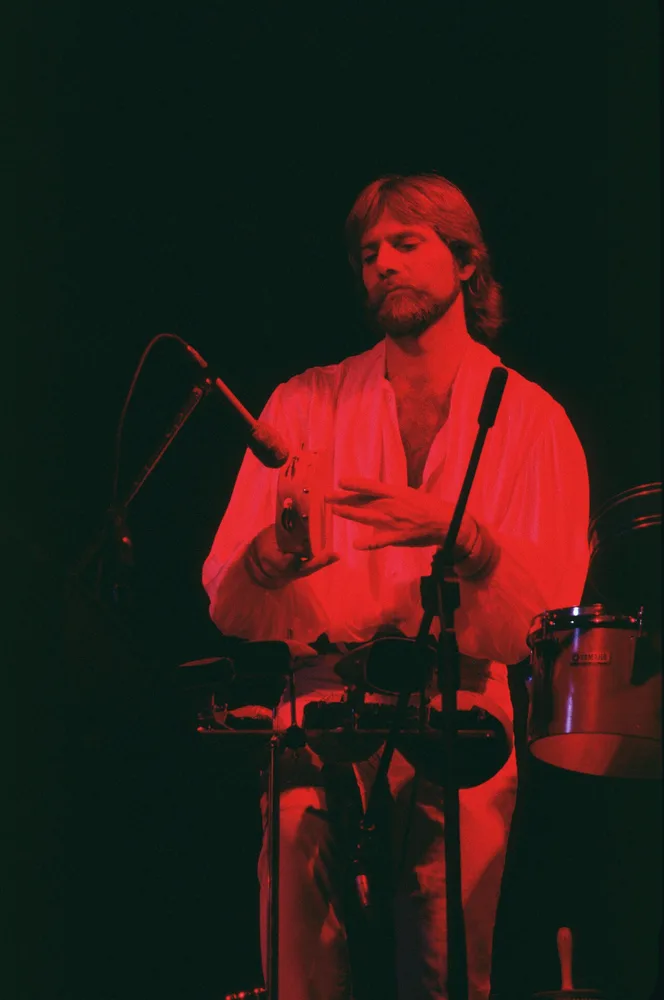
Tony Esposito in concert, early 1980s CC BY-SA 3.0 — Wikimedia Commons - https://commons.wikimedia.org/wiki/File:Tony_Esposito_01.jpg - Gorup de Besanez (own work)

Tony Esposito (Antonio Esposito) was born in Naples on July 16, 1950, and took up percussion as a teenager. He began working in the early 1970s as a drummer and percussionist on records by the new generation of Italian singer-songwriters. He is credited on drums and percussion on Alan Sorrenti's debut Aria (Harvest, 1972), and again on Sorrenti's Come un vecchio incensiere all'alba di un villaggio deserto (1973), where he plays drums, percussion and cymbals across both sides. Edoardo Bennato's I buoni e i cattivi (Ricordi, 1974) lists him on drums and Lucio Dalla's Automobili (RCA, 1976) on percussion; Wikipedia adds Francesco Guccini, Francesco De Gregori and Roberto Vecchioni to the list of artists he recorded with in those years.
His first record under his own name, Rosso napoletano (Numero Uno, released in December 1974 according to Discogs), came out of that circuit. The producer was Renato Marengo, who also produced his next three albums, and the five-track LP was recorded with the English arranger Paul Buckmaster on synthesizer and piano, Bob Fix on saxophones, Gigi De Rienzo on bass and guitar, Mark Harris on electric piano and Bennato adding vocal effects. Processione sul mare (1976) and Gente distratta (1977) kept the same small circle together, with Esposito credited on drums, percussion, marimba and santoor, De Rienzo as arranger and bassist, Fix on reeds and Ernesto Vitolo on keyboards for the third album. Discogs files all three under jazz-rock. La banda del sole (Philips, 1978) widened the lineup with Eugenio Bennato on mandolin, Karl Potter on congas and Aldo Mercurio on double bass. Italian sources group Esposito with Vitolo, De Rienzo, Fix and Harris as founding names of the Neapolitan "Napoli Power" scene, in which funk, jazz and world rhythms are grafted onto Naples song.
The most direct jazz-side credit of the decade is on the Italian jazz-rock group Perigeo's La valle dei templi (RCA Italiana, 1975), where Esposito plays percussion beside Giovanni Tommaso on bass and synthesizer, Franco D'Andrea on piano and synthesizers, Claudio Fasoli on saxophones, Bruno Biriaco on drums and the guitarist Tony Sidney. Italian Wikipedia says that La banda del sole led to his appearing at the Montreux Jazz Festival with Perigeo, and that he returned to Montreux in 1980 as a guest with his own Tony Esposito Group.
In 1981 he played percussion on four tracks of Pino Daniele's Vai mò (EMI), the album that Italian Wikipedia cites as the high point of the "blues metropolitano" sound, a term that Esposito, Tullio De Piscopo, James Senese, Joe Amoruso, Rino Zurzolo and Fabio Forte are said to have helped coin; Discogs lists it as jazz, rock and blues. Wikipedia also records his later work on Daniele's 2007 and 2008 albums.
Around 1982 his career turned toward pop. With the co-writer Remo Licastro he produced the Pagaia theme for the RAI program Domenica in and the album Tamburo (Bubble, 1982), and from there he became a chart act. "Kalimba de Luna," on Il grande esploratore (Bubble, 1984), won the Un disco per l'estate festival in 1984, charted in Italy and Switzerland, and was covered at almost the same time by Boney M, whose version reached No. 17 in Germany; Italian Wikipedia puts the song at more than five million copies worldwide, a figure given there without a source. He won the same festival again in 1985 with "As tu às." "Papa Chico" reached No. 2 in the Netherlands, where it held the position for five weeks, and No. 3 in Belgium. In 1986 he received a Nastro d'argento for the score of Lina Wertmüller's Camorra (Italian title Un complicato intrigo di donne, vicoli e delitti). He entered the Sanremo Festival in 1987 with "Sinuè," in 1990 beside Eugenio Bennato with "Novecento aufwiedersehen," and in 1993 with the group Ladri di Biciclette with "Cambiamo musica." He also invented and patented the tamborder, a hybrid electronic percussion instrument, which Discogs credits to him on As tu às.
His later releases are Il villaggio globale (1990), Tropico (1996), the soundtrack Storie d'amore con i crampi (1996), Viaggio tribale (2003), Sentirai (2011) and Tam Tam Bass (2013), the last made with the orchestra of the Accademia Nazionale di Santa Cecilia and released on Sony Classical. In 2014 he received the DiscoDays award, with a citation that praised the combination of world music, ethnic rhythms, funk and jazz in his playing. A single with Luca Maris, "Luna e sole," followed in 2016 and another, "Inès," in 2022.
Esposito is a percussionist first, and the records show it: the early albums are built on drum kit, percussion, marimba and santoor, with saxophone, electric piano and De Rienzo's bass carrying the tunes. The sound blends Neapolitan melody with African, Latin American and Mediterranean rhythm, which is why the first four albums sit between jazz-rock and what Italians call world or ethnic music. A Debaser review of La banda del sole describes it as instrumental progressive jazz-rock with Latin, Afro and Mediterranean color.
This is a crossover profile, and the pop side is the larger part of his public story. From 1982 the records turn to dance and radio formats: "Kalimba de Luna," "Papa Chico" and "As tu às" are electronic pop with tribal percussion. The jazz-side evidence is concentrated in 1972 to 1981: the four early albums, the Perigeo credit, the Montreux appearances and the sessions for Pino Daniele. He is best understood as a Neapolitan rhythm specialist whose fusion years fed both the "Napoli Power" scene and a later career of world-pop hits.
- Rosso napoletano (1974, Numero Uno) - His debut, five tracks of jazz-rock with Paul Buckmaster on synthesizer and Bob Fix on saxophones. Spotify - Rosso napoletano Listen
- Processione sul mare (1976, Numero Uno) - The second Marengo-produced album, with Francesco Bruno on guitar and Stefano Sabatini on keyboards, eight tracks ending with the title piece. Spotify - Processione sul mare Listen
- Gente distratta (1977, Numero Uno) - Percussion, marimba and santoor over Vitolo's keyboards and Fix's reeds, six tracks including "Session Man" and "Xantur."
- La banda del sole (1978, Philips) - The most ambitious of the early records, with mandolin, congas and double bass added to the core group and a track written for bass, piano, drums and pots. Spotify - La banda del sole Listen
- La valle dei templi (Perigeo, 1975, RCA Italiana) - His clearest credit in the Italian jazz-rock scene, as the percussionist added to the Tommaso, D'Andrea, Fasoli and Biriaco lineup.
- Vai mò (Pino Daniele, 1981, EMI) - Percussion on four tracks of the record that defined Neapolitan blues-rock.
- Il grande esploratore (1984, Bubble) - The album that contains "Kalimba de Luna" and marks the move into pop. Spotify - Il grande esploratore Listen
Tony Esposito: Full Discography
Discogs artist: Tony Esposito (61848) · Born July 16, 1950, Naples, Italy
His leader catalogue splits into two halves. The four albums of 1974 to 1978 are the jazz-rock and Mediterranean fusion records, listed first, and the albums from 1982 onward are the pop and world-music records built around "Kalimba de Luna" and "Papa Chico." Years and catalog numbers below come from the original pressings where a release could be checked, and Wikipedia where it could not; rows resting on Wikipedia alone say so.
Leader: Studio Albums
| Album | Year | Label | Personnel & Notes | Listen | Buy |
|---|---|---|---|---|---|
| Rosso napoletano | 1974 | Numero Uno (ZSLN 55677) | His debut, five tracks, produced by Renato Marengo. Paul Buckmaster (synthesizer, piano), Bob Fix (soprano and alto saxophones), Gigi De Rienzo (guitars, electric bass), Bruno Limone (electric bass), Mark Harris (Fender Rhodes), Edoardo Bennato (vocal effects). Esposito on drums, percussion, reco-reco and vocals. Listed on Discogs as jazz-rock and released there in December 1974 | Spotify | — |
| Processione sul mare | 1976 | Numero Uno (ZSLN 55686) | Produced by Renato Marengo with Esposito as artistic director and arranger. Gigi De Rienzo (electric bass), Francesco Bruno (electric and acoustic guitars), Stefano Sabatini (keyboards), Bob Fix (saxophones), Lina Sastri (vocal effects). Eight tracks. Listed on Discogs as jazz-rock | Spotify | — |
| Gente distratta | 1977 | Numero Uno (ZPLN 34015) | Six tracks including "Session Man," "Xantur" and "Kosen Rufen." Esposito on drums, percussion, marimba and santoor; Gigi De Rienzo (bass, arranger, music director), Ernesto Vitolo (piano, electric piano, synthesizer, organ), Bob Fix (tenor and soprano saxophones, melodica), Karl Potter (congas). Listed on Discogs as jazz-rock | — | — |
| La banda del sole | 1978 | Philips (6323 058) | Seven tracks, produced by Renato Marengo. Esposito (percussion, vocals), Gigi De Rienzo (bass), Ernesto Vitolo (keyboards), Francesco Bruno (electric guitar), Aldo Mercurio (double bass), Eugenio Bennato (mandolin), Bob Fix (saxophone), Karl Potter (congas), Andrea Smith (vocals). Includes "Quartetto," written for bass, piano, drums and pots | Spotify | — |
| Tamburo | 1982 | Bubble (BLU 19611) | Eleven tracks including "Pagaia" (the Domenica in theme), "Camminando," "Pata Pata" and "Caravan." Produced by Esposito and Willy David | — | — |
| Il grande esploratore | 1984 | Bubble (BLULP 1818) | Nine tracks, including "Kalimba de Luna," winner of Un disco per l'estate that year | Spotify | — |
| As tu às | 1985 | Bubble (BLULP 1821) | Nine tracks including the title song, "Papa Chico" and "Balafon." Produced and arranged by Mauro Malavasi and Esposito, with Remo Licastro (keyboards, backing vocals, arrangement), Luca Malaguti (bass, guitar), Luè Franco (lead vocals) and Esposito on tamborder, percussion, drum machine and vocals. The title song won Un disco per l'estate in 1985 | — | — |
| Tony Esposito | 1987 | Bubble (BLULP 1826) | Nine tracks. Details of the personnel not confirmed | — | — |
| Il villaggio globale | 1990 | Bubble (BLULP 1833) | Eight tracks. Details of the personnel not confirmed | — | — |
| Cambiamo musica | 1993 | Mint Records (88 001 65) | Eighteen tracks on the European release. The title song was his 1993 Sanremo entry with the group Ladri di Biciclette | — | — |
| Tropico | 1996 | RTI Music (RTI 1113-2) | Seventeen tracks. Details of the personnel not confirmed | — | — |
| Viaggio tribale | 2003 | Audioglobe | Made after travels around the Mediterranean, according to Italian Wikipedia. Year and label as given by Wikipedia; not independently confirmed | — | — |
| Sentirai | 2011 | RaiTrade (Suoni del Sud) | Year and label as given by Wikipedia; not independently confirmed | — | — |
| Tam Tam Bass | 2013 | Sony Classical | Made with the orchestra of the Accademia Nazionale di Santa Cecilia, according to Italian Wikipedia. Year and label as given by Wikipedia; not independently confirmed | — | — |
Compilations and Soundtracks
| Title | Year | Label | Type | Notes | Listen | Buy |
|---|---|---|---|---|---|---|
| Incontro con Toni Esposito | 1978 | Numero Uno (ZNLN 33062) | Compilation | Five tracks from his first three albums, produced by Renato Marengo | — | — |
| Un complicato intrigo di donne, vicoli e delitti | 1986 | Cinevox | Soundtrack | Score for Lina Wertmüller's film, which brought him a Nastro d'argento. Italian Wikipedia also lists an album titled L'ombra nera del Vesuvio on the same label that year; how the two relate is not confirmed | — | — |
| Le origini | 1996 | BMG Ricordi / Numero Uno (74321365192) | Compilation | Two discs, nineteen tracks, collecting Rosso napoletano, Processione sul mare and Gente distratta | — | — |
| Storie d'amore con i crampi | 1996 | Cecchi Gori Music | Soundtrack | Score for the film by Pino Quartullo | — | — |
Singles
| Single | Year | Label | Notes | Listen | Buy |
|---|---|---|---|---|---|
| "Danza dei bottoni" / "L'eroe di plastica" | 1975 | Numero Uno (ZN 50341) | His first single, both sides from Rosso napoletano | — | — |
| "Processione sul mare" / "Mercato di stracci" | 1976 | Numero Uno (ZN 50347) | From Processione sul mare | — | — |
| "Pagaia" / "Controra" | 1982 | Bubble (BLU 9320) | The Domenica in theme, from Tamburo | — | — |
| "Kalimba de Luna" / "Lagos" | 1984 | Bubble (BLU 9227) | Winner of Un disco per l'estate 1984; charted in Italy and Switzerland. Covered by Boney M, whose version reached No. 17 in Germany | Spotify | — |
| "Papa Chico" / "Waky Nà" | 1985 | Bubble (BLU 9232) | No. 2 in the Netherlands for five weeks and No. 3 in Belgium | Spotify | — |
| "Sinuè" | 1987 | Not confirmed | His Sanremo Festival entry in 1987 | — | — |
| "Novecento aufwiedersehen" | 1990 | Not confirmed | His Sanremo Festival entry in 1990, with Eugenio Bennato | — | — |
Guest and Sideman Appearances (selected)
Esposito is credited on a long run of Italian pop, rock and singer-songwriter records, and the table covers the ones with a jazz or fusion connection plus a few documented early credits. Wikipedia also lists him on records by Francesco Guccini, Francesco De Gregori and Roberto Vecchioni from 1973 and 1974, which are not itemized here.
| Year | Project (Leader) | Title | Label | Catalog | Role | Notes |
|---|---|---|---|---|---|---|
| 1972 | Alan Sorrenti | Aria | Harvest | 3C 064-17836 | Drums, percussion | Debut album of the singer |
| 1973 | Alan Sorrenti | Come un vecchio incensiere all'alba di un villaggio deserto | Harvest | 3C 064-17878 | Percussion, drums, cymbals | Credited on every track, with the instrument varying by track |
| 1974 | Edoardo Bennato | I buoni e i cattivi | Ricordi | SMRL 6129 | Drums | Bennato's second album |
| 1975 | Perigeo | La valle dei templi | RCA Italiana | TPL1-1175 | Percussion | Beside Giovanni Tommaso (bass, synthesizer, vocals), Franco D'Andrea (piano, synthesizers), Claudio Fasoli (saxophones), Bruno Biriaco (drums, percussion) and Tony Sidney (guitars). Discogs lists it as jazz-rock and fusion |
| 1976 | Lucio Dalla | Automobili | RCA Italiana | TPL1-1202 | Percussion | |
| 1977 | Luciano Cilio | Dialoghi del presente | EMI | 3C 064-18253 | Percussion | Credited as Toni Esposito |
| 1981 | Pino Daniele | Vai mò | EMI | 3C 064-18550 | Percussion | Four tracks: "Notte che se ne va," "Viento 'e terra," "Ma che ho" and "È sempe sera." Discogs lists it as jazz-rock |
- Renato Marengo - producer of his first four albums (1974 to 1978) and of the 1978 compilation Incontro con Toni Esposito.
- Paul Buckmaster - synthesizer and piano on Rosso napoletano (1974).
- Bob Fix, Gigi De Rienzo, Ernesto Vitolo, Mark Harris - the Neapolitan core of his 1974 to 1978 records on saxophones, bass and guitar, keyboards and electric piano.
- Giovanni Tommaso, Franco D'Andrea, Claudio Fasoli, Bruno Biriaco - his bandmates on Perigeo's La valle dei templi (1975), with the guitarist Tony Sidney.
- Alan Sorrenti - drums and percussion on Aria (1972) and Come un vecchio incensiere all'alba di un villaggio deserto (1973).
- Edoardo Bennato and Eugenio Bennato - Esposito plays drums on Edoardo's I buoni e i cattivi (1974), and Edoardo adds vocal effects to Rosso napoletano; Eugenio plays mandolin on La banda del sole and entered Sanremo with him in 1990.
- Lucio Dalla and Luciano Cilio - sessions for Automobili (1976) and Dialoghi del presente (1977).
- Pino Daniele - percussion on four tracks of Vai mò (1981), with later credits on his 2007 and 2008 albums.
- Remo Licastro - co-writer and arranger of the early 1980s hits.
- Tullio De Piscopo, James Senese, Joe Amoruso, Rino Zurzolo - fellow Neapolitan players named alongside him in the "blues metropolitano" circle.
- Don Cherry, Don Moye, Gato Barbieri, Eumir Deodato, Brian Auger, Billy Cobham, Naná Vasconcelos and Gilberto Gil - international musicians that Wikipedia says he played or recorded with; the specific sessions and dates are not documented in the sources checked.