 JAZZPROFILES lives in the music 1,572 Jazz Artists fully Profiled!
 Umberto Fiorentino
Last updated October 1, 2026
Listen on Spotify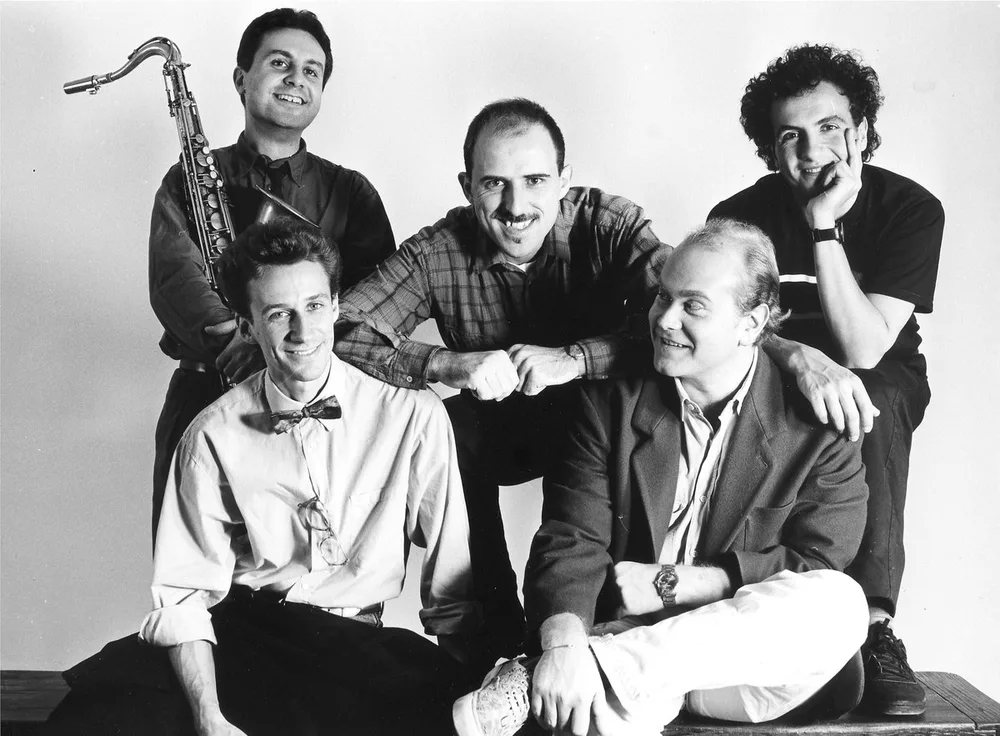
Lingomania in 1987: Umberto Fiorentino (guitar) and Roberto Gatto in front, with Maurizio Giammarco (tenor saxophone), Enzo Pietropaoli and Danilo Rea behind. Photo: Andrea Sabatello. CC BY-SA 4.0 (Creative Commons Attribution-ShareAlike 4.0 International) — Wikimedia Commons, File:Lingomania 1987 (foto A.Sabatello).jpg, https://commons.wikimedia.org/wiki/File:Lingomania_1987_(foto_A.Sabatello).jpg (uploaded as own work by the Wikimedia account "Maurizio Giammarco" while editing the Italian Wikipedia article on Lingomania; photograph credited to Andrea Sabatello)
.jpg)
Umberto Fiorentino was born in Rome on February 5, 1956, and has lived his entire life in and around the city. He is entirely self-taught: by his own account, hearing a high-school classmate play pieces by John McLaughlin and George Benson was "a shock" that sent him toward jazz. He began performing professionally on the Rome jazz club circuit in the mid-1970s, playing alongside musicians of his own generation before joining the groups led by drummer Roberto Gatto and saxophonist Maurizio Giammarco.
Those groups were a prelude to Lingomania, the electric jazz quintet Giammarco founded in 1984. Across its active years the band's lineup included Gatto on drums, trumpeter Flavio Boltro, bassist Furio Di Castri and, later, bassist Enzo Pietropaoli, keyboardist Danilo Rea and drummer Alberto D'Anna. Lingomania recorded three studio albums in the 1980s - Riverberi (1986), Grr...Expanders (1988) and Camminando (1989), all on Gala Records - and was voted best Italian group in Musica Jazz's critics' Top Jazz poll in 1984, 1985 and 1987. The band reunited in 2017 for Lingosphere (Abeat Records), with trumpeter Giovanni Falzone joining the original rhythm section of Fiorentino, Giammarco, Di Castri and Gatto.
While working within that circle, Fiorentino was a session guitarist on Gatto's Notes (1986/87, Gala Records), an album that also features the American tenor saxophonist Michael Brecker alongside Danilo Rea, pianist Rita Marcotulli, bassists Di Castri, Pietropaoli and Francesco Puglisi, Giammarco, trombonist Danilo Terenzi, Boltro and vocalist GeGè Telesforo. He also played guitar synthesizer on Paolo Damiani's Voices - Live in Rome (1989), alongside drummer Aldo Romano, and appears on Damiani's Unisoni from the same period.
Fiorentino released his first solo album, Inside Colors, in 1988 on Gala Records, built around a trio with Pietropaoli and Gatto and rounded out by bassist Luca Pirozzi, keyboardist Stefano Sastro and saxophonist Stefano D'Anna. Ulisse followed in 1995 on Caligola, a larger-ensemble session crediting bassist Dario Deidda, drummer Fabrizio Sferra, clarinetist Gabriele Mirabassi and tenor saxophonist Daniele Scannapieco; the album's own cover additionally bills American drummer Vinnie Colaiuta as a guest on three extra tracks, a credit sourced to the release itself and the artist's own biography rather than independently itemized in Discogs. Things to Come (2002, named in his biography but not found in Discogs) and Alice (2003, Brave Art Records, a solo-overdub record) rounded out his solo output of the period.
In 1998 he was also a guest guitarist on Grandi Spazi, the debut album by drummer Davide Pettirossi, and in 2006 played on pianist Carlo Mezzanotte's La Linea alongside Giammarco and Deidda.
From 2007 onward, Fiorentino's leader catalog shifted toward two long-running guitar-duo partnerships. The first, with Fabio Zeppetella, produced Temi, Variazioni e Metamorfosi (2007, Picanto Records) and Wordless Song (2019, Emme Record Label). The second, with Claudio Quartarone, began with Anamorfosi (2022, Birdbox Records), recorded in a single day at Nightingale Studios in a session dated November 2019, and continued with II (2024, also Birdbox). In 2017 he also wrote the Italian liner notes for guitarist Maurizio Brunod and Lorenzo Cominoli's duo album Kintsugi.
Outside jazz, Fiorentino spent several years as a touring and recording guitarist for the pop singer Mina, playing on three of her PDU-label albums: Cremona (1996), Leggera (1997) and Mina Celentano (1998, a duet album with Adriano Celentano).
Fiorentino's own biography and that of Rome's Saint Louis College of Music, where he has taught, also name a long list of live concert collaborations that have not been matched to a specific Discogs recording: Paolo Fresu, Palle Danielsson, Enrico Rava, Mike Stern, Vinnie Colaiuta, Albert Mangelsdorff, Bruno Tommaso, Ares Tavolazzi and others. These are reported here as named, press- and biography-sourced concert credits rather than verified recording sessions.
Teaching has run alongside performing for most of Fiorentino's career. He was a founding member of Percentomusica, a Rome music-education organization, and served two terms as its president. He has held jazz guitar faculty positions at the L. Refice Conservatory in Frosinone (2008-2012), the Cherubini Conservatory in Florence (2011-2016) and, since 2017, as full professor of jazz guitar at the Respighi Conservatory in Latina. He has also taught at Rome's Saint Louis College of Music, first from 1984 to 1988 and again since 2009. He has published two instructional books, Scale! (1999) and La Chitarra Jazz (2001), both with Carisch, and three instructional videos. He has repeatedly been voted best Italian jazz guitarist in the reader polls of the Italian magazines Chitarre and Guitar Club.
Fiorentino describes his own approach as a "less is more" aesthetic drawn from Jim Hall, whose 1969 album It's Nice to Be with You he has named as his single strongest influence: "Everything Jim played has a poetic and profound meaning... without frills of any kind." His earlier formation ran through fusion: John McLaughlin and the Mahavishnu Orchestra's Birds of Fire was, in his words, "a revelation" that arrived while he was listening to Genesis, King Crimson and Led Zeppelin, and pointed him back toward Miles Davis and John Coltrane. Pat Martino's Footprints then introduced him to post-bop phrasing. In more recent years he has pointed to Kurt Rosenwinkel, particularly the albums Reflections and The Next Step, as the guitarist he returns to most. He plays a Tele Thinline built by luthier Stefan Schottmueller and a Moffa Maestro archtop, the latter his guitar of choice in duo settings with Quartarone and Zeppetella, through a Fender Hot Rod Deluxe 40 George Benson amplifier.
Critics have made similar points about his playing across four decades: writing in La Repubblica, Ernesto Assante called him "without doubt one of the best Italian jazz soloists" with "few rivals" at the European level, citing his sustained work applying electronics to jazz guitar; Musica Jazz's Giuseppe Piacentino described a "substantial" musician whose technical command carries real sensitivity underneath it.
- Riverberi (1986, Gala Records, with Lingomania) - The electric quintet's debut, with Maurizio Giammarco, Flavio Boltro, Furio Di Castri and Roberto Gatto; voted among the best Italian jazz albums of its year by Musica Jazz. Buy
- Inside Colors (1988, Gala Records) - His solo debut, a trio session with Enzo Pietropaoli and Roberto Gatto. Spotify Listen · Buy
- Ulisse (1995, Caligola) - A larger-ensemble session featuring Dario Deidda, Fabrizio Sferra, Gabriele Mirabassi and Daniele Scannapieco, with Vinnie Colaiuta billed as a guest on three additional tracks. Spotify Listen · Buy
- Temi, Variazioni e Metamorfosi (2007, Picanto Records, with Fabio Zeppetella) - The first of two guitar-duo albums with Zeppetella. Spotify Listen · Buy
- Anamorfosi (2022, Birdbox Records, with Claudio Quartarone) - The first of two guitar-duo albums with Quartarone, recorded in a single day at Nightingale Studios. Spotify Listen · Buy
Umberto Fiorentino - Full Discography
Source: Discogs API (api.discogs.com), authenticated via this project's .env DISCOGS_TOKEN, artist ID 698953, per the standing full-discography rule in content-workflow.md. One title named consistently in Fiorentino's own biographical materials but not found in Discogs is listed separately below rather than merged into the Discogs-verified table.
Amazon Associates tag note: no Associates tag has been set up for this account yet, so Buy links below are plain (non-affiliate) Amazon search links. Add ?tag=<ASSOCIATES_TAG> to each once Erik provides one.
Leader (Discogs-verified, 7 releases)
| Album | Year | Label | Personnel | Notes | Listen | Buy |
|---|---|---|---|---|---|---|
| Inside Colors | 1988 | Gala Records | Umberto Fiorentino (guitar, guitar synthesizer, producer, mixed by), Roberto Gatto (drums, producer), Enzo Pietropaoli (electric bass), Luca Pirozzi (electric bass solo), Alberto D'Anna (drums), Stefano Sastro (keyboards, piano), Stefano D'Anna (soprano/tenor saxophone) | Discogs genre Jazz, style Contemporary Jazz. Debut leader album; reissued twice since (two further Discogs pressings, both remastered). | Spotify | Buy |
| Ulisse | 1995 | Caligola | Umberto Fiorentino (electric guitar, sequencer), Roberto Ciammarughi (piano, keyboards), Dario Deidda (electric bass), Francesco Puglisi (electric bass), Fabrizio Sferra (drums), Maurizio Dei Lazzaretti (drums), Gabriele Mirabassi (bass clarinet), Daniele Scannapieco (tenor saxophone), Jerry Popolo (tenor saxophone), Stefano D'Anna (tenor/sopranino saxophone), Alfonso Deidda (alto saxophone), Sandro Deidda (soprano saxophone) | Discogs genres Jazz/Blues, styles Fusion/Contemporary Jazz. The album's own cover and this project's artist-label research both credit American drummer Vinnie Colaiuta as a featured guest on three additional, previously unreleased tracks; Colaiuta is not itemized in this specific Discogs release's extraartists listing, so that credit is reported here as label/cover-sourced rather than Discogs-confirmed. | Spotify | Buy |
| Alice | 2003 | Brave Art Records | Umberto Fiorentino (guitars, recorded by, mixed by), Piero Fabrizi (producer) | Discogs genre Jazz, styles Contemporary Jazz/Fusion. A solo-overdub record; no other musicians are itemized in the Discogs credits. | Not on Spotify | Buy |
| Temi, Variazioni e Metamorfosi | 2007 | Picanto Records | Umberto Fiorentino and Fabio Zeppetella (guitars) | Discogs genre Jazz. First of two guitar-duo albums with Fabio Zeppetella. | Spotify | Buy |
| Wordless Song | 2019 | Emme Record Label | Fabio Zeppetella (electric guitar), Umberto Fiorentino (electric, classical and baritone guitar) | Discogs genre Jazz. Second guitar-duo album with Zeppetella, recorded at Tube Recording Studio in Fara in Sabina. | Spotify | Buy |
| Anamorfosi | 2022 | Birdbox Records | Umberto Fiorentino (guitar), Claudio Quartarone (classical, electric guitar) | Discogs genre Jazz, style Spiritual Jazz. First of two guitar-duo albums with Claudio Quartarone, recorded in a single day at Nightingale Studios (session dated November 2019 per press coverage), with one additional track added before release. | Spotify | Buy |
| II | 2024 | Birdbox Records | Umberto Fiorentino and Claudio Quartarone (guitars) | Discogs genre Jazz, style Contemporary Jazz. Second duo album with Quartarone, built around a shared blues-form foundation per press coverage. | Spotify | Buy |
Not found in Discogs - sourced only from biographical materials
| Album | Year | Label | Notes |
|---|---|---|---|
| Things to Come | 2002 (per bio) | Brave Art Records / Columbia-Sony | Named consistently in Fiorentino's Italian Wikipedia entry and Birdbox Records artist page, with personnel given there as Fiorentino, Gianluca Renzi and Fabrizio Sferra, but no Discogs entry, catalog number or independent review could be located. |
Co-Leader (Discogs-verified)
| Album | Year | Label | Co-billed with | Personnel | Listen | Buy |
|---|---|---|---|---|---|---|
| Riverberi | 1986 | Gala Records | Lingomania | Umberto Fiorentino (guitar), Maurizio Giammarco (saxophone, producer), Flavio Boltro (trumpet), Furio Di Castri (bass), Roberto Gatto (drums, producer) | not found | Buy |
| Grr...Expanders | 1988 | Gala Records | Lingomania | Umberto Fiorentino (electric guitar, guitar synthesizer), Maurizio Giammarco (soprano/tenor saxophone, programming), Danilo Rea (keyboards), Enzo Pietropaoli (electric bass), Roberto Gatto (drums) | not found | Buy |
| Camminando | 1989 | Gala Records | Lingomania | Not itemized in this release's Discogs extraartists (credited only to "Lingomania" as a group); per the band's own label biography, the lineup was Fiorentino, Maurizio Giammarco, Danilo Rea, Enzo Pietropaoli and Alberto D'Anna. | not found | Buy |
| Lingosphere | 2017 | Abeat Records | Lingomania | Umberto Fiorentino (electric guitar), Maurizio Giammarco (tenor saxophone), Furio Di Castri (double bass), Roberto Gatto (drums), Giovanni Falzone (trumpet, live electronics) | not found | Buy |
| Guitar Madness | 1990 | Heron Music | Guitar Madness | Umberto Fiorentino and Fabio Mariani and Lello Panico (guitars), Enzo Pietropaoli (double bass), Roberto Gatto (drums) | not found | Buy |
Guest / Sideman appearances (Discogs-verified)
| Release | Year | Leader | Label | Fiorentino's credit | Notes |
|---|---|---|---|---|---|
| Notes | 1986/87 | Roberto Gatto | Gala Records | Guitar, guitar synthesizer | Features Michael Brecker (tenor saxophone) alongside Danilo Rea, Rita Marcotulli, Antonio Faraò (piano), Furio Di Castri, Enzo Pietropaoli, Francesco Puglisi, Maurizio Giammarco, Danilo Terenzi (trombone), Flavio Boltro and GeGè Telesforo (vocals). |
| Unisoni | 1988/89 | Paolo Damiani | Clac Records | Credited artist (track-level credit; full release personnel not itemized in Discogs) | Listed in Fiorentino's own Discogs artist credits as a track appearance. |
| Voices - Live in Rome | 1989 | Paolo Damiani | Innowo / New Sound Planet | Guitar synthesizer | With Aldo Romano (drums), Roberto Ottaviano and Pierpaolo Pecoriello (saxophones), Lauren Newton and Tiziana Ghiglioni (voice), Fulvio Maras (percussion). |
| Orange Park | 1989/90 | Enzo Pietropaoli | Gala Records | Guitar (per artist credits; full release not independently re-verified beyond the artist discography listing) | Also features Maurizio Giammarco, Paolo Fresu, Enrico Pieranunzi, Roberto Gatto and Danilo Rea per Birdbox Records' own session listing. |
| L'Eco del Silenzio | 1994 | Leo Aniceto | Splasc(h) Records | Electric guitar | With Flavio Boltro (trumpet, flugelhorn), Dario Deidda (electric bass), Alfonso Deidda (alto saxophone), Sandro Deidda (soprano saxophone), Gerry Popolo (tenor saxophone). |
| Grandi Spazi | 1998 | Davide Pettirossi | Panastudio Productions | Guitar, on "Bootstraps (In the Game)" | Track-level credit; the album also features pianist Danilo Rea on "Mireja." |
| La Linea | 2006 | Carlo Mezzanotte | YVP Music | Guitar | With Maurizio Giammarco (alto saxophone), Dario Deidda (bass), Massimiliano Rosati (guitar). |
| Traps | 2007 | Roberto Gatto | C.A.M. Jazz | Electric guitar, on "Whispering" | Track-level credit. |
| Kintsugi | 2017 | Maurizio Brunod / Lorenzo Cominoli | UR Records | Italian liner notes | A written contribution, not a performance credit - included here for completeness and accuracy rather than overstated as a recording collaboration. |
Pop session work (outside this project's jazz scope, included for completeness)
Fiorentino played guitar on three albums by the Italian pop singer Mina, all on the PDU label: Cremona (1996), Leggera (1997) and Mina Celentano (1998, with Adriano Celentano). These are session credits on commercial pop releases, not part of his jazz discography, and are not reflected in the Subgenres field on his profile.
Teaching and published instructional materials (not recordings)
- Video methods: L'Improvvisazione (1990, Capital Video, VHS), Tecnica! (1991, Capital Video, VHS), Tecniche per l'improvvisazione (2000, Playgame, DVD).
- Books: Scale! (1999, Carisch) and La Chitarra Jazz (2001, Carisch); contributed to Roberto Fabbri's Le scale per chitarra (2001, Warner Music).
- Roberto Gatto (drums) - Lingomania bandmate on Riverberi (1986), Grr...Expanders (1988) and Lingosphere (2017); produced and played drums on Fiorentino's own Inside Colors (1988); Fiorentino played on Gatto's Notes (1986/87) and Traps (2007); Discogs-confirmed throughout. Already profiled on this site.
- Maurizio Giammarco (saxophone) - Lingomania's founder and leader, on Riverberi, Grr...Expanders and Lingosphere; also together on Carlo Mezzanotte's La Linea (2006); Discogs-confirmed. Already profiled on this site.
- Furio Di Castri (bass) - Lingomania bandmate on Riverberi (1986) and Lingosphere (2017); Discogs-confirmed. Already profiled on this site.
- Danilo Rea (keyboards) - Lingomania bandmate on Grr...Expanders (1988); also together on Gatto's Notes and Davide Pettirossi's Grandi Spazi; Discogs-confirmed. Already profiled on this site.
- Flavio Boltro (trumpet) - Lingomania bandmate on Riverberi (1986) and together on Leo Aniceto's L'Eco del Silenzio (1994); Discogs-confirmed. Already profiled on this site.
- Enzo Pietropaoli (bass) - Lingomania bandmate on Grr...Expanders (1988); also fellow credited musician on Fiorentino's own Inside Colors (1988) and on Guitar Madness (1990); Discogs-confirmed. Already profiled on this site.
- Luca Pirozzi (electric bass) - fellow credited musician on Inside Colors (1988); Discogs-confirmed. Already profiled on this site.
- Paolo Damiani (bass) - Fiorentino played guitar synthesizer on Damiani's Voices - Live in Rome (1989) and appears on Unisoni (1988/89); Discogs-confirmed. Already profiled on this site.
- Aldo Romano (drums) - fellow credited musician on Paolo Damiani's Voices - Live in Rome (1989); Discogs-confirmed. Already profiled on this site.
- Rita Marcotulli (piano) - fellow credited musician on Roberto Gatto's Notes (1986/87); Discogs-confirmed. Already profiled on this site.
- GeGè Telesforo (vocals) - fellow credited musician on Roberto Gatto's Notes (1986/87); Discogs-confirmed. Already profiled on this site.
- Danilo Terenzi (trombone) - fellow credited musician on Roberto Gatto's Notes (1986/87); Discogs-confirmed. Already profiled on this site.
- Michael Brecker (tenor saxophone) - fellow credited musician on Roberto Gatto's Notes (1986/87); Discogs-confirmed. Already profiled on this site under the main JazzProfiles catalog.
- Gabriele Mirabassi (bass clarinet) - fellow credited musician on Ulisse (1995); Discogs-confirmed. Already profiled on this site.
- Fabrizio Sferra (drums) - fellow credited musician on Ulisse (1995); Discogs-confirmed. Already profiled on this site.
- Dario Deidda (electric bass) - fellow credited musician on Ulisse (1995), Leo Aniceto's L'Eco del Silenzio (1994) and Carlo Mezzanotte's La Linea (2006); Discogs-confirmed. Already profiled on this site.
- Daniele Scannapieco (tenor saxophone) - fellow credited musician on Ulisse (1995); Discogs-confirmed. Already profiled on this site.
- Davide Pettirossi (drums) - Fiorentino guested on Pettirossi's leader debut Grandi Spazi (1998); Discogs-confirmed. Already profiled on this site.
- Fabio Zeppetella (guitar) - Fiorentino's first long-running guitar-duo partner, on Temi, Variazioni e Metamorfosi (2007) and Wordless Song (2019); Discogs-confirmed. Already profiled on this site.
- Claudio Quartarone (guitar) - Fiorentino's second guitar-duo partner, on Anamorfosi (2022) and II (2024); Discogs-confirmed. Already profiled on this site.
- Maurizio Brunod (guitar) - Fiorentino wrote the Italian liner notes for Brunod and Lorenzo Cominoli's duo album Kintsugi (2017); Discogs-confirmed as a credited contribution, not a performance. Already profiled on this site.

More Jazz Fusion Artists
See all 262 Jazz Fusion artists →More Italian Jazz Artists
See all 514 Italian artists →- Official site
- Umberto Fiorentino on Spotify
- Umberto Fiorentino on Discogs
- Umberto Fiorentino on Birdbox Records
- Umberto Fiorentino on Saint Louis College of Music's jazz archive
- Umberto Fiorentino on jazzprofiles.com
- r/ItalianJazz
- Discogs API, artist 698953 ("Umberto Fiorentino," profile text: "Jazz and fusion guitarist born in 1956 in Rome"), for identity and the full release history; individual releases fetched directly for personnel and genre/style tagging, including 3458866 (Inside Colors), 10421744 (Ulisse), 10822365 (Alice), 28317721 (Temi, Variazioni e Metamorfosi), 22607516 (Wordless Song), 34621630 (Anamorfosi), 29940511 (II), 2699062 (Riverberi), 4358706 (Grr...Expanders), 11783036 (Lingosphere), 3271472 (Guitar Madness), 32419941 (Notes), 3195588 (Voices - Live in Rome), 14314042 (L'Eco del Silenzio), 13676784 (Grandi Spazi), 22819652 (La Linea), 1379221 (Traps) and 10697663 (Kintsugi).
- Italian Wikipedia: Umberto Fiorentino - biography, discography and awards.
- Saint Louis College of Music - Umberto Fiorentino, jazz archive
- Birdbox Records - Umberto Fiorentino artist page - detailed collaboration and discography listing, press clippings.
- Joe Barth, "Central Italy's Tasteful Communicator on the Guitar, Umberto Fiorentino," Jazz Guitar Today, January 22, 2024 - first-person interview, source for the influences and equipment detail quoted above.