 JAZZPROFILES lives in the music 2,555 Jazz Artists fully Profiled!
Pippo Starnazza
Last updated November 11, 2026
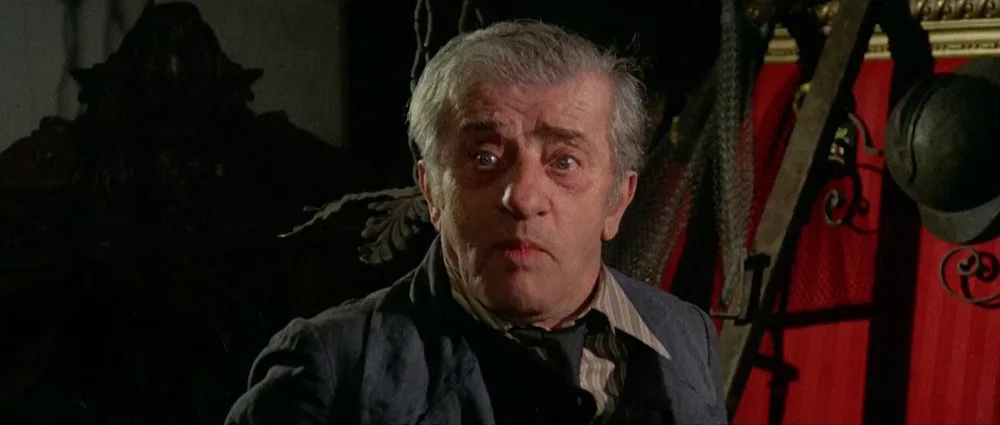
Pippo Starnazza in a scene from Umberto Lenzi's film *Milano odia: la polizia non può sparare* (1974) Public domain (Wikimedia Commons applies its Italian public-domain tags, PD-Italy and PD-1996, to this 1974 film frame) — Wikimedia Commons - https://commons.wikimedia.org/wiki/File:Pippo_Starnazza_Milano_odia.png - Umberto Lenzi (director) / Federico Zanni (cinematographer)

Pippo Starnazza was born Luigi Redaelli in Milan on April 16, 1909, and made his name as a Milan jazz drummer who turned comic singer and, later, film character actor. Italian accounts say he gave up the violin for the drums as a boy after hearing an American jazz band in the Galleria Vittorio Emanuele, and a 2024 history of the Milan scene names Arturo Agazzi, the club owner and bandleader known as Mirador, as the influence that turned him toward jazz. In the 1920s he was playing drums with the De Carli orchestra at the Orfeo music hall. From 1927 he worked in Piero Rizza's Louisiana Band, and he went on to play with most of the leading jazz orchestras in Milan, among them the Jazz Band Ernesto Marchi and, from 1929, Nanni DalDello's Hot Pickers, where his section-mates included Robert De Kers, Beppe Mojetta and Marino Marzaroli.
With the trombonist Mojetta he formed a duo in which he began to sing. The pair took American standards such as "Dinah," "Sweet Sue," "St. Louis Blues" and "I Can't Give You Anything but Love" and delivered them in a mock-English made of Milanese-accented gibberish, which became his trademark and earned his first records as a singer, issued by Odeon. In 1934 he joined the orchestra of Gorni Kramer and later that of Pippo Barzizza, while also working as a solo singer of comic Milanese versions of American songs.
Around 1939 and 1940 he took the stage name Pippo Starnazza and formed the Quintetto del Delirio, a group that, despite its name, was an eleven-piece band. Its reeds and accordion were played by Franco Mojoli, with Pietro Di Salvatore and Astore Pittana on trumpet, Clinio Bergamini on trombone, Piero Cottiglieri on tenor saxophone, Enzo Ceragioli on piano, Angelo Servida on guitar, Quirino Spinetti on vibraphone, Sergio Almangano on violin and Adriano Almangano on bass, with Starnazza on drums and vocals. Its Odeon 78s of 1941 to 1943 include "Come ti chiami?" (P. 573, 1941), written by Cosimo Di Ceglie and Gian Carlo Testoni, and "Io cerco la Titina" (1942), taken from the film Noi vivi. The band also accompanied other singers on record, among them Carlastella, Rudy Solinas, Enza Passatore and Otello "Canapino" Canapa. Italian histories credit him as the first singer in Italy to use a scat style, and he picked up the nickname Squà-Squà, which is why some discs are billed to Pippo Starnazza and his Squà Men. His stage act leaned on rubbery facial expressions and a bass drum painted with a comic portrait and the badge of Inter.
The jazz historians took notice of him. His Squà Men are heard on "Oh Bimba" on 40 anni di jazz in Italia, a two-LP survey of Italian jazz issued by Ricordi in 1963 and curated by Adriano Mazzoletti. A 1995 compilation of Milan recordings from 1941 to 1943, Jazz in Italy Under the Fascism, credits him on drums with I Maestri del Ritmo, and a 2010 CD on the same label, Jazz in Italy in the 40's, gathers 26 recordings by the Quintetto del Delirio and Starnazza. He kept recording for lighter markets through the next decades, for Durium in 1953, Odeon, Embassy and Combo in the late 1950s, Bluebell in 1960, CGD in 1965 and North in 1966, the last of these a version of "Dinah," the standard he had sung in the 1930s.
As his music career declined he moved into acting in the early 1960s and worked steadily as a supporting and character player. His credits include Mario Monicelli's I compagni (1963), Carlo Lizzani's La vita agra (1964), Monicelli's L'armata Brancaleone (1966), Ettore Scola's Il commissario Pepe (1969), Vittorio De Sica's I girasoli (1970), Monicelli's Romanzo popolare (1974) and, in 1975, Adriano Celentano's Yuppi du. Starnazza passed away in Milan on July 16, 1975, of cardiac arrest, at the age of 66. The drummer and comedian Gegè Di Giacomo later cited him as an inspiration, and the Skiantos singer Freak Antoni paid tribute by fronting a side project called Beppe Starnazza e i Vortici, in which he presented himself as Pippo's fictional son.
Starnazza worked at the border where Italian jazz met comic song. His drumming came from the Milanese dance-orchestra tradition of the 1920s and 1930s, and his jazz singing was a parody of English: swing standards sung in a made-up, Milanese-flavored mock-English, with nonsense syllables and scat-like phrasing that Italian sources treat as a first in the country. It is better described as a hot-dance comedy act than as improvised jazz singing, and his later fame rests on character acting rather than on jazz performance, which is why his place here is that of a crossover figure. Arturo Agazzi and the American bands that brought jazz to Milan shaped him, and the big-band and hot-dance orchestras of Kramer and Barzizza were his training ground. Later entertainers, notably Gegè Di Giacomo and Freak Antoni, cited him as a model for the clowning drummer-singer.
- "Come ti chiami?" (1941, Odeon P. 573) - The Quintetto del Delirio's calling card, with Starnazza on vocals, written by Cosimo Di Ceglie and Gian Carlo Testoni and reissued on later compilations.
- "Io cerco la Titina" (1942, Odeon P. 641) - The Quintetto del Delirio's version of the song from the film Noi vivi, which was still being reissued on a 1970 anthology EP.
- "Oh Bimba" on 40 anni di jazz in Italia (1963, Ricordi MRJ 8007/8) - His Squà Men on Adriano Mazzoletti's landmark two-LP survey of Italian jazz.
- Jazz and Hot Dance in Italy 1919-1948 (1990, Harlequin HQ 2078) - A British anthology that places the Quintetto del Delirio's "Gira...gira" among the period's Italian jazz and hot-dance records.
- Jazz in Italy Under the Fascism (1995, Riviera Jazz Records RJR CD-001) - Milan recordings from 1941 to 1943 by I Maestri del Ritmo, with Starnazza credited on drums.
- Jazz in Italy in the 40's (2010, Riviera Jazz Records RJRCD017) - A 26-track CD of Quintetto del Delirio and Starnazza recordings, the fullest collection of the band on disc.
- "Dinah" / "Ortega!" (1966, North C002) - A late return to the first standard he had sung in English-sounding Milanese, billed to Pippo Starnazza e suoi Squà Men.
Pippo Starnazza: Full Discography
Discogs artist: Pippo Starnazza (1524025) · Group entry: Quintetto Del Delirio (1831300) · Real name Luigi Redaelli · Born April 16, 1909, Milan
Starnazza's recordings are Italian 78 rpm singles, 45s and EPs, with no long-playing album under his own name, so this is a list of his singles and the compilations that carry him. The first table covers the Quintetto del Delirio and Odeon years. Years follow Italian Wikipedia and Discogs; where the two disagree, or neither gives one, the row says so.
Singles and EPs
| Release | Year | Label (Catalog) | Format | Personnel & Notes | Listen | Buy |
|---|---|---|---|---|---|---|
| "Straccione" / "Ticche... ta" | 1941 | Odeon (P. 537) | 78 rpm | Billed to Pippo Starnazza; the A side is the Quintetto del Delirio, the B side the Orchestra Mojoli led by Franco Mojoli. Starnazza on vocals | — | — |
| "Come ti chiami?" / "Mi jaca" | 1941 | Odeon (P. 573) | 78 rpm | A side by the Quintetto del Delirio, with Starnazza on vocals; written by Cosimo Di Ceglie and Gian Carlo Testoni. The B side is by the Orchestra da Ballo di Ceglie e il suo Ritmo | — | — |
| "Dalla terra... alla luna" | 1942 | Odeon (P. 584) | 78 rpm | Pippo Starnazza with the Quintetto del Delirio; composed by Alvise Natili and Antigono Godini | — | — |
| "Io cerco la Titina" | 1942 | Odeon (P. 641) | 78 rpm | With the Quintetto del Delirio; from the film Noi vivi | — | — |
| "Quando canto penso a te" / "Come ti chiami?" | 1942 | Odeon (catalog number not confirmed) | 78 rpm | Quintetto del Delirio, per Italian Wikipedia | — | — |
| "Maria Gilberta" / "Hop, hop, trotta, cavallino" | 1943 | Odeon (catalog number not confirmed) | 78 rpm | Credited to the Quintetto del Delirio | — | — |
| "La barca dei sogni" / "Dice lei... dice lui..." | 1943 | Odeon (P. 688) | 78 rpm | Starnazza sings the B side only; the A side is sung by Carlastella | — | — |
| "Buona notte amore mio" / "Nel vecchio castello" | 1946 | Odeon (TW 3169) | 78 rpm | Starnazza sings the B side only; the A side is sung by Corrado Lojacono | — | — |
| "O mama Inez" / "Fa i to pass" | 1953 | Durium (catalog number not confirmed) | 78 rpm | Pippo Starnazza e la sua Orchestra | — | — |
| Ciribiribin (EP; "Ciribiribin" / "Calypso blu" / "I Love You" / "Alonzo") | 1958 | Embassy (EP 131) | 7" EP | Italian Wikipedia gives 1958; Discogs lists the release under 1959 as Pippo Starnazza e il suo Complesso | — | — |
| Cantando calypso (EP) | 1958 | Odeon (MSEQ 35106) | 7" EP | Shared with Emilio Pericoli and Giorgio Consolini | — | — |
| Cara piccina (EP) | Not confirmed | Embassy (EP 132) | 7" EP | Year not confirmed | — | — |
| "Ya, ya" / "T'ho voluto bene" | 1959 | Combo Record (5278) | 7" single | Italian Wikipedia gives 1959; Discogs lists 1960. With the Quintetto Fantasma and the Red Vocalists | — | — |
| "Tu sei prismatica" / "Besame mucho" | 1960 | Bluebell Records (BB 03028) | 7" single | With the Orchestra Squà Men; arranged by Gianfranco Intra, who also wrote "Tu sei prismatica" with Leo Chiosso and Starnazza | — | — |
| "Squa squa" / "Ciribiribin" | 1965 | CGD (N 9602) | 7" single | Pippo Starnazza | — | — |
| "Dinah" / "Ortega!" | 1966 | North (C002) | 7" single | Billed to Pippo Starnazza e suoi Squà Men | — | — |
| "Signorina Zi Zu Za" / "Sangue viennese" | Not confirmed | Silver Gold (PUBB. 023) | 7" single | With the Silver Boys; the B side is by I Compari. Year not confirmed | — | — |
The Quintetto del Delirio's own Discogs entry lists further Odeon 78s of 1942 to 1944 on which Starnazza is not individually credited, including "Chiedo di te" / "Guarda un po'" (1942), "Cerco una melodia" / "Amo l'amore" (1943) and "Tristezza" / "Il giovanotto matto" (1944).
Compilations
| Release | Year | Label (Catalog) | Format | Notes | Listen | Buy |
|---|---|---|---|---|---|---|
| 40 anni di jazz in Italia (curated by Adriano Mazzoletti, supervised by Lino Patruno) | 1963 | Ricordi (MRJ 8007/8) | 2 LP | Includes "Oh Bimba" by Pippo Starnazza e suoi Squà Men: Giuliano Bernicchi (trumpet), Eraldo Romanoni (piano, arrangement), Armando Camera (guitar, violin), a bassist credited as Moschetti, Enrico Cuomo (drums), Starnazza (vocal) | — | — |
| La canzone italiana, No. 25 | 1970 | Fratelli Fabbri Editori (CaI 25) | 7" EP | Includes "Io cerco la Titina" with the Quintetto del Delirio, alongside Alberto Rabagliati, Natalino Otto and the Quartetto Cetra | — | — |
| Le canzoni dell'EIAR nelle interpretazioni originali degli anni '40 | 1977 | CGD (RB 117) | LP | Includes "Baldo, Baldo (Arcibaldo)" | — | — |
| Jazz and Hot Dance in Italy 1919-1948 | 1990 | Harlequin (HQ 2078) | LP | Includes "Gira...gira" by the Quintetto del Delirio with Starnazza; a UK release | — | — |
| Ballabili degli anni '40 e '50 (presented by Renzo Arbore) | 1990 | Armando Curcio Editore (DCI-47) | CD | Includes "La quadriglia di famiglia" | — | — |
| Lo swing | 1990 | Armando Curcio Editore | CD | Includes a track by Pippo Starnazza e Sorelle Passatore | — | — |
| Jazz in Italy Under the Fascism (I Maestri del Ritmo) | 1995 | Riviera Jazz Records (RJR CD-001) | CD | Milan recordings from 1941 to 1943. Starnazza on drums; also credited are Franco Mojoli (alto saxophone, clarinet), Piero Cottiglieri (tenor saxophone), Enzo Ceragioli (piano), Ubaldo Beduschi and Adriano Almangano (bass), Angelo Servida (guitar), Quirino Spinetti (vibraphone), trumpeters Astore Pittana, Natale Petruzzelli, Pietro Di Salvatore and Nino Culasso, and trombonist Clinio Bergamini, with Sergio Almangano as vocalist on one track | — | — |
| Jazz in Italy in the 40's (Quintetto del Delirio, Pippo Starnazza) | 2010 | Riviera Jazz Records (RJRCD017) | CD | 26 tracks, recorded in Milan in the 1940s, including "Come ti chiami?," "La marchesa Sinforosa," "Oh! Bimba," "Il fantasma innamorato," "Ritmando in Sol," "Starnazza," "Dinah" and "I speak English." Released in Austria | — | — |
Filmography (selected)
Starnazza's screen work is listed here because it fills most of his later career. Years follow Italian Wikipedia.
| Year | Film | Director |
|---|---|---|
| 1961 | Un figlio d'oggi | Marino Girolami |
| 1961 | Walter e i suoi cugini | Marino Girolami |
| 1963 | I compagni | Mario Monicelli |
| 1964 | La vita agra | Carlo Lizzani |
| 1965 | La congiuntura | Ettore Scola |
| 1966 | L'armata Brancaleone | Mario Monicelli |
| 1966 | Johnny Oro | Sergio Corbucci |
| 1969 | Il commissario Pepe | Ettore Scola |
| 1970 | I girasoli | Vittorio De Sica |
| 1971 | La moglie del prete | Dino Risi |
| 1973 | Sessomatto | Dino Risi |
| 1974 | Romanzo popolare | Mario Monicelli |
| 1974 | Milano odia: la polizia non può sparare | Umberto Lenzi |
| 1975 | Yuppi du | Adriano Celentano |
- Arturo Agazzi - the Milan club owner and bandleader known as Mirador, named in a 2024 Milanese history as the influence that drew him toward jazz and the drums.
- Quintetto del Delirio - his own band from about 1939 to 1940: Franco Mojoli (reeds, accordion), Pietro Di Salvatore and Astore Pittana (trumpet), Clinio Bergamini (trombone), Piero Cottiglieri (tenor saxophone), Enzo Ceragioli (piano), Angelo Servida (guitar), Quirino Spinetti (vibraphone), Sergio Almangano (violin) and Adriano Almangano (bass).
- Cosimo Di Ceglie - co-wrote "Come ti chiami?" with Gian Carlo Testoni; Starnazza sang it on the Quintetto del Delirio's 1941 Odeon 78.
- Gorni Kramer and Pippo Barzizza - bandleaders whose orchestras he joined, Kramer's from 1934 and Barzizza's afterward.
- Piero Rizza, Nanni DalDello and Beppe Mojetta - Milan bandleaders and the trombonist partner of the duo in which he first sang jazz standards.
- Carlastella, Rudy Solinas, Enza Passatore and Canapino - singers the Quintetto del Delirio accompanied on record.
- Adriano Mazzoletti - the jazz historian who curated the 1963 Ricordi anthology that includes the Squà Men; his history of jazz in Italy is among the standard references on this period.
- Lino Patruno - supervised the 1963 Ricordi anthology on which Starnazza's Squà Men appear.
- Alberto Rabagliati, Natalino Otto and the Quartetto Cetra - fellow performers on a 1970 anthology EP that reissued the Quintetto del Delirio's "Io cerco la Titina."
- Emilio Pericoli and Giorgio Consolini - shared the 1958 Odeon EP Cantando calypso.
- Gianfranco Intra - arranged "Tu sei prismatica" and "Besame mucho" (1960) for the Squà Men.
More Swing Artists
See all 273 Swing artists →More Italian Jazz Artists
See all 554 Italian artists →- Discogs: Pippo Starnazza
- Discogs: Quintetto Del Delirio
- MusicBrainz: Pippo Starnazza
- IMDb: Pippo Starnazza
- His profile on jazzprofiles.com
- r/CrossoverJazz
- Wikipedia: Pippo Starnazza
- Wikipedia (Italian): Pippo Starnazza
- Milano Città Stato: Pippo Starnazza, il jazzista che "milanesizzava" l'inglese
- Discogs: Pippo Starnazza
- Discogs: Quintetto Del Delirio
- MusicBrainz: Pippo Starnazza
- Wikidata: Pippo Starnazza
- Wikimedia Commons: Pippo Starnazza Milano odia.png