 JAZZPROFILES lives in the music 2,555 Jazz Artists fully Profiled!
Alberto Rabagliati
Last updated November 11, 2026
Listen on Spotify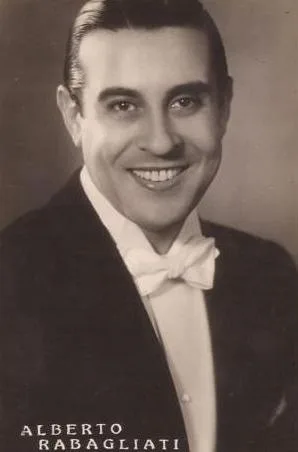
Alberto Rabagliati, promotional postcard from the 1940s Public domain (Italian promotional photograph more than 20 years old; Commons template PD-Italia) — Wikimedia Commons - https://commons.wikimedia.org/wiki/File:Alberto_Rabagliati.JPG - originally uploaded to Italian Wikipedia

Alberto Rabagliati was born in Milan on June 27, 1906, the only child of Leandro Valentino Rabagliati, a wine merchant, and Delfina Besso, both from Casorzo in the Monferrato hills of Piedmont. After his father's death he entered a competition run by Fox Film to find a double for Rudolph Valentino, who had died the year before, and won it. In 1927 he moved to Hollywood and stayed about four years. His acting career in America never took off, although Italian Wikipedia places him in a small part in Frank Borzage's Street Angel (1928). What he brought home was an ear for jazz, swing and scat singing, and a decision to become a singer.
Back in Italy (English Wikipedia dates the move to Rome to 1931) he sang for a short time with Pippo Barzizza's Blue Star orchestra, and in 1934 he joined the Lecuona Cuban Boys, a Cuban dance band that English Wikipedia calls a jazz band. With them he had a hit with Ernesto Lecuona's "Maria la O," and he sometimes performed in blackface. Records credited to him with the band include a 1935 Pathé single issued in France and a 1936 Columbia 78 of "Blue Rumba" and "Coubanakan." The composer and conductor Giovanni D'Anzi heard him with the band and suggested an audition for the state broadcaster EIAR. He passed, and he joined the singers of the Cetra Orchestra directed by Barzizza.
The Cetra 78s of 1939 to 1943 made him one of the best-known voices on Italian radio. Several are swing numbers written by D'Anzi: "Silenzioso slow (Abbassa la tua radio)," issued with "Illusione" as Cetra IT 692 in 1940, and "Il maestro improvvisa," which Italian Wikipedia lists as a 1940 record made with the Trio Lescano. Others are the sentimental songs that sold best: "Ba-ba-baciami piccina," "Ma l'amore no," "Mattinata fiorentina" and "C'è una casetta piccina." In 1941 he was given a weekly radio program, Canta Rabagliati, broadcast on Monday evenings, and other songwriters began working his name into their lyrics. Italian Wikipedia says his 78s together sold 100,000 copies, a large number for the period, and that he was paid 1,000 lire for a live evening.
At a time when foreign music was officially discouraged, he was allowed to keep an American-influenced style, and the Fascist government took one of his songs, "C'è una casetta piccina," known as "Sposi," as an informal anthem for its campaign to raise the birth rate. Italian Wikipedia repeats an anecdote that Mussolini personally disliked his records and once smashed one, telling him to go back to America.
His radio fame restarted his film work. From 1940 to 1965 he appeared in about twenty films, among them Carlo Ludovico Bragaglia's La vita è bella (1943), Pietro Francisci's Natale al campo 119 (1947), Joseph Mankiewicz's The Barefoot Contessa (1954) and Dino Risi's Il vedovo (1959). Italian Wikipedia adds that in 1954 Disney chose him to sing Kirk Douglas's songs in the Italian version of 20,000 Leagues Under the Sea. On stage he worked in revues and musical comedies into the mid-1950s, including Pirulì Pirulì... non andrà sempre così (1945) and Buonanotte Bettina (1963) by Garinei and Giovannini. After the war his Cetra records mixed Italian songs with French and Latin ones, such as "La vie en rose" and "La mer" (1948), "Babalù" (1947) and "Manon de Paris" with his own "Rabagliati samba" (1951). He married Maria Antonietta Tonnini in Rome on May 19, 1954, and in 1956 he recorded an album of Milanese dialect songs for Durium with the singer Evelina Sironi.
His clearest later return to the swing repertoire came on Ricordi. In 1962 the label issued Giorgio Gaslini presenta Alberto Rabagliati, an album of fourteen of his 1940s songs with the jazz pianist and composer Giorgio Gaslini credited as arranger and orchestra director. Gaslini is credited in the same way on a 1963 single of "C'è una casetta piccina (Sposi)" and "Ma l'amore no" and on the 1964 EP Quando canta Rabagliati, whose four songs include "Silenzioso slow" and "Maria la O." A full album under the title Quando canta Rabagliati followed in 1967. In June 1964 he won the television game show La fiera dei sogni, and in July he appeared with Natalino Otto and Nilla Pizzi in the special I magnifici re.
The 1970s brought a revival of 1940s music, and he sang again at the Excelsior terrace in Venice, the Piper Club in Rome and other venues. In 1973 he toured 42 dates in the show L'album dei ricordi with the singer Carla Boni, and in December that year he was a guest on Canzonissima. His last public appearance was in the first episode of the variety show Milleluci, hosted by Mina and Raffaella Carrà, recorded in February 1974. He passed away in Rome on March 8, 1974, of a cerebral thrombosis, shortly after the recording; the episode aired on March 16. He is buried in the Flaminio cemetery in Rome beside his mother.
Rabagliati is first of all a pop and radio star, and that is stated here plainly: most of his career was Italian light song, film, revue and television, and much of his recorded catalogue is sentimental songs, Milanese dialect numbers, Latin rhythms and French chansons rather than jazz. English Wikipedia calls him a jazz singer, Italian Wikipedia calls him the first star of Italian light music, and Treccani's biographical dictionary says he was known above all for his swing numbers. The jazz thread is real and documented. He met swing and scat singing in Hollywood around 1930, sang with Barzizza's Cetra Orchestra and the Lecuona Cuban Boys, and recorded D'Anzi's rhythm songs at the moment Italian dance orchestras were absorbing American swing. Discogs files the Giorgio Gaslini album and the 1964 EP under Swing and Vocal, and anthologies of Italian jazz and swing of the 1930s and 1940s on Riviera Jazz Records and Warner include his sides alongside the Trio Lescano and Natalino Otto. On the records his approach is that of a dance-band vocalist singing swing songs, not an improviser, and he is best understood as a central voice of how swing reached an Italian mass audience.
- "Maria la O" / "Santa" (1939, Cetra IT 627) - The Cetra single of his signature song from the Lecuona Cuban Boys years.
- "Illusione" / "Silenzioso slow (Abbassa la tua radio)" (1940, Cetra IT 692) - The D'Anzi swing number that became one of his calling cards.
- "Il maestro improvvisa" / "Due occhi neri" (1940, Cetra IT 804) - A swing record from the Cetra years, listed on Italian Wikipedia as made with the Trio Lescano.
- "Credi bambina al mio cuore" / "C'è una casetta piccina" (1940, Cetra DC 4058) - The song later adopted as the Fascist birth-rate campaign anthem, and the best known of his sentimental hits.
- Giorgio Gaslini presenta Alberto Rabagliati (1962, Ricordi MRL 6027) - Fourteen of his songs arranged and conducted by Giorgio Gaslini, filed on Discogs under Jazz and Pop with the styles Swing, Vocal and Latin Jazz.
- Quando canta Rabagliati (1964, Ricordi ERL 213) - A four-song EP, also arranged and directed by Gaslini, with "Silenzioso slow," "Maria la O," "Bambina innamorata" and the title song.
- Jazz and Hot Singers in the 30s (2006, Riviera Jazz Records RJR CD 013) - An anthology of Italian hot-jazz vocal records that includes his "Serenata a Daina" with the Cetra Orchestra.
- Swing all'italiana (2000, Warner Fonit 8573 84763-2) - A sixteen-track compilation spanning his Cetra years and later recordings, a convenient overview of the swing-flavored side of his catalogue.
Alberto Rabagliati: Full Discography
Discogs artist: Alberto Rabagliati (921305) · Born June 27, 1906, Milan · Died March 8, 1974, Rome
Most of his output is Italian light song, film and radio repertoire, much of it on 78 rpm records for Cetra between 1939 and 1951, so this page lists a selection of the singles, the albums and EPs, and the compilations and anthologies that place him in the Italian swing and jazz story. Catalog numbers and years come from Discogs and from Italian Wikipedia, and where a detail could not be confirmed it is marked as not confirmed. Namesakes on Discogs, such as the Canadian cartoonist Michel Rabagliati and a Vittorio Rabagliati, are different people and are not included. Listen and Buy links were not individually confirmed.
Albums and EPs
| Release | Year | Label (catalog) | Personnel & Notes | Listen | Buy |
|---|---|---|---|---|---|
| I canzon de "La Madonina" | 1956 | Durium (ms A 568), 10 inch LP | Billed jointly with the singer Evelina Sironi. Songs in Milanese dialect, among them Madonina, Nostalgia de Milan and Baloss d'on scior Batista. Reissued in 1966 as Nostalgia de Milan (Durium ms AI 77130) per Italian Wikipedia | — | — |
| Un po' di poesia (EP) | 1959 | Cetra (EPE 3073), 7 inch EP | Un po' di poesia, Quando canta Rabagliati, Tu musica divina, Oi Marì. Filed on Discogs under Vocal and Swing | — | — |
| Tu musica divina (EP) | 1960 | Poker Record (PNE 045), 7 inch EP | With the orchestra of Nino Casiroli. Tu musica divina, Vecchio frack, Il primo pensiero d'amore and one further song not itemized | — | — |
| Giorgio Gaslini presenta Alberto Rabagliati | 1962 | Ricordi (MRL 6027), mono LP | Arranged and directed by Giorgio Gaslini; liner notes by Vincenzo Micocci. Silenzioso slow (Abbassa la tua radio), Ma l'amore no, Il primo pensiero, Annie, La scuola del ritmo, Santa, Non partir, Maria la O, Tabù, Maria Bonita, C'è una casetta piccina (Sposi), Bambina innamorata, Il maestro improvvisa, Quando canta Rabagliati. Filed on Discogs under Jazz and Pop with the styles Easy Listening, Swing, Vocal and Latin Jazz. Vocal Comet is credited as accompanying group on three tracks | — | — |
| Quando canta Rabagliati (EP) | 1964 | Ricordi (ERL 213), 7 inch EP | Arranged and directed by Giorgio Gaslini. Silenzioso slow (Abbassa la tua radio), Maria la O, Bambina innamorata, Quando canta Rabagliati. Filed on Discogs under Swing and Vocal | — | — |
| Quando canta Rabagliati (LP) | 1967 | Ricordi (SMRP 9043), LP | Listed on Italian Wikipedia; track list and personnel not confirmed | — | — |
Selected singles
| Single | Year | Label (catalog) | Notes | Listen | Buy |
|---|---|---|---|---|---|
| Adieu, mon amour / Esclavo soy | 1935 | Pathé (PA 570), 78 rpm | Issued in France, billed to the Lecuona orchestra with Rabagliati as refrain singer | — | — |
| Blue Rumba (Rumba bleu) / Coubanakan | 1936 | Columbia (DQ 2567), 78 rpm | With the Lecuona Cuban Boys, per Italian Wikipedia | — | — |
| Campane del villaggio / Mi ricordi ancor | 1939 | Cetra (IT 625), 78 rpm | No further credits shown | — | — |
| Maria la O / Santa | 1939 | Cetra (IT 627), 78 rpm | Catalog number per Italian Wikipedia | — | — |
| Illusione / Silenzioso slow | 1940 | Cetra (IT 692), 78 rpm | Silenzioso slow (Abbassa la tua radio) is a swing number by Giovanni D'Anzi and Alfredo Bracchi | — | — |
| Walzer della fortuna / Passione | 1940 | Cetra (IT 735), 78 rpm | No further credits shown | — | — |
| Paradiso perduto / Mi ricordi ancor | 1940 | Cetra (IT 736), 78 rpm | No further credits shown | — | — |
| Domani / Questa sera da me | 1940 | Cetra (IT 740), 78 rpm | The B side is sung by Otello Boccaccini | — | — |
| Brilla una stella in cielo / Quando la radio | 1940 | Cetra (IT 801), 78 rpm | No further credits shown | — | — |
| Il maestro improvvisa / Due occhi neri | 1940 | Cetra (IT 804), 78 rpm | Italian Wikipedia lists the record as made with the Trio Lescano | — | — |
| Credi bambina al mio cuore / C'è una casetta piccina | 1940 | Cetra (DC 4058), 78 rpm | C'è una casetta piccina (Sposi) was taken up as a Fascist-era birth-rate anthem | — | — |
| Vienna, Vienna / Notte di ronda | 1940 | Cetra (DC 4102), 78 rpm | No further credits shown | — | — |
| Bolero cubano / Canzone del boscaiolo | 1941 | Cetra (DC 4030), 78 rpm | No further credits shown | — | — |
| Ho perduto i tuoi baci / Suona stanotte | 1941 | Cetra (IT 877), 78 rpm | No further credits shown | — | — |
| Dormi bambina / Oi Marì | 1941 | Cetra (IT 995), 78 rpm | No further credits shown | — | — |
| Santa / Annie!! | 1941 | Cetra (DC 4105), 78 rpm | No further credits shown | — | — |
| Non mi devi dir / Se la radio non ci fosse | 1942 | Cetra (DC 4129), 78 rpm | No further credits shown | — | — |
| Estrellita / Princessita | 1942 | Grammophon, Die Stimme seines Herrn (47629), 78 rpm | German pressing | — | — |
| T'amo perdutamente / Amapola | 1942 | Polydor (47664), 78 rpm | German pressing | — | — |
| Per te / La vita è bella | 1943 | Cetra (AA 344), 78 rpm | Songs from the film La vita è bella | — | — |
| La strada del bosco / Soli soli nella notte | 1943 | Cetra (AA 339), 78 rpm | No further credits shown | — | — |
| Male d'amore / Alleluja | 1946 | Cetra (AA 434), 78 rpm | Italian Wikipedia gives 1945 | — | — |
| Voglio bene soltanto a te / Le campane di Santa Maria | 1946 | Cetra (AA 462), 78 rpm | No further credits shown | — | — |
| La vie en rose / La mer | 1948 | Cetra (DC 4773), 78 rpm | Catalog number per Italian Wikipedia | — | — |
| Mam'selle / Chanson du souvenir | 1948 | Cetra (DC 4774), 78 rpm | No further credits shown | — | — |
| Luna lunera / Sin decirme adiós | 1949 | Cetra (DC 4889), 78 rpm | No further credits shown | — | — |
| Manon de Paris / Rabagliati samba | 1951 | Cetra (DC 5351), 78 rpm | No further credits shown | — | — |
| La vie en rose / Ciliegi rosa | 1958 | Cetra (SP 220), 7 inch | With Nilla Pizzi | — | — |
| Scoubidou | 1959 | Il Musichiere, The Red Record (N. 20031), flexi-disc | Single-sided flexi-disc issued with a magazine | — | — |
| C'è una casetta piccina (Sposi) / Ma l'amore no | 1963 | Ricordi (SRL 10-324), 7 inch | Arranged and directed by Giorgio Gaslini | — | — |
| Un violino / Marinella | 1964 | Durium (CN A 9107), 7 inch | No further credits shown | — | — |
With the Lecuona Cuban Boys
| Release | Year | Credit | Notes | Listen | Buy |
|---|---|---|---|---|---|
| Congas y rumbas | 1992 | Compilation; Lecuona Cuban Boys, Alberto Rabagliati and others | Label and catalog not confirmed | — | — |
| Siboney / Maria la O | 1939 | Lecuona Cuban Boys single | Maria la O is the song that made his name with the band; label and catalog not confirmed | — | — |
Compilations and anthologies
| Release | Year | Label (catalog) | Notes | Listen | Buy |
|---|---|---|---|---|---|
| Alberto Rabagliati | 1974 | Music Parade Cetra, LP | Compilation of his Cetra recordings | — | — |
| Alberto Rabagliati / Natalino Otto | 1974 | Not confirmed | Listed on Discogs as a joint release by the two singers; details not confirmed. A 1973 single pairs Natalino Otto's Mister Paganini with Rabagliati's Serenata a Daina (Fratelli Fabbri Editori) | — | — |
| Alberto Rabagliati: Stelle degli anni 40 | 1980 | Gruppo Editoriale Fabbri, LP | Compilation | — | — |
| Jazz all'italiana | 1982 | Gruppo Editoriale Fabbri, LP | Various artists; includes Rabagliati; catalog not confirmed | — | — |
| Swing all'italiana | 2000 | Warner Fonit (8573 84763-2), CD | Sixteen tracks, among them Ba-ba-baciami piccina, C'è una casetta piccina, Maria la O, Mattinata fiorentina and Il primo pensiero. Filed on Discogs under Jazz and Pop with the styles Vocal, Swing, Ballad and Schlager | — | — |
| Il Jazz in Italia: Dalle origini alle grandi orchestre, Jazz and Hot Dance Music Volume 2 | 2004 | Riviera Jazz Records (RJR CD 010), CD | Various artists. His track is La fidanzata di nessuno (Nobody's Sweetheart), credited with Ezio Ghieri and Mario Salerno | — | — |
| I grandi successi dello swing italiano Vol. 1 | 2005 | Warner Music Italy (5050467-6787-2-9), CD | Various artists. His track is Ba-ba-baciami piccina; the disc also has Natalino Otto, Fred Buscaglione, Quartetto Cetra and the Trio Lescano | — | — |
| Le più belle canzoni di Alberto Rabagliati | 2005 | Warner Strategic Marketing Italy, CD | Compilation | — | — |
| Jazz and Hot Singers in the 30s | 2006 | Riviera Jazz Records (RJR CD 013), CD | Various artists. His track is Serenata a Daina with the Cetra Orchestra; the disc also has the Trio Lescano, Vittorio De Sica and Carlo Buti | — | — |
| Playlist | 2016 | Rhino Records, CD | Compilation | — | — |
- Pippo Barzizza - bandleader of the Blue Star orchestra, whom he joined briefly after returning from the United States, and of the Cetra Orchestra, whose singer he became after the EIAR audition.
- Lecuona Cuban Boys and Ernesto Lecuona - the Cuban band he sang with from 1934 and the composer of "Maria la O."
- Giovanni D'Anzi - composer and conductor who proposed the EIAR audition and wrote many of his best-known songs, among them "Silenzioso slow," "Ma l'amore no," "Bambina innamorata" and "Quando canta Rabagliati," with lyricists including Alfredo Bracchi and Michele Galdieri.
- Trio Lescano - the vocal trio who appear with him on Cetra records of 1940.
- Cinico Angelini - bandleader photographed with him in 1940 and named in the credits of Cetra records on which he sings.
- Giorgio Gaslini - arranger and orchestra director of the 1962 Ricordi album, the 1963 single and the 1964 EP.
- Evelina Sironi - singer on his Milanese dialect album for Durium (1956).
- Nilla Pizzi and Natalino Otto - singers he shared the 1964 television special I magnifici re with; he also appears with Pizzi on a 1958 Cetra single of "La vie en rose" and "Ciliegi rosa."
- Carla Boni - his partner in the 42-date 1973 tour L'album dei ricordi.
- Mina and Raffaella Carrà - hosts of Milleluci, his final television appearance.
- Garinei and Giovannini - authors of the revues in which he appeared on stage.
More Swing Artists
See all 273 Swing artists →More Italian Jazz Artists
See all 554 Italian artists →- Wikipedia: Alberto Rabagliati
- Wikipedia (Italian): Alberto Rabagliati
- Treccani, Dizionario biografico degli italiani: Rabagliati, Alberto
- Wikidata: Alberto Rabagliati
- Discogs: Alberto Rabagliati
- MusicBrainz: Alberto Rabagliati
- Discogs: Giorgio Gaslini presenta Alberto Rabagliati
- Discogs: Jazz And Hot Singers In The 30s
- Discogs: Swing All'Italiana
- Wikimedia Commons: Alberto Rabagliati.JPG