 JAZZPROFILES lives in the music 2,303 Jazz Artists fully Profiled!
Friedrich Gulda
Last updated November 1, 2026
Listen on Spotify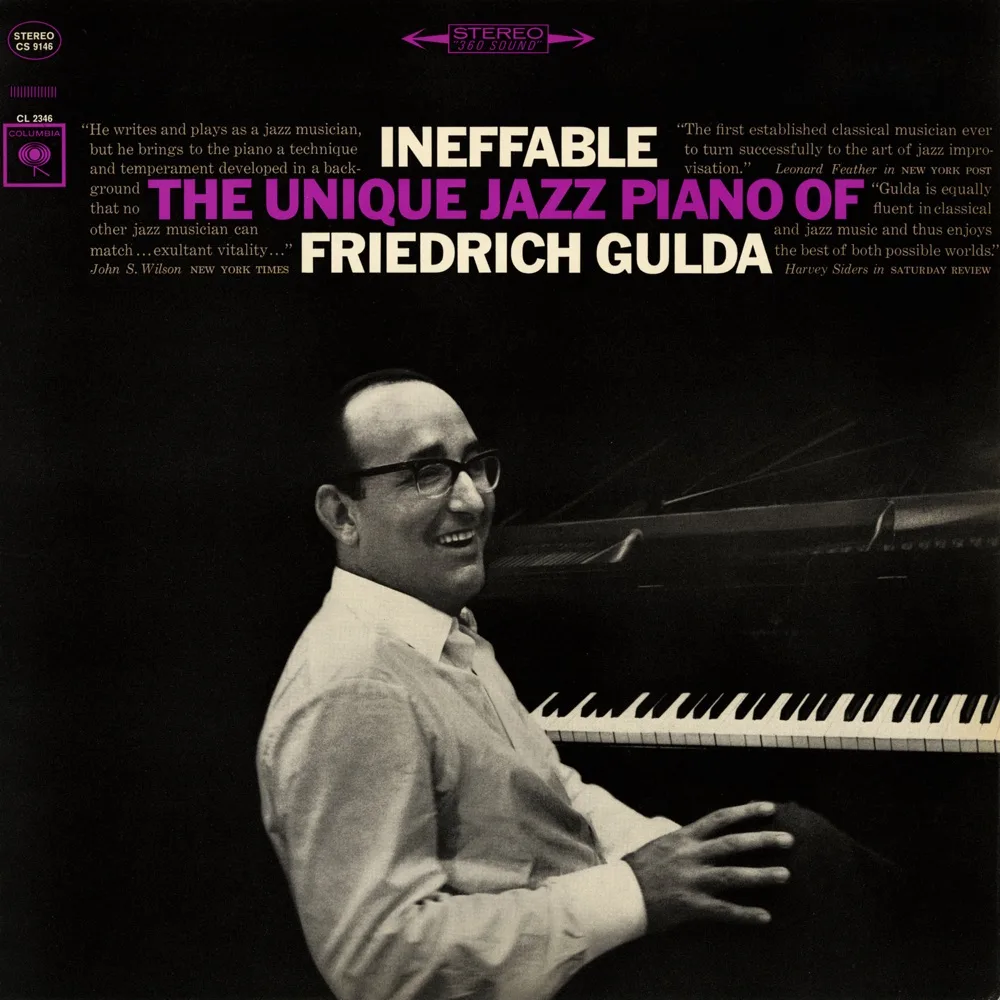
Friedrich Gulda on the cover of his album Ineffable: The Unique Jazz Piano of Friedrich Gulda (Columbia, 1965) Album cover art (not a CC-licensed artist photo), used as the only available image showing the artist — Apple Music cover artwork - https://music.apple.com/us/album/1040646052
Friedrich Gulda was a classical pianist first, and one of the most celebrated of the postwar era. He was born in Vienna on May 16, 1930, the son of a teacher, and began piano at seven with Felix Pazofsky at the Wiener Volkskonservatorium. In 1942 he entered the Vienna Music Academy, where he studied piano with Bruno Seidlhofer and theory with Joseph Marx. As teenagers during the war, he and his friend Joe Zawinul played forbidden music, jazz included, in defiance of the ban on it. In 1946 he won first prize at the Geneva International Music Competition, in a final vote that left one juror storming out in protest, and he made his Carnegie Hall debut in 1950. With his fellow Viennese Jörg Demus and Paul Badura-Skoda he formed what was called the "Viennese troika" of young postwar pianists.
His reputation rested on Mozart and Beethoven. In the late 1960s he recorded the complete Beethoven piano sonatas (Amadeo, 1968), and his recordings of Bach's Well-Tempered Clavier are well regarded; he often played Bach on the clavichord. He composed his own cadenzas for two Mozart concertos and recorded them, Nos. 20 and 21 for Deutsche Grammophon (1975), with his former pupil Claudio Abbado conducting the Vienna Philharmonic; his Mozart recordings often carried improvisations of his own. His students included Martha Argerich, who called him her most important influence, and Abbado himself. Philips included him in its Great Pianists of the 20th Century series in 1999.
The jazz side was never a late hobby. From the 1950s on he cultivated a serious interest in the music, and in June 1956 he played two weeks at Birdland in New York. John Hammond produced the recordings, made on June 28 and 29 with a septet of Idrees Sulieman (trumpet), Jimmy Cleveland (trombone), Phil Woods (alto saxophone), Seldon Powell (tenor saxophone), Aaron Bell (bass) and Nick Stabulas (drums). They were issued as Friedrich Gulda at Birdland (RCA Victor, 1957) and A Man of Letters (Decca). He is also documented at the 1956 Newport Jazz Festival. Back in Europe he led workshop bands and recorded for Columbia: the Jazz Workshop concert at the 1962 Ruhrfestspiele with Herb Geller, Toots Thielemans and Hans Koller, Music for Piano and Band (recorded September 28 to 30, 1962 in Saarbrücken), and From Vienna with Jazz (Columbia, 1964) with his own big band. In April 1964 he recorded the trio album Gulda Jazz in São Paulo, and in 1965 Ineffable: The Unique Jazz Piano of Friedrich Gulda for Columbia, produced by Hammond, with bassist Bob Cranshaw and drummer Albert Heath. He also played baritone saxophone on some of these dates.
In the mid-1960s he built a crossover repertoire for big band and soloists. He founded and led the Eurojazz Orchestra from 1964 to 1966. His Music for 4 Soloists and Band No. 1, composed in 1964 and premiered in Munich on September 9, 1965, was written for piano, trombone, trumpet and baritone saxophone, and the recording features J.J. Johnson, Freddie Hubbard and Sahib Shihab beside Gulda; the credited band includes Kenny Wheeler, Ron Carter, Mel Lewis and Herb Geller. Johnson spent time in Vienna in 1965 recording his Eurosuite with Gulda's orchestra, and the album Eurosuite / Variations (Preiser) pairs it with Gulda's Variations for Two Pianos and Band, on which Zawinul plays as a guest. In 1966 Gulda organized the International Competition for Modern Jazz in Vienna; the bassist George Mraz was among the entrants. In 1968 he founded the International Musikforum at Ossiach, a school for students who wanted to learn improvisation.
From the late 1960s he recorded jazz and open improvisation at MPS in the Black Forest with the producer Hans Georg Brunner-Schwer: the solo The Air from Other Planets (February 1969), the trio set As You Like It (1970, with bassist Johann Anton Rettenbacher and drummer Klaus Weiss), It's All One, The Long Road to Freedom (1971), whose "Variations on 'Light My Fire'" turned the Doors song into a piano piece, and Fata Morgana, recorded live at the Domicile in Munich in April 1971. Under the pseudonym Albert Golowin he also recorded Viennese-dialect songs, and critics were fooled for years about who he was. In 1972 to 1978 he played free improvised music with Paul and Limpe Fuchs in the trio Anima, and later as a duo with his partner, the singer and percussionist Ursula Anders. It's Up to You (Preiser, 1974) brought in Albert Mangelsdorff and Barre Phillips, and Nachricht vom Lande (1976), recorded live at Schloss Moosham in Salzburg province, featured Gulda on clavichord and piano with Cecil Taylor, Phillips, John Surman and Stu Martin. At the 1979 Salzburg Weltmusiktage he recorded Tales of World Music, which has one track with Dizzy Gillespie.
In 1982 he teamed up with Chick Corea for The Meeting, a live two-piano concert recorded at the Munich Piano Summer on June 27, 1982 and released by Philips, and the two later recorded Mozart's Concerto for Two Pianos with Nikolaus Harnoncourt and the Concertgebouw Orchestra (Teldec, 1984). His Concerto for Myself, scored for piano, electric bass, drums and symphony orchestra, premiered in Munich on March 9, 1988 with Gulda as soloist and conductor. In May 1988 he recorded Music for Two Pianos in Cologne with Zawinul and the WDR Big Band. That same year he cancelled a Salzburg Festival appearance after festival officials objected to Zawinul on the program. The organist Barbara Dennerlein played on his Mozart No End and the Paradise Band (Sony Classical, 1991). He also wrote a Concerto for Cello and Wind Orchestra, written for the cellist Heinrich Schiff.
Gulda cultivated a deliberately provocative image, and the press called him the "terrorist pianist." In 1969 he accepted the Beethoven Ring of the Vienna Music Academy and then handed it back, and he refused to announce his programs in advance. In 1999 he announced his own death in a press release, so that a concert at the Vienna Konzerthaus could be billed as a resurrection party. He passed away from heart failure at his home at Weissenbach am Attersee on January 27, 2000, Mozart's birthday, a date he had said he wanted. He left instructions that there be no obituary, and he is buried at Steinbach am Attersee. He was married twice, to the actress Paola Loew (1956 to 1966) and to Yuko Wakiyama (1967 to 1973); his sons Paul and Rico both became pianists. His honors included the Austrian Cross of Honour for Science and Art (1959) and the Honorary Ring of the City of Vienna (1989).
Gulda was a classical pianist of the first rank who insisted on being taken seriously as a jazz player as well, and the jazz side was documented in public from Birdland in 1956 to the Cologne concerts with Joe Zawinul in 1988. His classical playing was exact, rhythmically sharp and unsentimental, which is the same quality that makes his jazz piano swing in a clean, driving, bop-rooted way on records such as At Birdland and Ineffable. He said he valued jazz for its rhythmic drive and its element of risk, in contrast to the polished academic approach he had been taught. His improvising ranged from straight-ahead swing and bop standards through the rock-flavored trio recordings of 1970, such as his version of "Light My Fire," to free improvisation on electrically amplified clavichord with Cecil Taylor, Albert Mangelsdorff, Barre Phillips and John Surman. He worked in the third-stream tradition of writing for jazz soloists and a large band, and Concerto for Myself carried that idea into the concerto form. Some classical critics were slow to accept the crossings, and his stage conduct, including programs that changed on the night, kept the argument alive. Chick Corea and Zawinul both recorded with him as partners.
- Sämtliche Klaviersonaten (1968, Amadeo) - The complete Beethoven piano sonatas, the cornerstone of his classical reputation.
- Mozart: Piano Concertos Nos. 20 & 21 (1975, Deutsche Grammophon) - With Claudio Abbado and the Vienna Philharmonic, using cadenzas Gulda wrote himself. Apple Music - Album Listen
- Friedrich Gulda at Birdland (1957, RCA Victor) - The June 1956 Birdland sessions with Idrees Sulieman, Jimmy Cleveland, Phil Woods and Seldon Powell, mostly his own compositions. Apple Music - Album Listen
- Ineffable: The Unique Jazz Piano of Friedrich Gulda (1965, Columbia) - Piano trio date produced by John Hammond, with Bob Cranshaw and Albert Heath, including Joe Zawinul's "Riverbed." Apple Music - Album Listen
- Music for 4 Soloists and Band No. 1 (1965, SABA) - His concerto for piano, trombone, trumpet and baritone saxophone, with J.J. Johnson, Freddie Hubbard and Sahib Shihab.
- As You Like It (1970, MPS) - Trio recital of standards and originals, including "Round Midnight," "All Blues" and "Light My Fire."
- The Meeting (1983, Philips) - Live two-piano encounter with Chick Corea from the 1982 Munich Piano Summer. Apple Music - Album
- Concerto for Myself (1988, Amadeo) - His own sonata concertante for piano, electric bass, drums and the Munich Philharmonic, recorded live. Apple Music - Album Listen
Friedrich Gulda: Full Discography
Discogs artist: Friedrich Gulda (280177) · Born May 16, 1930, Vienna · Passed away January 27, 2000. Discogs also files his bands and pseudonym under separate entries: Friedrich Gulda's Reunion Big Band, Friedrich Gulda und sein Eurojazz-Orchester, Friedrich Gulda Trio, Friedrich Gulda Orchestra, Friedrich Gulda And His Sextet and Albert Golowin.
Discogs lists several hundred releases under his name, most of them classical and many of them reissues. This page leads with a short list of his landmark classical recordings, then covers the jazz, crossover and free-improvisation records in order. The full list is on Discogs.
Classical: Landmark Recordings (selected)
| Album | Year | Label | Personnel & Notes | Listen | Buy |
|---|---|---|---|---|---|
| Sämtliche Klaviersonaten (Beethoven) | 1968 | Amadeo (AVRS 1101) | The complete piano sonatas | — | — |
| Das Wohltemperierte Klavier, Erster Teil (Bach) | 1972 | MPS / BASF (49 21552-0) | First book of the Well-Tempered Clavier; the second book followed in 1973 | — | — |
| Beethoven: The Five Piano Concertos | 1971 | Decca | With the Vienna Philharmonic under Horst Stein | — | — |
| Mozart: Piano Concertos Nos. 20 and 21 | 1975 | Deutsche Grammophon (2530 548) | With the Vienna Philharmonic under Claudio Abbado, using Gulda's own cadenzas | Apple Music | — |
| Mozart: Piano Concertos Nos. 25 and 27 | 1976 | Deutsche Grammophon | With the Vienna Philharmonic under Claudio Abbado | — | — |
Jazz, Crossover and Free Improvisation: As Leader or Co-Leader
| Album | Year | Label | Personnel & Notes | Listen | Buy |
|---|---|---|---|---|---|
| Friedrich Gulda at Birdland | 1957 | RCA Victor (LPM-1355) | Recorded live at Birdland, New York, June 28 and 29, 1956. Produced by John Hammond. Idrees Sulieman (trumpet), Jimmy Cleveland (trombone), Phil Woods (alto saxophone), Seldon Powell (tenor saxophone), Gulda (piano), Aaron Bell (bass), Nick Stabulas (drums). Gulda wrote most of the program; the standards include "A Night in Tunisia" and "Bernie's Tune". A second LP from the same engagement, A Man of Letters, was issued by Decca | Apple Music | — |
| Jazz Workshop Concert, Ruhrfestspiele 1962 | 1962 | Columbia (C 83342) | Co-billed with Herb Geller, Toots Thielemans, Ack van Rooyen and Hans Koller. Gulda plays piano and baritone saxophone with a European workshop band including Arne Domnérus, Fatty George, Erich Kleinschuster and Bengt-Arne Wallin | — | — |
| Music for Piano and Band | 1963 | Columbia (C 83357) | Recorded September 28 to 30, 1962 in Saarbrücken. Gulda (piano, baritone saxophone, composer, leader) with Benny Bailey, Ack van Rooyen and Bengt-Arne Wallin (trumpets), Erich Kleinschuster (trombone), Arne Domnérus (alto saxophone) and Fatty George (clarinet). The title piece and Music for Three Soloists and Band | — | — |
| From Vienna with Jazz | 1964 | Columbia (CL 2251) | Billed to Friedrich Gulda's Reunion Big Band. Gulda (piano, arranger, conductor) with Sahib Shihab, Idrees Sulieman, Benny Bailey, Tubby Hayes, Jimmy Woode (bass) and Mel Lewis (drums); notes by John Hammond and Willis Conover. Contains Music for Piano and Band and The Veiled Old Land | Apple Music | — |
| Gulda Jazz | 1965 | Amadeo (AVRS 9165) | Recorded at RGE Studios, São Paulo, Brazil, April 16 and 17, 1964. Gulda (piano) with Jimmy Rowser (bass) and Albert Heath (drums) on the trio side | Apple Music | — |
| Ineffable: The Unique Jazz Piano of Friedrich Gulda | 1965 | Columbia (CS 9146, mono CL 2346) | Piano trio with Bob Cranshaw (bass) and Albert Heath (drums). Produced by John Hammond. Includes "Riverbed" (Joe Zawinul) and "Lament" (J.J. Johnson) | Apple Music | — |
| Music for 4 Soloists and Band No. 1 | 1965 | SABA (SB 15 097 ST) | Composed 1964, premiered in Munich on September 9, 1965. Soloists J.J. Johnson (trombone), Freddie Hubbard (trumpet), Sahib Shihab (baritone saxophone, flute) and Gulda (piano). The credited band includes Kenny Wheeler, Herb Geller, Tubby Hayes, Ron Carter, Mel Lewis and Pierre Cavalli. Also contains Minuet and Prelude and Fugue | — | — |
| Eurosuite / Variations | 1967 | Preiser (SPR 3141) | Billed to Gulda and his Eurojazz Orchestra featuring J.J. Johnson and Joe Zawinul. Eurosuite is by J.J. Johnson (trombone); Variations for Two Pianos and Band is by Gulda, with Joe Zawinul (piano) as guest. Orchestra credits include Kenny Wheeler, Tubby Hayes, Ernie Royal, Herb Geller and Ronnie Ross | Apple Music | — |
| The Air from Other Planets | 1969 | MPS (15 225 ST) | Solo piano, recorded in February 1969 at the MPS studio in Villingen, Black Forest. Produced by Hans Georg Brunner-Schwer; liner notes drawn from a conversation with Joachim-Ernst Berendt | — | — |
| Vienna Revisited | 1969 | MPS (15 226 ST) | Recorded February 1969. Gulda (piano) with Johann Anton Rettenbacher (bass) and Manfred Josel (drums); side two carries songs sung by Albert Golowin | — | — |
| As You Like It | 1970 | MPS (15 272 ST) | Recorded February 1970. Trio with Johann Anton Rettenbacher (bass) and Klaus Weiss (drums). "Blues for H.G.," "I Only Have Eyes for You," "What Is This Thing Called Love," "All Blues," "Light My Fire," "'Round Midnight" and "East of the Sun" | — | — |
| It's All One | 1970 | MPS (15 271 ST) | Suite for piano, electric piano and drums, with Klaus Weiss (drums) | Apple Music | — |
| The Long Road to Freedom | 1971 | MPS (33 20872-9) | Double album recorded February 26, 1971 at the MPS studio in Villingen, subtitled as a musical self-portrait in the form of a course of study. Includes Play Piano Play (ten exercises), the Variations on Light My Fire and Prelude and Fugue; Klaus Weiss (drums) and Albert Golowin (vocals) appear on the last side | — | — |
| Fata Morgana (Live at the Domicile) | 1971 | MPS (21 20886-9) | Recorded live at the Domicile, Munich, April 1971. Gulda (piano), Fritz Pauer (electric piano) and Klaus Weiss (drums) | Apple Music | — |
| Anima | 1972 | Pilz (20 29097-2) | Improvised recordings with Paul Fuchs and Limpe Fuchs (self-built instruments, percussion, voice, zither) and Johann Anton Rettenbacher (bass) | — | — |
| Midlife Harvest | 1973 | MPS / BASF (01 21701-9) | Box set of his compositions: the Galgenlieder, Golowin-Lieder, Concertino for Players and Singers, Play Piano Play, the Light My Fire variations and two piano concertos of his own | — | — |
| It's Up to You | 1974 | Preiser (SPR 3268) | Large improvising ensemble: Albert Mangelsdorff (trombone), Barre Phillips (bass), Munir Bashir (oud), Leszek Zadlo (soprano saxophone, percussion), Gerhard Herrmann (drums), Paul and Limpe Fuchs, and Ursula Anders. Gulda plays electric clavichord, electric piano and bass recorder and sings | — | — |
| Gegenwart | 1976 | E.R.P. (E.R.P. 1) | Solos and duos with Ursula Anders (percussion), recorded in January 1976 at Bavaria Studio. Gulda plays piano, electric clavichord and recorders | — | — |
| Nachricht vom Lande | 1976 | Brain (500.018) | Recorded live in summer 1976 at Schloss Moosham in Lungau, Salzburg. Gulda (clavichord, piano, bass recorder, bongos), Cecil Taylor (piano), Barre Phillips (bass), John Surman (soprano and baritone saxophones, synthesizer), Stu Martin (drums) and Ursula Anders (drums, whistle). Albert Mangelsdorff is among the billed players | Apple Music | — |
| Message from G. | 1979 | MPS (0188.049) | Box set of three solo concerts at the Grosser Musikvereinssaal, Vienna, October 12, 13 and 15, 1978, with Ursula Anders and Paul Fuchs on some sides; includes "Blues for Joe Venuti" | — | — |
| Tales of World Music (Was die Weltmusik erzählt...) | 1979 | Amadeo (AVRS 302) | Recorded live at the Salzburg Weltmusiktage, 1979, with Munir Bashir (oud), Ursula Anders, Günther Rabl (bass), Michael Carvin (drums), the Nuova Compagnia di Canto Popolare, and Dizzy Gillespie (trumpet) on one track, with Ed Cherry (guitar) and Michael Howell (bass) | — | — |
| The Meeting (with Chick Corea) | 1983 | Philips (410 397-1) | Two Steinway pianos, recorded live at the Münchner Klaviersommer, Congress Hall of the Deutsches Museum, Munich, June 27, 1982. Producers Karl-Heinz Hein and Manfred Frei | Apple Music | — |
| Fantasy for Two Pianos (with Chick Corea) | 1983 | Teldec (6.20338) | 12-inch single, Corea and Gulda each on grand piano | — | — |
| Double Concerto / Compositions (with Chick Corea) | 1984 | Teldec (6.42 961) | Mozart's Concerto for Two Pianos with Nikolaus Harnoncourt and the Concertgebouw Orchestra, plus compositions by Corea and Gulda | Apple Music | — |
| Concerto for Myself: Live Recording | 1988 | Amadeo (427 800-1) | Gulda (piano, conductor) with the Münchner Philharmoniker, Wayne Darling (electric bass) and Michael Honzak (drums). Premiered March 9, 1988 at the Münchner Klaviersommer | Apple Music | — |
| Music for Two Pianos (with Joe Zawinul) | 1988 | Capriccio (67 175) | Live at the Philharmonie, Cologne, May 20 and 21, 1988: Brahms's Variations on a Theme by Haydn, Gulda's Variations for Two Pianos and Band with the WDR Big Band, and Zawinul's Volcano for Hire | — | — |
| Mozart No End and the Paradise Band | 1991 | Sony Classical (SX2K 48082 / 48084) | Recorded July 20, 1989 and July 21, 1990 in Munich and June 14, 1990 in Vienna. Mozart with the Münchner Philharmoniker, plus Gulda originals with Wayne Darling (bass) and Barbara Dennerlein (organ) | — | — |
| Gulda Non-Stop | 1992 | Sony Classical (SMK 52499) | Solo piano: Gulda's own pieces ("For Rico," "Aria," "Prelude and Fugue") alongside Mozart, Debussy and Chopin | — | — |
Albert Golowin Releases
Gulda recorded Viennese-dialect songs as the singer "Albert Golowin," a persona that fooled critics for years. Discogs lists Wann I Geh' / Du und I (Preiser, 1970, billed Golovin Meets Gulda), Donau so Blue (MPS 14 004 ST, 1970, with Johann Anton Rettenbacher on bass and Manfred Josel on drums) and Vienna so Blue (Hör Zu Black Label / MPS, 1971).
Guest and Ensemble Appearances (selected)
| Year | Project | Title | Label | Notes |
|---|---|---|---|---|
| 1962 | Vienna Jazz Workshop | Vienna Jazz Workshop | Jazztone (J-1259) | Gulda (piano, baritone saxophone, recorder) with Hans Koller, Hans Salomon, Fatty George, Erich Kleinschuster, Dick Murphy, Hans Rettenbacher and Viktor Plasil. Billed to the band, not to Gulda |
| 1966 | Eurojazz-Orchester, directed by Friedrich Gulda | Internationaler Wettbewerb für modernen Jazz, Wien 1966 | Amadeo | Prizewinners' closing concert of the competition Gulda organized; the bassist George Mraz took part |
- Joe Zawinul - boyhood friend with whom he played banned jazz in wartime Vienna; guest pianist on Eurosuite / Variations (1967) and his partner on Music for Two Pianos (Cologne, 1988). Zawinul's composition "Riverbed" is on Ineffable.
- Chick Corea - two-piano partner on The Meeting (live, Munich, June 27, 1982), Fantasy for Two Pianos (1983) and the Mozart Concerto for Two Pianos (1984).
- J.J. Johnson - guest soloist on Eurosuite and Music for 4 Soloists and Band No. 1 (1965); his composition "Lament" is on Ineffable.
- Freddie Hubbard - trumpet soloist on Music for 4 Soloists and Band No. 1 (1965).
- Phil Woods, Idrees Sulieman, Jimmy Cleveland, Seldon Powell, Aaron Bell and Nick Stabulas - the Birdland band of June 1956.
- Toots Thielemans and Herb Geller - soloists on the Jazz Workshop concert at the Ruhrfestspiele, 1962.
- Kenny Wheeler, Ron Carter, Mel Lewis, Tubby Hayes and Herb Geller - credited in the Eurojazz Orchestra recordings of the mid-1960s.
- Cecil Taylor, Barre Phillips, John Surman, Stu Martin and Ursula Anders - the players on Nachricht vom Lande (live at Schloss Moosham, 1976).
- Albert Mangelsdorff and Barre Phillips - guests on It's Up to You (1974), alongside oud player Munir Bashir.
- Dizzy Gillespie - guest on one track of Tales of World Music (Salzburg, 1979).
- Paul Fuchs and Limpe Fuchs - his partners in the free-improvising trio Anima (1972 to 1978).
- Klaus Weiss, Johann Anton Rettenbacher and Fritz Pauer - drummer, bassist and electric pianist in his MPS trios of 1969 to 1971.
- Barbara Dennerlein - organist who studied with Gulda and played on Mozart No End and the Paradise Band (1991).
- Martha Argerich and Claudio Abbado - pupils; Abbado conducted his Mozart concerto recordings.
- George Mraz - took part in the 1966 International Competition for Modern Jazz that Gulda organized in Vienna.
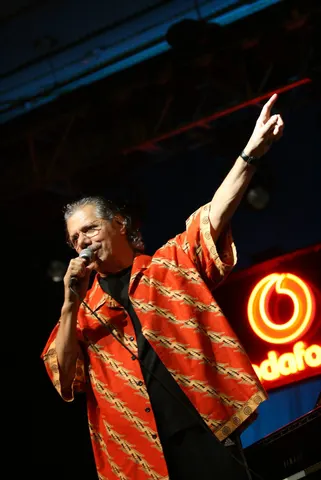
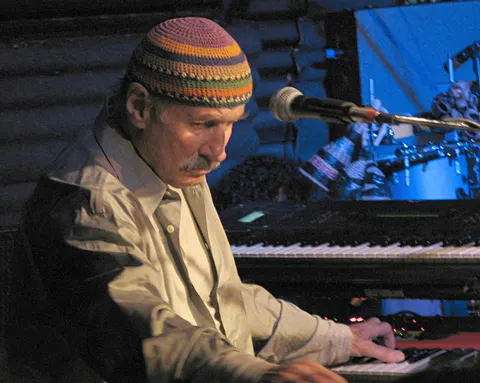
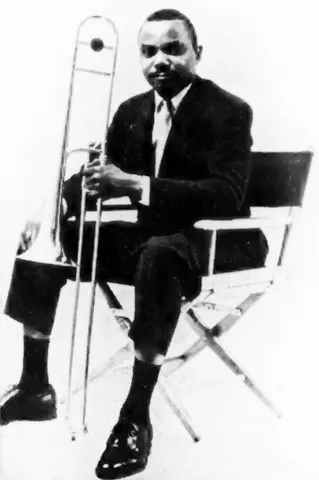
More Third Stream Artists
See all 135 Third Stream artists →- Wikipedia: Friedrich Gulda
- Wikipedia (German): Friedrich Gulda
- Wikipedia: Concerto for Myself
- AllMusic: Friedrich Gulda biography by Mike Duquette
- Discogs: Friedrich Gulda
- MusicWeb International: Friedrich Gulda at Birdland review
- Music Austria database: Music for 4 Soloists and Band No. 1
- Wikipedia: Chick Corea
- Wikipedia: J. J. Johnson
- MusicWeb International: Music for Two Pianos review