 JAZZPROFILES lives in the music 2,555 Jazz Artists fully Profiled!
Dave Bartholomew
Last updated November 9, 2026
Listen on Spotify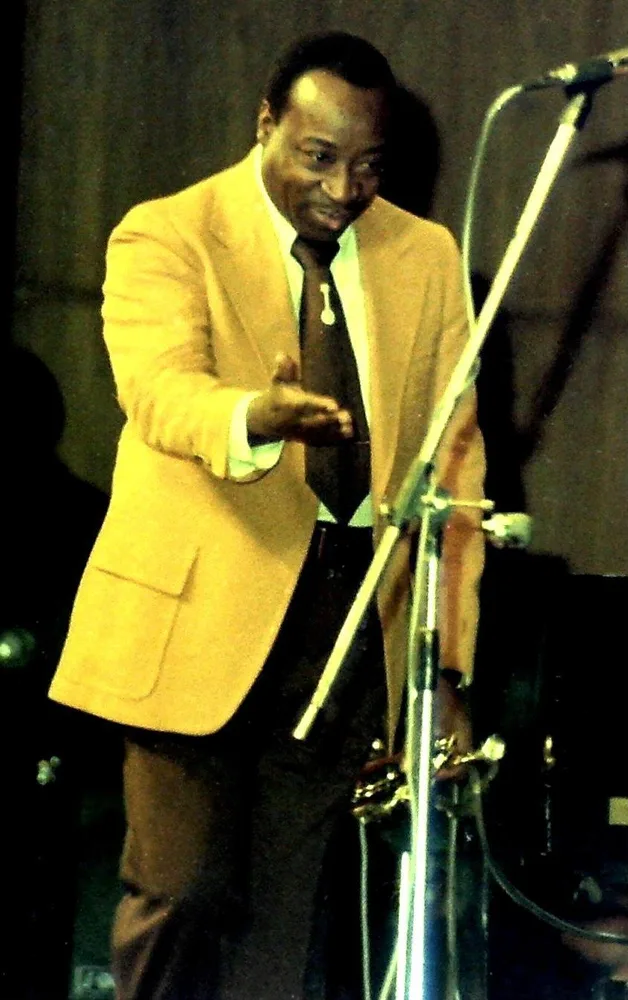
Dave Bartholomew, Rosengarten, Mannheim, Germany, 1977 (photograph by Klaus Hiltscher, cropped to Bartholomew alone by Spinningspark) CC BY-SA 2.0 — Wikimedia Commons — https://commons.wikimedia.org/wiki/File:Dave_Bartholemew.jpg — original frame https://commons.wikimedia.org/wiki/File:Dave_Bartholomew_on_left,_Fats_Domino_at_right.jpg


Dave Bartholomew was born Davis Bartholomew on December 24, 1918, in Edgard, Louisiana, to Mary and Louis Bartholomew. He first learned his father's instrument, the tuba, and then took up the trumpet under Peter Davis, a teacher who had also taught Louis Armstrong. Around 1933 the family moved to New Orleans, where he played in local jazz and brass bands, among them Papa Celestin's band and Fats Pichon's band on a Mississippi riverboat. He took over Pichon's band in 1941, spent a period in Jimmie Lunceford's orchestra, and then joined the US Army, where he learned scoring and arranging as a member of the 196th Army Ground Forces Band.
Back in New Orleans after the war, he was leading his own dance band by November 1945, Dave Bartholomew and the Dew Droppers, named for the Dew Drop Inn hotel and nightclub. The group became the house band of the city's rhythm and blues, and the historian Robert Palmer later called it a model for early rock and roll bands around the world. Its players included the saxophonists Alvin "Red" Tyler, Herb Hardesty and Clarence Hall, bassist Frank Fields, guitarist Ernest McLean, pianist Salvador Doucette and drummer Earl Palmer, with saxophonist Lee Allen arriving later. In 1947 the club owner Don Robey brought the band to Houston, where Bartholomew met Lew Chudd, the founder of Imperial Records. That September the band made its first records, including "She's Got Great Big Eyes," at Cosimo Matassa's studio for De Luxe, and its first hit, "Country Boy," reached No. 14 on Billboard's R&B chart in early 1950.
Chudd made him Imperial's New Orleans A&R man in 1949, and in December of that year Bartholomew produced "The Fat Man," a young pianist named Fats Domino's first record, with his own band behind him. It reached No. 2 on the R&B chart and sold more than a million copies. After a disagreement with Chudd he left Imperial at the end of 1950 and recorded for Decca, King and Specialty, writing and recording "My Ding-a-Ling" for King in January 1952 (Chuck Berry's rewritten version went to No. 1 in 1972) and producing Lloyd Price's "Lawdy Miss Clawdy" for Specialty, an R&B No. 1 that summer. Back at Imperial he co-wrote and produced the run of Domino hits that began crossing to the pop chart with "Ain't That a Shame" in 1955, followed by "I'm in Love Again" and "Blue Monday" in 1956, "I'm Walkin'" in 1957, "I'm Gonna Be a Wheel Someday" in 1959 and "Let the Four Winds Blow" in 1961. He also wrote, arranged and produced for Smiley Lewis ("I Hear You Knocking," "One Night"), the Spiders, Chris Kenner, Earl King, Tommy Ridgley, Robert Parker, T-Bone Walker, Roy Brown and Frankie Ford, produced Shirley and Lee's "Let the Good Times Roll" for Aladdin, and, according to the profile of James Booker, produced the teenage pianist's 1954 debut single. His wife Pearl King, whom he married in 1942, shares writing credit on several of the songs.
Under his own name he made two LPs for Imperial, Fats Domino Presents Dave Bartholomew and His Great Big Band (1961), built on Domino's hits, and New Orleans House Party (1963). After Imperial was sold to Liberty in 1963 he stayed in New Orleans, worked for Trumpet and Mercury, and in 1967 started his own Broadmoor label, which folded the next year when its distributor, Dover, collapsed. In the 1970s and 1980s he led a traditional Dixieland band in New Orleans and took part in Domino's international tours. Dave Bartholomew's New Orleans Jazz Band (Broadmoor, 1981) has him on trumpet with the clarinetist Willie Humphrey and the trombonist Waldren "Frog" Joseph, playing Dixieland standards alongside his own Domino-era hits. He was inducted into the Rock and Roll Hall of Fame in 1991 as a non-performer, and is also a member of the Songwriters Hall of Fame and the Louisiana Music Hall of Fame. In the 1990s he recorded two Dixieland CDs with the Maryland Jazz Band of Cologne, Walking to New Orleans and New Orleans 'Yea Yea' Breakdown (both 1995), and a large-band set with New Orleans horn players, New Orleans Big Beat (1998).
He celebrated his 100th birthday on Christmas Eve 2018, though plans for a concert in his honor were set aside when he was hospitalized. Bartholomew passed away of heart failure at East Jefferson General Hospital in Metairie, Louisiana, on June 23, 2019, at the age of 100. After the death of Pearl in 1967 he had married Rhea Douse, with whom he had four sons and a daughter.
Bartholomew is a crossover figure in the plainest sense: his fame rests on New Orleans rhythm and blues and early rock and roll rather than on jazz records, and, as the Rock and Roll Hall of Fame's essay on him notes, he never made the pop charts under his own name. What he brought to that music was a jazz musician's training. He came up in New Orleans brass and jazz bands, passed through Jimmie Lunceford's orchestra and learned arranging in an Army band, and he turned that into tight horn-section arrangements over a steady, danceable beat, with saxophonists such as Herb Hardesty and Lee Allen and the drummer Earl Palmer in the band. AllMusic calls him the self-proclaimed inventor of the "Big Beat," and the Rock Hall cites him as a key figure in the move from jump blues and swing to R&B. Cosimo Matassa, who engineered the sessions, remembered how firmly he insisted on discipline from the players. His trumpet and bandleading return openly to jazz in the 1961 big-band LP, the 1981 and 1995 Dixieland sets and his late appearances at festivals, which makes him a bridge between the older New Orleans jazz tradition and the rock and roll that grew out of the city's dance bands. Many of his songs were recorded by others, from Pat Boone and Gale Storm to Elvis Presley, Ricky Nelson and Dave Edmunds.
- "The Fat Man" (Fats Domino, 1950, Imperial) - Bartholomew's first major production and the start of the Domino partnership; recorded in December 1949 with his band, it sold more than a million copies.
- "Lawdy Miss Clawdy" (Lloyd Price, 1952, Specialty) - Bartholomew produced it, Domino played uncredited piano, and it topped the R&B chart.
- "My Ding-a-Ling" (Dave Bartholomew, 1952, King) - written and first recorded by him in January 1952. Spotify - My Ding-A-Ling Listen
- "I Hear You Knocking" (Smiley Lewis, 1955, Imperial) - written for Lewis, reaching No. 2 on the R&B chart, then a pop hit again for Gale Storm and Dave Edmunds.
- "Ain't That a Shame" (Fats Domino, 1955, Imperial) - the Domino-Bartholomew song that carried Domino to the pop audience.
- Fats Domino Presents Dave Bartholomew and His Great Big Band (1961, Imperial) - his big-band LP on Imperial, twelve tracks including "Blueberry Hill," "Blue Monday," "I'm Walkin'" and "The Fat Man."
- Dave Bartholomew's New Orleans Jazz Band (1981, Broadmoor) - his own Dixieland band with Willie Humphrey and Waldren "Frog" Joseph, on Dixieland standards and his Domino-era songs.
- New Orleans 'Yea Yea' Breakdown (1995, Timeless) - a Dixieland CD with the Maryland Jazz Band of Cologne, trumpet and vocals, including "Let the Four Winds Blow." Spotify - Let The Four Winds Blow Listen
Dave Bartholomew: Full Discography
Discogs artist: Dave Bartholomew (320620) · Born December 24, 1918, Edgard, Louisiana · Died June 23, 2019, Metairie, Louisiana
Discogs lists more than 2,300 credited rows under his name, almost all of them compilations and reissues that carry his songs or productions, so this is a curated discography: his own albums, selected compilations of his recordings, representative singles, and the best-known records he wrote, arranged or produced for others. His orchestra and jazz band billings sit under separate Discogs entries: Dave Bartholomew And His Orchestra (901088), Dave Bartholomew's Band (3538366), Dave Bartholomew & His Sextet (3643794) and Dave Bartholomew's New Orleans Jazz Band (8198807). The numbered Discogs entries named Dave Bartholomew (2) through (6) are other people and are not included. Recording dates are given only where a source states them; otherwise the cell reads Not confirmed.
As Leader / Co-Leader
| Album Title | Recording Date(s) | Release Date | Label | Catalog Number | Format(s) | Personnel | Role | Reissue History | Spotify | Buy | Notes |
|---|---|---|---|---|---|---|---|---|---|---|---|
| Fats Domino Presents Dave Bartholomew and His Great Big Band | Not confirmed | 1961 | Imperial | LP 12076 | Vinyl, LP, Album, Stereo | Dave Bartholomew (leader) and his orchestra; players not itemized on the release | Leader | Not itemized | — | — | Twelve tracks, mostly Fats Domino hits: "Blueberry Hill," "Ain't That a Shame," "Blue Monday," "I'm Walkin'," "Going to the River," "Let the Four Winds Blow," "The Fat Man" and others. |
| New Orleans House Party | Not confirmed | 1963 | Imperial | LP-9217 | Vinyl, LP, Mono | Not itemized on the release | Leader | Not itemized | — | — | Twelve tracks in two-part pieces and standards, including "Concerto for Alto Sax," "Blues in the Night," "Sultan's Dream," "Portrait of a Drummer" and "Charmaine." |
| Dave Bartholomew's New Orleans Jazz Band | Not confirmed | 1981 | Broadmoor | BR-1201 (also printed LP-1201) | Vinyl, LP, Album | Dave Bartholomew (trumpet, arranger, producer), Willie Humphrey (clarinet), Waldren "Frog" Joseph (trombone), Justin Adams (guitar), Frank Fields (bass), Frank Parker (drums); a banjo is credited to the late "Papa" French in a thanks line | Leader | Not itemized | — | — | Dixieland standards ("Preservation Hall Song," "Bourbon Street Parade," "Saints Go Marchin' In," "Sugar Blues") alongside "Blueberry Hill," "Ain't That a Shame," "I'm Walkin'" and "Let the Four Winds Blow." |
| Walking to New Orleans | Not confirmed | 1995 | G.H.B. | BCD-328 | CD, Album | Dave Bartholomew (trumpet, vocals), Klaus-Dieter George (clarinet), Gerhard Hund (trombone), Rowan Smith (piano), Hans-Martin Schöning (banjo, guitar), Markus Dombrowe (bass), Peter Wechlin (drums) | Co-leader (billed with the Maryland Jazz Band of Cologne) | Not itemized | — | — | Twelve Dixieland and standards tracks, including "Chinatown, My Chinatown," "Indiana," "Sheik of Araby," "I'm Walking" and "Walking to New Orleans." |
| New Orleans 'Yea Yea' Breakdown | Not confirmed | April 27, 1995 | Timeless | TTD 602 | CD, Album | Dave Bartholomew (trumpet, vocals), Klaus-Dieter George (clarinet), Gerhard Hund (trombone), Rowan Smith (piano), Hans-Martin Schöning (banjo, guitar), Markus Dombrowe (bass, tuba), Peter B. Wechlin (drums) | Co-leader (with the same German band) | Not itemized | Spotify - Let The Four Winds Blow (track) | — | Nine tracks including "Down in Honky Tonk Town," "Tenderly," "China Boy" and "Jazz Me Blues," plus "Let the Four Winds Blow" and "Blue Monday." |
| New Orleans Big Beat | Not confirmed | 1998 | Landslide | LDCD-1022 | CD, Album | Dave Bartholomew (trumpet, vocals), Glenn McCarthy, Stacey Cole and Willie Singleton (trumpets), Amadee Castenell, Carl Blouin, Fred Kemp and Warren Bell Sr. (saxophones), Bruce Hammond and Doc Poland Jr. (trombones), Edward Frank (piano), Charles Moore (guitar), David Barard and Erving Charles Jr. (bass), Bernard "Bunchy" Johnson (drums) | Leader | Not itemized | — | — | Twelve tracks including "Jazz Fest in New Orleans," a Domino-Bartholomew medley and "Mardi Gras in New Orleans." Credits are per track on the release. |
Compilations (selected)
| Album | Year | Label | Catalog | Notes | Spotify | Buy |
|---|---|---|---|---|---|---|
| The Monkey | 1985 | Imperial | 1561331 | Fourteen Imperial sides from 1949 to 1957, with Earl Palmer, Lee Allen, Herb Hardesty and Salvador Doucette among the players. | — | — |
| Shrimp and Gumbo | 1986 | Imperial | 1566311 | Second Imperial LP compilation. | — | — |
| The Classic New Orleans R&B Band Sound: The Best of Dave Bartholomew | 1989 | Stateside | SSL 6036 | Sixteen tracks compiled with notes by John Broven. | — | — |
| In the Alley | 1991 | Charly R&B | CD CHARLY 273 | His 1949 to 1952 recordings, including the King sides. | — | — |
| Spirit of New Orleans: The Genius of Dave Bartholomew | 1992 | EMI Records USA | 0777-7-80184-2 1 | Two-disc remastered set. | — | — |
| The Chronological Dave Bartholomew 1947-1950 | 2001 | Classics | CLASSICS 5002 | First of three chronological volumes. | — | — |
| The Big Beat of Dave Bartholomew: 20 of His Milestone New Orleans Productions 1949-1960 | 2002 | Capitol | 72435-37599-2-6 | Twenty tracks. | — | — |
| The Chronological Dave Bartholomew 1950-1952 | 2003 | Classics | CLASSICS 5055 | Second chronological volume. | — | — |
| The Chronological Dave Bartholomew 1952-1955 | 2006 | Classics | CLASSICS 5169 | Third chronological volume. | — | — |
| The Big Beat (The Dave Bartholomew Songbook) | 2011 | Ace | CDCHD 1303 | Twenty-five of his best-known songs, with notes by Tony Rounce. | — | — |
| Golden Rule in New Orleans: King & Imperial Sides, 1950-1961 | 2016 | Hoodoo Records | 263536 | Remastered. | — | — |
| Jump Children! | 2017 | Jasmine Records | JASCD 845 | Two-CD set. | — | — |
| The King of New Orleans R&B: The Best of the Rest | August 9, 2019 | Jasmine Records | JASCD 866 | Two-CD set released after his death. | — | — |
Singles and EPs (selected)
| Title | Year | Label | Billing | Notes | Spotify |
|---|---|---|---|---|---|
| Bum Mae / Dave's Boogie Woogie | 1947 | De Luxe | Dave Bartholomew and His Sextette | Among his earliest records. | — |
| Country Boy / Mr. Fool | Not confirmed | De Luxe | Dave Bartholomew and His Orchestra | "Country Boy" reached No. 14 on the Billboard R&B chart in early 1950. | — |
| Ain't Gonna Do It / Country Boy Goes Home | 1950 | Imperial | Dave Bartholomew and His Orchestra | — | |
| Carnival Day / That's How You Got Killed Before | 1950 | Imperial | Dave Bartholomew and His Orchestra | Spotify - Carnival Day | |
| Tra-La-La / Teejim | 1951 | Decca | Dave Bartholomew and His Orchestra | — | |
| Bad Habit / My Ding-A-Ling | 1952 | King | Dave Bartholomew | "My Ding-a-Ling" was first recorded in January 1952. | Spotify - My Ding-A-Ling |
| Who Drank the Beer While I Was in the Rear | 1952 | King | Dave Bartholomew | — | |
| The Golden Rule / Mother Knows Best | 1952 | King | Dave Bartholomew | — | |
| Jump Children / Cat Music | 1954 | Imperial | Dave Bartholomew | — | |
| Another Mule / I Want to Be with Her | 1954 | Imperial | Dave Bartholomew | — | |
| Texas Hop / When the Saints Go Marching In Boogie | 1954 | Imperial | Dave Bartholomew | — | |
| Shrimp and Gumbo / An Old Cowhand from a Blues Band | 1956 | Imperial | Dave Bartholomew | Spotify - Shrimp and Gumbo | |
| The Shufflin' Fox / The Monkey | 1957 | Imperial | Dave Bartholomew | Spotify - The Monkey | |
| Honky Tonk Trumpet (EP) | 1962 | Polydor | Dave Bartholomew | Four tracks: "Honky Tonk Trumpet," "A Sunday Kind of Love," "Yeah Yeah," "People Are Talking." Catalog 27.751. | — |
| The Monkey Speaks His Mind / Cherry Pie | 1964 | Trumpet | Dave Bartholomew and His Orchestra | — | |
| Wild As a Tiger / Wishbone | 1966 | Trumpet | The Dave Bartholomew Orchestra | — |
Selected Records as Producer, Arranger, Writer and Bandleader
Bartholomew's name is on the writing and production credits of far more records than it is on as a performer. These are the best-known of them. His band played behind Fats Domino on his Imperial recordings of this period, but the players on any single session are not itemized here unless stated.
| Year | Project (Leader) | Title | Label | Catalog | Role | Notes |
|---|---|---|---|---|---|---|
| 1950 | Jewel King | "3 x 7 = 21" | Imperial | Not confirmed | Writer, producer | Imperial's first national hit; No. 4 on the R&B chart. |
| 1950 | Fats Domino | "The Fat Man" | Imperial | 5058 | Producer, co-writer, bandleader | Recorded December 1949 with Bartholomew's band; No. 2 on the R&B chart; the record that launched Domino's career. |
| 1952 | Lloyd Price | "Lawdy Miss Clawdy" | Specialty | 428 | Producer | R&B No. 1 in mid-1952; Fats Domino played uncredited piano. |
| 1954 | Little Booker (James Booker) | "Doin' the Hambone" / "Thinkin' 'Bout My Baby" | Imperial | Not confirmed | Producer | Booker's first record, made at fourteen. |
| 1955 | Smiley Lewis | "I Hear You Knocking" | Imperial | X5356 | Writer (co-credit Pearl King), Imperial A&R | No. 2 on the R&B chart; later pop hits for Gale Storm (1955) and Dave Edmunds (1970). |
| 1955 | Fats Domino | "Ain't That a Shame" | Imperial | Not confirmed | Co-writer, producer, bandleader | Domino's first pop crossover hit. |
| 1956 | Shirley and Lee | "Let the Good Times Roll" | Aladdin | 3325 | Producer | |
| 1956 | Fats Domino | "Blue Monday" and "I'm in Love Again" | Imperial | Not confirmed | Co-writer, producer | Both written with Domino. |
| 1957 | Fats Domino | "I'm Walkin'" | Imperial | 5428 | Co-writer, producer | Ricky Nelson also had a hit with it. |
| 1959 | Fats Domino | "I'm Gonna Be a Wheel Someday" | Imperial | Not confirmed | Co-writer, producer | |
| 1961 | Fats Domino | "Let the Four Winds Blow" | Imperial | Not confirmed | Co-writer, producer |
Honors
- Rock and Roll Hall of Fame, inducted 1991 (non-performer category)
- Songwriters Hall of Fame (year not confirmed)
- Louisiana Music Hall of Fame (year not confirmed)
- Fats Domino - the pianist and singer whose Imperial records Bartholomew co-wrote, arranged and produced from "The Fat Man" (1949) through "Let the Four Winds Blow" (1961), with Bartholomew's band behind him on the records and on international tours in the 1970s and 1980s.
- Lew Chudd - founder of Imperial Records, who hired Bartholomew as the label's New Orleans A&R man in 1949.
- Cosimo Matassa - engineer of the New Orleans studio where the band recorded from 1947.
- Earl Palmer, Herb Hardesty, Lee Allen, Alvin "Red" Tyler, Clarence Hall, Frank Fields, Ernest McLean, Salvador Doucette - members of his band on the late 1940s and 1950s sessions.
- Smiley Lewis, Lloyd Price, Shirley and Lee, Chris Kenner, Earl King, Tommy Ridgley, Robert Parker, Frankie Ford, the Spiders, Roy Brown, T-Bone Walker - singers and groups he wrote for, arranged or produced.
- Pearl King - his first wife (married 1942, until her death in 1967), credited as co-writer on songs including "I Hear You Knocking" and "Witchcraft."
- James Booker - the pianist whose 1954 debut single Bartholomew produced, and whom he later used as a ghost pianist behind Domino and in studio bands, per Booker's own profile.
- Willie Humphrey, Waldren "Frog" Joseph, Frank Fields, Justin Adams, Frank Parker - clarinetist, trombonist, bassist, guitarist and drummer on Dave Bartholomew's New Orleans Jazz Band (1981).
- Maryland Jazz Band of Cologne - the German Dixieland band (Klaus-Dieter George on clarinet, Gerhard Hund on trombone, Rowan Smith on piano, Hans-Martin Schöning on banjo and guitar) behind his two 1995 CDs.
- Papa Celestin, Fats Pichon - New Orleans bandleaders in whose bands he played in the 1930s.
More Jump Blues Artists
See all 9 Jump Blues artists →More American Jazz Artists
See all 876 American artists →- Spotify artist page
- Discogs
- Rock and Roll Hall of Fame: Dave Bartholomew
- His profile on jazzprofiles.com
- r/CrossoverJazz
- Wikipedia: Dave Bartholomew
- AllMusic: Dave Bartholomew biography
- Rock and Roll Hall of Fame: Dave Bartholomew
- Discogs: Dave Bartholomew
- Discogs: Dave Bartholomew's New Orleans Jazz Band (release 7563539)
- Discogs: Fats Domino Presents Dave Bartholomew and His Great Big Band (release 8408350)
- Discogs: Walking To New Orleans (release 16122373)
- Discogs: New Orleans 'Yea Yea' Breakdown (release 16904307)
- Discogs: New Orleans Big Beat (release 16904046)
- MusicBrainz: Dave Bartholomew