 JAZZPROFILES lives in the music 2,303 Jazz Artists fully Profiled!
Lennie Niehaus
Last updated November 7, 2026
Listen on Spotify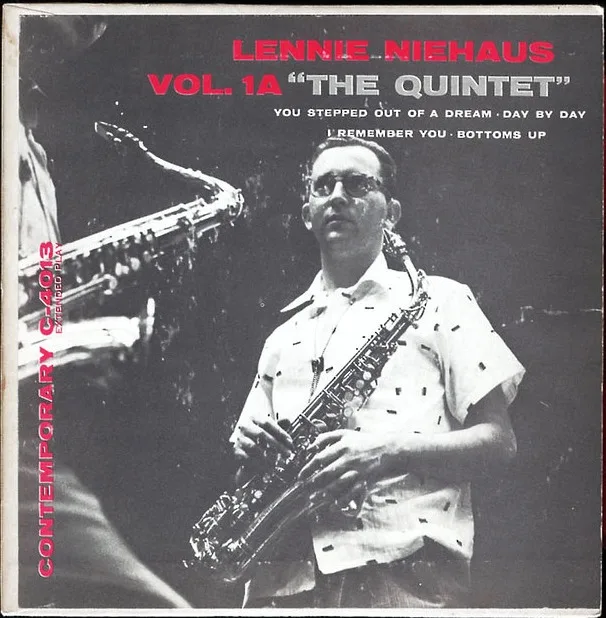
Lennie Niehaus on the front cover of the Contemporary Records EP Lennie Niehaus, Vol. 1A: The Quintet (C-4013, 1955), cover photograph by William Claxton, cropped from a scan of the sleeve Album cover art (not a CC-licensed artist photo), used as the only available image showing the artist. The scan was posted on Flickr by apfelauge with a CC0 dedication, which covers the uploader's scan only and not the original sleeve photograph or design. — Flickr (apfelauge, "lennie niehaus") — https://www.flickr.com/photos/35866663@N06/8649600412
Leonard "Lennie" Niehaus was born on June 1, 1929, in St. Louis, Missouri, the son of Aaron Niehaus, a Russian-born violinist who played in the orchestras that accompanied silent films. When talking pictures emptied the theater pits, the family moved to Los Angeles in the mid-1930s and his father found work in the Hollywood studio orchestras; his sister Agnes became a concert pianist. Niehaus began on violin at seven, played oboe and bassoon in school, and took up the alto saxophone and clarinet at thirteen. He later recalled hearing Charlie Parker at Billy Berg's in 1945 and being "blown away" by bebop. While still at Roosevelt High School he was the lead alto and arranger in the band of Phil Carreón, whose saxophone section included Herb Geller, Herbie Steward and Teddy Edwards, and which at different times also held Warne Marsh and the trombonist Jimmy Knepper. He studied at Los Angeles City College from 1946, alongside the future trumpeter Jack Sheldon and the tenor saxophonist Jack Montrose, and earned a music education degree at Los Angeles State College in 1951.
His professional break came with the Stan Kenton orchestra. Recommended to Kenton in the early 1950s as a replacement for Art Pepper, he auditioned by sight-reading Gerry Mulligan's "Limelight" and was hired, but after about six months on the road he was drafted in 1952 and served until 1954 at Fort Ord, California, in the 6th Infantry Division Band. There he met a fellow soldier, Clint Eastwood, and the two bonded over jazz; in his off hours Niehaus sat in with Shorty Rogers' Giants and Howard Rumsey's Lighthouse All-Stars. After his discharge he rejoined Kenton in 1954, taking the lead alto chair that Lee Konitz had just left, and stayed until 1959, the longest and most-recorded tenure of any of the band's lead altos. He soloed on albums including Contemporary Concepts (1955), Kenton in Hi-Fi (1956), Cuban Fire!, Rendezvous with Kenton and Back to Balboa (both 1958), and the 1959 Kenton Live from the Las Vegas Tropicana, toured Europe with the band in 1956, and was named Down Beat's New Star on alto saxophone in 1955. As a writer he supplied Kenton with charts throughout the decade, among them the whole of The Stage Door Swings (1958), which he wrote in about two and a half weeks, and later Sophisticated Approach and Adventures in Standards (both 1961), after he had stopped playing in the band.
Alongside the Kenton job he led his own records for Les Koenig's Contemporary label, on the advice of Shelly Manne. The first, a pianoless quintet date recorded in July 1954 with Jack Montrose, Bob Gordon, Monty Budwig and Manne, voiced three saxophones so that they sounded like six. An octet followed on August 23, 1954, with Lou Levy, Stu Williamson and Bob Enevoldsen; a second octet with Jimmy Giuffre and Bill Holman in early 1955; The Quintets and Strings in March and April 1955, which wrote a viola and cello quartet into the horn lines as if it were a sax section, with Hampton Hawes and Bill Perkins among the players; and The Sextet in January 1956. A further octet session on December 10, 1956, with Pepper Adams, Frank Rosolino and Red Mitchell, was later paired with the 1954 octet on Zounds! (1958), and he made one date for EmArcy, I Swing for You (1957). In the same years he arranged and played on records for others, including Duane Tatro's Jazz for Moderns and the Hollywood Saxophone Quartet.
In 1959 he gave up full-time playing to write, and from then on his working life was mainly in film and television. He wrote for the King Sisters, Mel Tormé, Dean Martin and Carol Burnett, and from 1962 orchestrated for the composer Jerry Fielding on about seventy television shows and films, among them Hogan's Heroes, Straw Dogs, The Bad News Bears, The Outlaw Josey Wales and Escape from Alcatraz. After Fielding's death in 1980 he became Eastwood's regular composer, writing the full score for Pale Rider (1985) and twelve more of Eastwood's films through Blood Work (2002), among them Heartbreak Ridge, Unforgiven, A Perfect World, The Bridges of Madison County and Space Cowboys, and orchestrating Eastwood's later films from Mystic River (2003) to Gran Torino (2008). His score for Bird (1988), Eastwood's film about Charlie Parker, was nominated for a BAFTA Award, and he coached the actor Forest Whitaker to look convincing playing the saxophone. He won a Primetime Emmy for the 1993 Showtime film Lush Life, in which Whitaker again played a jazz saxophonist, and was nominated again in 2008 for Mitch Albom's For One More Day. In the 1970s he published the method book Jazz Conception for Saxophone, followed by further educational volumes and saxophone ensemble pieces.
After many years away from the saxophone he returned to playing and recording in his sixties, leading a quintet with Frank Strazzeri, Bill Perkins and others on Patterns (recorded 1989), reuniting with Perkins and Jack Nimitz on Seems Like Old Times (recorded December 1997), and recording the live Live at Capozzoli's (October 1999) and, with an octet, Sunday Afternoons at the Lighthouse Cafe, Hermosa Beach (October 2004). He spent his last years playing with Los Angeles jazz groups. Niehaus passed away on May 28, 2020, at the age of 90, at his daughter's home in Redlands, California, under hospice care. He was survived by his wife, Patricia, his daughter Susan, and his grandchildren.
Niehaus played alto with a cool, clean tone and fast, flowing lines that came out of Charlie Parker and Lee Konitz, the two players he named as his main models; he also credited Benny Carter, Phil Woods, Joe Maini, Cannonball Adderley and Sonny Criss. He was best known as a writer of West Coast linear jazz, a contrapuntal approach he said grew from counterpoint studies in college: his small-group charts spread the horns in open voicings so that a quintet or octet sounded larger, and on The Quintets and Strings he wrote the strings as independent melodic lines, in the way a saxophone section would be handled, rather than as accompaniment. His Kenton arrangements moved that band toward more interplay between sections and a stronger reed voice. AllMusic singles out his Contemporary quintet and sextet albums, and the critic Marc Myers calls his mid-1950s small-group records the place to hear his musical gifts at full strength. He is also known to a much wider audience as a film and television composer, and AllMusic files him under both Jazz and Stage & Screen; his scores often kept a jazz base, as in the 1930s-style music for City Heat (1984), which used players such as Marshal Royal and Bill Perkins, and the Parker-centered score for Bird. His jazz recording is concentrated in two periods, roughly 1954 to 1959 and again from 1989 onward, with his film and television work filling the decades between.
- Lennie Niehaus, Vol. 1: The Quintet (1954, Contemporary) - His first date as a leader, recorded in July 1954 without piano, with Jack Montrose on tenor, Bob Gordon on baritone, Monty Budwig and Shelly Manne; "Whose Blues," "You Stepped Out of a Dream" and "Day by Day" are among its tracks.
- Lennie Niehaus, Vol. 2: The Octet (1955, Contemporary) - An eight-piece group recorded August 23, 1954, with Stu Williamson, Bob Enevoldsen and Lou Levy, including his originals "Figure 8," "Patti-Cake," "Night Life" and "Seaside."
- Lennie Niehaus, Vol. 4: The Quintets & Strings (1956, Contemporary) - Recorded in March and April 1955, with a viola and cello quartet written into the horn lines; Hampton Hawes, Bill Perkins and Stu Williamson appear on parts of it, and Marc Myers rates it his finest Contemporary small-group album.
- Lennie Niehaus, Vol. 5: The Sextet (1956, Contemporary) - A January 1956 session with Jimmy Giuffre, Bill Perkins, Stu Williamson and Shelly Manne, including "Thou Swell," "Ill Wind" and "Three of a Kind."
- Zounds! (1958, Contemporary) - Pairs the 1954 octet date with a second octet recorded December 10, 1956, with Pepper Adams on baritone, Frank Rosolino on trombone, Red Mitchell on bass and Mel Lewis on drums.
- I Swing for You (1957, EmArcy) - His only date for the label, an octet with Bill Perkins, Ed Leddy and Lou Levy; he wrote six of the eight arrangements.
- The Stage Door Swings (1958, Capitol) - Stan Kenton's Broadway-show album, arranged entirely by Niehaus around repeating riffs, with a reworked emphasis on the reed section.
- Seems Like Old Times (1998, Fresh Sound) - A reunion with former Kenton section mates Bill Perkins and Jack Nimitz, recorded in December 1997 with Frank Strazzeri, Tom Warrington and Joe LaBarbera.
Lennie Niehaus: Full Discography
Lennie Niehaus appears on Discogs as artist ID 535524 (real name Leonard Niehaus, born June 1, 1929, in St. Louis, Missouri, died May 28, 2020, in Redlands, California). That entry lists roughly 480 releases, most of them Stan Kenton albums and compilations on which he is one of many credited players. His group billings sit under three further Discogs entries, The Lennie Niehaus Octet (ID 2165674), Lennie Niehaus Quintet (ID 2165675) and Lennie Niehaus Quintet + One (ID 2165676), and all four were reconciled for the leader table below, which covers every album he led as a jazz instrumentalist. The second table is a representative set of sideman and arranger credits, each checked against the individual release; the full list is on Discogs. The third table lists his best-known film and television scores. Catalog numbers and recording dates are taken from the pressing named in each row.
As Leader / Co-Leader
| Album Title | Recording Date(s) | Release Date | Label | Catalog Number | Format(s) | Personnel | Role | Reissue History | Spotify | Buy | Notes |
|---|---|---|---|---|---|---|---|---|---|---|---|
| Lennie Niehaus, Vol. 1: The Quintet | July 2 and 9, 1954, Los Angeles | November 1954 | Contemporary | C 2513 | Vinyl, 10-inch LP, Album, Mono | Lennie Niehaus (alto saxophone, arranger), Jack Montrose (tenor saxophone), Bob Gordon (baritone saxophone), Monty Budwig (bass), Shelly Manne (drums) | Leader | Split into two 7-inch EPs, Vol. 1A (C-4013) and Vol. 1B (C-4014), in 1955; later issued as a 12-inch LP, C3518; reissued in the Lone Hill Jazz Complete Fifties Recordings set (2006) | — | — | Pianoless date; Niehaus voices the three saxophones to sound like six. |
| Lennie Niehaus, Vol. 2: The Octet | August 23, 1954, Hollywood | February 1955 | Contemporary | C 2517 | Vinyl, 10-inch LP, Album, Mono | Lennie Niehaus (alto saxophone), Stu Williamson (trumpet), Bob Enevoldsen (valve trombone), Jack Montrose (tenor saxophone), Bob Gordon (baritone saxophone), Lou Levy (piano), Monty Budwig (bass), Shelly Manne (drums) | Leader | Issued as two EPs, Vol. 2A and Vol. 2B, in 1955; reissued in 1958 on Zounds! (C-3540) | — | — | Niehaus wrote four of the eight tracks: "Figure 8," "Patti-Cake," "Night Life" and "Seaside." |
| Lennie Niehaus, Vol. 3: The Octet #2 | January 11 and 26 and February 15, 1955, Hollywood | 1955 | Contemporary | C-3503 | Vinyl, LP, Album, Mono | Lennie Niehaus (alto saxophone), Bill Holman (tenor saxophone), Jimmy Giuffre (baritone saxophone), Stu Williamson (trumpet), Bob Enevoldsen (valve trombone), Pete Jolly (piano), Monty Budwig (bass), Shelly Manne (drums) | Leader | Reissued in the Lone Hill Jazz Complete Fifties Recordings set (2006) | — | — | Twelve tracks including "Blue Room," "Rose Room" and "Cooling It." |
| Lennie Niehaus, Vol. 4: The Quintets & Strings | March 16 and 30 and April 25, 1955, Los Angeles | February 1956 | Contemporary | C3510 | Vinyl, LP, Album, Mono | Lennie Niehaus (alto saxophone, arranger), Bob Gordon (baritone saxophone) and Bill Perkins (tenor saxophone) on four tracks, Hampton Hawes (piano) and Stu Williamson (trumpet, valve trombone) on five tracks, Charlotte Harrison (cello), Barbara Simons, Christopher Kuzell and Thomas Hall (viola) on seven tracks, Monty Budwig (bass), Shelly Manne (drums) | Leader | Reissued in the Lone Hill Jazz Complete Fifties Recordings set (2006) | — | — | Viola and cello quartet written as a line-playing section rather than as accompaniment. |
| Lennie Niehaus, Vol. 5: The Sextet | January 9, 11 and 12, 1956, Contemporary's studio, Los Angeles | 1956 | Contemporary | C-3524 | Vinyl, LP, Album, Mono | Lennie Niehaus (alto saxophone), Bill Perkins (tenor saxophone, flute), Jimmy Giuffre (baritone saxophone), Stu Williamson (trumpet, valve trombone), Buddy Clark (bass), Shelly Manne (drums) | Leader | Reissued in the Lone Hill Jazz Complete Fifties Recordings set (2006) | — | — | Ten tracks including "Thou Swell," "Ill Wind" and "Three of a Kind." |
| I Swing for You | Not specified in Discogs data | 1957 | EmArcy | MG 36118 | Vinyl, LP, Album, Mono | Lennie Niehaus (alto saxophone, arranger), Bill Perkins (tenor saxophone, arranger), Steve Perlow (baritone saxophone), Ed Leddy (trumpet), Kenny Shroyer (bass trumpet), Lou Levy (piano), Red Kelly (bass), Jerry McKenzie (drums) | Leader | Reissued by Lone Hill Jazz in 2006 | — | — | Niehaus arranged six of the eight tracks and Perkins two; the front cover spells his first name "Lenny." |
| Zounds! | August 23, 1954, Hollywood (octet no. 1); December 10, 1956, Los Angeles (octet no. 2) | 1958 | Contemporary | C-3540 | Vinyl, LP, Album, Mono | Octet no. 1: Lennie Niehaus (alto saxophone), Stu Williamson (trumpet), Bob Enevoldsen (valve trombone), Jack Montrose (tenor saxophone), Bob Gordon (baritone saxophone), Lou Levy (piano), Monty Budwig (bass), Shelly Manne (drums). Octet no. 2: Niehaus, Bill Perkins (tenor saxophone), Pepper Adams (baritone saxophone), Frank Rosolino (trombone), Vincent DeRosa (French horn), Jay McAllister (tuba), Red Mitchell (bass), Mel Lewis (drums) | Leader | Reissued by Original Jazz Classics (OJCCD-1892-2, 1997) | — | — | Combines the Vol. 2 octet material with a second octet session recorded two years later. |
| Patterns | August 2 and 3, 1989, Sage & Sound Studios, Los Angeles | 1990 | Fresh Sound | FSR-CD 100 | CD, Album, Stereo | Lennie Niehaus (alto saxophone), Bill Perkins (tenor, soprano and baritone saxophones, bass clarinet), Frank Strazzeri (piano), Tom Warrington (bass), Joe LaBarbera (drums) | Leader (billed as Lennie Niehaus Quintet) | None listed | — | — | Liner notes by Bill Perkins. |
| Seems Like Old Times | December 13 and 14, 1997, Fox Fire Studio, Van Nuys, California | 1998 | Fresh Sound | FSR 5016 CD | CD, Album | Lennie Niehaus (alto saxophone), Bill Perkins (tenor saxophone, baritone saxophone on one track, bass clarinet on one track), Jack Nimitz (baritone saxophone on six tracks), Frank Strazzeri (piano), Tom Warrington (bass), Joe LaBarbera (drums) | Leader (billed as Lennie Niehaus Quintet + One) | None listed | — | — | Reunion of three former Kenton saxophone section mates. |
| Live at Capozzoli's | October 2 and 3, 1999 | 2000 | Woofy | WPCD96 | CD, Album | Lennie Niehaus (alto saxophone), Bill Perkins (tenor and baritone saxophones), Frank Strazzeri (piano), Tom Warrington (bass), Paul Kreibich (drums) | Leader (billed as The Lennie Niehaus Quintet) | None listed | — | — | Live date with a quintet; liner notes by Scott Yanow. |
| Sunday Afternoons at the Lighthouse Cafe, Hermosa Beach | October 17, 2004 | 2005 | Woofy | WPCD154 | CD, Album | Lennie Niehaus (alto saxophone), Tom Peterson (tenor saxophone), Jack Nimitz (baritone saxophone), Ron Stout (trumpet), Bob McChesney (trombone), Bob Florence (piano), Trey Henry (bass), Dick Weller (drums) | Leader (billed as The Lennie Niehaus Octet) | None listed | — | — | Live octet recording. |
The five Contemporary albums from 1954 to 1956 were collected by Lone Hill Jazz in 2006 as three volumes of Complete Fifties Recordings and again as a single set in 2016. Other credited releases not itemized above include the 1996 Giants of Jazz compilation Lennie Niehaus Quintet & Octet.
As Sideman and Arranger (selected major credits)
| Year | Project (Leader) | Title | Label | Catalog | Role | Notes |
|---|---|---|---|---|---|---|
| 1955 | Shorty Rogers (Augmented Giants) and Al Cohn | East Coast - West Coast Scene | RCA Victor | LJM-1020 | Alto saxophone (side two, three tracks) | Credits on the Rogers side were left off the liner notes and identified later. |
| 1955 | Hollywood Saxophone Quartet | Jazz in Hollywood | Liberty | LJH 6005 | Arranger, composer of selected tracks | Quartet of Jack Dumont, William Ulyate, Russ Cheever and Morrie Crawford; Niehaus arranged four tracks and wrote two of them. |
| 1955 | Stan Kenton | Contemporary Concepts | Capitol | T 666 | Alto saxophone | Recorded July 1955 with Charlie Mariano on the other alto; Bill Holman wrote the arrangements. |
| 1956 | Duane Tatro | Jazz for Moderns | Contemporary | C3514 | Alto saxophone (nine of twelve tracks) | Recorded September 1954, April 1955 and November 1955, with Joe Maini, Jimmy Giuffre, Bill Holman, Stu Williamson and Shelly Manne. |
| 1956 | Stan Kenton | Kenton in Hi-Fi | Capitol | W 724 | Saxophone | Recorded in Hollywood, February 1956. |
| 1956 | Stan Kenton | Cuban Fire! | Capitol | T 731 | Saxophone | Johnny Richards suite, recorded in New York City. |
| 1957 | Howard Rumsey's Lighthouse All-Stars | Vol. 5: In the Solo Spotlight! | Contemporary | C3517 | Alto saxophone (three tracks) | His tracks were recorded March 12, 1957, at Contemporary's studio. |
| 1957 | Quincy Jones | Go West, Man! | ABC-Paramount | ABC-186 | Arranger and composer (two tracks) | "Be My Guest" and "Kings Road Blues." |
| 1958 | Stan Kenton | Rendezvous with Kenton | Capitol | T 932 | Alto saxophone, soloist on three tracks | Soloist on "These Things You Left Me," "Two Shades of Autumn" and "Love Letters." |
| 1958 | Stan Kenton | Back to Balboa | Capitol | T 995 | Alto saxophone | Includes Johnny Richards' arrangement of "I Concentrate on You." |
| 1958 | Hollywood Saxophone Quartet | Sax Appeal | Liberty | LRP 3080 | Arranger, composer of four tracks | "Forget," "Open House," "That's the Way the Ball Bounces" and "Four at Liberty." |
| 1958 | Stan Kenton | The Stage Door Swings | Capitol | T 1166 | Arranger, alto saxophone | A full album of Broadway-show arrangements. |
| 1961 | Jack Sheldon and His Exciting All-Star Big-Band | Jack's Groove | GNP | GNP 60 | Alto saxophone (five tracks), arranger (three tracks) | Niehaus's side was recorded in December 1958, with Art Pepper and Herb Geller on alto and Chet Baker among the trumpets. |
| 1961 | Stan Kenton | Kenton Live from the Las Vegas Tropicana | Capitol | ST 1460 | Saxophone | Recorded live at the Tropicana Hotel in 1959; includes his arrangement of "End of a Love Affair." |
| 1961 | Stan Kenton | Sophisticated Approach | Capitol | T 1674 | Arranger | Written after he had left the band as a player. |
| 1981 | Madeleine Dring (music by); chamber jazz arrangements by Niehaus | Shades of Dring | Cambria | C-1016 | Arranger | Recorded September 9 and 10, 1981, with Bud Shank, Bill Perkins, Ray Brown and Shelly Manne. |
Selected Film and Television Scores
| Year | Title | Notes |
|---|---|---|
| 1984 | Tightrope | Starring Clint Eastwood; Niehaus orchestrated. |
| 1984 | City Heat | Period jazz score with Marshal Royal and Bill Perkins. |
| 1985 | Pale Rider | His first complete score for an Eastwood film. |
| 1986 | Heartbreak Ridge | BMI Film & TV Award. |
| 1988 | Bird | Biography of Charlie Parker; score nominated for a BAFTA Award. |
| 1990 | White Hunter Black Heart | Directed by Clint Eastwood. |
| 1990 | The Rookie | Directed by Clint Eastwood. |
| 1992 | Unforgiven | BMI Film & TV Award. |
| 1993 | Lush Life (television film) | Primetime Emmy Award for music composition. |
| 1993 | A Perfect World | Directed by Clint Eastwood. |
| 1995 | The Bridges of Madison County | BMI Film & TV Award. |
| 1997 | Absolute Power | Directed by Clint Eastwood. |
| 1997 | Midnight in the Garden of Good and Evil | Directed by Clint Eastwood. |
| 1999 | True Crime | Directed by Clint Eastwood. |
| 2000 | Space Cowboys | BMI Film & TV Award. |
| 2002 | Blood Work | The last Eastwood film he scored in full. |
| 2003 to 2008 | Mystic River, Million Dollar Baby, Flags of Our Fathers, Letters from Iwo Jima, Changeling, Gran Torino | Orchestrator for Eastwood's later films, from Mystic River through Gran Torino. |
| 2007 | Mitch Albom's For One More Day (television film) | Emmy nomination. |
- Stan Kenton - bandleader; Niehaus was lead alto and arranger in his orchestra for about six months before his Army service and again from 1954 to 1959, then wrote for it into the 1960s, including three full albums.
- Shelly Manne - drummer on his Contemporary sessions from 1954 to early 1956, and the friend who steered him to the label.
- Bill Perkins - tenor saxophonist and Kenton section mate; on the strings and sextet albums and several later dates, including Patterns, Seems Like Old Times and Live at Capozzoli's.
- Jimmy Giuffre - baritone saxophonist on the second octet album and the sextet album.
- Stu Williamson - trumpeter and valve trombonist on the octet and sextet records.
- Hampton Hawes - pianist on part of The Quintets and Strings (1955).
- Pepper Adams, Red Mitchell, Mel Lewis - baritone saxophonist, bassist and drummer on the December 1956 octet session later issued on Zounds!.
- Charlie Mariano - fellow Kenton alto saxophonist; the two shared the alto section on Contemporary Concepts (1955).
- Les Koenig - producer and owner of Contemporary Records, who recorded his 1950s small-group albums apart from the EmArcy date.
- Bill Holman - arranger and tenor saxophonist; wrote "Cherokee" for him on Contemporary Concepts and played tenor on the second octet album.
- Jack Montrose, Bob Gordon, Monty Budwig, Lou Levy, Bob Enevoldsen, Pete Jolly - the core of his 1954 and 1955 Contemporary groups.
- Frank Strazzeri, Tom Warrington, Joe LaBarbera, Jack Nimitz - members of his quintet and reunion records from 1989 to 2004.
- Jerry Fielding - film and television composer for whom Niehaus orchestrated from 1962 until Fielding's death in 1980.
- Clint Eastwood - director and fellow Fort Ord soldier; the two worked together on more than two dozen films, with Niehaus as composer or orchestrator, from the 1970s to 2008.
More West Coast Jazz Artists
See all 35 West Coast Jazz artists →More American Jazz Artists
See all 820 American artists →- Wikipedia: Lennie Niehaus
- AllMusic: Lennie Niehaus, biography by Matt Collar
- Jazz Journal: Obituary, Lennie Niehaus, by Gordon Jack (June 15, 2020)
- The Hollywood Reporter: Lennie Niehaus dead at 90 (June 2020)
- JazzWax (Marc Myers): Interview with Lennie Niehaus, parts 1, 3 and 4 (November 2009), as republished by All About Jazz
- Discogs: Lennie Niehaus (artist 535524)
- Discogs: The Lennie Niehaus Octet (artist 2165674)
- Discogs: Lennie Niehaus Quintet (artist 2165675)
- MusicBrainz: Lennie Niehaus
- JazzProfiles.com: Stan Kenton
- JazzProfiles.com: Shelly Manne
- JazzProfiles.com: Bill Perkins