 JAZZPROFILES lives in the music 1,002 Jazz Artists fully Profiled!
 Gary Bartz
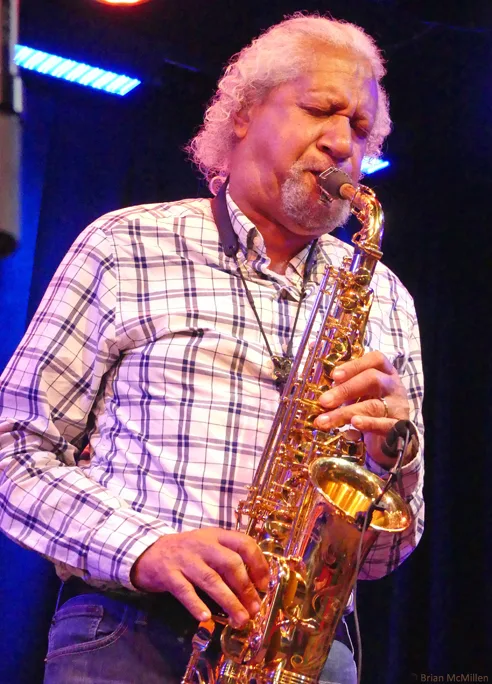
Gary Bartz performing at the Kuumbwa Jazz Center, Santa Cruz, California, July 7, 2017. CC BY-SA 4.0 — Wikimedia Commons, photo by Brian McMillen. https://commons.wikimedia.org/wiki/File:Gary_Bartz_KJC.jpg

Gary Lee Bartz was born September 26, 1940, in Baltimore, Maryland, the son of nightclub-owning parents whose venue brought touring jazz musicians through the house during his childhood. He picked up the alto saxophone at eleven, and as a teenager he got the chance to sit in with visiting players including Art Blakey and George Benson. After high school he enrolled at the Juilliard School in New York. From 1962 to 1964 he was a member of Charles Mingus's Jazz Workshop, where he worked alongside Eric Dolphy and first crossed paths with pianist McCoy Tyner. He also began gigging in the mid-1960s as a sideman with the Abbey Lincoln and Max Roach group, then briefly joined Art Blakey and the Jazz Messengers, making his recording debut on the band's 1965 album Soul Finger and remaining through 1966's Hold On, I'm Coming. In 1968 he joined Tyner's band Expansions, documented on the Blue Note album of the same name.
In 1968 Bartz formed his own band and signed to Milestone Records, debuting as a leader with Libra, a quintet date with drummer Billy Higgins, bassist Richard Davis, pianist Albert Dailey, and trumpeter Jimmy Owens. He followed it in 1969 with Another Earth, featuring Pharoah Sanders on tenor saxophone and Charles Tolliver on trumpet alongside bassist Reggie Workman, drummer Freddie Waits, and pianist Stanley Cowell; the album is now regarded as an influential early fusion of hard bop with modal and spiritual currents. In mid-1970, Miles Davis brought Bartz into his touring band on alto and soprano saxophone, a group that also included Keith Jarrett on electric keyboards, Michael Henderson on electric bass, Jack DeJohnette on drums, and, later, Airto Moreira on percussion and John McLaughlin on guitar. Bartz performed with Davis at the Isle of Wight Festival in August 1970 and at Washington, D.C.'s Cellar Door club that December; his playing from those engagements surfaced on Davis's 1971 album Live-Evil and, in full, on the 2005 box set The Cellar Door Sessions 1970.
Also in 1970, Bartz formed the NTU Troop, a group built around a fusion of jazz, funk, soul, and African and Caribbean musical elements, often with a spoken-word or vocal component. Vocalist Andy Bey joined the group for a run of Milestone and Prestige albums recorded between 1970 and 1974: Home! (a 1970 release drawn from a March 1969 concert at Baltimore's Left Bank Jazz Society, with Woody Shaw on trumpet), Harlem Bush Music: Taifa and Harlem Bush Music: Uhuru (both 1971, dedicated respectively to the memories of Malcolm X and John Coltrane), Juju Street Songs (1972), I've Known Rivers and Other Bodies (1973, recorded live at the Montreux Jazz Festival), Follow, the Medicine Man (1973), and the group's final outing, Singerella: A Ghetto Fairy Tale (1974), produced by Larry Mizell. That production relationship carried into 1975's The Shadow Do, made with Larry and Fonce Mizell alongside Davis's former bandmates Reggie Lucas, James Mtume, and Michael Henderson.
In 1977 Bartz again teamed with the Mizell brothers for Music Is My Sanctuary on Capitol Records, a jazz-funk album that reached the charts but which, in the words of AllMusic critic Thom Jurek, "initially proved far too funky for most jazz critics." He continued in a radio-friendly, pop-oriented direction for the rest of the decade with Love Affair (1978) and Bartz (1980, produced by Mtume and Lucas), then spent most of the 1980s working primarily as a sideman and billed collaborator, recording steadily with Tyner, Phyllis Hyman, Mtume, drummer Leon "Ndugu" Chancler, and Woody Shaw. He returned to hard-bop leader dates beginning with 1988's Monsoon and 1989's Reflections on Monk: The Final Frontier, followed by a run of live and studio albums for Candid and Atlantic: West 42nd Street (1990), There Goes the Neighborhood! (1991), Shadows (1992), The Red and Orange Poems (1994, praised in its liner notes by critic Stanley Crouch), and Episode 1: Children of Harlem (1994). In 1996 he assembled a larger studio band, including vocalist Jon Hendricks and pianist Cyrus Chestnut, for The Blues Chronicles: Tales of Life, and that same year recorded Spirit of '70 with organist Robert Walter and saxophonist Karl Denson. In 1998 Bartz won a Grammy Award for Best Latin Jazz Performance as a member of Roy Hargrove's Crisol on the album Habana.
Bartz joined the jazz studies faculty at Oberlin Conservatory of Music in 2001, where he holds the title of Professor of Jazz Saxophone. He released Soprano Stories in 2005, his first album-length showcase for his soprano playing, and later that year won a second Grammy, for Best Jazz Instrumental Album, as a sideman on McCoy Tyner's Illuminations, alongside Terence Blanchard, Christian McBride, and Lewis Nash. After a stretch of teaching and occasional performing, he returned as a bandleader with Coltrane Rules: Tao of a Music Warrior (2011) on his own OYO label. In 2015 he received the BNY Mellon Jazz Living Legacy Award at the Kennedy Center. In 2019, Revive Music brought him to New York's Winter Jazzfest to mark the 50th anniversary of Another Earth, a performance he reprised at the North Sea and Newport jazz festivals with original Another Earth personnel Charles Tolliver, plus drummer Nasheet Waits and saxophonist Ravi Coltrane. That same year, producer Gilles Peterson paired Bartz with the London spiritual-jazz group Maisha for the We Out Here festival; the collaboration led to 2020's Night Dreamer Direct-to-Disc Sessions, reworking earlier NTU Troop material. Bartz went on to record two volumes in Adrian Younge and Ali Shaheed Muhammad's Jazz Is Dead series. In 2024, the National Endowment for the Arts named him an NEA Jazz Master. He formed a new lineup of NTU and released The Eternal Tenure of Sound: Damage Control in 2025, and in May 2026 received an honorary Doctor of Music degree from the New England Conservatory.
Bartz's alto style is grounded in bebop and hard-bop vocabulary but carries an unmistakable modal and spiritual cast absorbed from his time around John Coltrane's generation, delivered with a vocal, cutting tone on both alto and soprano. What sets his catalog apart is the range: he moved between acoustic post-bop leader dates, the genre-blending jazz-funk-soul-African fusion of NTU Troop, and a run of unabashedly commercial 1970s crossover records, then returned to hard bop in the 1990s without ever fully leaving any of those lanes behind. That range, and NTU Troop's fusion of jazz with funk, soul, and spoken word in particular, has been cited as a direct influence on later spiritual-jazz and fusion-minded musicians including Kamasi Washington, Yazz Ahmed, and Shabaka Hutchings. Critic Stanley Crouch, writing in the liner notes to The Red and Orange Poems, called him "one of the very finest to have ever picked up the instrument."
- Libra (1968, Milestone) - Bartz's debut as a leader, a hard-bop quintet date with Billy Higgins, Richard Davis, Albert Dailey, and Jimmy Owens.
- Another Earth (1969, Milestone) - A landmark early fusion of hard bop and modal jazz, with Pharoah Sanders and Charles Tolliver guesting.
- Harlem Bush Music: Uhuru (1971, Milestone) - NTU Troop's Andy Bey-featuring set dedicated to the memory of John Coltrane, including the spiritual-jazz staple "Celestial Blues."
- Live-Evil (1971, Columbia) - As a sideman: Miles Davis's electric-era studio-and-live hybrid, capturing Bartz's brief but influential tenure in Davis's touring band.
- Music Is My Sanctuary (1977, Capitol) - Bartz's biggest commercial hit, a Larry and Fonce Mizell-produced jazz-funk record built around its charting title track.
- The Red and Orange Poems (1994, Atlantic) - A hard-bop quintet date with Dave Holland and Eddie Henderson, praised by critic Stanley Crouch in the liner notes.
- Habana (1997, Verve) - As a sideman: Roy Hargrove's Crisol, an Afro-Cuban jazz session that won the 1998 Grammy for Best Latin Jazz Performance.
- Illuminations (2004, Telarc) - As a sideman: McCoy Tyner's quintet album with Terence Blanchard, Christian McBride, and Lewis Nash, winner of the 2005 Grammy for Best Jazz Instrumental Album.
Gary Bartz: Full Discography
Identity confirmed via the live Discogs API, artist ID 45008 ("Gary Bartz," realname Gary Lee Bartz, profile giving a September 26, 1940 Baltimore, Maryland birth matching Wikipedia and AllMusic). Bartz's leader catalog is split across several Discogs entities that do not cross-reference each other: his main artist page, "Gary Bartz NTU Troop" (id 135926), "Gary Bartz Quintet" (id 376268), and "Gary Bartz Quartet" (id 1375200); all four were checked and reconciled here. The main artist ID alone is credited on 590 releases (64 in a "Main"/leader role, 305 sideman "Appearance" credits, plus track-level and reissue/compilation credits), and this is a career spanning six decades with a large body of both leader and sideman work. The table below itemizes his confirmed leader/co-leader catalog plus a representative set of his most significant and best-documented sideman dates; it does not attempt to itemize the full sideman log.
Two releases that Discogs' artist-releases endpoint tags with a "Main" role are, on inspection of the actual release credits, billed to other leaders with Bartz as a featured guest rather than as leader or co-leader: 1977's Virtue (billed to drummer Alphonse Mouzon) and 2016's A Place in Time (billed to trumpeter Wallace Roney). Both are listed in the sideman table below rather than the leader table.
As Leader / Co-Leader
| Album Title | Recording Date(s) | Release Date | Label | Catalog Number | Format(s) | Personnel | Role | Reissue History | Spotify | Buy | Notes |
|---|---|---|---|---|---|---|---|---|---|---|---|
| Libra | Recorded May 31 & June 15, 1967, Plaza Sound Studios, NYC | 1968 | Milestone | MSP 9006 | Vinyl, LP, Album, Stereo | Gary Bartz (alto sax), Jimmy Owens (trumpet, flugelhorn), Albert Dailey (piano), Richard Davis (bass), Billy Higgins (drums) | Leader (Gary Bartz Quintet) | None found | — | — | Bartz's recorded debut as a leader |
| Another Earth | Recorded June 19 & 25, 1968, NYC | 1969 | Milestone | MSP 9018 | Vinyl, LP, Album, Stereo | Gary Bartz (alto sax), Pharoah Sanders (tenor sax, side A only), Charles Tolliver (trumpet, side A only), Stanley Cowell (piano), Reggie Workman (bass), Freddie Waits (drums) | Leader | None found | — | — | Now regarded as an influential early fusion of hard bop and modal/spiritual jazz; celebrated for its 50th anniversary at New York's Winter Jazzfest in 2019 |
| Home! | Recorded live March 30, 1969, Left Bank Jazz Society, Baltimore, MD | 1970 | Milestone | MSP 9027 | Vinyl, LP, Album, Stereo | Gary Bartz (alto sax, steel drums, bells), Woody Shaw (trumpet), Albert Dailey (piano), Bob Cunningham (bass), Rashied Ali (drums) | Leader (Gary Bartz NTU Troop) | None found | — | — | First album billed to NTU Troop |
| Harlem Bush Music: Taifa | Not specified in Discogs data | 1971 | Milestone | MSP 9031 | Vinyl, LP, Album, Stereo | Gary Bartz (soprano/alto sax, narration), Andy Bey (vocals), Juini Booth (bass), Harold White (drums), Nat Bettis (percussion) | Leader (Gary Bartz NTU Troop) | None found | — | — | Dedicated to the memory of Malcolm X |
| Harlem Bush Music: Uhuru | Recorded November 1970 & January 1971, Decca Sound Studios, NYC | 1971 | Milestone | MSP 9032 | Vinyl, LP, Album, Stereo | Gary Bartz (alto/soprano sax, piano, vocals), Andy Bey (vocals), Juini Booth / Ron Carter (bass), Harold White (drums), Nat Bettis (percussion) | Leader (Gary Bartz NTU Troop) | None found | — | — | Dedicated to the memory of John Coltrane; includes "Celestial Blues" |
| Juju Street Songs | Not specified in Discogs data | 1972 | Prestige | PRST-10057 | Vinyl, LP, Album | Gary Bartz (alto/soprano/sopranino sax, voice, electric piano, percussion, producer), Andy Bey (vocals, electric piano, percussion), Stafford James (bass), Howard King (drums) | Leader (Gary Bartz Ntu Troop) | None found | — | — | |
| I've Known Rivers and Other Bodies | Recorded live July 7, 1973, Montreux Jazz Festival, Switzerland | 1973 | Prestige | P-66001 | Vinyl, 2xLP, Album | Gary Bartz (soprano/alto sax, vocals, arranger, producer), Hubert Eaves III (electric/acoustic piano), Stafford James (electric/acoustic bass), Howard King (drums) | Leader (Gary Bartz NTU Troop) | None found | — | — | Includes "I've Known Rivers," setting a Langston Hughes text |
| Follow, the Medicine Man | Recorded October 1972, Fantasy Studios, Berkeley, CA, and June 1973, CI Recording, NYC | 1973 | Prestige | PR 10068 | Vinyl, LP, Album, Stereo | Gary Bartz (alto/soprano/sopranino sax, voice, electric piano, percussion), Andy Bey / Hubert Eaves III (electric piano), Stafford James (bass), Howard King (drums), Hector Centeno (guitar) | Leader (Gary Bartz NTU Troop) | None found | — | — | |
| Singerella: A Ghetto Fairy Tale | Recorded November 1973 & February 1974, C.I. Recording (NYC) and Fantasy Studios (Berkeley) | 1974 | Prestige | P-10083 | Vinyl, LP, Album | Gary Bartz (alto/soprano sax, clarinet, synthesizer, vocals, producer, arranger), Hubert Eaves III (piano, electric piano, clavinet), Howard King (drums), James Benjamin (electric bass) | Leader (Gary Bartz NTU Troop) | None found | — | — | NTU Troop's final album; mixed by Larry Mizell |
| Music Is My Sanctuary | Not specified in Discogs data | 1977 | Capitol Records | ST-11647 | Vinyl, LP, Album, Stereo | Gary Bartz (sax, co-producer, arranger), Syreeta Wright (vocals); produced and arranged by Larry Mizell and Fonce Mizell, strings arranged by Wade Marcus | Leader | None found | — | — | Bartz's biggest commercial hit; title track and "Carnaval de l'Esprit" also issued as a single |
| Love Affair | Not specified in Discogs data | 1978 | Capitol Records | SW-11789 | Vinyl, LP, Album | Gary Bartz (alto/soprano sax, clarinet, vocals, producer), George Cables (keyboards, piano), Welton Gite (bass), Howard King / Tony Robertson (drums); includes a version of John Coltrane's "Giant Steps" | Leader | None found | — | — | |
| Bartz | Not specified in Discogs data | 1980 | Arista | AB 4263 | Vinyl, LP, Album | Gary Bartz, Tawatha (vocals); produced by James Mtume and Reggie Lucas | Leader | None found | — | — | |
| Monsoon | Recorded April 5, 1988 | 1988 | SteepleChase | SCCD 31234 | CD, Album | Gary Bartz (saxophone), Butch Lacy (piano), Clint Houston (bass), Billy Hart (drums) | Leader (Gary Bartz Quartet) | None found | — | — | Return to acoustic hard bop after the crossover years |
| Reflections on Monk: The Final Frontier | Recorded November 22, 1988 | 1989 | SteepleChase | SCS 1248 | Vinyl, LP, Album, Stereo | Gary Bartz (alto/soprano sax), Eddie Henderson (trumpet), Bob Butta (piano), Geoff Harper (bass), Billy Hart (drums) | Leader | None found | — | — | An album of Thelonious Monk compositions |
| West 42nd Street | Recorded live March 31, 1990, Birdland, NYC | 1990 | Candid | CCD 79049 | CD, Album | Gary Bartz (alto/soprano sax), Claudio Roditi (trumpet, flugelhorn), John Hicks (piano), Ray Drummond (bass), Al Foster (drums) | Leader (Gary Bartz Quintet) | None found | — | — | |
| There Goes the Neighborhood! | Recorded live November 11-12, 1990, Birdland, NYC | 1991 | Candid | CCD79506 | CD, Album | Gary Bartz (alto sax), Kenny Barron (piano), Ray Drummond (bass), Ben Riley (drums) | Leader | None found | — | — | Includes Kenny Barron's composition "Flight Path" |
| Shadows | Not specified in Discogs data | 1992 | Not specified in Discogs data | Not specified in Discogs data | Not specified in Discogs data | Gary Bartz (alto sax) with Benny Green (piano), Christian McBride (bass), Victor Lewis (drums), Willie Williams (tenor sax), per AllMusic | Leader | Not confirmed | — | — | Personnel per AllMusic's biography; not independently verified against a Discogs release record |
| The Red and Orange Poems | Recorded September 24-25, 1994, NYC | 1994 | Atlantic Jazz | 82720-2 | CD, Album | Gary Bartz (alto sax, producer, arranger), Eddie Henderson (trumpet, flugelhorn), Mulgrew Miller (piano), Dave Holland (bass), Greg Bandy (drums) | Leader | None found | — | — | Liner notes by critic Stanley Crouch |
| Episode 1: Children of Harlem | Not specified in Discogs data | 1994-06-24 | Challenge Jazz | CHR 70001 | CD, Album | Gary Bartz (alto sax), Larry Willis (piano), Buster Williams (bass), Ben Riley (drums) | Leader | None found | — | — | |
| The Blues Chronicles: Tales of Life | Not specified in Discogs data | 1996 | Atlantic | 82893-2 | CD, Album | Gary Bartz (alto/soprano sax, producer, arranger), Jon Hendricks (vocals), Cyrus Chestnut (piano, organ), Russell Malone (guitar), Dennis Chambers (drums) | Leader | None found | — | — | Larger studio band including rappers Nezkar Keith and Ransom |
| Soprano Stories | Not specified in Discogs data | 2005 | OYO Recordings | OYO 10022 | CD, Album | Gary Bartz (soprano sax, producer), John Hicks / George Cables (piano), James King (bass), Greg Bandy (drums) | Leader | None found | — | — | Bartz's first album-length showcase for soprano saxophone |
| Coltrane Rules: Tao of a Music Warrior | Recorded 2000 and 2008, various NYC studios | 2011 | OYO Recordings | Not specified in Discogs data | CD, Album | Gary Bartz (alto sax, sopranino sax, bass clarinet, producer), Barney McAll (piano), James King (bass), Greg Bandy (drums) | Leader | None found | — | — | Built around John Coltrane compositions |
| Night Dreamer Direct-to-Disc Sessions | Recorded October 29-30, 2019, Artone Studio, Haarlem, Netherlands | 2020-05-29 | Night Dreamer | Not specified in Discogs data | File, Album (also issued on vinyl) | Gary Bartz (alto/soprano sax) with Maisha: Shirley Tetteh (guitar), Twm Dylan (bass), Al MacSween (keyboards), Jake Long (drums), Tim Doyle (percussion), Axel Kaner-Lindstrom (trumpet) | Leader (Gary Bartz with Maisha) | None found | — | — | Reworks NTU Troop's "Uhuru Sasa" and "Dr. Follow's Dance" |
| The Eternal Tenure of Sound: Damage Control | Not specified in Discogs data | 2025-09-26 | OYO Recordings | Not specified in Discogs data | Not specified in Discogs data | Gary Bartz, billed with a reconstituted Gary Bartz NTU Troop | Leader | None found | — | — | Newly formed lineup of NTU released this album at age 84/85 |
As Sideman (selected major credits)
| Year | Project (Leader) | Title | Label | Catalog | Role | Notes |
|---|---|---|---|---|---|---|
| 1965-1966 | Art Blakey & the Jazz Messengers | Soul Finger / Hold On, I'm Coming | Not specified in Discogs data | Alto Saxophone | Bartz's recording debut, per AllMusic | |
| 1968 | McCoy Tyner | Expansions | Blue Note | Alto Saxophone | Bartz's first recorded association with Tyner as a bandleader | |
| 1971 | Miles Davis | Live-Evil | Columbia | Alto/Soprano Saxophone | Drawn from Bartz's 1970-71 tenure in Davis's touring band | |
| 1977 | Alphonse Mouzon | Virtue | MPS Records | 68.130 | Alto Saxophone (tracks A1, B1), Soprano Saxophone (tracks A2-A4, B2, B3) | Billed to Mouzon, not a Bartz leader date despite appearing under "Main" role in Discogs' artist-releases listing |
| 1997 | Roy Hargrove's Crisol | Habana | Verve | Alto/Soprano Saxophone | Won the 1998 Grammy Award for Best Latin Jazz Performance | |
| 2004 | McCoy Tyner | Illuminations | Telarc Jazz | Saxophone | With Terence Blanchard, Christian McBride, Lewis Nash; won the 2005 Grammy Award for Best Jazz Instrumental Album | |
| 2016 | Wallace Roney | A Place in Time | HighNote Records | HCD 7295 | Alto Saxophone | Billed to Roney, not a Bartz leader date despite appearing under "Main" role in Discogs' artist-releases listing; also features Buster Williams on bass |
| 2020 | Adrian Younge / Ali Shaheed Muhammad | Jazz Is Dead 1 | Jazz Is Dead | Alto Saxophone | First of Bartz's contributions to the Jazz Is Dead series | |
| 2021 | Adrian Younge / Ali Shaheed Muhammad | Jazz Is Dead 6 | Jazz Is Dead | Alto/Soprano Saxophone | Released as Gary Bartz JID006 |
Bartz's Discogs sideman log (305 "Appearance" credits on his main artist ID alone, spanning six decades) also includes extensive further work with McCoy Tyner across multiple albums and compilations, Woody Shaw, Phyllis Hyman, James Mtume, drummer Leon "Ndugu" Chancler, and the Mingus Big Band, plus guest and compilation appearances tied to Miles Davis's other 1970-71 live recordings (The Cellar Door Sessions 1970, the Isle of Wight festival set), not itemized exhaustively here.
- Miles Davis - alto and soprano saxophonist in Davis's touring band, 1970-1971, heard on Live-Evil and The Cellar Door Sessions 1970.
- McCoy Tyner - member of Tyner's band Expansions from 1968; reunited on multiple later Tyner albums including 2004's Illuminations, for which Bartz won a Grammy as a sideman.
- Pharoah Sanders - guest tenor saxophonist on Bartz's own 1969 leader date Another Earth.
- Charles Tolliver - trumpeter on Another Earth (1969); rejoined Bartz for the 2019 performances marking that album's 50th anniversary.
- Woody Shaw - trumpeter on NTU Troop's Home! (1970) and a frequent working collaborator through the 1980s.
- Reggie Workman - bassist on Another Earth (1969).
- Andy Bey - vocalist in NTU Troop, 1971-1974, featured on Harlem Bush Music: Taifa, Harlem Bush Music: Uhuru, and Juju Street Songs.
- Kenny Barron - pianist on There Goes the Neighborhood! (1991), also contributing the composition "Flight Path."
- Buster Williams - bassist on Episode 1: Children of Harlem (1994).
- Dave Holland - bassist on The Red and Orange Poems (1994).
- Billy Hart - drummer on Monsoon (1988) and Reflections on Monk: The Final Frontier (1989).
- Eddie Henderson - trumpeter on Reflections on Monk: The Final Frontier (1989) and The Red and Orange Poems (1994).
- Roy Hargrove - bandleader of Crisol, whose 1997 album Habana won Bartz a Grammy as a sideman.
- Christian McBride - bassist alongside Bartz on McCoy Tyner's Illuminations (2004).
- John Hicks - pianist on West 42nd Street (1990) and Soprano Stories (2005).
- Wallace Roney - Bartz appeared as a sideman on Roney's 2016 leader album A Place in Time.
- Wikipedia: Gary Bartz
- AllMusic: Gary Bartz biography by Thom Jurek
- Discogs: Gary Bartz (artist 45008)
- National Endowment for the Arts: Gary Bartz, 2024 NEA Jazz Master
- Oberlin College and Conservatory: Gary Bartz faculty page
- Wikipedia: The Cellar Door Sessions 1970
- Wikipedia: 47th Annual Grammy Awards