 JAZZPROFILES lives in the music 3,006 Jazz Artists fully Profiled!
Arthur Briggs
Last updated November 15, 2026
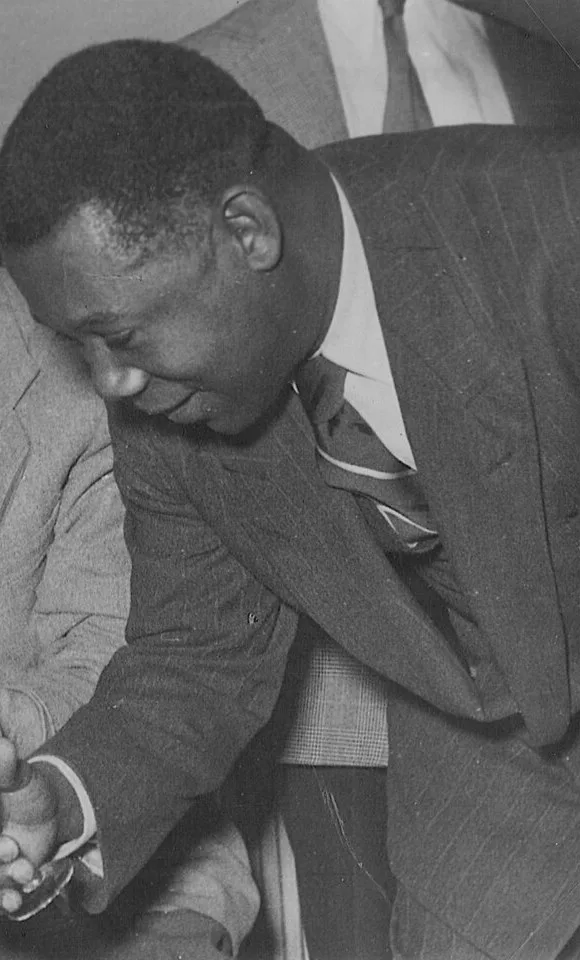
Arthur Briggs in Paris on February 21, 1948, cropped from a photograph that also shows Dizzy Gillespie (left) and the Australian bandleader Graeme Bell (centre); Briggs is the man on the right. The printed caption on the original reads "Paris Feb 21, 1948, Dizzy Gillespie, Graeme Bell, Arthur Briggs". Public domain. The Commons file page tags it Public domain / PD-Australia (Australian photograph taken before 1955, author unknown). — Wikimedia Commons - https://commons.wikimedia.org/wiki/File:Graeme_Bell_with_Dizzy_Gillespie_and_Arthur_Briggs_1948.jpg (original credit: Australian Jazz Museum, https://www.ajm.org.au/?page_id=17077)

Arthur Briggs (James Arthur Briggs) was a trumpeter and orchestra leader, born on April 9, 1901 in St. George's, Grenada, then a British colony, the youngest of ten children. He passed away on July 15, 1991 in Paris. He was a British subject by birth and learned his jazz in Harlem, so he belongs in the French section through his working life rather than his birth: he lived in Europe from June 1919 until his death, and in France without a break from 1931, some sixty of his seventy-two European years. In the 1930s he was called the "Louis Armstrong of France", he led dance and hot orchestras across the Continent in the 1920s, recorded with Coleman Hawkins in Paris in 1935, was interned by the Germans from October 1940 and taught music after the war.
Briggs left Grenada for the United States at about the age of sixteen (his biographer Travis Atria puts the move in 1917) and played in Harlem as a teenager. English Wikipedia says he studied with Will Marion Cook at the Martin-Smith School of Music and played in the 369th US Infantry Band; he gave 1899 as his birth year to be old enough to enlist, yet was still thought too young to be sent to Europe during the war. For most of his life he let people believe that he was American and born in South Carolina, and his Grenadian origin came to light only through later research and family testimony. In June 1919 he crossed to Europe with Cook's Southern Syncopated Orchestra, travelling with Sidney Bechet, who stayed a close friend until Bechet's death.
He did not go back. Atria describes the Savoy Syncopators, which Briggs led for years, as growing out of a residency at a Savoy Hotel in the early 1920s and being based in Brussels, and the band toured widely on the Continent. Billed as Arthur Briggs and his Savoy Syncops Orchestra, it made its best-known records in Berlin between about March and September 1927 for Grammophon, Polydor and Clausophon, among them "Bugle Call Rag", "Ain't She Sweet?" and "Do the Black Bottom with Me"; the English singer Al Bowlly is on some of them, and a 1978 compilation of the Berlin and London sides is credited to Bowlly and the orchestra.
By 1930 he was working between Paris and London. The session listings in Noble Sissle's profile put Briggs in the trumpet section, with Tommy Ladnier, of Sissle's Sizzling Syncopators in London on December 11, 1930 and in New York on February 24, 1931, the first of Bechet's dates with that band. From 1931 France was his base. With the pianist Freddy Johnson he co-led the Harlemites (also billed as the Johnson-Briggs orchestra) in Paris, a band a recent review of Atria's book calls the hottest in Europe around 1932; they recorded there on June 13 and July 8, 1933, and Decca issued "Sweet Madness" and "Harlem Bound" under Johnson's name, featuring Briggs, in 1934. He worked at Bricktop's cabaret in Montmartre, where Atria says the house band premiered Cole Porter's "Night and Day", and he later worked with Josephine Baker in Paris and on a tour in the late 1930s, which he is said to have resented as underpaid. On March 2, 1935 he was the trumpeter on the Paris sides that Hawkins made with Michel Warlop's orchestra ("Blue Moon", "What a Difference a Day Made", "Avalon" and "Star Dust"); English Wikipedia places Django Reinhardt on "Blue Moon". Atria says he helped Reinhardt and Stéphane Grappelli find their first engagements and recording contracts, and that he turned down chances to go home to the United States, one of them to stand in for Louis Armstrong.
On February 15, 1940 he recorded the two-part "Braggin' the Briggs", his own composition, with Reinhardt on guitar, the clarinettist Christian Wagner, the pianist Ray Stokes and the bassist Tony Rovira; a second Swing single, "Scatterbrain" and "My Melancholy Baby", lists the same players with Alix Combelle on tenor saxophone. The release came after the war. After the German occupation of Paris he was arrested in October 1940 as a British passport holder and held at first, English Wikipedia says, in an SS camp for political prisoners near Compiègne, until the British jazz musician Tom Waltham, an internee at the British civilians' camp at Saint-Denis, petitioned the Germans to have him moved there. At Saint-Denis he led the brass section of the camp orchestra and, with Waltham, much of its music; jazz was forbidden, so the internees played classical programmes, and a printed programme of 1942 lists works by Albéniz, Granados, de Falla, Mozart, Handel, Franck and Liszt under the name "Arthur Briggs et son Orchestre". Atria writes that he played Beethoven for the German military commander in France, Otto von Stülpnagel, around New Year 1941, and that he was held for about four years.
After the Liberation of Paris he organised and led his own bands. Discogs lists his orchestra on Pathé in the early 1950s as Arthur Briggs et son "Society Dance Orchestra", with the 10-inch LP Surprise Partie (1952) and 78s such as "Mambo B" and "Macaco" (1954), all dance music rather than jazz. A press photograph dated February 21, 1948 shows him in Paris with Dizzy Gillespie and the Australian bandleader Graeme Bell. English Wikipedia says that in the 1960s he settled in Chantilly and taught music; the Syncopated Times review of Atria's book says he left professional music as modern jazz took over and turned to teaching and family. The New York Times ran an obituary on July 18, 1991, and he is buried in the Montmartre cemetery. Atria's biography Better Days Will Come Again: The Life of Arthur Briggs, Jazz Genius of Harlem, Paris, and a Nazi Prison Camp (Chicago Review Press, 2020) draws on a memoir that Briggs recorded on tape before his death.
Briggs was admired for technical virtuosity and a clear tone, and what survives on record shows a hot-dance trumpeter of the late 1920s, quick and precise in the Berlin sides, who became a swing soloist and section leader in 1930s Paris. His nickname in France paid him the compliment of comparison with Armstrong rather than describing a copy of him. He was a bandleader and organiser first: the Savoy Syncopators, the Harlemites and the camp orchestra at Saint-Denis were all his or shared with a partner. His influence is as much social as musical: he was one of the Black American-trained players who made Paris a jazz city before the war and, according to Atria, he helped the young Reinhardt and Grappelli get started. His leader recordings are few and mostly 78 rpm sides, and his reputation rests on that scattered body of records and on a long period as a working musician and teacher in France.
- Hot Trumpet in Europe 1927/1933 (1995, EPM Musique / Jazz Archives 10, 158472) - the compilation that gathers the Savoy Syncops Orchestra's Berlin sides of 1927 with the Paris sides of 1933 with Freddy Johnson. YouTube - Bugle Call Rag Listen
- Do the Black Bottom with Me (Savoy Syncops Orchestra, Berlin, 1927) - one of the Berlin dance sides with Al Bowlly on the vocal. YouTube - Do the Black Bottom with Me Listen
- Sweet Madness / Harlem Bound (Freddy Johnson and His Harlemites featuring Arthur Briggs, Decca F. 3810, 1934) - the Johnson-Briggs band at its peak, Paris 1933 to 1934.
- Blue Moon / What a Difference a Day Made (Coleman Hawkins with Michel Warlop's orchestra and Arthur Briggs, His Master's Voice X.4497) - recorded in Paris on March 2, 1935.
- Braggin' the Briggs (Arthur Briggs et son Orchestre, Swing SW 205) - his own two-part composition, recorded on February 15, 1940 with Django Reinhardt and issued after the war.
- Scatterbrain / My Melancholy Baby (Arthur Briggs and His Orchestra, Swing SW 72, 1940) - the same Paris players with Alix Combelle on tenor saxophone.
- Surprise Partie (Arthur Briggs et son "Society Dance Orchestra", Pathé AT 1009, 1952) - a 10-inch LP of postwar dance music, the best-documented of his later records.
Arthur Briggs: Full Discography
Grenada-born trumpeter and bandleader, born April 9, 1901 in St. George's and passed away on July 15, 1991 in Paris. Discogs artist 403589; his bands are filed under separate entries there, among them Arthur Briggs And His Savoy Syncops Orchestra (2351135), Arthur Briggs And His Orchestra (835590), Freddy Johnson And His Harlemites (1575517), Freddy Johnson, Arthur Briggs & Their All-Star Orchestra (1031075), Arthur Briggs & His Boys (7337648) and Noble Sissle And His Sizzling Syncopators (1001544). The release lists of the first three of those orchestra entries and of his main entry were read for this listing, and his main entry also carries roughly a hundred compilation and reissue appearances, most of them Django Reinhardt and Coleman Hawkins reissues, which are not itemised. Leader and co-leader records come first, followed by a selection of sideman credits and compilations. Where a year, date, label or number could not be checked it reads "Not confirmed".
Name variations on record: Arthur Briggs, A. Briggs, Briggs.
Group affiliations on Discogs: Arthur Briggs And His Savoy Syncops Orchestra, Arthur Briggs And His Orchestra, Arthur Briggs & His Boys, Freddy Johnson And His Harlemites, Freddy Johnson & His Orchestra, Freddy Johnson, Arthur Briggs & Their All-Star Orchestra, Noble Sissle And His Sizzling Syncopators, Quintette Du Hot Club De France, Michel Warlop Et Son Orchestre, Eddie Barclay Et Son Orchestre, Alain Romans Du Poste Parisien Et Son Ensemble, Blue Star Swing Band.
As Leader / Co-Leader
| Album Title | Recording Date(s) | Release Date | Label | Catalog Number | Format(s) | Personnel | Role | Reissue History | Listen | Buy | Notes |
|---|---|---|---|---|---|---|---|---|---|---|---|
| Song of the Wanderer / Halleluja and other Berlin 78s (Arthur Briggs and His Savoy Syncops Orchestra) | Berlin, about March to September 1927 | 1927 | Grammophon (Die Stimme Seines Herrn); Polydor; Clausophon | 21034 (Grammophon, "Song of the Wanderer" / "Halleluja"); others Not confirmed | 78 rpm 10" singles | Arthur Briggs (trumpet, leader); full personnel Not confirmed; Al Bowlly is the vocalist on some sides | Leader | Several sides are collected on Hot Trumpet in Europe 1927/1933 (1995) and, with Bowlly vocals, on The Formative Years (AB Records, 1978) | YouTube, Do the Black Bottom with Me; YouTube, Are You Happy? | — | Discogs files these under the group entry Arthur Briggs And His Savoy Syncops Orchestra. Other pairings listed there: "Ain't She Sweet?" / "It All Depends On You"; "Since I Found You" / "I'm Coming, Virginia"; "Snag It" / "Vo-Do-Do-De-O"; "Rio Rita" / "Cheritza"; "Me And My Shadow" / "Are You Happy?"; "Ain't She Sweet?" / "Yale Blues"; "Ich Liebe Dich!" / "Ich Hab Von Ihr Geträumt" (Clausophon). |
| Hot Trumpet in Europe 1927/1933 | Berlin 1927; Paris, June 13 and July 8, 1933; one Paris side of uncertain date (about 1929) | 1995 | EPM Musique; Jazz Archives | 158472 (EPM Musique); N° 10 (Jazz Archives) | CD, compilation, remastered | Savoy Syncops Orchestra tracks 1 to 10 and 12 to 15 (Berlin, 1927); "Then Came The Dawn" (Arthur Briggs and His Boys); "Grabbin' Blues" and "Japanese Sandman" (Briggs with Freddy Johnson, Paris, June 13, 1933); "Sing About The Swanee", "My Baby's Gone", "Sweet Georgia Brown" and "Foxy And Grapesy" (Freddy Johnson, Arthur Briggs and Their All-Star Orchestra, Paris, July 8, 1933); tracks 11, 17 and 19 are by other bands | Leader (compilation) | — | YouTube, Bugle Call Rag | — | The one dated release filed under the plain name Arthur Briggs on Discogs. Twenty-four tracks. Liner notes by Daniel Nevers. |
| Sweet Madness / Harlem Bound (Freddy Johnson and His Harlemites featuring Arthur Briggs) | Paris, 1933 (exact date Not confirmed) | 1934 (Decca, UK); a Brunswick pressing is dated 1933 | Decca; Brunswick | F. 3810 (Decca); Brunswick number Not confirmed | Shellac 10", 78 rpm | Freddy Johnson (piano, leader), Arthur Briggs (trumpet); other members Not confirmed | Co-leader | — | — | — | Billed to Johnson with Briggs featured. |
| Grabbin' Blues / Japanese Sandman (Freddy Johnson et Arthur Briggs) | Paris, June 13, 1933 | Not confirmed | Brunswick | Not confirmed | Shellac 10", 78 rpm | Freddy Johnson, Arthur Briggs; other members Not confirmed | Co-leader | Both titles are on Hot Trumpet in Europe 1927/1933 | — | — | Dates of the sessions come from the notes of the 1995 compilation. |
| Sing About The Swanee / My Baby's Gone (Freddy Johnson and His Orchestra avec Arthur Briggs et "Big Boy" Goodie, Spencer Williams) | Paris, July 8, 1933 | Not confirmed | Brunswick | Not confirmed | Shellac 10", 78 rpm | Freddy Johnson (piano, leader), Arthur Briggs (trumpet), Frank "Big Boy" Goodie; other members Not confirmed | Co-leader | Both titles are on Hot Trumpet in Europe 1927/1933 | — | — | Session date from the same compilation notes. |
| Scatterbrain / My Melancholy Baby (Arthur Briggs and His Orchestra) | 1940 (exact date Not confirmed) | 1940 | Swing | SW. 72 | Shellac 10", 78 rpm | Arthur Briggs (trumpet), Django Reinhardt (guitar), Alix Combelle (tenor saxophone), Christian Wagner (clarinet), Ray Stokes (piano), Antonio "Tony" Rovira (bass); credited on Discogs | Leader | — | — | — | Made in France. |
| Braggin' the Briggs (Arthur Briggs et son Orchestre), Parts 1 and 2 | February 15, 1940 | Not confirmed (issued after the war) | Swing | SW 205 | Shellac 10", 78 rpm | Arthur Briggs (trumpet, composer), Django Reinhardt (guitar), Christian Wagner (clarinet), Ray Stokes (piano), Antonio "Tony" Rovira (bass); credited on Discogs | Leader | — | — | — | Discogs notes the recording date and that the release came after the war with no exact date. |
| Surprise Partie (Arthur Briggs et son "Society Dance Orchestra") | Not confirmed | 1952 | Pathé | AT 1009; 33 AT 1009 | 10" LP | Personnel Not confirmed | Leader | — | — | — | Ten tracks: "Rita De Panama", "Rag Mop", "Rose De La Tonelle", "Qu'elle Était Jolie", "Soft Shoe Song", "Cry", "Shanghai", "I Do, Do, Do Like You", "Une Petite Ile" and "Cheeky Cheeky Hoopla". Dance music. |
| Mambo B / Macaco and You're So Dangerous / Bal Aux Baléares (Arthur Briggs et son "Society Dance Orchestra") | Not confirmed | 1954 | Pathé | Not confirmed | 78 rpm singles | Personnel Not confirmed | Leader | — | — | — | Discogs also files La Nuit Sur La Vallée (1953) and a 1953 dance-music compilation, Cocktail De Danses, shared with the orchestras of Aïmé Barelli and Henri Rossotti, under his orchestra entry. |
As Sideman and on Compilations (selected)
| Year | Project (Leader) | Title | Label | Catalog | Role | Notes |
|---|---|---|---|---|---|---|
| 1930 to 1931 | Noble Sissle and His Sizzling Syncopators | Sessions in London (December 11, 1930; Columbia CB-192, CB-193) and New York (February 24, 1931; Brunswick 6073) | Columbia (UK); Brunswick | CB-192, CB-193 (Columbia); 6073 (Brunswick) | Trumpet | Briggs and Tommy Ladnier are the trumpets in the session listings on Sissle's profile; the New York date includes Sidney Bechet. Not checked against Discogs credits. |
| 1935 | Coleman Hawkins with Michel Warlop et son Orchestre and Arthur Briggs | Avalon / Star Dust | Disque Gramophone | K-7527 | Trumpet | Recorded March 2, 1935 at the Salle Chopin, Paris. |
| 1935 | Coleman Hawkins with Michel Warlop et son Orchestre and Arthur Briggs | Blue Moon / What A Difference A Day Made | His Master's Voice | X.4497 | Trumpet | Both sides recorded in Paris on March 2, 1935. English Wikipedia places Django Reinhardt on "Blue Moon". |
| 1935 | Quintette of the Hot Club of France | Avalon / Smoke Rings | Varsity | Not confirmed | Credited on Discogs; track-level role Not confirmed | Issued in 1940 on Discogs. |
| 1928 | John Abriani's Six | Just Once Again / My Regular Girl | Homocord | Not confirmed | Credited on Discogs; role Not confirmed | Berlin dance orchestra single. |
| 1983 | Various | Black Bands In Paris 1929-1930 | Pathé | Not confirmed | Compilation appearance | |
| 1983 | Various | AIE: Americans In Europe Volume 2, 1931/1938 | Tax | Not confirmed | Compilation appearance | |
| 1983 | Willie Lewis and His Entertainers | Paris 1935-1937 | Pathé | Not confirmed | Credited on Discogs; role Not confirmed | |
| 1984 | Bill Coleman | Tome 1, 1935-1937 | Pathé | Not confirmed | Credited on Discogs; role Not confirmed | |
| 1989 | Various | Americans In Paris, Vol. 1, 1918-1935 | EMI | Not confirmed | Compilation appearance | |
| 1990 | Various | Black Jazz In Europe, Vol. 1, 1926-1930 | EMI France | Not confirmed | Compilation appearance | |
| 2004 | Various | Jazz In Paris, Vol. 2: Montmartre (1924-1939) | Gitanes Jazz Productions | Not confirmed | Compilation appearance | |
| 2009 | Django Reinhardt | Intégrale Django Reinhardt, Saison 1 (1928-1938) and Saison 2 (1938-1947) | Frémeaux & Associés | Not confirmed | Compilation appearance | Collects Reinhardt sessions on which Briggs is credited. |
| 2013 | Various | Black Europe: The Sounds and Images of Black People in Europe Pre-1927 | Bear Family Records | Not confirmed | Track appearance | Pre-1927 recordings. Apple Music, Black Europe Vol. 22 |
- Will Marion Cook - Briggs's teacher in New York and the leader of the Southern Syncopated Orchestra with which he first crossed to Europe in June 1919.
- Sidney Bechet - fellow member of Cook's orchestra in 1919 and a lifelong friend; they were together again on Noble Sissle's New York sides of 1931.
- Noble Sissle and Tommy Ladnier - bandleader and fellow trumpeter on the Sizzling Syncopators sessions of December 1930 (London) and February 1931 (New York).
- Freddy Johnson - pianist and co-leader of the Harlemites in Paris, 1932 to 1934; they recorded together on June 13 and July 8, 1933.
- Al Bowlly - singer on a number of the Savoy Syncops Orchestra's Berlin sides of 1927.
- Coleman Hawkins and Michel Warlop - saxophonist and violinist-bandleader on the Paris sessions of March 2, 1935.
- Django Reinhardt and Stéphane Grappelli - Reinhardt is credited on the 1940 Swing sessions under Briggs's name and is placed on the 1935 Hawkins date by English Wikipedia; Atria says Briggs helped both men early on.
- Alix Combelle - tenor saxophonist on the 1940 single "Scatterbrain" and "My Melancholy Baby", and one of the leaders Combelle worked for in the early 1930s.
- Josephine Baker - Briggs worked with her in Paris in 1935 and on a late-1930s tour, according to Atria.
- Tom Waltham - British jazz musician with whom Briggs ran the music at the Saint-Denis camp.
More Swing Artists
See all 363 Swing artists →More French Jazz Artists
- Discogs: Arthur Briggs
- MusicBrainz: Arthur Briggs
- Wikipedia (English): Arthur Briggs (musician)
- Wikipedia (French): Arthur Briggs
- Bibliothèque nationale de France: Arthur Briggs
- Apple Music: Arthur Briggs
- Arthur Briggs on JazzProfiles.com
- Wikipedia (English): Arthur Briggs (musician)
- Wikipedia (French): Arthur Briggs
- Wikidata: Arthur Briggs
- Wikimedia Commons: Graeme Bell with Dizzy Gillespie and Arthur Briggs 1948.jpg
- Discogs: Arthur Briggs, artist 403589
- Discogs: Hot Trumpet In Europe 1927/1933, EPM Musique 158472
- Discogs: Sweet Madness / Harlem Bound, Decca F. 3810
- Discogs: Blue Moon / What A Difference A Day Made, His Master's Voice X.4497
- Discogs: Braggin' The Briggs, Swing SW 205
- Discogs: Scatterbrain / My Melancholy Baby, Swing SW 72
- Discogs: Surprise Partie, Pathé AT 1009
- MusicBrainz: Arthur Briggs
- The Syncopated Times: Better Days Will Come Again, review
- JerryJazzMusician: Interview with Travis Atria
- Paste Magazine: The Incredible Story of Arthur Briggs, the Harlem Jazz Trumpeter in a Nazi Prison Camp
- The Yucatan Times: The incredible story of Arthur Briggs, the musician who brought jazz to Europe (BBC Mundo report)
- Apple Music: Arthur Briggs