 JAZZPROFILES lives in the music 2,059 Jazz Artists fully Profiled!
João Gilberto
Last updated October 29, 2026
Listen on Spotify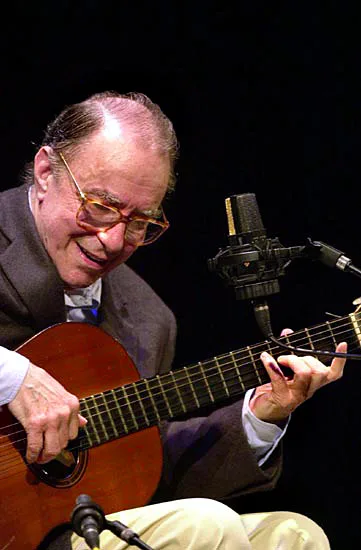
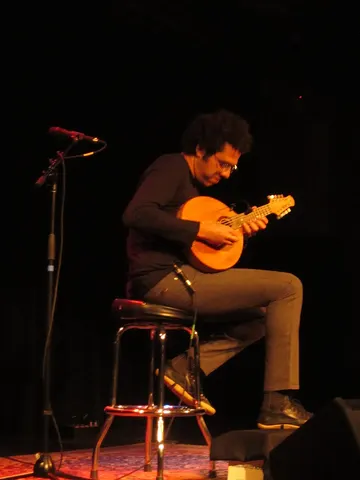
João Gilberto performing at Umbria Jazz, Perugia, Italy, July 1996 Public domain (released into the public domain by its author, the Wikimedia Commons user Starlight, who uploaded it as own work) — Wikimedia Commons — https://commons.wikimedia.org/wiki/File:Joao_Gilberto.jpg — Starlight

João Gilberto do Prado Pereira de Oliveira was born on June 10, 1931, in Juazeiro, a town on the São Francisco River in the interior of Bahia, the son of a merchant, Joviniano Domingos de Oliveira, and Martinha do Prado Pereira de Oliveira. He was given his first guitar at fourteen, formed a vocal group called Enamorados do Ritmo, and in 1947 moved to Salvador, where he left his studies to sing as a crooner on Radio Sociedade da Bahia at eighteen. In 1950 he went to Rio de Janeiro to join the vocal group Garotos da Lua. The group recorded two 78 rpm discs in 1951, he was dismissed soon after, and he cut a solo 78 for the Copacabana label in 1952 in the full-voiced radio style of his boyhood idol Orlando Silva. None of it made him known.
The sound he became famous for was worked out in isolation. In 1955 he went to Porto Alegre and spent eight months studying harmony with the composer and teacher Armando Albuquerque, then stayed with his sister in Diamantina, Minas Gerais, where he found that singing softly and without vibrato let him place the melody slightly ahead of or behind a guitar pulse that never wavered. Back in Juazeiro he wrote "Bim Bom." In Rio again by the late 1950s, he reconnected with Antonio Carlos Jobim, by then an arranger and producer at Odeon, who heard a way of updating samba in Gilberto's right hand and went looking for a song to carry it.
The song was "Chega de Saudade," by Jobim and the poet Vinícius de Moraes. In July 1958 Gilberto accompanied the singer Elizeth Cardoso on it and on "Outra Vez" for her LP Canção do Amor Demais, the first recordings of the bossa nova guitar beat. A month later he released his own 78 rpm of "Chega de Saudade" backed with "Bim Bom" on Odeon, with arrangements by Jobim, contributions from Dorival Caymmi and Aloysio de Oliveira, and the drummer Milton Banana among the players. He asked for two microphones, one for voice and one for guitar, so that both could sit at the level of ordinary speech and be heard in equal balance. The LP Chega de Saudade followed in March 1959 and sold well, and O Amor, o Sorriso e a Flor (1960) and João Gilberto (1961) completed the three LPs that define his early work. The second of them was released almost simultaneously in the United States as Brazil's Brilliant João Gilberto on Capitol.
The music reached American jazz musicians first. On November 21, 1962, a concert billed as the first North American bossa nova concert was presented at Carnegie Hall by Gilberto, Jobim, Luiz Bonfá, Roberto Menescal and Sérgio Mendes among others. Stan Getz and Charlie Byrd had already had hits that year with Jazz Samba, and after the concert the producer Creed Taylor set out to bring Jobim and Gilberto together with Getz. The sessions took place on March 18 and 19, 1963, at A & R Recording Studios in New York, with Phil Ramone engineering, Antonio Carlos Jobim on piano, Sebastião Neto on bass and Milton Banana on drums, and Gilberto singing in Portuguese. Gilberto spoke almost no English, so his wife, Astrud Gilberto, who had not sung professionally before, was asked to take the English-language parts of "The Girl from Ipanema" and "Corcovado." The album was held back for nearly a year and released by Verve in March 1964. At the 1965 Grammy Awards Getz/Gilberto won Album of the Year, Best Jazz Instrumental Album and Best Engineered Recording, and "The Girl from Ipanema" won Record of the Year. It has sold more than a million copies. The partnership was not easy. Getz and Gilberto disagreed over takes, which Taylor settled, and the live follow-up recorded at Carnegie Hall in October 1964, Getz/Gilberto #2 (1966), gives Getz's quartet one side and Gilberto alone with guitar the other.
Through the 1960s and 1970s he lived mostly abroad, in New York and Mexico City. João Gilberto en México appeared in 1970. In 1973 he recorded the self-titled album known as the white album at Rachel Elkind's brownstone studio in Manhattan, with Wendy Carlos engineering and Sonny Carr on percussion. In 1976 he reunited with Getz for The Best of Two Worlds on Columbia, with Miúcha, the singer he later married, taking the English vocals, and in May played a six-day engagement with him at the Keystone Korner in San Francisco, backed by the Getz band of Joanne Brackeen, Clint Houston and Billy Hart. Those live tapes were issued in 2016 as Getz/Gilberto '76. Amoroso (1977), with strings arranged and conducted by Claus Ogerman and produced by Tommy LiPuma and Helen Keane, was his first recording to include English, "'S Wonderful," and was nominated for a Grammy for Best Jazz Vocal Performance. He settled in Brazil again in 1979, recorded a television special in 1980 that was later issued as an album, and in 1981 made Brasil with Caetano Veloso, Gilberto Gil and Maria Bethânia.
Concert albums mark the later years. He played the 19th Montreux Jazz Festival in 1985, issued as Live in Montreux, and later released Live at Umbria Jazz (2002) and In Tokyo, drawn from one of four shows he played in Japan in 2003. João Voz e Violão, his first studio album since 1991 and made with nothing but his voice and guitar, won the Grammy for Best World Music Album in 2001. He was inducted into the International Latin Music Hall of Fame in 2002 and played the JVC Jazz Festival in 2008. From the 1990s he was also in a long legal dispute with EMI over remastered reissues of his early records. Columbia University awarded him an honorary doctorate in music in 2017, though he did not attend. He had two marriages, to Astrud Weinert, with whom he had a son, João Marcelo, and to Miúcha, with whom he had a daughter, Bebel Gilberto, and he also had a daughter with the journalist Claudia Faissol. He lived alone from about 2009, his last years were marked by money problems and declining health, and he passed away at his apartment in Rio de Janeiro on July 6, 2019, at the age of 88. He was buried in Niterói.
Gilberto's contribution was a method, and it is one of the few in popular music that can be described exactly. The right-hand thumb keeps a steady bass pattern while the fingers play chords in block form, compressing the layered percussion of a samba school into one instrument; the voice is small, close to speech, and free to lag or push against that pulse. Brazilian sources trace the technique to samba itself, and to singers such as Orlando Silva and Dorival Caymmi, rather than to jazz. Bossa nova has no tag of its own among the jazz subgenres, so the closest fits are used above, Samba-Jazz for the Getz collaborations and Vocal Jazz for the jazz-vocal Grammy nomination for Amoroso. His own records are bossa nova and Brazilian popular song, and they are not jazz.
The jazz connection is real but runs through repertoire and collaborators. Historians of the style note that samba guitarists had been using comparable chord structures since the 1920s, so bossa nova is better described as a parallel development than as a jazz derivative, though Gilberto and Jobim did build harmonies with American music in mind. What made it a jazz story was what American musicians did next: Getz and Byrd recorded Jazz Samba, the Carnegie Hall concert and Getz/Gilberto put the music in front of jazz audiences and the Grammy electorate, and "Desafinado," "Corcovado" and "Estate," which he recorded in 1977, became standards. Jon Hendricks recorded a whole album in his honor, ¡Salud! João Gilberto, in 1963, and musicians as different as Stacey Kent, Lisa Ono, Toninho Horta and Hamilton de Holanda name him among their formative influences. Rolling Stone placed him at number 81 on its 2023 list of the 200 greatest singers.
He was also famously exacting about sound. He is reported to have insisted on 28 takes of "Rosa Morena" to settle the pronunciation of a single vowel, and he sued EMI over remasters of his early albums that he said altered the originals. That perfectionism is audible: his records are quiet, close-miked and almost free of overdubs, and João Voz e Violão was made in three or four sessions with no accompaniment at all.
- Chega de Saudade (1959, Odeon) - The debut LP and the usual starting point for bossa nova, with "Desafinado," "Bim Bom" and the title song; inducted into the Grammy Hall of Fame in 2001. Spotify - Chega de Saudade Listen
- O Amor, o Sorriso e a Flor (1960, Odeon) - The second LP, issued in the United States as Brazil's Brilliant João Gilberto, and the first place American listeners heard "Corcovado" and "Meditation." Spotify - O Amor, o Sorriso e a Flor Listen
- Getz/Gilberto (1964, Verve) - With Stan Getz, Antonio Carlos Jobim and Astrud Gilberto; Grammy winner for Album of the Year and the record that carried bossa nova to a worldwide audience. Spotify - Getz/Gilberto Listen
- Getz/Gilberto #2 (1966, Verve) - Recorded live at Carnegie Hall in October 1964: Getz's quartet with Gary Burton on side one, Gilberto alone with guitar on side two.
- João Gilberto (1973, Polydor) - The white album, voice and guitar with light percussion, recorded in New York with Wendy Carlos at the board; ranked 47th on Rolling Stone Brasil's list of the 100 best Brazilian albums. Spotify - João Gilberto (1973) Listen
- The Best of Two Worlds (1976, Columbia) - The Getz reunion, with Miúcha singing the English vocals and Oscar Castro-Neves arranging for guitar and percussion. Spotify - The Best of Two Worlds Listen
- Amoroso (1977, Warner Bros.) - Claus Ogerman's string arrangements around Gilberto's guitar and voice; his first English-language performance on record and a Grammy nomination for Best Jazz Vocal Performance. Spotify - Amoroso Listen
- João Voz e Violão (2000, Verve) - Ten songs for voice and guitar alone, and the winner of the Grammy for Best World Music Album. Spotify - João Voz e Violão Listen
João Gilberto: Full Discography
Discogs artist: João Gilberto (346760) · Real name João Gilberto do Prado Pereira de Oliveira · Born June 10, 1931, Juazeiro, Bahia · Passed away July 6, 2019, Rio de Janeiro
A leader and co-leader discography of his albums, with catalog numbers where a release page confirms them. His Odeon recordings of 1958 to 1961 have been reissued and repackaged many times, and Discogs lists well over a thousand compilation and appearance entries, so only the original releases, the Stan Getz collaborations and the main live and archival albums are itemized here.
Leader and Co-Leader: Albums
| Album | Year | Label | Personnel & Notes | Listen | Buy |
|---|---|---|---|---|---|
| Chega de Saudade | 1959 | Odeon (MOFB 3073) | The debut LP, first issued in March 1959 and generally cited as the first bossa nova album. Arrangements by Antonio Carlos Jobim; includes "Chega de Saudade," "Desafinado" and "Bim Bom." Inducted into the Grammy Hall of Fame in 2001. | Spotify | — |
| O Amor, o Sorriso e a Flor | 1960 | Odeon (MOFB 3151) | Produced by Aloysio de Oliveira; issued almost simultaneously in the United States as Brazil's Brilliant João Gilberto (Capitol ST 10280). Includes "Samba de Uma Nota Só," "Corcovado" and "Meditation." Cover art by César Gomes Villela. | Spotify | — |
| João Gilberto | 1961 | Odeon (MOFB 3202) | The third LP, recorded in two stages, one with Walter Wanderley's group and one with an orchestra conducted by Antonio Carlos Jobim. | Spotify | — |
| Getz/Gilberto (with Stan Getz) | 1964 | Verve (V-8545) | Recorded March 18 and 19, 1963, at A & R Recording Studios, New York; released March 1964. Produced by Creed Taylor, engineered by Phil Ramone. Stan Getz (tenor saxophone), João Gilberto (guitar, vocals), Antonio Carlos Jobim (piano), Sebastião Neto (bass), Milton Banana (drums); Astrud Gilberto sings on "The Girl from Ipanema" and "Corcovado." Grammys for Album of the Year, Best Jazz Instrumental Album and Best Engineered Recording (1965). Cover painting by Olga Albizu. Some reissues incorrectly list Tommy Williams as bassist. | Spotify | — |
| Getz/Gilberto #2 (with Stan Getz) | 1966 | Verve (V/8623) | Live at Carnegie Hall, October 1964. Side one: Stan Getz (tenor saxophone), Gary Burton (vibraphone), Gene Cherico (bass), Joe Hunt (drums). Side two: João Gilberto alone on guitar and voice with Keter Betts (bass) and Hélcio Milito (drums). Produced by Creed Taylor; mastered by Rudy Van Gelder. | — | — |
| João Gilberto en México | 1970 | Orfeon (LP 12-717) | Made during his years in Mexico City; includes "Ela é Carioca" and boleros. | — | — |
| João Gilberto (the white album) | 1973 | Polydor (2451 037) | João Gilberto (vocals, classical guitar), Sonny Carr (percussion), Miúcha (vocals on "Izaura"). Produced by Rachel Elkind at her New York studio, engineered by Wendy Carlos. Includes "Águas de Março" and "Undiú." Ranked 47th on Rolling Stone Brasil's list of the 100 best Brazilian albums. | Spotify | — |
| The Best of Two Worlds (Stan Getz featuring João Gilberto) | 1976 | Columbia (PC 33703) | Stan Getz (tenor saxophone, producer), João Gilberto (guitar, Portuguese vocals), Miúcha (English vocals), Albert Dailey (piano), Clint Houston and Steve Swallow (bass), Billy Hart and Grady Tate (drums), Oscar Castro-Neves (guitar, arrangements), Airto Moreira, Ray Armando, Rubens Bassini and Sonny Carr (percussion). Executive producer Teo Macero. | Spotify | — |
| Amoroso | 1977 | Warner Bros. (36.022) | João Gilberto (guitar, vocals) with strings arranged and conducted by Claus Ogerman; Grady Tate and Joe Correro (drums), Jim Hughart (bass), Ralph Grierson (keyboards), Israel Baker (concertmaster). Produced by Tommy LiPuma and Helen Keane, mixed by Al Schmitt. Includes "'S Wonderful" (his first English-language recording), "Estate" and "Besame Mucho." Grammy nominee for Best Jazz Vocal Performance, 1978. | Spotify | — |
| João Gilberto Prado Pereira de Oliveira | 1980 | Warner Bros. (BR 36.164) | Recorded live for television on TV Globo with the network's orchestra; arrangements by Guto Graça Mello, Dori Caymmi, João Donato and Lindolfo Gaya, conducted by Alceo Bocchino. Bebel Gilberto guests on "Chega de Saudade" and Rita Lee on "Jou Jou Balangandãs." | — | — |
| Brasil (with Caetano Veloso, Gilberto Gil and Maria Bethânia) | 1981 | Warner Bros. (WEA BR 38.045) | Orchestra arranged and conducted by Johnny Mandel, with Jim Hughart (bass), Joe Correro (drums) and Bud Shank (flute). Reissued on one CD with Amoroso in 1993. | — | — |
| Live in Montreux | 1987 | Elektra Musician | Recorded at the 19th Montreux Jazz Festival in 1985, solo voice and guitar. The single-disc edition of the double album Live at the 19th Montreux Jazz Festival (Warner Bros., 1986; catalog 615.6001). | Spotify | — |
| João | 1991 | Philips (848 188-2) | Clare Fischer arranged and conducted; produced by Carmela Forsin and Mayrton Bahia. Issued on CD. | — | — |
| Ao Vivo, Eu Sei Que Vou Te Amar | 1994 | Epic | Live recording; João Gilberto on guitar and vocals. | — | — |
| João Voz e Violão | 2000 | Verve (546 713-2) | Voice and guitar only, produced by Caetano Veloso. His first studio album since 1991. Grammy for Best World Music Album (2001). | Spotify | — |
| Live at Umbria Jazz | 2002 | EGEA (EUJ 1004) | Live at the Umbria Jazz festival, voice and guitar; released in Italy. | — | — |
| João Gilberto in Tokyo | 2004 | Verve (B0002545-02) | Recorded September 12, 2003, at the Tokyo International Forum, one of four Japanese concerts that month; produced by João Gilberto and Shigeki Miyata. Latin Grammy nominee for Best MPB Album (2005). | Spotify | — |
| Um Encontro no Au Bon Gourmet (with Antonio Carlos Jobim, Vinícius de Moraes and Os Cariocas) | 2015 | Doxy (ACV2046) | A 1962 live recording from the Rio restaurant Au Bon Gourmet: João Gilberto (guitar, vocals), Antonio Carlos Jobim (piano, vocals), Vinícius de Moraes (vocals), Os Cariocas, Milton Banana (drums), Octavio Bailly Jr. (bass), directed by Aloysio de Oliveira. | — | — |
| Getz/Gilberto '76 (with Stan Getz) | 2016 | Resonance (HLP-9021) | Recorded at the Keystone Korner, San Francisco, in May 1976: Stan Getz (tenor saxophone), João Gilberto (guitar, vocals), Joanne Brackeen (piano), Clint Houston (bass), Billy Hart (drums). | Spotify | — |
| Relicário: João Gilberto (Ao Vivo no Sesc 1998) | 2023 | Selo SESC SP | Posthumous two-disc release of a concert recorded April 5, 1998, in São Paulo. | Spotify | — |
Early 78s and EPs
| Release | Year | Label | Notes |
|---|---|---|---|
| "Quando Ela Sai" / "Meia Luz" | 1952 | Copacabana | His first solo 78, cut before the bossa nova guitar style. |
| "Chega de Saudade" / "Bim Bom" | 1958 | Odeon (14.360) | The single that launched bossa nova; arrangements by Antonio Carlos Jobim, with Milton Banana on drums. Recorded with two microphones, one for voice and one for guitar. |
| "Desafinado" / "Hô-bá-lá-lá" | 1958 | Odeon (14.426) | The second Odeon 78, with Gilberto's own "Hô-bá-lá-lá." |
| "Lôbo Bôbo" / "Maria Ninguém" | 1959 | Odeon (14.460) | |
| Cantando as Músicas do Film 'Orfeu do Carnaval' | 1959 | Odeon | A 7-inch EP combining two 78s: "A Felicidade" / "O Nosso Amor" (14.491) and "Manhã de Carnaval" / "Frêvo" (14.495). |
Guest Appearances
| Year | Project | Title | Notes |
|---|---|---|---|
| 1958 | Elizeth Cardoso | Canção do Amor Demais | Gilberto plays guitar on "Chega de Saudade" and "Outra Vez" (songs by Antonio Carlos Jobim and Vinícius de Moraes), the first recordings of the bossa nova beat. |
Reissues and Compilations (selected)
The Boss of the Bossa Nova (Atlantic, 1963; US edition of João Gilberto) · The Warm World of João Gilberto (Atlantic, 1963; US edition of Chega de Saudade) · Gilberto and Jobim (Capitol, 1964; US edition of Brazil's Brilliant João Gilberto) · João Gilberto Interpreta Tom Jobim (Odeon, 1978) · O Mito (EMI, 1988; the three Odeon LPs plus the Orfeu do Carnaval EP, issued in the United States as The Legendary João Gilberto: The Original Bossa Nova Recordings 1958-1961, World Pacific, 1990) · Stan Getz Meets João & Astrud Gilberto: New York 1964 (Giants of Jazz, 1990) · The Warm World of João Gilberto: The Man Who Invented Bossa Nova, Complete Recordings 1958-1961 (2012).
Awards
| Year | Category | Work | Result |
|---|---|---|---|
| 1965 | Album of the Year (Grammy) | Getz/Gilberto (with Stan Getz, producer Creed Taylor) | Winner |
| 1965 | Best Jazz Instrumental Album, Individual or Group (Grammy) | Getz/Gilberto | Winner |
| 1965 | Best Engineered Recording, Non-Classical (Grammy) | Getz/Gilberto | Winner |
| 1965 | Record of the Year (Grammy) | "The Girl from Ipanema" (Stan Getz and Astrud Gilberto) | Winner |
| 1978 | Best Jazz Vocal Performance (Grammy) | Amoroso | Nominee |
| 2001 | Best World Music Album (Grammy) | João Voz e Violão | Winner |
| 2001 | Grammy Hall of Fame; Latin Grammy Hall of Fame | Chega de Saudade | Inducted |
| 2001 | Latin Grammy Hall of Fame | Getz/Gilberto | Inducted |
| 2002 | International Latin Music Hall of Fame | João Gilberto | Inducted |
| 2005 | Best MPB Album (Latin Grammy) | João Gilberto in Tokyo | Nominee |
- Antonio Carlos Jobim - his first arranger and the composer of much of his repertoire, from "Chega de Saudade" in 1958; plays piano on Getz/Gilberto.
- Stan Getz - co-leader of Getz/Gilberto (1964), Getz/Gilberto #2 (1966) and The Best of Two Worlds (1976), and of the Keystone Korner week in San Francisco in 1976.
- Creed Taylor - produced Getz/Gilberto and set up the meeting after the 1962 Carnegie Hall concert.
- Astrud Gilberto - his wife at the time of Getz/Gilberto; sang the English vocals on "The Girl from Ipanema" and "Corcovado."
- Milton Banana - drummer on his earliest Odeon recordings and on Getz/Gilberto.
- Miúcha - singer, his second wife; sings on "Izaura" on the 1973 album and takes the English vocals on The Best of Two Worlds.
- Gary Burton - vibraphone with Getz's quartet on Getz/Gilberto #2.
- Billy Hart, Joanne Brackeen and Clint Houston - the Getz rhythm section at the Keystone Korner in 1976.
- Airto Moreira - one of the percussionists on The Best of Two Worlds.
- Claus Ogerman - arranged and conducted the strings on Amoroso; produced by Tommy LiPuma and Helen Keane.
- Wendy Carlos and Rachel Elkind - engineer and producer of the 1973 album.
- Caetano Veloso, Gilberto Gil and Maria Bethânia - co-billed on Brasil (1981).
- Jon Hendricks - recorded the tribute album ¡Salud! João Gilberto (Reprise, 1963).



More Samba-Jazz Artists
See all 56 Samba-Jazz artists →More Brazilian Jazz Artists
See all 25 Brazilian artists →- Wikipedia: João Gilberto
- Wikipedia: João Gilberto (Portuguese)
- Wikipedia: Getz/Gilberto
- Wikipedia: Getz/Gilberto #2
- Wikipedia: Getz/Gilberto '76
- Wikipedia: The Best of Two Worlds
- Wikipedia: Chega de Saudade (album)
- Wikipedia: O Amor, o Sorriso e a Flor
- Wikipedia: João Gilberto (1973 album)
- Wikipedia: Amoroso (album)
- Wikipedia: João Voz e Violão
- Wikipedia: Live in Montreux
- Wikipedia: Bossa nova
- Wikipedia: The Girl from Ipanema
- Discogs: João Gilberto
- MusicBrainz: João Gilberto