 JAZZPROFILES lives in the music 1,002 Jazz Artists fully Profiled!
 Richard Bona
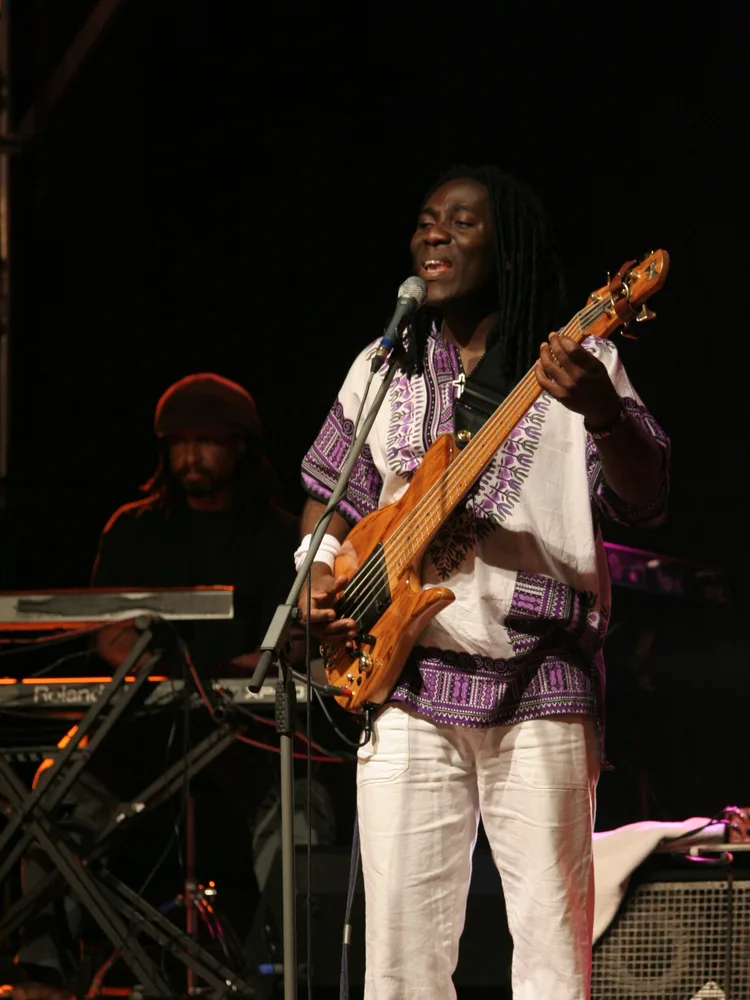
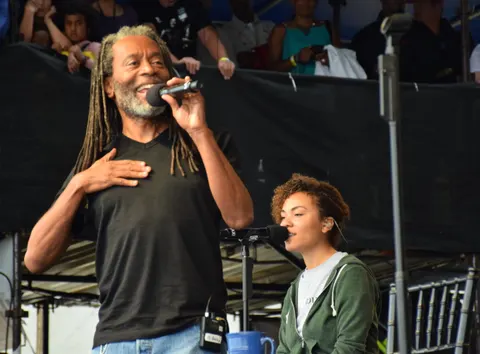
Richard Bona singing at the microphone while playing his five-string fretless bass, in concert in Toruń, Poland, July 14, 2007 CC BY-SA 3.0 Unported (the Commons file page multi-licenses the image, also offering CC BY-SA 1.0 Generic; CC BY-SA 3.0 Unported is the licence named here) — Wikimedia Commons — https://commons.wikimedia.org/wiki/File:Richard_Bona_Torun.jpg (photographer: Commons user Pko, own work; file 721,258 bytes, 2061 x 2748 px, saved as portrait.jpg)

Richard Bona was born Bona Pinder Yayumayalolo on October 28, 1967, in Minta, a village in Cameroon's Centre region, into a family where music was inherited rather than chosen: his grandfather was a griot and percussionist, his mother a singer. He started on the balafon at four and was singing in the village church at five. Instruments were not something the family could buy, so he built them, guitars strung with whatever wire came to hand and stretched over a scavenged motorcycle tank. He took up guitar at eleven, and at thirteen he assembled his first band for a French-run jazz club in Douala. The club's owner handed him a record by Jaco Pastorius. Bona switched to electric bass and has named that single encounter as the hinge of his career ever since.
In 1989, at twenty-two, he left Cameroon for Germany and studied at the Düsseldorf music institute, then moved on to Paris. The French years were his apprenticeship as a working sideman, and several of those jobs left a paper trail rather than just a publicity line. His earliest documented jazz date is trumpeter Eric Le Lann's Cap Fréhel (Musidisc, 1992), where he plays bass throughout, and he is credited on bass and double bass across Jacques Higelin's Aux Héros de la Voltige (EMI France, 1994). Paris also put him on club and festival stages alongside Manu Dibango, Salif Keita and violinist Didier Lockwood. He stayed until 1995, when French authorities declined to renew his work papers, and left for New York.
New York rewired the career within two years. He joined Joe Zawinul's Syndicate, appearing on My People (1996) and then across the live double album World Tour (1998), where he shares the bass chair with Victor Bailey and contributes vocals and two compositions. In 1997 he recorded Spaces Revisited with Larry Coryell, a quartet date with Billy Cobham on drums and Biréli Lagrène on second guitar, and he moved close enough into Harry Belafonte's circle that An Evening with Harry Belafonte & Friends (Island, 1997) carries two Bona compositions. He was Belafonte's musical director for the 1998 European tour. Columbia signed him as a leader, and Scenes from My Life, cut at Manhattan Center Studios between November 1998 and January 1999, introduced the model he has worked in ever since: a Douala-language vocal melody carried in unison with his own bass, with the rest of the arrangement built outward from that pair. Michael Brecker guests on one track, Jean-Michel Pilc and Edsel Gomez split the piano, and Ari Hoenig and Omar Hakim are among four drummers who split the record between them.
The 2000s were the decade of the phone call. He produced and played nearly everything on Sadao Watanabe's Sadao 2000, then returned for Wheel of Life (2003) and the co-billed "One for You" Sadao & Bona Live. He held the bass chair through most of George Benson's Irreplaceable (GRP, 2003), sang and played across Danilo Pérez's Motherland (Verve, 2002), and became a fixture of Mike Stern's bands, on record from Voices (2001) through All Over the Place (2012) and co-billed on the concert film Live: The Paris Concert (2006) alongside drummer Dennis Chambers. He joined Kazumi Watanabe's New Electric Trio with Horacio "El Negro" Hernández for the Mo' Bop records. In 2002 he joined the Pat Metheny Group for Speaking of Now and its world tour, arriving with drummer Antonio Sánchez and trumpeter Cuong Vu in the band's generational turnover; his credit on that album is vocals and percussion rather than bass, Steve Rodby keeping the bass chair, and the same holds on The Way Up (2005), where Bona appears as a guest voice, percussionist and member of the record's toy-instrument ensemble. Speaking of Now won the Grammy for Best Contemporary Jazz Album in 2003. He also spent part of the decade in Mike Mainieri's Steps Ahead, taking the bass chair Eddie Gomez had held for most of the group's life, in a 2005 touring lineup with Mainieri, Mike Stern, saxophonist Bill Evans and drummer Steve Smith.
The leader catalogue kept widening. Reverence (Columbia, 2001) set his voice against Gil Goldstein string arrangements, with Pat Metheny guesting on acoustic guitar on one track. Munia: The Tale (Universal and EmArcy, 2003) was cut at his own Bonayuma studio in New York, with Salif Keita's guest vocal recorded separately at Moffou Studio in Bamako. Toto Bona Lokua (No Format, 2004), an acoustic trio of voices and guitars with Gérald Toto and Lokua Kanza, was recorded across five days in December 2003 and became his most quietly durable record, revisited thirteen years later on Bondeko (2017). Tiki (2005) brought in Djavan, Susheela Raman and Toninho Horta, closed a circle with a Jaco Pastorius composition, and was nominated for Best Contemporary World Music Album at the 2007 Grammy Awards. Its 2006 edition added "Please Don't Stop," a duet with John Legend that was also issued as a single. The Ten Shades of Blues (2009), which traces the blues back toward West Africa, was recorded partly at Blue Frog Studio in Mumbai. Te Mesia (2011) put him in front of the Danish Radio Big Band in charts by Jesper Riis. Bonafied (2013) was certified gold in France.
Since the mid-2010s his own work has leaned into the Caribbean corner of the Atlantic triangle. Heritage (2016), issued on Quincy Jones's Qwest label, is a full Afro-Cuban band record made with Mandekan Cubano: Osmany Paredes on piano, Ludwig Afonso on drums, Luisito and Roberto Quintero on percussion, and a two-horn front line of Dennis Hernández and Rey David Alejandre. In September 2015 he opened Club Bonafide at 212 East 52nd Street in Manhattan with restaurateur Laurent d'Antonio, running it as a small room for jazz, Latin, funk and soul until it closed. He has taught jazz improvisation at New York University. His current working group is a trio with Cuban pianist Alfredo Rodríguez and Cuban drummer Michael Olivera, billed across European stages from 2022 onward and still touring in 2026.
Bona is the rare bassist whose signature is a voice. He sings a wordless or Douala-language line in near-unison with what his hands are playing, so the bass reads as a second voice rather than as support, an effect frequently compared to what George Benson does with a guitar. Underneath that, the playing descends directly from Jaco Pastorius: fretless tone, singing upper-register melody, a light and forward-leaning time feel, and a fondness for harmonics. The comparison has followed him since his first records, and the two nicknames that stuck to him early, "the African Jaco" and "the African Sting," say more about how hard critics found him to place than about the music itself. What separates him from the Pastorius line is where the material comes from. His writing is built on Cameroonian song, on balafon patterns and on the makossa and bikutsi rhythms of the Douala coast, then routed through jazz harmony, Brazilian song on Tiki and Afro-Cuban clave on Heritage, rather than through the blues. He is also a genuine multi-instrumentalist on his own records, playing bass, guitar, keyboards, percussion, balafon and mbira across most of them and producing all of them himself. Recognition has come as much from the world-music side as from the jazz side: Best International Artist at the 2004 Victoires du Jazz, the Antonio Carlos Jobim Award at the 2010 Festival International de Jazz de Montréal, and the SACEM Grand Prix du Jazz in 2012.
- Scenes from My Life (1999, Columbia) - The debut, recorded in New York across the winter of 1998 to 1999, and the record that established the voice-and-bass unison as his signature. Spotify - Scenes From My Life Listen
- Reverence (2001, Columbia) - Wider and more orchestral than the debut, with Gil Goldstein string arrangements, Michael Brecker on one track and Pat Metheny guesting on acoustic guitar on another. Spotify - Reverence Listen
- Munia: The Tale (2003, Universal / EmArcy) - His most intimate leader date, cut at his own Bonayuma studio, and the record carrying a guest vocal from Salif Keita, taped in Bamako. Spotify - Munia (The Tale) Listen
- Toto Bona Lokua (2004, No Format) - Three African and Caribbean voices with almost nothing but acoustic guitars behind them, recorded in five days in December 2003 with Gérald Toto and Lokua Kanza. Its 2017 sequel is Bondeko.
- Tiki (2005, EmArcy / Universal Music Jazz France) - Nominated for Best Contemporary World Music Album at the 2007 Grammy Awards, with Djavan, Susheela Raman, Toninho Horta, Mike Stern and a Jaco Pastorius tune. Spotify - Tiki Listen
- The Ten Shades of Blues (2009, Universal Music France / EmArcy) - A concept record following the blues back toward West Africa, recorded partly at Blue Frog Studio in Mumbai.
- Bonafied (2013, Universal Music France) - A gold-certified return to the song-first format, with accordionist Vincent Peirani, guitarist Sylvain Luc and vocalist Camille. Spotify - Bonafied Listen
- Heritage (2016, Qwest Records) - The Afro-Cuban record, made with the Mandekan Cubano band and released on Quincy Jones's label. Spotify - Heritage Listen
- Live: The Paris Concert (2006, in-akustik) - Co-billed with Mike Stern, Dennis Chambers and Bob Franceschini, and the best documentation of how the singing-bass approach works at full volume in a fusion band.
Richard Bona: Full Discography
Identity confirmed via the live Discogs API, artist ID 299647 ("Richard Bona," realname Bona Pinder Yayumayalolo, born October 28, 1967, in Minta, Cameroon). Discogs credits Bona on 429 releases; the great majority of that figure is compilation appearances, promo singles and reissues. The leader and co-leader table below is complete for his studio and live albums. The sideman table is a selected set of the significant credits, and every entry in it was checked by fetching the individual release rather than reading the coarse artist-level listing, which reports a bare "Appearance" and cannot distinguish an album-wide chair from a single-track guest spot. Where a release's credit block is empty or incomplete on Discogs, that is noted rather than papered over.
As Leader / Co-Leader
| Album Title | Recording Date(s) | Release Date | Label | Catalog Number | Format(s) | Personnel | Role | Reissue History | Spotify | Buy | Notes |
|---|---|---|---|---|---|---|---|---|---|---|---|
| Scenes from My Life | Recorded and mixed at Manhattan Center Studios, New York, November to December 1998 and January 1999; additional recording at Piccolo Studio, Paris | July 20, 1999 | Columbia | CK 69768 2 | CD, Album | Richard Bona (bass, guitar, keyboards, organ, mbira, percussion, vocals, producer), Michael Brecker (tenor saxophone, track 10), Aaron Heick (alto saxophone, tracks 3, 5), Jean-Michel Pilc (piano, tracks 1, 4), Edsel Gomez (piano, track 6), Etienne Stadwijk (keyboards, tracks 5, 9), Omar Hakim (drums, tracks 1, 7), Ari Hoenig (drums, track 4), Mokhtar Samba (drums, tracks 2, 11), Stéphane Véra (drums, tracks 3, 9), Jeremy Gaddie (drums, track 5), Luisito Quintero (percussion, track 6), Frédérique Favarel (guitars, track 3), Alune Faye (sabbar, track 2), plus a string quartet on track 8 | Leader, producer | Anthologised on This Is Richard Bona Anthology (Decca Records France, 2015) | Spotify - Scenes From My Life | — | The debut. Mastered at Sterling Sound. A promo single, "Eyala" (Columbia SAMPCS 80711), was drawn from it |
| Reverence | Not documented | September 7, 2001 | Columbia | COL 504497 2 | CD, Album | Richard Bona (bass, vocals, guitar, keyboards, producer, engineer), Pat Metheny (acoustic guitar, track 6), Michael Brecker (tenor saxophone, track 10), Vinnie Colaiuta (drums, tracks 2, 7, 8, 10, 12), Ari Hoenig (drums, tracks 3, 6), Edsel Gomez (piano, tracks 4, 11), George Whitty (piano, keyboards, tracks 7, 8, 12), Etienne Stadwijk (keyboards, tracks 2, 7, 8, 10), Oz Noy (guitar, track 2), Aaron Heick (saxophones, tracks 2, 4, 7), Luisito Quintero (percussion, track 4), Michael Davis (trombone), Jimmy Hynes (trumpet), Gil Goldstein (conductor and string arranger, tracks 3, 6) with an eleven-piece string and woodwind group | Leader, producer | Reissued on CD | Spotify - Reverence | — | Metheny's guest appearance is on one track only, not across the album |
| Munia: The Tale | Recorded at Bonayuma Recording Studio and Sear Sound, New York; Salif Keita's voice recorded at Moffou Studio, Bamako, Mali | September 22, 2003 | Universal / EmArcy / Universal Music Jazz France | 980 109-3 | CD, Album | Richard Bona (bass, vocals, multiple instruments, recording engineer), Salif Keita (voice, track 2). Full instrumental personnel is not listed on the release | Leader | Reissued on CD | Spotify - Munia (The Tale) | — | Mixed at Right Track Recording, mastered at Sterling Sound. Keita's contribution was recorded in Mali and flown in, per the release's own notes. A promo single, "Kalabancaro," was issued from it |
| Toto Bona Lokua | Recorded at each artist's home studio and at Calm Studio, December 2 to 3 and December 22 to 24, 2003; mixed January 11 and February 1, 2004 | April 20, 2004 | No Format | NØF. 3 | CD, Album | Richard Bona (vocals, bass, acoustic guitar, bouzouki, keyboards, percussion, vocal percussion), Gérald Toto (vocals, acoustic guitar, whistle, finger snaps), Lokua Kanza (vocals, acoustic guitar, piano) | Co-leader | Reissued on CD and vinyl by No Format | — | — | Writing split four tracks each: Bona wrote 1, 2, 6 and 11. Produced by Laurent Bizot |
| Tiki | Not documented | October 2, 2005 (2006 edition adds "Please Don't Stop") | EmArcy / Universal Music Jazz France / Universal | 9833457 | CD, Album | Richard Bona (lead vocals, bass, acoustic and electric and twelve-string guitar, keyboards, percussion, mbira, producer), Djavan (lead vocals, track 7), Susheela Raman (lead vocals, track 1), Mike Stern (electric guitar, track 2), Toninho Horta (acoustic guitar, tracks 7, 12), Vinnie Colaiuta (drums, tracks 2, 4), Ari Hoenig (drums, track 5), Nathaniel Townsley III (drums, track 1), Etienne Stadwijk (keyboards), George Colligan (piano, track 5), Osmany Paredes (piano, tracks 6, 12), Marc Berthoumieux (accordion, tracks 6, 7), Marcos Suzano and Luisito Quintero (percussion), Aquiles Baez (tres, track 6), Barry Danielian (trumpet, tracks 4, 7), Gil Goldstein (string arrangement, track 8) | Leader, producer | The 2006 edition adds the John Legend duet "Please Don't Stop," also issued as a single (Universal Music France / EmArcy 011 316-7, 2006) | Spotify - Tiki | — | Nominated for Best Contemporary World Music Album at the 2007 Grammy Awards, where it was listed under Decca. Track 8, "Three Women," is a Jaco Pastorius composition. Peaked at number 10 on Billboard's Top World Albums chart. The Spotify edition carries fifteen tracks, i.e. the 2006 sequence |
| Bona Makes You Sweat: Live | Recorded live on the A38 ship, Budapest; date not documented | March 7, 2008 | Decca | 0600753054628 | CD, Album | Richard Bona (bass, vocals, producer), Ernesto Simpson (drums), John Caban (guitar), Etienne Stadwijk (keyboards), Samuel Torres (percussion), Taylor Haskins (trumpet) | Leader, producer | Also issued as a DVD | — | — | The touring band of the Tiki period, captured in Hungary |
| The Ten Shades of Blues | Recorded at Blue Frog Studio, Mumbai; Skyline Studio, Brooklyn; and Avatar Studios, New York. Session dates not documented | October 19, 2009 | Universal Music France / EmArcy / Universal Music Jazz France | 00600753202258 | CD, Album | Richard Bona (music, lyrics, producer, recording engineer). Frank McComb wrote the lyrics to track 3 and Morley the lyrics to track 9. Instrumental personnel is not listed on the release | Leader, producer | Reissued on CD | — | — | Mixed at Legacy Recording Studio, New York; mastered at Sterling Sound. The Mumbai sessions are named in the release's own notes |
| Te Mesia | Not documented | November 14, 2011 | Red Dot Music (distributed by EMI) | EMI 0915612 | CD | Richard Bona (bass, vocals), the Danish Radio Big Band, Jesper Riis (arranger, conductor), Chris Minh Doky (producer), George Whitty (mixing, mastering) | Co-leader, billed "Richard Bona with DR Big Band" | None traced | Spotify - Te Mesia | — | His only big-band leader date |
| Bonafied | Not documented | April 22, 2013 | Universal Music France | 3736377 / 0602537363773 | CD, Album, Stereo | Richard Bona (bass, guitar, balafon, percussion, body percussion, vocals, producer), Vincent Peirani (accordion, tracks 4, 6), Sylvain Luc (guitar, track 11), Camille (vocals, track 9), Obed Calvaire (drums, tracks 2, 4, 6), Etienne Stadwijk (piano, tracks 1, 8, 10), Osmany Paredes (piano, tracks 2, 4, 6), Luisito Quintero (percussion, tracks 2, 4, 8), Michael Rodriguez (trumpet, tracks 2, 8), Dave Eggar (cello), Gil Goldstein (string arrangement, tracks 2, 6) | Leader, producer | Reissued on CD | Spotify - Bonafied | — | Certified gold in France. Track 11 is a James Taylor composition; track 9 is co-written with Camille |
| Heritage | Not documented | June 2016 | Qwest Records / Membran | 234245 | CD, Album (digipak) | Richard Bona (bass, guitar, electric guitar, vocals, percussion, keyboards), Osmany Paredes (piano), Ludwig Afonso (drums), Luisito Quintero and Roberto Quintero (percussion), Rey David Alejandre (trombone), Dennis Hernández (trumpet). All credits album-wide | Leader, billed "Richard Bona & Mandekan Cubano" | Reissued digitally in 2023 | Spotify - Heritage | — | Released on Quincy Jones's Qwest label. Twelve tracks including "Aka Lingala Te," "Bilongo" and "Kivu" |
| Bondeko | Not documented | November 2017 | No Format | NØF.39 LP | Vinyl, LP, Album | Richard Bona, Gérald Toto and Lokua Kanza, all three credited as performers, writers and composers | Co-leader | Also issued on CD and digitally | — | — | The sequel to Toto Bona Lokua, thirteen years on. Executive producer Laurent Bizot; mastered by Raphaël Jonin |
| Afreekhan Rhapsody vol. 1 | Not documented | 2025 | Not on label (self-released) | None | Vinyl, LP, Stereo | Not listed on the release | Leader | None | — | — | Sold direct at concerts on the 2025 tour rather than through a label. No personnel or session information appears on the pressing |
As Sideman (selected major credits)
| Year | Project (Leader) | Title | Label | Catalog | Role | Notes |
|---|---|---|---|---|---|---|
| 1992 | Eric Le Lann | Cap Fréhel | Musidisc | 500312 | Bass, album-wide | His earliest documented jazz credit, from the Paris years |
| 1994 | Jacques Higelin | Aux Héros de la Voltige | EMI France | 8302582 | Bass, double bass, album-wide | Corroborates the standard account of his Paris apprenticeship |
| 1996 | Joe Zawinul | My People | JMS / CREAM Records | JMS 18688-2 / CR 410-2 | Bass, tracks 6 and 7; vocals, tracks 7 and 10 | Not the album's bassist. Matthew Garrison plays bass on tracks 2, 3, 5 and 8 |
| 1997 | Larry Coryell | Spaces Revisited | Electric Bird | KICP 611 | Bass, album-wide | With Billy Cobham on drums and Biréli Lagrène on guitar. Released October 22, 1997 |
| 1997 | Harry Belafonte | An Evening with Harry Belafonte & Friends | Island Records | 314-524384-2 | Composer, tracks 6 and 11 | The release lists no band personnel at all, so no playing credit can be confirmed from it. What the record does document is that Belafonte performed two Bona compositions |
| 1998 | Joe Zawinul and The Zawinul Syndicate | World Tour | ESC Records | ESC/EFA 03656-2 | Bass on tracks 1-3, 1-7, 1-8, 2-2, 2-3 and 2-8; vocals; composer of two tracks | A live double album on which Bona and Victor Bailey share the bass chair |
| 1999 | Mino Cinelu | Mino Cinelu | EmArcy | 546 403-2 | Acoustic guitar, electric bass, album-wide | |
| 1999 | Bob James | Joy Ride | Warner Bros. Records | 9362 47355-2 | Bass, track 5; bass, guitar, drum programming, percussion, vocals and arrangement, track 12 | |
| 1999 | Renee Rosnes | Art & Soul | Blue Note | 7243 4 99997-2 5 | Percussion only: djembe, udu and shaker on track 4; kalimba and rainstick on track 5 | No bass credit anywhere on the record |
| 1999 | Jacky Terrasson | What It Is | Blue Note | 7243 4 98756 2 3 | Electric bass, tracks 4 and 8 | |
| 2000 | Sadao Watanabe | Sadao 2000 | Verve Records | POCJ-1480 | Producer; electric bass, guitar, percussion, vocoder, vocals, all album-wide | Released May 1, 2000. His largest production credit on someone else's record |
| 2001 | Randy Brecker | Hangin' in the City | ESC Records | EFA CD 03674-2 | Electric bass, track 4 only | |
| 2001 | Mike Stern | Voices | Atlantic / Division One | 83483-2 | Vocals, bass, kalimba, tracks 1, 2, 8 and 9 | The start of the longest sideman relationship in his catalogue |
| 2002 | Pat Metheny Group | Speaking of Now | Warner Bros. / Metheny Group Productions | 9 48025-2 | Vocals and percussion, album-wide | Steve Rodby plays bass on the album. Bona joined the group with drummer Antonio Sánchez and trumpeter Cuong Vu. Winner of the 2003 Grammy for Best Contemporary Jazz Album |
| 2002 | Danilo Pérez | Motherland | Verve Records | 314 543 904-2 | Lead vocals and electric bass, album-wide | A remix 12-inch, Panafrica (Melodious Remixes), was drawn from the same material in 2001 |
| 2002 | Joe Zawinul | Faces & Places | ESC Records | ESC/EFA 03679-2 | Bass, tracks 4, 7 and 14; vocals on 7 | |
| 2002 | Eliane Elias, Dave Grusin, Herbie Hancock, Bob James, Brad Mehldau | Portrait of Bill Evans | JVC | VICJ-61025 | Electric bass, tracks 1 and 4 only | Released December 26, 2002 in Japan |
| 2003 | George Benson | Irreplaceable | GRP | 0602498612873 | Bass on tracks 2 and 4 to 10; vocal chant and vocal arrangement on track 5 | Effectively the record's bassist |
| 2003 | Kazumi Watanabe New Electric Trio (Kazumi Watanabe) | Mo' Bop | EWE Records | EWSA 0080 | Bass, album-wide | A trio with Horacio "El Negro" Hernández on drums. Followed by Mo' Bop II (2004) and Mo' Bop III (2006) |
| 2003 | Sadao Watanabe | Wheel of Life | Verve Records | 038 465-2 | Electric bass, electric guitar, percussion, vocals, tracks 1 to 9 | |
| 2003 | Mike Stern | These Times | ESC Records | ESC/EFA 03689-2 | Vocals, bass and percussion on tracks 2, 3, 5 and 10; lyrics on track 5 | |
| 2003 | Jaco Pastorius Big Band | Word of Mouth Revisited | Heads Up International | HUCD 3078 | Bass, track 5 only | A single-track guest spot on a large-ensemble tribute record, not a band role. The follow-up, The Word Is Out! (Heads Up HUSA 9110, 2006), carries no personnel block at all on Discogs, so his part in it is not release-verified |
| 2004 | Mario Canonge, Roy Hargrove, Richard Bona | Rhizome | O+ Music | OP102 | Lead and backing vocals, track 5 only | Recorded in New York, December 1 to 3, 2003, at East Sound Studio. Bona is billed as a co-leader, but Michel Alibo plays the electric bass throughout and Bona's only credit is a vocal on one track |
| 2005 | Pat Metheny Group | The Way Up | Nonesuch / Metheny Group Productions | 79876-2 | Guest percussion and voice, plus toy guitar in the record's toy-instrument ensemble | A guest credit rather than a chair |
| 2005 | Bobby McFerrin | Live in Montreal | Universal | 0602498717639 | Vocals and electric bass, tracks 10 and 11 | |
| 2005 | Sadao Watanabe | "One for You" Sadao & Bona Live | JVC | VICJ-61361 | Electric bass and vocals, album-wide | Co-billed in the album title. With Etienne Stadwijk on piano and keyboards and Nathaniel Townsley III on drums |
| 2006 | Mike Stern, Richard Bona, Dennis Chambers, Bob Franceschini | Live: The Paris Concert | in-akustik | INAK 6456-2 DVD | Bass and vocals, tracks 1 to 5 | Co-billed on the sleeve. Lincoln Goines takes over the bass on tracks 6 and 7 |
| 2006 | Mike Stern | Who Let the Cats Out? | Heads Up International | HUCD 3115 | Bass and vocals, tracks 3, 4, 5 and 10 | Released August 15, 2006 |
| 2006 | Lee Ritenour | Smoke 'n' Mirrors | Peak Records | PKD-30018-2 | Electric bass on tracks 1, 4, 10 and 14; electric guitar on track 2; scat vocal on track 14 | |
| 2007 | Manu Dibango | Lion of Africa | Global Mix | GMCD/DVD01 | Composer, track 7 | Bona has no playing credit on the release. Listed because his name appears on it and because the two are routinely paired in biographical summaries |
| 2008 | Victor Wooten | Palmystery | Heads Up International | HUCD 3135 | Vocals and percussion, track 3 only | No bass credit. Mike Stern plays guitar on tracks 5 and 6 of the same record |
| 2009 | Béla Fleck | Throw Down Your Heart (Tales from the Acoustic Planet Vol. 3, Africa Sessions) | Rounder Records | 11661-0634-2 | Electric bass and vocals, track 6 | Released March 3, 2009 |
| 2009 | Mike Stern | Big Neighborhood | Heads Up International | HUCD 3157 | Bass and vocals, track 3 only | |
| 2009 | Joe | Signature | 563 Entertainment / Kedar Entertainment | KEDARCD3 | Bass, tracks 3, 4, 8 and 11 | An R&B date, listed for completeness |
| 2010 | Lionel Loueke | Mwaliko | Blue Note | 509996 88508 2 1 | Bass and vocals, tracks 4 and 12 | |
| 2011 | Keiko Matsui | The Road... | Shanachie | 5188 | Arranger, bass, guitar, vocals and percussion on tracks 2, 3 and 7; co-producer of track 2; composer of tracks 3 and 8 | Bona's connection to Matsui runs through this album. He carries no credit on her Moyo (Victor VICJ-61521, 2007), whose Discogs entry lists only two credits in total |
| 2012 | Mike Stern | All Over the Place | Heads Up International | HUI-33186-02 | Credited "Musician" and "Engineer," album-wide, with no instrument named | The release's credit block does not specify what he plays |
| 2013 | Dianne Reeves | Beautiful Life | Concord Records | CRE-34171-02 | Bass, track 5 only | |
| 2016 | Alfredo Rodríguez | Tocororo | Mack Avenue | MAC1109 | Featured guest, tracks 3 ("Raíces"), 7 ("Ay, Mamá Inés") and 13 (the "Ay, Mamá Inés" remix) | Released March 4, 2016. Produced by Alfredo Rodríguez and Quincy Jones. The record that led to the standing Bona / Rodríguez touring partnership |
| 2024 | Mike Stern | Echoes and Other Songs | Artistry Music / Mack Avenue Records | Not confirmed | Appearance | The most recent Stern date carrying his name |
Bona's remaining Discogs credits run to roughly four hundred further entries, overwhelmingly various-artists compilations, promo singles, festival samplers and reissues, plus a substantial run of Cameroonian and French African-pop sessions from 1986 to 1995 that predate his move to New York. Those are not itemised here. A handful of listings could not be confirmed at release level and are therefore not asserted anywhere in this profile: Ibrahim Maalouf's 40 Melodies (Mister Ibe IBM 32, 2020) and Regina Carter's Rhythms of the Heart (Verve VERCD54, 1999) both associate Bona with the record at artist level while carrying no Bona credit, or in Carter's case no credit block at all, on the release itself.
- Joe Zawinul - his entry point into the New York scene. Bona plays bass on two tracks of My People (1996), shares the bass chair with Victor Bailey across the live World Tour (1998) and plays bass on three tracks of Faces & Places (2002); Discogs lists him as a member of The Zawinul Syndicate.
- Pat Metheny - a member of the Pat Metheny Group from 2002, credited with vocals and percussion on Speaking of Now (2002) and as a guest voice, percussionist and toy-instrument player on The Way Up (2005). Metheny returned the visit, playing acoustic guitar on one track of Reverence (2001).
- Mike Stern - the longest-running of his sideman relationships, running from Voices (2001) through These Times (2003), Who Let the Cats Out? (2006), Big Neighborhood (2009) and All Over the Place (2012), plus co-billing on Live: The Paris Concert (2006) and a Stern guest spot on Bona's own Tiki.
- Sadao Watanabe - Bona produced Sadao 2000 and played bass, guitar, percussion, vocoder and vocals on it, then returned for Wheel of Life (2003) and the co-billed live album "One for You" Sadao & Bona Live.
- Kazumi Watanabe - bassist in the New Electric Trio with drummer Horacio "El Negro" Hernández across Mo' Bop (2003), Mo' Bop II (2004) and Mo' Bop III (2006).
- Harry Belafonte - musical director for Belafonte's 1998 European tour. Two Bona compositions appear on An Evening with Harry Belafonte & Friends (Island, 1997).
- Mike Mainieri - Bona held the Steps Ahead bass chair in the group's mid-2000s touring lineup, documented on festival stages in 2005 alongside Mainieri, Mike Stern, Bill Evans and Steve Smith. No studio album came out of that lineup.
- Larry Coryell and Billy Cobham - the band on Spaces Revisited (1997), Coryell's sequel to his 1970 Spaces, with Biréli Lagrène on second guitar and Bona on bass throughout.
- George Benson - bass on eight tracks of Irreplaceable (GRP, 2003), plus the vocal arrangement on one of them.
- Danilo Pérez - lead vocals and electric bass across Motherland (Verve, 2002).
- Bobby McFerrin - vocals and electric bass on two tracks of McFerrin's Live in Montreal (2005), a meeting of the two musicians on the scene who have gone furthest in treating the human voice as a full instrumental section.
- Michael Brecker - guest tenor saxophone on one track each of Scenes from My Life and Reverence. His brother Randy Brecker used Bona on one track of Hangin' in the City (2001).
- Roy Hargrove - co-billed with Bona and pianist Mario Canonge on Rhizome (O+ Music, 2004), recorded in New York in December 2003, a record on which Bona sings lead on one track rather than playing bass.
- Quincy Jones - released Heritage (2016) on his Qwest label, and produced Alfredo Rodríguez's Tocororo (2016), on which Bona is the featured guest on three tracks.
- Alfredo Rodríguez and Michael Olivera - his current working trio, billed across Europe from 2022 onward. The three have not made a studio record together; the association is a touring one.
- Victor Wooten - vocals and percussion on one track of Wooten's Palmystery (Heads Up, 2008), the one release the two bassists actually share.
- Lee Ritenour - bass, guitar and a scat vocal across five tracks of Smoke 'n' Mirrors (Peak, 2006).
- Keiko Matsui - co-producer, arranger, bassist, guitarist and vocalist on three tracks of The Road... (Shanachie, 2011), and the writer of two of its tunes.
- Dianne Reeves, Bob James, Herbie Hancock, Brad Mehldau and Dave Grusin - single-session encounters: bass on one track of Reeves's Beautiful Life (2013), two tracks of James's Joy Ride (1999), and two tracks of the all-star Portrait of Bill Evans (JVC, 2002) that the last four share.
- Lionel Loueke - bass and vocals on two tracks of the Beninese guitarist's Mwaliko (Blue Note, 2010), one of the few records pairing two African musicians working at the centre of the New York jazz scene.
- Béla Fleck - electric bass and vocals on one track of Throw Down Your Heart (Rounder, 2009), Fleck's album of African collaborations.
- Matthew Garrison - the other bassist on Zawinul's My People (1996), the two of them splitting the record's tracks between them.
- Wikipedia: Richard Bona
- Wikipedia: Tiki (album)
- Wikipedia: Speaking of Now
- Wikipedia: Steps Ahead
- Discogs: Richard Bona (artist 299647) - identity, birth date and every credit named in this profile verified release by release against the live Discogs API
- World Music Central: World Music Nominees for 2007 Grammy Awards - the Best Contemporary World Music Album shortlist naming Tiki
- LA Phil: Richard Bona - Victoires du Jazz, Jobim Award and SACEM Grand Prix
- Richard Bona: official biography
- Canarias Jazz: Richard Bona & Alfredo Rodríguez feat. Michael Olivera - the current trio
- Cosmopolite, Oslo: Richard Bona & Alfredo Rodriguez Trio - the trio's continuing 2026 touring
- Guitar World: Richard Bona interview - the homemade instruments of his childhood
- Wikimedia Commons: File:Richard Bona Torun.jpg - portrait licence and provenance