 JAZZPROFILES lives in the music 1,765 Jazz Artists fully Profiled!
Tib Kamayatsu
Last updated October 21, 2026
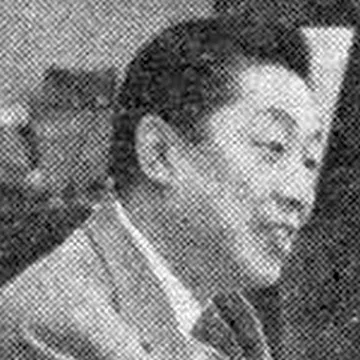
Tib Kamayatsu, from the July 1956 issue of Swing Journal. Public domain (Wikimedia Commons tag PD-Japan-oldphoto: a photograph published in Japan before 1 January 1958) — https://commons.wikimedia.org/wiki/File:Singer_Tib_Kamayatsu_1956.png

Tib Kamayatsu (ティーブ釜萢, real name 釜萢正, Kamayatsu Tadashi) was born on May 7, 1911, in Los Angeles, a second-generation Japanese American whose parents ran a clothing shop. He took up guitar and banjo, and in his twenties joined a Japanese American band called the Show Tokians. The Depression had left Japanese Americans short of work in California, and in 1937 the group put together a band and sailed for Japan. His bandmates went home soon afterwards. He did not.
That decision is the whole reason he belongs in the story of Japanese jazz, and the record for it is long. From 1937 until his death in 1980 he lived and worked in Japan, a stretch of 43 years. He played in the bands on the passenger ships that ran between Japan and the United States, then settled in Tokyo as a jazz singer, and the Nichigai Associates biographical dictionary of entertainers records him performing at the Florida dance hall in Tameike, Akasaka. His son Hiroshi, later known as Monsieur Kamayatsu, was born in Tokyo in January 1939. In 1944, still holding American citizenship and speaking almost no Japanese, he was called up by the Japanese army and sent to the China front, where his ability to drive got him posted to a transport unit; the same dictionary records that he gave up his American nationality and took Japanese nationality that year. He is buried at Kensoji temple in Moto-Azabu, Tokyo.
After the war he was among the musicians who brought American-style jazz to Japanese audiences. He joined the New Pacific Band, with Yoshiko Ishii as vocalist and his brother-in-law Hisashi Moriyama among the players, and worked the officers' clubs and camps of the Allied occupation forces, mostly in the Tokyo area. Nichigai Associates adds that he became a popular vocalist with Hiroshi Watanabe and the Star Dusters, the band based at the Daiichi Hotel in Shimbashi, before going out on his own, and Japanese Wikipedia also names a group billed as Tib Kamayatsu and the Blue Ribbon. The Nichigai entry singles out his guitar playing and his English pronunciation and phrasing.
In 1950 he opened the Japan Jazz School (日本ジャズ学校) and served as its principal. Japanese Wikipedia, citing a book review by Haruomi Hosono, names three pupils who went on to lead postwar Japanese pop: Mickey Curtis, Masaaki Hirao and Peggy Hayama. Curtis's own Japanese Wikipedia biography independently says that he attended the school around 1955, while still in high school, and Japanese Wikipedia cites entries for the school in a 1955 directory of recognised vocational schools in Tokyo and in a 1962 guide to Tokyo schools. The claim that it was Japan's first jazz school, made by the Nichigai dictionary, is contested: a Tokyo Shimbun article of October 2023 gives that distinction to the Iida Jazz School, founded in 1955 in Suginami.
One film appearance is documented: the 1953 Shintoho film Seishun Jazz Musume, in which he appears as a guest judge in the opening scene, a university jazz contest. On October 20, 1957, he sang "My Blue Heaven" in a set of recordings made for NHK broadcast, with the trumpeter Fumio Nanri conducting that session; Polydor's 2009 CD Dynamic Jazz collects the set, and on it Toshio Oida sings "Dark Eyes" and Hisashi Moriyama sings "I Can't Give You Anything But Love, Baby". A 1975 two-LP Victor compilation, Nihon no Jazz Kashu-tachi (Japan's jazz singers), put his "Sioux City Sue" alongside tracks by Oida, Eiji Kitamura and other singers and players of the early postwar scene.
His own records are few. Father & Mad Son (Philips, 1971) is a joint album with his son, filed on Discogs under rock, folk rock and contemporary jazz, on which both men sing and play guitar; its programme includes "Walking My Baby Back Home", which he also recorded for his own album five years later. In 1976 he made the only album released under his name alone, Sing A Simple Melody (Bellwood), a set of eleven standards with Eiji Kitamura on clarinet and tenor saxophone. Two years later he sang the lead on "Japanese Rhumba" on Haruomi Hosono's Paraiso (Alfa, 1978), an album of tropical pop recorded in Tokyo over the winter of 1977 and 1978, on which his son sang backing vocals on the same track.
Tib Kamayatsu passed away on March 10, 1980, aged 68. He was the father of Hiroshi "Monsieur" Kamayatsu of the group The Spiders, a separate person with his own, mostly rock and pop, career, and Japanese Wikipedia credits him with naming that band. Through his wife's family he was also related to the singer Ryoko Moriyama, who is his wife's niece and the daughter of Hisashi Moriyama.
He was an American-raised jazz and pop singer working in English. The Nichigai dictionary credits him with strong guitar technique and a stylish, easy way of singing, with the English of someone who grew up speaking it. The repertoire on his own album is the American standard songbook of the swing era and earlier: "On the Sunny Side of the Street", "Alexander's Ragtime Band", "After You've Gone", "Route 66", "Lover Come Back to Me", "'S Wonderful".
His importance is larger than his discography. He ran a jazz school in Tokyo from 1950, and the singers who passed through it included some of the best-known popular vocalists of the 1950s. He also moved easily out of strict jazz: Father & Mad Son is a rock and folk album led by his son, and the 1978 Paraiso session was a Hosono pop record, so the jazz label fits his career as a singer, bandleader and teacher more than it fits every record he appears on.
- Sing A Simple Melody (1976, Bellwood OFL 3006) - His only album under his own name: eleven standards with Eiji Kitamura (clarinet, tenor saxophone), Akio Mitsui (trumpet), Yoshitaka Akimitsu (piano), Ikuo Shiosaki (electric guitar) and Jimmy Takeuchi (drums). Apple Music - Sing A Simple Melody
- Father & Mad Son (1971, Philips FX-8026, with Monsieur Kamayatsu) - The joint album with his son, a rock and folk record with guitar and vocals from both Kamayatsus. YouTube - Father & Mad Son, full album Listen
- "Sioux City Sue" (from Nihon no Jazz Kashu-tachi, Victor SPX-1031~2, 1975) - His vocal on a two-LP survey of Japanese jazz singers. YouTube - Sioux City Sue Listen
- "Japanese Rhumba" (from Paraiso, Alfa ALR-6003, 1978) - The best-known performance of his later years, his lead vocal on a Haruomi Hosono record. YouTube - Japanese Rhumba Listen
- "My Blue Heaven" (from Dynamic Jazz, Polydor UCCJ-4064, recorded October 20, 1957; 2009 CD) - A vocal from a 1957 NHK session conducted by Fumio Nanri, available on a 2009 Polydor CD.
Tib Kamayatsu (ティーブ釜萢) - Full Discography
Japanese jazz singer, guitarist and banjo player, born in Los Angeles on May 7, 1911, active in Japan from 1937 until his death on March 10, 1980. Real name 釜萢正 (Kamayatsu Tadashi). Discogs artist 7684637.
Name variations on record: Teave Kamayatsu, ティーブ釜萢, ティーブかまやつ.
Not to be confused with: his son Hiroshi "Monsieur" Kamayatsu (かまやつひろし), of The Spiders, who has separate Discogs entries (774092 and 30242).
His recorded legacy is small: one album under his own name, one joint album with his son, and a handful of compilation and guest appearances.
Leader
| Album | Year | Label | Personnel | Notes | Listen | Buy |
|---|---|---|---|---|---|---|
| Sing A Simple Melody (sleeve subtitle Tib's Friends; Japanese title スウィング・ア・シンプル・メロディ) | 1976 | Bellwood Records, OFL 3006 | Tib Kamayatsu (vocals), Eiji Kitamura (clarinet, tenor saxophone), Akio Mitsui (trumpet), Yoshitaka Akimitsu (piano), Ikuo Shiosaki (electric guitar), Jimmy Takeuchi (drums) | Vinyl LP, eleven tracks. Side A: "On the Sunny Side of the Street", "It's a Sin to Tell a Lie", "Walking My Baby Back Home", "Play a Simple Melody", "Cotton Fields", "'S Wonderful". Side B: "Route 66", "Bei Mir Bist Du Schön", "Lover Come Back to Me", "Alexander's Ragtime Band", "After You've Gone". Sleeve design by Akiko Ohtsuka, photography by Noboru Kikuchi. Discogs release 15009896. Released digitally by King Record (Apple Music lists a November 21, 1976 date). | Apple Music | Amazon |
Co-Leader
| Album | Year | Label | Co-billed with | Personnel | Notes | Listen | Buy |
|---|---|---|---|---|---|---|---|
| Father & Mad Son (ファーザー&マッド・サン) | 1971 | Philips, FX-8026 | Monsieur Kamayatsu (Hiroshi Kamayatsu) | Tib Kamayatsu (vocals, guitar), Hiroshi Kamayatsu (vocals, guitar), Tetsu Yamauchi and Isao Eto (bass), Hiro Tsunoda and Yujin Harada (drums), Pipi Shibata (guitar), Shigeru Narumo (guitar, organ), Masaharu Honjo (piano, backing vocals), with backing vocals from Garo, Katsumi Kahashi and Miki Curtis | Ten programme items on one LP, including "Don't Let Me Be Misunderstood", "Walking My Baby Back Home", "Fire and Water", "Long Road Home", "Ride On Pony" and a "Heavy Christmas" medley. Discogs files the album under jazz, rock, blues and pop, with styles that include folk rock, blues rock, psychedelic rock and contemporary jazz. Reissued on CD by Philips (CHOP D-049) in 1997. Discogs master 2497309, main release 14842746. | Full album on YouTube | Amazon |
Guest, sideman and compilation appearances
| Year | Title | Credited artist | Label | Tib Kamayatsu's part | Listen | Buy |
|---|---|---|---|---|---|---|
| 1957 (2009 CD) | Dynamic Jazz | NHK All Stars | Polydor, UCCJ-4064 | Vocals on track 4, "My Blue Heaven", recorded October 20, 1957 for NHK broadcast, with Fumio Nanri conducting tracks 4 to 6. Other vocalists on the set are Toshio Oida ("Dark Eyes"), Hisashi Moriyama ("I Can't Give You Anything But Love, Baby") and Masae Kowaki. Discogs release 38665932. | not found | Amazon |
| 1975 | 日本のジャズ歌手たち - ジャズ・コン華やかなりし頃 (Nihon no Jazz Kashu-tachi) | Various | Victor, SPX-1031~2 | Vocals on "Sioux City Sue" (track A5 of a two-LP set). The survey also carries Toshio Oida, Eiji Kitamura, George Kawaguchi, Martha Miyake, Hidehiko Matsumoto and other singers and players. Discogs release 21648961. | Sioux City Sue on YouTube | Amazon |
| 1978 | Paraiso | Haruomi Hosono and The Yellow Magic Band | Alfa, ALR-6003 | Lead vocal on "Japanese Rhumba" (track A3), credited on English Wikipedia as Tadashi Kamayatsu; Hiroshi Kamayatsu and Tomoko Kawada also sing on the track. Recorded at Studio A, Shibaura, Tokyo, December 1977 to January 1978. Discogs master 288638. | Japanese Rhumba on YouTube | Amazon |
| 2006 | Golden Best | Monsieur Kamayatsu | Solid Records | Compilation of his son's recordings; Discogs lists Tib Kamayatsu among its appearances, with no track-level credit shown. Discogs release 38630553. | not found | Amazon |
Sources
- Discogs: Tib Kamayatsu, artist 7684637
- Discogs: Tib Kamayatsu, Sing A Simple Melody, Bellwood OFL 3006
- Discogs: Monsieur and Tib Kamayatsu, Father & Mad Son, Philips FX-8026
- Discogs: NHK All Stars, Dynamic Jazz, Polydor UCCJ-4064
- Discogs: Various, Nihon no Jazz Kashu-tachi, Victor SPX-1031~2
- Discogs: Haruomi Hosono and The Yellow Magic Band, Paraiso, Alfa ALR-6003
- Wikipedia: Paraiso (Haruomi Hosono album)
- Wikipedia (Japanese): ティーブ釜萢
- Eiji Kitamura - clarinet and tenor saxophone on Sing A Simple Melody (1976); Kitamura also appears on the 1975 Victor compilation that carries Kamayatsu's "Sioux City Sue".
- Fumio Nanri - conductor, and trumpet, on tracks 4 to 6 of the NHK sessions issued as Dynamic Jazz, including Kamayatsu's "My Blue Heaven" (recorded October 20, 1957).
- Toshio Oida - fellow vocalist on Dynamic Jazz ("Dark Eyes") and on the 1975 Victor compilation.
- Hiroshi "Monsieur" Kamayatsu - his son, co-credited on Father & Mad Son (1971) and a backing vocalist on "Japanese Rhumba" (1978).
- Haruomi Hosono - producer and bassist of Paraiso (1978), on which Kamayatsu sings lead on "Japanese Rhumba".
- Akio Mitsui, Yoshitaka Akimitsu, Ikuo Shiosaki, Jimmy Takeuchi - trumpet, piano, electric guitar and drums on Sing A Simple Melody (1976).
- Hisashi Moriyama - his brother-in-law, a fellow Nisei jazz musician, and a vocalist on Dynamic Jazz ("I Can't Give You Anything But Love, Baby").
- Yoshiko Ishii - the vocalist of the New Pacific Band, in which he played after the war.
- Mickey Curtis, Masaaki Hirao, Peggy Hayama - pupils at the Japan Jazz School, according to Japanese Wikipedia.
More Swing Artists
See all 144 Swing artists →More Japanese Jazz Artists
See all 262 Japanese artists →- Discogs: Tib Kamayatsu
- Apple Music artist page
- Wikipedia (Japanese): ティーブ釜萢
- Wikidata: Q11319049
- Tib Kamayatsu on JazzProfiles.com
- r/JapaneseJazz
- Wikipedia (Japanese): ティーブ釜萢
- Kotobank: ティーブ釜范, from Nichigai Associates, Shinsen Geinojin Jiten (2010)
- Wikidata: Tib Kamayatsu, Q11319049
- Wikipedia (Japanese): ミッキー・カーチス
- Wikipedia: Hiroshi Kamayatsu
- Wikipedia: Paraiso (Haruomi Hosono album)
- Tokyo Shimbun, October 25, 2023: Iida Jazz School, Suginami
- Seishun Jazz Musume (1953) film review
- Discogs: Tib Kamayatsu, artist 7684637
- Discogs: Tib Kamayatsu, Sing A Simple Melody, Bellwood OFL 3006
- Discogs: Monsieur and Tib Kamayatsu, Father & Mad Son, Philips FX-8026
- Discogs: NHK All Stars, Dynamic Jazz, Polydor UCCJ-4064
- Discogs: Various, Nihon no Jazz Kashu-tachi, Victor SPX-1031~2
- Discogs: Haruomi Hosono and The Yellow Magic Band, Paraiso, Alfa ALR-6003
- Wikimedia Commons: File:Singer Tib Kamayatsu 1956.png