 JAZZPROFILES lives in the music 1,572 Jazz Artists fully Profiled!
 Toru Takemitsu
Last updated August 26, 2026
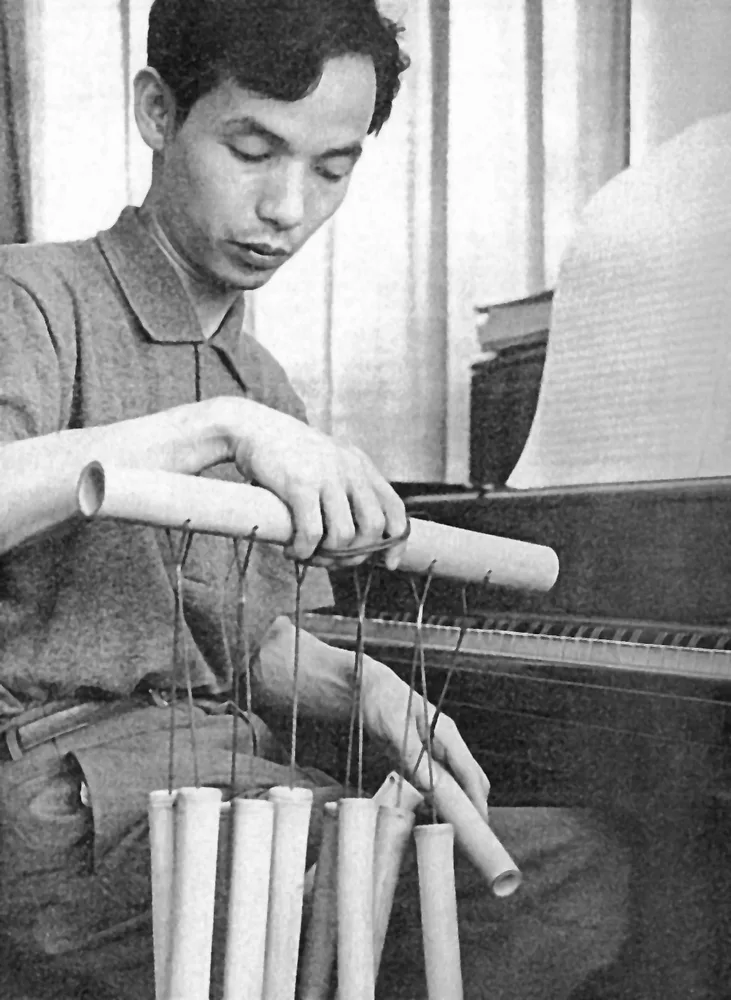
Toru Takemitsu, Japanese composer, photographed in 1961. Public domain (PD-Japan-organization; published in Geijutsu Shincho, Shinchosha Publishing Co., July 1961 issue) — Wikimedia Commons — https://commons.wikimedia.org/wiki/File:Toru_Takemitsu_Shinchosha_1961-7.jpg

Toru Takemitsu was born in Tokyo's Hongō district on October 8, 1930. His family relocated to Manchuria within a month; after his father's death in 1938, he returned to Japan for schooling, only to be conscripted at fourteen during the final stretch of World War II — an experience he described as "extremely bitter." During his military service, he first heard Western classical music, played secretly on a makeshift gramophone. Hospitalized with tuberculosis after the war, he listened extensively to Western music via US Armed Forces broadcasts. He studied briefly with composer Yasuji Kiyose from 1948, but was otherwise largely self-taught.
In 1951 he co-founded Jikken Kōbō (Experimental Workshop), an anti-academic, multidisciplinary collective, and independently developed musique concrète principles around 1948, roughly concurrent with Pierre Schaeffer's parallel development of the same techniques in France.
His international breakthrough came in 1958, when Igor Stravinsky, visiting Japan, happened to hear Takemitsu's 1957 Requiem for string orchestra during an NHK broadcast. Stravinsky insisted on hearing the piece in full and praised its "sincerity" and "passionate" writing, later inviting Takemitsu to lunch and, by most accounts, personally recommending him to Aaron Copland for a Koussevitzky Foundation commission — resulting in Dorian Horizon (1966), premiered by the San Francisco Symphony under Copland's baton.
Takemitsu credited John Cage, whose 1961 Japan premiere of Concert for Piano and Orchestra deeply impressed him, with helping him reconcile Western composition with Japanese tradition rather than moving away from it. He began studying the biwa and other traditional instruments from the early 1960s, and in 1967 the New York Philharmonic commissioned November Steps for its 125th anniversary — a landmark, genuinely difficult synthesis of biwa, shakuhachi, and full orchestra.
He also built one of the most prolific film-scoring careers of his generation, writing music for more than 100 films across less than 40 years. His work with Akira Kurosawa is best known, especially his score for Ran (1985), which won the Los Angeles Film Critics Award. For the film's central battle sequence, he wrote elegiac music that cuts off abruptly at a gunshot, leaving only the raw sound of the fighting — a deliberate compositional use of silence. He won the Grawemeyer Award for Music Composition in 1994, for Fantasma/Cantos.
He died in Tokyo on February 20, 1996, at 65, of pneumonia complicating a bladder cancer diagnosed the previous year, while still working toward an opera with novelist Barry Gifford that his illness prevented him from completing. He was posthumously awarded a Columbia University honorary doctorate and the Glenn Gould Prize. The Tokyo Opera City Concert Hall, opened in 1997, is dedicated to his memory, and the Toru Takemitsu Composition Award, established the same year, continues in his name.
Takemitsu's music synthesizes Western modernist technique — drawing directly on Debussy (his "great mentor"), Messiaen, and John Cage — with a deliberate, deepening engagement with traditional Japanese instruments and aesthetics, moving over his career from simple alternation between the two toward genuine integration. Many later works use a recurring E♭-E-A motif (spelling "Sea" in German solmization), appearing across his water-themed compositions.
- Ran (1985 soundtrack) - His best-known film score, for Akira Kurosawa. Spotify Listen
- November Steps (1967) - His landmark biwa/shakuhachi/orchestra synthesis. Spotify Listen
- Requiem for String Orchestra (1957) - The piece that caught Stravinsky's attention.
- Fantasma/Cantos (1994) - Won the Grawemeyer Award for Music Composition.
Toru Takemitsu: Full Discography
Discogs artist ID 115467. Identity confirmed via matching Discogs profile facts plus a directly-fetched, successfully-read Wikipedia article. 779 total credits across 8 pages, all Main role — the largest single-role credit count of any artist in this project, reflecting both a prolific film-scoring career and extensive individual cataloguing of his concert works across many classical labels. Only page 1 was reviewed; this discography is a small, landmark-only selection.
Concert works (selection)
| Work | Year | Notes | Listen | Buy |
|---|---|---|---|---|
| Requiem for String Orchestra | 1957 | The piece Igor Stravinsky overheard by chance in 1958 | Amazon | |
| Dorian Horizon | 1966 | Premiered by the San Francisco Symphony under Aaron Copland, following Stravinsky's introduction | Amazon | |
| November Steps | 1967 | Commissioned by the New York Philharmonic for its 125th anniversary; combines biwa, shakuhachi, and orchestra | Spotify | Amazon |
| A Flock Descends into the Pentagonal Garden | 1977 | Amazon | ||
| Toward the Sea | 1981 | Amazon | ||
| Rain Tree Sketch | 1982 | Spotify | Amazon | |
| Quotation of Dream | 1991 | Amazon | ||
| Fantasma/Cantos | 1994 | Grawemeyer Award for Music Composition, 1994 | Amazon |
Film scores (selection)
| Film | Year | Director | Notes | Listen | Buy |
|---|---|---|---|---|---|
| Seppuku (Harakiri) | 1962 | Masaki Kobayashi | Amazon | ||
| Ran | 1985 | Akira Kurosawa | Won the Los Angeles Film Critics Award, 1987; his best-known film score | Spotify | Amazon |
| Fire Festival | 1985 | Mitsuo Yanagimachi | Amazon | ||
| Black Rain | 1989 | Shohei Imamura | Amazon | ||
| Rikyu | 1989 | Hiroshi Teshigahara | Amazon |
Jikken Kōbō era (co-founder, 1951)
Early electroacoustic and multidisciplinary experimental works, including Saegirarenai Kyūsoku I (1952) and Water Music (1960).
Scale note
779 total credits across 8 pages, all Main role — the largest single-role credit count of any composer in this project. Only page 1 was reviewed. The tables above select the works most directly documented in Wikipedia's own biographical account (the Stravinsky connection, the November Steps commission, the Grawemeyer-winning piece, the Kurosawa collaboration); the great majority of his output — over 100 film scores and dozens of further concert works — is not individually catalogued.
- Igor Stravinsky - Overheard his Requiem by chance in 1958 and connected him to Aaron Copland.
- Aaron Copland - Premiered Dorian Horizon with the San Francisco Symphony.
- John Cage - A key philosophical influence, helping reconcile Western composition with Japanese tradition.
- Akira Kurosawa - His most significant film-directing collaborator, especially on Ran (1985).
- Seiji Ozawa - Conducted recordings of his major concert works, including November Steps.
More Nu Jazz Artists
See all 78 Nu Jazz artists →More Japanese Jazz Artists
See all 70 Japanese artists →- Tōru Takemitsu — Wikipedia (fetched directly and successfully)
- Toru Takemitsu — Discogs artist 115467 (profile and partial paginated release list retrieved via the Discogs API)
- Spotify Web API catalog lookups