JAZZPROFILES lives in the music 2,555 Jazz Artists fully Profiled!
François Jeanneau
Last updated November 14, 2026
Listen on Spotify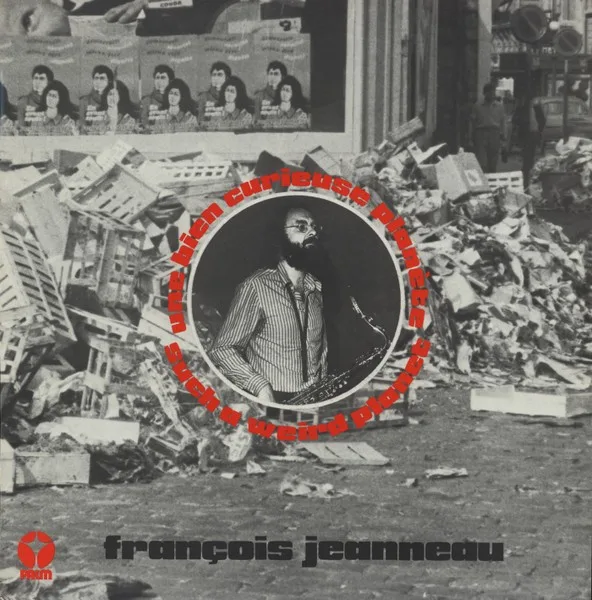
Cover of *Une Bien Curieuse Planète / Such A Weird Planet* (Palm, PALM 22, 1975), one of François Jeanneau's own albums. It is an album sleeve, not a Creative Commons photograph of the artist. Standard copyright, all rights reserved, held by the label or rights holder. This is not a Creative Commons or public-domain image; it is an album cover shown as an honestly disclosed editorial identification image. — https://coverartarchive.org/release-group/c8dfbe6b-7724-47f0-8cea-cf123caf696b/front-1200 (Cover Art Archive image for the MusicBrainz release group "Une Bien Curieuse Planète", 1975)
François Jeanneau is a Paris-born saxophonist, flautist, composer and teacher, born on June 15, 1935, who has been a fixture of French jazz since the early 1960s. He was the first musical director of the Orchestre national de jazz when it was created in 1986, founded the large ensemble Pandémonium, and for years ran the jazz and improvised music department at the Paris Conservatoire. He turned 91 in June 2026 and was still releasing records in 2025.
He grew up in a family of amateur musicians and learned the flute at the Conservatoire de Paris, where he studied with René Le Roy, but he taught himself the saxophone, soprano first and then tenor. He discovered jazz in 1949 through concerts by Charlie Parker and Sidney Bechet in Paris, and Bechet was his first model. He turned professional in 1960 in the quartet of the drummer Mac Kac, which played every night at the Club Saint-Germain, and learned the trade accompanying American musicians passing through Paris. In 1962 he travelled to Finland with the drummer Aldo Romano and the bassist Jean-François Jenny-Clark, and heard free jazz there for the first time, played by Archie Shepp and Bill Dixon.
Back in Paris he took part in the early French free-jazz sessions: he played soprano saxophone on Jef Gilson's Enfin ! (recorded between December 1962 and February 1963, released 1964), on François Tusques's Free Jazz (1965) and, in April 1966, in the Jef Gilson nonet that recorded New Call From France with Jean-Louis Chautemps and Bernard Lubat. He also took session work well outside jazz, among it the accompaniment of Claude François at the Olympia in 1964, alongside René Urtreger. From 1970 to 1974 he was in Triangle, a group that made records for Pathé and played rock-leaning music, with Jeanneau on flute and synthesizer.
His own records start in the middle of the decade. Une Bien Curieuse Planète (Palm, recorded in September 1975) pairs him with Bernard Lubat, Michel Graillier and Jean-François Jenny-Clark; Techniques Douces (Owl, 1977, recorded in June 1976) has him writing and playing soprano, alto and tenor with Graillier, Jenny-Clark and Aldo Romano; and Éphémère (Owl, 1977) adds an Oberheim synthesizer and a Lyricon wind synthesizer to his tenor and soprano. In 1979 he formed Pandémonium, a band of strings, guitar and rhythm section whose first players included Aldo Romano and Didier Lockwood; its Terrains Vagues (Owl), recorded in January 1983, has Chautemps, Philippe Maté and Jacques Di Donato in the reeds, three French horns, a tuba, Daniel Humair and the bassists Henri Texier and Jean-Paul Céléa. He had won the Prix Boris Vian of the Académie du Jazz in 1976, and in 1980 he took its Prix Django-Reinhardt. That year he founded a saxophone quartet with Jean-Louis Chautemps, Philippe Maté and Jacques Di Donato, wrote the jazz opera Desmodus Minor and continued the trio with the drummer Daniel Humair and the bassist Henri Texier that had made an Owl album in 1979 and recorded Akagera for JMS in the autumn of 1980. In 1981 he was among the reeds in Martial Solal's big band on its Gaumont album, and he was one of the musicians on John McLaughlin's Belo Horizonte (Warner Bros.), with Katia Labèque, Paco de Lucía and others.
In 1986 he became the first leader of the Orchestre national de jazz, the state-supported big band created that year, and recorded its first album for Label Bleu (LBC 6503), with Chautemps, Michel Benita, Andy Emler and Marc Ducret in the band and John Scofield as a guest on one piece. He then created the jazz department of the conservatoire in La Réunion (1987 to 1991), recorded Maloya Transit with the island's Trio Tambour (January 1991, issued by Label Bleu in 1992), and was the first head of the jazz and improvised music department at the Conservatoire national supérieur de musique et de danse de Paris, a post he held until 2000. In 1999 he met the American composer Walter Thompson and went on to help develop soundpainting, the live-composition sign language, leading the soundpainting orchestra Spoumj from 2005. His discography after 2000 includes Quand Se Taisent Les Oiseaux (Bee Jazz, 2007, his first French album as leader in twelve years, with the kora player Ablaye Cissoko), duo records with the pianist Uli Lenz (2008, 2013), Very Sensitive (2009) with the Bernica Octet, Duo pour deux, mais pas plus with the cellist Vincent Ségal (RSX, 2022), and The Straight Horn with the pianist Emil Spanyi (2025). In 2025 he also published an autobiography, Une anche passe.
Jeanneau came to the saxophone through Sidney Bechet and Charlie Parker, and then through the free jazz he heard in Finland in 1962; he is described as one of the pioneers of free jazz in France. The records that followed are less simply free than that label suggests: composed, orchestrated and often electric, with synthesizers on Éphémère, a rock-adjacent group in Triangle, a string-and-rhythm band in Pandémonium and, in 2007, a Weather Report-like quartet with kora that All About Jazz's Jeff Dayton-Johnson praised for its tunes and arrangements and for a soprano saxophone sound he heard as distinctively Jeanneau's even in a Wayne Shorter-like setting. Large-ensemble writing is the other constant, from Pandémonium to the Orchestre national de jazz and the Le POM orchestra, and he is as well known as a teacher: his first pupils in La Réunion included Olivier Ker Ourio, Henri-Claude Moutou and Jean-Luc Trulès.
- Une Bien Curieuse Planète (1975, Palm) - recorded on September 16 and 17, 1975 with Bernard Lubat, Michel Graillier and Jean-François Jenny-Clark, and his own tenor, soprano and flute with synthesizers and electric piano.
- Techniques Douces (1977, Owl) - soprano, alto and tenor saxophones, composition and arrangement over a Graillier, Jenny-Clark and Romano rhythm section; recorded in June 1976. Apple Music - Techniques Douces Listen
- Daniel Humair, François Jeanneau, Henri Texier, Akagera (recorded 1980, JMS) - the trio's studio record, nine short pieces with Jeanneau on tenor and soprano saxophones, flute and Lyricon and Texier doubling on oud. Apple Music - Akagera Listen
- Terrains Vagues (1983, Owl) - Pandémonium in an octet-plus line-up with horns and tuba, recorded January 7 to 10, 1983.
- Taxiway (1988, Label Bleu) - the François Jeanneau Quartet. Apple Music - Taxiway Listen
- Maloya Transit (1992, Label Bleu) - his quartet with Andy Emler, Michel Benita and Joël Allouche joined by the Trio Tambour de La Réunion, recorded in January 1991.
- Quand Se Taisent Les Oiseaux (2007, Bee Jazz) - the quartet record with Emil Spanyi, Joe Quitzke, Guillaume Juramie, Sébastien Boisseau and Ablaye Cissoko.
- Duo pour deux, mais pas plus with Vincent Ségal (2022, RSX) - a saxophone and cello duo. Apple Music - Duo pour deux, mais pas plus Listen
François Jeanneau: Full Discography
French saxophonist, flautist and composer. Born June 15, 1935, Paris. Discogs artist 340652; related Discogs entries for François Jeanneau Pandemonium (3857560), the François Jeanneau Quartet (2970580) and the Trio Humair-Jeanneau-Texier (5168480).
This list covers the records he leads, co-leads or directs, then a selection of sideman and guest appearances. Discogs lists more than 180 entries under his name, many of them compilations, reissues and television or pop sessions, so the second table is a selection and not a complete log. Where a detail could not be confirmed it says so.
Leader, co-leader and directed records
| Album | Year | Label | Personnel | Notes | Listen | Buy |
|---|---|---|---|---|---|---|
| Une Bien Curieuse Planète / Such A Weird Planet | 1975 | Palm, PALM 22 | François Jeanneau (tenor and soprano saxophones, flute in C, recorder in G, synthesizers, electric piano, piano, percussion), Jean-François Jenny-Clark (bass, percussion), Bernard Lubat (drums, percussion), Michel Graillier (electric piano, piano, synthesizers, percussion) | Recorded at Studio Palm on September 16 and 17, 1975. Nine pieces: "Triton I", "Kaïna", "Theme For An Unknown Island", "Fébrile Et Solitaire", "Une Bien Curieuse Planète", "Mr J.C. For Ever", "Nostalgique Futur", "Droit D'Asile" and "À L'ombre Des Forces Obscures - Triton II". Jef Gilson engineered. Reissued digitally by SouffleContinu Records in 2023. Discogs master 1521908, release 3411347. | — | — |
| The Paris Quartet (billed as The Paris Quartet, Jazz A Confronto 28) | 1976 | Horo Records, HLL 101-28 | François Jeanneau (soprano and tenor saxophones), Michel Graillier (piano), Jean-François Jenny-Clark (bass), Aldo Romano (drums) | Recorded in Rome on November 2, 1975. Seven pieces, among them "Mr. J.C. Forever" and "Droit D'Asile", both of which are also on Une Bien Curieuse Planète. Wikipedia dates the record 1975; the Discogs pressing (release 6712334) is dated 1976. Discogs files it as an appearance under a group name. | — | — |
| Techniques Douces | 1977 | Owl Records, OWL 04 | François Jeanneau (soprano, alto and tenor saxophones, composition, arrangement), Michel Graillier (piano), J.-F. Jenny-Clark (bass), Aldo Romano (drums, percussion) | Recorded at Sysmo Records, Paris, in June 1976. Seven pieces, among them "Autrefois Les Baleines", "O'Kunidé" and "Le Lynx". Cover photograph by Gilles Ehrmann; produced by Jean-Jacques Pussiau. Reissued by EmArcy in 2006 (0602498398975). Discogs master 640964, release 6973274. | Apple Music | — |
| Éphémère | 1977 | Owl Records, OWL 07 | François Jeanneau (tenor and soprano saxophones, Oberheim polyphonic synthesizer, Lyricon), all music composed, arranged and orchestrated by him | Eight pieces, "Aurore", "Fables", "Complicité", "Sortilèges", "Éphémère", "Effervescence", "Quiétude" and "Crépuscule". Produced by Jean-Jacques Pussiau; cover photograph by Guy Jaumotte. Discogs master 694657, release 1427860. | — | — |
| Europamerica (billed to L. "Butch" Morris, J.-L. Chautemps, F. Jeanneau, A. Jaume, Ph. Maté and others) | 1977 | Palm, PALM 28 (Disques Vendémiaire VDE/PAL 080, 1978) | Jef Gilson (piano, conductor), Butch Morris (cornet), François Jeanneau (soprano saxophone), Jean-Louis Chautemps, Alain Hatot, Marc Richard and Philippe Maté (tenor saxophones), André Jaume (tenor saxophone, bass clarinet), Jean-Charles Capon, Pierre-Yves Sorin, George Brown (cello, bass guitar, drums) | Concert at Cardin for Radio France on December 23, 1976. Co-billed record conducted by Jef Gilson; Jeanneau is one of eleven names on the sleeve billing. | — | — |
| Humair Jeanneau Texier (Trio Humair-Jeanneau-Texier) | 1979 | Owl Records, OWL 016 | François Jeanneau (tenor, alto and soprano saxophones, flute), Daniel Humair (drums), Henri Texier (acoustic bass) | Recorded in Paris at Studio Acousti on March 21 and 22 and June 18, 1979. Six pieces, among them "Fluctuations", "Suite Éolienne", "Bram Van Velde" and "Syotanka"; gatefold sleeve with a cover photograph by Gilles Ehrmann; produced by Jean-Jacques Pussiau. Reissued digitally by Decca France. Discogs master 363043, release 1421189. | Apple Music | — |
| Double Messieurs (Le Quatuor de Saxophones) | 1980 | Open | Le Quatuor de Saxophones: François Jeanneau, Jean-Louis Chautemps, Philippe Maté, Jacques Di Donato (per Wikipedia; instruments are the four saxophones) | Filed on Discogs as an appearance under the group name (release 2481725). The group's second album, Mad Sax 2 (CY Records, 1982; release 6154417), is listed the same way. | — | — |
| Akagera (Daniel Humair, François Jeanneau, Henri Texier) | 1982 | Disques JMS, JMS 012 | François Jeanneau (tenor and soprano saxophones, flute, Lyricon), Daniel Humair (drums, percussion, Syntoba), Henri Texier (double bass, oud, percussion), Gordon Beck (piano on "Nebbia") | Recorded at studio CBS in October and November 1980. The sleeve prints ℗ 1980 and Wikipedia lists the album under 1980, while the Discogs pressing (vinyl LP, stereo) is dated 1982. Nine pieces: "Akagera", "Akagera II", "Rampoon", "Le Cyclope", "Arfia", "Maghreb De Canard", "Mongol Fier", "Nebbia" and "Le Gorille". Produced by Jean-Marie Salhani. Discogs master 300181. | Apple Music | — |
| Soli Solo... Plus (Jean-Louis Chautemps, Jean-Pierre Drouet, Daniel Humair, François Jeanneau, Jean-François Jenny-Clark, Henri Texier) | 1982 | Arc - Les Amis Du Musée D'Art Moderne De La Ville De Paris | Six musicians as billed; instruments not itemised on Discogs | LP, Album. Discogs release 1809588. | — | — |
| Prao (Denis Barbier, Mino Cinelu, François Couturier, Patrice Cinelu, François Jeanneau, J-Jacques Cinelu) | 1983 | CY Records (per Wikipedia) | As billed; instruments not itemised on Discogs | Discogs master 2267620. | — | — |
| Terrains Vagues (François Jeanneau Pandemonium) | 1983 | Owl Records, OWL 033 | François Jeanneau (soprano and tenor saxophones, flute, Casiotone keyboard, composition, arrangement), Jean-Louis Chautemps (soprano and tenor saxophones, bass clarinet), Philippe Maté (soprano, alto and tenor saxophones, flute, senza), Jacques Di Donato (soprano, tenor and baritone saxophones, bass clarinet), Jacques Blanc, Jean-Jacques Justafré and Yves Valada (French horns), Mel Culbertson (tuba), François Couturier (piano), Henri Texier and Jean-Paul Céléa (basses), Daniel Humair and Philippe Macé (drums, vibraphone), Carole Rowley (vocals) | Recorded January 7 to 10, 1983; five pieces, among them "La Rue De La Vieille Lanterne" and "La Grande Roue". Jeanneau also produced, with Guy Van Minden and Jean-Jacques Pussiau. Discogs release 3765728. | — | — |
| Orchestre National De Jazz 86 (direction François Jeanneau) | 1986 | Label Bleu, LBC 6503 | François Jeanneau (director, soprano and tenor saxophones, keyboards), Jean-Louis Chautemps (soprano and alto saxophones, flute), Pierre-Olivier Govin (alto saxophone, flute), Richard Foy (reeds), Eric Barret (tenor and soprano saxophones), Bruno Rousselet (baritone and bass saxophones, bass clarinet, bassoon), Christian Martinez, Eric Mula and Michel Delakian (trumpets, bugles), Denis Leloup, Jean-Louis Damant and Yves Robert (trombones), Didier Havet (tuba), Andy Emler and Denis Badault (piano, synthesizers), Marc Ducret (guitar), Michel Benita (bass guitar, double bass), Aaron Scott (drums), François Verly (vibraphone, marimba, percussion); guest John Scofield (guitar on track 8) | Label Bleu LBC 6503, eight pieces among them "Jazz Lacrymogène", "Kalimba" and "Waltz". Recorded and mixed at Studio Charles Cros; Scofield's part was recorded at Electric Lady in New York. The first album of the orchestra, with Jeanneau as director. A concert from the same year was issued as Jazz Bühne Berlin 1986 (Amiga, 1987). Discogs master 727108. | — | — |
| Pandemonium (François Jeanneau) | 1988 | Carlyne Music, CAR C 12 | François Jeanneau (composition on seven of the eight pieces), Philippe Maté (alto and tenor saxophones, flute), Jacques Di Donato and Jean-Louis Chautemps (soprano and tenor saxophones), François Chassagnite (trumpet), Denis Leloup (trombone), Gilles Mahaud and Jean-Jacques Justafré (French horns), Michel Godard (tuba), Marc Ducret (guitar), Dominique Pifarély (violin), François Couturier (piano, synthesizer), Jean-Paul Céléa (double bass), François Laizeau (drums), Philippe Macé (vibraphone, synthesizer, percussion), Timna Brauer (vocals) | Recorded at Dunois in December 1985; eight pieces, among them "Arfia" (15:39), "Palabres" and "09-27" (20:13). Billed to Jeanneau alone and sharing its name with his ensemble. Discogs master 3291082, release 28741276. | — | — |
| Taxiway (François Jeanneau Quartet) | 1988 | Label Bleu | Quartet; personnel not confirmed in the sources checked | Wikipedia dates it 1989; the Discogs master and the Apple Music edition give 1988. Discogs master 728197. | Apple Music | — |
| Mixtures: Music For Media | 1989 | Music For Media, MFM 2035 | François Jeanneau | No personnel confirmed in the sources checked. | — | — |
| Up Date 3.3 (Humair Jeanneau Texier) | 1990 | Label Bleu, LBLC 6530 | Daniel Humair (drums), François Jeanneau (saxophone), Henri Texier (bass) | Recorded on February 12 to 14, 1990 at Studio Charles Cros and mixed in May. Eight pieces, among them "Kel Essouf", "Scratchbook" and "Update 3.3". Billed to the Trio Humair-Jeanneau-Texier. Discogs release 4594906. | — | — |
| Rencontre (François Jeanneau, Jean-Paul Céléa, Bertrand Renaudin) | 1991 | CC Production, 987604 | François Jeanneau (saxophone), Jean-Paul Céléa (double bass), Bertrand Renaudin (drums) | Eight pieces, among them "Majunga", "Souhait" and "Melodious Tonk". Discogs release 11354589. | — | — |
| Tribute to Mingus (Enrico Rava, François Jeanneau, Hervé Sellin, François Méchali, André Ceccarelli) | 1992 | Adda / Charlotte Records, 581291 | Enrico Rava (trumpet), François Jeanneau (tenor saxophone), Hervé Sellin (piano), François Méchali (bass), André Ceccarelli (drums) | Recorded in November 1991 at Studio Acousti, Paris. Seven pieces: "Pithecanthropus Erectus", "Duke Ellington's Sound Of Love", "Remember Rockfeller In Attica", "Nostalgia In Times Square", "Fables Of Faubus", "Goodbye Porkpie Hat" and "La Téte À L'Envers". Discogs release 2856367. | — | — |
| "Maloya Transit" (François Jeanneau Quartet et le Trio Tambour de La Réunion) | 1992 | Label Bleu, LBLC 6546 | François Jeanneau (tenor and soprano saxophones), Andy Emler (piano), Michel Benita (double bass), Joël Allouche (drums); Le Trio Tambour de La Réunion: Nicolas Moucazambo (lead voice, tambour), Christian Daffreville and Gilbert Mariapin (tambour) | CD, released May 14, 1992; recorded in January 1991. Nine pieces, among them "Sweet Bazil", "Boucan Canot" and "Oté La Renyon". Produced by the Maison de la Culture d'Amiens, with photographs by Guy Le Querrec. Discogs release 12022502. | — | — |
| Love Affair In Clermont-Ferrand (Ballet, Brun, Caratini, Jeanneau, Verly) | 1993 | Deux Z | As billed: Ballet, Brun, Caratini, Jeanneau, Verly (first names and instruments not itemised on Discogs) | CD. Discogs release 21666472. | — | — |
| Putain D'orchestre Modulaire (Le POM, direction Andy Emler, François Jeanneau, Philippe Macé) | 1997 | Not confirmed | Le POM; personnel not confirmed | Discogs master 2053885. A second record, Estramadure, followed in 1999 (master 2053897). | — | — |
| Framework (François Jeanneau, Jean-Paul Céléa, Leonzio Cherubini) | 2000 | Altrisuoni | As billed: François Jeanneau, Jean-Paul Céléa, Leonzio Cherubini | CD. Discogs release 7025766. | — | — |
| Flench Wok (Jean-Philippe Muvien, Daniel Humair, François Jeanneau, Jean-Philippe Viret) | 2005 | Bee Jazz, BEE 011 | As billed: Jean-Philippe Muvien, Daniel Humair, François Jeanneau, Jean-Philippe Viret | CD. Discogs release 3810496. | — | — |
| Quand Se Taisent Les Oiseaux | 2007 | Bee Jazz, BEE 017 | François Jeanneau (soprano saxophone), Emil Spanyi (piano, keyboards), Guillaume Juramie (electric bass on 1, 3-5, 7, 9), Sébastien Boisseau (double bass on 2, 6, 8, 10), Joe Quitzke (drums, percussion), Ablaye Cissoko (kora on 1, 4, 9; voice on 9) | Ten pieces, among them "Alerte 3", "Rumeurs", "Ninki (Le Dragon)" and "Tourmentes". The track-by-track personnel is from the All About Jazz review by Jeff Dayton-Johnson, which also notes that it was his first album as leader in France for twelve years. Discogs release 14558046. | — | — |
| Art Of The Duo: Walking In The Wind (François Jeanneau, Uli Lenz) | 2008 | Tutu Records, CD 888226 | François Jeanneau (saxophones), Uli Lenz (piano) | Live duo recording. Discogs release 4996944. | — | — |
| Pierre & Le Loup (Conte Musical) (François Jeanneau, Pandémonium, Jérôme Bardeau) | 2008 | Victorie Music | As billed: François Jeanneau, Pandémonium, Jérôme Bardeau | Musical tale, CD. A CD plus DVD edition, Peter & Lupus, followed in 2009 (release 11382627). Discogs release 16796685. | — | — |
| Very Sensitive (Bernica Octet, François Jeanneau) | 2009 | Cristal Records | Bernica Octet and François Jeanneau; personnel not itemised in the sources checked | CD. A soundpainting double album, Périple En Soundpainting / Bric-à-Brac, followed in 2011 (Cristal Records / Latitudes 5.4, release 6598166). Discogs release 10677264. | Apple Music | — |
| Jazz Live Trio With Guests (Jazz Live Trio with Albert Mangelsdorff, François Jeanneau) | 2011 | TCB Records | Jazz Live Trio with guests Albert Mangelsdorff and François Jeanneau | CD. The same broadcast material is on Apple Music as Swiss Radio Days Jazz Series, Vol. 22 (TCB Music). Discogs release 11095780. | Apple Music | — |
| Les Danses De Vulcain (François Jeanneau & Uli Lenz) | 2013 | Tutu Records | François Jeanneau (saxophones), Uli Lenz (piano) | CD. Discogs release 7642328. | — | — |
| Tarot Du Kebar (François Jeanneau, texts by Emmanuel Tugny) | 2016 | Gwen Catalá Éditeur | François Jeanneau with texts by Emmanuel Tugny | CD. Discogs release 25060750. | — | — |
| Duo pour deux, mais pas plus (François Jeanneau & Vincent Ségal) | 2022 | RSX, RSX001 | François Jeanneau (soprano saxophone, composition), Vincent Ségal (cello) | Recorded in Marseille in March 2022. Eleven pieces on the LP, titled with the numbers "Deux" to "Douze". The Apple Music edition is dated September 3, 2022; the Discogs LP (release 27389187) is dated July 1, 2023. | Apple Music | — |
| The Straight Horn (François Jeanneau & Emil Spanyi) | 2025 | Parallel Records | François Jeanneau (soprano saxophone, Lyricon emulator), Emil Spanyi (piano, Fender Rhodes, synthesizers) | Released October 10, 2025 and recorded in 2023 and 2024 at LDF Lausanne, per the release's Bandcamp page; 15 tracks. | Apple Music | — |
| Une Anche passe (François Jeanneau & Friends) | 2025 | Anima Persa Editions | François Jeanneau and guests; personnel not itemised in the sources checked | The Apple Music edition has 30 tracks and is dated December 5, 2025; French Wikipedia describes a three-CD box set. Not to be confused with the 1988 Cybelia compilation of the same title, on which several saxophonists share the billing. | Apple Music | — |
Sideman, guest and group appearances
| Year | Release | Actual leader | Label | Credit and details | Listen | Buy |
|---|---|---|---|---|---|---|
| 1964 | Enfin ! | Jef Gilson | Disques du Club de l'Échiquier, CED 30 J 1002 | Soprano saxophone on seven of the ten tracks (A1 to A4, B2 to B4), in a band that also has Jean-Louis Chautemps, Michel Portal, Henri Texier, Bernard Vitet and Jean-Luc Ponty on violin; recorded between December 23, 1962 and February 2, 1963 and issued in 1964 (Discogs master 417250) | Apple Music | — |
| 1964 | À L'Olympia | Claude François | Not confirmed | Played in the accompanying band at the Olympia, with René Urtreger, per Wikipedia (Discogs master 450217) | — | — |
| 1965 | Free Jazz | François Tusques | Disques Mouloudji, EM 13507 S | Saxophone and flute, in a band with Michel Portal (bass clarinet), Bernard Vitet (trumpet), Beb Guérin (bass) and Charles Saudrais (percussion); four pieces, among them "Description Automatique D'Un Paysage Désolé" (Discogs master 239003) | — | — |
| 1966 | New Call From France | The Jef Gilson Nonet feat. Jean-Louis Chautemps | SABA, SB 15 081 | Tenor and soprano saxophones; recorded April 18 and 19, 1966 at the Saba studio in Villingen, with Bernard Lubat on vibraphone and percussion | Apple Music | — |
| 1970 | Triangle | Triangle | Pathé | Member of the group; Discogs master 335250. A second album, Homonymie, followed in 1973 (master 529219) | — | — |
| 1977 | Europamerica | Jef Gilson / Butch Morris | Palm, PALM 28 | Soprano saxophone, in the concert recorded at Cardin on December 23, 1976 (see the leader table) | — | — |
| 1981 | Martial Solal Big Band | Martial Solal | Gaumont Musique, 753 804 | Reeds, in a band with Jacques Di Donato and Philippe Maté among the reeds, Roger Guérin, Eric Le Lann and Tony Russo on trumpets and André Ceccarelli on drums; recorded June 15 to 17, 1981 at Studio Davout, Paris (Discogs master 802415) | — | — |
| 1981 | Belo Horizonte | John McLaughlin | Warner Bros., BSK 3619 | Soprano and tenor saxophones, with Katia Labèque, François Couturier, Jean-Paul Céléa, Tommy Campbell, Jean-Pierre Drouet, Steve Shehan, Augustin Dumay and Paco de Lucía | Apple Music | — |
| 1990 | Gris | Marc Ducret | Label Bleu | Soprano saxophone, with Enrico Rava (trumpet) and Yves Robert (trombone) | Apple Music | — |
- Daniel Humair and Henri Texier - drummer and bassist of his trio, documented on Akagera (recorded 1980) and Up Date 3.3 (Label Bleu, 1990); Texier and Humair also play on Pandémonium's Terrains Vagues (1983).
- Aldo Romano - travelled with him to Finland in 1962 and played drums on Techniques Douces (1977).
- Jean-François Jenny-Clark - bassist on his 1975 and 1977 albums and a travelling companion in 1962.
- Michel Graillier - pianist on Une Bien Curieuse Planète and Techniques Douces.
- Martial Solal - pianist and leader of the Martial Solal Big Band, whose 1981 album (Gaumont Musique, recorded June 15 to 17, 1981) credits Jeanneau among the reeds, with Jacques Di Donato and Philippe Maté.
- Enrico Rava - trumpeter and co-leader of Tribute to Mingus (Adda, recorded in November 1991 and issued in 1992), on which Jeanneau plays tenor saxophone, with Hervé Sellin, François Méchali and André Ceccarelli.
- John McLaughlin - guitarist and leader of Belo Horizonte (1981), on which Jeanneau plays soprano and tenor saxophones.
- John Scofield - guitarist on "Waltz", the last piece of the 1986 Orchestre national de jazz album that Jeanneau directed (his part was recorded at Electric Lady Studios in New York).
- Jean-Luc Ponty - violinist on Jef Gilson's Enfin ! (recorded 1962 and 1963), on which Jeanneau plays soprano saxophone.
- Jean-Louis Chautemps, Philippe Maté and Jacques Di Donato - the other saxophonists of the Quatuor de saxophones he founded in 1980.
- Uli Lenz - German pianist, his duo partner on Art of the Duo: Walking in the Wind (2008) and Les Danses de Vulcain (2013).
- Vincent Ségal - cellist, partner on Duo pour deux, mais pas plus (2022).
- Emil Spanyi - pianist in the quartet of Quand Se Taisent Les Oiseaux (2007) and co-leader of The Straight Horn (2025).
- François Chassagnite - trumpeter in the first Orchestre National de Jazz under Jeanneau (1986 to 1988) and in the trumpet section of Pandemonium (Carlyne Music, 1988).