 JAZZPROFILES lives in the music 2,303 Jazz Artists fully Profiled!
Louie Ramírez
Last updated November 6, 2026
Listen on Spotify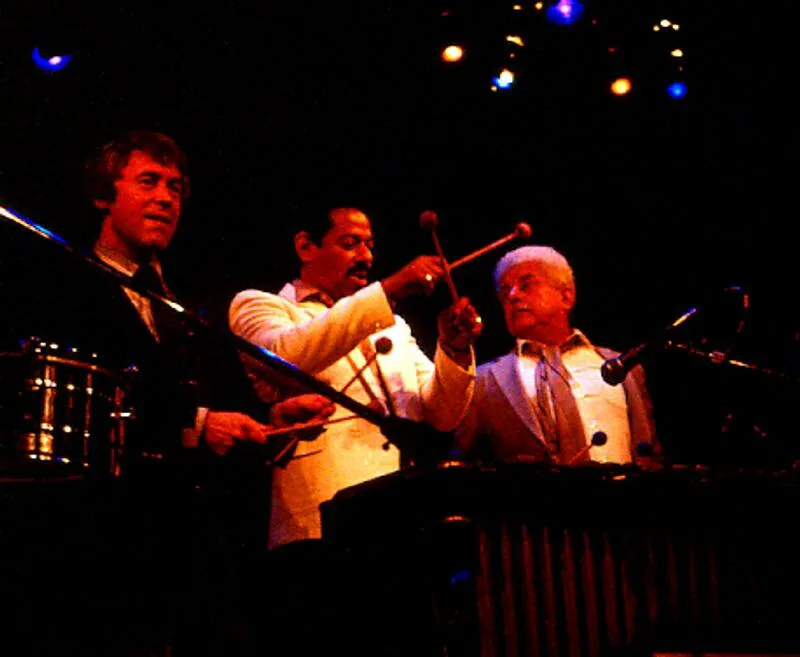
Louie Ramírez at the vibraphone with Warren Chiasson and Tito Puente at the Village Gate, New York City, in the 1980s CC BY-SA 4.0 — Wikimedia Commons (https://commons.wikimedia.org/wiki/File:Louie_R_with_Warren_C_and_Tito_P.jpg), photo by SigmaIota

Louie Ramírez was born in New York City on February 24, 1938, the son of Puerto Rican parents. He began music studies in his teens and made his professional debut in 1956 by taking the vibraphone chair in Joe Loco's band from Pete Terrace. His first recording, with Loco for Ansonia, followed in 1957. A few years later his writing was already on the Latin dance floor: he is credited as a writer of "El Güiro de Macorina," a Johnny Pacheco number on Pacheco y su Charanga (Alegre, 1961), the year he also played percussion on Sabu Martínez's Sabu's Jazz Españole (Alegre LPA 802). The salsa and Latin dance music of New York's Puerto Rican neighborhoods was his working world for the rest of his life, and most of what he made was salsa, boogaloo and romantic dance-band music, with Latin jazz as a vibraphone-led side of the same career.
His first record as a leader was Introducing Louie Ramírez (Remo, LPR 1512, 1964), a program of pachanga, bolero, son montuno, cha-cha-cha, descarga and guaguancó with Ramírez on timbales and vibraphone, Sabu Martínez on bongos, Bobby Valentín and Larry Spencer on trumpets and Chivirico Dávila and Victor Velázquez singing. From 1965 to 1968 he worked closely with Charlie Palmieri and Joe Cuba. He played timbales on Palmieri's boogaloo album Latin Bugalu (Atlantic, 1968), wrote "I'm Insane" for the Joe Cuba Sextet's My Man Speedy! (Tico, 1968), and made Vibes Galore (Alegre LPA 845, 1966) with his Conjunto Changó, an album of vibraphone-led dance music that includes his tune "El Títere." In 1967 Mercury issued the boogaloo album In the Heart of Spanish Harlem (SR 61121), arranged by Ramírez with Richard Marin producing and bilingual track titles on the sleeve.
Fania released Ali Baba (Fania LP 357, 1968) with him billed under that pseudonym; the label's own history says the alias was a way around an earlier recording commitment. Jerry Masucci produced and Pacheco was the recording director. Ramírez arranged and played timbales, Rudy Calzado sang the Spanish lyrics and Bobby Marín the English ones, and Ramírez wrote six of the nine tracks, "El Títere" among them. He and the singer Pete Bonet, formerly with Ray Barretto's band, then made records as Pete & Louie, including the album Pete & Louie (Fania LP 390, 1970), which streaming services carry as The Beautiful People. In 1972 he arranged En Algo Nuevo for the singer Tito Rodríguez (TR Records), and in 1974 he produced and arranged his own Típico for UA Latino with the singer Victor Velázquez. He also wrote the arrangement of "La Familia" on Barretto's Indestructible (Fania, 1973).
In 1975 he became a staff producer at Fania, and the decade's New York salsa records are full of his name in the production credit. Discogs lists him as producer of albums by Joe Cuba, Kako, Típica '73, Sonora Ponceña, Ricardo Ray and Bobby Cruz, Vítin Avilés, La Lupe, Orquesta Novél and Chocolate Armenteros, among many others, and of the Fania All Stars' Tribute to Tito Rodríguez (1976), on which he also arranged three tracks. He arranged two pieces for Héctor Lavoe's La Voz (Fania, 1975) and wrote and arranged "Los Bravos" for the All Stars' Cross Over (Columbia, 1979). For Tito Puente he produced The Legend (Tico, 1977) and the Beny Moré tribute Homenaje a Beny (Tico, 1978). Fania's history says he also performed with the Fania All Stars on their international tours. The trade gave him a nickname that stuck, "the Quincy Jones of salsa."
His own albums at Cotique, a label that came into the Fania group, were more adventurous than the production work. A Different Shade of Black (Cotique CS 1085, 1976) is a crossover record with Bernard Purdie on drums, Cornell Dupree on guitar and Paul Griffin on piano. Marty Sheller wrote most of the charts, and the program includes "Salsa," "Latin Rhapsody" and a version of "Do It Any Way You Wanna." Louie Ramírez y Sus Amigos (Cotique JMCS-1096, 1978) adds a Moog synthesizer and the Selwart Clarke Strings, covers two Beatles songs, "Something" and "Because" (the latter as a danzón), and opens with "Paula C," a song by Rubén Blades. Salsa Progresiva (Cotique JMCS-1100, 1979) has Tito Allen, Adalberto Santiago and Angela Bofill on backing vocals and turns "Stella by Starlight" into a guaguancó. Salsero (Cotique JMCS 1104, 1980) has him on timbales, vibraphone and piano.
The 1980s belong to his partnership with the singer Ray De La Paz. He produced Noche Caliente: Los Éxitos Más Románticos de Ayer en Ritmo de Salsa (K-Tel, 1982), a set of romantic ballads in salsa arrangements issued under the name Noche Caliente, which is often cited as a starting point for the romantic salsa wave. Their Caiman albums followed: Con Caché (Caiman CLP-9004, 1984), Alegres y Románticos (Caiman 9011, 1985, with Pacheco among the chorus) and Sabor con Clase (Caiman CLP-9019, 1986), each credited to Ramírez and De La Paz together. In 1986 he paid tribute to the vibraphonist Cal Tjader on the Latin jazz album A Tribute to Cal Tjader (Caiman CLP 9025). He plays vibraphone, timbales and synthesizer, arranged and produced it, and has Paquito D'Rivera on alto saxophone. Later albums included El Genio (1989), Sexy Salsa (1989), a second Louie Ramírez y Sus Amigos (1990) and The King of Latin Vibes (Sugar, 1991), with Carlos "Patato" Valdés on congas. A photograph from the 1980s shows him at the Village Gate in Manhattan, where Monday nights were billed as "Salsa Meets Jazz," playing vibraphone beside Tito Puente and the vibraphonist Warren Chiasson.
He passed away on June 7, 1993, at 55, after a heart attack while driving on Junction Boulevard in Queens. He was recording his third album with Ray De La Paz, Prepárate Bailador, which RMM released later that year.
Ramírez was a bandleader and arranger first and a vibraphone soloist second. The records that made his reputation are dance records: charanga-era descargas, boogaloo, hard-driving Fania salsa and, in the 1980s, the smoother romantic salsa he made with Ray De La Paz. His reputation as "the Quincy Jones of salsa" rests on that behind-the-scenes arranging and producing for other bandleaders more than on any one solo.
The jazz side is real but smaller. His vibraphone career began in Joe Loco's New York Latin band rather than in a bebop group, and his vibes lines sit inside the clave-based vocabulary he worked in. The clearest jazz documents are Vibes Galore, A Tribute to Cal Tjader, in which he plays the repertoire of Cal Tjader ("Soul Sauce," "Mambo for Cal," "Lullaby of Birdland") over a Latin rhythm section, and The King of Latin Vibes. A Different Shade of Black shows a third direction, a salsa-and-funk crossover with American studio players. He was a bridge figure, a musician working inside the salsa industry who kept returning to the vibraphone and to jazz repertoire when the label allowed it.
- Introducing Louie Ramírez (1964, Remo) - His debut as a leader, a mambo-era set of pachanga, son, bolero and guaguancó with Sabu Martínez on bongos. Spotify - Introducing Listen
- Vibes Galore (1966, Alegre) - Vibraphone-led Latin dance music with his Conjunto Changó, including his tune "El Títere." Spotify - Vibes Galore Listen
- Ali Baba (1968, Fania) - His Fania debut, a salsa-boogaloo record on which he arranged, played timbales and wrote most of the material. Spotify - Ali Baba Listen
- A Different Shade of Black (1976, Cotique) - A crossover album with Bernard Purdie, Cornell Dupree and Paul Griffin, mixing Latin percussion with soul-jazz and funk rhythm-section playing.
- Louie Ramírez y Sus Amigos (1978, Cotique) - Moog, strings and Beatles covers in salsa dress, with "Paula C" and the danzón "Because." Spotify - Louie Ramírez y Sus Amigos Listen
- Salsa Progresiva (1979, Cotique) - Progressive salsa with a guaguancó treatment of "Stella by Starlight"; streaming services carry it as Como Nunca. Spotify - Como Nunca Listen
- Con Caché (1984, Caiman) - The first of three Caiman albums by Ramírez and Ray De La Paz, with a salsa version of "Just the Two of Us" called "Solo Tu Y Yo."
- A Tribute to Cal Tjader (1986, Caiman) - His Latin jazz tribute to Cal Tjader, with Paquito D'Rivera and Mario Rivera among the horns. Spotify - Tribute To Cal Tjader
Louie Ramírez: Full Discography
Discogs artist: Louie Ramirez (19595) · Born February 24, 1938, New York City · Died June 7, 1993, Queens, New York
Ramírez recorded more than twenty albums as a bandleader and produced or arranged for dozens of other leaders. His own records are mostly salsa, boogaloo and romantic dance music, with a smaller Latin jazz and crossover strand; the notes say which is which. Discogs files his work under several entities (Louie Ramírez Y Su Orquesta, Louie Ramírez and His Latin Jazz Ensemble, Louie Ramírez y la Superbanda, Louie Ramírez Y Sus Amigos, Ali Baba and others), and this list follows the albums rather than the entity. It is a selected list, not an exhaustive one: dozens of singles and compilation appearances are left out.
Leader and Co-Leader: Albums
| Album | Year | Label | Personnel & Notes | Listen | Buy |
|---|---|---|---|---|---|
| Introducing Louie Ramírez | 1964 | Remo (LPR 1512) | Ramírez on timbales and vibraphone; Sabu Martínez (bongos, cowbell), Ozzie Torrens (congas), Bobby Valentín and Larry Spencer (trumpets), Shep Pullman (baritone saxophone), Chivirico Dávila and Victor Velázquez (vocals). Twelve tracks spanning pachanga, bolero, son montuno, cha-cha-cha, descarga and guaguancó | Spotify | — |
| Vibes Galore (Louie Ramírez and His Conjunto Changó) | 1966 | Alegre (LPA 845) | Ramírez on vibraphone; Willie Torres (lead vocals), Ismael Quintana (chorus), Charlie Palmieri and Al Santiago (recording supervisors); includes "El Títere" and "I'm in the Mood for Love" | Spotify | — |
| In the Heart of Spanish Harlem (En el Corazón de Harlem Español) | 1967 | Mercury (SR 61121) | Boogaloo album with bilingual track titles. Ramírez arranged and played vibraphone; Richard Marin produced; Willie Torres and Rudy Calzado sang and Jimmy Sabater was in the chorus. Includes "Lucy's Spanish Harlem," "Louie's Mozambique" and "The Boogie Man." Streaming services carry the same program as Latin Cool Classics: Louie Ramirez, with some tracks retitled | Spotify (as Latin Cool Classics) | — |
| Ali Baba | 1968 | Fania (LP 357) | Issued under the pseudonym Ali Baba. Ramírez arranged, played timbales and wrote six of the nine tracks, including "El Títere." Rudy Calzado (Spanish vocals), Bobby Marín (English vocals), Bobby Valentín and Larry Spencer (trumpets); produced by Jerry Masucci with Johnny Pacheco as recording director; liner notes by Max Salazar | Spotify | — |
| Pete & Louie (co-led with the singer Pete Bonet) | 1970 | Fania (LP 390) | Ramírez on timbales and wrote six of the eight tracks; Pat Patrick (baritone saxophone), Ray Armando (congas), Ira Herscher (piano, guitar). Streaming services carry it as The Beautiful People | Spotify (as The Beautiful People) | — |
| En Algo Nuevo (billed to Tito Rodríguez and Louie Ramírez) | 1972 | TR Records (TLP-00300) | Tito Rodríguez sings; Discogs credits Ramírez with the arrangements (Artie Azenzer arranged three tracks) | Spotify | — |
| Típico | 1974 | UA Latino (LT-LA 208-D) | Produced and arranged by Ramírez; Victor Velázquez sings. Includes "Everybody Knows," "Sabroso Guaguancó" and "Plena de San Anton" | Spotify | — |
| A Different Shade of Black | 1976 | Cotique (CS 1085) | Crossover album recorded at Bell Sound, New York. Ramírez on vibraphone and timbales; Bernard Purdie (drums), Cornell Dupree (guitar), Paul Griffin (piano), Bobby Porcelli (alto saxophone), Arthur Jenkins (congas); arranged mostly by Marty Sheller, with Dick Meza and Ramírez; Jerry Masucci and Ramírez producing. Includes "Salsa," "Latin Rhapsody," "Laura" and "Do It Any Way You Wanna" | — | — |
| Louie Ramírez y Sus Amigos | 1978 | Cotique (JMCS-1096) | Ramírez on timbales, piano and Moog synthesizer, also producer; Sonny Bravo (piano), Mauricio Smith (flute), Papo Vázquez and Sam Burtis (trombones), Nicky Marrero, Johnny Rodríguez and Ismael Quintana (percussion), the Selwart Clarke Strings. Includes "Paula C," "Something" and "Because (Porque)," the latter a danzón | Spotify | — |
| Salsa Progresiva | 1979 | Cotique (JMCS-1100) | Produced by Ramírez. Backing vocals by Adalberto Santiago, Tito Allen and Angela Bofill. Includes "Latin New York," "Orgullo de la Montaña" and a guaguancó treatment of "Stella by Starlight." Streaming services carry the program as Como Nunca | Spotify (as Como Nunca) | — |
| Salsero | 1980 | Cotique (JMCS 1104) | Ramírez on timbales, vibraphone and piano, also producer and arranger of three tracks; Adalberto Santiago (vocals), Sonny Bravo (piano), Nestor Torres (flute), Orestes Vilató (bongos). Closes with "Latin Jazz" | Spotify | — |
| Super Cañonazos Con Louie Ramírez | 1983 | GiGi (JM 11343) | Ramírez directed and produced and plays timbales; Ray De La Paz sings; Isidro Infante (piano), José Madera (congas) | — | — |
| Con Caché (Louie Ramírez Y Su Orquesta with Ray De La Paz) | 1984 | Caiman (CLP-9004) | Ramírez and De La Paz credited as co-leaders; Ramírez on timbales and vibraphone, Isidro Infante on piano, Marty Sheller arranging. Includes "Solo Tu Y Yo," a salsa version of "Just the Two of Us" | — | — |
| Alegres y Románticos (with Ray De La Paz) | 1985 | Caiman (9011) | Ramírez on timbales, vibraphone, marimba and celesta; produced by Ramírez, De La Paz and Isidro Infante; Johnny Pacheco in the chorus | — | — |
| Sabor con Clase (with Ray De La Paz) | 1986 | Caiman (CLP-9019) | Ramírez on timbales and vibraphone, producer and arranger; Isidro Infante (piano, synthesizer); includes "En un Beso la Vida" and "La Bikina" | — | — |
| A Tribute to Cal Tjader (Louie Ramírez and His Latin Jazz Ensemble) | 1986 | Caiman (CLP 9025) | Latin jazz album. Ramírez on vibraphone, timbales and synthesizer, also arranger and producer; Paquito D'Rivera (alto saxophone), Mario Rivera (flute, tenor and soprano saxophones), José Fajardo (flute), Isidro Infante (keyboards), Ray De La Paz (vocals), Papo Pepin (congas). Includes "Soul Sauce," "Mambo for Cal," "Lullaby of Birdland" and "El Títere" | Spotify | — |
| Louie Ramírez Y Super Banda | 1987 | Faisan (FLP 508) | Ramírez on timbales, producer and arranger. Includes "Feo Pero Sabroso" and "Los Timbales de la Salsa," both written by Ramírez | Spotify (as Super Banda) | — |
| El Genio (reissued as Noches en Copa con Louie Ramírez y Su Orquesta, CBS, 1989) | 1989 | L&T (LTR 2419) | Ramírez on timbales and vibraphone, executive producer and arranger of most tracks; Adalberto Santiago and Tito Allen in the chorus. Includes "Salsa Romántica" and "Vibes a la Louie" | — | — |
| Sexy Salsa | 1989 | The Mayor (TM 003) | Ramírez on timbales and vibraphone, producer and director; Paquito D'Rivera (flute, alto saxophone), José Fajardo (flute), Ricky González (piano) | — | — |
| Louie Ramírez Y Sus Amigos | 1990 | Caché Records & Tapes (AM-001) | Ramírez on timbales and piano, producer; Papo Pepin (congas), Adalberto Santiago and Tito Allen in the chorus. Includes "Pruebame" and "Donde Hubo Fuego." Streaming services carry it as Maestro | Spotify (as Maestro) | — |
| The King of Latin Vibes | 1991 | Sugar (SLP 111) | Ramírez on vibraphone and synthesizer; Carlos "Patato" Valdés (congas), Ricky González (keyboards), Sammy González (vocals). Includes "Midnight Sun" and "Pare Cochero" | — | — |
| Otra Noche Caliente (with Ray De La Paz) | 1992 | RMM (RMD-80748) | Ramírez on timbales, vibraphone, marimba, piano and synthesizer, also producer with De La Paz; Ralph Mercado executive producer; Oscar Hernández and Isidro Infante among the arrangers. Pressed in several territories | — | — |
| Sexy Salsa Vol. 2 | 1992 | The Mayor (TM 004) | Ramírez on timbales and vibraphone, producer and director; Paquito D'Rivera (flute, alto saxophone), Mauricio Smith (flute), Adalberto Santiago and Tito Allen in the chorus | — | — |
Posthumous and Compilation Releases
| Release | Year | Label | Notes | Listen | Buy |
|---|---|---|---|---|---|
| Préparate Bailador (Ray De La Paz) | 1993 | RMM (CD-81180) | The album he was recording when he passed away. Credited to Ramírez as music director, producer and timbales player | — | — |
| Louie's Grooves | 2005 | Vampi Soul (VAMPI CD 052) | Compilation of 1960s and 1970s tracks, including "Chin Chon Chow," "Don Maceo" and "I Dig Rhythm" | — | — |
| Temas Inéditos | 2016 | G&A Records | Previously unreleased recordings, including "Vibes in G Minor" and "Ink, Booze and Funk" | Spotify | — |
| Fania Rare Grooves | n.d. | Fania | Compilation of ten tracks drawn from his Cotique albums | Spotify | — |
As Producer, Arranger and Sideman (selected)
Credits below are read from the individual releases on Discogs. Producer and arranger work is listed with the role named, because a producer credit is not a playing credit.
| Year | Project (Leader) | Title | Label | Catalog | Role | Notes |
|---|---|---|---|---|---|---|
| 1961 | Sabu Martínez | Sabu's Jazz Españole | Alegre | LPA 802 | Percussion | |
| 1961 | Johnny Pacheco | Pacheco y su Charanga | Alegre | LPA 801 | Writer | Credited as writer of "El Güiro de Macorina" |
| 1963 | Ray Barretto | "Ritmo Sabroso" (7 inch, also on Charanga Moderna) | Tico | T-419 | Writer | |
| 1966 | Celia Cruz | Son con Guaguancó | Tico | LP 1143 | Arranger | Credit is not broken down by track |
| 1968 | Charlie Palmieri | Latin Bugalu | Atlantic | SD 8166 | Timbales | |
| 1968 | Joe Cuba Sextet | My Man Speedy! | Tico | LP 1161 | Writer | Wrote "I'm Insane" |
| 1973 | Ray Barretto | Indestructible | Fania | SLP 00456 | Arranger | Arranged "La Familia" |
| 1975 | Héctor Lavoe | La Voz | Fania | SLP 00461 | Arranger | Two tracks |
| 1975 | Joe Cuba | "Joe Cuba's Latin Hustle" / "Ataca de Nuevo" (7 inch) | Tico | T-648 | Producer | |
| 1976 | Fania All Stars | Tribute to Tito Rodríguez | Fania | SLP 00493 | Producer, arranger | Arranged "Cuando, Cuando, Cuando," "Fue en Santiago" and "Los Muchachos de Belén" |
| 1977 | Tito Puente | The Legend | Tico | JMTS-1413 | Producer, arranger | Arranged the title track |
| 1978 | Tito Puente | Homenaje a Beny | Tico | JMTS-1425 | Producer | Tribute to Beny Moré |
| 1979 | Fania All Stars | Cross Over | Columbia | JC 36109 | Featured player, arranger, writer | Wrote and arranged "Los Bravos"; arranged "Isadora" |
| 1981 | Fania All Stars | Latin Connection | Fania | JM 595 | Featured player, arranger | Arranged "Mi So Den Boso" |
Discogs also lists Ramírez as producer of releases by Kako, Típica '73, Sonora Ponceña, Ricardo Ray and Bobby Cruz, Vítin Avilés, La Lupe, Orquesta Novél, Chocolate Armenteros, Tito Allen, Ismael Rivera, and Jimmy Sabater, mostly between 1973 and 1983. Those credits are shown on Discogs's artist page but were not each checked against the release credits.
- Joe Loco and Pete Terrace - the bandleader who gave him his professional debut in 1956, and the vibraphonist whose chair he took; first recording with Loco for Ansonia in 1957.
- Johnny Pacheco - co-wrote "El Güiro de Macorina" (1961), directed the recording of Ali Baba, and sang in the chorus on Alegres y Románticos.
- Sabu Martínez - bongos on Introducing Louie Ramírez; Ramírez played percussion on Sabu's Jazz Españole (1961).
- Charlie Palmieri and Joe Cuba - his main working partners from 1965 to 1968; Ramírez plays timbales on Latin Bugalu and wrote for the Joe Cuba Sextet.
- Ray Barretto - Ramírez wrote the arrangement of "La Familia" on Indestructible (1973).
- Tito Rodríguez - Ramírez arranged En Algo Nuevo (1972).
- Jerry Masucci - Fania's president, producer of Ali Baba and executive producer of several of his Cotique records.
- Tito Puente - Ramírez produced The Legend (1977) and Homenaje a Beny (1978).
- Cornell Dupree, Bernard Purdie, Paul Griffin and Marty Sheller - the guitarist, drummer, pianist and arranger on A Different Shade of Black.
- Angela Bofill - backing vocals on Salsa Progresiva.
- Adalberto Santiago, Tito Allen, Jimmy Sabater - singers on his Cotique records of the late 1970s.
- Ray De La Paz and Isidro Infante - singer and pianist-arranger in his 1980s Caiman band.
- Paquito D'Rivera, Mario Rivera, José Fajardo - horn players on A Tribute to Cal Tjader; D'Rivera is also credited on Sexy Salsa.
- Carlos "Patato" Valdés - congas on The King of Latin Vibes (1991).
- Warren Chiasson - the vibraphonist who shared the stand with Ramírez and Tito Puente at the Village Gate in the 1980s.
- Pete Bonet - the singer, formerly with Ray Barretto, with whom he recorded as Pete & Louie.
More Latin Jazz Artists
See all 212 Latin Jazz artists →More American Jazz Artists
See all 820 American artists →- Wikipedia: Louie Ramirez
- Wikipedia (French): Louie Ramírez
- Spotify artist page, with the AllMusic biography by Max Salazar
- Wikipedia: Fania Records
- Fania Records: Louie Ramirez
- Fania Records: Louie Ramirez and Orchestra, Good News
- Peace and Rhythm: Louie Ramirez, Feb 24, 1938 to June 7, 1993
- Discogs: Louie Ramirez
- MusicBrainz: Louie Ramírez
- Wikimedia Commons: Louie R with Warren C and Tito P.jpg