 JAZZPROFILES lives in the music 1,002 Jazz Artists fully Profiled!
 Sam Rivers
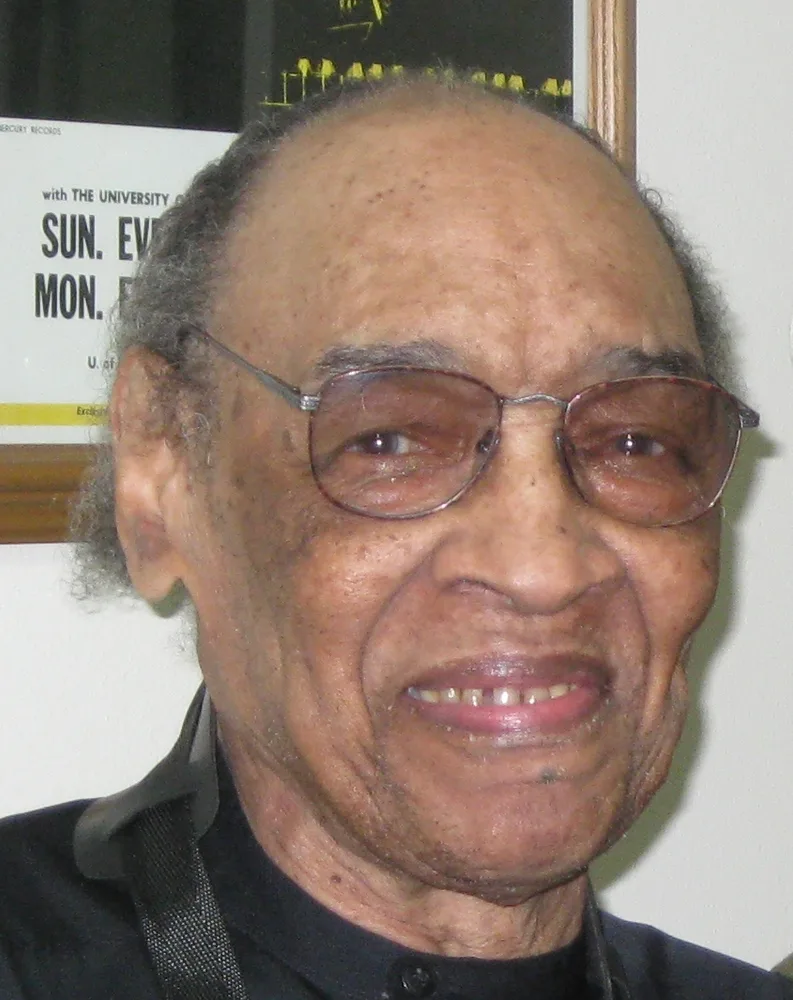
Saxophonist and composer Sam Rivers, photographed at the University of Miami, March 27, 2009. CC BY 3.0 (Creative Commons Attribution 3.0 Unported) — Wikimedia Commons, uploaded as own work by the user Smalagodi - https://commons.wikimedia.org/wiki/File:Sam_Rivers.jpg

Samuel Carthorne Rivers was born September 25, 1923, in El Reno, Oklahoma. His father was a gospel musician who had sung with the Fisk Jubilee Singers and the Silverstone Quartet, and his grandfather, Marshall W. Taylor, was a religious leader from Kentucky, so Rivers grew up around music from childhood. He served in the Navy in the 1940s, stationed in California, where he performed semi-regularly with the blues singer Jimmy Witherspoon. In 1947 he moved to Boston, Massachusetts, and studied at the Boston Conservatory under the composer Alan Hovhaness, working locally with Quincy Jones, Herb Pomeroy, and Tadd Dameron as he built a reputation in the city's bebop scene.
In 1959 Rivers began performing with a 13-year-old drummer named Tony Williams, a relationship that would change the direction of his career. On Williams's recommendation, Rivers joined the Miles Davis Quintet in 1964, appearing on the single live album the group produced, Miles in Tokyo, recorded July 14 at Kohseinenkin Hall with Davis, Ron Carter, Tony Williams, and Herbie Hancock. The stint was brief: his playing was already pushing further outside the harmony than Davis wanted at the time, and he was replaced within months by Wayne Shorter. Blue Note Records signed him that same year. Over the rest of the decade he recorded four albums as a leader for the label: Fuchsia Swing Song (1965), with Jaki Byard, Ron Carter, and Tony Williams; Contours (1967), with Freddie Hubbard, Herbie Hancock, Ron Carter, and Joe Chambers; A New Conception (1967), a standards-based quartet date with Hal Galper, Herbie Lewis, and Steve Ellington; and Dimensions & Extensions (recorded 1967, not released until 1986), with Donald Byrd, Julian Priester, James Spaulding, and Cecil McBee. He also appeared as a sideman on other Blue Note sessions of the period, including Tony Williams's Life Time (1964) and Spring (1966), Larry Young's Into Somethin' (1965), Bobby Hutcherson's Dialogue (1965), and Andrew Hill's Change (recorded 1966). His ballad "Beatrice," from Fuchsia Swing Song, went on to become a standard among tenor saxophonists, later recorded by Joe Henderson on The State of the Tenor and by Stan Getz.
Through the 1970s Rivers and his wife, Beatrice, ran Studio Rivbea, a jazz loft on Bond Street in Manhattan's NoHo district, opened in 1970 as part of the first New York Musicians Festival. The critic John Litweiler later wrote that "in New York, loft jazz meant free jazz in the seventies," calling Studio Rivbea the movement's most famous venue; a series of recordings made there was issued as the Wildflowers sessions on the Douglas label. Rivers continued to record through the decade, including several albums for Impulse!: Streams, recorded live at the Montreux Jazz Festival, the trio sessions later collected on Hues, the quartet date Sizzle, and his first big-band record, Crystals. The best-known recording of the period, though, is one on which he was a sideman rather than a leader: Dave Holland's Conference of the Birds (1973, ECM), the only occasion Rivers and Anthony Braxton, two of the era's most original saxophonists, recorded together, alongside Holland and drummer Barry Altschul. Rivers and Holland's musical partnership continued afterward on Rivers's own Sizzle and Contrasts (1980, ECM, with trombonist George Lewis), and much later on the trio reunion album Reunion: Live in New York (recorded 2007).
In the early 1990s Rivers and Beatrice moved to Orlando, Florida, in part so he could develop his orchestral writing with a dedicated reading band; the resulting group became the longest-running edition of the RivBea Orchestra, and he also led a working trio there with bassist Doug Mathews and drummer Anthony Cole. Between 1996 and 1998 he recorded three projects in France for Nato Records with pianist Tony Hymas. In 1998, with help from the saxophonist and producer Steve Coleman, he recorded two big-band albums for RCA Victor with the RivBea All-Star Orchestra, Culmination and Inspiration, both of which received Grammy nominations; the title track of Inspiration is an elaborate reworking of Dizzy Gillespie's "Tanga," a nod to Rivers's own late-career stint in Gillespie's band. He kept recording into his eighties, releasing Celebration in 2004 and the three-disc Mosaic Records box Trilogy in 2011, the year of his death. Rivers died of pneumonia on December 26, 2011, in Orlando, at the age of 88. Between 2019 and 2022, NoBusiness Records issued six further live albums drawn from his personal tape collection as the Sam Rivers Archive Series, and "Beatrice" itself keeps circulating well beyond jazz circles, most recently as the tune Israeli saxophonist Yuval Cohen covered on his own 2007 debut, Freedom.
Rivers's playing grew out of bebop but pushed past it: his approach, sometimes called "inside-outside," frequently abandons the stated harmony to play "outside" it while keeping a concealed thread back to the changes, so that a solo can return to the form without ever sounding like it left carelessly. He was unusually versatile for a saxophonist of his generation, moving between tenor and soprano saxophone, bass clarinet, flute, and piano within a single set or record, and his writing for larger ensembles, from Crystals through the Grammy-nominated RivBea All-Star Orchestra albums, extended that same harmonic freedom to big-band composition. As a bandleader and loft-scene organizer at Studio Rivbea he was a central, hands-on figure in 1970s free jazz, providing a stage and a model of artist-run presentation for a generation of players who came after him. "Beatrice," his best-known composition, has had a life independent of his own catalog, covered by tenor players from Joe Henderson to Stan Getz to Yuval Cohen decades later.
- Fuchsia Swing Song (1965, Blue Note) - His debut as a leader, with Jaki Byard, Ron Carter, and Tony Williams; home of "Beatrice," the ballad that became a standard. Spotify - Fuchsia Swing Song Listen
- Contours (1967, Blue Note) - A harder-driving quintet date with Freddie Hubbard, Herbie Hancock, Ron Carter, and Joe Chambers. Spotify - Contours Listen
- Conference of the Birds (1973, ECM) - As a sideman on Dave Holland's landmark quartet date, the only recorded meeting between Rivers and fellow saxophonist Anthony Braxton.
- Streams (1973, Impulse!) - A trio recorded live at the Montreux Jazz Festival, among the most acclaimed free-jazz trio dates of the era.
- Contrasts (1980, ECM) - A quartet with Dave Holland, George Lewis, and Thurman Barker, produced by Manfred Eicher.
- Inspiration (1999, RCA Victor) - A Grammy-nominated big-band record with the RivBea All-Star Orchestra, made with the help of Steve Coleman; its title track reworks Dizzy Gillespie's "Tanga."
- Black Stars (2001, Blue Note) - A late-career sideman date with pianist Jason Moran, connecting Rivers to a much younger generation of players.
Sam Rivers: Full Discography
Sam Rivers led or co-led recording sessions across six decades (1964-2011) and appears on several hundred additional releases as a sideman, compiler, or reissue credit in Discogs's listing for artist ID 244170. This file does not attempt exhaustive coverage; it curates the roughly 20 leader, co-leader, and sideman dates of greatest historical significance, each checked against the live Discogs API at the release level rather than the coarser artist-releases endpoint.
As Leader / Co-Leader
| Album Title | Recording Date(s) | Release Date | Label | Catalog Number | Format(s) | Personnel | Role | Reissue History | Spotify | Buy | Notes |
|---|---|---|---|---|---|---|---|---|---|---|---|
| Fuchsia Swing Song | December 11, 1964 | 1965 | Blue Note | BLP 4184 | Vinyl, Album | Sam Rivers (tenor saxophone, composer), Jaki Byard (piano), Ron Carter (bass), Tony Williams (drums) | Leader | Reissued on CD and streaming | Spotify - Fuchsia Swing Song | — | His debut as a leader; "Beatrice" became a jazz standard |
| Contours | May 21, 1965 | 1967 | Blue Note | BLP 4206 | Vinyl, Album | Sam Rivers (tenor/soprano saxophone, flute, composer), Freddie Hubbard (trumpet), Herbie Hancock (piano), Ron Carter (bass), Joe Chambers (drums) | Leader | Reissued in Blue Note's Tone Poet vinyl series | Spotify - Contours | — | Recorded two years before release |
| A New Conception | November 1, 1966 | 1967 | Blue Note | BLP 4249 | Vinyl, Album | Sam Rivers (tenor/soprano saxophone, flute), Hal Galper (piano), Herbie Lewis (bass), Steve Ellington (drums) | Leader | None found | — | — | A standards-based quartet date, a contrast to his more exploratory originals-based records |
| Dimensions & Extensions | August 25, 1967 | 1986 | Blue Note | BST 84261 | Vinyl, Album | Sam Rivers (tenor/soprano saxophone, flute), Donald Byrd (trumpet), Julian Priester (trombone), James Spaulding (alto saxophone, flute), Cecil McBee (bass), Steve Ellington (drums) | Leader | Shelved for nearly two decades before Blue Note issued it | — | — | Recorded the same year as A New Conception but held back until 1986 |
| Streams | July 4, 1973 (live, Montreux Jazz Festival) | 1973 | Impulse! | AS-9251 | Vinyl, Album | Sam Rivers (tenor/soprano saxophone, flute, piano, composer), Cecil McBee (bass), Norman Connors (drums, gongs) | Leader | None found | — | — | A trio set later collected on CD, with material from the same period, as Trio Live |
| Crystals | 1974 | 1974 | ABC Impulse! | ASD-9286 | Vinyl, Album | Sam Rivers (composer, flute, tenor saxophone), large ensemble including Ted Daniel, Richard Williams and Sinclair Acey (trumpets), Charles Greenlee, Charles Stephens and Joe Daley (trombones), Roland Alexander, Joe Ferguson, Paul Jeffrey and Fred Kelly (reeds), Greg Maker (bass), Warren Smith and Harold E. Smith (drums, percussion) | Leader | None found | — | — | His first big-band record |
| Sizzle | 1975 | 1976 | ABC Impulse! | ASD-9316 | Vinyl, Album | Sam Rivers (tenor/soprano saxophone, flute, piano), Dave Holland (bass, cello), Ted Dunbar (guitar), Barry Altschul (drums), Warren Smith (drums, vibraphone, timpani) | Leader | None found | — | — | — |
| Contrasts | 1979 | 1980 | ECM | ECM 1162 | Vinyl, Album | Sam Rivers (soprano/tenor saxophone, flute, composer), George Lewis (trombone), Dave Holland (bass), Thurman Barker (drums, marimba); produced by Manfred Eicher | Leader | Reissued on CD | — | — | — |
| Colours | 1982 | 1983 | Black Saint | BSR 0064 | Vinyl, Album | Sam Rivers with the "Winds of Manhattan" reed ensemble, including Bobby Watson, Steve Coleman, Talib Kibwe, Marvin Blackman and others on various saxophones, flutes and clarinets | Leader | None found | — | — | A large all-reeds ensemble project |
| Concept | 1996 | 1997 | Rivbea Sound | — | CD | Sam Rivers with Anthony Cole and Doug Mathews | Leader | None found | — | — | His working Orlando trio |
| Culmination | 1998 | 1999 | RCA Victor / BMG France | 74321647172 (shared catalog family with Inspiration) | CD | Sam Rivers' RivBea All-Star Orchestra; assembled with the help of Steve Coleman | Leader | None found | — | — | Grammy-nominated big-band album |
| Inspiration | 1998 | 1999 | RCA Victor / BMG France | 74321647172 | CD | Sam Rivers (soprano/tenor saxophone, flute, composer) leading the RivBea All-Star Orchestra: Steve Coleman and Greg Osby (alto saxophone), Chico Freeman and Gary Thomas (tenor saxophone), Hamiet Bluiett (baritone saxophone), Ralph Alessi, Baikida Carroll, James Zollar and Ravi Best (trumpets), Ray Anderson, Art Baron and Joseph Bowie (trombones), Bob Stewart (tuba), Joe Daley (baritone horn), Doug Mathews (bass), Anthony Cole (drums); produced by Steve Coleman | Leader | None found | — | — | Grammy-nominated; title track reworks Dizzy Gillespie's "Tanga" |
| Celebration | 2003 | 2004 | Posi-Tone | — | CD | Sam Rivers with his working Orlando trio and guests | Leader | None found | — | — | — |
| Mosaic Select: Trilogy | 2008-2009 | 2011 | Mosaic | — | 3xCD | Sam Rivers with the Rivbea Orchestra | Leader | Limited Mosaic box set | — | — | Released the year of his death; 22 previously unheard compositions |
| Dave Holland / Sam Rivers | 1976 | 1976 | Improvising Artists | — | Vinyl | Sam Rivers, Dave Holland (duo) | Co-leader | Followed by a Vol. 2 | — | — | — |
| Reunion: Live in New York | 2007 (live) | 2012 | Pi Recordings | — | CD | Sam Rivers, Dave Holland, Barry Altschul (trio) | Co-leader | None found | — | — | A reunion of players from the Conference of the Birds/Sizzle era, released the year after Rivers's death |
As Sideman (selected major credits)
Every row below reflects a release individually confirmed from Discogs at the release level.
| Year | Project (Leader) | Title | Label | Catalog | Role | Notes |
|---|---|---|---|---|---|---|
| 1964 | Miles Davis | Miles in Tokyo | CBS/Sony | SONX 60064-R | Tenor Saxophone | His only recording with the Miles Davis Quintet, live in Japan, July 14, 1964; Ron Carter, Tony Williams, Herbie Hancock also present |
| 1964 | Tony Williams | Life Time | Blue Note | BLP 4180 | Tenor Saxophone | Album-wide credit sits only in tracklist[].artists, not the release-level block; confirmed on at least two tracks ("2 Pieces of One," "Tomorrow Afternoon") alongside Gary Peacock and Richard Davis on bass |
| 1965 | Larry Young | Into Somethin' | Blue Note | BLP 4187 | Tenor Saxophone | — |
| 1965 | Bobby Hutcherson | Dialogue | Blue Note | BLP 4198 | Tenor Saxophone, Soprano Saxophone, Bass Clarinet, Flute | — |
| 1966 | Tony Williams | Spring | Blue Note | BLP 4216 | Tenor Saxophone | — |
| 1966 | Andrew Hill | Change | Blue Note | 0946 3 85190 2 7 | Tenor Saxophone | Recorded 1966, not issued until a later Blue Note reissue programme |
| 1969 | Cecil Taylor | The Great Concert of Cecil Taylor | Prestige | — | Soprano Saxophone, Tenor Saxophone | Recorded live in Paris; also features Jimmy Lyons (alto) and Andrew Cyrille (drums); not released until 1977 |
| 1972 (recorded November 30) | Dave Holland | Conference of the Birds | ECM | ECM 1027 | Reeds, Flute | Untagged, empty tracks field on Discogs but so is every other credit on the release except Holland's own composer/design credits, consistent with an album-wide contribution; the only recorded meeting of Rivers and Anthony Braxton; produced by Manfred Eicher |
| 1993 | James Blood Ulmer's Music Revelation Ensemble | In the Name of... | DIW | DIW-885 | Featuring, Soprano/Tenor Saxophone, Flute | Track-restricted credit (tenor on one grouping of tracks, soprano and flute on others), per Discogs |
| 2001 | Jason Moran | Black Stars | Blue Note | 7243 5 32922 2 5 | Tenor Saxophone, Soprano Saxophone, Flute | A late-career pairing with a much younger pianist |
| 2002 | Steven Bernstein | Diaspora Blues | Tzadik | — | — | Listed on Discogs's artist-releases index for Rivers; not independently re-verified at the release-credit level for this profile |
- Tony Williams - the teenage drummer who began playing with Rivers in Boston in 1959 and later recommended him to Miles Davis; employed him on his own Life Time (1964) and Spring (1966).
- Miles Davis - briefly Rivers's employer in 1964; the only recording of that quintet is Miles in Tokyo.
- Dave Holland - a four-decade collaborator, from Conference of the Birds (1973) through Contrasts (1980) and Sizzle to the trio reunion Reunion: Live in New York (recorded 2007).
- Manfred Eicher - produced Conference of the Birds and Contrasts for ECM.
- Ron Carter - bassist on both Fuchsia Swing Song and Contours.
- Herbie Hancock and Freddie Hubbard - the rhythm and horn partners on Contours (1967).
- Bobby Hutcherson - leader of Dialogue (1965), on which Rivers is a sideman.
- Cecil Taylor - fellow first-generation free-jazz pioneer; both appear on The Great Concert of Cecil Taylor (recorded 1969, released 1977).
- James Blood Ulmer - Rivers guested on Ulmer's Music Revelation Ensemble album In the Name of... (1993).
- Anthony Braxton and Barry Altschul - Rivers's only recorded meeting with Braxton, alongside Altschul, came on Conference of the Birds.
- Steve Coleman - produced and helped assemble the Grammy-nominated RivBea All-Star Orchestra albums Culmination and Inspiration (1998-99).
- Quincy Jones - an early Boston-scene colleague in the late 1940s, before either man's recording career began.
- Jason Moran - a much younger pianist Rivers recorded with on Black Stars (2001).
- Wikipedia: Sam Rivers (jazz musician)
- Discogs: Sam Rivers, artist 244170, verified against the live API at the release level for the Blue Note quartet/quintet dates, Conference of the Birds, Life Time, and several others
- The Sam Rivers Sessionography and Gigography (bb10k.com)
- uDiscoverMusic: "Contours": How Sam Rivers Hit New Heights Of Creativity
- ECM Records: Conference Of The Birds product page
- Spotify's catalog could not confidently confirm a single correctly-matched Sam Rivers artist page (multiple mismatched and mislabeled entries exist under his name), so no Spotify artist link is asserted anywhere in this profile; individual album links above were each confirmed directly.