 JAZZPROFILES lives in the music 1,572 Jazz Artists fully Profiled!
 The Platina
Last updated September 12, 2026
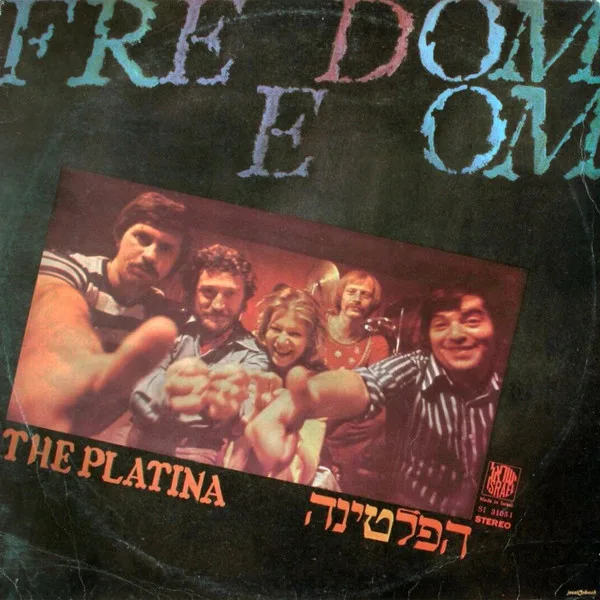
The Platina pictured on the front cover of their 1974 Isradisc album *Freedom* (SI 31051). The five members shown are the *Freedom* lineup: Roman Kunsman, Aharon "Arale" Kaminski, Alona Turel, Nachum Perperkovich and Lev Zabeginsky. Cover photography credited to Avi Ganor, Aviv Yzhaki and Yossi Orbach. Album cover art (not a CC-licensed artist photo), used as the only available image showing the band. No free or public-domain photograph of the Platina exists on Wikimedia Commons. — Discogs, release page for The Platina, Freedom (Isradisc SI 31051, 1974) — https://www.discogs.com/release/4333508-The-Platina-Freedom
The Platina began as a hired backing band and turned into one of the first ensembles in Israel built around original jazz composition. In 1971 the singer Arik Einstein asked drummer Aharon "Arale" Kaminski, a fixture of the small Tel Aviv jazz scene that met in private apartments and at the Bar Barim club, to assemble a group to back him on the road. Around the same time Kaminski happened to hear the saxophonist and flutist Roman Kunsman playing at the Soromlo club in Jerusalem and decided to build the band with him. Kunsman had arrived from the Soviet Union at the end of 1970 with a full career behind him: from 1963 to 1970 he led his own quartet in Leningrad, his piece "Loneliness" won a prize at the Second Leningrad Jazz Festival, and in 1967 the Oleg Lundstrem Orchestra performed his "Ray of Darkness" at the Moscow Jazz Festival. After he emigrated his name was struck from official Soviet jazz history and went unmentioned in Russia until the 1990s.
Kaminski and Kunsman filled out the first lineup with guitarist Yitzhak Klepter and the American bassist Paul Silver, and Einstein, who gave the band its name, took them out on the tour supporting his album Badeshe Etzel Avigdor. Almost immediately the group also began working on its own, under Kunsman's artistic direction: he wrote most of the original material and all of the arrangements. When Klepter left to join Acharit Hayamim and Silver returned to the United States, keyboardist Yaakov Nagar and bassist Alon Oleartchik came in, a lineup the newspaper Davar covered in January 1972 under Eli Mohar's headline "Platina is good material." Nagar's departure brought in Alona Turel, a pianist and arranger just back from studies in New York, and Nachum Perperkovich, another recent immigrant, who doubled on viola and melodica.
The band's first record, Live at the "Bar Barim" (Isradisc, 1973), caught the early quintet of Kunsman, Kaminski, Turel, Perperkovich and bassist Victor Fonarov working a jazz-funk and soul-jazz vein across long pieces like "Amen" and "Evangelist." Freedom (Isradisc, 1974) was a considerably more ambitious record: an extended Kunsman suite plus two other originals, cut at Tritone Sound Studios with Michael Tapuach producing, Lev Zabeginsky on bass, and Turel filling the corners with Mellotron, Synthi and a Fender fuzz-wah while Kaminski worked through berimbau, agogô, cabasa, cuica and gong. The reissue market and jazz-rock collectors have treated Freedom as the group's high point ever since.
Alongside their own records the Platina were the house band of choice for Israeli singers looking for something more harmonically adventurous than a standard pop backing. They played on records by Tiki Dayan, Esther Ofarim, Edna Goren and Dani Litani, appeared on the Israel Broadcasting Authority's Dorival Caymmi tribute O Mar (The Sea), and backed the American blues singer Memphis Slim. The best documented of these partnerships is Chava Alberstein and the Platina (CBS, July 1974), built out of a concert tour with Chava Alberstein that started in September 1973, was broken off by the Yom Kippur War, and resumed in January 1974 with a run of dates in outlying towns. Kunsman arranged most of the twelve tracks, with single arrangements by Turel, Nurit Hirsh and Misha Segal, and the album closes with Hannah Senesh's "Halicha LeKesariya."
Their furthest reach came in 1974. After opening for B.B. King on an Israeli date in the early 1970s, King's manager helped get the group onto the bill of the Newport Jazz Festival in the United States, and Ma'ariv marked the trip on June 7, 1974 with a piece headlined "Our quintet at Newport." Voice of America broadcasts carried their music further, and a twenty-minute documentary about the band, Platina (1974), survives in the Israeli Film Archive. In 1976 they recorded a third album around a long jazz reworking of Debussy's "The Girl with the Flaxen Hair," with Haim Kario on guitar, Bernie Senensky and Yakov Erich on keyboards and Ricky Manor singing, but the tapes went missing and the group broke up that year. The recordings resurfaced in 2001 and were finally issued by Mio Records in December 2003, a year after Kunsman's death in November 2002 at Beit Gamliel. Kaminski, Kunsman, Perperkovich and Oleartchik had reunited in the mid-1990s for concerts that produced Live '95, with Chen Zimbalista added on percussion.
The Platina's five years cover an unusually wide arc for such a short-lived band. They started as a jazz-rock backing unit for a pop singer, and the electric keyboards, fuzz and rock rhythm section never entirely left; Live at the "Bar Barim" sits closer to jazz-funk and soul-jazz than to anything else recorded in Israel at the time. Kunsman pulled them steadily toward composed, open-form writing, and by Freedom the group had absorbed the airy, reverberant textures then associated with ECM while keeping a hard-bop player's attack in the solos, with Middle Eastern melodic turns surfacing in the themes. The 1976 material goes further still into modal and post-bop territory, alternating Kunsman originals with a Debussy arrangement and standards like "Doxy" and "I Can't Get Started." Their influence on Israeli music ran well past the jazz audience: the band was a proving ground for Klepter and Oleartchik, both of whom became central figures in Israeli rock, and Kaminski and Perperkovich went on to long careers as arrangers and session players.
- Freedom (1974, Isradisc) - the band's most sought-after record, an extended Kunsman suite plus "Galim" and "Kishooff," and the album collectors point to as the group's peak. YouTube - Freedom Listen
- Live at the "Bar Barim" (1973, Isradisc) - their debut, six long pieces in a jazz-funk and soul-jazz vein, named for the Tel Aviv club at the center of the local scene. YouTube - Live at the "Bar Barim" Listen
- Chava Alberstein and the Platina (1974, CBS) - the collaboration album drawn from a 1973-74 tour, with Kunsman arranging most of the twelve songs. Spotify - Chava Alberstein and the Platina Listen
- The Girl with the Flaxen Hair (recorded 1976, released 2003, Mio Records) - the lost final album, built around a twelve-minute jazz treatment of Debussy, released posthumously for Kunsman. YouTube - Capricorn Dance Listen
- Live '95 (1995, M.I. Music / MCI Records) - the reunion concert record, with Alon Oleartchik on bass and Chen Zimbalista on percussion, revisiting "Amen," "Kishoof" and "Africa."
The Platina: Full Discography
Identity confirmed via the live Discogs API, artist ID 1571702 ("The Platina," name variations "Lahakat HaPlatina," "הפלטינה," formed 1971 by Roman Kunsman, Aharon "Arale" Kaminski and Yitzhak Klepter). Discogs credits the group on 16 releases in total: 5 in a "Main" role, 5 sideman "Appearance" credits and 6 track-level credits, the rest compilations. Because the leader catalogue is small, the tables below are complete rather than curated. The Buy column is uniformly blank, since no affiliate program is set up for this site.
Two dating conflicts are worth flagging up front. Hebrew Wikipedia dates Freedom to 1973; the Discogs entry for the physical LP (Isradisc SI 31051) and JazzRockSoul both give 1974, and the catalogue number runs after the 1973 debut (SI 31045), so 1974 is used here. Hebrew Wikipedia dates the Dorival Caymmi tribute O Mar to 1975; Discogs gives 1974.
As Leader / Co-Leader
| Album Title | Recording Date(s) | Release Date | Label | Catalog Number | Format(s) | Personnel | Role | Reissue History | Spotify | Buy | Notes |
|---|---|---|---|---|---|---|---|---|---|---|---|
| Live at the "Bar Barim" (הקלטה חיה ב"ברברים") | Recorded April 19, 1973, Kolinor Studios, per the Discogs release note | 1973 | Isradisc | SI 31045 | Vinyl, LP, Album | Roman Kunsman (flute, alto saxophone), Aharon "Arale" Kaminski (drums, percussion), Nachum Perperkovich (Fender piano), Victor Fonarov (bass, electric bass), Alona Turel (percussion) | Leader (band's debut) | No commercial reissue found; a sought-after original pressing on the collector market | Not confirmed on Spotify. YouTube - full album | — | Six extended pieces: "D.J. Dori," "Children Song," "Amen," "Cock Fight," "Tenderly," "Evangelist." The sleeve credits a live recording at the Bar Barim club while the Discogs note gives Kolinor Studios; the discrepancy is unresolved |
| Freedom (חירות) | Recorded at Tritone Sound Studios, Tel Aviv; exact dates not documented | 1974 | Isradisc | SI 31051 | Vinyl, LP, Album | Roman Kunsman (alto saxophone, flute, alto flute, finger cymbals, marimba; composed and arranged all material), Aharon "Arale" Kaminski (drums, Indian bells, triangle, maracas, berimbau, shaker, flextone, agogô, cabasa, cowbell, cuica, gong, whistle, jawbone), Alona Turel (Fender Rhodes, Fender fuzz-wah, Mellotron, Synthi synthesizer, percussion), Nachum Perperkovich (Fender Rhodes, acoustic piano), Lev Zabeginsky (bass) | Leader | No reissue found | Not confirmed on Spotify. YouTube - "Freedom", YouTube - "Kishooff" | — | Produced by Michael Tapuach, engineered by Tommy Friedman. Side one is the "Freedom Suite"; side two holds "Galim" (Waves) and "Kishooff" (Witchcraft). Hebrew Wikipedia dates it 1973 |
| The Girl with the Flaxen Hair (הנערה בעלת שיער הפשתן) | Recorded 1976: tracks 1-3 at Triton studios, tracks 4-7 live at the Bar Barim club, track 8 location unknown | December 2003 | Mio Records | MIO-030 | CD, Album, Reissue | Roman Kunsman (flute, alto saxophone, alto flute), Haim Kario (electric guitar), Yakov Erich (keyboards), Bernie Senensky (piano), Lev Zabeginsky (double bass, bass guitar), Aharon "Arale" Kaminski (drums, percussion), Ricky Manor (vocals) | Leader | First release; the 1976 tapes were lost, resurfaced in 2001, and were remastered by Asaf Carmeli in November 2003 | Not confirmed on Spotify. YouTube - "Capricorn Dance" | — | Issued a year after Kunsman's death. Original production by Michael Tapuach, recording by Tommy Friedman; liner notes by Kaminski and Mark Jung. Includes the twelve-minute Debussy arrangement that gives the album its title, plus "Doxy" and "I Can't Get Started" |
| Live '95 (בהופעה 95') | Recorded live, 1995, digitally on 24-channel A-DAT by Zaza Mobile Recordings | 1995 | M.I. Music / MCI Records | 89001-2 | CD | Roman Kunsman (alto saxophone, flute, arrangements), Alon Oleartchik (bass), Aharon "Arale" Kaminski (drums, percussion), Nachum Perperkovich (piano, keyboards), Chen Zimbalista (percussion) | Leader (reunion lineup) | None | Not confirmed on Spotify | — | Nine tracks revisiting the 1970s book ("Amen," "Witchcraft," "Children's Song," "Africa," "D.J. Dori," the Debussy piece) alongside newer Kunsman writing. Mixed by David Luria, produced by Meir Israel |
As Backing Band / Sideman (complete documented credits)
| Year | Project (Leader) | Title | Label | Catalog | Role | Notes |
|---|---|---|---|---|---|---|
| 1972 | Arik Einstein | Badeshe Etzel Avigdor tour | n/a | n/a | Touring backing band | The commission that created the group; Einstein named the band. Documented in Hebrew Wikipedia rather than on a Platina-credited release |
| 1973 | Chava Alberstein | Lu Yehi (לו יהי) | Not itemized on the Discogs master | n/a | Backing musicians (Appearance credit) | Discogs lists the band as an appearance credit on this Alberstein album |
| 1974 | Chava Alberstein and the Platina | Chava Alberstein and the Platina (חוה אלברשטיין והפלטינה) | CBS | CBS 70129 | Co-billed backing band and arrangers | Released July 1974, 12 tracks, 47:43. Roman Kunsman (flute, clarinet, saxophone) arranged most of the album; single arrangements by Alona Turel, Nurit Hirsh and Misha Segal. Also credited: Kaminski (drums, percussion), Lev Zabeginsky and Victor Fonarov (bass guitar), Turel (Fender piano, percussion), Perperkovich (viola, melodica, Fender piano). Drawn from a tour that began September 1973, paused for the Yom Kippur War and resumed January 1974. Spotify |
| 1974 | Various (Israel Broadcasting Authority) | O Mar (The Sea): Songs by Dorival Caymmi (הים) | Hed-Arzi / Israel Broadcasting Authority | n/a | Backing band (Appearance and TrackAppearance credits) | Israeli artists including Matti Caspi, The Dudaim, Michal Tal and Nitza Shaul singing Caymmi; Hebrew Wikipedia dates the release 1975, Discogs 1974 |
| 1970s | Tiki Dayan, Esther Ofarim, Edna Goren, Dani Litani | Various albums and concerts | n/a | n/a | Backing band | Named in Hebrew Wikipedia and on Esther Ofarim's official site. Specific release titles and catalogue numbers not confirmed, except Litani's Dani Litani im Lehakat Shamayim |
| 1970s | Memphis Slim | Israeli concert appearances | n/a | n/a | Backing band | Named on Esther Ofarim's official site; no recording confirmed |
| 1995 | Various | Shom'im 70 (שומעים 70 / Israeli's 70's) | Helicon Records | n/a | Compilation appearance | |
| 1997 | Various | The Israeli Songs of the 70's, Vol. 2 | התקליט | n/a | Compilation track appearance | |
| 1997 | Various | Ani Ashir Lach Shir: Beautiful Songs from the 70's, Vol. 5 | התקליט | n/a | Compilation track appearance | |
| 2000 | Various | Rav Chovel (Yitzhak Rabin memorial) | NMC | n/a | Compilation appearance | |
| 2003 | Chava Alberstein | The Early Years (השנים הראשונות) | NMC | n/a | Compilation appearance | Boxed reissue collecting Alberstein's early catalogue, including the Platina material |
| 2004 | Various | Back to Life: Mio 2004 Sampler | Mio Records | n/a | Compilation appearance | Promotional sampler following the Girl with the Flaxen Hair release |
| Undated | Soulico | Archeology: A Deep Dig into Israeli Grooves | JDUB Records | n/a | Sampled / mixed track appearance | DJ mix drawing on 1970s Israeli records |
Other documented recordings and film
- A live recording of the group's 1974 Newport Jazz Festival set circulates on SoundCloud (listen); no commercial release of the set has been found.
- Platina (1974), a twenty-minute documentary about the band, is held by the Israeli Film Archive (record).
- Roman Kunsman's solo album Heavy Skies, recorded 1979, was released in 2003 after his death. It is a Kunsman leader date rather than a Platina record and is not itemized above.
- Roman Kunsman - co-founder, alto saxophone, flute and alto flute, and the band's artistic director from 1971 to 1976; wrote most of the original repertoire and all the arrangements. Born December 7, 1941 in Kuibyshev, died November 2002 at Beit Gamliel, Israel.
- Aharon "Arale" Kaminski - co-founder and drummer, the only member besides Kunsman present for the whole run, and the link to the Tel Aviv jazz scene that produced the group.
- Yitzhak Klepter - guitarist in the original 1971 backing-band lineup; left for Acharit Hayamim and later became one of Israel's best known rock guitarists.
- Alon Oleartchik - bassist from 1972, before co-founding Kaveret in 1973; returned for the 1995 reunion and Live '95.
- Alona Turel - keyboards and arrangements from roughly 1972, on both Live at the "Bar Barim" and Freedom, and arranger of one track on the Alberstein album.
- Nachum Perperkovich - keyboards, viola, melodica and clarinet until 1975, and again on the 1995 reunion record.
- Victor Fonarov, Lev Zabeginsky, Zeev Zhvizhinsky - the bassists who cycled through the group after Oleartchik.
- Haim Kario, Kobi Erlich, Ricky Manor - guitar, keyboards and vocals in the 1975-76 lineup heard on The Girl with the Flaxen Hair.
- Bernie Senensky - Canadian pianist credited on the 1976 sessions.
- Arik Einstein - commissioned the band in 1971, named it, and used it as his touring group for Badeshe Etzel Avigdor.
- Chava Alberstein - toured with the group in 1973-74 and shared billing on the 1974 CBS album.
- Tiki Dayan, Esther Ofarim, Edna Goren, Dani Litani, Memphis Slim - singers the band accompanied on record or on stage.
More Jazz Rock Artists
See all 75 Jazz Rock artists →More Israeli Jazz Artists
See all 228 Israeli artists →- Discogs: The Platina
- Hebrew Wikipedia: להקת הפלטינה
- SoundCloud: The Platina live at Newport, 1974
- Israeli Film Archive: "Platina" (1974), 20-minute documentary
- Hebrew Wikipedia: להקת הפלטינה (The Platina)
- Hebrew Wikipedia: חוה אלברשטיין והפלטינה (Chava Alberstein and the Platina)
- German Wikipedia: Roman Kunsman
- Discogs: The Platina (artist 1571702)
- Discogs: The Platina, Freedom (Isradisc SI 31051, 1974)
- Discogs: The Platina, Live at the "Bar Barim" (Isradisc SI 31045, 1973)
- Discogs: Chava Alberstein and the Platina (CBS 70129, 1974)
- JazzRockSoul: The Platina
- KlezmerShack: CD review, Platina, The Girl with the Flaxen Hair
- Esther Ofarim official site: The Platina
- Stereo ve Mono: Chava Alberstein and the Platina (1974)