 JAZZPROFILES lives in the music 1,002 Jazz Artists fully Profiled!
 Louis Armstrong
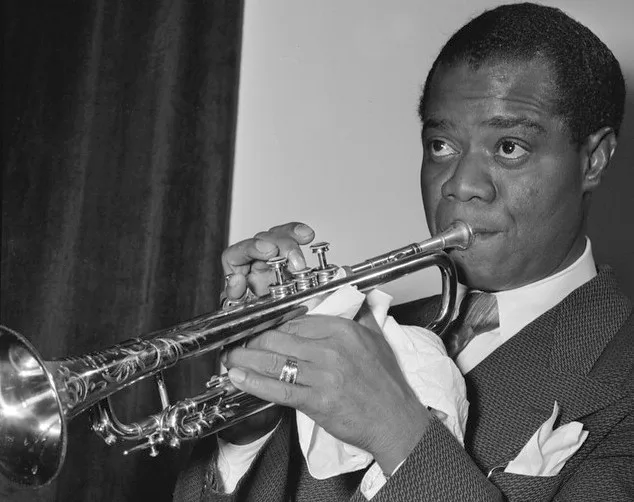
Louis Armstrong, portrait photograph by William P. Gottlieb, taken sometime between 1938 and 1948 Public Domain (William P. Gottlieb Collection, Library of Congress; per Gottlieb's own wishes, the entire collection entered the public domain on February 16, 2010) — Wikimedia Commons: https://commons.wikimedia.org/wiki/File:Louis_Armstrong,_between_1938_and_1948_(William_P._Gottlieb_09601)_cropped.jpg (photographer William P. Gottlieb, from the Library of Congress's Gottlieb Collection, https://www.loc.gov/collections/jazz-photography-of-william-p-gottlieb/about-this-collection/)
_cropped.jpg)
Louis Daniel Armstrong was born August 4, 1901, in a poor section of New Orleans known as the Battlefield, near the edge of the Storyville district, to Mary "Mayann" Albert and William Armstrong, who left the family soon after his birth. For decades Armstrong himself gave his birth date as July 4, 1900, a story he told so often it became broadly accepted; a baptismal record uncovered by researcher Tad Jones in 1988 established the true date. Raised largely by his mother and grandmother in deep poverty, he left school after the fifth grade to work odd jobs and sang for pennies on street corners with a boys' vocal quartet. On New Year's Eve 1912 he fired a pistol into the air during a celebration and was arrested and sent to the Colored Waif's Home for Boys, a reform school where bandmaster Peter Davis gave him his first formal instruction, on cornet. He left the home in 1914 and began working New Orleans dance halls and honky-tonks, increasingly under the mentorship of cornetist Joe "King" Oliver, who treated him almost as a son and gave him one of his own cornets.
When Oliver left for Chicago in 1918, Armstrong took his chair in trombonist Kid Ory's band, then spent two years (1919-1921) playing summers on Mississippi riverboats in Fate Marable's dance orchestra, where he learned to read music. In August 1922, Oliver summoned him to Chicago to play second cornet in the King Oliver Creole Jazz Band, then the most celebrated hot band in the city, alongside clarinetist Johnny Dodds and, from 1923, pianist Lil Hardin. The band's April 1923 sessions for Gennett Records are among the earliest and most influential recordings of New Orleans-style jazz, and Armstrong's answering cornet breaks already stood out from the ensemble. He married Hardin, his second wife, in February 1924; she pushed him toward featured billing and a larger career. Later that year he left Oliver for New York to join Fletcher Henderson's Orchestra as featured soloist, where his rhythmic looseness and blues-drenched phrasing, startling next to the band's stiffer stock arrangements, helped push Henderson and the whole orchestra toward the swing feel that would come to define big-band jazz within a decade.
Back in Chicago in 1925, Armstrong began recording under his own name for OKeh Records, leading a studio-only group billed as the Hot Five: himself, Lil Hardin Armstrong on piano, Johnny Dodds on clarinet, Kid Ory on trombone, and Johnny St. Cyr on banjo. Their first session was cut November 12, 1925, and the sides that followed, including 1926's "Heebie Jeebies," on which Armstrong is said to have dropped his lyric sheet and filled the gap with improvised nonsense syllables, popularizing scat singing on record, made him a star among Black record buyers. An expanded Hot Seven, adding tuba and drums, recorded "Potato Head Blues" and "Wild Man Blues" in 1927, and a reconstituted group with pianist Earl Hines cut "West End Blues" and the Armstrong-Hines duet "Weather Bird" in 1928; the extended, unaccompanied trumpet cadenza that opens "West End Blues" is commonly cited as the moment jazz solo improvisation announced itself as the music's true center of gravity.
Through the late 1920s and 1930s Armstrong moved away from small combos toward fronting large dance orchestras as a featured vocalist-trumpeter, popularizing songs from Broadway and Tin Pan Alley, including "Ain't Misbehavin'" (1929, from Fats Waller's revue Hot Chocolates), "St. Louis Blues," and "When It's Sleepy Time Down South," which became his signature closing theme. His upper-register power, capable of dozens of high Cs in a single performance, drew audiences who had never encountered a jazz soloist as showman. He toured England and continental Europe in 1932 and again in 1933-1935, among the first American jazz musicians to become an international celebrity, and in 1935 hired Joe Glaser as his manager, a relationship that stabilized his finances and bookings for the rest of his career, with Luis Russell's orchestra backing him through the early 1940s. He also became a familiar screen presence, appearing in dozens of films from the 1930s onward, including Pennies from Heaven (1936) with Bing Crosby, Cabin in the Sky (1943), New Orleans (1947), and High Society (1956).
A landmark May 1947 concert at New York's Town Hall, built around a stripped-down band rather than his touring big orchestra, was so well received that Armstrong permanently reorganized around a six-piece group billed as the All Stars, initially featuring trombonist Jack Teagarden, clarinetist Barney Bigard, pianist Earl Hines, bassist Arvell Shaw, and drummer Sid Catlett. The All Stars format, with rotating personnel over the years, became his vehicle for the rest of his life and for near-constant international touring; State Department-adjacent goodwill tours through Africa, Europe, Asia, and South America in the 1950s earned him the nickname "Ambassador Satch." He was also capable of open political defiance: in 1957, amid the Little Rock school desegregation crisis, he publicly condemned President Eisenhower's inaction and canceled a planned Soviet tour in protest, a rare and risky public stand for a Black entertainer whose commercial appeal depended heavily on white audiences. His recorded output in this period included the concept albums Louis Armstrong Plays W.C. Handy (1954, Columbia) and Satch Plays Fats (1955, Columbia), the multi-volume Satchmo: A Musical Autobiography (1956-57, Decca), a pairing with Duke Ellington on Recording Together for the First Time (1961, Roulette), and, for producer Norman Granz's Verve label, a celebrated run of duet albums with Ella Fitzgerald: Ella and Louis (1956), Ella and Louis Again (1957), and a two-disc reading of Porgy and Bess (1957-58), alongside Louis Armstrong Meets Oscar Peterson (1957), pairing him with Oscar Peterson's trio.
In December 1963 Armstrong and the All Stars recorded "Hello, Dolly!," a modest studio afterthought cut for the title song of an as-yet-unopened Broadway musical; released as a single in early 1964, it climbed to number one on the Billboard Hot 100 in May, displacing the Beatles at the height of the British Invasion and making the 62-year-old Armstrong the oldest artist ever to top the chart. In 1967, producer Bob Thiele brought him a new ballad, "What a Wonderful World," recorded for ABC-Paramount's Kapp label; it sold modestly in the United States on first release but became a British number one and, two decades later, an enormous worldwide standard after its prominent use in the 1987 film Good Morning, Vietnam. Heart and kidney problems slowed him through the late 1960s, but he kept performing almost to the end, closing a two-week engagement at New York's Waldorf-Astoria in early March 1971. He died in his sleep at his home in Corona, Queens, on July 6, 1971, roughly a month before his 70th birthday.
Armstrong's central innovation was to move jazz's center of gravity from collective New Orleans ensemble polyphony to the single virtuoso improviser, a shift so complete that nearly every subsequent development in jazz, from swing-era big-band soloing through bebop, presumes it. His playing combined blues-rooted phrasing, a rhythmic looseness that let a melody push ahead of or lag behind the beat in ways contemporaries had not attempted, and, later in his career, an unmatched command of the trumpet's upper register. His gravelly, instantly identifiable singing voice and his popularization of scat singing gave jazz vocals their own comparable path toward improvisatory freedom. Miles Davis, who idolized him, once said the whole history of jazz could be told in four words: Louis Armstrong, Charlie Parker. Trumpeters from Roy Eldridge to Dizzy Gillespie built directly on the vocabulary he established, and his crossover stardom, decades before the phrase existed, made him the first jazz musician most of the world outside the United States ever heard.
- The Complete Hot Five and Hot Seven Recordings (rec. 1925-1928, compiled 2000s, Columbia/Legacy) - The OKeh sides that made Armstrong a star and reoriented jazz around the soloist, including "Heebie Jeebies," "Potato Head Blues," "West End Blues," and the Armstrong-Earl Hines duet "Weather Bird."
- The Complete King Oliver's Creole Jazz Band 1923 (rec. 1923, compiled 1990, Retrieval) - Armstrong's recording debut, on second cornet in mentor Joe "King" Oliver's Chicago band, alongside Johnny Dodds and Lil Hardin.
- Louis Armstrong Plays W.C. Handy (1954, Columbia) - A concept album devoted to the "Father of the Blues," with the All Stars, widely regarded as one of his finest sustained studio statements.
- Satch Plays Fats: A Tribute to the Immortal Fats Waller (1955, Columbia) - A companion tribute record to Fats Waller, cut with the same working All Stars band.
- Satchmo: A Musical Autobiography (1956-57, Decca) - A multi-volume career retrospective on which Armstrong re-recorded and narrated highlights of his own catalog for a new generation of listeners.
- Ella and Louis (1956, Verve) - The first of three Norman Granz-produced duet albums with Ella Fitzgerald, backed by the Oscar Peterson Trio.
- Recording Together for the First Time (1961, Roulette), with Duke Ellington - A meeting of two of jazz's most consequential figures, cut with Ellington's own rhythm section behind Armstrong's All Stars horns.
- "Hello, Dolly!" (single, 1964, Kapp) - A number-one Billboard hit that knocked the Beatles off the top of the chart, making Armstrong, at 62, the oldest artist to top the Hot 100.
- "What a Wonderful World" (single, 1967, ABC-Paramount/Kapp) - A minor US hit on release that became one of the best-known recordings in popular music after its use in the 1987 film Good Morning, Vietnam.
Louis Armstrong: Full Discography
Identity confirmed via the live Discogs API: artist ID 38201 (realname Louis Daniel Armstrong, born August 4, 1901, New Orleans, died July 6, 1971, New York City, matching Wikipedia, Britannica, and AllMusic). Discogs credits this single artist entry with over 15,000 releases across 152 pages of its artist-releases endpoint, spanning original 78 rpm sides from the 1920s through 1930s big-band and film work, the 1940s-60s All Stars era, and an enormous ongoing reissue, compilation, and bootleg history typical of a founding figure of the recorded music era. Per the build spec's guidance for hugely prolific bandleaders, this table does not attempt to itemize the full release list. It covers his essential leader/co-leader recordings as packaged in the standard reference compilations most readers will actually encounter, plus his most historically significant sideman and duet-partner credits, each verified by title against Discogs.
As Leader / Co-Leader
| Album Title | Recording Date(s) | Release Date | Label | Catalog Number | Format(s) | Personnel | Role | Reissue History | Spotify | Buy | Notes |
|---|---|---|---|---|---|---|---|---|---|---|---|
| The Complete Hot Five and Hot Seven Recordings | Recorded November 1925-December 1928, Chicago | Compiled 2000s | Columbia/Legacy | 63527-63530 (Hot Five/Hot Seven box series) | CD, Compilation | Louis Armstrong (cornet/trumpet, vocals), Lil Hardin Armstrong (piano), Johnny Dodds (clarinet), Kid Ory (trombone, Hot Five/Seven era), Johnny St. Cyr (banjo), Pete Briggs (tuba, Hot Seven), Baby Dodds (drums, Hot Seven), Earl Hines (piano, 1928 Savoy Ballroom Five sides) | Leader | Reissued in numerous configurations since the 1940s; the source 78s and early LP reissues have been superseded by several complete CD box editions | — | — | Includes the November 1925 debut session, 1926's "Heebie Jeebies," 1927's expanded Hot Seven sides ("Potato Head Blues," "Wild Man Blues"), and the 1928 Earl Hines sessions ("West End Blues," "Weather Bird") |
| The Complete King Oliver's Creole Jazz Band 1923 | Recorded April-December 1923, Richmond, Indiana and Chicago | 1990 | Retrieval | RTR 79007 | CD, Compilation | Joe "King" Oliver and Louis Armstrong (cornets), Johnny Dodds (clarinet), Lil Hardin (piano), Honore Dutrey (trombone), Bill Johnson (banjo/bass), Baby Dodds (drums) | Sideman (second cornet) | Earlier partial reissues of these Gennett/OKeh sides circulated for decades before this became a standard complete edition | — | — | Armstrong's recording debut, on second cornet under his mentor Joe "King" Oliver, before he had begun recording under his own name |
| Louis Armstrong Plays W. C. Handy | Recorded July 1954, New York | 1954 | Columbia | CL 591 | Vinyl, LP, Mono | Louis Armstrong (trumpet, vocals), Trummy Young (trombone), Barney Bigard (clarinet), Billy Kyle (piano), Arvell Shaw (bass), Barrett Deems (drums), Velma Middleton (vocals) | Leader | Reissued repeatedly on CD, most often paired with Satch Plays Fats | — | — | A concept album devoted to composer W. C. Handy's blues songbook, cut with the working All Stars band |
| Satch Plays Fats: A Tribute to the Immortal Fats Waller by Louis Armstrong and His All-Stars | Recorded April 1955, New York | 1955 | Columbia | CL 708 | Vinyl, LP, Mono | Louis Armstrong (trumpet, vocals), Trummy Young (trombone), Barney Bigard (clarinet), Billy Kyle (piano), Arvell Shaw (bass), Barrett Deems (drums), Velma Middleton (vocals) | Leader | Reissued frequently on CD, often bundled with the W. C. Handy album | — | — | Companion tribute album to Fats Waller, cut with the same working All Stars personnel as the Handy record |
| Satchmo: A Musical Autobiography of Louis Armstrong | Recorded 1956-1957, New York | 1957 | Decca | DXM 155 | Vinyl, LP box, Mono | Louis Armstrong (trumpet, vocals, narration) with the All Stars, re-creating and narrating repertoire from across his career | Leader | Originally issued as a multi-volume box; later reissued in trimmed single- and double-disc CD editions | — | — | A career-spanning studio retrospective, with Armstrong narrating and re-recording landmark pieces from the Hot Five/Seven era onward |
| Ella and Louis | Recorded August 1956, Los Angeles | 1956 | Verve | MG V-4003 | Vinyl, LP, Mono | Louis Armstrong (trumpet, vocals), Ella Fitzgerald (vocals), Oscar Peterson (piano), Herb Ellis (guitar), Ray Brown (bass), Buddy Rich (drums) | Co-leader | Later folded into 1997's The Complete Ella Fitzgerald & Louis Armstrong on Verve box | — | — | The first of producer Norman Granz's three Armstrong/Fitzgerald duet albums, backed by the Oscar Peterson Trio |
| Ella and Louis Again | Recorded July 1957, Los Angeles | 1957 | Verve | MG V-4006 | Vinyl, LP, Mono | Louis Armstrong (trumpet, vocals), Ella Fitzgerald (vocals), Oscar Peterson (piano), Herb Ellis (guitar), Ray Brown (bass), Louie Bellson (drums) | Co-leader | Later folded into the 1997 complete Verve box set | — | — | Second Armstrong/Fitzgerald duet album for Verve |
| Porgy and Bess | Recorded August 1957-January 1958, Los Angeles | 1959 | Verve | MG VE-4011-2 | Vinyl, LP, 2-LP, Mono | Louis Armstrong (trumpet, vocals), Ella Fitzgerald (vocals), Russell Garcia (arranger/conductor), full studio orchestra | Co-leader | Later folded into the 1997 complete Verve box set | — | — | A two-disc reading of the Gershwin opera, arranged and conducted by Russell Garcia |
| Louis Armstrong Meets Oscar Peterson | Recorded 1957, Los Angeles | 1959 | Verve | MG V-8322 | Vinyl, LP, Mono | Louis Armstrong (trumpet, vocals), Oscar Peterson (piano), Herb Ellis (guitar), Ray Brown (bass), Louie Bellson (drums) | Co-leader | Reissued on CD in the 1990s and 2000s | — | — | An intimate small-group session pairing Armstrong with Oscar Peterson's working trio |
| Recording Together for the First Time | Recorded April 1961, New York | 1961 | Roulette | R 52103 | Vinyl, LP, Mono | Louis Armstrong (trumpet, vocals) and His All Stars, Duke Ellington (piano), with Ellington's own rhythm section (Mort Herbert or Sam Jones, bass; Danny Barcelona, drums) | Co-leader | Reissued on CD, sometimes paired with a second Armstrong/Ellington session from the same dates | — | — | Armstrong's only studio meeting with Duke Ellington, recorded with Ellington sitting in on piano within the All Stars' own working rhythm section |
| Hello, Dolly! (single) | Recorded December 1963, New York | 1964 | Kapp | K-573 | Vinyl, 7", 45 RPM | Louis Armstrong (trumpet, vocals) and His All Stars | Leader | The parent album Hello, Dolly! followed later in 1964; the single has been reissued on numerous compilations since | — | — | Reached number one on the Billboard Hot 100 in May 1964, displacing the Beatles; made Armstrong, at 62, the oldest artist to top the chart |
| What a Wonderful World (single) | Recorded August 1967, New York | 1967 | ABC-Paramount/Kapp | K-573 (later reissues on ABC) | Vinyl, 7", 45 RPM | Louis Armstrong (vocals), with orchestra arranged and conducted by Tommy Goodman/Artie Butler, produced by Bob Thiele | Leader | A modest US chart entry on first release, reissued constantly since its use in the 1987 film Good Morning, Vietnam made it an enormous worldwide standard | — | — | Produced by Bob Thiele; became one of the best-known recordings in popular music, decades after its initial release |
As Sideman (selected major credits)
| Year | Project (Leader) | Title | Label | Catalog | Role | Notes |
|---|---|---|---|---|---|---|
| 1923 | King Oliver's Creole Jazz Band | "Dipper Mouth Blues" / "Chimes Blues" | Gennett | 5135, 5133 | Second Cornet | Armstrong's recording debut, under his mentor Joe "King" Oliver, before recording under his own name |
| 1924-1925 | Fletcher Henderson and His Orchestra | Various OKeh and Columbia sides | OKeh/Columbia | (various 78s) | Trumpet (featured soloist) | A one-year stint as featured soloist that is widely credited with pushing Henderson's orchestra, and the wider big-band idiom, toward a swing feel |
| 1925 | Clarence Williams' Blue Five (with Sidney Bechet) | "Cake Walking Babies from Home" | OKeh | 8300 | Cornet | A celebrated cutting-contest-style session pairing Armstrong with soprano saxophonist Sidney Bechet |
| 1929 | Carroll Dickerson's Orchestra (billed as Louis Armstrong and His Orchestra) | "Ain't Misbehavin'" | OKeh | 8714 | Trumpet, vocals | From Fats Waller's Broadway revue Hot Chocolates; one of Armstrong's first major popular-song hits away from small-combo jazz |
Discogs' artist-releases listing for ID 38201 also carries many thousands of further "Appearance" and compilation credits spanning V-Disc wartime recordings, radio transcriptions, film soundtrack cues, and the enormous downstream reissue and box-set history that has accrued to nearly every session Armstrong ever recorded; none of these are itemized here.
- Joe "King" Oliver - cornetist mentor who gave Armstrong his professional start, first in New Orleans and then in his own Chicago-based Creole Jazz Band from 1922; not yet profiled on JazzProfiles.com.
- Lil Hardin Armstrong - pianist, composer, and his second wife (married 1924), a member of both King Oliver's band and the Hot Five/Hot Seven, and the collaborator most responsible for pushing him toward featured billing; not yet profiled on JazzProfiles.com.
- Fletcher Henderson - bandleader who hired Armstrong as featured soloist in his New York orchestra in 1924-25, a stint credited with helping push the band, and the wider big-band idiom, toward swing.
- Earl Hines - pianist on the pivotal 1928 "West End Blues"/"Weather Bird" sessions and later a founding member of the 1947 All Stars; not yet profiled on JazzProfiles.com.
- Jack Teagarden - trombonist and founding member of the 1947 All Stars; not yet profiled on JazzProfiles.com.
- Ella Fitzgerald - vocalist and duet partner on three acclaimed Verve albums produced by Norman Granz between 1956 and 1958; not yet profiled on JazzProfiles.com.
- Duke Ellington - fellow titan of the music's first half-century, paired with Armstrong on 1961's Recording Together for the First Time.
- Oscar Peterson - pianist whose trio backed Armstrong on 1957's Louis Armstrong Meets Oscar Peterson and on the Ella Fitzgerald duet albums.
- Joe Glaser - manager from 1935 until Glaser's death in 1969, who stabilized Armstrong's bookings and finances and helped engineer his enduring mainstream stardom.