 JAZZPROFILES lives in the music 1,765 Jazz Artists fully Profiled!
John Kaizan Neptune
Last updated October 21, 2026
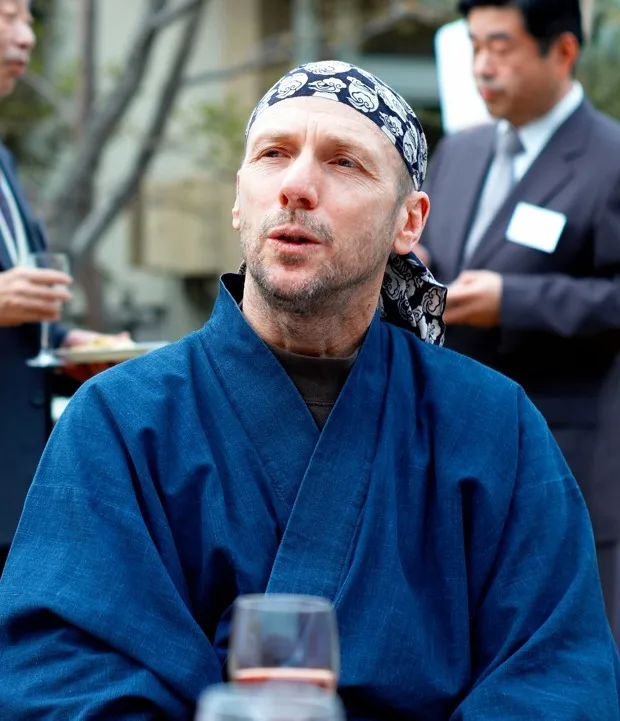
John Kaizan Neptune, 7 April 2007. CC BY 2.0 — https://commons.wikimedia.org/wiki/File:John_Kaizan_Neptune.jpg

John Kaizan Neptune (ジョン・海山・ネプチューン) is an American shakuhachi player and maker who first came to Japan in 1973 and has built his entire career there. He was born in Oakland, California, on 13 November 1951, played trumpet in high school and later drummed in a rock band, and grew up surfing. At the University of Hawaii he studied ethnomusicology; he has said he wanted to learn the tabla, found no teacher, and took up the shakuhachi as his second choice. In 1971 he began lessons in Hawaii with a Japanese Buddhist priest.
In 1973 he spent a year in Kyoto, went back to Honolulu to finish his degree, and then returned to Kyoto for several years of intensive study in the Tozan school, under the shakuhachi master Genzan Miyoshi (三好芫山). In March 1977 he received the shi-han, the master's certificate, and the professional name Kaizan (海山), "Sea Mountain." He has lived in Japan ever since, and for decades in Kamogawa, a surfing town on the Chiba coast. His earliest Japanese recording credits are shakuhachi parts on two Teichiku LPs by the Oriental Mechanic Band, in 1977 and 1978. As a non-Japanese player of a Japanese instrument he drew considerable public interest from the start.
His first jazz session on record is a small-group date. On 20 September 1978 the pianist Norio Maeda recorded We Three Jazz for the Adam label as a PCM digital recording, with Yasuo Arakawa on bass and Takeshi Inomata on drums, and Neptune is credited on shakuhachi, with a track called "Bamboo Blues" carrying his name. His debut as a leader, Bamboo Textures, followed on Toshiba in 1979, then Joy on Kosei in 1980, and in 1980 the record that made his reputation: Bamboo, made with the Arakawa Band, a fusion group led by the saxophonist Tatsuhiko Arakawa. It was recorded at Toshiba EMI Studio in Tokyo between April and June 1980 and arranged by Arakawa and Osamu Shiomura, with liner notes that included a contribution from the American critic Leonard Feather. Bamboo received an Excellence Award at Japan's Agency for Cultural Affairs Art Festival (文化庁芸術祭優秀賞), and the reports repeated on his Wikipedia entry and on the album's reissue pages say it was the first time the prize went to a jazz recording and the first time it went to a foreign artist. Inner City Records issued it in the United States.
The next three years were his most jazz-facing. Shogun (Express, 1981), billed to John Kaizan Neptune and Mu'ryō, was recorded in October and November 1980 in Tokyo with Takao Naoi arranging and playing guitar and a Tokyo horn section, and Discogs tags it jazz-funk. Mixed Bag (Eastworld, 1981) was recorded and mixed in Glendale, California, at Monterey Sound Studios, with Don Grusin arranging and co-producing; the single "Soft Melody" / "Shakuhachi Dance," taken from it, lists Grusin as co-producer. For West of Somewhere (Eastworld, 1981) he went to New York, where the album was recorded at Blank Tape Studio on 12 to 21 August 1981 with Buster Williams on bass, Idris Muhammad and Alex Acuña on drums, Cornell Dupree and Akira Kon on guitars, Kenny Kirkland on keyboards, Becky Friend on flute and Yvonne Lewis on vocals. It includes his arrangement of Stevie Wonder's "Isn't She Lovely." In 1982 he made Two In Flight with Naoi, recorded from 28 June to 9 July with Takeru Muraoka on tenor saxophone, Souichi Noriki on synthesizer and Nobuo Kurata on piano, and Digital 45 (DAM, 1982), a 45 rpm LP of shakuhachi with two basses, including Kunimitsu Inaba, and percussion, which Discogs tags free improvisation and contemporary jazz and which includes a reading of "Hey Jude."
From the mid-1980s the records widen. The Circle (Denon, 1985) set the shakuhachi against piano, bass, drums, koto, Indian violin and Indian percussion, Jazzen (Denon, 1987) against guitar, bass, vibraphone and percussion, and a Jazzen track, "Bamboo Born," which Neptune produced himself, was chosen for Denon Jazz Sampler Volume 2 (1987), a label compilation that sat his piece beside tracks from Peter Erskine and Eliane Elias albums. Tokyosphere (JVC, 1988) and Sky Spirit (JVC, 1991) followed. In September 1991 he recorded the unaccompanied Words Can't Go There at his own dome house in Kamogawa. Kite (Kosei, 1992) was recorded in a church in Germany with the Modern String Quartet, River Rhythm (Kosei, 1994) in Madras, India, in February 1993 with South Indian musicians, and Prime Numbers (1994) with the koto player Yasuko Watanabe, issued on his own Nep Tunes label with Victor. He plays shakuhachi and percussion on the taiko drummer Kenny Endo's Eternal Energy (1994), and he is the guiding figure behind the bamboo-percussion group TakéDaké, which plays his compositions on instruments many of which he built; its album Asian Roots (Denon, 1998) is billed to TakéDaké with Neptune.
He returned to the jazz repertoire with Shakuhachi Mellow Jazz (Nep Tunes, 1999), fifteen standards from "In a Sentimental Mood" to "Over the Rainbow" with guitarist Takao Naoi, bassist Toru Kase and drummer Mark DeRose, and made Bamboo Magic (Nep Tunes, 2007) with Indian and Japanese players. His son David Neptune directed Words Can't Go There, a documentary about his father's path from California surfer to shakuhachi professional, which premiered in Japan on 5 October 2019. Neptune still lives in Kamogawa, where he grows bamboo and makes his own shakuhachi and other bamboo instruments, and he turned 74 in November 2025. A remastered vinyl reissue of Bamboo on Universal Music Japan (UPJY-9545) is listed by retailers for 2026.
Neptune is a borderline case for a jazz catalogue, and the plain description is that he is a Tozan-school shakuhachi master who has spent half a century working in jazz, fusion and cross-cultural settings. The jazz case is real: Bamboo with a fusion band led by a jazz saxophonist, the arts-festival honour reported as a first for a jazz recording, a first jazz credit on a 1978 Norio Maeda trio date, a 1981 run of records made with American players such as Buster Williams, Idris Muhammad, Cornell Dupree and Don Grusin, Denon's decision to place his track on a jazz sampler, a 1999 album of standards, and Discogs tags that list jazz on most of his leader and co-leader releases. Wikipedia's infobox lists jazz and jazz fusion ahead of new age and world music, and Wikidata gives jazz as his genre. The case against is also real: much of his later output is filed under folk, world or new age, Discogs files Kite as classical, Words Can't Go There and Prime Numbers are traditional or chamber-scale shakuhachi music, and the TakéDaké albums are world-music projects.
The sound at the jazz end of his work is a bamboo flute with a breathy, sustained attack, played over a rhythm section rather than in place of one. On Bamboo and Shogun the shakuhachi sits on top of jazz-funk and fusion arrangements and horn sections; on West of Somewhere it carries a Stevie Wonder melody over New York session players; on Digital 45 it plays over two basses with almost nothing else around it. He composes and arranges much of his own material and produces many of the records himself. At the other end he is a certified traditional player, with a track called "Honshirabe" on Words Can't Go There and a catalogue of koto and shakuhachi chamber pieces including Five and Thirteen Are Prime Numbers.
- Bamboo (1980, Express ETJ-85008, with the Arakawa Band) - Five tracks of shakuhachi fusion recorded at Toshiba EMI Studio, Tokyo, and the record behind the Agency for Cultural Affairs award. YouTube - Bamboo, full album Listen · Buy
- Shogun (1981, Express ETJ-85009, with Mu'ryō) - Jazz-funk with a Tokyo horn section and Takao Naoi's arrangements. YouTube - Shogun, full album Listen · Buy
- West of Somewhere (1981, Eastworld WTP-90119) - The New York session with Buster Williams, Idris Muhammad, Alex Acuña, Cornell Dupree and Kenny Kirkland. YouTube - West of Somewhere, full album Listen · Buy
- Two In Flight (1982, Eastworld WTP-90189, with Takao Naoi) - Shakuhachi and guitar leading a Tokyo horn section. YouTube - Two in Flight, full album
- Jazzen (1987, Denon YF-7131-ND) - The quartet record that produced "Bamboo Born." YouTube - Bamboo Born · YouTube - Zen Forest Listen · Buy
- Shakuhachi Mellow Jazz (1999, Nep Tunes JKN-1839) - Fifteen standards in a guitar, bass and drums setting. Buy
John Kaizan Neptune (ジョン・海山・ネプチューン) - Full Discography
American shakuhachi player, composer and instrument maker, born 13 November 1951 in Oakland, California; resident in Japan since the 1970s. Discogs artist 161498.
Name variations on record: John Kaizan Neptune, John 海山 Neptune, John "Kaizan" Neptune, J. K. Neptune, John Neptune, Neptune, ジョン・海山・ネプチューン, ジョン・海山ネプチューン, ジョン海山ネプチューン, ネプチューン海山.
Group affiliations: Mu'ryō, Oriental Mechanic Band.
Leader
| Album | Year | Label | Personnel | Notes | Listen | Buy |
|---|---|---|---|---|---|---|
| Bamboo Textures (バンブー・テクスチュアーズ) | 1979 | Toshiba Records, TP-72323 | John Kaizan Neptune (shakuhachi, composer), 大嶽和久 (koto), Kyoko Takahashi (bass koto), Toru Kitano (percussion) | Four tracks: "Blue Wind", "Haiku Music", "Mixed Weave", "Weather Warning". Composed in 1978 and 1979. Cover art by Clifton Karhu. Discogs lists it as jazz and folk/world, styled jazz-funk and shinkyoku. | Full album on YouTube | Amazon |
| Joy (歓喜) | 1980 | Kosei, KNR-5980 | John Kaizan Neptune (shakuhachi, composer, arranger), Yoshinobu Nishimura (acoustic guitar), Junko Handa (biwa), Takeshi Onodera (congas), Yasuo Arakawa (double bass), Roetsu Tousha (tsuzumi), Premadasa Hegoda (tabla, sitar), Hiromitsu Katada (taiko) | Six tracks: "Joy", "West of Somewhere", "Winding Path", "Temple Road", "Playground", "Words Can't Go There". Cover art by Clifton Karhu. Paste-on cover with obi and a bilingual insert. | Title track on YouTube | Amazon |
| Soft Melody / Shakuhachi Dance (7 inch single) | 1981 | Toshiba Records, TSE-90002 | John Kaizan Neptune (shakuhachi, writer) | Taken from the album Mixed Bag. Gen Morita producer, Don Grusin co-producer. | Soft Melody on YouTube | Amazon |
| Mixed Bag | 1981 | Eastworld, WTP-90131 | John Kaizan Neptune (shakuhachi); Don Grusin (arranger, co-producer) | Recorded and mixed at Monterey Sound Studios, Glendale, California. Eight tracks: "Shakuhachi Dance", "Soft Melody", "South of Someplace", "Trapped in Fact", "How Could I Know", "Mixed Weave Part 1", "Mixed Weave Part 2", "Bamboo Blues". Gen Morita producer. The sideman credits for the session are not itemised on the release. | Full album on YouTube | Amazon |
| West of Somewhere | 1981 | Eastworld, WTP-90119 | John Kaizan Neptune (shakuhachi, arranger, writer), Buster Williams (acoustic and electric bass), Alex Acuña and Idris Muhammad (drums), Akira Kon and Cornell Dupree (electric guitar), Kenny Kirkland (keyboards), Becky Friend (flute), Nobu Urushiyama and Steve Thornton (percussion), Yvonne Lewis (vocals) | Recorded at Blank Tape Studio, New York, 12 to 21 August 1981. Eight tracks: "Sailing With You", "West of Somewhere", "Rhythm", "Shakuhachi Shuffle", "Four Seater", "S.F.", "Isn't She Lovely" (Stevie Wonder), "The Last Song". Shoichiro Ono producer, Bob Blank engineer. | Full album on YouTube | Amazon |
| Digital 45 | 1982 | DAM, DOR-0114 | John Kaizan Neptune (shakuhachi), Kunimitsu Inaba and Takashi Mizuhashi (bass), Sumire Yoshihara (percussion) | 45 rpm LP. Five tracks: "Explore", "Temple Road", "Hey Jude", "East of Everywhere", "Penta Sonic". Discogs styles: free improvisation, contemporary jazz. | Full album on YouTube | Amazon |
| Dance for the One in Six | 1982 | Kosei, KNR-5982 | John Kaizan Neptune (shakuhachi, composer, arranger, producer), Ryusuke Seto (acoustic guitar), Yukihiro Takao (bass), Kiichi Futamura (piano), Yoshinori Nohmi (percussion), Tadahiro Wakabayashi (tabla, sitar), Yachiyo Wakabayashi (tambura) | Eight tracks, recorded at Japan Victor Big Box. Reissued on CD in 1991 as Dance for the One in Six (法楽, Kosei KJKN-9100) with three added tracks from Joy: "Joy", "West of Somewhere" and "Playground". | Full album on YouTube | Amazon |
| The Circle | 1985 | Denon, YF-7113-ND | John Kaizan Neptune (shakuhachi), Kiichi Futamura (piano), Yukihiro Takao (acoustic bass), Kiyoshi Hasegawa (drums), David Harnish (acoustic guitar), Yasuko Watanabe (koto), Yoshio Maeda (sanxian), T. Raja and Yoshinori Nohmi (percussion), V. S. Narasimhan (violin), Hiromitsu Katada (xalam), Mayu Yamamoto (synthesizer) | Recorded at Nippon Columbia Studios, Tokyo, July and August 1985. Eight tracks: "The Circle", "Soul of the Deep", "Ryukyu", "India Indigo", "Spring Breeze", "Mountain Mist", "Tokyo Pace", "Musashi". | Full album on YouTube | Amazon |
| Jazzen | 1987 | Denon, YF-7131-ND | John Kaizan Neptune (shakuhachi, producer), Takao Naoi (guitar), Yukihiro Takao (bass), Hitoshi Hamada (vibraphone, marimba), Yoshinori Nohmi (percussion) | Seven tracks on the LP: "Five Directions", "On a Raft", "Zen Forest", "Water's Edge", "Footnotes", "Bamboo Born", "Can You Feel the Beat". Tatsunori Konno co-producer. "Bamboo Born" was also placed on Denon Jazz Sampler Volume 2 (1987). | Five Directions on YouTube · Bamboo Born on YouTube · Zen Forest on YouTube | Amazon |
| Tokyosphere | 1988 | JVC, JD-3316 | John Kaizan Neptune (shakuhachi); Soh Fujimoto (producer) | Ten tracks: "Yamato Dawn", "Seventh Avenue", "Tokyo Blues", "Jungle Trail", "Hear the Light", "Time Design", "Flow", "Sway", "Stream Dance", "In the Air". "Yamato Dawn" was also placed on JVC World Class Music Sampler Vol. II (1989). | Full album on YouTube | Amazon |
| Sky Spirit (飛天) | 1991 | Zen / JVC, VICG-8024 | John Kaizan Neptune (shakuhachi, composer, arranger, producer), Takao Naoi (guitar), Paul Jackson (bass), Lewis Pragasam (drums), Masa Matsuda (keyboards), Yasuko Watanabe (koto), Christopher Hardy, Ichiro Hosoya and Yoshinori Nohmi (percussion), Noboru Kurosaka (tabla), 郭敏 (yangqin) | Nine tracks, from "Sky Spirit" to "Rosie". Soh Fujimoto producer. Discogs styles: fusion, new age, instrumental. | not found | Amazon |
| Words Can't Go There | 1991 | Nep Tunes, JKN-1239 / Victor, PRCD-5052 | John Kaizan Neptune (shakuhachi, producer) | Unaccompanied shakuhachi, recorded at Neptune's dome house in Kamogawa, 29 and 30 September 1991. Ten tracks including "Tsuru no Sugomori", "Honshirabe", "Shika no Tone", "Kogarashi" and the title piece. Liner notes by Ron Korb. | not found | Amazon |
| Kite (凧) | 1992 | Kosei, KJKN-9200 | John Kaizan Neptune (shakuhachi, composer, arranger, producer), Modern String Quartet, Georg Lawall (guitar) | Recorded at St. Maria Church, Oberlenningen, Germany, 14 to 16 September 1992, with Takao Naoi helping with the recording and editing. Ten tracks including "Bamboo Cutter", "Bamboo Princess", "Kite" and "Two's Blues". Discogs files it as classical. | Full album on YouTube | Amazon |
| River Rhythm (リバー・リズム) | 1994 | Kosei, KJKN-9300 | John Kaizan Neptune (shakuhachi, composer, arranger, producer), Lewis Pragasam (drums), Masa Matsuda (keyboards), V. S. Narasimhan (violin, co-producer), Naveen Kumar (Indian flute), R. Visweswaran (santoor), R. Parthasarathy (veena) and other South Indian players | Recorded at Media Artists, Madras, India, 19 to 25 February 1993. Twelve tracks including "River Rhythm", "Adyar Sunrise", "Two Pockets" and "A Piece in Our Time". | Full album on YouTube | Amazon |
| Shakuhachi Mellow Jazz | 1999 | Nep Tunes, JKN-1839 | John Kaizan Neptune (shakuhachi, producer), Takao Naoi (guitar), Toru Kase (bass), Mark DeRose (drums) | Fifteen tracks including "In a Sentimental Mood", "Georgia on My Mind", "Summertime", "Willow Weep for Me", "Tenderly", "Autumn Leaves", "Skylark" and "Over the Rainbow". | not found | Amazon |
| Bamboo Magic | 2007 | Nep Tunes, JKN-2339 | John Kaizan Neptune (shakuhachi, producer), Takao Naoi (guitar), Andy Peterson (bass), Lewis Pragasam (drums), Sawako Fukuhara (koto), Giridhar Udupa (ghatam), Prasad (tabla), Madras String Quartet, Kai Neptune and Visalakshi Nityanand (voice) | Ten tracks including "Mountain Festival", "Riding Clouds", "Khanda Caper" and "Light the Way". Discogs files it as folk, world and country. | not found | Amazon |
Co-Leader
| Album | Year | Label | Co-billed with | Personnel | Notes | Listen | Buy |
|---|---|---|---|---|---|---|---|
| Bamboo | 1980 | Express, ETJ-85008 | Arakawa Band | John Kaizan Neptune (shakuhachi); arrangements by Tatsuhiko Arakawa and Osamu Shiomura | Recorded at Toshiba EMI Studio, Tokyo, April to June 1980. Five tracks: "Bamboo", "Blue Wind", "Walk Downtown", "Genji", "Fun Key". Producers Shoichiro Ono and Yuji Hashimoto. Insert liner notes by Leonard Feather, Malcolm B. Davis, Yozo Iwanami, Hisamitsu Noguchi and Neptune. Cover design by Clifton Karhu. Released in the United States by Inner City Records. Awarded an Excellence Award at the Agency for Cultural Affairs Art Festival. A remastered vinyl reissue on Universal Music Japan (UPJY-9545) is listed for 2026. | Full album on YouTube · Bamboo (track) on YouTube · Blue Wind on YouTube | Amazon |
| Shogun | 1981 | Express, ETJ-85009 | Mu'ryō | John Kaizan Neptune (shakuhachi, composer), Takao Naoi (guitar, arranger), Nobuo Kurata (piano), Haruo Togashi (keyboards), Takashi Mizuhashi and Kenji Takamizu (bass), Akira Doi (drums), Yoshinori Nohmi (percussion), Kiyomi Ishigaki (koto), Shigeru Iwanami (sho), Hiromitsu Katada (taiko), trombones (Fumio Iwase, Minoru Otaka, Takaaki Hayakawa, Yoshiaki Kawasaki) and trumpets (Toshio Araki, Yoshihiro Nakagawa, Yoshikazu Kishi, Susumu Kazuhara) | Recorded at Toshiba EMI Studio, Tokyo, October and November 1980. Eight tracks: "Shogun", "Day Beginning", "Brazz Breeze", "Ninja", "Sailing East", "Samurai", "Shibumi (String Play)", "Five Windows". Producers Shoichiro Ono and Teiichi Hori. Discogs style: jazz-funk. | Full album on YouTube | Amazon |
| Two In Flight | 1982 | Eastworld, WTP-90189 | Takao Naoi | John Kaizan Neptune (shakuhachi), Takao Naoi (guitar, arranger), Nobuo Kurata (piano, electric piano), Hiromi Sano (alto saxophone), Takeru Muraoka (tenor saxophone), Soichi Noriki (synthesizer), Kazuya Sugimoto (electric bass), Jun Moriya (drums), Minoru Ishiyama (percussion), Kathy Black (vocals), trombones and trumpets | Recorded 28 June to 9 July 1982. Eight tracks: "Sampaguita", "Hopeful", "Open Eyes", "What Does It Take", "Simple Happy Song", "Soaring Mosaic", "Tsuru (Cranes)", "Mountain Path". Producer Shoichiro Ono. Discogs styles: soul, funk, fusion. | Full album on YouTube | Amazon |
| Sir Duke / Summertime 76/45 | 1987 | DAM PC, DOR-0151 | Paula Desmond | John Kaizan Neptune (shakuhachi), Takao Naoi (guitar), Kiichi Futamura (piano), Kiyoshi Hasegawa (drums) | 45 rpm LP. Six tracks: "Summertime", "Sir Duke", "Georgia on My Mind", "Till There Was You", "Manha do Carnaval and Samba de Orfeu", "My Favourite Things". | not found | Amazon |
| Concert in Hontakiji (video) | 1992 | Yamaha, 19-6110 | Masa Matsuda | John Kaizan Neptune (shakuhachi), Masa Matsuda (Electone) | VHS, NTSC, 50 minutes, recorded at the Hontakiji temple concert of 22 August 1992 in Osaka. | not found | Amazon |
| Prime Numbers | 1994 | Nep Tunes, JKN-1639 / Victor, PRCD-5135 | Yasuko Watanabe | John Kaizan Neptune (shakuhachi), Yasuko Watanabe and the Watanabe Ensemble (koto), Hideaki Kuribayashi (bass koto), Akiko Nishigata (shamisen) | Six tracks: "Canyon View", "Moon Spirits", "Knock on Sky", "Roots and Branches", "Going to Town", "Five and Thirteen Are Prime Numbers". Discogs files it as folk, world and country. | not found | Amazon |
| Asian Roots | 1998 | Denon, COCY-80766 | TakéDaké | John Kaizan Neptune (shakuhachi), Yoshinori Nohmi, Mark DeRose, Christopher Hardy, Hitoshi Hamada and Yoshihiko Katori (bamboo percussion and bass instruments) | Twelve tracks including "Ocean Motion", "Japanese Roots", "Java", "Korea Idea" and "Angklung Journey". Discogs files it as folk, world and country. | Japanese Roots on YouTube | Amazon |
Guest, sideman and compilation appearances
Chronological. Seventy-five releases carry Neptune's name on Discogs artist 161498; the leader and co-leader entries are above and the rest are below. Roles are given where the release credits state one.
| Year | Release | Actual leader | Label | Role | Listen | Buy |
|---|---|---|---|---|---|---|
| 1977 | Discotheque Fantasy | Oriental Mechanic Band | Teichiku Records | Shakuhachi | not found | Amazon |
| 1978 | Sonic Syncopation (ソニック・シンコペイション) | Oriental Mechanic Band | Teichiku Records, PP-1504 | Shakuhachi | not found | Amazon |
| 1978 | We Three Jazz | Norio Maeda Trio | Adam, AAC-3001 | Shakuhachi; track "Bamboo Blues" carries his credit. Recorded 20 September 1978; Norio Maeda (piano), Yasuo Arakawa (bass), Takeshi Inomata (drums) | not found | Amazon |
| 1981 | Silver Moon | Casey Rankin | Alfa, ALR-28024 | Shakuhachi on the title track | not found | Amazon |
| 1983 | Asiabeat | Asiabeat | CBS, M 111 | Writing credits on "Joy" and "Bamboo Groove" | not found | Amazon |
| 1984 | Arrival | Marty and Mystics | Electric Bird, K28P-6301 | Shakuhachi on "Got to Go" | not found | Amazon |
| 1984 | 道が俺達の背を押した | Isseifubi Sepia | Bourbon Records, BMD-1027 | Shakuhachi | not found | Amazon |
| 1987 | Denon Jazz Sampler Volume 2 | Various | Denon | Producer, shakuhachi and writer of "Bamboo Born" | not found | Amazon |
| 1988 | Pelayaran | Asiabeat | ASP / Musica | Composer and arranger of "Waterfall" | not found | Amazon |
| 1989 | JVC World Class Music Sampler Vol. II | Various | JVC, JD-3319 | Composer of "Yamato Dawn" | not found | Amazon |
| 1991 | Rokudan: Koto no Meikyoku (六段 琴の名曲) | Various | Victor Musical Industries | Compilation appearance | not found | Amazon |
| 1991 | Bon Voyage Vol. 2: Nature's Voice | Various | Denon Electronic | Compilation appearance | not found | Amazon |
| 1992 | The 24K Jazz | Various | Sined Records | Compilation appearance | not found | Amazon |
| 1993 | Drumusique | Asiabeat and Friends | Skin, CS 00017 | Shakuhachi; writer of "Joy", "North of No Place" and "West of Somewhere" | not found | Amazon |
| 1993 | Love Notes: J-Wave Presents AZ-wave Compilation | Various | JVC / Victor | Compilation appearance | not found | not found |
| 1994 | Eternal Energy | Kenny Endo | Asian Improv Records | Shakuhachi and percussion | not found | Amazon |
| 1995 | Audio CD | Various | Audio (magazine) | Compilation appearance | not found | not found |
| 1995 | 春の海・六段 箏の名曲 | Various | Victor | Compilation appearance | not found | not found |
| 1995 | Top 12 in Gold (Music That Resound in Life) | Various | Golden String Audiophile Repertory | Compilation appearance | not found | not found |
| 1996 | Monsoon | Asiabeat | DOMO, 71012-2 | Shakuhachi | not found | Amazon |
| 1998 | Unwind Classic Crossover Collection | Various | Sony Music | Compilation appearance | not found | not found |
| 1999 | Jazz Divas | Various | Cosmos Records | Compilation appearance | not found | not found |
| 2000 | ゲンザンの響 Part 2 / 独奏曲と委嘱作品集 | Genzan Miyoshi | Genzan Music Corporation, GMC-2003 | Composer of the shakuhachi solo "混色" | not found | not found |
| 2001 | Buddha-Bar III | Ravin | George V Records | Composer of "Golden Lotus" | not found | Amazon |
| 2002 | Experimental Musical Instruments: Later Years | Various | Experimental Musical Instruments | Compilation appearance | not found | not found |
| 2002 | Geisha Lounge | Various | Virgin | Compilation appearance | not found | Amazon |
| 2003 | Bamboo Born | TakéDaké | Cloud 9, JKN-1939 | Shakuhachi | not found | Amazon |
| 2005 | The Most Relaxing New Age Music in the Universe and More of the Most Relaxing New Age Music in the Universe | Various | Kin Kou | Compilation appearances | not found | not found |
| 2006 | Café Bossa | Sitti | Warner Music Philippines | Writer of "Soft Melody" | not found | not found |
| 2006 | The Ultimate Most Relaxing New Age Music in the Universe | Various | Kinkou Music | Compilation appearance | not found | not found |
| 2013 | Wohlfühlklänge Selected by Burmester | Various | Burmester Audiosysteme | Compilation appearance (promo) | not found | not found |
| 2025 | Crossover City: Mint Breeze | Various | Universal Music Group | Compilation appearance | not found | not found |
- Norio Maeda - pianist and leader of the Norio Maeda Trio on We Three Jazz (Adam AAC-3001, recorded 20 September 1978), the earliest jazz session on which Neptune is credited, on shakuhachi.
- Takeshi Inomata - drums on the same We Three Jazz session (1978).
- Don Grusin - arranger and co-producer of Mixed Bag (Eastworld, 1981) and co-producer of the single "Soft Melody" / "Shakuhachi Dance" (1981).
- Buster Williams - acoustic and electric bass on West of Somewhere (1981).
- Idris Muhammad - drums on West of Somewhere (1981), alongside Alex Acuña.
- Cornell Dupree - electric guitar on West of Somewhere (1981), alongside Akira Kon.
- Stevie Wonder - composer of "Isn't She Lovely," which Neptune arranged for West of Somewhere (1981).
- Takeru Muraoka - tenor saxophone on Two In Flight (1982).
- Souichi Noriki - synthesizer on Two In Flight (1982).
- Kunimitsu Inaba - bass on Digital 45 (DAM, 1982), alongside Takashi Mizuhashi.
- Takao Naoi - guitarist and arranger on Shogun (1981), co-leader of Two In Flight (1982), and a regular on Jazzen (1987), Sky Spirit (1991), Shakuhachi Mellow Jazz (1999) and Bamboo Magic (2007).
- Tatsuhiko Arakawa and the Arakawa Band - the fusion group and its saxophonist leader on Bamboo (1980); Arakawa and Osamu Shiomura arranged the album.
- Mu'ryō - the band credited with him on Shogun (1981).
- Yasuko Watanabe - koto player on Prime Numbers (1994), Sky Spirit (1991) and The Circle (1985).
- Kenny Endo - taiko and percussion leader on Eternal Energy (Asian Improv Records, 1994), on which Neptune plays shakuhachi and percussion.
- Masa Matsuda - Electone player, co-billed on the 1992 video Concert in Hontakiji and a guest keyboardist on Sky Spirit and River Rhythm.
- TakéDaké - the bamboo-percussion group behind Asian Roots (Denon, 1998) and Bamboo Born (2003).
- Takashi Mizuhashi - bassist on Shogun (Express, 1981, as Mu'ryo) and, with Kunimitsu Inaba, on Digital 45 (DAM, 1982).
More Jazz Fusion Artists
See all 351 Jazz Fusion artists →More Japanese Jazz Artists
See all 262 Japanese artists →- Official site: The Shakuhachi World of John Kaizan Neptune
- YouTube: John Kaizan Neptune - Topic
- Discogs: John Kaizan Neptune
- International Shakuhachi Society: John Kaizan Neptune
- John Kaizan Neptune on JazzProfiles.com
- r/JapaneseJazz
- Wikipedia: John Kaizan Neptune
- Wikipedia (Japanese): ジョン・海山・ネプチューン
- Wikidata: Q6242431
- Discogs: John Kaizan Neptune, artist 161498
- Discogs: Bamboo, Express ETJ-85008, 1980
- Discogs: West Of Somewhere, Eastworld WTP-90119, 1981
- Discogs: We Three Jazz, Norio Maeda Trio, Adam AAC-3001, 1978
- Light in the Attic: Bamboo reissue listing
- Raganet: John Kaizan Neptune profile (Batish Institute)
- Metropolis Japan: Words Can't Go There, David Neptune interview
- World Shakuhachi Festival 2018: John Kaizan Neptune