 JAZZPROFILES lives in the music 2,303 Jazz Artists fully Profiled!
Humphrey Lyttelton
Last updated November 7, 2026
Listen on Spotify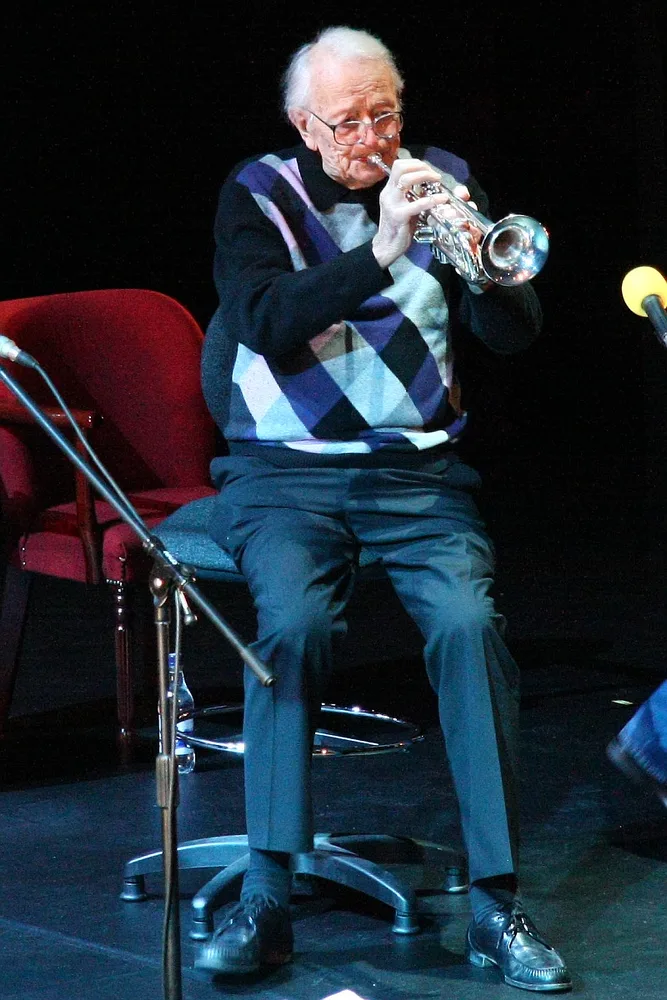
Humphrey Lyttelton playing trumpet at the recording of the I'm Sorry I Haven't a Clue Christmas special "Humph in Wonderland", Lyric Theatre, London, November 25, 2007, photographed by Andy Davison CC BY-SA 2.0 — Wikimedia Commons — https://commons.wikimedia.org/wiki/File:Humphrey_Lyttleton_-playing_trumpet_-Lyric_Theatre_25n2007c.jpg

Humphrey Richard Adeane Lyttelton, known to everyone as Humph, was born on May 23, 1921, at Eton College, where his father, George William Lyttelton, was a house master. His father was the second son of the 8th Viscount Cobham, which placed the family within the Lyttelton clan of cricketers and politicians; the politician and sportsman Alfred Lyttelton was his great-uncle. He went from Sunningdale Preparatory School to Eton, where he fell for the records of Louis Armstrong and the English trumpeter Nat Gonella, taught himself the trumpet, and in 1936 formed a school quartet. After Eton he spent a spell at the Port Talbot steel plate works in South Wales, was called up, and was commissioned in the Grenadier Guards on November 29, 1941. He saw action at Salerno during Operation Avalanche, coming ashore with a pistol in one hand and his trumpet in the other. On VE Day in 1945 he played the trumpet from a wheelbarrow in the street celebrations, an impromptu first broadcast performance whose BBC recording survives.
Demobilised, he studied for two years at Camberwell Art College and met the clarinetist and cartoonist Wally Fawkes, who signed his drawings "Trog." In 1947 both joined George Webb's Dixielanders, a semi-professional band widely counted as the first British revivalist jazz group. Lyttelton left the Dixielanders in January 1948 to form his own band, and Fawkes went with him; Webb himself joined the new band that September and stayed until June 1951, and the brothers Keith Christie (trombone) and Ian Christie (clarinet) soon completed a front line that became a leader of the postwar New Orleans revival. He signed with Parlophone in late 1949, and the label went on issuing his records through the 1950s. In 1949 he also began working beside Fawkes on the Daily Mail strip Flook, staying with the paper until 1956. That same year he recorded with Sidney Bechet, which meant defying the Musicians' Union's restrictions on working with visiting American players.
By the early 1950s he was steering away from strict revivalism toward the mainstream swing of players such as the trumpeter Buck Clayton. He added saxophones to the band in 1953, and when the alto saxophonist Bruce Turner made his debut at Birmingham Town Hall that year, a banner in the audience read "Go Home Dirty Bopper!" On April 20, 1956, in London, the band recorded his fast instrumental blues "Bad Penny Blues." Johnny Parker's boogie-woogie piano riff was pushed to the front by Joe Meek, the engineer for producer Denis Preston, and the record became the first British jazz record to reach the UK Top 20, staying there for six weeks; Paul McCartney later modeled the piano part of "Lady Madonna" on its riff. From 1958 he settled on an eight-piece band with alto, tenor and baritone saxophones, which served as a training ground for players including Tony Coe, Joe Temperley, Kathy Stobart, Jimmy Hastings, Alan Barnes and Karen Sharp.
Lyttelton's band backed visiting Americans throughout those years. Jimmy Rushing toured Britain with it in 1957 and 1958, and a live set from Lyttelton's club at 100 Oxford Street on September 11, 1957, was recorded by Meek. Clayton recorded with the band in the early 1960s and toured with it repeatedly, regarding Lyttelton as a brother; Clayton, Vic Dickenson and Big Joe Turner toured together in 1965, and in later decades Lyttelton made records with Buddy Tate, Kenny Davern and Bud Freeman. He was the subject of the television programme This Is Your Life in 1958. In 1983 he founded Calligraph Records, which reissued his Parlophone-era recordings and released the band's later work. He co-led two Calligraph CDs with Acker Bilk, At Sundown (1992) and Three in the Morning (1994), and the band joined the Giants of British Jazz tours with Bilk and George Melly. A demo by the American singer Stacey Kent was played on his Radio 2 programme, and he introduced her to British audiences; he made Between Friends in 2000 with Kent and the saxophonist Jim Tomlinson. In 2001 his band played on "Life in a Glasshouse," the closing track of Radiohead's Amnesiac; in 2003 he issued Trouble in Mind with the singer Elkie Brooks, with whom he had first worked in the early 1960s.
Lyttelton was equally prominent off the bandstand. From 1967 until April 2007 he presented The Best of Jazz on BBC Radio 2, and from 1972 he chaired the BBC Radio 4 comedy panel game I'm Sorry I Haven't a Clue, where his deadpan manner made him the oldest active panel-show host in Britain by the time of his death. He published a shelf of books, among them the memoir I Play as I Please (1954), and was a calligrapher who served as president of the Society for Italic Handwriting. He turned down a knighthood in 1994.
On April 18, 2008, the producers of I'm Sorry I Haven't a Clue announced that he was going into hospital to repair an aortic aneurysm; he postponed the operation and performed on all but the last night of the spring tour, then passed away on April 25, 2008, following the surgery. A humanist funeral was held on May 6, 2008. BBC Radio 2 listeners voted him Jazz Artist of the Year on July 23, 2008, and a celebration concert took place at the Hammersmith Apollo on April 25, 2010, organized by his son Stephen, who founded the Humph Trust to support young jazz musicians.
Lyttelton began as a devotee of Louis Armstrong and the New Orleans revival, and his first Parlophone recordings keep to that repertoire of stomps, rags and blues. He did not stay there. From the early 1950s he moved toward the saxophone-augmented mainstream approach favored by American players such as Buck Clayton, a change some of his original fans resented, and his repertoire grew to take in lesser-known pieces by Duke Ellington and even "The Champ" from Dizzy Gillespie's band book; his 1975 album Take It from the Top is subtitled a dedication to Ellington. His own trumpet playing was declamatory and blues-soaked, a tone that drew praise from Armstrong himself. He saw himself primarily as a bandleader, and the band became a training ground for a long line of British saxophonists and trombonists. Alongside the music he worked as a cartoonist, author and calligrapher, and for generations of listeners his voice on radio was as familiar as his trumpet, but the jazz band remained the center of his working life and toured until his final spring.
- Bad Penny Blues / Close Your Eyes (1956, Parlophone) - the 78 that gave British jazz its first Top 20 hit, built on Johnny Parker's boogie-woogie riff and the balance of Joe Meek. Spotify - Bad Penny Blues 1955-1956 (compilation)
- Sidney Bechet with Humphrey Lyttelton and His Band (recorded 1949; EP issued 1955, Melodisc) - four sides including "Who's Sorry Now" and "Georgia," from the Bechet sessions that broke the Musicians' Union's bar on American guests; Sidney Bechet plays soprano saxophone.
- Humph at the Conway (1954, Parlophone) - a live set recorded at Conway Hall, London, on September 2, 1954, with Bruce Turner's alto saxophone in the front line.
- Humph in Perspective (1958, Parlophone) - the saxophone-augmented band at full strength, with Tony Coe, Jimmy Skidmore and Joe Temperley alongside trombonist John Picard.
- Me and Buck (1963, World Record Club) - recorded in Interlaken in 1963, a two-trumpet date with Buck Clayton and a rhythm section that includes pianist Ian Armit.
- Take It from the Top: A Dedication to Duke Ellington (1975, Black Lion) - recorded in Wimbledon on June 23, 1975: nine Lyttelton originals and a closing Ellington medley, with Kathy Stobart and Bruce Turner on saxophones and Elkie Brooks singing on four tracks.
- Between Friends (2000, Calligraph) - recorded in March 2000 with the singer Stacey Kent and the saxophonist Jim Tomlinson, alongside the regular band.
- "Life in a Glasshouse" on Radiohead's Amnesiac (2001, EMI) - Lyttelton's band plays on the album's closing track, which introduced his sound to a younger audience.
Humphrey Lyttelton: Full Discography
Discogs artist ID 148132 ("Humphrey Lyttelton," real name Humphrey Richard Adeane Lyttelton, born May 23, 1921, in Eton, died April 25, 2008) lists several hundred entries across leader, band, compilation and appearance credits, most of them reissues, 78 rpm singles and archive compilations of the same sessions. His band work is filed under a separate Discogs entity, Humphrey Lyttelton And His Band (artist ID 599445, with more than 300 entries), and smaller entities cover the Bell-Lyttelton Jazz Nine, Ten and Twelve, Carlo Krahmer's Chicagoans and Hot Seven, Humphrey Lyttelton's Paseo Band and the Grant-Lyttelton Paseo Jazz Band. Both main entities were checked and reconciled. Because his catalog runs to hundreds of releases across seven decades, the table below is a curated selection of 29 landmark leader, co-leader and archive releases: the first Parlophone concert albums, the Bad Penny Blues single, the saxophone-band LPs of the late 1950s, the Buck Clayton, Buddy Tate, Kenny Davern, Bud Freeman and Acker Bilk collaborations, the Calligraph albums and two Lake Records archive sets. Catalog numbers are those of the first or best-documented pressing on Discogs; recording dates come from Discogs release notes and Wikipedia, and "Not specified in Discogs data" marks a date the sources do not give.
As Leader / Co-Leader
| Album Title | Recording Date(s) | Release Date | Label | Catalog Number | Format(s) | Personnel | Role | Reissue History | Spotify | Buy | Notes |
|---|---|---|---|---|---|---|---|---|---|---|---|
| Sidney Bechet with Humphrey Lyttelton and His Band | 1949 (month not confirmed) | February 1955 (EP; the sides first appeared as 78s in 1949) | Melodisc | EPM 7-51 | Vinyl, 7", EP, 45 RPM | Humphrey Lyttelton (trumpet), Sidney Bechet (soprano saxophone), Keith Christie (trombone), Wally Fawkes (clarinet), Ian Christie (clarinet, track A1), George Webb (piano), Buddy Vallis (banjo), John Wright (bass), Bernard Saward (drums) | Leader (Bechet as featured guest) | Sides first issued on 78s in 1949; see Discogs master 1007194 | — | — | Four sides: "Who's Sorry Now," "Sleepy Time Down South," "I Told You Once, I Told You Twice" and "Georgia." |
| A Jazz Concert | Not specified in Discogs data | 1953 | Parlophone | PMD 1006 | Vinyl, 10", LP | Humphrey Lyttelton (trumpet) and his band; full personnel not itemized on Discogs | Leader | Pressing history on Discogs master 637462 | — | — | Ten tracks including "Panama Rag," "Trouble in Mind" and "Wolverine Blues." |
| Humph at the Conway | September 2, 1954, Conway Hall, London | December 1954 | Parlophone | PMC 1012 | Vinyl, LP, Mono | Humphrey Lyttelton (trumpet), Bruce Turner (alto and soprano saxophone), Wally Fawkes (clarinet), Johnny Parker (piano), Freddy Legon (banjo, guitar), Micky Ashman (bass), George Hopkinson (drums, washboard) | Leader | Pressing history on Discogs master 797052; reissued with the Royal Festival Hall set by Calligraph Records in 2000 | — | — | Live recording; Lyttelton also wrote the liner notes. |
| Jazz at the Royal Festival Hall | November 28, 1954, Royal Festival Hall, London | 1955 | Parlophone | PMD 1032 | Vinyl, 10", LP | Humphrey Lyttelton (trumpet), Bruce Turner (alto saxophone), Wally Fawkes (clarinet), John Picard (trombone), Johnny Parker (piano), Freddy Legon (banjo), Micky Ashman (bass), George Hopkinson (drums) | Leader | Pressing history on Discogs master 413277 | — | — | Live concert; eight tracks including "High Society" and "When the Saints Go Marching In." |
| Bad Penny Blues / Close Your Eyes | April 20, 1956, London | 1956 | Parlophone | R 4184 | Shellac, 10", 78 RPM | Humphrey Lyttelton (trumpet), Johnny Parker (piano), Jim Bray (bass), Stan Greig (drums), as listed for the A-side on Wikipedia; the rest of the band is not itemized | Leader | Pressing history on Discogs master 549910; recorded again with Elkie Brooks in 2002 for Trouble in Mind | — | — | First British jazz record in the UK Top 20; official producer Denis Preston, with Joe Meek as engineer. |
| Humph in Perspective | Not specified in Discogs data | 1958 | Parlophone | PMC 1070 | Vinyl, LP, Album, Mono | Humphrey Lyttelton (trumpet), Tony Coe (alto saxophone, clarinet), Jimmy Skidmore (tenor saxophone), Joe Temperley (baritone saxophone), John Picard (trombone), Ian Armit (piano), Brian Brocklehurst (bass), Eddie Taylor (drums) | Leader | Not itemized | — | — | Produced by Denis Preston; ten tracks including "Weary Blues" and "Struttin' with Some Barbecue." |
| Kath Meets Humph | November 25 to December 3, 1957 | 1958 | Parlophone | PMD 1052 | Vinyl, 10", LP | Humphrey Lyttelton (trumpet), Kathy Stobart (tenor saxophone), Tony Coe (alto saxophone), John Picard (trombone; Eddie Harvey on track A2), Ian Armit (piano), Brian Brocklehurst (bass), Eddie Taylor (drums) | Co-leader (billed with Kathy Stobart) | Not itemized | — | — | Joe Meek engineered the sessions; Denis Preston produced. |
| I Play as I Please | September to December 1957 | September 1958 | Decca | LK 4276 | Vinyl, LP, Album, Mono | Humphrey Lyttelton (trumpet) with a band that varies by track and includes Tony Coe and Ronnie Ross (alto saxophone), Jimmy Skidmore and Don Rendell (tenor saxophone), John Picard (trombone), Ian Armit (piano) | Leader | Not itemized | — | — | Named for his 1954 memoir; one session uses a larger ensemble with flutes, vibraphone and Latin percussion. |
| Triple Exposure | Not specified in Discogs data | 1959 | Parlophone | PMC 1110 | Vinyl, LP, Album, Mono | Humphrey Lyttelton (trumpet), Tony Coe (alto saxophone), Jimmy Skidmore (tenor saxophone), Joe Temperley (baritone saxophone), John Picard (trombone), Ian Armit (piano), Brian Brocklehurst (bass), Eddie Taylor (drums) | Leader | Reissued as a 2-CD set by Calligraph Records in 2004 | — | — | Eleven tracks, mostly originals, including "One Day I Met an African." |
| Humph Plays Standards | Not specified in Discogs data | March 1961 | Columbia | 33SX 1305 | Vinyl, LP, Mono | Humphrey Lyttelton (trumpet); personnel not itemized on Discogs | Leader | Pressing history on Discogs master 761007 | — | — | Ten standards including "Love for Sale," "Body and Soul" and "The Man I Love." |
| Humph Meets Cab | Not specified in Discogs data | 1961 | Columbia | 33SX 1364 | Vinyl, LP, Mono | Humphrey Lyttelton (trumpet) and Cab Kaye (vocals); band personnel not itemized on Discogs | Co-leader (billed with Cab Kaye) | Not itemized | — | — | Twelve tracks including "Jealous" and "You Can Depend on Me." |
| Me and Buck | 1963, Interlaken | 1963 | World Record Club | T 324 | Vinyl, LP, Album, Mono | Humphrey Lyttelton (trumpet, tenor horn), Buck Clayton (trumpet), Danny Moss (tenor saxophone), Joe Temperley (baritone saxophone), Ian Armit (piano), Pete Blannin (bass), Eddie Taylor (drums) | Leader (with Buck Clayton) | Pressing history on Discogs master 2904355 | — | — | Denis Preston supervised the recording. |
| The Great Buck Clayton | Not specified in Discogs data | 1966 | International Polydor Production | 423 213 | Vinyl, LP, Mono | Buck Clayton (trumpet), Humphrey Lyttelton (trumpet), Tony Coe (tenor saxophone), Joe Temperley (baritone saxophone), Eddie Harvey (piano), Pete Blannin (bass), Eddie Taylor (drums) | Co-billed (Clayton featured with Lyttelton's band) | Pressing history on Discogs master 1108955 | — | — | German pressing; Lyttelton wrote the liner notes and Doug Dobell produced. |
| Take It from the Top: A Dedication to Duke Ellington | June 23, 1975, R. G. Jones Studios, Wimbledon | 1975 | Black Lion | BLP 12134 | Vinyl, LP | Humphrey Lyttelton (trumpet), Bruce Turner (alto saxophone, clarinet), Kathy Stobart (tenor, baritone and soprano saxophone), Mick Pyne (piano), Dave Green (bass), Tony Mann (drums), Elkie Brooks (vocals, four tracks) | Leader | Pressing history on Discogs master 753656 | — | — | Lyttelton wrote nine of the ten tracks; the closing medley is by Duke Ellington. He also produced. |
| Kansas City Woman | Not specified in Discogs data | 1975 | Black Lion | BL-312 | Vinyl, LP, Album | Humphrey Lyttelton (trumpet), Buddy Tate (tenor saxophone, clarinet), Bruce Turner (alto saxophone, clarinet), Kathy Stobart (tenor and baritone saxophone, clarinet), Mick Pyne (piano), Dave Green (bass), Tony Mann (drums) | Co-leader (billed with Buddy Tate) | Its tracks reappear on a Jazz Colours CD (874713-2) billed as Buddy Tate with Humphrey Lyttelton and Ruby Braff, which adds five further tracks | — | — | The title track is by Buck Clayton; Lyttelton also produced. |
| Humphrey's About with Bud Freeman | October 12, 1978, Chichester Festival Theatre | 1978 | Magnus Records | Magnus 1 | Vinyl, LP, Album, Stereo | Humphrey Lyttelton (trumpet) and Bud Freeman (tenor saxophone); band personnel not itemized on Discogs | Co-leader (billed with Bud Freeman) | Not itemized | — | — | Live recording in binaural stereo; nine tracks including "East St. Louis Toodle-oo" and "Crazy Rhythm." |
| Humph & Wally '83: It Seems Like Yesterday | September 28, 1983, Porcupine Studios, London | 1983 | Calligraph Records | CLGLP 001 | Vinyl, LP, Album | Humphrey Lyttelton (trumpet, clarinet), Wally Fawkes (clarinet, special guest), Bruce Turner (alto saxophone), Johnny Barnes (baritone saxophone), Pete Strange (trombone), Mick Pyne (piano), Paul Bridge (bass), Adrian Macintosh (drums) | Leader (with Wally Fawkes) | Discogs lists a later CD edition, It Seems Like Yesterday (2001), as a related release | — | — | Catalog number 001 on the label he founded in 1983. |
| Humphrey Lyttelton in Canada | Not specified in Discogs data | May 1984 | Sackville Recordings | 3033 | Vinyl, LP, Album | Humphrey Lyttelton (trumpet, clarinet), Jim Galloway (saxophone, clarinet), Ed Bickert (guitar), Neil Swainson (bass), Terry Clarke (drums) | Leader | Pressing history on Discogs master 1485547 | — | — | Recorded with Canadian musicians; eight tracks including "Sprauncy" and "Looking for Turner." |
| This Old Gang of Ours | December 10, 1985, Porcupine Studios, London | 1986 | Calligraph Records | CLGLP 012 | Vinyl, LP, Album, Stereo | Humphrey Lyttelton (trumpet), Kenny Davern (clarinet), Johnny Barnes (alto, baritone and soprano saxophone), Martin Litton (piano), Mick Hutton (bass), Colin Bowden (drums) | Co-leader (billed with Kenny Davern) | Pressing history on Discogs master 2124562 | — | — | Ten tracks including "Undecided" and "Sidney, My Man." |
| At Sundown | Not specified in Discogs data | 1992 | Calligraph Records | CLGCD 027 | CD, Album | Humphrey Lyttelton (trumpet) and Acker Bilk (clarinet); full personnel not itemized on Discogs | Co-leader (billed with Acker Bilk) | Not itemized | — | — | Billed as the first record on which the two appeared together. |
| Three in the Morning | Not specified in Discogs data | 1994 | Calligraph Records | CLG CD 030 | CD, Album | Humphrey Lyttelton (trumpet) and Acker Bilk (clarinet); full personnel not itemized on Discogs | Co-leader (billed with Acker Bilk) | Not itemized | — | — | Sixteen tracks including "Easter Parade" and "Last Smile Blues"; the second of their two Calligraph CDs. |
| Sing, Swing Together | Not specified in Discogs data | 1998 | Calligraph Records | CLG CD 034 | CD, Album | Helen Shapiro (vocals), Humphrey Lyttelton (trumpet, vocals on one track), Jimmy Hastings (alto saxophone, clarinet, flute), Kathy Stobart (tenor and baritone saxophone), Pete Strange (trombone), Ted Beament (piano), Paul Bridge (bass), Adrian Macintosh (drums) | Co-leader (billed with Helen Shapiro) | Not itemized | — | — | Fifteen tracks including "Shiny Stockings" and "Caravan." |
| Between Friends | March 10 and 22, 2000 | August 29, 2000 | Calligraph Records | CLG CD 037 | CD, Album | Humphrey Lyttelton (trumpet, clarinet), Stacey Kent (voice), Jim Tomlinson (tenor, alto and baritone saxophone, bass clarinet), Jimmy Hastings (alto saxophone, flute, clarinet), Kathy Stobart (tenor and baritone saxophone, clarinet), Pete Strange (trombone), Ted Beament (piano), Paul Bridge (bass), Adrian Macintosh (drums) | Leader | Not itemized | — | — | Fifteen tracks including "Everything but You" and "Creole Love Call"; Lyttelton co-produced. |
| Trouble in Mind | Not specified in Discogs data | 2003 | Slave to the Rhythm Records | CPA7063X | CD, Album | Elkie Brooks (vocals), Humphrey Lyttelton (trumpet, bongos), Jimmy Hastings (saxophone, clarinet, flute), Kathy Stobart (saxophone), Pete Strange (trombone), Ted Beament (piano), Mick Hutton (bass), Adrian Macintosh (drums) | Co-leader (billed with Elkie Brooks) | Pressing history on Discogs master 485919 | — | — | Includes a sung version of his own "Bad Penny Blues." |
| Sad, Sweet Song & Crazy Rhythms | Not specified in Discogs data | 2005 | Calligraph Records | CLGCD 042 | CD, Album | Humphrey Lyttelton (trumpet) and his band; personnel not itemized on Discogs | Leader | Not itemized | — | — | Fourteen tracks mixing standards with Lyttelton originals such as "Lion Rampant" and "Madly." |
| Cornucopia | Not specified in Discogs data | 2007 | Calligraph Records | CLG CD 044 | CD, Album | Humphrey Lyttelton (trumpet) and his band; personnel not itemized on Discogs | Leader | Not itemized | — | — | Sixteen tracks including "Willow Weep for Me" and "Trouble in Mind." |
| A Night in Oxford Street | September 11, 1957, 100 Oxford Street, London | CD issue, year not stated | Upbeat Jazz | URCD186 | CD, Album | Jimmy Rushing (vocals), Humphrey Lyttelton (trumpet), Tony Coe (alto saxophone), Jimmy Skidmore (tenor saxophone), John Picard (trombone), Ian Armit (piano), Brian Brocklehurst (bass), Eddie Taylor (drums) | Leader (with Jimmy Rushing) | Not itemized | — | — | Recorded by Joe Meek at Lyttelton's club on Rushing's 1957 British visit. |
| Bad Penny Blues 1955-1956 | 1955 and 1956 (dates vary by track) | 2007 | Lake Records | LACD238 | 2xCD, Compilation | Humphrey Lyttelton (trumpet) and his band | Leader (archive compilation) | Compiled by Paul Adams; forty-one tracks | Spotify - Bad Penny Blues 1955-1956 | — | Parlophone-era recordings; Discogs notes doubt over the recording date of one track. |
| 1957-58 | 1957 and 1958 | 2009 | Lake Records | LACD269 | 2xCD, Album | Humphrey Lyttelton (trumpet) and his band | Leader (archive compilation) | Thirty-eight tracks | Spotify - 1957-58 | — | Includes "Baby Doll," "Red Beans and Rice" and "Creole Serenade." |
As Sideman and Guest (selected credits)
| Year | Project (Leader) | Title | Label | Catalog | Role | Notes |
|---|---|---|---|---|---|---|
| 1947-1950 | Carlo Krahmer's Chicagoans | "Original Dixieland One-Step" / "Bluin' the Blues" and other Esquire singles | Esquire | 10-001 (first single) | Cornet | Discogs files these under a separate entity; the first single was recorded at a Birmingham Town Hall concert on November 21, 1947, with Wally Fawkes (clarinet), Dill Jones (piano) and Bobby Mickleburgh (trombone). |
| 1970 and 1971 | Alex Welsh and His Band, with George Chisholm and Bruce Turner | Salute to Satchmo | Black Lion | BLPX 12161/2 | Trumpet (guest) | Two-LP compilation of Queen Elizabeth Hall concerts recorded July 4, 1970 and November 28, 1971, billed to Alex Welsh, George Chisholm, Lyttelton and Turner; issued 1977. |
| 2001 | Radiohead | "Life in a Glasshouse" on Amnesiac | EMI | Not listed | Featured guest, with his band | Lyttelton's band plays on the album's closing track; the album was released on May 30, 2001. Individual band credits are not itemized. |
- Wally Fawkes - clarinet; Camberwell classmate who joined George Webb's Dixielanders alongside Lyttelton in 1947, left with him to form the new band in January 1948, and stayed until 1956; the two also collaborated on the Flook strip and made It Seems Like Yesterday together in 1983.
- George Webb - pianist and leader of the Dixielanders; played in Lyttelton's band from September 1948 to June 1951.
- Keith Christie and Ian Christie - trombone and clarinet; the Blackpool-born brothers who completed the early front line.
- Johnny Parker, Jim Bray and Stan Greig - the piano, bass and drums heard on "Bad Penny Blues."
- Sidney Bechet - American soprano saxophonist; recorded with the band in 1949.
- Bruce Turner - alto saxophonist who joined in 1953 and remained a regular for decades; the subject of the "Dirty Bopper" banner incident.
- Tony Coe, Joe Temperley, Jimmy Skidmore and Kathy Stobart - saxophonists in the postwar mainstream band; Stobart co-led Kath Meets Humph (1958).
- Jimmy Rushing - blues singer; toured with the band in 1957 and 1958, with a live set recorded at Lyttelton's club on September 11, 1957.
- Buck Clayton - trumpeter; recorded and toured with Lyttelton from the early 1960s, including Me and Buck (1963).
- Vic Dickenson and Big Joe Turner - American guests, with Clayton, on a 1965 tour.
- Buddy Tate, Kenny Davern and Bud Freeman - American saxophonists and clarinetists with whom he recorded; Tate and Ruby Braff are together with Lyttelton on a Jazz Colours CD.
- Acker Bilk - clarinetist; co-led At Sundown (1992) and Three in the Morning (1994) with Lyttelton and joined him on the Giants of British Jazz tours.
- Stacey Kent and Jim Tomlinson - singer and saxophonist on Between Friends (2000).
- Elkie Brooks and Helen Shapiro - singers who recorded with him; Brooks first worked with him in the early 1960s and made Trouble in Mind (2003), and Shapiro is co-billed on Sing, Swing Together (1998).
- Joe Meek - recording engineer for "Bad Penny Blues" and the live Rushing set.
More Trad Jazz Artists
See all 31 Trad Jazz artists →More British Jazz Artists
See all 32 British artists →- Wikipedia: Humphrey Lyttelton
- Wikipedia: Bad Penny Blues
- Wikipedia: George Webb (musician)
- Wikipedia: Wally Fawkes
- Wikipedia: Amnesiac (album)
- AllMusic: Humphrey Lyttelton biography by Jason Ankeny
- Encyclopedia.com: Lyttelton, Humphrey 1921-2008
- Discogs: Humphrey Lyttelton
- MusicBrainz: Humphrey Lyttelton