 JAZZPROFILES lives in the music 2,303 Jazz Artists fully Profiled!
Eberhard Weber
Last updated November 7, 2026
Listen on Spotify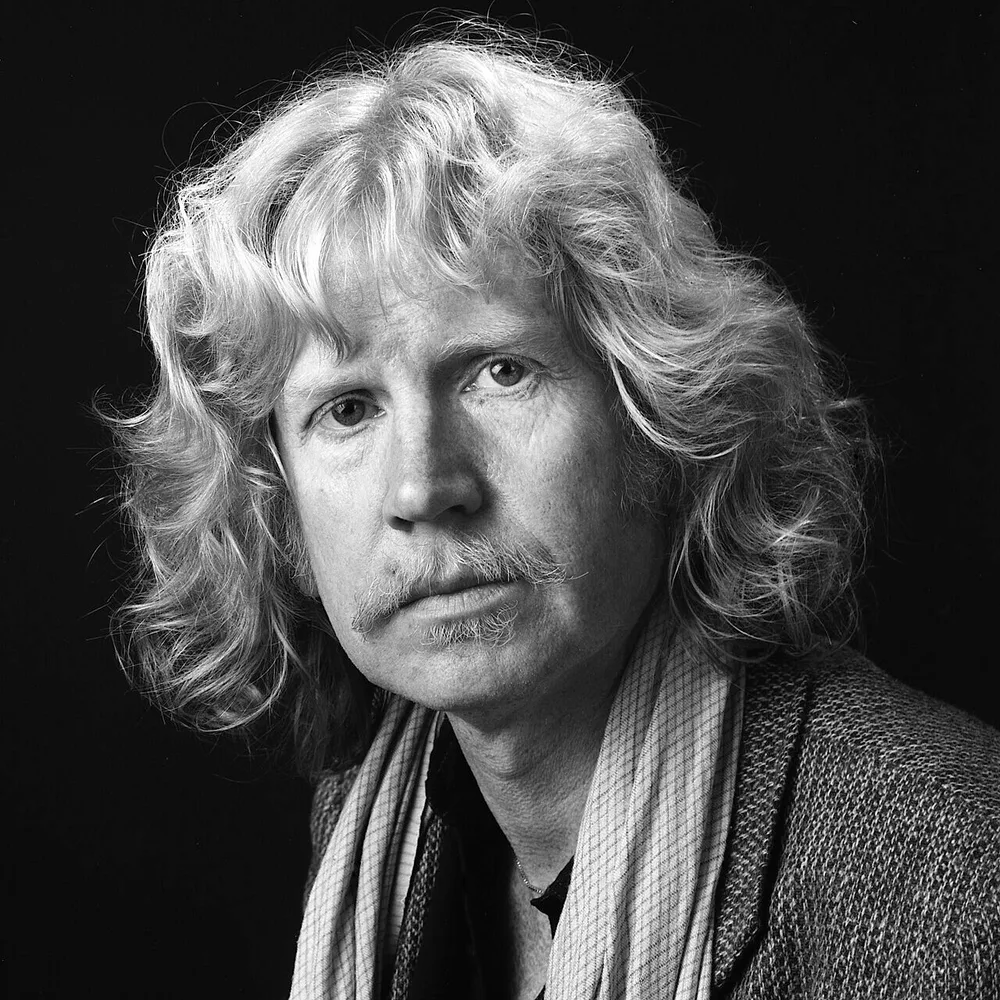
Eberhard Weber, black-and-white studio portrait, March 1987, photographed by Gert Chesi CC BY-SA 4.0 (photographer Gert Chesi, own work) — Wikimedia Commons: https://commons.wikimedia.org/wiki/File:Eberhard_Weber_-_Portrait_by_Gert_Chesi.jpg

Eberhard Weber was born on January 22, 1940, in Stuttgart and grew up in nearby Esslingen. His father taught music and gave him his first cello lessons at the age of six. He took up the double bass at about 16, when his school orchestra needed a bassist, and learned it largely on his own; he never attended a conservatory. After an apprenticeship as a photographer he worked in broadcasting and film before turning fully to music, and he later also worked as a television and theater director.
In the early 1960s he met the pianist Wolfgang Dauner at the Düsseldorf Amateur Jazz Festival, and Dauner became his closest musical partner for the next decade, in projects that ran from mainstream jazz to jazz-rock and avant-garde experiments, among them Dauner's group Et Cetera, formed in 1970. By 1973 Weber estimated that he had played on 35 to 40 records, many of them for the German label MPS, alongside players such as Hampton Hawes, Mal Waldron, the Brazilian guitarist Baden Powell, Joe Pass, Stéphane Grappelli and the Mike Gibbs Orchestra. He also played in Volker Kriegel's band Spectrum in the early 1970s.
In 1972 he bought the body of an old double bass, had a violin maker restore it, and fitted it with a pickup and an extra high string, then spent months removing the resonances that muddied its sound so that notes would ring longer and cleaner. The resulting electric upright, with a reduced solid body, became his only bass; AllMusic reports that he added a further string above that one in the late 1970s. On it he recorded The Colours of Chloë in December 1973, his first album under his own name, released on ECM in 1974 with pianist Rainer Brüninghaus, drummer Peter Giger, flugelhorn player Ack van Rooyen and a cello section from the Stuttgart radio orchestra; Weber himself played bass, cello, ocarina and voice. AllMusic's David R. Adler called it his best-known and most influential record.
The ECM connection drew him into the label's circle. He played on Gary Burton's Ring (recorded July 1974) and, as a featured guest with Burton's quartet, on Passengers (November 1976); on Ralph Towner's Solstice (December 1974) with Jan Garbarek and drummer Jon Christensen, and its sequel Sound and Shadows (1977); and on Pat Metheny's Watercolors (February 1977), a quartet date that also included Lyle Mays. In the mid-1970s he formed Colours with saxophonist Charlie Mariano, Brüninghaus and Christensen; John Marshall replaced Christensen after the first record, Yellow Fields, and the quartet went on to make Silent Feet and Little Movements, toured North America in 1976, 1978 and 1979, and disbanded in 1981. Between those records he led The Following Morning (1977), a drummerless set with Brüninghaus and members of the Oslo Philharmonic, and Fluid Rustle (recorded January 1979), a quintet with Bill Frisell, in his first ECM session, Burton, and the singers Bonnie Herman and Norma Winstone. He was also a member of the United Jazz + Rock Ensemble, a German all-star band.
In December 1978 he first recorded with Garbarek, on Photo with Blue Sky, White Cloud, Wires, Windows and a Red Roof, and from the early 1980s he was a regular member of the Jan Garbarek Group, which he stayed with until 2007; he appears on ten Garbarek albums released between 1979 and 1998. His own records in those years included Later That Evening (March 1982), with Paul McCandless, Michael Di Pasqua, Frisell and Mays; Chorus (recorded September 1984), with Garbarek; Orchestra (1988), with a brass octet; the solo-bass Pendulum (1993); and Endless Days (recorded April 2000). From 1985 he gave solo concerts in which electronic devices recorded his bass as he played and fed it back, so that he could accompany himself. He also played on four albums by Kate Bush: The Dreaming (1982), Hounds of Love (1985), The Sensual World (1989) and Aerial (2005). For his 65th birthday in March 2005 he recorded a concert at the Theaterhaus Stuttgart with Garbarek, Burton, Dauner and the Stuttgart Radio Symphony Orchestra, released as Stages of a Long Journey.
On April 23, 2007, Weber suffered a stroke while on tour with the Garbarek group, and he has not been able to play the bass since; Yuri Daniel took his place in the band. He has kept working as a composer and editor of his own archive. Résumé (2012) and Encore (2015) rework solos recorded live with Garbarek's group between 1990 and 2007, with keyboards and processing added by Weber, Garbarek's saxophone on the first and Ack van Rooyen's flugelhorn on the second. He received the Albert Mangelsdorff Prize in 2009, the year ECM reissued three of his Colours albums as a box set. Two concerts in Stuttgart in January 2015 marked his 75th birthday, with the SWR Big Band playing his music alongside Metheny, Garbarek, Burton and others; the broadcaster's recording was issued by ECM as Hommage à Eberhard Weber. His autobiography, Résumé: Eine deutsche Jazzgeschichte, appeared in 2015, with an English translation by Heidi Kirk, A German Jazz Story, in 2021. That year Lyle Mays's posthumous tribute composition "Eberhard" was released, and it won the 2022 Grammy Award for Best Instrumental Composition; ECM also issued Once Upon a Time (Live in Avignon), a 1994 concert recording. A January 2026 festival report describes Weber as living in the south of France and as patron of the Esslingen Jazz Festival since its beginning.
Weber is known for a highly distinctive tone and phrasing. His electric upright sings in long, sustained lines, often over repeating ostinato figures with finely differentiated tonal colors, and from the mid-1980s he used electronic devices to layer his own playing so that a solo bass could sound like an ensemble. AllMusic traces his use of contrasting ostinato patterns to the composer Steve Reich and describes his influences as primarily European, drawn from contemporary classical and new music rather than from the blues or from an animated, energetic approach. His compositions blend chamber jazz, European classical music, minimalism and ambient music, and they are regarded as characteristic examples of the ECM sound. By his own account his sound ideal was shaped by the muffled low frequencies he heard through a wall as a child, listening to his father's chamber-music evenings. He took titles for several pieces and albums from Richard Adams's novel Watership Down, and his wife Maja Weber, a painter who died in 2011, made the cover images for his albums from 1973. AllMusic's biography calls him not strictly a jazz bassist and one of the least flamboyant improvisers, yet among the finest bassists in Europe; his place in jazz rests on his ECM catalog, his work with Gary Burton, Ralph Towner, Pat Metheny and Jan Garbarek, and honors such as the German jazz prize named for Albert Mangelsdorff, which he received in 2009. The posthumous tribute "Eberhard" by Lyle Mays is the most direct homage to his compositional style, and The Colours of Chloë and Yellow Fields are still cited as defining records of ECM's chamber-jazz sound.
- The Colours of Chloë (1974, ECM) - His first record as a leader and the one that made his name: symphonic, slow-moving chamber jazz with Brüninghaus, Ack van Rooyen and a cello section.
- Yellow Fields (1976, ECM) - The first Colours quartet record, with Charlie Mariano, Brüninghaus and Jon Christensen; the Penguin Guide to Jazz placed it in its Core Collection.
- Fluid Rustle (1979, ECM) - A quintet date with Bill Frisell and Gary Burton plus two singers, Bonnie Herman and Norma Winstone; AllMusic gave it 4.5 stars.
- Later That Evening (1982, ECM) - A quintet with Paul McCandless, Michael Di Pasqua, Frisell and Lyle Mays; AllMusic's Scott Yanow called it one of Weber's more stimulating ECM releases.
- Pendulum (1993, ECM) - A solo-bass album of nine originals, rated 4.5 stars by AllMusic.
- Résumé (2012, ECM) - Built from twelve of his solos recorded live with the Jan Garbarek Group, reworked with keyboards and with Garbarek and Di Pasqua added; the first record made after his stroke.
- Solstice (1975, ECM) - Ralph Towner's quartet record with Jan Garbarek, Weber on bass and cello, and Jon Christensen; AllMusic called it Towner's crowning achievement as a leader. Spotify - Solstice
- Photo with Blue Sky, White Cloud, Wires, Windows and a Red Roof (1979, ECM) - His first record with the Jan Garbarek Group, recorded December 20, 1978, with Bill Connors, John Taylor and Jon Christensen. Spotify - Photo with Blue Sky, White Cloud, Wires, Windows and a Red Roof Listen
Eberhard Weber: Full Discography
Discogs artist ID 169989 ("Eberhard Weber," born January 22, 1940, in Stuttgart) lists 372 entries across leader, collaborative, appearance and compilation releases. His own group names are filed under separate entries: "Eberhard Weber Colours" (artist ID 343221, covering Silent Feet and Little Movements) and "Eberhard Weber Group" (artist ID 7150385, a single sampler appearance); both were checked and folded into the table below. Because Weber's catalog as a leader is compact, the leader table lists every ECM album under his own name or the Colours name, plus the one co-billed non-ECM release and the Colours box. Catalog numbers and dates come from the ECM catalog as listed on MusicBrainz and from Wikipedia, and the Notes column flags the few places where sources disagree. The sideman table is a selection rather than a complete list: it covers his ECM sessions with Gary Burton, Ralph Towner, Pat Metheny and Jan Garbarek, his Jan Garbarek Group albums from 1979 to 1998, his MPS and SABA records of the 1960s and 1970s, and his four albums with the singer-songwriter Kate Bush. A Spotify link appears only where an album page was confirmed. The full list of releases is on Discogs.
As Leader / Co-Leader
| Album Title | Recording Date(s) | Release Date | Label | Catalog Number | Format(s) | Personnel | Role | Reissue History | Spotify | Buy | Notes |
|---|---|---|---|---|---|---|---|---|---|---|---|
| The Colours of Chloë | December 1973 | 1974 | ECM | ECM 1042 ST | Vinyl, LP, Album | Eberhard Weber (bass, cello, ocarina, voice), Rainer Brüninghaus (piano, synthesizer), Peter Giger (drums), Ralf Hübner (drums, track 2), Ack van Rooyen (flugelhorn), Gisela Schäuble (voice), cellists of the Südfunk Orchestra Stuttgart | Leader | Reissued on CD by ECM, including 833 331-2 (2005); also on streaming services | — | — | His first album as a leader; AllMusic gave it 4.5 stars. |
| Yellow Fields | September 1975 | 1976 | ECM | ECM 1066 | Vinyl, LP, Album | Eberhard Weber (double bass), Charlie Mariano (soprano saxophone, shehnai, nagaswaram), Rainer Brüninghaus (piano, synthesizer), Jon Christensen (drums) | Leader (Colours quartet) | CD reissue 1991 (ECM 1066); collected in the three-disc Colours set (2009) | — | — | First album by the Colours quartet; the Penguin Guide to Jazz placed it in its Core Collection. |
| The Following Morning | August 1976 | 1977 | ECM | ECM 1084 | Vinyl, LP, Album | Eberhard Weber (bass), Rainer Brüninghaus (piano, keyboards), members of the Oslo Philharmonic (celli, French horns, oboe) | Leader | CD reissue 1986 (829 116-2), again in 2019 (674 3101) | — | — | No drummer. Wikipedia says it came out in 1976; MusicBrainz and Discogs date the first pressing 1977. |
| Silent Feet | November 1977 | 1978 | ECM | ECM 1107 | Vinyl, LP, Album | Charlie Mariano (soprano saxophone, flute), Rainer Brüninghaus (piano, synthesizer), Eberhard Weber (bass), John Marshall (drums) | Leader (billed Eberhard Weber Colours) | CD reissue 1988 (835 017-2); collected in the three-disc Colours set (2009) | — | — | Marshall replaced Christensen in the Colours quartet. |
| Fluid Rustle | January 1979 | May 25, 1979 | ECM | ECM 1137 | Vinyl, LP, Album | Eberhard Weber (bass, percussion), Bill Frisell (guitar, balalaika), Gary Burton (vibraphone, marimba), Bonnie Herman and Norma Winstone (vocals) | Leader | CD reissue 2010 (829 381-2) | — | — | Bill Frisell's first recording for ECM; AllMusic gave it 4.5 stars. |
| Little Movements | July 1980 | October 1980 | ECM | ECM 1186 | Vinyl, LP, Album | Charlie Mariano (soprano saxophone, flute), Rainer Brüninghaus (piano, synthesizer), Eberhard Weber (bass), John Marshall (drums, percussion) | Leader (billed Eberhard Weber Colours) | Collected in the three-disc Colours set (2009) | — | — | Last of the three Colours albums; the band dissolved in 1981. Wikipedia's album article says 1981, while MusicBrainz and its own artist article date it 1980. |
| Later That Evening | March 1982 | 1982 | ECM | ECM 1231 | Vinyl, LP, Album | Eberhard Weber (bass), Paul McCandless (soprano saxophone, oboe, English horn, bass clarinet), Michael Di Pasqua (drums, percussion), Bill Frisell (guitar), Lyle Mays (piano) | Leader | CD reissue (829 382-2) | — | — | AllMusic: 4 stars. |
| Chorus | September 1984 | 1985 | ECM | ECM 1288 | Vinyl, LP, Album | Eberhard Weber (bass, synthesizer), Jan Garbarek (soprano and tenor saxophones), Ralf-R. Hübner (drums), Manfred Hoffbauer (clarinet, flute), Martin Künstner (oboe, English horn) | Leader | CD edition (823 844-2) | Spotify - Chorus | — | Wikipedia's discography lists it as 1985; the recording was made in 1984. |
| Orchestra | May to August 1988 | 1988 | ECM | ECM 1374 | Vinyl, LP, Album | Eberhard Weber (bass, percussion, keyboards), Herbert Joos and Anton Jillich (flugelhorn), Rudolf Diebetsberger and Thomas Hauschild (French horn), Wolfgang Czelustra and Andreas Richter (trombone), Winfried Rapp (bass trombone), Franz Stagl (tuba) | Leader | CD reissue 1989 (837 343-2) | — | — | Weber with a brass octet; AllMusic gave it 2 stars, noting little conventional jazz content. |
| Pendulum | 1993 | 1993 | ECM | ECM 1518 | CD, Album | Eberhard Weber (bass) | Leader | CD reissue (519 707-2) | — | — | Solo bass album of nine originals; AllMusic gave it 4.5 stars. |
| Endless Days | April 2000 | 2001 | ECM | ECM 1748 | CD, Album | Eberhard Weber (bass), Paul McCandless (oboe, English horn, bass clarinet, soprano saxophone), Rainer Brüninghaus (piano, keyboards), Michael Di Pasqua (drums, percussion) | Leader | Issued on CD in Germany and the US (013 420-2; 440 013 420-2) | — | — | Recorded in Norway. |
| Stages of a Long Journey | Live, March 2005, Theaterhaus Stuttgart | April 2007 | ECM | ECM 1920 | CD, Album | Eberhard Weber (bass), Jan Garbarek (soprano and tenor saxophones), Gary Burton (vibraphone), Rainer Brüninghaus (piano), Wolfgang Dauner (piano, track 3), Marilyn Mazur (percussion), Nino G. (beatbox, track 10), Reto Weber (hang, track 10), Stuttgart Radio Symphony Orchestra conducted by Roland Kluttig | Leader | US pressing July 2007 (B0008744-02) | — | — | Recorded for his 65th birthday. Garbarek, Burton and Brüninghaus play on most tracks, the orchestra on seven. |
| Résumé | Live at various locations, 1990 to 2007 | November 2012 | ECM | ECM 2051 | CD, Album | Eberhard Weber (bass, keyboards), Jan Garbarek (soprano saxophone, tenor saxophone, selje flute), Michael Di Pasqua (drums, percussion, tracks 9 and 11) | Leader | CD and digital release in 2012 | — | — | Weber's solos from concerts with the Jan Garbarek Group, reworked after his 2007 stroke; the first record he completed afterward. |
| Encore | Live at various locations, 1990 to 2007 | 2015 | ECM | ECM 2439 | CD, Album | Eberhard Weber (bass, keyboards), Ack van Rooyen (flugelhorn) | Leader | CD release 2015 | — | — | Thirteen bass solos from thirteen European cities, mixed in southern France in November 2014. Further guest credits were not confirmed. |
| Hommage à Eberhard Weber | Live, Stuttgart, January 2015 | 2015 | ECM | Not confirmed | CD, Album | Pat Metheny, Jan Garbarek, Gary Burton, Scott Colley, Danny Gottlieb, Paul McCandless, with Michael Gibbs and Helge Sunde conducting the SWR Big Band | Honoree (tribute concert to his compositions; archival video of Weber played on stage) | None found | — | — | Recorded by the broadcaster SWR at the concerts for his 75th birthday. |
| Once Upon a Time (Live in Avignon) | Live, 1994, Avignon | May 11, 2021 | ECM | ECM 2699 | CD, Album | Eberhard Weber (bass); full personnel not confirmed | Leader | Digital release November 2021 | Spotify - Once Upon a Time (Live in Avignon) | — | Archival concert recording issued 27 years after it was made. |
| Islands | Not confirmed | 1977 | Enja | 2082 | Vinyl, LP, Album | Benny Bailey, Eberhard Weber, Siggi Schwab, Lala Kovacev (instruments not confirmed) | Co-leader (four-way billing) | None found | — | — | MusicBrainz dates the first pressing 1976; Discogs and Wikipedia say 1977. |
| Colours | Compiled from 1975 to 1980 recordings | November 6, 2009 | ECM | ECM 2133-35 | 3 CDs, Compilation | As on Yellow Fields, Silent Feet and Little Movements | Leader (compilation) | Reissues the three Colours albums in one box | — | — | Compilation; other ECM anthologies are Works (1985, 825 429-2) and Rarum XVIII: Selected Recordings (2004, 014 202-2). |
As Sideman (selected major credits)
| Year | Project (Leader) | Title | Label | Catalog | Role | Notes |
|---|---|---|---|---|---|---|
| 1964 | Wolfgang Dauner Trio | Dream Talk | CBS | S 62 478 | Bass | Listed in Wikipedia's sideman discography. |
| 1967 | Wolfgang Dauner | Free Action | SABA | SB 15 095 | Bass | Listed in Wikipedia's sideman discography. |
| 1968 | Hampton Hawes | Hamp's Piano | SABA | SB 15 149 ST | Bass | Trio with drummer Claus Weiss, recorded November 8, 1967, in Villingen. |
| 1969 | Wolfgang Dauner Quintet | The Oimels | MPS | MPS 15248 ST | Bass | Listed in Wikipedia's sideman discography. |
| 1970 | Wolfgang Dauner | Output | ECM | ECM 1006 | Bass | An early ECM release. |
| 1970 | Joe Pass | Intercontinental | MPS | MPS 15 279 ST | Bass | Trio with drummer Kenny Clare, recorded June 1970 in Villingen. Spotify - Intercontinental |
| 1971 | Stéphane Grappelli | Afternoon in Paris | MPS | 21 20876-1 | Bass | With pianist Marc Hemmeler and drummer Kenny Clare, recorded March 1971. Spotify - Afternoon in Paris |
| 1971 | Mal Waldron | The Call | Japo | JAPO 60001 | Bass | Listed in Wikipedia's sideman discography. |
| 1971 | Michael Naura | Call | MPS | Not confirmed | Bass | Listed in Wikipedia's sideman discography. |
| 1974 | Gary Burton | Ring | ECM | ECM 1051 | Bass | Gary Burton Quintet with Eberhard Weber; with Mick Goodrick, Pat Metheny, Steve Swallow and Bob Moses, recorded July 1974. |
| 1975 | Ralph Towner | Solstice | ECM | ECM 1060 | Bass, cello | With Jan Garbarek and Jon Christensen, recorded December 1974. Spotify - Solstice |
| 1975 | Michael Naura | Vanessa | ECM | ECM 1053 ST | Bass | Recorded 1974 per Wikipedia. |
| 1975 | Monty Alexander | Love and Sunshine | MPS / BASF | 20 22620-4 | Bass | Quartet with guitarist Ernest Ranglin and drummer Kenny Clare, recorded October 1974 in Villingen. |
| 1977 | Gary Burton | Passengers | ECM | ECM 1092 | Bass | Gary Burton Quartet with Eberhard Weber, with Pat Metheny, Steve Swallow and Danny Gottlieb, recorded November 1976. |
| 1977 | Ralph Towner | Sound and Shadows | ECM | ECM 1095 | Bass | Same quartet as Solstice, recorded February 1977. Spotify - Sound and Shadows |
| 1977 | Pat Metheny | Watercolors | ECM | ECM 1097 | Bass | Quartet with Lyle Mays and drummer Dan Gottlieb, recorded February 1977. Spotify - Watercolors |
| 1979 | United Jazz + Rock Ensemble | The Break Even Point | MOOD | 33.619 | Bass | Weber was a member of the ensemble in the late 1970s; Wikipedia dates this record and a live follow-up to 1984. |
| 1979 | Jan Garbarek | Photo with Blue Sky, White Cloud, Wires, Windows and a Red Roof | ECM | ECM 1135 | Bass | Jan Garbarek Group, recorded December 20, 1978. Spotify - Photo with Blue Sky, White Cloud, Wires, Windows and a Red Roof |
| 1982 | Jan Garbarek | Paths, Prints | ECM | ECM 1223 | Bass | With Bill Frisell and Jon Christensen, recorded December 1981. Spotify - Paths Prints |
| 1982 | Kate Bush | The Dreaming | EMI | Not itemized | Bass (track credits not itemized) | One of four Kate Bush albums on which Weber played. |
| 1983 | Jan Garbarek | Wayfarer | ECM | ECM 1259 | Bass | Jan Garbarek Group, with Bill Frisell and Michael Di Pasqua. |
| 1983 | Manfred Schoof Orchester | Reflections | MOOD | MOOD 42 | Bass | With Albert Mangelsdorff and Wolfgang Dauner; MusicBrainz dates it 1983, Wikipedia 1984. |
| 1985 | Jan Garbarek | It's OK to Listen to the Gray Voice | ECM | ECM 1294 | Bass | Jan Garbarek Group, with David Torn and Michael Di Pasqua. Spotify - It's OK to Listen to the Gray Voice |
| 1985 | Kate Bush | Hounds of Love | EMI | Not itemized | Bass (track credits not itemized) | One of four Kate Bush albums on which Weber played. |
| 1987 | Jan Garbarek | All Those Born with Wings | ECM | ECM 1324 | Bass | Jan Garbarek Group. |
| 1988 | Jan Garbarek | Legend of the Seven Dreams | ECM | ECM 1381 | Bass | With Rainer Brüninghaus and Naná Vasconcelos. |
| 1989 | Kate Bush | The Sensual World | EMI / Columbia | Not itemized | Bass (track credits not itemized) | One of four Kate Bush albums on which Weber played. |
| 1990 | Jan Garbarek | I Took Up the Runes | ECM | ECM 1419 | Bass | With Rainer Brüninghaus, Naná Vasconcelos and Manu Katché. Spotify - I Took Up the Runes |
| 1993 | Jan Garbarek | Twelve Moons | ECM | ECM 1500 | Bass | Jan Garbarek Group. Spotify - Twelve Moons |
| 1996 | Jan Garbarek | Visible World | ECM | ECM 1585 | Bass | Jan Garbarek Group. Spotify - Visible World |
| 1998 | Jan Garbarek | Rites | ECM | ECM 1685 / 1686 | Bass | Double album summarizing Garbarek's work to that point. Spotify - Rites |
| 2005 | Kate Bush | Aerial | EMI | Not itemized | Bass (track credits not itemized) | Weber's fourth Kate Bush album. |
- Wolfgang Dauner - pianist and his closest partner from the early 1960s into the 1970s, in duo and in Dauner's groups including Et Cetera (1970).
- Gary Burton - vibraphonist on whose ECM records Ring (1974) and Passengers (1977) Weber played; Burton in turn played on Fluid Rustle and Stages of a Long Journey.
- Ralph Towner - guitarist and pianist; Weber was in his Solstice quartet (1974) and its sequel Sound and Shadows (1977).
- Pat Metheny - guitarist on Passengers and Watercolors (1977), and a guest soloist at the 2015 birthday concert.
- Jan Garbarek - saxophonist whose group Weber belonged to from the early 1980s until 2007, who also plays on Chorus, Stages of a Long Journey and Résumé.
- Lyle Mays - pianist on Watercolors and Later That Evening, and composer of the tribute "Eberhard" (2021).
- Bill Frisell - guitarist who made his ECM debut on Fluid Rustle and also played on Later That Evening.
- Charlie Mariano - saxophonist and co-founder of Colours, on Yellow Fields, Silent Feet and Little Movements.
- Kenny Wheeler - trumpeter; both he and Weber were members of the United Jazz + Rock Ensemble at different times.
- Manfred Eicher - ECM's founder and producer of many of Weber's ECM records, among them Yellow Fields, The Following Morning and Passengers.
- Rainer Brüninghaus - pianist and keyboardist on his records from The Colours of Chloë to Endless Days, and a member of Colours and of Garbarek's group.
- Jon Christensen, John Marshall, Michael Di Pasqua - the drummers of Colours and of his later quartets and quintets.
- Hampton Hawes, Mal Waldron, Joe Pass, Stéphane Grappelli, Monty Alexander - leaders he recorded with between 1967 and 1975, mostly for MPS and SABA.
- Volker Kriegel, Michael Naura - German bandleaders with whom he recorded in the 1970s.
- Kate Bush - British singer-songwriter on four of whose albums he played, from The Dreaming (1982) to Aerial (2005).
More Chamber Jazz Artists
See all 176 Chamber Jazz artists →More German Jazz Artists
See all 14 German artists →- Wikipedia: Eberhard Weber
- Wikipedia (German): Eberhard Weber (Musiker)
- Wikipedia: The Colours of Chloë
- Wikipedia: Yellow Fields
- Wikipedia: Fluid Rustle
- Wikipedia: Later That Evening
- Wikipedia: Pendulum (Eberhard Weber album)
- Wikipedia: Résumé (album)
- Wikipedia: Stages of a Long Journey
- AllMusic: Eberhard Weber biography
- ECM Records: Eberhard Weber
- Jazzblues.eu: Larry Grenadier and the Seim Randalu Klampanis Janke Quartet, Esslingen (January 2026)
- Grammy.com: Best Instrumental Composition, 2022
- Discogs: Eberhard Weber (artist 169989)
- MusicBrainz: Eberhard Weber
- JazzProfiles.com: Jan Garbarek
- JazzProfiles.com: Ralph Towner
- JazzProfiles.com: Lyle Mays