 JAZZPROFILES lives in the music 1,002 Jazz Artists fully Profiled!
 Chris Cheek
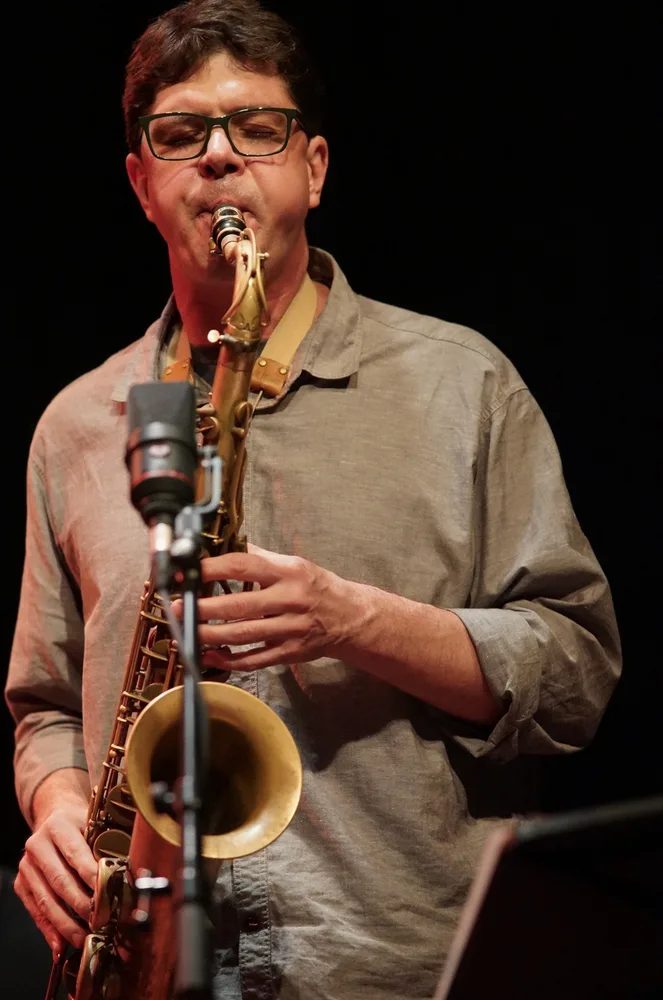
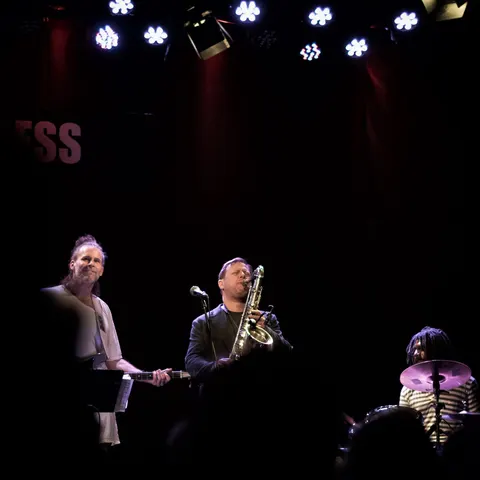
Chris Cheek playing tenor saxophone with Chris Lightcap's Bigmouth at the Bimhuis, Amsterdam, March 19, 2017 CC BY 2.0 (photograph by Dirk Neven) — Wikimedia Commons - https://commons.wikimedia.org/wiki/File:Chris_Lightcap%E2%80%99s_Bigmouth_19_maart_2017_BIM_Amsterdam_%E2%80%93_Chris_Cheek_%2851331710693%29.jpg

Christopher Carson Cheek was born on September 16, 1968 in St. Louis, Missouri, into a household where the instrument was already in the room. His father, Robert Cheek, spent 37 years as a band director in Webster Groves, and Chris took up the alto saxophone at eleven. He has credited his high-school band director, Don Kinnison, with two hours of daily instruction that mixed jazz with concert repertoire and with being the first working musician he ever met. He studied at Webster University, then at the Berklee College of Music in Boston under Joe Viola, Hal Crook and Herb Pomeroy, taking a bachelor's degree in jazz performance; a master's in jazz arranging and composition from Queens College in New York followed later. His earliest recordings come from the Boston years, on bassist Stephane Furic's Soul Note albums Kishinev (1991) and The Twitter-Machine (1993), a partnership that has run intermittently ever since.
He moved to New York City in 1992 and was inside Paul Motian's Electric Bebop Band within two years. The band's Reincarnation of a Love Bird was cut live to two-track at the Power Station in June 1994 and issued by JMT, with Cheek and Chris Potter sharing the front line, Kurt Rosenwinkel and Wolfgang Muthspiel on the two guitars, Steve Swallow on bass and Don Alias on percussion. Cheek stayed for twelve years and five more records: Flight of the Blue Jay (Winter & Winter, 1997), Play Monk & Powell (1999), on which the band worked only Thelonious Monk and Bud Powell tunes, Europe (2001), Holiday for Strings (2002) and, once the group had been renamed the Paul Motian Band, Garden of Eden (ECM, recorded November 2004, released February 2006), where he also contributed the composition "Desert Dream." In parallel he co-founded the Bloomdaddies with fellow tenor player Seamus Blake, a two-tenor electric band whose first album was recorded in New York on December 16, 1995 and released by Criss Cross in 1996 under Blake's name, followed by the self-released Racer X and Mosh for Lovers (Fresh Sound New Talent, recorded January 2001).
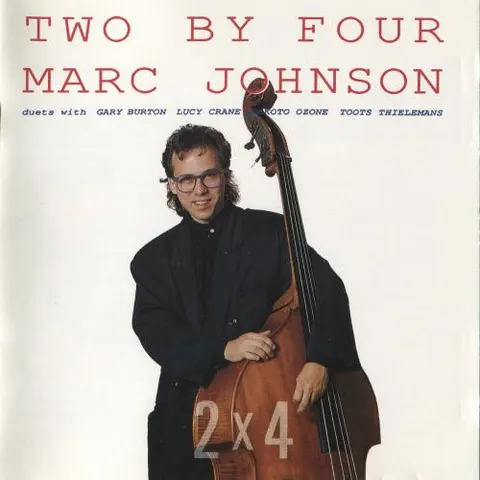
His own catalog began in 1997 and, for its first decade, belonged almost entirely to Jordi Pujol's Barcelona label Fresh Sound New Talent. I Wish I Knew (FSNT 022) is a quartet with Rosenwinkel, bassist Chris Higgins and drummer Jorge Rossy. A Girl Named Joe (FSNT 032, 1998) doubled the front line with Mark Turner on second tenor and added Marc Johnson and Ben Monder. Vine, recorded in New York on December 20 and 21, 1999, put Brad Mehldau at the piano alongside Rosenwinkel, Matt Penman and Rossy. Two live records, Guilty and Lazy Afternoon, came out of the same four nights at the Jamboree in Barcelona, March 21 to 24, 2000, with Ethan Iverson, Ben Street and Rossy. Blues Cruise, cut at Avatar Studios on March 16 and 17, 2005 with Mehldau, Larry Grenadier and Rossy, closed the sequence. Rossy is on every one of those records and on eleven titles in this discography, which makes him Cheek's longest-running musical relationship by a distance.
Alongside the leader dates he built one of the broadest section-player resumes of his generation, and it runs through some of the most demanding large ensembles in New York. He has held a tenor chair in Guillermo Klein's Los Guachos on five albums from Los Guachos II (Sunnyside, 1999) to Cristal (2019). He was in both incarnations of Charlie Haden's Liberation Music Orchestra under Carla Bley's direction, on Not in Our Name (Verve, recorded in Rome in July 2004) and the posthumous Time/Life (Impulse!, 2016), alongside Steve Cardenas and Matt Wilson. He is the tenor voice of Steve Swallow's quintet on Into the Woodwork (XtraWATT/ECM, recorded November 2011) and Winter Songs (ECM, recorded September 2024). Two of the big bands he plays in went to the Grammys: Dafnis Prieto's, whose Back to the Sunset won Best Latin Jazz Album in February 2019 with Cheek on baritone, and Alan Ferber's, whose Jigsaw was nominated for Best Large Jazz Ensemble Album the year before. He also plays baritone in the Identities Big Band on Miguel Zenón's Identities Are Changeable (2014), and on two tracks of Mehldau's Finding Gabriel (Nonesuch, 2019). He recorded twice with Lee Konitz and Furic on ESP-Disk, and on March 31, 2009 Posi-Tone released guitarist Yotam Silberstein's Next Page, with Cheek on tenor, Sam Yahel on organ and Willie Jones III on drums.
Since 2007 he has taught at the New School in New York, and in December 2021 the Royal Conservatoire in The Hague appointed him its main-subject teacher for jazz saxophone. His recent leader work has drifted steadily away from the piano quartet. Two Criss Cross albums reunited him with Seamus Blake under the band name Reeds Ramble, Reeds Ramble (recorded April 4, 2013) and Let's Call the Whole Thing Off (recorded September 10, 2015), both with Iverson, Penman and Jochen Rueckert. Saturday Songs (Sunnyside, June 24, 2016) was recorded in the Spanish village of Estivella in July 2015 and replaced the piano with Cardenas's guitar, David Soler's pedal steel and Rossy on drums, vibraphone and marimba. The Jerome Kern Songbook (Fresh Sound, 2020) came from two days in Barcelona in September 2018. In May 2025 the audiophile label Analog Tone Factory issued Keepers of the Eastern Door, recorded on November 8 and 9, 2024 by a quartet of Cheek with Bill Frisell, Tony Scherr and Rudy Royston, the guitarist's long-standing trio; Cheek first met Frisell on a Paul Motian gig at the Knitting Factory years earlier. He wrote the record after looking at Edward S. Curtis photographs, one of which is on the sleeve, and reading Steinbeck's The Pearl, and took its title from the Mohawk role in the Haudenosaunee Confederacy.
Cheek's sound is the least aggressive thing about him: a light, slightly dry tenor tone with very little vibrato, placed far enough behind the beat that it can read as diffidence until the line resolves somewhere unexpected. That restraint is why bandleaders as different as Motian, Bley, Swallow and Guillermo Klein have used him as a section voice rather than as a soloist to be featured, and why he has held two-tenor chairs opposite players with much bigger sounds, Chris Potter in the Electric Bebop Band, Seamus Blake in the Bloomdaddies and Reeds Ramble, Tony Malaby in Chris Lightcap's Bigmouth, without ever trying to match them for volume. He grew up on 1970s St. Louis rock and country radio before he found jazz, and that shows in his writing more than in his playing: his tunes tend to be short, singable and harmonically plain on the surface, and he has said he takes his cues from guitar-based music, which is why Saturday Songs is scored for guitar, pedal steel and marimba and why Keepers of the Eastern Door is built around Bill Frisell. He is also a genuine multi-instrumentalist within the saxophone family, and the baritone work of the last decade, on the Prieto and Zenón big bands and on Finding Gabriel, is a substantial second career that his own leader records barely hint at.
- Vine (rec. 1999, rel. 2000, Fresh Sound New Talent) - The quintet with Brad Mehldau, Kurt Rosenwinkel, Matt Penman and Jorge Rossy, and the record where his writing and his band arrived at the same time. Spotify - Vine Listen
- Keepers of the Eastern Door (2025, Analog Tone Factory) - His most recent leader album, a quartet with Bill Frisell, Tony Scherr and Rudy Royston written around Edward S. Curtis photographs and cut direct for an audiophile one-step vinyl pressing. Spotify - Keepers of the Eastern Door Listen
- Saturday Songs (rec. 2015, rel. 2016, Sunnyside) - Guitar, pedal steel and marimba in place of a piano, eleven Cheek originals plus a Jobim tune, and the clearest statement of what his songwriting actually sounds like. Spotify - Saturday Songs Listen
- I Wish I Knew (1997, Fresh Sound New Talent) - The leader debut, a quartet with Rosenwinkel, Chris Higgins and Rossy, still the record most often cited when his name comes up. Spotify - I Wish I Knew Listen
- Blues Cruise (2005, Fresh Sound New Talent) - Two days at Avatar with Mehldau, Larry Grenadier and Rossy, and the one leader date where he plays alto, tenor and soprano across a single program. Spotify - Blues Cruise Listen
- Reeds Ramble (rec. 2013, rel. 2014, Criss Cross Jazz) - Co-led with Seamus Blake, the two-tenor front line of the Bloomdaddies rebuilt as a straight-ahead quintet with Ethan Iverson, Matt Penman and Jochen Rueckert. Spotify - Reeds Ramble Listen
- Play Monk & Powell (1999, Winter & Winter) - As a sideman: Paul Motian's Electric Bebop Band with two tenors and two guitars, playing nothing but Thelonious Monk and Bud Powell. Spotify - Play Monk & Powell
- Into the Woodwork (rec. 2011, rel. 2013, XtraWATT/ECM) - As a sideman: the Steve Swallow Quintet with Carla Bley on organ, Steve Cardenas and Rossy, and the best-recorded document of Cheek's ensemble tenor. Spotify - Into the Woodwork
Chris Cheek: Full Discography
Identity confirmed via the live Discogs API, artist ID 330420 ("Chris Cheek," profile text "American jazz tenor saxophonist, born 16 September 1968 in St. Louis, Missouri, USA"). Discogs credits Cheek on 184 releases under that ID (30 filed as "Main," 146 as sideman "Appearance," 5 as track-level "TrackAppearance," and 3 unofficial pressings of records already counted). He has appeared on well over a hundred albums, so the sideman table below is a representative set, not an exhaustive one, chosen for the leaders and ensembles he worked with repeatedly or where the record itself is significant.
The group entities were queried separately, and it mattered. Cheek's Discogs artist record lists 37 group memberships. Chris Cheek Quartet (artist 1404482) holds his leader debut I Wish I Knew, which is filed under his personal ID only as an "Appearance"; The Bloomdaddies (artist 3471510) holds two albums the personal index does not surface as leader dates; Chris Cheek Plus Four (artist 8064587) holds one. A leader-catalog pass against the personal ID alone would have missed all four records.
Session dates, studios and personnel below come from the individual Discogs release records rather than the artist index, cross-checked against Fresh Sound Records' own catalog pages and the Apple iTunes Search API. Where two sources disagree, the conflict is named in the Notes column rather than resolved silently.
The Buy column is a plain hyphen throughout: no affiliate program is set up.
Two source cautions specific to this catalog. (1) Apple returns recording dates rather than release dates for Fresh Sound's back catalog, all of it stamped "(P) 2007" or "(P) 2008 Fresh Sound Records," so Apple was not used for any Fresh Sound title here. (2) Spotify's own catalogue search was unavailable, so every Spotify link below was found by domain-restricted search and then validated individually against Spotify's unauthenticated oEmbed endpoint.
As Leader / Co-Leader
| Album Title | Recording Date(s) | Release Date | Label | Catalog Number | Format(s) | Personnel | Role | Reissue History | Spotify | Buy | Notes |
|---|---|---|---|---|---|---|---|---|---|---|---|
| I Wish I Knew | Not stated on the pressing; Wikipedia gives 1996-97 | 1997 | Fresh Sound New Talent | FSNT 022CD | CD, Album | Chris Cheek (tenor saxophone), Kurt Rosenwinkel (guitar), Chris Higgins (bass), Jorge Rossy (drums) | Leader (billed to Chris Cheek Quartet) | None found | Spotify - I Wish I Knew | - | His leader debut. Filed on Discogs under the group entity Chris Cheek Quartet, not his personal ID. Nine tracks; the pressing carries an erratum note that track 7 is correctly titled "Time Remembered" |
| A Girl Named Joe | Not stated on the pressing; recorded 1997 per Wikipedia | 1998 | Fresh Sound New Talent | FSNT 032 | CD, Album | Chris Cheek and Mark Turner (tenor saxophones), Ben Monder (guitar), Marc Johnson (double bass), Jorge Rossy and Dan Rieser (drums) | Leader | None found | Spotify - A Girl Named Joe | - | Ten tracks. A two-tenor front line, the format he returns to with Seamus Blake sixteen years later. Wikipedia's prose dates this 1997, which is the recording year; its own table says 1998 |
| Vine | Recorded December 20-21, 1999, New York City | 2000 | Fresh Sound New Talent | FSNT 086 | CD, Album | Chris Cheek (tenor and soprano saxophone, all compositions, producer), Brad Mehldau (piano, Fender Rhodes), Kurt Rosenwinkel (guitar), Matt Penman (bass), Jorge Rossy (drums); James Farber, engineer and mixing; Paul Zinman, mastering; Jordi Pujol, executive producer | Leader | None found | Spotify - Vine | - | Eight tracks, all Cheek originals. Wikipedia's prose dates it 1999, the recording year |
| Guilty (Live at the Jamboree) | Recorded live at the Jamboree Club, Barcelona, March 21-24, 2000 | 2002 | Fresh Sound New Talent | FSNT 125 CD | CD, Album | Chris Cheek (tenor saxophone), Ethan Iverson (piano, producer), Ben Street (bass, producer), Jorge Rossy (drums); Jordi Vidal, engineer; A.T. Michael MacDonald, mastering | Co-leader (four names share the billing) | None found | Not found on Spotify | - | Wikipedia lists this as a Blue Moon release; the disc is Fresh Sound New Talent. Companion volume to Lazy Afternoon, from the same four nights |
| Lazy Afternoon (Live at the Jamboree) | Recorded live at the Jamboree Club, Barcelona, March 21-24, 2000 | 2002 | Fresh Sound New Talent | FSNT 126 CD | CD, Album | Same quartet as Guilty | Co-leader | None found | Not found on Spotify | - | Same billing question as Guilty. Seven tracks |
| Blues Cruise | Recorded at Avatar Studios, New York City, March 16-17, 2005 | 2005 | Fresh Sound New Talent | FSNT 235 | CD, Album | Chris Cheek (tenor, alto and soprano saxophone), Brad Mehldau (piano, Fender Rhodes), Larry Grenadier (bass), Jorge Rossy (drums); James Farber, engineer; A.T. Michael MacDonald, mastering | Leader | None found | Spotify - Blues Cruise | - | Nine tracks, four of them Cheek's, plus Duke Ellington's "Low Key Lightly," Rimsky-Korsakov's "Song of India" and Mancini's "The Sweetheart Tree." Wikipedia dates this 2006; Fresh Sound's own catalog page and the disc's "(P)&(C) 2005" both say 2005 |
| Jugendstil | Recorded in New York City, June 2006; edited 2007; mixed in Paris, June 2008 | 2008 | ESP-Disk' | ESP 4048 | CD, Album | Chris Speed (clarinet), Chris Cheek (tenor and soprano saxophone), Stephane Furic Leibovici (double bass, all compositions); Jim Black, producer and liner notes; Kevin Whitehead, liner notes; Joe Marciano, recording | Co-leader (three names share the billing) | None found | Not found on Spotify | - | Eleven tracks, all Furic compositions. Absent from Wikipedia's leader list, which files it under "with Stephane Furic" |
| Jugendstil II | Recorded at Systems Two, New York City, August 15, 2005 | 2010 | ESP-Disk' | ESP 4059 | CD, Album | Lee Konitz (alto saxophone), Chris Cheek (tenor saxophone), Stephane Furic Leibovici (double bass, all compositions), with Chris Speed (clarinet), Jim Black (vibraphone, glockenspiel, chimes), Dan Dorrance (flutes), Joy Plaisted (harp), Maria Garcia (celesta) | Co-leader (three names share the billing) | None found | Not found on Spotify | - | Recorded five years before release, and three years before the album billed as its first volume. Eight tracks |
| Reeds Ramble | Recorded April 4, 2013, Systems Two Recording Studios, Brooklyn | February 18, 2014 | Criss Cross Jazz | Criss 1364 CD | CD, Album | Seamus Blake (tenor saxophone), Chris Cheek (tenor and soprano saxophone), Ethan Iverson (piano), Matt Penman (bass), Jochen Rueckert (drums); Gerry Teekens, producer; Michael Marciano, engineer and mixing | Co-leader | None found | Spotify - Reeds Ramble | - | Nine tracks. Apple bills this to "TRUE & Chris Cheek," where "TRUE" is a corruption of Seamus Blake's name that recurs across Apple's catalog |
| Let's Call the Whole Thing Off | Recorded September 10, 2015 | May 5, 2016 | Criss Cross Jazz | Criss 1388 CD | CD, Album | Same quintet as Reeds Ramble, billed "Seamus Blake / Chris Cheek with Reeds Ramble" | Co-leader | None found | Spotify - Let's Call the Whole Thing Off | - | Eight tracks. Apple dates it 2016-06-17, six weeks after the Discogs pressing date |
| Saturday Songs | Recorded at Supertone Studios, Estivella, Spain, July 2015; mixed at the Bunker, Brooklyn, October 2015 | June 24, 2016 | Sunnyside | SSC 1453 | CD, Album | Chris Cheek (tenor saxophone, composer on 11 of 12 tracks), Steve Cardenas (guitar), David Soler (pedal steel guitar), Jaume Llombart (bass), Jorge Rossy (drums, vibraphone, marimba); Aaron Nevezie, mixing; Alex DeTurk, mastering | Leader | None found | Spotify - Saturday Songs | - | Twelve tracks; the twelfth is Antonio Carlos Jobim's. No piano and no drums-and-bass conventional rhythm section. Wikipedia says it was recorded at "Supertone Records, Valencia"; the disc says Supertone Studios, Estivella, a village in the province of Valencia |
| The Jerome Kern Songbook | Recorded at Medusa Estudio, Barcelona, September 5-6, 2018 | 2020 | Fresh Sound Records | FSR-CD 5110 | CD, Album | Chris Cheek (tenor and soprano saxophone), Gustav Lundgren (guitar, producer, mixing), Tom Warburton (bass), Jorge Rossy (drums, vibraphone); Juanjo Alba, engineer; Alar Suurna, mastering; Jordi Pujol, executive producer | Co-billed (four names on the sleeve, Cheek first) | None found | Not found on Spotify | - | Eight Jerome Kern compositions. Absent from Wikipedia's discography entirely |
| Keepers of the Eastern Door | Recorded November 8-9, 2024 | May 23, 2025 | Analog Tone Factory (under licence to La Reserve Records) | ATF 002 | Vinyl, LP, Limited Edition, Numbered, Stereo; also digital | Chris Cheek (tenor and soprano saxophone, producer), Bill Frisell (electric and acoustic guitar), Tony Scherr (bass), Rudy Royston (drums); Pete Rende and Jerome Sabbagh, co-producers; James Farber, recording; Bernie Grundman, mastering and lacquer cut | Leader | Extended Edition issued July 17, 2026 | Spotify - Keepers of the Eastern Door | - | Eight tracks. A numbered one-step pressing pressed at Gotta Groove Records. The sleeve credits Edward S. Curtis for the photography; Cheek has said the record grew out of Curtis's images, Steinbeck's The Pearl and Mohawk history. Absent from Wikipedia's discography |
As Co-Founder: The Bloomdaddies
The two-tenor electric band Cheek co-founded with Seamus Blake. Filed on Discogs under three different billings, which is why the group is easy to miss.
| Album Title | Recording Date(s) | Release Date | Label | Catalog Number | Personnel | Notes |
|---|---|---|---|---|---|---|
| The Bloomdaddies | Recorded December 16, 1995, New York City | 1996 | Criss Cross Jazz | Criss 1110 CD | Seamus Blake and Chris Cheek (tenor saxophones), with the Bloomdaddies rhythm section | Billed on Discogs to Seamus Blake, not to the band, so it does not appear under the Bloomdaddies artist entity |
| Racer X | Not stated | Undated on the pressing; Wikipedia gives 1998 | Not on Label (self-released) | none | Blake, Cheek, Jesse Murphy, Jorge Rossy, Dan Rieser | Self-released and undated on Discogs. The one album in the catalog whose year could not be confirmed from any source |
| Mosh for Lovers | Recorded January 3-5, 2001, Water Music; mixed February 3-5, 2001, Shelter Island Sound | 2002 | Fresh Sound New Talent | FSNT 131CD | Chris Cheek and Seamus Blake (tenor saxophones), Jesse Murphy (bass, lead vocals), Dan Rieser, Jorge Rossy and Tony Mason (drums); Joe Ferla, recording and mixing; Greg Calbi, mastering | Eleven tracks, three drummers. Absent from Wikipedia's leader table and listed only under "As member" |
As Sideman (selected major credits)
| Year | Project (Leader) | Title | Label | Catalog | Role | Notes |
|---|---|---|---|---|---|---|
| 1991 | Stephane Furic | Kishinev | Soul Note | 121215-2 | Tenor and soprano saxophone | Recorded July 1990 at Blue Jay Studio, Boston. His earliest documented recording, from the Berklee years, which makes Wikipedia's "years active 1992-present" a New York start date rather than a career start |
| 1993 | Stephane Furic | The Twitter-Machine | Soul Note | none listed | Tenor and soprano saxophone | Wikipedia dates this 1992 and drops the hyphen from the title |
| 1993 | Wolfgang Muthspiel Group | In & Out | Amadeo | none listed | Saxophone | Wikipedia lists it as "In and Out" |
| 1994 | Paul Motian and the Electric Bebop Band | Reincarnation of a Love Bird | JMT | jmt 514016-2 | Tenor saxophone (right channel) | Recorded live to two-track at the Power Station, New York, June 1994. With Chris Potter (tenor and alto, left channel), Kurt Rosenwinkel and Wolfgang Muthspiel (guitars), Steve Swallow (bass), Don Alias (percussion) |
| 1996 | Frank Carlberg | The Crazy Woman | Accurate Records | none listed | Saxophone | Wikipedia dates this 1995 |
| 1996 | Stephane Furic | Crossing Brooklyn Ferry | Soul Note | none listed | Saxophone | Wikipedia dates this 1995 |
| 1997 | Paul Motian and the Electric Bebop Band | Flight of the Blue Jay | Winter & Winter | 910 009-2 | Tenor saxophone (right side) | Recorded at Avatar Studios, August 20-21, 1996. Two tenors (Cheek and Potter) and two guitars (Rosenwinkel and Brad Schoeppach). Wikipedia dates it 1996, the recording year |
| 1998 | Mika Pohjola | Announcement | YLE | none listed | Saxophone | Wikipedia gives the label as Blue Music Group and the year as 1997 |
| 1999 | Paul Motian and the Electric Bebop Band | Play Monk & Powell | Winter & Winter | 910 045-2 | Tenor saxophone | Recorded at Avatar Studios, November 28-29, 1998. Nine tracks: five Thelonious Monk tunes and four Bud Powell tunes. Spotify - Play Monk & Powell |
| 1999 | Guillermo Klein | Los Guachos II | Sunnyside | SSC 1082 | Tenor and soprano saxophone | Recorded February 4-5, 1999. A three-tenor front line with Bill McHenry and Tony Malaby. Spotify - Los Guachos II |
| 2000 | Luciana Souza | The Poems of Elizabeth Bishop and Other Songs | Sunnyside | none listed | Saxophone | Named in the New Grove entry as one of his defining collaborations |
| 2001 | Paul Motian and the E.B.B.B. | Europe | Winter & Winter | none listed | Tenor saxophone | Wikipedia dates this 2000 |
| 2002 | Paul Motian and the E.B.B.B. | Holiday for Strings | Winter & Winter | none listed | Tenor saxophone | Wikipedia dates this 2001 |
| 2002 | Guillermo Klein / Los Guachos | Los Guachos III | Sunnyside | SSC 1099 | Tenor and soprano saxophone | Double album. Cheek on discs 1 and part of 2 |
| 2003 | Stephane Furic | Music for 3 (Vol. 1) | Soul Note | none listed | Saxophone | Wikipedia dates this 1997, six years early, the largest single year error found in the article |
| 2005 | Charlie Haden / Liberation Music Orchestra | Not in Our Name | Verve | B0004949-02 | Tenor saxophone | Recorded July 19-22, 2004 at Studio Forum Music Village, Rome. Carla Bley, arranger, conductor and producer. With Tony Malaby (tenor), Miguel Zenón (alto), Steve Cardenas (guitar), Matt Wilson (drums) |
| 2005 | Brad Mehldau Trio | Day Is Done | Nonesuch | 79910-2 | Composer only, not a player | Cheek wrote track 8, "Granada." All eight Discogs pressings were checked and none credits him as a musician: the record is a piano trio. Listed here because Discogs's artist index files it as an "Appearance," which is misleading |
| 2006 | Paul Motian Band | Garden of Eden | ECM | ECM 1917 | Saxophone; also composer of track 6, "Desert Dream" | Recorded November 2004 at Avatar Studios, released February 3, 2006. Three guitars (Ben Monder, Jakob Bro, Steve Cardenas), two saxophones (Cheek and Tony Malaby), Jerome Harris on bass. Wikipedia dates it 2004. Spotify - Garden of Eden |
| 2007 | Rudder | Rudder | Nineteen-Eight Records | 19/8 1005 | Saxophone | Released April 16, 2007. An electric quartet co-led with Henry Hey (keyboards), Tim Lefebvre (bass) and Keith Carlock (drums), and the furthest thing in the catalog from his acoustic leader dates. Second album Matorning (2009) |
| 2007 | Joshua Redman | Back East | Nonesuch | 7559-79993-8 | Saxophone, track 8 only ("Mantra #5") | The release-level credit block names only Redman and the three rhythm sections; the guest tenor credits are tagged at track level. One of three guest saxophonists on the album, one track each |
| 2008 | Guillermo Klein / Los Guachos | Filtros | Sunnyside | SSC 1177 | Saxophone | Recorded June 19-20, 2007 |
| 2010 | Chris Lightcap's Bigmouth | Deluxe | Clean Feed | CF174CD | Tenor saxophone | Recorded October 8-9, 2008. Two tenors (Cheek and Tony Malaby), Craig Taborn on keyboards, Gerald Cleaver on drums |
| 2010 | Jared Gold | Out of Line | Posi-Tone | PR8067 | Tenor saxophone | Organ quartet with Gold, Dave Stryker and Mark Ferber. This is the Gold record Cheek is actually on. Wikipedia instead lists Intuition (2012), which is a Gold trio with no saxophone |
| 2009 | Yotam Silberstein | Next Page | Posi-Tone | PR8050 | Tenor saxophone | Released March 31, 2009. Ten tracks. With Sam Yahel (organ) and Willie Jones III (drums); all compositions by Silberstein. Discogs's release record gives 2009-06-02, which is wrong: Apple returns 2009-03-31 with "(P) 2008 Posi-Tone Records," and the same bad June date appears on the adjacent Posi-Tone catalog number PR8048 |
| 2012 | Guillermo Klein / Los Guachos | CaRREra | Sunnyside | SSC 1286 | Tenor and baritone saxophone | Recorded at Systems Two, Brooklyn, May 6-7, 2011. His first documented baritone credit with Klein |
| 2013 | The Swallow Quintet | Into the Woodwork | XtraWATT / ECM | XtraWATT/13 | Tenor saxophone | Recorded November 15-16, 2011, mixed and mastered at Studios La Buissonne. Steve Swallow (bass), Carla Bley (organ), Steve Cardenas (guitar), Jorge Rossy (drums). Released June 14, 2013. Spotify - Into the Woodwork |
| 2013 | Alan Ferber | March Sublime | Sunnyside | SSC1367 | Baritone saxophone | Recorded May 31 and June 1, 2012; released July 30, 2013 |
| 2014 | Miguel Zenón | Identities Are Changeable | Miel Music | none | Baritone saxophone, in the Identities Big Band | The Discogs release credits only Zenon's quartet, so a Discogs-only check returns nothing. The big-band personnel, Cheek included, is documented on Zenon's own site and in the album's press materials. Commissioned by Montclair State University's Peak Performances |
| 2015 | Chris Lightcap's Bigmouth | Epicenter | Clean Feed | CF315CD | Tenor saxophone | Recorded December 16-17, 2013, Brooklyn Recording; released March 4, 2015 |
| 2016 | Charlie Haden / Liberation Music Orchestra | Time/Life (Song for the Whales and Other Beings) | Impulse! | 479 848-0 | Tenor saxophone | Released October 14, 2016, after Haden's death. Haden plays bass on tracks 1 and 5, Steve Swallow on 2 to 4. Carla Bley arranges and conducts |
| 2016 | Guillermo Klein / Los Guachos | Los Guachos V | Sunnyside | SSC 1414 | Soprano, tenor and baritone saxophone | Recorded at Avatar Studios, May 15-16, 2015 |
| 2017 | Alan Ferber Big Band | Jigsaw | Sunnyside | SSC 1494 | Saxophone | Nominated for Best Large Jazz Ensemble Album at the 60th Grammy Awards (2018) |
| 2018 | Dafnis Prieto Big Band | Back to the Sunset | Dafnison Music | 007 | Baritone saxophone | Recorded at Systems Two, Brooklyn, August 28-29, 2017; released April 6, 2018. Won Best Latin Jazz Album at the 61st Grammy Awards, February 10, 2019. Guests included Henry Threadgill, Steve Coleman and Brian Lynch. Spotify - Back to the Sunset |
| 2018 | Madeleine Peyroux | Anthem | Decca | 676506-4 | Tenor and baritone saxophone | Produced by Larry Klein. Absent from Wikipedia's list |
| 2019 | Brad Mehldau | Finding Gabriel | Nonesuch | 7559-79263-5 | Tenor and baritone saxophone on "The Garden"; baritone on "The Prophet Is a Fool" | Two of ten tracks, not the whole album. No Discogs pressing carries a release-level credit for him; the credits are tagged at track level on the European LP and the Japanese CD |
| 2019 | Chris Lightcap | SuperBigmouth | Pyroclastic Records | PR 07 | Tenor saxophone | The expanded Bigmouth |
| 2019 | Guillermo Klein / Los Guachos | Cristal | Sunnyside | SSC 1567 | Sopranino, tenor and baritone saxophone | Three saxophones on one record, his widest instrumental spread in the catalog |
| 2026 | Steve Swallow | Winter Songs | ECM | ECM 2879 | Tenor saxophone | Recorded September 2024 at Sear Sound, New York; released June 26, 2026. Swallow (bass), Michael Rodriguez (trumpet), Steve Cardenas (guitar), Gil Goldstein (piano), Adam Nussbaum (drums). His most recent released credit at the time of writing |
Co-Billed and Guest-Billed Dates
Records where Cheek is named on the sleeve as a featured guest rather than as leader or as an ordinary sideman. Discogs files most of these under "Main," which inflates his leader count; none of them is a Chris Cheek album.
| Year | Billing on the sleeve | Title | Label | Catalog |
|---|---|---|---|---|
| 1997 | Elisabet Raspall Quintet featuring Chris Cheek | Triangles | Fresh Sound New Talent | none listed |
| 1998 | Mark Turner, Chris Cheek, George Colligan, Mario Rossy, Jordi Rossy | The Music of Mercedes Rossy | Fresh Sound New Talent | none listed |
| 2003 | Trioscope featuring Chris Cheek | Trioscope | Cope Records | none listed |
| 2005 | Klemens Marktl, Chris Cheek, Matt Penman, Aaron Goldberg | Ocean Avenue | Fresh Sound New Talent | none listed |
| 2006 | Daniel Schenker Quartet inviting Chris Cheek | Soundlines | TCB Records | none listed |
| 2006 | Orquestra Jazz de Matosinhos invites Chris Cheek | OJM Invites Chris Cheek | Fresh Sound New Talent | FSNT277 |
| 2008 | Bruno Raberg, Chris Cheek, Ben Monder, Matt Wilson, Ted Poor | Lifelines | OrbisMusic | none listed |
| 2012 | Philippe Le Baraillec, Chris Cheek, Mauro Gargano, Ichiro Onoe | Involved | Outnote Records | none listed |
| 2012 | Elisabet Raspall, Chris Cheek | El Peto (The Kiss) | Raspall Records | none listed |
| 2013 | Bridges Trio & Chris Cheek | South Lamar Boulevard | Petit Indie | none listed |
| 2014 | Marcello Tonolo Quartet featuring Chris Cheek Plus Four | Crazeology | Caligola | none listed |
| 2017 | Fox, Pierre Perchaud, Nicolas Moreaux, Jorge Rossy + Chris Cheek | Pelican Blues | Jazz&People | none listed |
| 2018 | MMO featuring Chris Cheek | The Hiker | Unit Records | none listed |
| 2018 | Wild Man Conspiracy & Chris Cheek | Live at the Bimhuis | Red Piano Records | none listed |
| 2019 | Map + Chris Cheek | Map + Chris Cheek | Carimbo Porta-Jazz | none listed |
| 2019 | Gianni Gagliardi featuring Chris Cheek | Bikram | AMP Music & Records | none listed |
| 2020 | Daniel Schenker Quintet featuring Chris Cheek | Times of Innocence | TCB Records | none listed |
| 2024 | Orquestra Jazz de Matosinhos & Chris Cheek | Farol: Musica de Carlos Azevedo | CARA | none listed |
Credits Excluded, and Why
- Jared Gold, Intuition (Posi-Tone, 2012). Named by Wikipedia. The pressing is an organ trio with no saxophone. Excluded; Out of Line (2010) is the correct record and is in the table above.
- Jen Chapin, Live at the Bitter End (Purple Chair Music, 1999) and Brooklyn Boogaloo Blowout, The Boog at Sunny's (2017), both named by Wikipedia, appear nowhere in Cheek's Discogs index under those titles. The index does hold a Brooklyn Boogaloo Blowout release called Old Soul (StorySound, undated). Neither Wikipedia title could be confirmed and neither is asserted here.
- Uri Gurvich, The Storyteller (Tzadik, 2009) is in Cheek's Discogs artist index but carries no Cheek credit on the release record itself. Not asserted.
- Wikipedia's Racer X date of 1998 could not be confirmed: the Discogs entry is undated and the album was self-released. The table says so rather than repeating the year as fact.
- Jorge Rossy - the central relationship, eleven records over almost thirty years. Drummer on every Fresh Sound leader date from I Wish I Knew (1997) to Blues Cruise (2005), on Saturday Songs (2016) and The Jerome Kern Songbook (2020), and on Cheek's sideman work with Steve Swallow and the Orquestra Jazz de Matosinhos.
- Seamus Blake - co-founder of the Bloomdaddies in the mid-1990s and co-leader of Reeds Ramble twenty years later. Five albums together: The Bloomdaddies (1996), Racer X, Mosh for Lovers (2002), Reeds Ramble (2014) and Let's Call the Whole Thing Off (2016).
- Paul Motian - twelve years and six albums in the Electric Bebop Band and its successor the Paul Motian Band, 1994 to 2006, the association that established him in New York.
- Guillermo Klein - a tenor and soprano chair in Los Guachos across five albums between 1999 and 2019, plus Klein's quintet and his duo record with Aaron Goldberg.
- Brad Mehldau - pianist on Vine (1999) and Blues Cruise (2005), recorded Cheek's tune "Granada" on his own Day Is Done (2005), and used him on tenor and baritone on two tracks of Finding Gabriel (2019).
- Kurt Rosenwinkel - guitarist on I Wish I Knew and Vine and a fellow Electric Bebop Band member on the first three Motian records.
- Carla Bley and Steve Swallow - his two large-ensemble employers of the last two decades, through the Liberation Music Orchestra (2004 and 2016) and the Swallow Quintet (Into the Woodwork, 2013; Winter Songs, 2026).
- Stephane Furic Leibovici - the oldest partnership in the catalog, six albums from Kishinev (1991) to Jugendstil II (2010), the last two of which also feature Lee Konitz and Chris Speed.
- Ethan Iverson, Matt Penman and Jochen Rueckert - the rhythm section of both Reeds Ramble albums; Iverson and Ben Street had been the Guilty and Lazy Afternoon quartet in 2000.
- Chris Lightcap - a two-tenor chair opposite Tony Malaby in Lightcap's Bigmouth on Deluxe (2010), Epicenter (2015) and SuperBigmouth (2019).
- Bill Frisell - first met on a Paul Motian gig at the Knitting Factory; the guitarist's trio with Tony Scherr and Rudy Royston is the band on Keepers of the Eastern Door (2025).
- Wikipedia: Chris Cheek
- Discogs: Chris Cheek (artist 330420)
- Discogs: Chris Cheek Quartet (artist 1404482)
- Discogs: The Bloomdaddies (artist 3471510)
- Royal Conservatoire The Hague: Chris Cheek appointed main-subject teacher, jazz saxophone (December 2021)
- JazzTrail: Chris Cheek interview, New York
- Chris Cheek on Bandcamp
- Fresh Sound Records: Chris Cheek albums
- Fresh Sound Records: Blues Cruise (FSNT-235)
- Dafnison Music: Dafnis Prieto Big Band wins the Grammy for Best Latin Jazz Album (February 2019)
- Miguel Zenon: Identities Are Changeable
- Wikimedia Commons: File:Chris Lightcap's Bigmouth 19 maart 2017 BIM Amsterdam - Chris Cheek
- Apple iTunes Search API (release dates and copyright lines)