 JAZZPROFILES lives in the music 1,795 Jazz Artists fully Profiled!
Jung Sung-jo
Last updated October 24, 2026
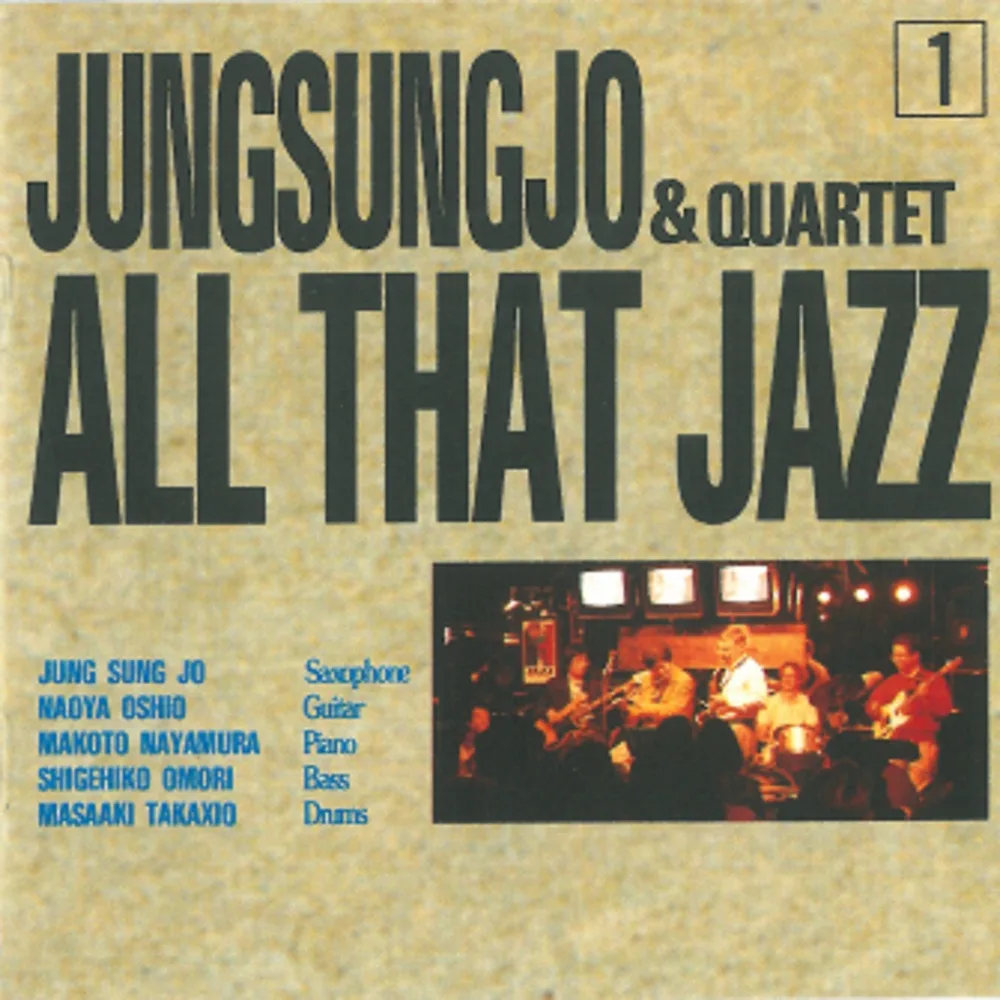
Cover of *All That Jazz* by Jung Sung Jo & Quartet (오감엔터테인먼트, 2022 release), one of the albums recommended in this profile. It is a printed sleeve with the title, a list of five musicians and a small photograph of a band on a club stage; it is not a photograph of the artist alone. Standard copyright, all rights reserved, held by 오감엔터테인먼트. This is not a Creative Commons or public-domain image; it is an album cover shown as an honestly disclosed editorial identification image. — https://music.apple.com/us/album/all-that-jazz/1646189289 (Apple Music artwork for the album, 1000 x 1000 version)
Jung Sung-jo (정성조, also romanized Jeong Seong-jo and, on his big band records, Sungjo Jung) was a South Korean saxophonist, flautist, arranger, composer and bandleader who passed away on October 26, 2014, at the age of 68. Korean newspapers called him a first-generation jazz musician, and Berklee College of Music believes he was the first Korean student to enroll there, in 1979. His career ran on three tracks at once: film and pop music, where he wrote about 40 to 50 scores and led the KBS orchestra for roughly a decade; jazz education, where he helped found the practical music department of the Seoul Institute of the Arts, which Korean press calls the country's first; and jazz playing, in Seoul clubs and, late in life, on big band albums. The records released under his own name from the 1970s and 1980s are mostly film soundtracks and disco-era albums, which Discogs files largely under funk, soul and pop. The straight jazz records come after 2010, so the case for him as a jazz musician rests on his club work, his teaching and his big band writing as much as on his early discography.
He was born on April 8, 1946; no source found gives his birthplace. According to a 2009 TenAsia interview he learned music near a U.S. military base in the 1950s, starting on piano, and Seoul High School knew him as a jazz talent. Obituaries in the Korean press say he took up the saxophone at Seoul Middle School and, as a high school student in the 1960s, played with a U.S. Eighth Army band. In the 2009 interview he says he began professionally before finishing school as a flautist with the composer Gil Ok-yoon, worked with him for six years and toured with the singer Patti Kim. He then studied composition at Seoul National University, where in 1968 he won a silver prize at the national college jazz festival. His earliest performing credit on Discogs is Kim Min-ki (김민기)'s debut album of 1971, on which he is credited as arranger and plays flute and saxophone on four tracks; Korean Wikipedia says his quartet accompanied the singer.
In the 1970s he led Jung Sung-jo and the Messengers, which obituaries in Korean newspapers describe as Korea's first brass-rock group. Its records were two film soundtrack LPs on Shin Segye Record, 어제 내린 비 (It Rained Yesterday, 1975) and 영자의 全盛時代 (Yeong-ja's Heyday, 1976), with the trumpeter Choi Sun Bae in the horn section on both. Korean Wikipedia and Discogs say he made his debut as a film music director on the 1974 film It Rained Yesterday, writing the title song that the singer Yoon Hyung-joo recorded, and in 1977 he scored Winter Woman (겨울여자), which TenAsia says drew about one million viewers.
In 1979, finding the Korean market limiting, he went to Berklee, a school he had first seen advertised in Down Beat while still in high school; Berklee says he was touring the United States as a backing musician for Korean singers when he decided to enroll. He earned a degree in professional music by 1983, and TenAsia says he returned to Seoul that autumn. Berklee's account adds that he brought back the first copy of the Real Book that Korean musicians had seen, and that it was widely copied. He names Greg Hopkins, Barry Nettles, Phil Wilson and Bill Pierce among his teachers there. Back in Korea he wrote more film music, including Deep Blue Night (깊고 푸른 밤, soundtrack LP 1985), which he called his favorite, and the baseball film Lee Jang-ho's Baseball Team (soundtrack LP 1986), and he served as music director for Korean productions of musicals including West Side Story, Jesus Christ Superstar and Evita.
In the late 1980s he helped build the practical music department at the Seoul Institute of the Arts (서울예술대학); sources give 1987, 1988 and 1989 as the year it opened, and Berklee says he taught the first jazz theory courses there in 1988. He left teaching in 1995 to conduct the KBS Orchestra, a post he held for about ten years that included television programs such as Open Concert and Big Show, and he went back to the Institute in 2005. In 2009 he received the Jecheon International Music & Film Festival's film music award. Through those years he kept playing: the TenAsia interview says he had appeared at the Seoul club All That Jazz for 27 years, and the notes to his 2013 album say he played the Cheongdam-dong club Once in a Blue Moon every Friday night for almost ten years. The Seoul Shinmun's September 2000 profile of the drummer Choi Se-jin names him, with Gil Ok-yoon, as a co-founder of the Korea Jazz Association; the article gives no dates.
His own jazz records came late. Sungjo Jung Big Band In New York (2010) collects arrangements his Seoul Institute of the Arts big band class had played for years, offered in his liner note to young players and arrangers, and a Korean newspaper reported in July 2010 on a big band concert at Seoul's Drama Center that played much of the same repertoire. By November 2011 a Jeonbuk newspaper described him as a research professor at the City University of New York, and he took a master's degree at Queens College. There he recorded Jung Sungjo Big Band In New York-2 (2013) with the Queens College big band and its trumpet professor Mike Mossman, adding a piece, "Seoul Express", that he wrote to mark his year and a half in New York. A quartet album, All That Jazz, lists four other musicians on its sleeve and is on streaming services in a 2022 release; its recording date is not given in the sources found.
He retired from the Seoul Institute of the Arts in 2011. In his last years he headed the practical music department at the Seoul School of Integrated Arts (서울종합예술학교), where he formed a big band with students; TenAsia says the SAC Big Band performed successfully in May 2014, and at the time of his death he also led a jazz quintet. An acquaintance told TenAsia that he had no known chronic illness and that a cancer of the muscle had been found a few months earlier; other Korean newspapers name it as a sarcoma, and he passed away at 12:50 p.m. on October 26, 2014. He received a music prize at the 1999 Korea Broadcasting Awards and a presidential commendation at the 2013 Korean Popular Culture and Arts Awards. His wife, Kim Jung-ae, and his son, the trombonist Jung Joong-hwa, survived him; Edaily says the son joined the faculty of the Seoul School of Integrated Arts in 2014.
His working instrument in jazz was the tenor saxophone, which is how Berklee lists him, and his obituaries add flute and clarinet. The flute is a real part of his voice: on "My Romance" from the 2013 album he plays the main solo himself, over trombones and saxophones in unison with the trumpets switched to flugelhorn, and he plays flute again on the mambo-time "Au Privave".
He wrote as an arranger first. His liner notes complain that arranging, meaning the recreation of an existing tune in the arranger's own way, was little understood in Korea, and say that foreign arranging textbooks are built on the big band. He names Sammy Nestico, whose The Professional Arranger he calls a bible, as the arranger he studied hardest, and "Hello, Sammy" is his own tune in his honor. "Here's That Rainy Day" is a Count Basie style chart, and "My Shining Hour" borrows Billy May's short, forceful phrases. The big band albums mix standards by Dorham, Parker, Davis, Miller and Rodgers with Korean material: "Arirang", the popular song "Dolawayo Busanhange" and a film music suite appear on the 2010 album, and "Seoul Express" quotes the folk tune "Ganggangsullae".
On the film side, Discogs files the two Messengers soundtracks under funk, soul and pop, with sax, flute, trumpet, organ and guitar in the band, and describes the 1977 Winter Woman soundtrack as jazz-funk. His club repertoire, on the quartet album All That Jazz, is almost all standards: "In a Sentimental Mood", "All the Things You Are", "Black Orpheus", "Corcovado" and "Wave".
- Sungjo Jung Big Band In New York (2010, Genie Music / Stone Music) - thirteen big band tracks, among them "Blue Bossa", "Old Devil Moon", "Confirmation", "Four", "For Minors Only" and "Arirang". YouTube - Blue Bossa · YouTube - Arirang Listen
- All That Jazz (Jung Sung Jo & Quartet, 오감엔터테인먼트; 2022 release) - nine standards, with Jung on saxophone. Apple Music - All That Jazz · YouTube - In a Sentimental Mood Listen
- Jung Sungjo Big Band In New York-2 (2013, Genie Music / Stone Music) - the Queens College big band with Mike Mossman, nine tracks including "Au Privave" and "Seoul Express".
- Jung Sung-jo & The Messengers, 어제 내린 비 (1975, Shin Segye Record S가 8014) - soundtrack LP with Choi Sun Bae on trumpet. YouTube - Dark Alley Listen
- Jung Sung-jo & The Messengers, 영자의 全盛時代 (1976, Shin Segye Record S가 8027) - the second Messengers soundtrack. YouTube - full album Listen
- O.S.T. 겨울女子 (Winter Woman) (1977, Shin Segye Record SO-7619) - his best-known film score. YouTube - 겨울 이야기 Listen · Buy
- Kim Min-ki, 김민기 (1971, Taedo EU 716) - his earliest credit, as arranger and on flute and saxophone. YouTube - 종이연 Listen
- OST 깊고푸른밤 (1985, Jigu Records JLS-1201941) - the Deep Blue Night score, shared with the singer Bang Mi. YouTube - side A Listen
Jung Sung-jo (정성조) - Full Discography
South Korean saxophonist, flautist, arranger, composer and bandleader, born April 8, 1946, passed away October 26, 2014. Discogs artist 2531929 (billed there as Sung-Jo Jung).
Name variations on record: Sung-Jo Jung, Jung Sung-jo, Jung Sung Jo, Sungjo Jung, Jung Sungjo, Jeong Seong-jo, 정성조, 鄭成朝 (the Chinese-character form given by Wikidata and Korean Wikipedia).
Group affiliations on record: The Messengers (정성조와 그 메신저스, billed with him on his 1975 and 1976 albums), Jung Sung Jo & Quartet, Sung-Jo Jung Jazz Ensemble (정성조 재즈 앙상블), Jung Sungjo Big Band with the Queens College big band.
What the records are: most of the albums issued under his name in the 1970s and 1980s are film soundtracks and disco-era records, filed by Discogs mostly under funk, soul, pop and stage and screen. His straight jazz records are the quartet and ensemble albums called All That Jazz and the two big band albums of 2010 and 2013, which are not on Discogs; their details come from Bugs, Melon and Apple Music listings.
Leader and co-leader
| Album | Year | Label | Personnel | Notes | Listen | Buy |
|---|---|---|---|---|---|---|
| 어제 내린 비 (It Rained Yesterday, billed as 정성조 & The Messengers) | 1975 | Shin Segye Record, S가 8014 | Jung Sung-jo (saxophone, flute), Choi Sun Bae (trumpet), 변성용 (organ, synthesizer), 장석웅 (guitar, vocals), 조경수 (bass guitar, vocals), Young-Soo Yoo (drums), 최병걸 (lead vocals) | Soundtrack LP for the 1974 film. Thirteen tracks including "어제 내린 비", "사랑의 찬가", "달려서 가네", "웃어야할텐데", "어두운 골목길" and instrumental versions of several of them. Discogs notes that press reports place the first release in 1975 and that the pink-label copies are probably the first run; later pressings are listed with dates from 1977 to 1980. Discogs master 2270626. | Dark Alley (instrumental) on YouTube | Amazon |
| 영자의 全盛時代 (Yeong-ja's Heyday, billed as 정성조 와 그 메신저스) | 1976 | Shin Segye Record, S가 8027 | Jung Sung-jo (saxophone, flute), Choi Sun Bae (trumpet), Byun Sung Yong (organ), Jang Suk Ung (guitar), Cho Kyeong Soo (bass guitar), Young-Soo Yoo (drums), 최병걸 (lead vocals) | Soundtrack LP released in February 1976 with the same group as the 1975 album. Thirteen tracks including "너무 많아요", "그림자", "이젠 가야지" and "가고 싶어요", with the vocal tracks repeated as instrumentals. Discogs release 9680006. | Full album on YouTube | Amazon |
| O.S.T. 겨울女子 (Winter Woman) | 1977 | Shin Segye Record, SO-7619 | Not itemized on the release | Eight tracks, among them "겨울여자", "겨울노래", "겨울사랑", "겨울이야기". Released September 30, 1977; a cassette (OT-7624) followed on October 15, 1977, and an unofficial reissue (열린음악 OPL-051) with the singer Kim Se-hwa in 2017. Discogs styles it funk, soul and jazz-funk. Discogs master 2250727. | "겨울 이야기" on YouTube | Amazon |
| DISCO 경음악 제4집 (Sung-Jo Jung and Lee Bong Jo) | 1978 | Oasis Records, OL2109 | Not itemized on the release | Sixteen disco instrumentals of Korean popular songs, among them "돌아와요 부산항에", "눈이 내리네" and "아버지". Released December 26, 1978. Discogs release 15908351. | not found | Amazon |
| 밤의 찬가 | 1980 | HKR, HLK-1001 | Not itemized on the release | Twelve tracks including "밤의 찬가", "주기도문", "꿈과 사랑사이" and "우리는 대한국군". Released March 15, 1980; Discogs credits Jung as executive producer and files the record under jazz, funk, soul and pop. Discogs master 3342289. | not found | Amazon |
| Demonstration 오디오 TEST판 (Ryu Bok Sung's Bongo Orchestra, Sung-Jo Jung and the Yankees) | 1980 | Hyundai Records, HDIN-807 | Ryu Bok Sung (bongos) with the billed groups | Seven tracks; Jung is credited as arranger of "Superman". Discogs release 15908124. | not found | Amazon |
| Disco! 나이트크럽 (Ryu Bok Sung's Bongo Orchestra, Sung-Jo Jung, Ham Joong Ah and Ra Eum Pa) | 1980 | Hyundai Records, HDIN-805 | Ryu Bok Sung (bongos) with the billed artists | Twelve tracks, including "Superman", "Memphis Underground" and "돌아와요 부산항에". Discogs release 15912606. | not found | Amazon |
| OST 깊고푸른밤 (Jung Sung-jo and Bang Mi) | 1985 | Jigu Records, JLS-1201941 | Not itemized on the release | Nine tracks including "깊고 푸른 밤", "안녕히", "제인의 테마" and "도시의 사냥꾼", shared with the singer Bang Mi. Released May 10, 1985. Discogs release 11099346. | Side A on YouTube | Amazon |
| 이장호의 외인구단 (영화주제곡 모음) | 1986 | Jigu Records, JLS-1202038 | Not itemized on the release | Twelve tracks, including "난 너에게", "외인구단" and "사랑의 테마"; Discogs credits Jung as composer. Released August 2, 1986. Discogs release 15890670. | not found | Amazon |
| 영화음악 Y, STORY / 와이의 체험 | 1987 | Shin Segye Record, SIS-870278 | Not itemized on the release | Eleven tracks; Discogs credits Jung as composer and lyricist. Released September 25, 1987. Discogs release 21295054. | not found | Amazon |
| All That Jazz (billed as 정성조 재즈 앙상블, Sung-Jo Jung Jazz Ensemble) | 1993 or 1997 (not confirmed) | Listed on Melon as 오감엔터테인먼트 | Not itemized in the listings found | Ten tracks: "All That Jazz", "Summer Breeze", "Simple Swing", "Blue Sunday", "Blue Monk", "Mr. Jin", "Comin' Home Baby", "Take Five", "Ricardo Bossa", "Blues Walk". One YouTube upload dates the album to 1993; Melon gives January 1, 1997. A different album from the quartet record of the same name below. | Full album on YouTube | not found |
| Sungjo Jung Big Band In New York (billed as 정성조) | 2010 | Genie Music / Stone Music | Not itemized in the listings found | Released July 27, 2010 (66 minutes). Thirteen tracks: "Blue Bossa", "Film Music Suit", "돌아와요 부산항에", "Cuny #219", "애수의 소야곡", "Mother", "Someday", "Hank's Tune", "Old Devil Moon", "Confirmation", "Four", "For Minors Only", "아리랑". Charts from his Seoul Institute of the Arts big band class and concerts, issued with an arrangement book from Sekwang Music Publishing. | Blue Bossa on YouTube · Arirang on YouTube | Amazon |
| All That Jazz (billed as 정성조 & 퀄텟, Jung Sung Jo & Quartet) | 2012 (reissued 2022) | 오감엔터테인먼트 | The sleeve prints Jung Sung Jo (saxophone), Naoya Oshio (guitar), Makoto Nayamura (piano), Shigehiko Omori (bass), Masaaki Takaxio (drums) | Bugs dates it April 13, 2012 (59 minutes); Apple Music, Melon and Bugs list a 2022 release dated September 22, 2022 with the same nine tracks: "In a Sentimental Mood", "All the Things You Are", "Black Orpheus", "Softly as in a Morning Sunrise", "Corcovado", "Over the Rainbow", "Bye Bye Blackbird", "Confirmation", "Wave". The sleeve is numbered "1" and shows a club stage; no recording date is given in the listings found. | Apple Music · "In a Sentimental Mood" on YouTube | Amazon |
| Jung Sungjo Big Band In New York-2 (billed as 정성조와 퀸스 컬리지 빅밴드) | 2013 | Genie Music / Stone Music | Queens College big band; Mike Mossman (lead trumpet and solos); trombonist Amadis Dunkel is thanked in the notes | Released April 30, 2013 (46 minutes). Nine tracks: "Hello, Sammy", "The Night With a Blue Moon", "Here's That Rainy Day", "My Romance", "Bernie's Tune", "Au Privave", "It Never Entered My Mind", "My Shining Hour", "Seoul Express". Recorded at the end of 2012 per his liner note; Jung plays the flute solos on "My Romance" and "Au Privave" and tenor saxophone on "The Night With a Blue Moon". | not found | Amazon |
Sideman, composer, arranger and producer credits
Chronological, as credited on Discogs artist 2531929. Most are composer or arranger credits on other artists' records rather than playing credits; where a credit is for one track only, the track is named.
| Year | Release | Actual leader | Label | Jung's credit and details | Listen | Buy |
|---|---|---|---|---|---|---|
| 1971 | 쉐그린 힛트 앨범 추억 / 동물농장 | 쉐그린 | Universal, KLS-22 | Composer and lyricist, as listed on Discogs. | not found | Amazon |
| 1971 | 김민기 (Kim Min-ki) | Kim Min-ki | Taedo, EU 716 | Arranger; flute and saxophone on A2 "아하 누가 그렇게...", A3 "바람과 나", B1 "길" and B4 "종이연" with Young-Soo Yoo (drums), 조원익 (bass) and Son Soo Gil (piano). Released October 21, 1971. Discogs release 17940178. | "종이연" on YouTube | Amazon |
| 1974 | 영원한 사랑 / 자기 | 정명규 | Universal, KLS-108 | Composer and lyricist of A6 "동물농장". | not found | Amazon |
| 1975 | 정 / 허전한 마음 | 호와섭 | Shin Segye Record, S가8013 | Composer and lyricist, as listed on Discogs. | not found | Amazon |
| 1976 | 골든폭송 베스트14 | Various | Shin Segye Record, S-가8034 | Composer and lyricist, as listed on Discogs. Released September 17, 1976. | not found | Amazon |
| 1978 | 겨울 장미 / 복순이 | 이은하 (Lee Eun-ha) | SRB Records, SR-0128 (cassette) | Arranger of A3 "사랑을 하나봐요". | not found | Amazon |
| 1979 | 소망 / 눈물로 쓴 편지 | 이숙 | SRB Records, SLK-1048 | Producer; Discogs notes that all songs were written and arranged by Jung. Released February 28, 1979. | not found | Amazon |
| 1979 | 도시의 사냥꾼 | 지윤경 (Ji Yun-gyeong) | SRB Records, SLK-1049 | Arranger of track 1, "도시의 사냥꾼". Released February 28, 1979. | not found | Amazon |
| 1979 | 아낌없이 주련다 / 나 있잖아 | 최병걸 (Choi Byung-gul) | Universal, K-APPLE-879 | Composer, as listed on Discogs. Released April 30, 1979. | not found | Amazon |
| 1979 | Shin Se Gye Greatest Hit Vol.1 외로운 밤과 함께! Mystic Mood | 엄진 (Um Jin) | Shin Segye Record, S경-5057 | Composer of B4 "눈물로 쓴 편지" and B6 "겨울여자". Released April 30, 1979. | not found | Amazon |
| 1979 | 하모니의 정상 | 닐리리트리오 (also billed Romantica) | Shin Segye Record, S가-8065 | Composer of A4 "눈물로 쓴 편지" and writer of B3 "정". Released May 31, 1979. | not found | Amazon |
| 1979 | 깊은 정 | 이세진 (Lee Se Jin) | SRB Records, SLK-1055 | Composer of A4 "앉으세요" and A5 "도시의 사냥꾼". Released July 15, 1979. | not found | Amazon |
| 1980 | 밤의 찬가 / 바보처럼 살았군요 | 김도향 (Kim Do Hyang) | HKR, HKS-1001 | Composer and lyricist, as listed on Discogs. | not found | Amazon |
| 1980 | 수퍼스타 예수 그리스도 = Jesus Christ Superstar (Korean cast recording) | Andrew Lloyd Webber and Tim Rice | HKR, HKS-1002 | Arranger. Cast includes 이종용 (Jesus), 김도향 (Judas), 윤복희 (Mary Magdalene), 유인촌 (Pilate). | not found | Amazon |
| 1980 | 밤은 우리의 친구 | 하야로비 | HKR, HKS-1003 | Composer and lyricist of A1 "밤은 우리의 친구". | not found | Amazon |
| 1980 | 무한대분의 일 / 가위바위보 | 김도향 and 송창식 | SRB Records, SLK-1058 | Composer of B4 "다시 만나리" and B5 "공군가". Released January 15, 1980. | not found | Amazon |
| 1980 | 영화 "우요일" 주제가 / 작은풀잎 | 김세화 (Kim Se-hwa) | Oasis Records, OL 2260 | Composer and lyricist of B4 "정". Released April 16, 1980. | not found | Amazon |
| 1981 | 눈내리던 겨울밤 / 그대와 나 | 이화 (Lee Hwa) | HKR, HKS-1005 | Composer of A2 "그게 나에요", A4 "밤의 찬가 II" and B4 "꿈과 사랑사이". Released May 12, 1981. | not found | Amazon |
| 1981 | 바람처럼 낙엽처럼 | 김도향 | HKR, HKS-1006 | Arranger. Released May 28, 1981. | not found | Amazon |
| 1993 | 안혜지 골든 | 안혜지 (An Hey Ji) | Jigu Records, JCDS-0340 (CD compilation) | Composer of track 5, "도시의 사냥꾼". | not found | Amazon |
| 2020 | 부평사운드 Vol.1 = Bupyeong Sound Vol.1 | 최선배 (Choi Sun Bae) with 하헌진밴드 and 소울트레인 | Beatball, BPS-001 | Writer of side A, "어두운 골목길", the song from his 1975 soundtrack album on which Choi plays trumpet. Limited-edition 7-inch single. | not found | Amazon |
- Choi Sun Bae - trumpeter on both Messengers soundtrack LPs, 어제 내린 비 (1975) and 영자의 全盛時代 (1976), where Discogs credits Jung on saxophone and flute and Choi on trumpet.
- Gil Ok-yoon (길옥윤) - composer with whom Jung says he began playing flute as a teenager and with whom he worked for six years.
- Kim Min-ki (김민기) - singer and songwriter whose 1971 debut album (Taedo) Jung arranged and played on.
- Young-Soo Yoo - drummer on the 1971 Kim Min-ki tracks on which Jung plays and on both Messengers LPs.
- 변성용, 장석웅 and 조경수 - organ and synthesizer, guitar and bass in the Messengers on the 1975 album; the 1976 album lists the same group under variant romanizations of the names.
- 최병걸 - lead vocalist on both Messengers LPs; Jung also composed songs for a 1979 record of his.
- Yoon Hyung-joo (윤형주) - singer of the title song of It Rained Yesterday, which Jung composed.
- Bang Mi (방미) - singer billed beside him on the Deep Blue Night soundtrack LP.
- Ryu Bok Sung (유복성) - bongo player of the Bongo Orchestra billed with Jung on two 1980 Hyundai Records LPs.
- Mike Mossman - Queens College trumpet professor, lead trumpeter and soloist on Jung Sungjo Big Band In New York-2 (2013).
- Naoya Oshio, Makoto Nayamura, Shigehiko Omori and Masaaki Takaxio - guitar, piano, bass and drums as printed on the sleeve of All That Jazz.
- Jung Joong-hwa (정중화) - his son, a jazz trombonist and faculty member at the Seoul School of Integrated Arts.
More Big Band Artists
See all 221 Big Band artists →More South Korean Jazz Artists
See all 31 South Korean artists →- Korean Wikipedia: 정성조
- Wikidata: Jeong Sung-jo (Q19162031)
- Discogs: Sung-Jo Jung
- Berklee: Berklee's Korean Legacy
- TenAsia obituary, October 27, 2014
- Apple Music: 정성조
- Bugs: 정성조
- Jung Sung-jo on JazzProfiles.com
- Discogs: Sung-Jo Jung, artist 2531929
- Discogs: 어제 내린 비, master 2270626
- Discogs: 영자의 全盛時代, Shin Segye Record S가 8027
- Discogs: O.S.T. 겨울女子 (Winter Woman), master 2250727
- Discogs: 김민기, Taedo EU 716
- Discogs: OST 깊고푸른밤, Jigu JLS-1201941
- Discogs: 이장호의 외인구단, Jigu JLS-1202038
- Wikipedia (Korean): 정성조
- Wikidata: Jeong Sung-jo
- Berklee: Berklee's Korean Legacy
- TenAsia: interview with Jung Sung-jo at the Jecheon International Music & Film Festival (August 14, 2009)
- TenAsia: obituary (October 27, 2014)
- Edaily via Newsis: obituary (October 26, 2014)
- eToday: obituary (October 27, 2014)
- Seoul Shinmun: obituary (October 27, 2014)
- Newsis: obituary (October 26, 2014)
- Dong-A Hankuk News: Seoul Institute of the Arts big band concert (July 14, 2010)
- Jeonbuk Ilbo: 2011 jazz festival at Wonkwang University (November 15, 2011)
- Bugs: Sungjo Jung Big Band In New York
- Bugs: All That Jazz, Jung Sung Jo & Quartet
- Bugs: Jung Sungjo Big Band In New York-2
- Melon: All That Jazz, 정성조 재즈 앙상블
- Apple Music: All That Jazz
- Seoul Shinmun: profile of Choi Se-jin (September 4, 2000)
- The Korea Times: Seoul's All That Jazz keeps the groove alive, decades on (July 1, 2025)