 JAZZPROFILES lives in the music 1,795 Jazz Artists fully Profiled!
Kang Tae Hwan
Last updated October 24, 2026
Listen on Spotify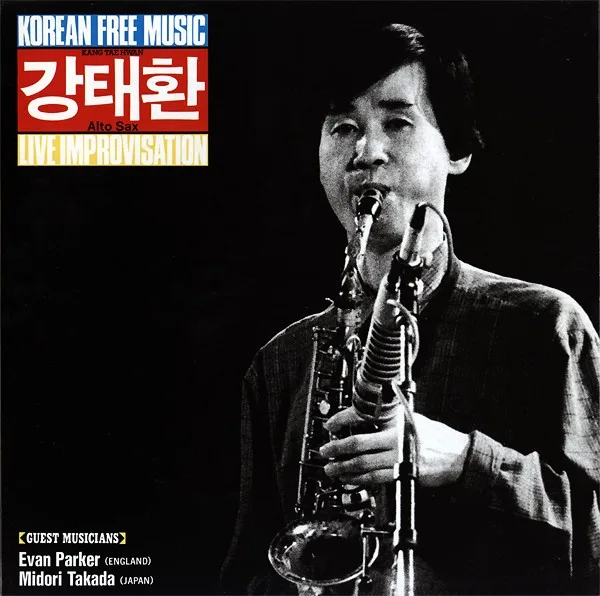
Kang Tae Hwan on the cover of *Korean Free Music* (Yeh Eum Records, 1989), his own album. It shows him in three-quarter view playing an alto saxophone against a black background, with his name in Hangul and "Alto Sax" printed above. Standard copyright, all rights reserved, held by the rights holder named above. This is not a Creative Commons or public-domain image; it is an album cover shown as an honestly disclosed editorial identification image. — https://coverartarchive.org/release/30c7bc69-e518-4d86-8930-9b46f7e60037 (Cover Art Archive front image for the 1989 Yeh Eum LP, MusicBrainz release 30c7bc69-e518-4d86-8930-9b46f7e60037)
Kang Tae Hwan (강태환, written 姜泰煥 in Japan) is a South Korean alto saxophonist and one of the founding figures of free jazz and free improvised music in his country. He plays seated cross-legged, uses circular breathing to hold sound for minutes at a time, and has long preferred to call what he does "free music" rather than jazz. Discogs lists about 15 releases under his own name, from Korean Free Music (1989) to the double CD Microcosm (2024), and his work has been issued in Korea, Japan, Lithuania and Hong Kong. He was born on July 15, 1944. Discogs and MusicBrainz give Seoul as his birthplace, while Korean press traces his childhood schooling to Incheon; no biography states where he was born. He turned 82 in July 2026.
In a 2011 interview with GQ Korea he said his family ran a brewery and had no artists in it, that his school pushed him into its band and that he resisted, running away more than once. He has described weak lungs as a boy. He entered Incheon Dongsan Middle School on a special track and then Seoul Arts High School (서울예고), where by his account he was the only boy admitted on the practical exam alone; Korean press give differing accounts of whether he left in his second year or graduated. Clarinet came first and the alto saxophone later, and he has said he began in a swing band. Korean Wikipedia says that in 1968 he became the youngest jazz bandleader in the country.
The group that made his name began in 1978. Weekly Hankook's 2002 profile of him says the Kang Tae Hwan Trio started that year at Space Sarang (공간 사랑), the experimental arts space in Seoul, with the percussionist Kim Dae Hwan (김대환), his cousin, and the trumpeter Choi Sun Bae (최선배). The same article counts 76 performances between 1978 and 1986, when Kang proposed stopping because the group had run out of new ideas, and says the trio became the first Korean jazz group invited to Japan, in 1985. Korean Wikipedia calls it the country's first free jazz group and dates its end to 1988, and later press profiles repeat the "first" description; the 2002 article does not make that claim, and the three musicians were still recording together in 1988. As the Seoul Free Music Trio they were recorded in Tokyo on June 23, 1988, and that session opens Korean Free Music (Yeh Eum, 1989), his first album, reissued in Korea in 1998 as Korean Free Jazz. The album also holds a solo piece, a duo with the percussionist Midori Takada recorded at Suntory Hall in Tokyo on July 3, 1988, and a duo with the British saxophonist Evan Parker recorded at Yeh Eum Hall in Seoul on September 14, 1988. A set from Shinjuku Pit Inn on July 5, 1988, with the same three players, appears on Kim Dae Hwan's Like a Dew Also Like a Thunder (2004). Kim Dae Hwan passed away in March 2004. The trio reunited from time to time; Weekly Hankook describes a 2002 concert at Buam Art Hall in Seoul as its first reunion in five years.
Japan gave him an audience early. Tokebi (JVC's Zen label, 1991), recorded on April 12, 1991, pairs his alto with the hojeok, a Korean double-reed shawm, played by Kim Suk Chul and the janggu drum of Kim Yong Toek in two long pieces, "Sora-E (To The Sky)" and "Eien (Eternity)". Weekly Hankook says that in 1990 he formed a trio called Donggeurami (동그라미, the Korean word for circle) with the pianist Masahiko Satoh and Midori Takada; its first two albums, on the Japanese label Ninety-One and filed on Discogs under the name Ton•Klami, are In Moers, recorded at the Moers festival in Germany on May 19, 1991, and Paramggod, recorded in Tokyo on September 8, 1994 with the American reed player Ned Rothenberg as guest. In a 2025 interview he says that Satoh is officially his teacher and privately his older brother, that the trio toured the Soviet Union, Southeast Asia and Japan and played 13 shows in two weeks at Pit Inn, and that he has given solo concerts in about 80 Japanese cities.
Much of the 1990s record comes from the Japanese producer Takeo Suetomi, who ran the coffee shop Café Amores in Hofu, Yamaguchi, and the label Chap Chap Records. Suetomi recorded the 1994 concerts that became Kang Tae Hwan (Chap Chap, 1995), with Rothenberg and the turntablist Otomo Yoshihide as guests, and three 1995 concerts that NoBusiness Records of Lithuania later issued: the Satoh and Takada trio recorded on May 27 as Prophecy of Nue (2017), a solo set recorded on October 8 as Live at Café Amores (2018), and the duo with Takada recorded on March 14 as An Eternal Moment (2019). On October 10, 1995 he recorded a Shinjuku Pit Inn trio with Satoh and the percussionist Masahiko Togashi, released the next year by the Korean label AD.forte as Asian Spirits. A 1993 concert in Matsue with the vocalist Sainkho Namtchylak was released as Live, and concerts in Hofu, Hiroshima and Kobe in November 1999 with the drummer Yoshimitsu Ichiraku and the guitarist Kazuhisa Uchihashi were issued as the limited double CD Clearness (2000). Another Kang Tae Hwan Trio, with the guitarist and sarangi player Makoto Kawabata and Ichiraku, recorded the single 49-minute piece Love Time in Nagoya on April 16, 2001; it was released in 2004.
Back in Korea he became the partner of the drummer Park Je Chun (박재천) and the pianist Miyeon (미연). Their Improvised Memories was recorded live on December 22, 2002 to two-track DSD, and Korean Wikipedia credits it as the first Korean album recorded in DSD and issued on SACD. Isaiah, recorded on March 19, 2005 at Dolce Classical Hall in Ilsan, is one 49-minute continuous performance, issued in 2006 in a numbered edition of 500 and reissued in Hong Kong in 2018. The three still play together; the Korea Jazz Association filmed a trio set at the 2022 Seoul Jazz Festa. Seven Breath (2002) collects his own compositions and was produced by Park, and its "A Deep Breath" was chosen for the 2006 Wire sampler for the Atlantic Waves festival.
Sorefa (素來花, 2011), a two-CD solo album recorded in Seoul and released by Audioguy Records, won the Best Jazz & Crossover (Performance) award at the 10th Korean Music Awards in 2013. In 2019 he improvised with the violinist Kang Haejin at the IAP Collabo Stage in Seoul on September 22; the performance became Circle Point. A December 2021 Dong-A Ilbo profile reported that he had been treated for heart failure a few years earlier and still practised eight to ten hours a day, and announced a trio concert at the Seoul venue Ghetto Alive titled "始原音 - the starting point of Korean free jazz". Ghetto Alive held a master class with him on January 17, 2024, and released his solo double CD Microcosm that year, recorded in his own underground practice room and described in its release notes as his first solo work in thirteen years. On February 29, 2024 the 21st Korean Music Awards gave him its lifetime achievement award (공로상). The critic Kim Hak-seon wrote in Pressian that his name is nearly synonymous with Korean free jazz and that he is held in higher regard abroad than at home. In August 2025 three archival live recordings from Seoul house concerts, dated 2005, 2006 and 2011, were released digitally.
His method rests on breath. He has said he taught himself circular breathing after hearing of the technique second-hand, that two or three minutes came easily, ten or twenty were hard, and that long practice brought him to about 40 minutes. For about three years he recorded himself daily on cassette, cut roughly 500 pieces down to 25 and memorised them, since he considers his music impossible to notate. Tom Greenland of the New York City Jazz Record heard five extended improvisations on Live at Café Amores built on circular breathing and multiphonics, a spare, restrained approach with shifting timbres, and wrote that he does not sound quite like anyone else; Stef Gijssels of the Free Jazz Blog admired his tone and his skill in altering the timbre of the horn. Keith Prosk heard the 1995 An Eternal Moment as a recording from a chrysalis stage of his style, with Takada's drum kit and marimba answering his extended techniques.
He talks about improvisation as a matter of beauty rather than method: in the GQ interview he said it is not important that you are improvising, only that it is beautiful, and that in a duet one player should answer the other without overpowering or being overpowered. In the 2025 interview he says that in improvisation all language is excluded, which is why he likes to play with foreign musicians, and that he numbered his works in a series under the label FM, for Free Music, because he thinks of jazz as free music not bound by the history or geography of free jazz. In 2002 he called his own style "personality music". Korean press often calls him one of the three great free jazz saxophonists in the world, alongside Evan Parker and Ned Rothenberg; it is a reputation rather than a published ranking.
Korean instruments and song enter his work at the edges, most clearly in the hojeok and janggu of Tokebi. His Japanese partnerships, with Satoh, Takada, Togashi and Otomo, drove the albums of the 1990s, and the Japanese critic Teruto Soejima coordinated, produced or wrote the notes for several of them.
- Korean Free Music (1989, Yeh Eum YPDL 8004; reissued 1998 as Korean Free Jazz) - the 1988 sessions: the Seoul Free Music Trio, duos with Midori Takada and Evan Parker, and a solo. YouTube - full album · YouTube - Seoul Free Music Trio Listen
- Tokebi (1991, Zen/JVC VICG-8025) - two long pieces with hojeok and janggu, recorded on April 12, 1991. YouTube - full album Listen
- Ton•Klami, Paramggod (1995, Ninety-One CRCJ-9125) - the trio with Masahiko Satoh and Midori Takada, with Ned Rothenberg as guest. YouTube - Fu-Hak Listen
- Kang Tae Hwan / Masahiko Satoh / Masahiko Togashi, Asian Spirits (1996, AD.forte CD-9602) - solo, duo and trio from Shinjuku Pit Inn on October 10, 1995. YouTube - full album Listen
- Live at Café Amores (2018, NoBusiness NBCD 104) - five solos recorded in Hofu on October 8, 1995. NoBusiness Records Listen · Buy
- Kang Tae Hwan and Midori Takada, An Eternal Moment (2019, NoBusiness NBCD 115) - recorded in Hofu on March 14, 1995. NoBusiness Records
- Kang Tae Hwan, Miyeon and Park Je Chun, Improvised Memories (2003, Tawon Access / DIW / Polyphone) - the Korean trio, recorded live to DSD. YouTube - full album Listen
- Kang Tae Hwan, Miyeon and Park Je Chun, Isaiah (2006, Audioguy Records) - one 49-minute performance. YouTube - full album Listen
- Sorefa (2011, Audioguy AGCD0031) - the double-CD solo album that won at the 2013 Korean Music Awards. Apple Music - Sorefa · YouTube - Sorefa, Pt. I - II - III Listen
- Kang Tae Hwan and Kang Haejin, Circle Point (2020, Dancing Butterfly Records DBC-008) - improvised violin and alto saxophone, recorded on September 22, 2019. Apple Music - Circle Point Listen
- Seven Breath (2002, News) - his own compositions, produced by Park Je Chun. YouTube - full album Listen · Buy
Kang Tae Hwan (강태환) - Full Discography
South Korean free jazz and free improvisation alto saxophonist, also clarinet. Discogs artist 372511; group pages Kang Tae Hwan Trio 1289008 and Ton•Klami 5432088.
Name variations on record: Kang Tae Hwan, Kang Tae-Hwan, Kang Taehwan, Kang Teahwan, Taehawn Kang, Tae Hwan Kang, Kang Tae Whan (Apple Music), 강태환, 姜泰煥.
Leader, co-leader and group releases
Chronological by first release. Ton•Klami is the trio with Masahiko Satoh and Midori Takada; the Kang Tae Hwan Trio on Love Time is a separate lineup, with Makoto Kawabata and Yoshimitsu Ichiraku, and is not the Seoul trio of the 1980s.
| Album | Year | Label | Personnel | Notes | Listen | Buy |
|---|---|---|---|---|---|---|
| Korean Free Music (reissued 1998 as Korean Free Jazz) | 1989 | Yeh Eum Records, YPDL 8004 (LP); Ponycanyon Korea, PCLD-00002 (CD, 1998) | Kang Tae Hwan (alto saxophone); Kim Dae Hwan (percussion) and Choi Sun Bae (trumpet) on track 1; Midori Takada (percussion) on track 2; Evan Parker (saxophone) on track 3 | Four tracks: "Seoul Free Music Trio" (11:23), "Duo" with Takada (13:27), "Duo" with Parker (15:09) and "Solo" (7:22). Tracks 1 and 4 recorded on June 23, 1988 at FM Tokyo Hall, Tokyo; track 2 on July 3, 1988 at Suntory Hall, Tokyo; track 3 on September 14, 1988 at Yeh Eum Hall, Seoul. Released on November 30, 1989. Produced by Choi Won Bock and Teruto Soejima, with liner notes by Soejima. Discogs master 218161. | Full album on YouTube | Amazon |
| Tokebi (トケビ, also written Dokkaebi) | 1991 | Zen (JVC), VICG-8025 | Kang Tae Hwan (alto saxophone), Kim Suk Chul (hojeok), Kim Yong Toek (janggu) | Two pieces: "Sora-E (To The Sky)" (28:16) and "Eien (Eternity)" (17:49). Recorded on April 12, 1991. Released on September 21, 1991. Produced by Soh Fujimoto. Discogs release 4297504. | Full album on YouTube | Amazon |
| In Moers (Ton•Klami) | 1993 | Ninety-One, CRCJ-9110 | Kang Tae Hwan (alto saxophone), Masahiko Satoh (piano), Midori Takada (percussion) | Six pieces titled "Link 1" to "Link 6". Recorded live at the Moers International New Jazz Festival on May 19, 1991. Released on March 5, 1993. Discogs release 1589143. | not found | Amazon |
| Live (Kang Tae Hwan and Sainkho Namtchylak) | 1993 | Free Improvisation Network, FIN CD-9301 | Kang Tae Hwan (alto saxophone, tracks 1 and 3 to 5), Sainkho Namtchylak (voice, tracks 1 to 3 and 5) | Five "Improvisations", including no. 4 "Hakutobo" (25:03). Recorded live on March 8, 1993 at Weather Report, Matsue, Japan. Discogs release 3291422. | not found | Amazon |
| Kang Tae Hwan | 1995 | Chap Chap Records, CPCD-001; reissued 2015 as POCS-9349 (CD) and POJE-9002/3 (LP) | Kang Tae Hwan (alto saxophone); Ned Rothenberg (alto saxophone, bass clarinet) and Otomo Yoshihide (turntables) as special guests | Five tracks: "Solo I", "Duo I" with Rothenberg, "Duo II" with Otomo, "Solo II" and a trio. Tracks 1, 2 and 4 recorded at Café Amores, Hofu, on September 1, 1994; tracks 3 and 5 at Pepperland, Okayama, on August 30, 1994. Calligraphy by Kim Dae Hwan; produced by Takeo Suetomi and Masanori Tsuda. Discogs master 873989. | not found | Amazon |
| Paramggod (Ton•Klami) | 1995 | Ninety-One, CRCJ-9125 | Kang Tae Hwan (alto saxophone), Masahiko Satoh (piano, producer), Midori Takada (percussion), Ned Rothenberg (alto saxophone, bass clarinet, special guest) | Seven pieces including "Bamboo Shoots", "Narai", "Fu-hak" (風伯), "Paramggod" and "Zuun Salkhi". Recorded on September 8, 1994 at CRS Studio No. 1, Tokyo. Released on February 22, 1995. Discogs release 1548031. | Fu-Hak on YouTube | Amazon |
| Asian Spirits (Kang Tae Hwan, Masahiko Satoh, Masahiko Togashi) | 1996 | AD.forte, CD-9602 | Kang Tae Hwan (alto saxophone), Masahiko Satoh (piano, tracks 2 and 3), Masahiko Togashi (percussion, track 3) | Three improvisations: solo (16:22), duo with Satoh (15:46) and trio (23:24). Recorded on October 10, 1995 at Shinjuku Pit Inn, Tokyo. Discogs release 4220503. | Full album on YouTube | Amazon |
| Clearness (Kang Tae Hwan with Yoshimitsu Ichiraku and Kazuhisa Uchihashi) | 2000 | Psycho Disc, psycho-0103-4 | Kang Tae Hwan (alto saxophone); Yoshimitsu Ichiraku (drums, percussion, electronics) on disc 1; Kazuhisa Uchihashi (guitar, effects) on disc 2 | Limited, numbered edition of 300 in a DVD box, two CD-Rs of untitled pieces. Disc 1 recorded live at Indoyo, Hofu, on November 23, 1999; disc 2 at Big Apple, Kobe, on November 25, 1999 and Otis, Hiroshima, on November 24, 1999. Discogs release 1395738. | not found | Amazon |
| I Think So | 2002 | IMA Shizuoka, ima-szok 01 | Kang Tae Hwan (alto saxophone) | Two long pieces, 黄想念 (35:40) and 来歴諦念 (31:24). Recorded live on May 31, 2002 at Shizuoka Aoshima Hall. Produced by Shigeru Inoue; notes and photographs by Teruto Soejima. Discogs release 1034097. | not found | Amazon |
| Seven Breath | 2002 | News (Korea), no catalogue number | Kang Tae Hwan (alto saxophone, compositions) | Seven pieces: "The Breath Of Bless", "The Breath In The Past", "A Deep Breath", "The Breath Of Confession", "The Breath Of Patience", "The Breath In The Relaxation" and "The Breath Of A Vagabond". Recorded at Duomull Hall; produced by Park Je Chun. Discogs release 4220467. | Full album on YouTube | Amazon |
| Improvised Memories (Kang Tae Hwan, Miyeon, Park Je Chun) | 2003 | Tawon Access, GOOD 3069; DIW, DIW-459; Polyphone, GOOD 3069 | Kang Tae Hwan (alto saxophone), Miyeon (piano), Park Je Chun (percussion, producer) | Six pieces, including "Where Are You Going?", "Hitchhiking With The Blue Haired Pipe", "Wayfarer's Prayer" and "Free Fall 1899-1959". Recorded live to two-track DSD at the KOCCA recording studios on December 22, 2002; released on April 15, 2003. Discogs release 1548007. | Full album on YouTube | Amazon |
| Love Time (Kang Tae Hwan Trio) | 2004 | VHF Records, VHF#79 | Kang Tae Hwan (alto saxophone), Makoto Kawabata (sarangi, electric guitar), Yoshimitsu Ichiraku (drums, percussion) | One piece of 49:23, recorded live at Tokuzo, Nagoya, on April 16, 2001. Letterpress gatefold sleeve. Discogs release 1548002. | On Apple Music · Full album on YouTube | Amazon |
| Isaiah (Kang Tae Hwan, Miyeon, Park Je Chun) | 2006 | Audioguy Records (Korea); reissued 2018 by Noise Asia, NAICD161 (Hong Kong) | Kang Tae Hwan (alto saxophone), Miyeon (piano), Park Je Chun (percussion, producer) | One continuous performance of 49:36, divided into six parts for CD listeners. Recorded at Dolce Classical Hall, Ilsan, on March 19, 2005; mastered at Audioguy Studio, Seoul. Numbered limited edition of 500. Discogs master 1655668. | Full album on YouTube | Amazon |
| Sorefa (소래화, 素來花) | 2011 | Audioguy Records, AGCD0031 | Kang Tae Hwan (alto saxophone) | Two CDs, nine pieces, including "20 Years Ago", "Sorefa", "Rain", "Angel's Horn", "Fly Away", "Tidal Wave" and "Tears Of Moses". Recorded at SonicEdge Studio and mixed and mastered at Audioguy Studio, Seoul, in 2011; produced by Park Je Chun. 12-page booklet with notes in Korean and English. Korean Wikipedia dates the release to December 26, 2011; reissued digitally in 2020. Winner of the Best Jazz & Crossover (Performance) award at the 10th Korean Music Awards, 2013. Discogs release 4220399. | On Apple Music · Sorefa, Pt. I - II - III on YouTube | Amazon |
| Prophecy of Nue (Ton-Klami) | 2017 | NoBusiness Records, NBCD 102 | Kang Tae Hwan (alto saxophone), Masahiko Satoh (piano), Midori Takada (marimba, percussion) | Three pieces: "Prophecy Of Nue" (21:51), "Manifestation" (16:52) and "Incantation" (17:13). Recorded live on May 27, 1995 at Design Plaza Hofu, Yamaguchi, by Takeo Suetomi. Limited edition. Discogs release 10855063. | not found | Amazon |
| Live at Café Amores | 2018 | NoBusiness Records, NBCD 104 (CD) and NBLP 113 (LP, edition of 300) | Kang Tae Hwan (alto saxophone, compositions) | Five solos, "Solo I" to "Solo V". Recorded live on October 8, 1995 at Café Amores, Hofu, Yamaguchi, by Takeo Suetomi. Discogs master 1433389. | NoBusiness Records | Amazon |
| An Eternal Moment (Kang Tae Hwan and Midori Takada) | 2019 | NoBusiness Records, NBCD 115 (CD, limited); NBLP 125 (LP) | Kang Tae Hwan (alto saxophone), Midori Takada (percussion, marimba on track 3) | Three pieces: "Syun-Soku" (41:52), "Solo" (15:09) and "Dan-Shi" (19:25). Recorded live on March 14, 1995 at Café Amores, Hofu, by Takeo Suetomi. All music credited to Takada and Kang. Discogs master 1564846. | NoBusiness Records | Amazon |
| Circle Point (Kang Tae Hwan and Kang Haejin) | 2020 | Dancing Butterfly Records, DBC-008 (CD, limited to 200); DBL-008 (LP, 2021) | Kang Tae Hwan (alto saxophone), Kang Haejin (violin, producer) | Seven pieces: "Prologue", "Point", "Point Reprise", "Circle I", "Circle I Reprise", "Circle II" and "Return To The Point". Improvised live performance at IAP Collabo Stage, Seoul, on September 22, 2019. The CD is dated March 13, 2020; the digital release appeared on November 28, 2019. Discogs master 1705122. | On Apple Music | Amazon |
| Microcosm (소우주) | 2024 | GhettoAlive Records (Korea) | Kang Tae Hwan (alto saxophone) | Two CDs of the same seven untitled pieces, the first stereo and the second binaural for headphones. Recorded in his underground practice room; described in the release notes as his first solo work in thirteen years. CD only, no digital distribution listed. Discogs master 4287381. | not found | not found |
Sideman, guest and compilation appearances
Chronological. Where a credit is limited to certain tracks, they are named.
| Year | Release | Actual leader | Label | Kang's credit and details | Listen | Buy |
|---|---|---|---|---|---|---|
| 2001 | Mol-e Mori II | Park Je Chun (박재천) | Sang-Joong-Ha Music, SJHCD-001 | Alto saxophone on tracks 2 and 4. Park (drums, percussion, producer); Masahiko Satoh (piano, track 1); Wadada Leo Smith (trumpet, bamboo flute, track 3, composed with Park); Gustavo Aguilar and Richard Maurer Jr. (percussion, track 4). Recorded live between 1996 and 1999 at several halls. | not found | Amazon |
| 2001 | Deluxe Improvisation Series Vol. 2: 2001 Pt. 1 | Various | ASE, ASE-03 | Track 4, an untitled piece of 8:36 credited to Kang with I.S.O. (Otomo Yoshihide, Yoshimitsu Ichiraku and Sachiko M) and Toshimaru Nakamura. | not found | Amazon |
| 2002 | Festival Beyond Innocence: A Brief History In 67 Chapters | Various | FBI Disc, FBI 102/5 (4 CDs) | Three tracks: an untitled 1999 piece with Kazuhisa Uchihashi and Yasuhiro Yoshigaki (Enka), "Dig" (2000) with Samm Bennett and Haruna Ito (Skist), and an untitled 2000 piece with Seiichi Yamamoto and Makoto Inada. | not found | Amazon |
| 2002 | Stylus#3 | Various | College Chart Japan, CCJ-0004 | Track 6, "14.11.2001" (5:03), with I.S.O. (Otomo Yoshihide, Yoshimitsu Ichiraku and Sachiko M). | not found | Amazon |
| 2002 | Grimpoteuthis | Saga Yuki | TSR, TSR-001 | Alto saxophone on track 5, recorded in 2002. All songs improvised and recorded live at "F" in Tokyo between 1997 and 2002. | not found | Amazon |
| 2004 | Like A Dew Also Like A Thunder (如露亦如雷) | Kim Dae Hwan | Bigtory, BIGD-001 | Alto saxophone on tracks 5 and 6, with Kim Dae Hwan (percussion) and Choi Sun Bae (trumpet), recorded at Shinjuku Pit Inn on July 5, 1988. Other tracks feature Kazumi Watanabe, Yosuke Yamashita and Yoriyuki Harada. Released in November 2004. | not found | Amazon |
| 2004 | Improvised Music From Japan 2004 | Various | Improvised Music From Japan, IMJ-304/5 (2 CDs) | Track 10 of disc 2, an untitled piece of 7:42. | not found | Amazon |
| 2006 | Atlantic Waves 2006 (The Wire Sampler) | Various | Calouste Gulbenkian Foundation with The Wire, CGFCD106-2 (2 CDs, promotional) | Track 5 of disc 1, "A Deep Breath" (6:12). | not found | not found |
| 2007 | Spring Road - Duo Japan Tour 2003 | Michel Doneda and Tetsu Saitoh | Travessia, TRV-004 (DVD) and TRV-005 (CD) | Credited among the performers on the DVD track alongside many others, including Nobuyoshi Ino; the DVD documents the 2003 Japan tour of Tetsu Saitoh and Doneda. | not found | Amazon |
| 2025 | The House Concert Live Collection, Vol. 12: Tae Hwan Kang (with Chang Soo Park) | The House Concert | The House Concert, digital | Two live pieces of 41:45 and 12:28, recorded at Chang Soo Park's house in Yeonhui-dong, Seoul, dated 2/4/2005 in the title. Released in August 2025. | On Apple Music | not found |
| 2025 | The House Concert Live Collection, Vol. 13: Tae Hwan Kang (with Chang Soo Park and Jung Oh Lee) | The House Concert | The House Concert, digital | One live piece of 35:48, recorded at the house in Yeonhui-dong, dated 7/5/2006 in the title. Released in August 2025. | On Apple Music | not found |
| 2025 | The House Concert Live Collection, Vol. 14: Tae Hwan Kang (with Chang Soo Park) | The House Concert | The House Concert, digital | Eight live pieces, from 1:42 to 35:47, dated 2/11/2011 in the title. Released in August 2025. | On Apple Music | not found |
Sources
- Discogs: Kang Tae Hwan, artist 372511
- Discogs: Kang Tae Hwan Trio, artist 1289008
- Discogs: Ton•Klami, artist 5432088
- MusicBrainz: Kang Tae Hwan
- Wikipedia (Korean): Audioguy Records
- Wikipedia (Korean): Korean Music Awards, list of winners
- NoBusiness Records: Live at Cafe Amores
- NoBusiness Records: An Eternal Moment
- Apple Music: Sorefa
- Apple Music: Circle Point
- Kim Dae Hwan (김대환) - percussionist and his cousin, a member of the Kang Tae Hwan Trio from 1978 and on Korean Free Music (the Seoul Free Music Trio, 1988) and on two trio tracks of his own album Like a Dew Also Like a Thunder (2004). He passed away in March 2004.
- Choi Sun Bae - trumpeter of the same trio, credited on the opening track of Korean Free Music and on the July 5, 1988 Pit Inn trio set issued on Kim Dae Hwan's 2004 album.
- Masahiko Satoh - pianist on In Moers, Paramggod and Prophecy of Nue with Ton•Klami, on Asian Spirits (1996) and on the opening track of Park Je Chun's Mol-e Mori II (2001); Kang names him as his teacher.
- Masahiko Togashi - percussionist on the trio piece of Asian Spirits, recorded on October 10, 1995.
- Otomo Yoshihide - guest turntablist on two tracks of Kang Tae Hwan (Chap Chap, 1995), recorded in Okayama on August 30, 1994.
- Wadada Leo Smith - trumpeter on Park Je Chun's Mol-e Mori II (Sang-Joong-Ha Music, 2001), the album that also carries two tracks with Kang on alto saxophone; Smith appears on a piece he composed with Park.
- Midori Takada - percussionist and marimba player in Ton•Klami, in the duo on Korean Free Music and on An Eternal Moment (2019).
- Evan Parker - British saxophonist, his duo partner on Korean Free Music (September 14, 1988).
- Ned Rothenberg - guest on Paramggod and on Kang Tae Hwan (1995), in duo and trio with Kang.
- Park Je Chun (박재천) and Miyeon (미연) - drummer and pianist, his regular Korean trio from the early 2000s: Improvised Memories, Isaiah, and Park's productions of Seven Breath and Sorefa.
- Kang Haejin (강해진) - violinist on Circle Point (2020).
- Sainkho Namtchylak - vocalist on Live, recorded in Matsue on March 8, 1993.
- Yoshimitsu Ichiraku - drummer on Clearness (2000) and on Love Time (2004), with Kazuhisa Uchihashi on guitar for Clearness and Makoto Kawabata on guitar and sarangi for Love Time.
- Kim Suk Chul and Kim Yong Toek - hojeok and janggu players on Tokebi.
- Takeo Suetomi - Hofu producer and engineer behind the Chap Chap releases and the NoBusiness albums drawn from his 1995 tapes.
- Teruto Soejima - Japanese free jazz critic who coordinated, produced or wrote liner notes for Korean Free Music, Kang Tae Hwan, Asian Spirits and I Think So.
- Tetsu Saitoh and Nobuyoshi Ino - bassists credited alongside Kang among the performers on the DVD of Spring Road - Duo Japan Tour 2003, the 2003 tour by Saitoh and the saxophonist Michel Doneda.
More Free Jazz Artists
See all 304 Free Jazz artists →More South Korean Jazz Artists
See all 31 South Korean artists →- Discogs: Kang Tae Hwan
- MusicBrainz: Kang Tae Hwan
- Wikidata: Kang Tae Hwan
- Korean Wikipedia: Kang Tae Hwan
- Spotify: Kang Tae Hwan
- NoBusiness Records: An Eternal Moment
- Free Jazz Blog: review of An Eternal Moment by Keith Prosk
- Jazzaje: Kang Tae Hwan interview feature (November 19, 2025)
- YouTube: Kang Tae Hwan Trio at the 2022 Seoul Jazz Festa
- Kang Tae Hwan on JazzProfiles.com
- Discogs: Kang Tae Hwan, artist 372511
- Discogs: Kang Tae Hwan Trio, artist 1289008
- Discogs: Ton•Klami, artist 5432088
- MusicBrainz: Kang Tae Hwan
- Wikidata: Kang Tae Hwan (Q10855144)
- Wikipedia (Korean): Kang Tae Hwan
- Wikipedia (Japanese): Kang Tae Hwan
- Wikipedia (Korean): Korean Music Awards, list of winners
- Wikipedia (Korean): the 21st Korean Music Awards
- Wikipedia (Korean): Audioguy Records
- Weekly Hankook: "Free music saxophonist Kang Tae Hwan" by Jang Byeong-wook (September 14, 2002)
- GQ Korea: "Desperately", interview by Jung Woo-young (March 3, 2011)
- Dong-A Ilbo via Ghetto Alive: profile by Lim Hee-yoon (December 10, 2021)
- Incheon-in: "Korea's avant-garde master was from Incheon" by Bae Young-su (August 25, 2017)
- Pressian: Kim Hak-seon on Lee Ho-jun and the 21st Korean Music Awards (March 9, 2024)
- Korea JoongAng Daily: "Music without rules" by Chun Su-jin (May 13, 2004)
- Hankook Ilbo: "The Shock of Korean Free Jazz" (December 31, 1999)
- Ghetto Alive and Ministry of Culture: Kang Tae Hwan Master Class 5, January 17, 2024
- Squid's Ear: Seishin-Seido, with Kim Dae Hwan's biography
- NoBusiness Records: Live at Cafe Amores
- Free Jazz Blog: Prophecy of Nue, Live At Café Amores and An Eternal Moment coverage
- Discogs: Korean Free Music, master 218161
- Discogs: Tokebi, release 4297504
- Discogs: Asian Spirits, release 4220503
- Discogs: An Eternal Moment, release 13723228
- Discogs: Like A Dew Also Like A Thunder, release 6075433
- Apple Music: Sorefa