JAZZPROFILES lives in the music 2,555 Jazz Artists fully Profiled!
Didier Malherbe
Last updated November 9, 2026
Listen on Spotify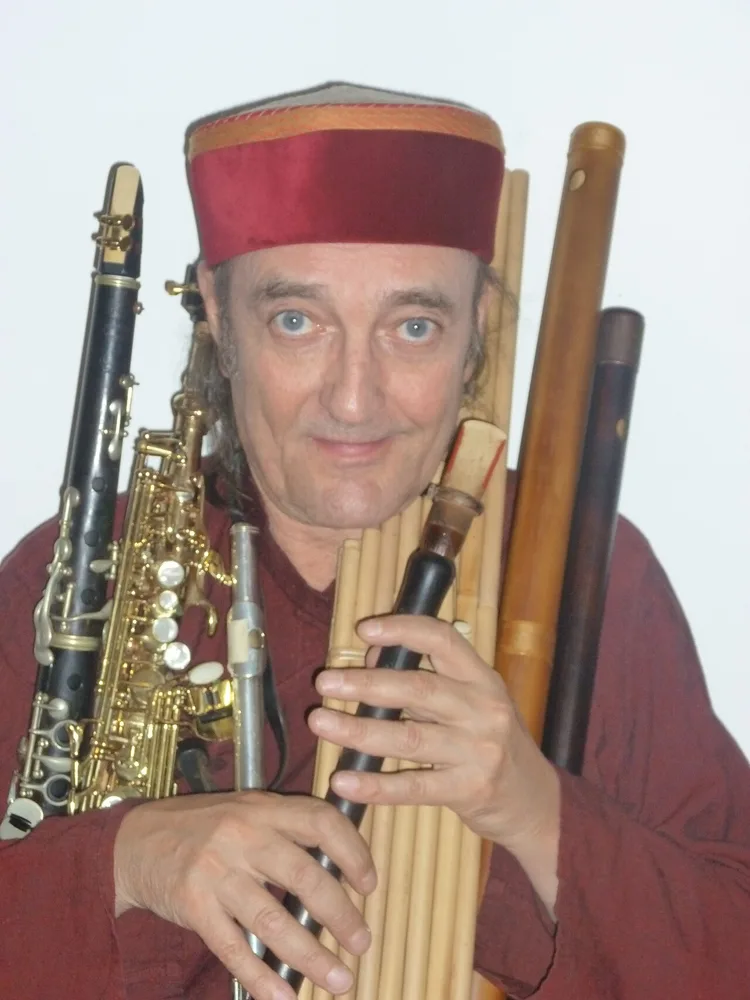
Didier Malherbe with a selection of his wind instruments, July 8, 2011 CC BY-SA 4.0 — Wikimedia Commons - https://commons.wikimedia.org/wiki/File:Didier_Malherbe.jpg - Niquette Malherbe (own work)

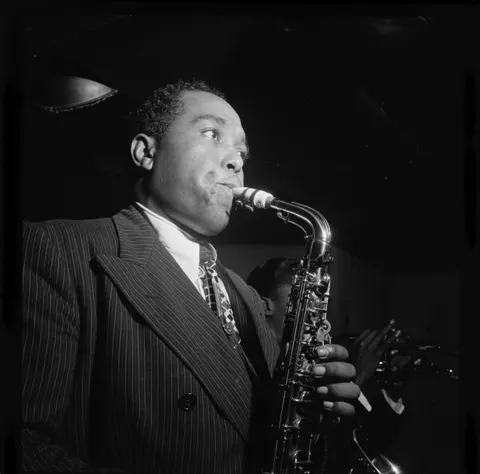
Didier Malherbe was born in Paris on January 22, 1943. He took up the saxophone at thirteen after hearing Charlie Parker's "Bloomdido," the title he would later carry as a stage name. After two years of formal lessons he was sitting in at Paris jazz clubs, playing with the bassist Alby Cullaz, the drummer Jacques Thollot and the organist Eddy Louiss. He came to find bebop puzzling for all its rules, and free jazz, which discarded them, did not hold him either: he decided to look elsewhere for his music.
In 1962, after hearing Ravi Shankar's first album, he travelled to India and learned the bansuri, the Indian bamboo flute. Back in Paris he studied ancient languages and classical flute at the Sorbonne. In 1964 and 1965 he lived in a community of musicians in Tangier, playing alongside the guitarist Davey Graham and picking up the basics of Arabic music. In 1966 he played saxophone with Les Rollsticks in Marc'O's musical comedy Les Idoles, which was filmed in 1968. In the summer of 1968 he moved to Majorca and lived on the property of the writer Robert Graves, where he spent time with Kevin Ayers and Daevid Allen.
He returned to Paris in 1969 and joined a raga-blues-folk trio called Morning Calm. That year he also played free jazz with the American pianist Burton Greene on an album for BYG, the label that issued Gong's first album, Magick Brother. Gong played its first concert at the Amougies festival in October 1969, and Allen gave Malherbe the stage name Bloomdido Bad de Grasse, a fusion of the Parker title and a joke on his surname. His saxophone and flute ran through the albums that made Gong's reputation: Camembert Electrique (1971), the soundtrack Continental Circus (1972) for Jérôme Laperrousaz's film, and the Radio Gnome Invisible trilogy on Virgin, Flying Teapot and Angel's Egg (both 1973) and You (1974).
When Allen and Steve Hillage left in 1975, Gong swung toward jazz-fusion, with Weather Report cited as an influence, and Malherbe stayed on and added world-music color, notably the piece "Bambooji" on Shamal (February 1976). On Gazeuse! (late 1976), the vibraphone-led jazz-fusion record made under Pierre Moerlen, he played tenor saxophone on two tracks and flute on one, alongside the guitarist Allan Holdsworth. He then formed Bloom, a band that fused jazz and rock and toured France, and released the album Bloom in 1979. In 1982 he teamed with Faton Cahen, a former pianist with Magma and Zao, in Faton Bloom, which made an album in 1986. He also worked with the singer Jacques Higelin on stage and on the album Aï (1985) and played on the debut by Equip'Out, the band of the former Gong drummer Pip Pyle.
His solo records of the 1990s moved steadily toward world music. Fetish (1990) used the Yamaha WX7 wind synthesizer. Zeff (Tangram, 1992) was built around the sound of a bent PVC pipe, the zeff, which also turned up in Vangelis's score for Ridley Scott's 1492: Conquest of Paradise, and was a critical and commercial success. Fluvius (1994) used a quartet with Loy Ehrlich, Henri Agnel and Shyamal Maitra. In 1996 he formed Hadouk with Ehrlich, the name joining the hajhouj, the Gnawa bass of Morocco that Ehrlich plays, and the duduk, the Armenian double-reed oboe that has been Malherbe's favorite instrument since 1995. Through those years he also toured with Classic Gong in Europe and the United States, left the band in 1999, and later returned as a guest on Zero to Infinity (2000) and 2032 (2009). He recorded with Brigitte Fontaine on Les Palaces and with the guitarist Pierre Bensusan on Live at the New Morning (1997).
In 1999 the American percussionist Steve Shehan joined the duo and the group became the Hadouk Trio. Its studio albums were Shamanimal (1999), Now (2002), Utopies (2006) and Air Hadouk (2010), and it also released the live records Live à FIP (2004) and Baldamore (2007), taken from two nights at Paris's Cabaret Sauvage in May of that year. The trio played jazz festivals including Nancy Jazz Pulsations and Jazz sous les Pommiers and, in 2007, won the Victoires du Jazz award for French instrumental artist or group of the year. In 2001 Djivan Gasparyan invited Malherbe to the international duduk festival in Armenia, and the same year he published L'Anche des Métamorphoses, a book of sonnets about reeds that became a solo show mixing poetry and music.
A duo with the guitarist Éric Löhrer produced Nuit d'Ombrelle (2011), a double album that sets jazz standards played on duduk beside improvisations in one continuous suite. From 2012 he played with the classical pianist Jean-François Zygel on Zygel's France 2 program La Boîte à Musique and performed in a trio with the percussionist Joël Grare under the title A World Tour in 80 Minutes. The Hadouk Quartet, with Löhrer and the percussionist Jean-Luc Di Fraya, formed in 2013 and released Hadoukly Yours on November 4 of that year and Le Cinquième Fruit in 2017. Le Concile des Oiseaux (2024), a duo record with Ehrlich, closed the cycle the two began in the 1990s. On September 15, 2026 he released Cheerful Pendulum on Tribal Zik Records, an album with the multi-instrumentalist Raphaël Didjaman on which he plays duduk and bawu.
Malherbe's fame rests on Gong, and the honest label for his career is jazz-rooted rather than simply jazz: he learned the saxophone from Charlie Parker records and Paris jam sessions, built his reputation in psychedelic and progressive rock, and since the mid-1990s has worked in a world-music setting that French sources file as ethno-jazz or world jazz. AllMusic lists his genres as both Pop/Rock and Jazz and tags his styles as Canterbury Scene, Fusion, Global Jazz and Post-Bop, which matches the split. His music is built from reeds and breath rather than from bebop vocabulary: soprano saxophone, flutes and the bansuri from his Indian studies, and since the 1990s the duduk, alongside the Chinese bawu and hulusi, ocarina and the Laotian khene. The influences are travel and collaboration as much as records: Parker first, then Ravi Shankar, the Moroccan music he heard in Tangier, Daevid Allen's circle in Majorca, and the Armenian duduk tradition of Gasparyan. He is also a published poet, with two books of sonnets, and has built shows around spoken verse and music.
- Camembert Electrique (1971, BYG) - The Gong album that made the band, alongside Magma, part of the French underground scene, with Malherbe on saxophone and flute.
- You (1974, Virgin) - The close of the Radio Gnome Invisible trilogy, Gong's best-known work.
- Gazeuse! (1976, Virgin) - The jazz-fusion side of Gong, led by Pierre Moerlen, with Allan Holdsworth on guitar and Malherbe on tenor saxophone and flute.
- Zeff (1992, Tangram) - His third album as a leader and a critical and commercial success, built around the PVC-pipe flute that gave it its name.
- Shamanimal (1999, Celluloid) - The first album under the Hadouk Trio name, with Loy Ehrlich and Steve Shehan.
- Utopies (2006, Naïve) - The trio's third studio album, released the year before the group won the Victoires du Jazz award.
- Nuit d'Ombrelle (2011, Naïve) - Duduk and guitar with Éric Löhrer, mixing jazz standards with improvisation.
Didier Malherbe: Full Discography
Discogs artist: Didier Malherbe (254010) · Also filed under Hadouk Trio (470692), Hadouk Quartet (3676281), Hadouk (15322683), Bloom (4389146) and Faton Bloom (1226679) · Born January 22, 1943, Paris, France
Discogs lists nearly four hundred credited entries for Malherbe, most of them guest spots and Gong-related reissues. The tables below cover his own albums, the Hadouk Trio and Quartet, his Gong albums and a selection of guest work. Catalog numbers are those printed on the releases where Discogs confirms them.
Leader and Co-Leader Albums
| Album | Year | Label (Catalog) | Personnel & Notes | Listen | Buy |
|---|---|---|---|---|---|
| Bloom | 1979 | Sonopresse (2S 068 16686) | Billed to Bloom, his jazz-rock band. Malherbe (soprano, alto and tenor saxophone, flute, voice), Yan Emeric Vagh (guitar), Mico Nissim (keyboards), Jano Padovani (drums), Winston Berkeley (bass), Peter Kimberley (voice); produced by Jérémy Stefen. The single "Danskorla" (Sonopresse, 1980) came from the same band | — | — |
| Melodic Destiny | 1981 | Ottersongs (cassette) | Co-billed with Yan Emeric Vagh. Guy Evans (drums), Gilli Smyth (voice); produced and engineered by Harry Williamson | — | — |
| Faton Bloom | 1986 | Cryonic (MAD 3029) | Co-led with the pianist Faton Cahen, with Rémy Sarrazin (bass), Éric Bedoucha (drums) and Roger Raspail (percussion) | — | — |
| Saxo Folies | 1987 | Koka Media (KOK 60) | LP with Armand Frydman (piano, keyboards, synthesizer); Malherbe on saxophone and flute | — | — |
| Fetish | 1990 | Mantra (COM 6031CD) | Flute, tenor and soprano saxophone, Yamaha WX7 wind synthesizer and rap; includes pieces written with Jean-Philippe Rykiel and Pierre Bensusan | — | — |
| Zeff | 1992 | Tangram New Series (842620) | Flutes including the circular plastic bass flute that gave the album its name, Indian bamboo flutes, ocarina, alto clarinet, sopranino and tenor saxophone; Shyamal Maitra (tabla, ghatam, percussion); mixed by Didier Weiss | — | — |
| Fluvius | 1994 | Tangram (TC 20 11) | Billed to Malherbe with Henri Agnel, Loy Ehrlich and Shyamal Maitra. Malherbe on flutes, saxophones and alto clarinet; Ehrlich (hajouj, bolon, kora, pianos, sampler); Agnel (oud, sarod, flamenco guitar, rebec, prepared piano); Maitra (tabla, darbouka, ghatam) | — | — |
| Hadouk | 1995 | Tangram (TC 30 27) | The first duo album with Loy Ehrlich, with Steve Shehan on percussion; reissued in 2024 as Le Bal des Oiseaux. Some sources date it 1996 | — | — |
| Live at the New Morning | 1997 | XIII bis Records (176652) | Duo with the guitarist Pierre Bensusan. Malherbe on flute, soprano saxophone, bamboo flute, ocarina, duduk and alto clarinet; Bensusan on electroacoustic guitar and voice | — | — |
| Desert Lands | 1998 | Kosinus (KOS 44) | With Loy Ehrlich, whose instruments include hajouj, keyboards and n'goni; Joël Grare on percussion; Malherbe on flutes, duduk, clarinets, bansuri and ney | — | — |
| Windprints: L'Empreinte du Vent | 2003 | Cezame (CEZ 4031) | A solo album on duduks, taragot, saxophone, bass and alto clarinets, ocarina, bansuri and flutes including the zeff; Daevid Allen contributed a drawing to the booklet | — | — |
| Carnets d'Asie et d'Ailleurs | 2008 | Vox Terrae (VT 0206) | Duo with Loy Ehrlich: Malherbe on bansuri, Ehrlich on kora | — | — |
| Nuit d'Ombrelle | 2011 | Naïve (NJ621211) | Double CD with the guitarist Éric Löhrer: duduk and soprano saxophone against guitar, jazz standards beside improvisations; mastered by Raphaël Jonin | — | — |
| Le Concile des Oiseaux | 2024 | Continuo Jazz (CC777.835/2) | Released October 25, 2024 as Hadouk, the duo of Malherbe and Loy Ehrlich, with Steve Shehan and Tao Ehrlich on percussion; the closing record of the cycle the duo began in the 1990s | — | — |
| Cheerful Pendulum | 2026 | Tribal Zik Records (TBZ 30) | Released September 15, 2026, co-billed with the multi-instrumentalist Raphaël Didjaman (didgeridoo, berimbau, synthesizer, drums, piano), with Laure Volpato on cello; Malherbe plays duduk and bawu | — | — |
Hadouk Trio and Hadouk Quartet
The trio of Malherbe, Loy Ehrlich (hajouj or Gnawa bass, kora, keyboards) and Steve Shehan (percussion) won the Victoires du Jazz award for French instrumental artist or group of the year in 2007. The quartet that followed in 2013 added the guitarist Éric Löhrer and the percussionist Jean-Luc Di Fraya.
| Album | Year | Label (Catalog) | Personnel & Notes | Listen | Buy |
|---|---|---|---|---|---|
| Shamanimal | 1999 | Celluloid (67015-2) | The first album under the Hadouk Trio name. Malherbe (duduk, flute, soprano saxophone, clarinets, ocarina), Ehrlich (hajouj, kora, keyboards, awicha, n'goni), Shehan (djembe, congas, derbouka, sanza, hadgini, brushes); produced by Malherbe and Ehrlich | — | — |
| Now | 2002 | Mélodie; reissued by Naïve (ND 68530) | Studio album. Malherbe (bamboo flute, saxophone, duduk), Ehrlich (guimbri, kora, mbira, keyboards, producer), Shehan (percussion). The Naïve catalog number is for the 2006 reissue | — | — |
| Live à FIP | 2004 | Celluloid (67053-2) | Live album with guests Peter Herbert (double bass), Jean-Philippe Rykiel (saï-saï) and Wasis Diop (vocals) | — | — |
| En Concert au Satellit Café | 2004 | Naïve (NV 802611) | Concert DVD (DVD-Video, PAL) | — | — |
| Utopies | 2006 | Naïve (NV 809411) | Released June 6, 2006. Malherbe (duduk, flutes including the zeff, ocarina, khene), Ehrlich, Shehan; guest Jon Hassell on trumpet | — | — |
| Baldamore | 2007 | Naïve (NV 812811) | Live from Paris's Cabaret Sauvage in May 2007, issued in November with a bonus DVD; guests Malouma (vocals), Nicolas Genest (trumpet) and Bachar Khalifé (percussion) | — | — |
| Air Hadouk | 2010 | Naïve (NJ620611) | The trio's last studio album; produced by the Hadouk Trio, mixed by Philippe Teissier du Cros | — | — |
| Hadouk Trio | 2013 | Naïve (NJ622911) | Box set released February 12, 2013 reissuing the first four Hadouk Trio CDs | — | — |
| Hadoukly Yours | 2013 | Naïve (NJ623411) | The Hadouk Quartet's debut, released November 4, 2013. Malherbe, Ehrlich, Éric Löhrer, Jean-Luc Di Fraya; adds the Chinese bawu and hulusi | — | — |
| Le Cinquième Fruit | 2017 | Naïve (NJ628311) | Billed as Hadouk. Malherbe (duduk, flute, soprano saxophone, hulusi), Ehrlich (gumbass, sintir, ribab, tanbur), Di Fraya (drums, percussion, voice), Löhrer (guitar, lap steel) | — | — |
Gong (selected)
Malherbe was a core member of Gong from its first album in 1969 until the late 1970s, rejoined Daevid Allen's reformed band in the early 1990s, toured with Classic Gong until 1999 and has returned as a guest since. The albums below are those he is credited on in the band's catalog.
| Album | Year | Label | Notes | Listen | Buy |
|---|---|---|---|---|---|
| Magick Brother | 1970 | BYG | Gong's first album, with Malherbe alongside musicians from pop and jazz backgrounds | — | — |
| Camembert Electrique | 1971 | BYG | The second album, with the band's space-rock sound in place | — | — |
| Continental Circus | 1972 | Philips | Soundtrack to Jérôme Laperrousaz's film of the same name | — | — |
| Flying Teapot | 1973 | BYG / Virgin | First part of the Radio Gnome Invisible trilogy | — | — |
| Angel's Egg | 1973 | Virgin | Second part of the trilogy | — | — |
| You | 1974 | Virgin | Third part of the trilogy | — | — |
| Shamal | 1976 | Virgin | Released February 13, 1976 and produced by Nick Mason; includes "Bambooji," an early sign of his later world-music leanings | — | — |
| Gazeuse! | 1976 | Virgin | Released late in 1976 (retitled Expresso in the United States). The jazz-fusion, vibraphone-led record of the Pierre Moerlen lineup, with Allan Holdsworth on guitar. Malherbe plays tenor saxophone on two tracks and flute on one | — | — |
| Gong est mort, vive Gong | 1977 | Tapioca / Celluloïd | Credited to Gong | — | — |
| Live Etc. | 1977 | Virgin | Live and archive album of the Virgin-era band | — | — |
| Shapeshifter | 1992 | Mélodie / Celluloïd | The album by Daevid Allen's reformed Gong | — | — |
| Zero to Infinity | 2000 | Snapper Music | Guest appearance after he left the band in 1999 | — | — |
| 2032 | 2009 | G-Wave | Released September 21, 2009; he is credited as a former member on duduk, saxophone and flute | — | — |
Guest and Sideman Appearances (selected)
A selection of the records by other artists on which Malherbe is credited. The credit is listed here without an instrument unless it is confirmed on the release.
| Album | Year | Leader | Label | Listen | Buy |
|---|---|---|---|---|---|
| Aquariana | 1969 | Burton Greene | BYG | — | — |
| Obsolete | 1971 | Dashiell Hedayat | Shandar | — | — |
| Whatevershebringswesing | 1972 | Kevin Ayers | Harvest | — | — |
| Hatfield and the North | 1974 | Hatfield and the North | Virgin | — | — |
| To Keep from Crying | 1974 | Comus | Virgin | — | — |
| Fish Rising | 1975 | Steve Hillage | Virgin | — | — |
| Clearlight Symphony | 1975 | Clearlight | Virgin | — | — |
| Downwind | 1979 | Pierre Moerlen's Gong | Arista | — | — |
| Solilaï | 1982 | Pierre Bensusan | RCA | — | — |
| Casino de Paris | 1983 | Jacques Higelin | Pathé-Marconi | — | — |
| Aï | 1985 | Jacques Higelin | Pathé-Marconi | — | — |
| Pip Pyle's Equip' Out | 1987 | Pip Pyle | 52e Rue Est | — | — |
| French Corazon | 1989 | Brigitte Fontaine | Midi | — | — |
| Les Palaces | 1997 | Brigitte Fontaine | Virgin | — | — |
| Soup Songs Live: The Music of Robert Wyatt | 2000 | Various artists | Voiceprint | — | — |
| Kekeland | 2001 | Brigitte Fontaine | Virgin | — | — |
| Folklores Imaginaires | 2005 | Éric Séva | Harmonia Mundi | — | — |
| Conspiracy Theories | 2006 | Phil Miller's In Cahoots | Crescent Discs | — | — |
| Elevations | 2006 | Steve Shehan | Safar Éditions | — | — |
Awards
| Year | Award | Work | Result |
|---|---|---|---|
| 2007 | Victoires du Jazz, French instrumental artist or group of the year | Hadouk Trio | Winner |
- Loy Ehrlich - his closest long-term partner: duo from 1996, Hadouk Trio and Quartet, and the 2024 duo album Le Concile des Oiseaux.
- Steve Shehan - percussionist in the Hadouk Trio from 1999 until the group became a quartet in 2013.
- Éric Löhrer - guitarist in the duo that made Nuit d'Ombrelle (2011) and in the Hadouk Quartet from 2013.
- Daevid Allen - the Gong founder who named him Bloomdido Bad de Grasse, and the leader of the band during its early 1970s peak.
- Allan Holdsworth - guitarist on Gazeuse! (1976).
- Pierre Moerlen - the Gong drummer who led the fusion lineup behind Gazeuse!.
- Steve Hillage - Gong guitarist until 1975, on whose debut Fish Rising (1975) Malherbe played.
- Faton Cahen - pianist and co-leader of Faton Bloom, 1982 to 1987.
- Pierre Bensusan - guitarist, partner on Live at the New Morning (1997).
- Brigitte Fontaine - singer, with whom he recorded Les Palaces (1997) and Kekeland (2001).
- Jean-François Zygel - pianist, partner on France 2's La Boîte à Musique from 2012.