 JAZZPROFILES lives in the music 2,555 Jazz Artists fully Profiled!
Demetrio Stratos
Last updated November 10, 2026
Listen on Spotify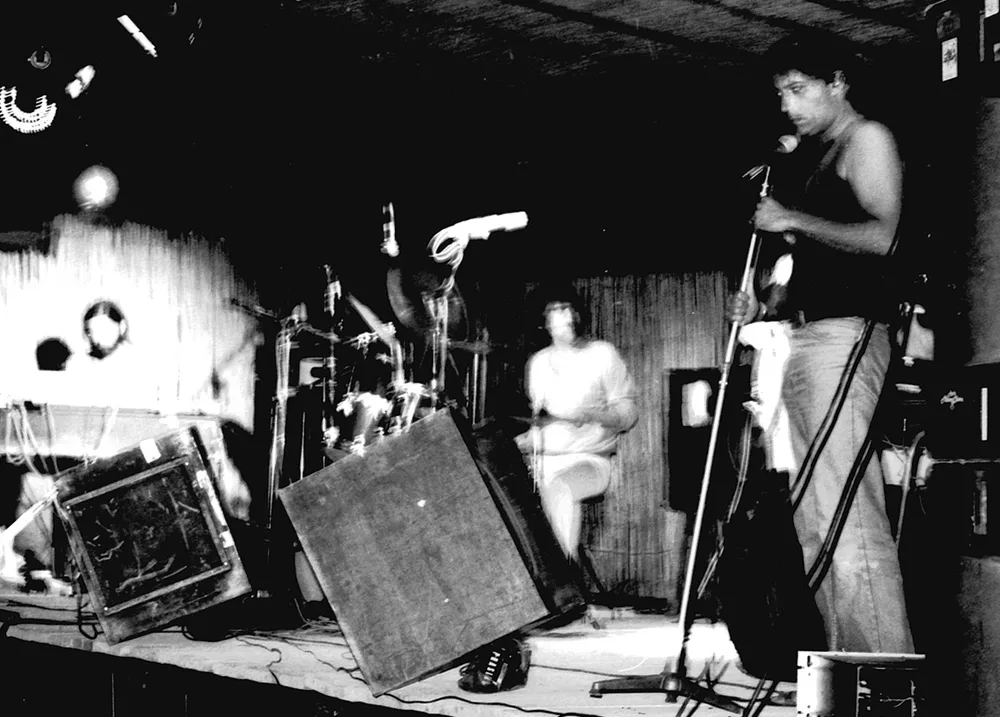
Demetrio Stratos on stage with Area at the stadium in Castelmassa, Rovigo, Italy, August 1978, shortly after the band's return from Cuba Public domain (released into the public domain by its photographer, Raffaello Regoli, who scanned it from his own negative) — Wikimedia Commons - https://commons.wikimedia.org/wiki/File:Demetrio_stratos.JPG - Raffaello Regoli (uploaded as Stratuz on Italian Wikipedia)

Demetrio Stratos was born Efstratios Dimitriou in Alexandria, Egypt, on April 22, 1945, to Greek parents. He studied piano and accordion as a child and grew up hearing Byzantine church chant, traditional Arabic music and the first rock and roll. In 1957 the political upheaval in Egypt sent him to a Catholic college in Nicosia, Cyprus, where his family joined him two years later. In 1962 the family moved to Milan, and he enrolled in the architecture faculty of the Politecnico. He formed his first group there in 1963, began singing when the regular vocalist could not make a gig, and worked as a session keyboardist in Milan studios while his repertoire ran to soul, blues and rhythm and blues.
In 1967 he joined the beat band I Ribelli as keyboardist and singer, and the group's singles, among them "Pugni chiusi," made him a name in Italy. He left in 1970 and began the work that would define the rest of his life, an investigation of what a voice can do before it is trained into language. The starting point, he said, was watching his infant daughter Anastassia, born that year, play with sound in her first months of babbling. In 1971 he put out the single "Daddy's Dream" on Numero Uno, the label run by Mogol and Lucio Battisti. It was his last commercial pop record.
In 1972 he and the drummer Giulio Capiozzo founded Area in Milan, and the band's first album, Arbeit macht frei, appeared on Cramps Records in 1973. The founding lineup included the saxophonist Eddie Busnello and the bassist Patrick Djivas, both soon gone, and it settled around Patrizio Fariselli on keyboards, Paolo Tofani on guitar and synthesizer, and from 1974 Ares Tavolazzi on bass and trombone. Stratos sang and also played organ, steel drums and percussion, and Discogs credits him on harpsichord on the second and third albums. English Wikipedia describes Area as an Italian progressive rock and jazz fusion group, and the record catalogs reflect it: Discogs files Arbeit macht frei, Are(A)zione and their last album with him under jazz-rock. The band played about two hundred concerts in Italy in 1976 alone, and toured festivals in France, Portugal, Switzerland, Chile and Cuba.
The most openly jazz chapter of his career came in 1976. In Milan, Stratos, Fariselli and Tofani played a concert at the Aula Magna of the Università Statale with the American soprano saxophonist Steve Lacy and the English percussionist Paul Lytton, recorded on October 27 and issued by Cramps in 1979 as Event '76. Lacy and Lytton also joined Area on the studio album Maledetti (Maudits), whose central piece, "Caos," hands each player five cards naming a state (silence, irony, sex, violence, hypnosis) to improvise for a few minutes before drawing the next. In the same period he sang on "Amna," a track on La Cantata Rossa per Tall el Zaatar (1977), a record about the Tall al-Zaatar massacre led by the pianist Gaetano Liguori and the poet Giulio Stocchi.
Alongside Area he built a solo practice in extended vocal technique. Working with the phonetics researcher Franco Ferrero at the University of Padua, he showed that he could produce two, three and even four tones at once and reach frequencies near 7,000 Hz. The records of that work are Metrodora (1976) and Cantare la voce (1978), and neither is a jazz record in the ordinary sense. They belong to the avant-garde of the voice, and the circle around them was the Fluxus and John Cage world. Stratos recorded Cage's Sixty-Two Mesostics Re Merce Cunningham for solo voice, and in March 1978 Cage invited him to the Roundabout Theatre in New York for an Event staged by the Merce Cunningham Dance Company. That summer he took part in Cage's ten-hour broadcast in Amsterdam and in the three train rides of "Il Treno di John Cage."
He left Area after the 1978 album Gli dei se ne vanno, gli arrabbiati restano! to concentrate on voice research. In January 1979 he recorded Le Milleuna, a one-hour piece with a text by Nanni Balestrini, and he made a rock and roll record, Rock 'n' Roll Exhibition, with Mauro Pagani and Paolo Tofani. His last concert was a solo recital in Monza on March 30, 1979. In April he was diagnosed with aplastic anemia, was admitted to the Milan Polyclinic on April 2 and was taken to New York for treatment while he waited for a bone marrow transplant. He passed away there on June 13, 1979, aged 34. A benefit concert for his medical costs, set for the next day at the Arena in Milan, became his memorial, with some 60,000 people in the audience and over a hundred musicians on the bill. He is buried at Scipione Castello, near Salsomaggiore Terme, which began holding a memorial music festival in 2000. Since 2005 an international prize for experimental music has carried his name, and its career awards have gone to Diamanda Galás, Meredith Monk and Fred Frith, among others.
Stratos is best known as the voice of Italian progressive rock, and the jazz in his story is real but specific. In Area it was the improvising rhythm section, the metric and harmonic freedom of the writing, and a band that could open a concert to free improvisation with Steve Lacy and Paul Lytton. For his own vocal model, Italian sources point to the most advanced American Black-music singers, Leon Thomas among them, and he then went well past them into overtone singing, vocal traditions from the Mediterranean to Mongolia and Tibet, and the idea that a child's pre-verbal voice is the richest instrument there is. He treated voice as sound before it was language, and argued that exploring it was a form of psychological and political liberation as much as technique.
His solo albums are best heard as experimental vocal art rather than jazz, and he sits among the crossover artists for the Area records, the free-jazz sessions and the company he kept in Milan's improvising scene. Many critics and vocalists regard his extended techniques as an important step in what the voice can do on a record.
- Arbeit macht frei (1973, Cramps) - Area's debut and the clearest statement of their jazz-rock method, with Stratos on vocals, organ and steel drums.
- Are(A)zione (1975, Cramps) - the live album from the peak of the band's touring years, filed as jazz-rock on Discogs.
- Maledetti (Maudits) (1976, Cramps) - the improvisation-led studio record on which Steve Lacy and Paul Lytton sit in beside the band.
- Event '76 (recorded 1976, issued 1979, Cramps) - a live free-improvisation set from the University of Milan with Lacy and Lytton, Stratos on voice; Discogs lists it under jazz alone.
- La Cantata Rossa per Tall el Zaatar (1977, Edizioni di Cultura Popolare) - Gaetano Liguori's trio with the poet Giulio Stocchi, with Stratos singing on "Amna."
- Metrodora (1976, Cramps) - the first solo record of voice research, with synthesizer by Paolo Tofani.
- Cantare la voce (1978, Cramps) - the fullest document of his multiphonic technique, built from "Investigazioni," "Criptomelodie infantili" and "Flautofonie ed altro."
- 1978 Gli dei se ne vanno, gli arrabbiati restano! (1978, Ascolto) - the last Area album with Stratos.
Demetrio Stratos: Full Discography
Discogs artist: Demetrio Stratos (328448) · Real name Efstratios Demetriou · Born April 22, 1945, Alexandria, Egypt · Died June 13, 1979, New York City
Stratos recorded as the co-founder and lead voice of Area, made a short run of solo records of voice research, and appeared on a handful of other artists' records. Area's catalog also holds further posthumous live and archive releases that are not itemized here. The solo records are experimental vocal art and are listed for completeness; the jazz-side material is concentrated in the Area and collaboration tables.
Solo and Co-Led Records
| Album | Year | Label | Personnel & Notes | Listen | Buy |
|---|---|---|---|---|---|
| Metrodora | 1976 | Cramps (CRSLP 6205) | Solo voice research. Paolo Tofani (synthesizer); Piero Bravin (sound engineer); Gianni Sassi (art direction); the Zaj founders Juan Hidalgo and Walter Marchetti are credited as collective coordinators. Discogs files it under experimental and avant-garde | — | — |
| Cantare la voce | 1978 | Cramps (5206 119) | Solo voice. Compositions and texts by Stratos, with the research acknowledgments naming John Cage, Daniel Charles, Franco Ferrero and Lucio Croatto among others. Contains "Investigazioni (Diplofonie e triplofonie)," "Criptomelodie infantili," "Flautofonie ed altro" and "Le sirene" | — | — |
| Rock 'n' Roll Exhibition | 1979 | Cramps (5205 901) | Co-billed with Mauro Pagani (violin) and Paolo Tofani (electric guitar). Stratos sings and plays piano. Walter Calloni (drums), Stefano Cerri and Paolo Donnarumma (bass). Rock and roll standards recorded live in Milan | — | — |
| Recitarcantando: Cremona 21 Settembre 1978 | 1980 | Cramps (5206-501) | Live solo recital, with Lucio Fabbri on violin. Released after his death | — | — |
| Le Milleuna | 1990 | Cramps (CRSCD 034) | One-hour vocal piece for the dance work of Valeria Magli, text by Nanni Balestrini, recorded in January 1979. Released on CD in 1990 | — | — |
| Concerto all'Elfo | 1998 | Not confirmed | Live album from a solo concert at the Elfo theatre in Milan, listed in the Italian Wikipedia and AllMusic discographies | — | — |
| Daddy's Dream (single) | 1971 | Numero Uno (ZN 50142) | His only solo pop single, on Mogol and Lucio Battisti's label, backed with "Since You've Been Gone" | — | — |
With Area
Studio and live albums made with Stratos in the lineup, in order of release. Personnel is the core band unless noted.
| Album | Year | Label | Personnel & Notes | Listen | Buy |
|---|---|---|---|---|---|
| Arbeit macht frei | 1973 | Cramps (CRS LP5101) | Demetrio Stratos (vocals, organ, steel drums), Patrizio Fariselli (piano, electric piano), Paolo Tofani (guitar, VCS 3 synthesizer), Patrick Djivas (bass), Giulio Capiozzo (drums, percussion). Discogs genre Jazz and Rock, style jazz-rock | — | — |
| Caution Radiation Area | 1974 | Cramps (CRSLP 5102) | Stratos (vocals, organ, harpsichord, steel drums, percussion), Fariselli (keyboards, bass clarinet, synthesizer), Tofani (guitar, synthesizer, flute), Ares Tavolazzi (bass, double bass, trombone), Capiozzo (drums) | — | — |
| Crac! | 1975 | Cramps (CRSLP 5103) | Same five players as the previous album; Discogs credits Stratos on voice, organ, harpsichord, steel drums and percussion | — | — |
| Are(A)zione | 1975 | Cramps (CRSLP 5104) | Live album. Same lineup, with Tavolazzi also on pocket trumpet. Discogs styles: jazz-rock, avant-garde, prog rock | — | — |
| Maledetti (Maudits) | 1976 | Cramps (CRSLP 5105) | Studio album recorded in Milan. Steve Lacy (soprano saxophone) and Paul Lytton (percussion) guest, together with the Arze brothers on txalaparta, Walter Calloni and Hugh Bullen; the central piece "Caos" uses improvising instruction cards. Discogs styles include free jazz and free improvisation. According to Italian Wikipedia, Capiozzo and Tavolazzi did not take part in the sessions | — | — |
| 1978 Gli dei se ne vanno, gli arrabbiati restano! | 1978 | Ascolto (ASC 20063) | The last Area studio album with Stratos; Discogs credits him for writing. Discogs styles: jazz-rock, avant-garde, experimental, prog rock | — | — |
| Event '76 | 1979 | Cramps (5205 107) | Live, recorded at the Aula Magna of the Università Statale, Milan, October 27, 1976. Stratos (voice), Fariselli (piano), Tofani (guitar, synthesizer), Steve Lacy (soprano saxophone), Paul Lytton (percussion); Capiozzo and Tavolazzi did not play this concert. Discogs genre Jazz, styles free jazz, free improvisation and experimental | — | — |
Area compilations and archive releases with Stratos
| Album | Year | Label | Notes | Listen | Buy |
|---|---|---|---|---|---|
| Anto/Logicamente | 1977 | Cramps | Compilation of 1973 to 1976 recordings | — | — |
| Area '70 | 1980 | Cramps | Compilation of 1973 to 1976 recordings | — | — |
| The Real Jazz Rock (Area and Demetrio Stratos) | 1998 | Minos-EMI / Cramps (7243 4 97779 2 7) | CD compilation issued on a jazz imprint of the Greek label, with "Arbeit macht frei," "Gerontocrazia," "Flautofonie ed altro" and "L'Internazionale" among its twelve tracks | — | — |
| Concerto Teatro Uomo | 1996 | Cramps | Live recording from 1976, released posthumously | — | — |
| Parigi-Lisbona | 1996 | Cramps | Live recording from 1976, released posthumously | — | — |
Guest and Collaboration Appearances
| Album | Year | Leader | Stratos's credit | Listen | Buy |
|---|---|---|---|---|---|
| Radius | 1972 | Alberto Radius | Vocals, piano and organ on the Italian rock group's album | — | — |
| Nova Musicha N. 1: John Cage | 1974 | John Cage (Cramps, CRSLP 6101) | Solo-voice performance of an excerpt from Sixty-Two Mesostics Re Merce Cunningham, the first release in Cramps's Nova Musicha series | — | — |
| La Cantata Rossa per Tall el Zaatar | 1977 | Gaetano Liguori and Giulio Stocchi (Edizioni di Cultura Popolare, VPA 113) | Vocals on "Amna," a duet track with Liguori. Recorded October 1976 at Studio Zanibelli, Milan. Gaetano Liguori (piano), Pasquale Liguori (percussion), Roberto Del Piano (bass), Concetta Busacca (vocals), Stocchi (voice and words). Discogs styles include free jazz, contemporary jazz and free improvisation | — | — |
| Mauro Pagani | 1978 | Mauro Pagani | Stratos, Capiozzo, Fariselli and Tavolazzi appear on the pieces "L'albero di canto" and "L'albero di canto II" | — | — |
| Il Treno di Cage / Cage's Train | 1979 | John Cage (Grafis Edizioni / Fylkingen Records) | Cassette documenting the three train concerts of 1978; Discogs lists Stratos as an uncredited performer | — | — |
Tributes and posthumous releases
| Album | Year | Artist | Notes | Listen | Buy |
|---|---|---|---|---|---|
| Il Concerto: Omaggio a Demetrio Stratos | 1979 | Various artists (Cramps) | Double album taken from the benefit and memorial concert at the Arena in Milan | — | — |
| Pic_nic @ Valdapozzo | 2004 | Picchio dal Pozzo | Built around 1979 tape recordings of Stratos's voice found in 2002 | — | — |
| Confusional Quartet Play Demetrio Stratos | 2014 | Confusional Quartet | Tribute album | — | — |
Earlier beat-era records
With I Ribelli, Stratos recorded singles including "Pugni chiusi" and the 1969 album I Ribelli. These are beat and pop records and are not itemized.
- Giulio Capiozzo - drummer and co-founder of Area in 1972, with whom Stratos led the band until 1978.
- Patrizio Fariselli and Paolo Tofani - the keyboardist and the guitarist and synthesizer player who shaped Area's sound from 1973; both played on Event '76, and Tofani on Metrodora.
- Ares Tavolazzi - Area's bassist and trombonist from 1974.
- Steve Lacy - soprano saxophone with Area at the 1976 Milan concert released as Event '76, and on Maledetti.
- Paul Lytton - percussion on the same two 1976 projects.
- Eugenio Colombo - the Roman saxophonist and flutist, who names Stratos among his collaborators and appears among the 1976 collaborators on kazumba in English Wikipedia's Area entry.
- Gaetano Liguori and Giulio Stocchi - the pianist and the poet behind La Cantata Rossa per Tall el Zaatar (1977).
- Gianni Sassi - the founder of Cramps Records, Area's unofficial member and art director, and the label head behind Stratos's solo albums.
- Mauro Pagani - violinist, and the partner with Tofani on Rock 'n' Roll Exhibition (1979).
- John Cage - the composer whose Sixty-Two Mesostics Re Merce Cunningham Stratos recorded, and who brought him to New York in 1978.
- Juan Hidalgo and Walter Marchetti - the Zaj founders who worked with him in Milan in the Fluxus context.
- Franco Ferrero - the University of Padua phonetician who measured his vocal range in the 1970s.
- Outside jazz: I Ribelli, with whom he made the beat-era hit "Pugni chiusi," and the Numero Uno label.
More Jazz Fusion Artists
See all 478 Jazz Fusion artists →More Italian Jazz Artists
See all 554 Italian artists →- Wikipedia: Demetrio Stratos
- Wikipedia (Italian): Demetrio Stratos
- Wikipedia: Area (Italian band)
- Wikipedia (Italian): Event '76
- Discogs: Demetrio Stratos
- Discogs: Event '76
- Discogs: Maledetti (Maudits)
- Discogs: La Cantata Rossa per Tall el Zaatar
- MusicBrainz: Demetrio Stratos
- AllMusic: Demetrio Stratos