 JAZZPROFILES lives in the music 1,002 Jazz Artists fully Profiled!
 Charlie Parker
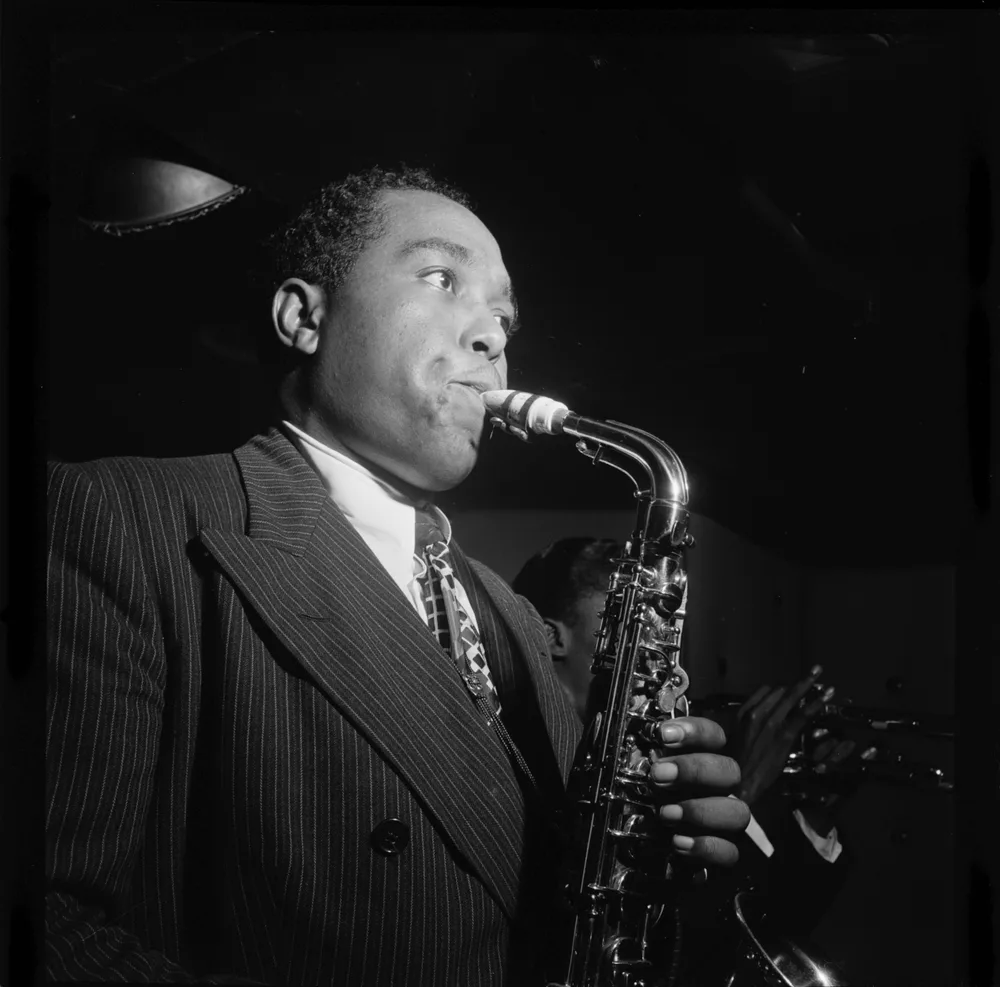
Charlie Parker playing a Conn 6M alto saxophone at the Three Deuces club, New York, N.Y., in August 1947, with Miles Davis standing beside him Public Domain (William P. Gottlieb Collection, Library of Congress; per Gottlieb's own wishes, the entire collection entered the public domain on February 16, 2010) — Wikimedia Commons: https://commons.wikimedia.org/wiki/File:Portrait_of_Charlie_Parker_in_1947.jpg (photographer William P. Gottlieb, from the Library of Congress's Flickr Commons account, https://www.flickr.com/photos/library_of_congress/4843755786/)

Charles Parker Jr. was born August 29, 1920, in Kansas City, Kansas, and raised across the state line in Kansas City, Missouri, the only child of Charles Parker Sr., a Pullman waiter, pianist, and vaudeville singer and dancer, and Adelaide "Addie" Bailey Parker, who worked night shifts for Western Union. He began on alto saxophone around age eleven, purchased by his mother, and joined the Lincoln High School band under Alonzo Lewis at fourteen, where a young trombonist named Robert Simpson gave him his first real instruction in improvisation. He withdrew from school in December 1935 to pursue music full time. An early, formative humiliation came at a jam session at a Kansas City club when he lost track of the chord changes and drummer Jo Jones threw a cymbal at his feet to drive him off the bandstand; rather than quit, Parker reportedly practiced up to fifteen hours a day for the next several years, developing the harmonic fluency that would define him.
In 1938 he joined pianist Jay McShann's territory band, making his professional recording debut with the group in 1940 and picking up the nickname "Yardbird," soon shortened to "Bird." He moved to New York in 1939, working odd jobs including dishwashing at Jimmie's Chicken Shack, where he heard pianist Art Tatum play nightly. Alto saxophonist Buster Smith took him in for six months and gave him band work. Practicing "Cherokee" with guitarist William "Biddy" Fleet, Parker discovered that he could use the higher intervals of a chord as a melody line over appropriately altered harmony, the technical breakthrough at the root of his mature style. Back in Kansas City with McShann in 1940, trumpeter Bernard Anderson introduced him to Dizzy Gillespie; the two quickly recognized a shared musical direction. Parker left McShann's band in 1942 and spent roughly a year in Earl Hines's orchestra, which also carried Gillespie, before an American Federation of Musicians recording ban left most of this formative period undocumented. Late-night sessions at Clark Monroe's Uptown House and Minton's Playhouse in Harlem, alongside Gillespie, Thelonious Monk, guitarist Charlie Christian, and drummer Kenny Clarke, became the incubator for what would be named bebop.
The new music reached record for the first time in February 1945, when Parker joined a Gillespie-led sextet with pianist Al Haig, bassist Curly Russell, and drummer Sidney Catlett for the Guild Records session that produced "Salt Peanuts," "Hot House," and "Groovin' High." On June 22, 1945, the two co-led a concert at New York's Town Hall (not commercially released until a 2005 archival issue). Then, on November 26, 1945, Parker led his own record date for Savoy, billed as Charlie Parker's Reboppers, with Gillespie and a nineteen-year-old Miles Davis sharing the trumpet chair, Russell on bass, and Max Roach on drums. The session, advertised at the time as "the greatest jazz session ever held," produced "Ko-Ko," "Billie's Bounce," and "Now's the Time," among the foundational recorded documents of bebop. A disastrous December 1945 booking at Billy Berg's club in Los Angeles left Parker stranded on the West Coast; he cashed his return ticket for heroin and stayed. A chaotic, alcohol-fueled July 1946 session for the independent Dial label, capturing a visibly disintegrating "Lover Man," was followed within days by a breakdown, a brief arrest, and six months' commitment to Camarillo State Mental Hospital. He returned to recording in 1947 in improved health, cutting "Relaxin' at Camarillo" as a direct reference to the stay.
Back in New York from 1947, Parker recorded prolifically for Savoy and Dial, leading a quintet built around Miles Davis and Max Roach with, in rotation, pianists Duke Jordan and Bud Powell and bassist Tommy Potter, producing "Donna Lee," "Chasin' the Bird," "Scrapple from the Apple," "Embraceable You," and "Bird of Paradise," among dozens of others. Heroin use resumed and never fully stopped. Signing with producer Norman Granz's Mercury, Clef, and later Verve labels opened new settings: a November 30, 1949 date pairing Parker with a mixed string and chamber ensemble arranged by Jimmy Carroll became Charlie Parker with Strings, a commercial and critical landmark that placed his sound against oboe and violins on "Just Friends" and "April in Paris." In December 1950 he recorded the Afro-Cuban Jazz Suite as featured soloist with Machito's orchestra under Chico O'Farrill's arrangement, and that same year cut Bird and Diz with Gillespie and, in one of their rare joint studio appearances, Thelonious Monk on piano.
Parker's Carnegie Hall and Jazz at the Philharmonic appearances under Granz's promotion, and the 1949 opening of the Broadway club Birdland, named in his honor, cemented his stature even as his health and reliability declined. On May 15, 1953, he joined Gillespie, Bud Powell, bassist Charles Mingus, and Max Roach for a concert at Massey Hall in Toronto, billed afterward as "the Quintet of the Year"; because of a contractual conflict Parker was credited on the original release as "Charlie Chan." Mingus recorded and released the concert on his own Debut label as Jazz at Massey Hall, one of the few surviving documents of Parker and Gillespie together at full strength on a concert stage. Parker's final years were marked by worsening health, a bleeding ulcer, and advancing cirrhosis; the death of his two-year-old daughter Pree in 1954 devastated him, and he attempted suicide twice that year. He played his last engagement at Birdland on March 4, 1955. Eight days later, on March 12, 1955, he died in the Stanhope Hotel suite of his friend Baroness Pannonica de Koenigswarter while watching television, officially of lobar pneumonia and a bleeding ulcer; the coroner mistook his 34-year-old body for that of a man in his fifties. He was buried in Kansas City's Lincoln Cemetery. Graffiti reading "Bird Lives" appeared on New York walls within days.
Parker's playing fused blues-rooted phrasing from his Kansas City upbringing with a harmonic vocabulary no saxophonist had previously commanded: rapid passing chords, altered extensions, and chord substitutions delivered at tempos and with a rhythmic freedom that redefined what improvisation could sound like. He absorbed the light tone and long, legato lines of Lester Young as a teenager before developing a harder, brighter alto sound of his own, and he built new melodies over the chord changes of existing standards and blues forms, a practice known as writing "contrafacts," turning "How High the Moon" into "Ornithology" and "I Got Rhythm" into "Moose the Mooche." Alongside Dizzy Gillespie he is credited as bebop's co-founder, and his vocabulary of eighth-note lines, upper-structure harmony, and rhythmic displacement became, within a decade, the working language of virtually every serious jazz improviser regardless of instrument. Miles Davis, who played at his side through the mid-to-late 1940s, later said the history of jazz could be told in four words: Louis Armstrong, Charlie Parker. Four of his recordings, "Ko-Ko," "Ornithology," Jazz at Massey Hall, and Charlie Parker with Strings, are inducted into the Grammy Hall of Fame, and the Library of Congress added "Ko-Ko" to the National Recording Registry in 2002.
- The Complete Savoy and Dial Studio Recordings 1944-1948 (compiled 2000, Savoy/Atlantic) - Gathers the November 26, 1945 "Ko-Ko"/"Billie's Bounce"/"Now's the Time" session with Dizzy Gillespie, Miles Davis, Curly Russell, and Max Roach, plus the 1947-48 New York quintet sides, the bedrock of the recorded bebop canon.
- Bird Lives: The Complete Dial Masters (compiled 1988, Spotlite) - The 1946-1947 Los Angeles and New York sessions for the independent Dial label, including "Ornithology," "A Night in Tunisia," "Relaxin' at Camarillo," and "Embraceable You."
- Charlie Parker with Strings (rec. Nov. 1949, rel. 1950, Mercury) - A quintet-plus-chamber-ensemble date arranged by Jimmy Carroll with Ray Brown on bass and Buddy Rich on drums; a commercial breakthrough Parker himself was proud of despite critics' skepticism of the setting.
- Bird and Diz (rec. 1950, rel. 1952, Mercury) - A reunion with Dizzy Gillespie, unusually pairing Parker on record with pianist Thelonious Monk, plus Buddy Rich and Curly Russell.
- Jazz at Massey Hall (rec. May 15, 1953, rel. 1953, Debut) - The "Quintet of the Year" concert with Dizzy Gillespie, Bud Powell, Charles Mingus, and Max Roach, released on Mingus's own label; Parker, under contract elsewhere, is credited as "Charlie Chan."
- Swedish Schnapps (compiled 1958, Verve) - Small-group sides from 1949-1951 gathering some of his tightest working-quintet playing of the era.
- One Night in Birdland (rec. live 1950, rel. 1977, Columbia) - A club recording with Fats Navarro, Bud Powell, and Art Blakey, capturing the working nightclub sound largely absent from his studio sessions.
- Ko-Ko / Billie's Bounce (1945, Savoy) - The original 78 rpm single from the November 1945 session; inducted into the Grammy Hall of Fame and added to the Library of Congress National Recording Registry in 2002.
Charlie Parker: Full Discography
Identity confirmed via the live Discogs API: artist ID 75617 ("Charlie Parker," realname Charles Parker Jr., born August 29, 1920, Kansas City, died March 12, 1955, New York City, matching every biographical detail against Wikipedia and AllMusic). Discogs credits this single artist entry with 7,389 releases, the overwhelming majority original 78 rpm singles and the enormous downstream reissue, compilation, and bootleg history typical of a foundational figure who recorded almost entirely for 78 rpm release before the LP era. Parker never worked in the "one leader, one album" model common to later jazz careers: his essential recordings were made as sides for Savoy and Dial between 1944 and 1948, then for Mercury, Clef, and Verve under producer Norman Granz from 1949 until his death. The table below covers his essential leader/co-leader sessions as they are packaged in the standard reference compilations, plus his most historically significant sideman and guest-soloist credits, verified session by session against Discogs; it does not attempt to itemize the thousands of individual 78 rpm sides, radio transcriptions, or posthumous bootleg releases in the Discogs database.
As Leader / Co-Leader
| Album Title | Recording Date(s) | Release Date | Label | Catalog Number | Format(s) | Personnel | Role | Reissue History | Spotify | Buy | Notes |
|---|---|---|---|---|---|---|---|---|---|---|---|
| The Complete Savoy and Dial Studio Recordings 1944-1948 | Recorded 1944-1948, various New York and Los Angeles sessions | 2000 | Atlantic (Savoy) | 92911-2 | CD, Compilation | Charlie Parker (alto sax), Dizzy Gillespie and Miles Davis (trumpet, on the founding Nov. 26, 1945 date), Curly Russell (bass), Max Roach (drums), plus rotating personnel across later Savoy dates | Leader | Definitive CD compilation of the Savoy studio catalog; earlier partial reissues include Bird Symbols (Savoy, 1950s) and The Charlie Parker Story (Savoy, 1956) | — | — | Includes the Nov. 26, 1945 "greatest jazz session ever" date ("Ko-Ko," "Billie's Bounce," "Now's the Time") and the 1947-48 New York quintet sides ("Donna Lee," "Chasin' the Bird," "Cheryl") |
| Bird Lives: The Complete Dial Masters | Recorded 1946-1947, Los Angeles and New York | 1988 | Spotlite/New Musical Express | JU-6-7333 | LP box, Compilation | Charlie Parker (alto sax) with, across sessions, Miles Davis or Howard McGhee (trumpet), Duke Jordan or Dodo Marmarosa or Erroll Garner (piano), Tommy Potter or Red Callender (bass), Max Roach or Roy Porter (drums) | Leader | Reissued in numerous partial forms over the decades, including The Legendary Dial Masters (1989) and Complete DIAL Sessions (2016) | — | — | The independent-label sessions that produced "Ornithology," "A Night in Tunisia," "Relaxin' at Camarillo," and "Embraceable You"; the notoriously chaotic July 29, 1946 "Lover Man" date, made under visible physical and mental distress, is included |
| "Bird" Symbols | Recorded 1946-1947, Los Angeles | 1961 | Charlie Parker Records | PLP-407 | Vinyl, LP, Compilation, Mono | Charlie Parker (alto sax), Lucky Thompson (tenor sax), Dodo Marmarosa or Duke Jordan or Erroll Garner (piano), Arvin Garrison (guitar), Vic McMillan or Red Callender or Tommy Potter (bass), Harold "Doc" West or Max Roach or Roy Porter (drums) | Leader | One of several early Dial-material compilation LPs issued under different titles before the 1988 and 2000 definitive CD box sets | — | — | An early (1961) Dial-era compilation LP, useful for its detailed session-by-session personnel breakdown |
| Charlie Parker with Strings | Recorded November 30, 1949, New York | 1950 | Mercury | C-101 | Vinyl, LP, 10" | Charlie Parker (alto sax), Jimmy Carroll (arranger), Ray Brown (bass), Buddy Rich (drums), Stan Freeman (piano), Mitch Miller (oboe, English horn), Myor Rosen (harp), Bronislaw Gimpel and Max Hollander (violin), Frank Brieff (viola), Frank Miller (cello) | Leader | Reissued repeatedly by Mercury, Clef, and Verve through the 1950s-60s as the string-orchestra format was expanded on subsequent sessions | — | — | Landmark pairing of Parker with a chamber string section, arranged by Jimmy Carroll; a commercial breakthrough Parker himself considered some of his best work despite critical skepticism of the format |
| Bird and Diz | Recorded June 6, 1950, New York | August 1952 | Mercury (Clef) | MGC-512 | Vinyl, LP, 10", Mono | Charlie Parker (alto sax), Dizzy Gillespie (trumpet), Thelonious Monk (piano), Curly Russell (bass), Buddy Rich (drums) | Co-leader | Later folded into the 1988 box Bird: The Complete Charlie Parker on Verve | — | — | One of Parker's only studio sessions alongside Thelonious Monk |
| South of the Border | Recorded 1951-1952 | 1952 | Mercury (Clef) | MGC-513 | Vinyl, LP, 10" | Charlie Parker (alto sax) with a Latin rhythm section drawn from the Machito organization | Leader | Later folded into the 1988 Verve box set | — | — | Afro-Cuban-flavored small-group sides distinct from the separately billed Machito Afro-Cuban Jazz Suite session below |
| Jazz at Massey Hall | Recorded live May 15, 1953, Massey Hall, Toronto | 1953 | Debut Records | DLP-2 | Vinyl, LP, 10" | "Charlie Chan" [Charlie Parker] (alto sax), Dizzy Gillespie (trumpet), Bud Powell (piano), Charles Mingus (bass), Max Roach (drums) | Co-leader ("the Quintet of the Year") | Reissued on CD numerous times, often paired with the companion Bud Powell Trio set from the same night, Jazz at Massey Hall Volume Two | — | — | Recorded and released by Charles Mingus on his own Debut label; Parker, under contract to Mercury/Clef at the time, is credited on the original sleeve as "Charlie Chan" |
| Charlie Parker Big Band | Recorded 1952-1954 | 1954 | Clef Records | MG C-609 | Vinyl, LP, Mono | Charlie Parker (alto sax/saxophone) with a Norman Granz-assembled studio big band and string section | Leader | Later material for this era was folded into Bird: The Complete Charlie Parker on Verve | — | — | Big-band and orchestral-strings sides produced during Parker's Clef contract years |
| Swedish Schnapps | Recorded 1949-1951, New York | 1958 | Verve | MG V-8010 | Vinyl, LP, Mono | Charlie Parker (alto sax) with small groups including Walter Bishop Jr. (piano) and Teddy Kotick (bass) across sessions | Leader | Later folded into Bird: The Complete Charlie Parker on Verve (1988) and The Complete Verve Master Takes (2003) | — | — | Compiles several late-1940s/early-1950s small-group dates not issued as a unified session at the time |
| One Night in Birdland | Recorded live June 30, 1950, Birdland, New York | 1977 | Columbia | JG 34808 / C 34809 | Vinyl, LP, Album | Charlie Parker (alto sax), Fats Navarro (trumpet), Bud Powell or Walter Bishop Jr. (piano), Curly Russell (bass), Art Blakey or Roy Haynes (drums), Jimmy Scott (vocals, one track) | Leader | First official release of amateur recordings made from the audience decades after the performance | — | — | A rare surviving document of Parker's working nightclub sound, released decades after the fact from amateur tape |
| Town Hall, New York City, June 22, 1945 | Recorded live June 22, 1945, Town Hall, New York | 2005 | Uptown Records | UPCD 27.51 | CD | Charlie Parker (alto sax), Dizzy Gillespie (trumpet), Al Haig (piano), Curly Russell (bass), Sidney Catlett (drums) | Co-leader | Rediscovered acetate, first commercially released 2005 | — | — | One of the earliest surviving live documents of the Parker-Gillespie bebop quintet, only months after their first studio sides |
| Early Bird | Recorded 1940-1942, various | 1973 | Spotlite Records | SPJ 120 | Vinyl, LP, Compilation | Charlie Parker (alto sax) with the Jay McShann Orchestra | Sideman/featured soloist | Later material of this vintage circulates on several other McShann-era compilations | — | — | Compiles Parker's earliest studio recordings, made as a section player and emerging soloist in Jay McShann's territory band |
| Bird: The Complete Charlie Parker on Verve | Recorded 1946-1954, various | 1988 | Verve | 837 141-2 | 10-CD box, Compilation | Charlie Parker (alto sax) across the full run of his Mercury, Clef, and Verve sessions | Leader/Co-leader | Superseded in part by 2003's The Complete Verve Master Takes, a master-takes-only trim of the same box | — | — | The reference box set for the entire second half of Parker's recording career; used here as the citation for the complete Mercury/Clef/Verve era rather than itemizing every constituent session |
As Sideman (selected major credits)
| Year | Project (Leader) | Title | Label | Catalog | Role | Notes |
|---|---|---|---|---|---|---|
| 1945 | Dizzy Gillespie Sextet | "Salt Peanuts" / "Hot House" | Guild Records | (10" shellac) | Alto Saxophone | February 1945 session with Dizzy Gillespie, Al Haig, Curly Russell, and Sidney Catlett; among the first studio recordings issued under the bebop name |
| 1945 | Charlie Parker / Dizzy Gillespie (Miles Davis on trumpet) | Billie's Bounce / Now's the Time | Savoy Records | 573 | Alto Saxophone, Written-By | The Nov. 26, 1945 Savoy session, with Miles Davis on trumpet, Curly Russell on bass, and Max Roach on drums; also produced "Ko-Ko," not on this specific single |
| 1951 | Machito and His Afro-Cubans (arr. Chico O'Farrill) | Afro-Cuban Jazz Suite | Mercury (Clef) | MG C-505 | Alto Saxophone (featured soloist) | Recorded December 1950; Parker and tenor saxophonist Flip Phillips are the featured jazz soloists over Machito's Afro-Cuban orchestra, arranged and conducted by Chico O'Farrill |
| 1955 | Savoy Records compilation (various leaders) | Groovin' High | Savoy Records | MG 12020 | Alto Saxophone (on selected tracks) | A Savoy small-group anthology spanning several mid-1940s bebop sessions; Parker's own tracks on this LP derive from the sessions detailed above rather than from a single unified date |
Parker's Discogs artist-releases listing also carries hundreds of further "Appearance" and "TrackAppearance" credits spanning the 1940s Jazz at the Philharmonic all-star jam sessions, Metronome All Stars poll-winner sessions, and radio transcriptions with Woody Herman's and Red Norvo's orchestras, none itemized here.
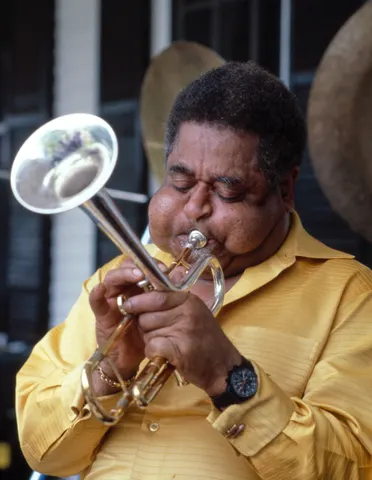
- Dizzy Gillespie - co-architect of bebop; bandmate from the early 1940s Harlem after-hours scene through the 1945 Guild sides, the Town Hall concert, Bird and Diz, and the 1953 Massey Hall concert.
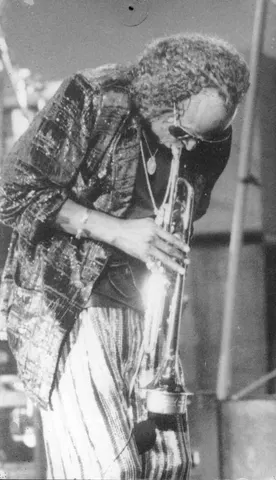
- Miles Davis - trumpeter in Parker's working quintet from the pivotal November 1945 Savoy session through the 1947-48 New York Dial and Savoy dates.
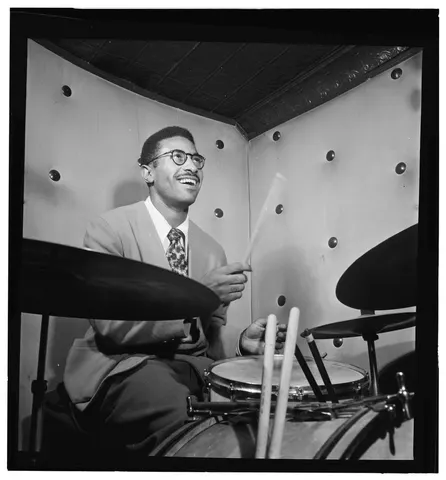
- Max Roach - drummer on the 1945 Savoy session, much of the 1947-48 quintet work, and the 1953 Massey Hall concert.
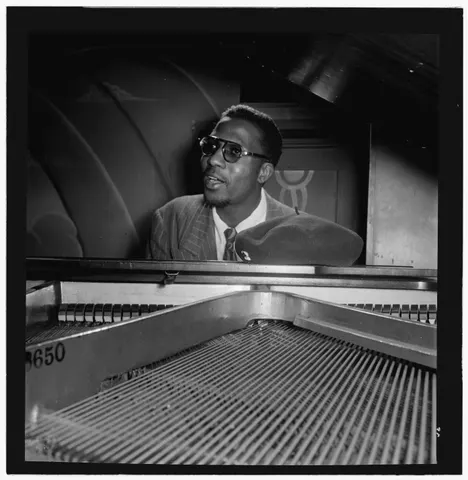
- Thelonious Monk - fellow architect of the Minton's/Uptown House bebop scene of the early 1940s; one of Parker's rare studio pairings with him came on 1950's Bird and Diz.
- Charles Mingus - bassist and producer of the 1953 Jazz at Massey Hall concert on his own Debut label.
- Bud Powell - pianist on a run of 1947 New York sessions and at the 1953 Massey Hall concert.
- Machito - Latin jazz bandleader with whom Parker recorded the 1950 Afro-Cuban Jazz Suite, arranged by Chico O'Farrill; not yet profiled on JazzProfiles.com.
- Norman Granz - producer who signed Parker to Mercury, Clef, and Verve from 1949 onward and built the string-section and Latin-jazz settings of his final years.