 JAZZPROFILES lives in the music 1,002 Jazz Artists fully Profiled!
 Dan Gottfried
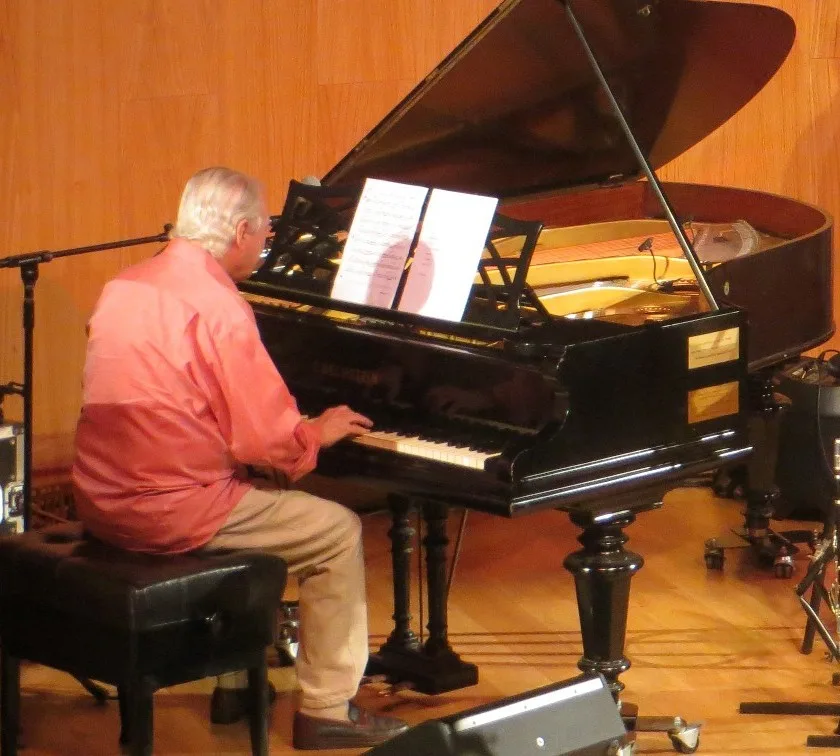
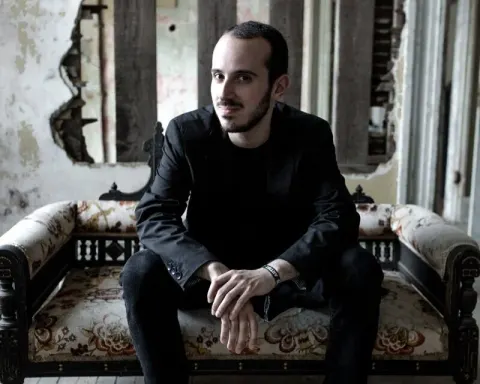
Dan Gottfried at the piano, Beit Hatfutsot, Tel Aviv, June 14, 2013. Cropped from a photograph of the full quartet, which also shows Albert Piamenta on saxophone, Eli Magen on bass and Arale Kaminsky on drums. Saved locally as `portrait.jpg`, 840 x 756 pixels, 161,936 bytes. CC BY 2.5. The crop is a permitted adaptation under that licence and is attributed to the original photographer below. — Yehudit Garinkol, via the PikiWiki Israel free image collection project and Wikimedia Commons. Original file: https://commons.wikimedia.org/wiki/File:PikiWiki_Israel_32383_Israeli_jazz_musicians.JPG (full-resolution asset at https://upload.wikimedia.org/wikipedia/commons/8/8a/PikiWiki_Israel_32383_Israeli_jazz_musicians.JPG, 2000 x 1236, 679,140 bytes). PikiWiki source record id 32383. The Commons file page's Hebrew description names all four players and is the basis for identifying Gottfried as the pianist.
Dan Gottfried, also credited as Danny Gottfried, is the pianist who played on the first instrumental jazz album recorded in Israel and then spent the next four decades building the institutions the country's jazz scene grew inside.
He trained as a classical pianist at the Tel Aviv Academy of Music and won First Prize in the Mozart Piano competition in 1959. In 1962 he took an undergraduate degree in economics at the Hebrew University of Jerusalem and went on to study law. His performing career began in the early 1960s on the classical side, and it turned toward jazz through his working partnership with the saxophonist Albert Piamenta, which produced the two recordings that make up almost his entire discography.
The first was an EP for the A.Z.R. label by the Carmel Quartet, a dance band assembled around Gottfried and Piamenta for a European tour that took them to Holland and Sweden in 1963. Produced by the Greek-Israeli singer Aris San, it is a working musician's record rather than a statement.
The second is the one that matters. In 1973 Isradisc released Mezare Israel Yekabtzenu (SI 31028), six tracks cut in a single day at Koliner Studios in Tel Aviv by a quartet billing itself as the Jazz Work Shop, or Sadnat Hajazz: Piamenta on alto and soprano saxophone, Gottfried on piano, Teddy Kling of the Israel Philharmonic Orchestra on double bass, and Jerry Garval, a student of Max Roach who had played with Sun Ra, on drums. It was the first instrumental jazz album recorded in Israel, and its argument was that Israeli jazz should draw on Arab maqams, Druze rhythms and Hasidic melody rather than reproduce American standards. The record then went out of print for 41 years, until Fortuna Records reissued it on vinyl in 2014 and the London label Jazzman placed its title track on the compilation Spiritual Jazz 5: The World the same year, with CD reissues following in Israel and Japan in 2015.
The larger part of Gottfried's working life went into building places for other musicians to play. In 1981 he founded the jazz faculty at the Jerusalem Academy of Music and Dance and led it for eight years. In 1985 he founded the jazz studies department at the Thelma Yellin High School of the Arts in Givatayim, the school that has since trained a large share of Israel's internationally known jazz musicians. In 1987 he initiated the Red Sea Jazz Festival in Eilat and served as its artistic director for 22 years, presenting more than 1,500 musicians and building an event that draws audiences of around 70,000 at roughly 2,500 people per concert. He stepped down in 2008 and was succeeded by the bassist Avishai Cohen.
He built concert programming alongside the schools and the festival. The Tel Aviv Museum of Art commissioned him to direct its jazz concert series in 1992. In 1994 he began an annual ten-lecture series on the history of jazz at the Open University of Israel. From 1998 to 2004 he ran "Jazz at The Opera" at the Tel Aviv Opera House.
Through all of it he kept playing. He leads a trio with Eli Magen on bass and Arale Kaminsky on drums, and a quintet that the Israeli Ministry of Foreign Affairs sent abroad to present Israeli jazz: Belarus in 1993, Latvia in 1996, India in 1998, Italy in 2004. He has shared stages with Dizzy Gillespie, Benny Golson, Frank Foster, Sam Rivers, Niels-Henning Ørsted Pedersen, Randy Brecker, Von Freeman, Clark Terry, Ronnie Cuber, Sheila Jordan, Georgie Fame, Mark Murphy and Kevin Mahogany. None of that work was commercially recorded.
Israel's Ministry of Culture gave him its lifetime achievement prize in jazz in 2007 and its senior artists prize in 2018. The Jerusalem Academy of Music and Dance awarded him its Gold Medal in 2010. He is president of the Israeli Musicians' Union and general manager of the Israeli Musicians' Collecting Society. His son, Yaron Gottfried, is a conductor, composer and pianist.
Gottfried came to jazz from a classical training, and the discipline shows in his playing: clean voicing, an accompanist's restraint, and a comping style built to leave room for a horn rather than to compete with one. On the 1973 record his role is structural. He holds the harmony steady underneath Piamenta while the melodic material moves through modes that the standard jazz vocabulary does not accommodate, which is the whole point of the album.
That record places him in the same current as the ethno-jazz and spiritual-jazz recordings being made elsewhere in the world in the same years, and Jazzman's decision to anthologise it alongside them in 2014 confirmed the connection retroactively. His own trio work runs on different ground: international jazz standards, played straight, in a mainstream idiom.
The more durable part of his influence is not stylistic but curatorial. As artistic director in Eilat for 22 years he decided which musicians Israeli audiences heard, and as the founder of two jazz departments he decided what Israeli students were taught. Both are compositional acts at a different scale.
- Mezare Israel Yekabtzenu (1973, Jazz Work Shop, Isradisc SI 31028) - The first instrumental jazz album recorded in Israel, and the reason Gottfried's name belongs in any account of how the country's jazz scene started. He plays piano; Piamenta leads. The title track is the entry point. Spotify - "Mezare Israel" (via Spiritual Jazz 5: The World) · YouTube - full album Listen · Buy
- Spiritual Jazz 5: The World (2014, Jazzman) - The compilation that brought the 1973 recording to an international audience 41 years after the fact, placing it alongside modal and spiritual jazz from around the world. Spotify - Spiritual Jazz 5: The World Listen
- Wooly Bully (A.Z.R. 11-14, EP) - The Carmel Quartet EP, produced by Aris San. A dance-band record rather than a jazz one, and the earliest documented Gottfried recording. No streaming source found.
Dan Gottfried: Full Discography
Dan Gottfried (born 1939) is Discogs artist 4120871, name variation "Danny Gottfried". His recorded catalogue is unusually small for a career of this length and importance, and it contains no leader dates. He appears on two original releases, both with the saxophonist Albert Piamenta, and on one compilation that reissued a track from the second of them.
As Leader
None. Gottfried has led a working trio and a quintet since the 1980s, and toured internationally with both, but neither has issued a commercial recording. There is no leader date to list.
As Sideman / Group Member
| Album | Year | Billed Artist | Label | Catalog | Format | Personnel | Gottfried's Role | Listen | Buy | Notes |
|---|---|---|---|---|---|---|---|---|---|---|
| Wooly Bully | 1964 (per Discogs) | The Carmel Quartet | A.Z.R. | 11-14 | 7", EP | Dan Gottfried (piano); Albert Piamenta (saxophone); Yossi Pepo (drums); Aris San (producer); Joe Israel (songwriter) | Piano | not found | not found | Four tracks: "Wooly Bully", "Mare", "Zannuba", "Who Put The Bomb". Discogs release 8945519. The Carmel Quartet was a dance band assembled for a European tour; this project's Albert Piamenta spotlight records that Piamenta and Gottfried took it to Holland and Sweden in 1963. Produced by Aris San, the Greek-Israeli singer and guitarist. |
| Mezare Israel Yekabtzenu | 1973 | Jazz Work Shop (Sadnat Hajazz) | Isradisc | SI 31028 | LP, Album | Albert Piamenta (alto saxophone, soprano saxophone); Dan Gottfried (piano); Teddy Kling (bass); Jerry Garval (drums) | Piano | YouTube, full album | Amazon | The first instrumental jazz album recorded in Israel. Six tracks, cut in a single day at Koliner Studios, Tel Aviv: "Mezare Israel Yekabtzenu" (7:42), "Rabbi Elimelech" (6:30), "Sha Shtil Harabbi Ba" (5:38), "Ala Dal'ona" (6:41), "Ken Yovdu Kol Oyvecha" (7:07), "Hamichtav" (6:01). The material adapts Arab maqams, Druze rhythms and Hasidic melody. Teddy Kling came from the Israel Philharmonic Orchestra; Jerry Garval had studied with Max Roach and played with Sun Ra. Discogs master 764646, main release 6351150. |
Reissues of Mezare Israel Yekabtzenu
| Year | Label | Catalog | Country | Format | Listen | Buy |
|---|---|---|---|---|---|---|
| 2014 | Fortuna Records | FTNLP002 | Israel | LP, Limited Edition, Reissue | YouTube, label channel | Fortuna Records |
| 2015 | Skyton | CDS 31028 | Israel | CD, Album, Reissue, Stereo | YouTube, full album | Amazon |
| 2015 | Production Dessinée / Vivid Sound | PDCD-167, VSCD-9498 | Japan | CD, Album, Reissue | YouTube, full album | not found |
Individual tracks from the Fortuna reissue, on the label's own YouTube channel: "Mezare Israel Yekabtzenu", "Sha Shtil Harabbi Ba", "Ala Dal'ona", "Hamichtav".
Compilation Appearances
| Compilation | Year | Label | Track | Position | Listen | Buy |
|---|---|---|---|---|---|---|
| Spiritual Jazz 5: The World (Esoteric, Modal And Deep Jazz From Around The World 1961-79) | 2014 | Jazzman | "Mezare Israel Yekabtzenu", credited to Jazz Work Shop | A4 | Spotify, album · Spotify, track | Amazon |
| il Dramma 06 - The Joker | 2007 | not found | Track appearance credited to Jazz Work Shop | not found | not found | not found |
Unrecorded Work
The following are documented parts of Gottfried's performing career that produced no commercial release. They are listed because a discography alone misrepresents what he did.
| Ensemble / Series | Period | Personnel or Detail |
|---|---|---|
| Dan Gottfried Trio | Long-running, still performing | Dan Gottfried (piano), Eli Magen (bass), Arale Kaminsky (drums). Repertoire built on international jazz standards. |
| Dan Gottfried Quintet | 1990s onward | Toured for the Israeli Ministry of Foreign Affairs: Belarus 1993, Latvia 1996, India 1998, Italy 2004. |
| Guest and festival appearances | 1960s onward | Shared stages with Dizzy Gillespie, Benny Golson, Frank Foster, Sam Rivers, Niels-Henning Ørsted Pedersen, Randy Brecker, Von Freeman, Johnny Frigo, Franz Jackson, Clark Terry, Major Holley, Jaroslav Jakubovič, Ronnie Cuber, Sheila Jordan, Georgie Fame, Mark Murphy, Kevin Mahogany, Jean Loup Longnon, Gyula Babos. |
Research notes, sourcing detail and open questions for this discography are kept separately, in dan-gottfried_notes.md.
- Albert Piamenta (alto and soprano saxophone) - Gottfried's longest and most consequential musical partnership, running from the Carmel Quartet's European tour in 1963 through the 1973 Jazz Work Shop album. Both of Gottfried's original recordings are with Piamenta.
- Jazz Work Shop / Sadnat Hajazz (1973) - piano, alongside Piamenta, Teddy Kling (double bass, Israel Philharmonic Orchestra) and Jerry Garval (drums).
- The Carmel Quartet (1963 onward) - piano, alongside Piamenta and Yossi Pepo (drums), produced by Aris San.
- Dan Gottfried Trio - bandleader; Eli Magen (bass), Arale Kaminsky (drums). A long-running standards trio, unrecorded commercially.
- Dan Gottfried Quintet - bandleader; toured for the Israeli Ministry of Foreign Affairs to Belarus (1993), Latvia (1996), India (1998) and Italy (2004).
- Guest appearances - performed with Dizzy Gillespie, Benny Golson, Frank Foster, Sam Rivers, Niels-Henning Ørsted Pedersen, Randy Brecker, Von Freeman, Johnny Frigo, Franz Jackson, Clark Terry, Major Holley, Jaroslav Jakubovič, Ronnie Cuber, Sheila Jordan, Georgie Fame, Mark Murphy, Kevin Mahogany, Jean Loup Longnon and Gyula Babos.

- Dan Gottfried on jazzprofiles.com
- r/IsraelJazz
- Red Sea Jazz Festival
- Jerusalem Academy of Music and Dance
- Thelma Yellin High School of the Arts
- Discogs: Dan Gottfried
- Wikipedia: Dan Gottfried
- Wikipedia: Red Sea Jazz Festival
- Discogs: Dan Gottfried (artist 4120871)
- Discogs: Jazz Work Shop, Mezare Israel Yekabtzenu (release 6351150)
- Discogs: The Carmel Quartet, Wooly Bully (release 8945519)
- Fortuna Records: The Jazz Workshop, Mezare Israel Yekabtzenu
- Wikimedia Commons: PikiWiki Israel 32383, Israeli jazz musicians

Research notes, sourcing detail and open questions for this profile are kept separately, in dan-gottfried_notes.md.