 JAZZPROFILES lives in the music 1,002 Jazz Artists fully Profiled!
 George Cables
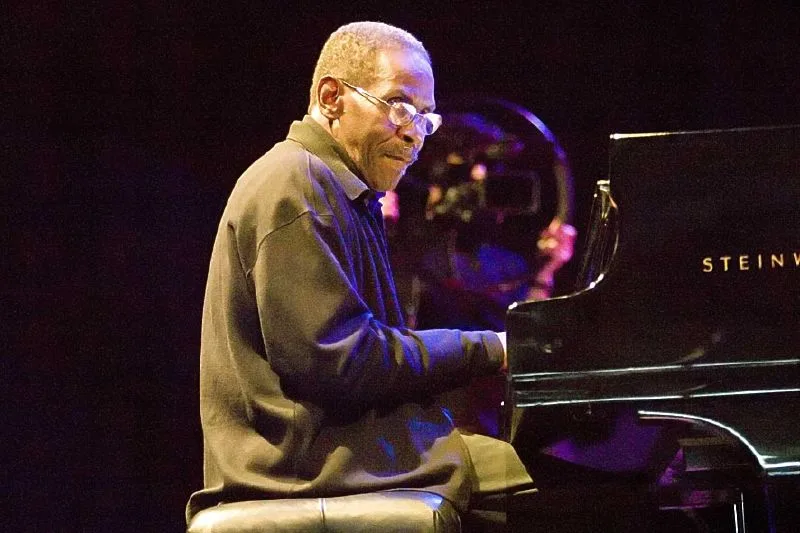
George Cables performing live at the piano CC BY 2.0 — Wikimedia Commons (originally Flickr, photographed by Tom Beetz) — https://commons.wikimedia.org/wiki/File:George_Cables.jpg

George Andrew Cables was born November 14, 1944, in New York City and studied classical piano as a child before entering the High School of Performing Arts, where jazz first caught him by surprise. He went on to Mannes College of Music from 1963 to 1965, but his real education came on the bandstand: by 1964 he was playing in the Jazz Samaritans, a young co-op group whose ranks included drummer Billy Cobham, drummer/pianist Lenny White, and bassist Clint Houston. Gigs at the Top of the Gate and Slugg's built his reputation quickly, and before the decade was out he had recorded with tenor saxophonist Paul Jeffrey, appeared on Max Roach's Lift Every Voice and Sing, and held down a brief 1969 tenure in Art Blakey's Jazz Messengers.
A 1969 tour with Sonny Rollins carried Cables to the West Coast, and by 1971 he had become a fixture of the Los Angeles and San Francisco jazz scenes. His early-1970s dance card filled with major names: he recorded Sonny Rollins's Next Album, appeared with Joe Henderson, and, on trumpeter Woody Shaw's Contemporary debut Blackstone Legacy (recorded December 8 and 9, 1970, released 1971), played piano and electric piano across the entire record and co-wrote two of its tracks with Shaw. The Cables/Shaw partnership continued across Song of Songs (1973), Woody Three (1979), and Jazz Patterns (1982). Cables also became a favored partner of vibraphonist Bobby Hutcherson, appearing on Hutcherson-adjacent dates including drummer Eddie Marshall's Dance of the Sun (1978), and worked frequently on electric piano through this period, a texture he would largely set aside once the second half of the decade pulled him back toward the acoustic instrument.
That pivot came from tenor giant Dexter Gordon, who invited Cables into his working quartet in 1977 after Gordon's celebrated return to the United States. The two years Cables spent with Gordon, documented on Sophisticated Giant (1977), Manhattan Symphonie (1978), Great Encounters (1979), and the extensive live tapes issued later as the multi-volume Nights at the Keystone (recorded 1978 at San Francisco's Keystone Korner), reimmersed him in bebop vocabulary and rekindled his commitment to acoustic piano after years of doubling on electric keyboards.
The longest-running relationship of Cables's career, though, was with alto saxophonist Art Pepper, who nicknamed him "Mr. Beautiful" and made him his favored pianist for the last five years of his life. Cables appears on a long run of Pepper's Contemporary and Galaxy quartet dates, including extensive live engagements at the Village Vanguard, and the two also recorded as a duo: Goin' Home, cut May 11 and 12, 1982, at Fantasy Studios in Berkeley, and Tête-à-Tête, drawn mostly from sessions in April 1982 with one additional title recorded that same May 11. Pepper died June 15, 1982, roughly a month after the Goin' Home sessions, making that duo record the more widely cited candidate for his final studio recording; either way, the two duo albums stand together as the closing chapter of one of Pepper's most sustained late-career partnerships.
Cables built an extensive leader catalog of his own alongside all of this sideman work, beginning with the trio date Why Not (1975, recorded in Los Angeles for the Japanese Trio label) and running, by way of Cables' Vision (1980, Contemporary, with Freddie Hubbard and Bobby Hutcherson), Circle and Phantom of the City (both Contemporary, mid-1980s), and the tribute album By George: George Cables Plays the Music of George Gershwin (1987), into a prolific run for the Danish label SteepleChase through the 1990s (Quiet Fire, Person to Person, Skylark, among others) and a solo outing, George Cables at Maybeck (1994, Concord), in that label's long-running solo-piano recital series. In the 2000s he became a fixture of alto saxophonist Frank Morgan's working quartet, documented on two volumes recorded live at New York's Jazz Standard, and paid tribute to his former employer on the trio album A Letter to Dexter (2006, with Rufus Reid and Victor Lewis). Cables underwent a simultaneous liver and kidney transplant in 2007, several months after recording You Don't Know Me, following roughly five years on hemodialysis; he returned to touring and recording afterward. His longtime partner Helen Wray died of pancreatic cancer in 2009, and Cables dedicated the 2012 trio album My Muse to her memory. Around the same period he became a founding member of the all-star band the Cookers, whose 2010 debut Warriors grew out of a working group he had crystallized in the late 2000s alongside Billy Harper, Eddie Henderson, Cecil McBee, Billy Hart, and David Weiss. His recent HighNote output, largely in a working trio with bassist Essiet Essiet, includes The George Cables Songbook (2016), I'm All Smiles (2019), Too Close for Comfort (2021), and I Hear Echoes (2024). In February 2025, the Mellon Foundation and Jazz Foundation of America named him one of twenty inaugural Jazz Legacies Fellows. Most recently, Cables played piano throughout Roni Ben-Hur's Stories (Dot Time Records, recorded September 11 and 12, 2020, released 2021), a sideman role he shares with trumpeter Ingrid Jensen and, in the bass/mixing chair, Harvie S; he also composed the album's closing track, "Melodious Funk."
Cables is a lyrical, harmonically sophisticated pianist whose touch and voicings made him one of the most in-demand accompanists of his generation, comfortable inside hard bop's fast tempos and equally persuasive on ballads. He has said he was shaped less by any single pianist than by the collective sound of bands like Miles Davis's and John Coltrane's, and his own catalog bears that out: he moves fluently between the bebop language he absorbed from Dexter Gordon, the intimate duo rapport he built with Art Pepper, and his own body of original compositions, several of which ("Helen's Song," "Quiet Fire," and the record-titling "My Muse" among them) have since been recorded by other musicians. Critics have consistently singled out his gift for economical, melodic solo construction over flashy technique, and his decades as a first-call sideman across so many different leaders' bands are themselves a form of critical recognition rarely afforded a musician who was, for much of his career, "everyone's favorite sideman" before belatedly getting his due as a bandleader.
- Blackstone Legacy (1971, Contemporary) - Woody Shaw's leader debut, with Cables on piano and electric piano throughout and co-writer of two tracks; the recording that opened Cables's long partnership with Shaw. Spotify - Blackstone Legacy
- Cables' Vision (1980, Contemporary) - His own best-known leader date, a quintet session with Freddie Hubbard and Bobby Hutcherson, widely praised on release. Spotify - Cables' Vision Listen
- Goin' Home (1982, Galaxy) - A duo album with Art Pepper recorded a month before Pepper's death, often cited as the saxophonist's final studio session. Spotify - Goin' Home Listen
- Sophisticated Giant (1977, Columbia) - The first studio album to document Cables's two-year stint in Dexter Gordon's quartet following Gordon's return to the U.S.
- George Cables at Maybeck (1994, Concord) - A solo-piano recital recorded live at Maybeck Recital Hall, part of Concord's long-running Maybeck series.
- My Muse (2012, HighNote) - A trio tribute to Cables's late partner Helen Wray, with Essiet Essiet and Victor Lewis. Spotify - My Muse Listen
- The George Cables Songbook (2016, HighNote) - A career-spanning collection of his own compositions, featuring vocalist Sarah Elizabeth Charles and saxophonist Craig Handy.
- I Hear Echoes (2024, HighNote) - His most recent trio recording, sustaining a 50-plus-year recording career into its ninth decade of the pianist's life.
George Cables: Full Discography
Identity confirmed via the live Discogs API (artist ID 255116) ("George Cables," matching the piano/electric piano credits and cross-referenced session dates described in his own published biography). Discogs credits Cables on 412 releases total across every role. His own leader/co-leader catalog runs to more than 40 albums recorded between 1975 and 2024, which is too large to itemize exhaustively here; the table below curates the most significant, best-documented entries, verified individually at the release level rather than trusted from Discogs's coarser artist-releases listing. (That coarser listing tags several releases "Main" that turned out, on release-level inspection, to be sideman or featured-artist credits rather than Cables's own leader dates - among them 1981's Someday, credited to "Joe Farrell / George Cables / John Dentz / Tony Dumas"; 1989's Elsie Street, billed to "Chuck Metcalf Quintet Featuring George Cables"; 1992's Introducing Jeff Jerolamon; and Odla, actually an unrelated release by Danila Satragno. These are omitted below rather than miscounted as Cables leader dates.) A second table covers a representative set of his major sideman credits with Woody Shaw, Dexter Gordon, and Art Pepper, the three most significant employer relationships of his career, plus a few other landmark dates.
As Leader / Co-Leader
| Album Title | Recording Date(s) | Release Date | Label | Catalog Number | Format(s) | Personnel | Role | Reissue History | Spotify | Buy | Notes |
|---|---|---|---|---|---|---|---|---|---|---|---|
| Why Not | Recorded October 7, 1975, Record Plant, Los Angeles | 1975 | Whynot / Trio Records | PA-7119 | Vinyl, LP | George Cables (piano), Tony Dumas (bass), Carl Burnett (drums) | Leader | Not confirmed | — | — | All compositions by Cables; original Japanese pressing |
| Cables' Vision | Recorded December 17-19, 1979, Ocean Way Sound Recorders, Los Angeles | 1980 | Contemporary Records | C 14001 | Vinyl, LP | George Cables (piano, electric piano), Freddie Hubbard (flugelhorn), Bobby Hutcherson (vibraphone), Ernie Watts (tenor sax, flute), Tony Dumas (bass, electric bass), Peter Erskine (drums), Vince Charles (percussion) | Leader | Reissued on CD | Spotify - Cables' Vision | — | AllMusic gave it 4.5 stars; widely considered his best-known leader date |
| Circle | Recorded March 27-29, 1979, Contemporary Records studio, Los Angeles | 1985 | Contemporary Records | C-14015 | Vinyl, LP | George Cables (piano, electric piano, clavinet), Rufus Reid or Tony Dumas (bass, by track), Eddie Gladden or Peter Erskine (drums, by track), Joe Farrell (flute), Ernie Watts (tenor sax) | Leader | Not confirmed | — | — | Recorded 1979, held back six years before release |
| Goin' Home | Recorded May 11-12, 1982, Fantasy Studios, Berkeley | 1982 | Galaxy Records | GXY-5143 | Vinyl, LP | Art Pepper (alto sax), George Cables (piano) | Co-leader (duo) | Reissued as part of The Complete Galaxy Recordings (1989) | Spotify - Goin' Home | — | Recorded roughly a month before Pepper's death; often cited as his final studio session |
| Tête-à-Tête | Recorded April 13-14 and May 11, 1982, Fantasy Studios, Berkeley | 1983 | Galaxy Records | GXY-5147 | Vinyl, LP | Art Pepper (alto sax), George Cables (piano) | Co-leader (duo) | Not confirmed | — | — | A second duo album with Pepper from the same final spring sessions as Goin' Home |
| Phantom of the City | Recorded May 14-15, 1985, Fantasy Studios, Berkeley | 1985 | Contemporary Records | C-14014 | Vinyl, LP | George Cables (piano, producer), John Heard (acoustic bass), Tony Williams (drums) | Leader | Reissued on CD | — | — | Trio session; the drummer credited as "Anthony Williams" on the release is not independently confirmed here as the Miles Davis-era Tony Williams |
| The Big Jazz Trio | Recorded May 7-9, 1984, Japan | 1985 | Eastworld | CP35-5022 | Vinyl, LP | George Cables (piano), Stanley Clarke (bass), Peter Erskine (drums) | Leader | Not confirmed | — | — | Japan-only release |
| Double Image | Recorded May 21-22, 1986, Monterey Sound Studio, Glendale, CA | 1987 | Contemporary Records | CCD-14035-2 | CD | Frank Morgan (alto sax), George Cables (piano) | Co-leader (duo) | Not confirmed | — | — | Studio duo with the alto saxophonist Cables would later tour and record with extensively in the 2000s |
| By George: George Cables Plays the Music of George Gershwin | Not specified in Discogs data | 1987 | Contemporary Records | CCD-14030-2 | CD | George Cables (piano) plus ensemble, not fully itemized in Discogs data | Leader | CD adds bonus track "Summertime" | — | — | A full-album tribute to George Gershwin |
| Night and Day | Not specified in Discogs data | 1991 | DIW | DIW-606 | CD | George Cables (piano), Cecil McBee (bass), Billy Hart (drums) | Leader | Not confirmed | — | — | Trio date, billed "George Cables With Cecil McBee, Billy Hart" |
| George Cables at Maybeck | Recorded live January 9, 1994, Maybeck Recital Hall, Berkeley | 1994 | Concord Jazz | CCD-4630 | CD | George Cables (solo piano) | Leader | Not confirmed | — | — | Volume 35 of Concord's Maybeck Recital Hall solo-piano series |
| Quiet Fire | Recorded April 1994 | 1995 | SteepleChase | SCCD 31357 | CD | George Cables (piano), Ron McClure (bass), Billy Hart (drums) | Leader | Not confirmed | — | — | First of two 1995 SteepleChase trio dates |
| Person to Person | Not specified in Discogs data | 1995 | SteepleChase | SCCD 31369 | CD | George Cables (piano) plus trio, not fully itemized in Discogs data | Leader | Not confirmed | — | — | |
| Skylark | Recorded April 1995, SteepleChase Digital Studio | 1996 | SteepleChase | SCCD 31381 | CD | George Cables (piano), Jay Anderson (bass), Albert "Tootie" Heath (drums) | Leader | Not confirmed | — | — | |
| Shared Secrets | Not specified in Discogs data | 2001 | MuseFX Records | 7010809 | CD | George Cables (piano) plus ensemble, not fully itemized in Discogs data | Leader | Not confirmed | Spotify - Shared Secrets | — | |
| Looking for the Light | Not specified in Discogs data | 2003 | MuseFX Records | MFX 1005 | CD | George Cables (piano) | Leader | Not confirmed | — | — | |
| Portal | Not specified in Discogs data | 2004 | Origin Records | 82425 | CD | George Cables (piano, electric piano/Rhodes), Michael Spiro (percussion), Hans Teuber (tenor/alto sax) | Leader | Not confirmed | — | — | |
| A Letter to Dexter | Recorded May 25, 2004, and other 2004 dates | 2006 | Kind of Blue Records | KOB 10006 | CD | George Cables (piano), Rufus Reid (bass, tracks 1-10), Victor Lewis (drums, tracks 1-10) | Leader (George Cables Trio) | Not confirmed | — | — | A full-album tribute to Dexter Gordon, built from compositions written by or associated with him |
| You Don't Know Me | Recorded May 5-6, 2007, Avatar Studios, New York | 2008 | Kind of Blue Records | KOB 10024 | 2xCD | George Cables (piano) plus ensemble, not fully itemized in Discogs data | Leader | Not confirmed | — | — | Recorded several months before Cables's 2007 liver/kidney transplant |
| My Muse | Recorded January 27, 2012, Sear Sound, New York | 2012 | HighNote Records | HCD 7244 | CD | George Cables (piano), Essiet Essiet (bass), Victor Lewis (drums) | Leader | Not confirmed | Spotify - My Muse | — | Dedicated to Cables's late partner Helen Wray |
| In Good Company | Not specified in Discogs data | 2015 | HighNote Records | HCD 7275 | CD | George Cables (piano) plus ensemble, not fully itemized in Discogs data | Leader | Not confirmed | — | — | |
| Montreal Memories | Not specified in Discogs data | 2018 | HighNote Records | HCD 7320 | CD | Frank Morgan (alto sax), George Cables (piano), plus rhythm section not fully itemized | Co-leader (duo billing) | Not confirmed | — | — | Billed "Frank Morgan & George Cables"; a posthumous release, Morgan having died in 2007 |
| The George Cables Songbook | Not specified in Discogs data | 2016 | HighNote Records | HCD 7292 | CD | George Cables (piano, composer), Craig Handy (saxophone, flute), Essiet Essiet (bass), Victor Lewis (drums), Steve Kroon (percussion), Sarah Elizabeth Charles (vocals) | Leader | Not confirmed | — | — | A career-spanning collection of Cables's own compositions |
| I'm All Smiles | Recorded October 26, 2018, Sear Sound, New York | 2019 | HighNote Records | HCD 7322 | CD | George Cables (piano), Essiet Essiet (acoustic bass), Victor Lewis (drums) | Leader | Not confirmed | — | — | |
| Too Close for Comfort | Recorded September 9, 2020, Sear Sound, New York | 2021 | HighNote Records | HCD 7335 | CD | George Cables (piano), Essiet Essiet (bass), Victor Lewis (drums) | Leader | Not confirmed | — | — | |
| I Hear Echoes | Recorded January 10 and May 2, 2024, Sear Sound, New York | 2024 | HighNote Records | HCD 7356 | CD | George Cables (piano), Essiet Essiet (bass), Jerome Jennings (drums) | Leader | Not confirmed | — | — | His most recent release as leader |
Also co-billed as a quartet member (not itemized above as leader/co-leader since he shares top billing with three others, not two): Raising the Standard: Live at the Jazz Standard, Vol. 2 (recorded November 28-30, 2003, released 2005, HighNote HCD 7143) and A Night in the Life: Live at the Jazz Standard, Vol. 3 (same sessions, released 2007, HighNote HCD 7164), both billed "Frank Morgan, George Cables, Curtis Lundy, Billy Hart."
As Sideman (selected major credits)
| Year | Project (Leader) | Title | Label | Catalog | Role | Notes |
|---|---|---|---|---|---|---|
| 1971 | Woody Shaw | Blackstone Legacy | Contemporary Records | S7627/8 | Piano, Electric Piano | Recorded December 8-9, 1970; also co-wrote two tracks with Shaw; Shaw's debut as a leader |
| 1973 | Woody Shaw | Song of Songs | Contemporary Records | Piano | ||
| 1979 | Woody Shaw | Woody III | Columbia | Piano | ||
| 1982 | Woody Shaw | Jazz Patterns | Piano | |||
| 1977 | Dexter Gordon | Sophisticated Giant | Columbia | Piano | First studio album from Cables's two years in Gordon's quartet | |
| 1978 | Dexter Gordon | Manhattan Symphonie | Columbia | Piano | ||
| 1979 | Dexter Gordon | Great Encounters | Columbia | Piano | ||
| 1978/1990s | Dexter Gordon | Nights at the Keystone (Vols. 1-3) | Blue Note | Piano | Recorded live 1978 at Keystone Korner, San Francisco; issued across three volumes years later | |
| 1977-1981 | Art Pepper | Village Vanguard live recordings (multiple volumes, incl. Thursday/Friday/Saturday Night at the Village Vanguard) | Contemporary Records | Piano | Extensive live document of the working quartet | |
| 1982 | Art Pepper | Darn That Dream | RealTime Records | RT-309 | Piano | Recorded March 23, 1982, one of Pepper's final studio sessions before his death that June |
| 1987 | Art Pepper | Live at the Village Vanguard | Contemporary Records | VDP-5043~6 | Piano | Posthumous Japanese box set; billed "Art Pepper, George Cables, George Mraz, Elvin Jones" |
| 1971 | Max Roach | Lift Every Voice and Sing | Atlantic | Piano | Early-career credit, per Cables's own published biography | |
| 1978 | Eddie Marshall | Dance of the Sun | Timeless Records | SJP 109 | Piano | With Bobby Hutcherson |
| 2021 | Roni Ben-Hur | Stories | Dot Time Records | DT9098 | Piano (album-wide, no track restriction); also composer, "Melodious Funk" (track 8) | Recorded September 11-12, 2020; verified at the individual release level (Discogs release 17796232) - Cables carries no "Guest" tag and an empty tracks field, indicating a core, album-wide role rather than a guest appearance; fellow sideman Harvie S plays bass and mixed, credited on the same footing |
Cables's complete Discogs sideman log runs to several hundred further "Appearance" credits across a six-decade career, including additional work with Sonny Rollins, Joe Henderson, Freddie Hubbard, Bobby Hutcherson, Roy Haynes, Art Blakey, and Frank Morgan; not itemized exhaustively here.
- Woody Shaw - recurring collaborator from Blackstone Legacy (1971) through Jazz Patterns (1982); a defining early-career association.
- Dexter Gordon - pianist in Gordon's working quartet, 1977-1979, documented on Sophisticated Giant, Manhattan Symphonie, Great Encounters, and the Nights at the Keystone live recordings.
- Art Pepper - Pepper's favored pianist for the last five years of his life, on numerous Contemporary and Galaxy quartet and live dates and the duo albums Goin' Home and Tête-à-Tête (both 1982).
- Frank Morgan - member of Morgan's working quartet in the 2000s, documented on two volumes recorded live at New York's Jazz Standard, and on the co-billed studio duo album Double Image (1987).
- Freddie Hubbard & Bobby Hutcherson - featured sidemen on Cables's own leader date Cables' Vision (1980).
- The Cookers - founding member of the all-star band alongside Billy Harper, Eddie Henderson, Cecil McBee, Billy Hart, and David Weiss, from its 2010 debut Warriors onward.
- Victor Lewis & Essiet Essiet - Cables's regular working trio partners across most of his HighNote-era output from the 2000s onward, including A Letter to Dexter, My Muse, The George Cables Songbook, I'm All Smiles, Too Close for Comfort, and I Hear Echoes.
- Roni Ben-Hur - pianist throughout Ben-Hur's Stories (2021), alongside sideman Harvie S and trumpeter Ingrid Jensen; also composed the closing track.
- Also recorded and performed with Max Roach, Art Blakey, Joe Henderson, Roy Haynes, and Sonny Rollins, among many others, across a sideman career spanning six decades.
- Wikipedia: George Cables
- Discogs: George Cables (artist 255116)
- georgecables.com: Biography
- Wikipedia: Cables' Vision
- Wikipedia: A Letter to Dexter
- Wikipedia: My Muse
- Wikipedia: Skylark (George Cables album)
- Wikipedia: Goin' Home (Art Pepper and George Cables album)
- Wikipedia: Tête-à-Tête (Art Pepper and George Cables album)