 JAZZPROFILES lives in the music 1,002 Jazz Artists fully Profiled!
 Julius Hemphill
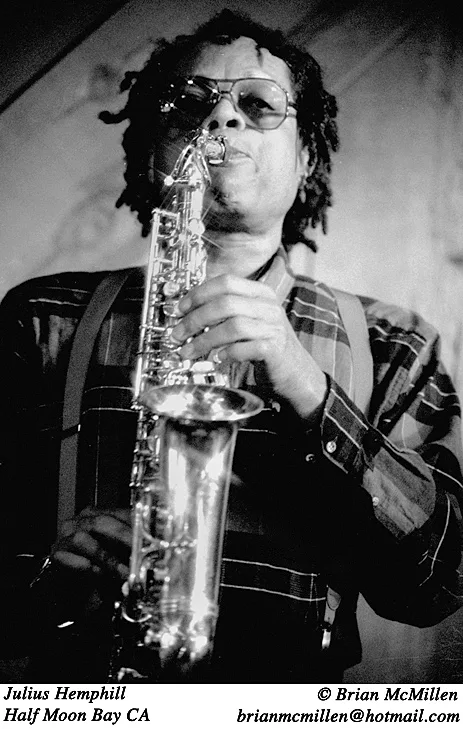
Julius Hemphill performing at the Bach Dancing & Dynamite Society, Half Moon Bay, California, March 6, 1988 CC BY-SA 4.0 — Wikimedia Commons, https://commons.wikimedia.org/wiki/File:Julius_Hemphill.jpg (photo by Brian McMillen, self-licensed; uploader and credited photographer match, no VRT concern)

Julius Arthur Hemphill was born January 24, 1938, in Fort Worth, Texas, and attended I.M. Terrell High School, the same segregated Fort Worth school that produced Ornette Coleman. He took up clarinet first, studying with the Fort Worth jazz clarinetist John Carter, another I.M. Terrell alumnus, before switching to saxophone; he played baritone in high school and cited Gerry Mulligan as an early influence. He went on to study music at North Texas State College. In 1964 Hemphill joined the United States Army and served several years in the U.S. Army Band; after his discharge he played for a time with Ike Turner's band before settling into St. Louis in 1968.
In St. Louis, Hemphill co-founded the Black Artists' Group (BAG), a multidisciplinary collective of musicians, actors, poets, dancers and visual artists that formed out of frustration with the limited opportunities available to Black artists in the city. Fellow saxophonists Oliver Lake and Hamiet Bluiett, trumpeters Baikida Carroll and Floyd LeFlore, and trombonist Joseph Bowie were among BAG's other core members. Around this time Hemphill started his own record label, Mbari, to document his music independently. Its first release, Dogon A.D., recorded in February 1972 at Archway Studios in St. Louis with Baikida Carroll on trumpet, Abdul Wadud on cello and Philip Wilson on drums, became one of the most acclaimed records of the free-jazz era and remains his best-known leader date. He followed it in 1977 with Blue Boyé, a solo album built from overdubbed alto, soprano and flute parts, on which a young Tim Berne, then studying saxophone with Hemphill, worked as assistant producer.
Hemphill moved to New York City in the mid-1970s and became active in the loft-jazz scene, recording as a sideman with Anthony Braxton and Lester Bowie and cutting his own Coon Bid'ness for Arista/Freedom in 1975 with Arthur Blythe, Hamiet Bluiett, Abdul Wadud and Barry Altschul. He had already been performing in all-saxophone ensembles with Braxton, and in 1976 he formalized the idea by founding the World Saxophone Quartet with Oliver Lake, Hamiet Bluiett and David Murray. The Quartet became the most durable and commercially successful of Hemphill's projects, recording steadily for Moers Music and Black Saint through the late 1970s and early 1980s (Point of No Return, 1977; Steppin' with the World Saxophone Quartet, 1979; W.S.Q., 1981; Revue, 1982) before moving to Nonesuch and Elektra later in the decade for Plays Duke Ellington (1986), Dances and Ballads (1987) and Rhythm and Blues (1989). Hemphill wrote much of the group's book and was widely regarded as its most distinctive composer. He also maintained a strong interest in theater, incorporating spoken narration into his 1977 solo album Roi Boyé & the Gotham Minstrels and later composing an extended theatrical work he called "a saxophone opera," Long Tongues.
Through the 1980s Hemphill kept up his own leader dates alongside the WSQ, including Flat-Out Jump Suite (1980, Black Saint) with Abdul Wadud, Olu Dara and Warren Smith, and Georgia Blue (1984, Minor Music), which featured a young Nels Cline on guitar. In 1988 he got his only opportunity to record his big-band writing on Julius Hemphill Big Band (Elektra Musician), a session that included Bill Frisell, Marty Ehrlich, John Purcell and J.D. Parran. He also composed the score for the Bill T. Jones/Arnie Zane Dance Company's Last Supper at Uncle Tom's Cabin/The Promised Land, performed by a Hemphill saxophone sextet, which premiered at the Brooklyn Academy of Music in November 1990 and earned Hemphill a Bessie Award (New York Dance and Performance Award) the following year.
Hemphill left the World Saxophone Quartet in the early 1990s and formed his own all-saxophone sextet with players including Marty Ehrlich, Andrew White and a young James Carter, debuting on Fat Man and the Hard Blues (1991, Black Saint). Worsening diabetes and subsequent heart surgery soon forced him to stop playing altogether; on the sextet's second album, Five Chord Stud (1993/94, Black Saint), Hemphill appears only as composer and conductor, with his former student Tim Berne taking the alto chair in his place. He remained a special guest on Björk's 1994 MTV Unplugged taping, later issued on her Debut Live release. Julius Hemphill passed away in New York City on April 2, 1995, at age 57, from complications of diabetes. He was inducted into the DownBeat Critics Poll Hall of Fame that same year.
Hemphill's sextet, subsequently led by Marty Ehrlich, continued performing and recording his compositions after his death, and interest in his catalog has only grown since: New World Records issued the seven-disc archival box set The Boyé Multi-National Crusade for Harmony, drawn from performances between 1977 and 2007, in 2021, and a previously unreleased 1982 duo recording with Ehrlich, Circle the Heart, appeared on Relative Pitch Records in January 2026. Hemphill recorded more than twenty albums as a leader and roughly ten with the World Saxophone Quartet over his career.
Hemphill's alto sound was famously huge and rough-edged, a tone critics have likened to a saxophone built from a length of steel pipe, and it carried a formidable technique in service of a restless compositional imagination that fused his jazz roots with elements of European classical music, African rhythm and American musical theater. He worked comfortably across a striking range of formats, from unaccompanied overdubbed solo records to duos, an all-saxophone sextet and, on his one chance to record for big band, a fourteen-piece ensemble, and he was widely credited as the World Saxophone Quartet's most individual writer even among three other strong composer-improvisers. He gave saxophone lessons to David Sanborn and Tim Berne, both of whom have cited his early Mbari recordings as formative, and his combination of a blues-and-gospel-rooted tone with structurally ambitious writing placed him alongside Anthony Braxton and the AACM generation as one of the defining composer-instrumentalists of the 1970s and '80s avant-garde.
- Dogon A.D. (1972, Mbari) - Hemphill's debut as a leader, cut with Baikida Carroll, Abdul Wadud and Philip Wilson; a landmark of 1970s free jazz still cited as one of the decade's essential recordings.
- Coon Bid'ness (1975, Arista/Freedom) - a quintet date with Arthur Blythe, Hamiet Bluiett, Abdul Wadud and Barry Altschul, recorded not long before Hemphill founded the World Saxophone Quartet.
- Point of No Return (1977, Moers Music) - the World Saxophone Quartet's debut album as a leaderless collective, with Hemphill, Oliver Lake, Hamiet Bluiett and David Murray.
- Flat-Out Jump Suite (1980, Black Saint) - a quartet session with cellist Abdul Wadud, cornetist Olu Dara and percussionist Warren Smith, praised alongside his concurrent WSQ work.
- Julius Hemphill Big Band (1988, Elektra Musician) - his only recorded outing for a full big band, featuring Bill Frisell, Marty Ehrlich and John Purcell among others.
- Fat Man and the Hard Blues (1991, Black Saint) - the debut of his all-saxophone sextet, with Marty Ehrlich, Andrew White and a young James Carter.
- New York, Fall 1974 (1975, Arista) - as a sideman: Anthony Braxton's album, on which Hemphill joins Braxton, Hamiet Bluiett and Oliver Lake in a saxophone-only quartet on "Cut Two," a preview of the World Saxophone Quartet's sound a year before it was named.
- The Boyé Multi-National Crusade for Harmony (2021, New World Records) - a seven-disc archival box drawing on live and studio recordings from 1977 to 2007.
Julius Hemphill: Full Discography
Identity confirmed via the live Discogs API: artist ID 593607 ("Julius Hemphill," matching birth/death dates and the World Saxophone Quartet and Black Artists' Group affiliations). Hemphill's catalog is split across several related Discogs entities that do not cross-reference each other from the main artist page: the Julius Hemphill Quartet (1539178), The Julius Hemphill Sextet (1232279), Julius Hemphill Trio (1700989), Julius Hemphill Big Band (2500586) and Julius Hemphill Quintet (8694175), plus the separate World Saxophone Quartet entity (309757) for his work in that group. All were checked. The table below covers his confirmed leader/co-leader catalog in full, his complete run of World Saxophone Quartet albums as a member, and a representative set of his most significant sideman dates; it does not itemize the many later compilations, samplers and posthumous tribute recordings of his compositions performed by other musicians.
As Leader / Co-Leader
| Album Title | Recording Date(s) | Release Date | Label | Catalog Number | Format(s) | Personnel | Role | Reissue History | Spotify | Buy | Notes |
|---|---|---|---|---|---|---|---|---|---|---|---|
| Dogon A.D. | Recorded February 1972, Archway Studios, St. Louis, MO | 1972 | Mbari | MPC 501 | Vinyl, LP | Julius Hemphill (alto sax, flute), Baikida Carroll (trumpet), Abdul Wadud (cello), Philip Wilson (drums) | Leader | Reissued on Freedom (LP, 1977); reissued on CD by International Phonograph (2011) with a bonus track adding Hamiet Bluiett | — | — | Hemphill's own label's first release; widely cited (AllMusic, NPR, All About Jazz) as one of the essential recordings of 1970s free jazz |
| 'Coon Bid'ness | Recorded 1975 | 1975 | Arista/Freedom | AL 1012 | Vinyl, LP | Julius Hemphill (alto sax, composer), Arthur Blythe (alto sax), Hamiet Bluiett (baritone sax), Abdul Wadud (cello), Barry Altschul (drums), Daniel Ben Zebulon (congas) | Leader | Reissued as Reflections (Freedom/1201 Music, 1995) | — | — | Two altos in different stereo channels (Hemphill center, Blythe left) |
| Live in New York | Recorded 1976 (issued 1978) | 1978 | Red Record | VPA 138 | Vinyl, LP | Julius Hemphill (alto sax, composer), Abdul Wadud (cello) | Leader (duo) | None found | — | — | Italian label release; duo format with Wadud |
| Blue Boyé | Recorded 1977 | 1977 | Mbari | MPC 1000X | Vinyl, LP | Julius Hemphill (alto, soprano, flute, overdubbed solo) | Leader | Reissued on CD by Screwgun (1999) | — | — | Solo, entirely overdubbed studio recording; Tim Berne, then a saxophone student of Hemphill's, worked as assistant producer |
| Roi Boyé & the Gotham Minstrels | Recorded 1977 | 1977 | Sackville Recordings | 3014/15 | Vinyl, LP (2xLP) | Julius Hemphill (alto, soprano, flute, sound effects, spoken text) | Leader | None found | — | — | Theatrical solo work incorporating spoken narration |
| Raw Materials and Residuals | Recorded 1977 (issued 1978) | 1978 | Black Saint | BSR 0015 | Vinyl, LP | Julius Hemphill (alto, soprano sax), Abdul Wadud (cello), Famoudou Don Moye (percussion) | Leader (trio) | None found | — | — | |
| Buster Bee | Recorded 1978 | 1978 | Sackville Recordings | 3018 | Vinyl, LP | Julius Hemphill (alto, soprano sax), Oliver Lake (alto sax, flute) | Co-leader (duo with Oliver Lake) | None found | — | — | |
| Flat-Out Jump Suite | Recorded 1980 | 1980 | Black Saint | BSR 0040 | Vinyl, LP | Julius Hemphill (flute, tenor sax, composer), Abdul Wadud (cello), Olu Dara (trumpet), Warren Smith (percussion) | Leader | None found | — | — | Critically praised alongside Hemphill's concurrent World Saxophone Quartet work |
| Georgia Blue | Recorded 1984 | 1984 | Minor Music | Minor Music 003 | Vinyl, LP | Julius Hemphill (alto, soprano sax, composer), Nels Cline (guitar), Steuart Liebig (bass), Alex Cline (drums, percussion), Jumma Santos (congas, percussion) | Leader | None found | — | — | Recorded with future Wilco guitarist Nels Cline, then an emerging Los Angeles improviser |
| Julius Hemphill Big Band | Recorded 1988 | 1988 | Elektra Musician | 960 831-1 U | Vinyl, LP | Julius Hemphill (alto, soprano sax, composer, arranger), Bill Frisell (guitar), Marty Ehrlich, John Purcell, John Stubblefield (reeds), J.D. Parran (baritone sax, flute), Rasul Siddik, David Hines (trumpet), Frank Lacy (trombone), David Taylor (bass trombone), Vincent Chancey (French horn), Jerome Harris (electric bass), Ronnie Burrage (drums), Gordon Gottlieb (percussion) | Leader | None found | — | — | Hemphill's only recorded outing for a full big band |
| Fat Man and the Hard Blues | Recorded 1991 | 1991 | Black Saint | 120 115-2 | CD | Julius Hemphill (alto sax, composer), Marty Ehrlich (soprano, alto sax, flute), Andrew White (tenor sax), Carl Grubbs (alto, soprano sax), Sam Furnace (baritone sax, flute), James Carter (tenor sax) | Leader | None found | — | — | Debut recording of Hemphill's all-saxophone sextet |
| Live from the New Music Cafe | Recorded 1991 (issued 1992) | 1992 | Music & Arts | CD-731 | CD | Julius Hemphill (alto, soprano sax, composer), Abdul Wadud (cello), Joe Bonadio (drums, percussion) | Leader (trio) | None found | — | — | |
| Oakland Duets | Recorded 1992 | 1993 | Music & Arts | CD-791 | CD | Julius Hemphill (saxophone, composer), Abdul Wadud (cello, composer) | Co-leader (duo with Abdul Wadud) | None found | — | — | |
| Five Chord Stud | Recorded 1993 | 1994 | Black Saint | 120140-2 | CD | Julius Hemphill (composer, conductor, producer, not performing), Marty Ehrlich (soprano, alto sax), Tim Berne (alto sax), Andrew White (tenor sax), James Carter (tenor sax), Fred Ho (baritone sax) | Leader (composer/conductor only) | None found | — | — | By this session diabetes had forced Hemphill to stop playing; his sextet chair was taken by his former student Tim Berne |
| Chile New York | Recorded 1980 (issued 1998) | 1998 | Black Saint | 120146-2 | CD | Julius Hemphill (alto, tenor sax, flute, voice, composer, producer), Warren Smith (percussion) | Leader | None found | — | — | Posthumous release of a 1980 recording |
| Live at Kassiopeia | Recorded 1987 (issued 2011) | 2011 | NoBusiness Records | NBCD 35/36 | CD (2xCD) | Julius Hemphill (alto, soprano sax), Peter Kowald (bass) | Co-leader (duo with Peter Kowald) | None found | — | — | Posthumous release of a 1987 live European duo recording |
| The Boyé Multi-National Crusade for Harmony (Archival Recordings 1977-2007) | Recorded 1977-2007 | 2021 | New World Records | 80825-2 | CD (7xCD box set) | Julius Hemphill in a variety of solo, duo, big band and sextet contexts across the set | Leader (archival compilation) | None found | — | — | Posthumous 7-disc box set produced by Marty Ehrlich, drawing on live and studio tapes across three decades |
| Circle the Heart | Recorded January 25, 1982 | January 23, 2026 | Relative Pitch Records | RPR1247 | CD | Julius Hemphill (saxophone, right channel), Marty Ehrlich (saxophone, left channel) | Co-leader (duo with Marty Ehrlich) | None found | — | — | Previously unreleased 1982 duo tape; released more than three decades after it was recorded and after Hemphill's death |
As World Saxophone Quartet Member (1976-c.1991)
Hemphill co-founded the group in 1976 with Oliver Lake, Hamiet Bluiett and David Murray and remained its most-cited composer through the following albums, all issued while he was a member, before leaving in the early 1990s.
| Album Title | Release Date | Label | Catalog Number | Notes |
|---|---|---|---|---|
| Point of No Return | 1977 | Moers Music | 01034 | Recorded live; the Quartet's debut album |
| Steppin' with the World Saxophone Quartet | 1979 | Black Saint | BSR 0027 | |
| W.S.Q. | 1981 | Black Saint | BSR 0046 | |
| Revue | 1982 | Black Saint | BSR 0056 | |
| Live in Zurich | 1984 | Black Saint | BS 120077-2 | |
| Live at Brooklyn Academy of Music | 1986 | Black Saint | BSR 0096 | |
| Plays Duke Ellington | 1986 | Nonesuch | 9 79137-1 | The Quartet's arrangements of Ellington repertoire |
| Dances and Ballads | 1987 | Elektra Nonesuch | 979 164-1 | |
| Rhythm and Blues | 1989 | Elektra Musician | 96 08641 | Hemphill's last studio album with the Quartet before his early-1990s departure |
As Sideman (selected major credits)
| Year | Project (Leader) | Title | Label | Catalog | Role | Notes |
|---|---|---|---|---|---|---|
| 1973 | Lightnin' Rod | Hustlers Convention | United Artists | Alto Saxophone | Spoken-word/proto-rap album with jazz backing | |
| 1974 | Lester Bowie | Fast Last! | Muse | Alto Saxophone, Arranger | ||
| 1975 | Anthony Braxton | New York, Fall 1974 | Arista (AL 4032) | Alto Saxophone (track B2 only) | Verified at track level: Hemphill joins Braxton, Hamiet Bluiett and Oliver Lake as a saxophone quartet on "Cut Two," a year before the World Saxophone Quartet was formally named | |
| 1978 | Charles "Bobo" Shaw | Streets of St. Louis | Moers Music | Alto Saxophone | Fellow BAG alumnus | |
| 1982 | Baikida Carroll | Shadows and Reflections | Soul Note | Alto/Tenor Saxophone | Fellow BAG co-founder's leader date | |
| 1982 | Kalaparusha Maurice McIntyre | Ram's Run | Cadence | Tenor Saxophone | ||
| 1983 | Jamaaladeen Tacuma | Show Stopper | Gramavision | Alto Saxophone | ||
| 1987 | Paul Cram | Beyond Benghazi | Apparition Records | A-0987-8 | Alto Saxophone | Discogs tags this "Main" on Hemphill's own artist page, but the release-level credits show Paul Cram as composer/producer; Hemphill is a sideman alongside a second alto player, Nic Gotham |
| 1987 | Jean-Paul Bourelly | Jungle Cowboy | JMT | Alto Saxophone | ||
| 1989 | Bill Frisell | Before We Were Born | Elektra Musician | Alto Saxophone (guest) | ||
| 1990 | Allen Lowe | At the Moment of Impact | Fairhaven Records | Fairhaven 002 | Alto Saxophone | Discogs also tags this "Main" on Hemphill's artist page, but Allen Lowe is the leader and composer |
| 1991 | Peter Kowald | Duos America / Duos: Europa-America-Japan | FMP | Alto/Soprano Saxophone | ||
| 1994 | David Murray | David Murray 1994 (Black Saint/Musica Jazz sampler) | Black Saint | BSRMJ 002 | Alto Saxophone (track 6, "David's Tune") | Verified at track level via Discogs; his last documented sideman recording, alongside his World Saxophone Quartet co-founder |
| 2004 | Björk | Debut Live | One Little Indian | TPLP363CD | Guest, MTV Unplugged | Archival release of a 1994 MTV Unplugged taping on which Hemphill appeared as a special guest |
Hemphill's Discogs credits also include numerous posthumous compilations, box sets and reissues where his older recordings are anthologized (the Smithsonian Collection of Classic Jazz, multiple Black Saint/Soul Note samplers, Wildflowers: The New York Loft Jazz Sessions), plus a growing number of 21st-century tribute and repertory recordings of his compositions performed by other musicians without him (Tim Berne's Diminutive Mysteries (Mostly Hemphill), 1993; the Julius Hemphill Sextet's posthumous At Dr. King's Table, 1997, and The Hard Blues: Live in Lisbon, 2004, both led by Marty Ehrlich; Do Tell's Hotend, 2015; The Hemphill Stringtet's 2025 tribute album), not itemized exhaustively here since Hemphill does not perform on any of them.
- Oliver Lake and Hamiet Bluiett - fellow founders of the Black Artists' Group in St. Louis and, with David Murray, co-founders with Hemphill of the World Saxophone Quartet in 1976; Lake also co-led the duo album Buster Bee (1978, Sackville) with Hemphill.
- Abdul Wadud - cellist and one of Hemphill's most frequent collaborators, appearing on Dogon A.D. (1972), Coon Bid'ness (1975), Live in New York (1978), Flat-Out Jump Suite (1980) and the duo album Oakland Duets (1992/93).
- David Murray - founding World Saxophone Quartet member alongside Hemphill from 1976; Hemphill later guested on a track from a 1994 David Murray sampler release on Black Saint.
- Anthony Braxton - Hemphill performed in Braxton's pre-WSQ saxophone-only ensembles in the mid-1970s, documented on Braxton's New York, Fall 1974 (Arista, 1975), where Hemphill, Braxton, Hamiet Bluiett and Oliver Lake play together as a quartet.
- Marty Ehrlich - member of Hemphill's 1990s sextet, co-composer partner on the archival duo album Circle the Heart (recorded 1982, released 2026), and the musician who led the Hemphill Sextet's performances and recordings of his book after his death.
- Tim Berne and David Sanborn - saxophone students of Hemphill's in the 1970s; Berne also worked as assistant producer on Blue Boyé (1977) and later took Hemphill's own chair in his sextet on Five Chord Stud (1993/94) once illness stopped Hemphill from playing.
- Baikida Carroll - trumpeter and fellow BAG co-founder who played on Dogon A.D. (1972) and led his own Shadows and Reflections (1982, Soul Note) with Hemphill as a sideman.
- Wikipedia: Julius Hemphill
- Wikipedia: Black Artists Group
- Wikipedia: Dogon A.D.
- AllMusic: Julius Hemphill biography, by Chris Kelsey
- Discogs: Julius Hemphill (artist 593607)
- Discogs: World Saxophone Quartet (artist 309757)
- DownBeat Hall of Fame
- Wikidata: Julius Hemphill (Q303112)
- NYU Fales Library: Julius Hemphill Papers, Last Supper at Uncle Tom's Cabin/The Promised Land