 JAZZPROFILES lives in the music 1,002 Jazz Artists fully Profiled!
 Michiyo Yagi
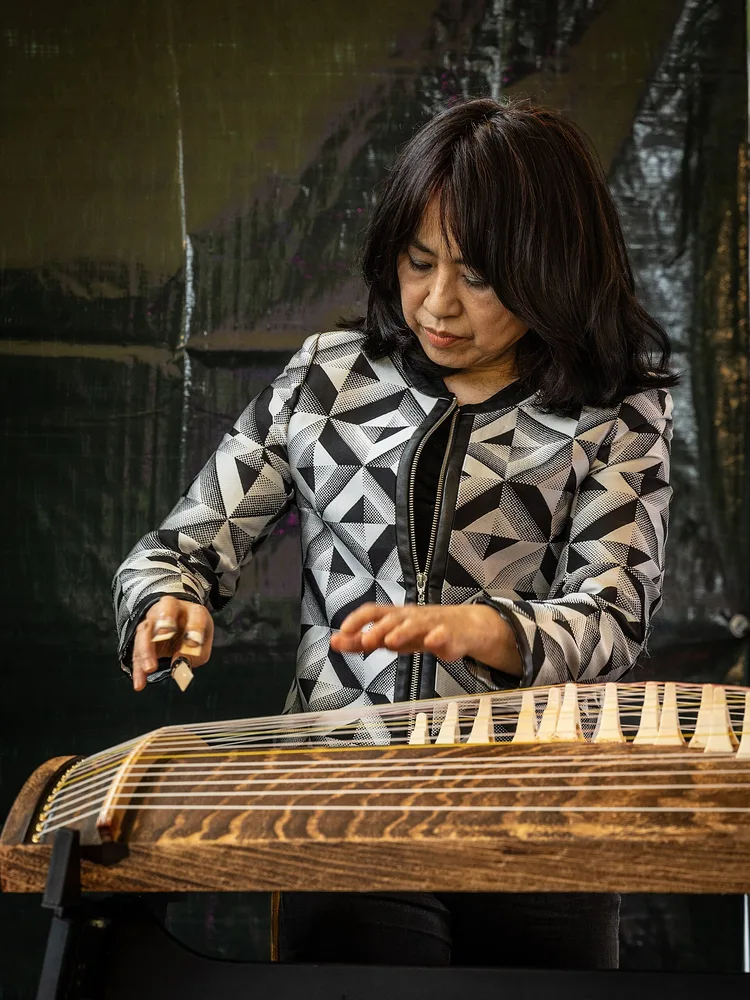
Michiyo Yagi playing the koto at the Moers Festival, Germany, 19 May 2024 CC BY-SA 4.0 (Creative Commons Attribution-ShareAlike 4.0 International), attribution required to Harald Krichel — Wikimedia Commons, File:Michiyo Yagi-69220.jpg, photographer Harald Krichel , https://commons.wikimedia.org/wiki/File:Michiyo_Yagi-69220.jpg

Michiyo Yagi grew up in Tokoname City, in Aichi Prefecture, with a koto in the house. Her mother taught the instrument locally and put her in front of one at around four years old. She did not take to it. Japanese schooling in that period treated Japanese music as the lesser thing beside Western music, and Yagi went to the piano instead, studying it seriously from the age of five. The koto stayed her mother's instrument for most of a decade.
What changed her mind was a performance. In high school she heard Teiko Kikuchi play a contemporary composition on the 17-string koto, and the instrument stopped sounding like inherited furniture and started sounding like something with a future in it. She began studying seriously with Satomi Kurauchi, herself an apprentice of Tadao Sawai. Yagi graduated from Aichi Junior College in 1983, and two years later was admitted to the advanced studies programme at the Sawai Koto School, where she lived in the home of Tadao and Kazue Sawai as a full-time apprentice. She also came through the NHK Professional Training School for Traditional Musicians. By the second half of the 1980s she was performing professionally.
The turn toward improvisation happened in the United States. In 1989 she appeared at the Bang on a Can festival in New York alongside Kazue Sawai and encountered John Cage's work at close range. In the early 1990s she took a post as guest instructor in the ethnomusicology department at Wesleyan University in Connecticut, the department with which Cage had long been associated, and premiered commissioned pieces by Christian Wolff and John Zorn. She had crossed the Pacific as a specialist in a traditional instrument. She returned as an improviser, and she has spent every decade since declining to be filed under either heading. Asked to describe the musician she wants to be, she has answered: "a genre unto myself."
Her first records came through the groups. Koto Vortex, a quartet of fellow Sawai apprentices with Yoko Nishi, Miki Maruta and Etsuko Takezawa, released two albums in 1994 and 1996. Kokoo, a trio she co-founded, plays original material and progressive rock covers on traditional Japanese instruments only, and put out Super-Nova on Seven Seas in 2000. Hoahio, the avant-pop trio she forms one third of, landed Ohayo! Hoahio! (2000) and Peek-Ara-Boo (2003) on Zorn's Tzadik label.
Her own name arrived on Tzadik first. Shizuku (TZ 7218, 1999) is a solo koto record produced by Zorn, with cover design by Ikue Mori and photography by Nobuyoshi Araki. Seventeen followed in 2005 on Zipangu Products, built entirely on the 17-string bass koto, the low end of the family and the size that lets her hold a bottom register rather than decorate someone else's.
From 2006 she ran her own imprint, Idiolect, and it documents the working partnership that has shaped her sound more than any other. Norwegian drummer Paal Nilssen-Love plays on Live! At Super Deluxe (2006, with bassist Ingebrigt Håker Flaten), on Head On with Peter Brötzmann (2008), on Volda with Brötzmann again (2010), on Angular Mass with Lasse Marhaug (2015), on Soul Stream with Joe McPhee and Marhaug (2015), and on Decayed, recorded live at Aketa no Mise in Tokyo with Håker Flaten and guest guitarist Henry Kaiser (2017). Six records between 2006 and 2017. Norway recurs elsewhere in the catalogue too: Tonebod (2008) with Bugge Wesseltoft, Knut Buen and Anne Gravir Klykken; Bibi (2023) with composer Dai Fujikura on the Oslo label Jazzland; and Free Rangers, made with the Norwegian group Chrome Hill and released on Clean Feed on 20 March 2026.
Since 2014 her main vehicle has been Dōjō, a duo with drummer Tamaya Honda. Dōjō Vol. 1 (2014) brought in Nilssen-Love and trumpeter Nils Petter Molvær as guests; Dōjō Vol. 2 (2017) brought in Akira Sakata on alto saxophone and Keisuke Ohta on violin. The duo has since worked as a unit inside larger collaborations, with Gordon Grdina's The Twain (2022) and with Chrome Hill on two records. Her most expansive record under her own name alone remains Into The Forest (2019), where she plays 21-string koto, 17-string koto, electronics and voice, writes and arranges everything, and puts two drummers behind her, Tamaya Honda and Noritaka Tanaka, with Takashi Sugawa on bass and cello.
She is alive, working, and still touring internationally, with festival appearances including Moers in Germany in 2024.
Yagi's training is orthodox and her application of it is not. She plays the 13, 17, 18 and 21-string kotos and the shamisen, amplifies them, and runs them through electronics, so that the instrument can hold its own next to a drum kit or a saxophone at full volume rather than being placed decoratively on top of a Western ensemble. She treats the different string counts as genuinely different instruments with different jobs: the 17-string bass koto functions as a bottom voice, the electric 21-string as a lead one.
The formative influences are split across two traditions that rarely meet. On one side, Satomi Kurauchi and then Tadao and Kazue Sawai, the lineage responsible for dragging the koto into contemporary composition in the first place. On the other, the American experimental tradition she met in New York and at Wesleyan: John Cage, Christian Wolff, and John Zorn, who went on to produce her first solo record. Reviewers reach for the free jazz vocabulary when describing her playing with Brötzmann and Nilssen-Love, and for a more textural, composed vocabulary on records like Bibi and Into The Forest. Both are accurate, and the refusal to settle between them is the point. Her own summary of the ambition is "a genre unto myself."
- Shizuku (1999, Tzadik) - Solo koto, produced by John Zorn. The cleanest available document of what she does with the instrument unaccompanied, and the record that put her in the downtown New York catalogue. Spotify - Shizuku Listen · Buy
- Seventeen (2005, Zipangu Products) - Solo, built entirely on the 17-string bass koto. The clearest demonstration of her argument that the different koto sizes are different instruments. Spotify - Seventeen Listen · Buy
- Head On (2008, Idiolect) - With Peter Brötzmann and Paal Nilssen-Love. Yagi amplified and at full volume against one of the loudest saxophonists in European free jazz. Bandcamp - Head On Listen · Buy
- Bibi (2023, Jazzland Recordings) - Duo with composer Dai Fujikura, acoustic and electric kotos against synthesizer and electronics, everything co-composed. The most through-written record in the catalogue. Spotify - Bibi Listen · Buy
- Free Rangers (2026, Clean Feed) - Dōjō with the Norwegian group Chrome Hill, released 20 March 2026. The current state of the Norwegian thread that runs through her whole career. Bandcamp - Free Rangers Listen
Michiyo Yagi (八木美知依), Full Discography
Koto, shamisen, electronics, voice. Discogs artist 374468. Real name 八木美知依 (Yagi Michiyo). Name variations on record: Michiyo Yagi, Yagi Michiyo, Michiyo, Yagi, Michigo Yagi, 八木美知依. Group affiliations: Hoahio, Kokoo, Koto Vortex, Dōjō, Kazue Sawai Koto Ensemble, The Raymond MacDonald International Big Band.
73 credits in total: 18 filed as Main, 45 as Appearance, 9 as TrackAppearance, 1 as UnofficialRelease.
Leader and Co-Leader (Main role)
| Album | Year | Label | Personnel | Notes | Listen | Buy |
|---|---|---|---|---|---|---|
| Shizuku | 1999 | Tzadik (TZ 7218) | Michiyo Yagi (koto, all compositions) | Solo koto. Produced by John Zorn, design by Ikue Mori, photography by Nobuyoshi Araki. | Spotify | Amazon |
| ゆらる (Yural) | 2001 | BAJ Records (BJCD-0018) | Michiyo Yagi & Paulownia Crush | Billed to Yagi with the group Paulownia Crush. No individual performer credits listed on the Discogs entry. | not found | Amazon |
| Seventeen | 2005 | Zipangu Products (ZIP-0019) | Michiyo Yagi (17-string bass koto, all compositions) | Solo, built entirely on the 17-string bass koto. | Spotify | Amazon |
| Live! At Super Deluxe | 2006 | Idiolect (ID-01), Bomba Records (BOM26002) | Michiyo Yagi (electroacoustic 17- and 21-string kotos); Ingebrigt Håker Flaten (contrabass, electronics); Paal Nilssen-Love (drums) | First of the Idiolect series and the start of the long Nilssen-Love partnership. All three share composition credit. | Bandcamp | Amazon |
| Head On | 2008 | Idiolect (ID-02) | Peter Brötzmann (alto and tenor saxophone); Michiyo Yagi (21- and 17-string koto); Paal Nilssen-Love (drums, percussion) | Billed Brötzmann / Yagi / Nilssen-Love. | Bandcamp, YouTube (live, 2008) | Amazon |
| Tonebod | 2008 | Nyrenning (NYCD 12) | Knut Buen (hardingfele, recitation); Bugge Wesseltoft (piano, organ, rhythm and various instruments); Michiyo Yagi (koto); Anne Gravir Klykken (vocals) | Norwegian traditional and jazz crossover session. | not found | Amazon |
| Volda | 2010 | Idiolect (ID-03) | Paal Nilssen-Love (drums); Michiyo Yagi (21-string koto, 17-string bass koto); Peter Brötzmann (tenor and alto saxophone, clarinet, tárogató) | Billed Paal / Michiyo / Broe. Same trio as Head On, recorded in Volda, Norway. | Bandcamp | Amazon |
| Reflexions | 2010 | Idiolect (ID-04) | Michiyo Yagi (21-string koto, 17-string bass koto); Elliott Sharp (Koll 8-string guitarbass) | Duo. | not found | Amazon |
| Concert For Fukushima Wels 2011 | 2013 | Trost Records (TR 114), PanRec (PANDVD08) | Peter Brötzmann Chicago Tentet with Peter Brötzmann, Mats Gustafsson, Ken Vandermark, Joe McPhee, Jeb Bishop, Johannes Bauer, Per Åke Holmlander, Fredrick Lonberg-Holm, Kent Kessler, Michael Zerang, Paal Nilssen-Love; guests Otomo Yoshihide (electric guitar), Michiyo Yagi (21-string koto, 17-string bass koto), Akira Sakata (reeds), Toshinori Kondo (electric trumpet) | DVD. Concert recorded 2011, released 2013. Yagi is credited as a guest, so this sits between leader and sideman work. | not found | Amazon |
| Dōjō Vol. 1 | 2014 | Idiolect (ID-05) | Michiyo Yagi (electric 21-string koto, 17-string bass koto, electronics); Tamaya Honda (drums, percussion); guests Paal Nilssen-Love (drums, percussion), Nils Petter Molvær (trumpet) | First record by the Dōjō duo. Yagi and Honda share composition credit. | YouTube (Dōjō live, 2017) | Amazon |
| Angular Mass | 2015 | PNL (PNL028) | Michiyo Yagi (electric 21-string and 17-string bass koto); Paal Nilssen-Love (drums, percussion); Lasse Marhaug (electronics) | Trio, all three sharing composition credit. | Bandcamp | Amazon |
| Soul Stream | 2015 | PNL (PNL032) | Michiyo Yagi (electric 21-string and 17-string bass koto); Joe McPhee (pocket trumpet, tenor and alto saxophone); Lasse Marhaug (electronics); Paal Nilssen-Love (drums, percussion) | Quartet, all four sharing composition credit. | Bandcamp | Amazon |
| Decayed (Live! At Aketa No Mise) | 2017 | Idiolect (ID-06) | Michiyo Yagi (electric 21-string koto, 17-string bass koto, electronics); Ingebrigt Håker Flaten (contrabass, electric bass); Paal Nilssen-Love (drums, percussion); special guest Henry Kaiser (electric guitar) | Live at Aketa no Mise, Tokyo. | Bandcamp | Amazon |
| Dōjō Vol. 2 | 2017 | Idiolect (ID-07) | Michiyo Yagi (electric 21-string koto, 17-string bass koto, electronics, voice); Tamaya Honda (drums, percussion); guests Akira Sakata (alto saxophone, voice), Keisuke Ohta (electric and acoustic violin, voice) | Second Dōjō record. Akira Sakata guests. | not found | Amazon |
| The Swallow | 2017 | Self-released (Marco Lucchi) | Michiyo Yagi (koto, voice); Marco Lucchi (electronics) | Duo, digital self-release. | not found | Amazon |
| Into The Forest [森の中へ] | 2019 | Idiolect (ID-08) | Michiyo Yagi (21-string koto, 17-string koto, electronics, vocals, all compositions and arrangements); Takashi Sugawa (bass, cello); Tamaya Honda (drums); Noritaka Tanaka (drums) | Two drummers. Six tracks: Morning Dew, Into the Forest, The Road Not Taken, MZN3, Song of the Steppes, Evening Mist. | not found | Amazon |
| Live At Super Deluxe | 2021 | Discus (DISCUS113LP) | The Geordie Approach: Petter Frost Fadnes (alto saxophone, electronics), Chris Sharkey (electronics), Ståle Birkeland (drums); with Michiyo Yagi (koto, electronics) | LP. Distinct from the 2006 Idiolect album of almost the same name, different band and different year. | YouTube, Pt. 1, Pt. 2 | Amazon |
| Bibi | 2023 | Jazzland Recordings | Michiyo Yagi (acoustic and electric 21- and 17-string koto, 13-string koto, electronics); Dai Fujikura (synthesizer, electronics); all tracks composed by both | Released 10 February 2023. 13 tracks. | Spotify, Bandcamp | Amazon |
| Free Rangers | 2026 | Clean Feed (CF685CD) | Chrome Hill: Asbjørn Lerheim (electric guitar, Fender Bass VI, electronics), Atle Nymo (tenor saxophone, clarinet, bass clarinet), Roger Arntzen (double bass, electronics); Dōjō: Michiyo Yagi (electric 21-string koto, electronics), Tamaya Honda (drums) | Released 20 March 2026. Seven tracks: The Showdown, Red Sun Rising, Fjord Fairlane, Point Of No Return, Badlands, Trident, Auroral Fire. | Bandcamp | Amazon |
Group memberships
Yagi's work with Koto Vortex, Kokoo and Hoahio is filed by Discogs under those group entities rather than under her own Main role, so it appears below in the Appearance list. The releases are hers as a full member, not as a guest.
| Group | Records | Years | Listen | Buy |
|---|---|---|---|---|
| Koto Vortex (with Yoko Nishi, Miki Maruta, Etsuko Takezawa) | Koto Vortex I (Works By Hiroshi Yoshimura); Koto Vortex II: Arcadia (Paradise Records) | 1994, 1996 | not found | Amazon |
| Kokoo | Super-Nova (Seven Seas); Moon | 2000, 2001 | not found | Amazon |
| Hoahio | Happy Mail (Amoebic); Ohayo! Hoahio! (Tzadik); Peek-Ara-Boo (Tzadik) | 1997, 2000, 2003 | not found | Amazon |
| Kazue Sawai Koto Ensemble | Live At Dacapo In Bremen '93 (d'c records) | 1994 | not found | Amazon |
| Dōjō (with Tamaya Honda) | See Dōjō Vol. 1, Dōjō Vol. 2, Free Rangers, and the Gordon Grdina and Chrome Hill collaborations | 2014 onward | see above | see above |
Guest and sideman credits (Appearance role), chronological
45 credits. Listed chronologically with billed artist, title and label.
| Year | Billed artist | Title | Label | Listen | Buy |
|---|---|---|---|---|---|
| 1994 | Kazue Sawai Koto Ensemble | Live At Dacapo In Bremen '93 | d'c records | not found | Amazon |
| 1994 | Mamadou Doumbia | Mandinka Acoustic - Sobe | Bad News Records | not found | Amazon |
| 1994 | Koto Vortex | Koto Vortex I (Works By Hiroshi Yoshimura) | (unlisted) | not found | Amazon |
| 1995 | Various | Koto - Shakuhachi | Playa Sound | not found | Amazon |
| 1995 | Masahiko Satoh ・ Randooga Orchestra | Naorai (直会) | Ninety-One | not found | Amazon |
| 1996 | Koto Vortex | Koto Vortex II: Arcadia | Paradise Records | not found | Amazon |
| 1997 | Elliott Sharp | Spring & Neap | zOaR Records | not found | Amazon |
| 1997 | Hoahio | Happy Mail | Amoebic | not found | Amazon |
| 1997 | 菅谷昌弘 (Masahiro Sugaya) | 船を見る (Ship In A View) | Not On Label | not found | Amazon |
| 1997 | Cassiber with Shinoda Masami | Live In Tokyo | (master) | not found | Amazon |
| 1999 | Otomo Yoshihide | Plays The Music Of Takeo Yamashita (山下毅雄を斬る) | (master) | not found | Amazon |
| 1999 | The Saboten | The Saboten | (master) | not found | Amazon |
| 2000 | Hoahio | Ohayo! Hoahio! | Tzadik | not found | Amazon |
| 2000 | Various | Mottomo Otomo, Unlimited XIII | Trost Records | not found | Amazon |
| 2000 | Ayuo | Izutsu | Tzadik | not found | Amazon |
| 2000 | Kokoo | Super-Nova | Seven Seas | not found | Amazon |
| 2000 | Various | Miniatures 2 | (master) | not found | Amazon |
| 2001 | Various | Improvised Music From Japan | Improvised Music From Japan | not found | Amazon |
| 2001 | Kokoo | Moon | (master) | not found | Amazon |
| 2002 | Otomo Yoshihide & Masahiko Shimada | Miira Ni Naru Made / My Dear Mummy (German version) | Charhizma | not found | Amazon |
| 2002 | Various | Festival Beyond Innocence: A Brief History In 67 Chapters | FBI Disc | not found | Amazon |
| 2002 | Saga Yuki | Grimpoteuthis | TSR | not found | Amazon |
| 2002 | Malte Jaspersen | Sushi (Vom Erlebnis In Japan Essen Zu Gehen) | Der Audio Verlag | not found | Amazon |
| 2002 | Ayumi Hamasaki | Ayu-mi-x 4 + Selection Acoustic Orchestra Version | (master) | not found | Amazon |
| 2003 | Hoahio | Peek-Ara-Boo | Tzadik | not found | Amazon |
| 2004 | Yuka Murakami (村上ユカ) | 角砂糖 | Think Sync Records | not found | Amazon |
| 2006 | Various | From Kyoto To Tokyo - Japan | Playa Sound | not found | Amazon |
| 2007 | Elliott Sharp | Spring & Neap - RE:ITERATIONS | NEOS JAZZ | not found | Amazon |
| 2007 | Jamshied Sharifi | One | Ceres Records | not found | Amazon |
| 2008 | Steven Wilson | Insurgentes | (master) | not found | Amazon |
| 2009 | Chris Mosdell And The Incendiary Orchestra | Chris Mosdell & The Incendiary Orchestra | CMD Project | not found | Amazon |
| 2010 | The Raymond MacDonald International Big Band | Buddy | Textile Records | not found | Amazon |
| 2011 | 坂本弘道 (Hiromichi Sakamoto) | 緑子 (Midori-Ko) Original Soundtrack | Hibana Records | not found | Amazon |
| 2012 | Akira Sakata & Chikamorachi | Sora Wo Tobu! | King Records | not found | Amazon |
| 2013 | Various | Long Story Short | Trost Records | not found | Amazon |
| 2013 | Cassiber | 1982-1992 (30th Anniversary Cassiber Box) | ReR Megacorp | not found | Amazon |
| 2014 | Ken Vandermark / Paal Nilssen-Love | Extended Duos | PNL, Audiographic Records | not found | Amazon |
| 2016 | Genji Sawai | Tokyo | "T"RUST OVER 30 recordings | not found | Amazon |
| 2017 | Zu | Jhator | (master) | not found | Amazon |
| 2021 | Steven Wilson, Pat Mastelotto | Steven Wilson P@ Remix EP 1: 2009 Salvaging | Not On Label | not found | Amazon |
| 2022 | Gordon Grdina's The Twain featuring Dōjō and Koichi Makigami | The Twain | The Black Dot, Attaboygirl Records | not found | Amazon |
| 2022 | Various | Musicworks #144 | Musicworks | not found | Amazon |
| 2023 | Chrome Hill Duo Meets Dōjō | Live At Aketa No Mise | Clean Feed | not found | Amazon |
| 2023 | Cassiber | 1982-1992 (40th Anniversary Cassiber Box) | ReR Megacorp | not found | Amazon |
| 2026 | Chrome Hill & Dōjō | Free Rangers | Clean Feed | Bandcamp | Amazon |
Compilation and single-track credits (TrackAppearance role)
| Year | Title | Label |
|---|---|---|
| undated | Splendour Of Japanese Instruments: Shamisen, Shakuhachi, Koto | Playa Sound |
| 1994 | Japon - Splendeur Du Koto (Japan - Splendour Of The Koto) | (master) |
| 2001 | Improvised Music From Japan | Improvised Music From Japan |
| 2002 | Festival Beyond Innocence: A Brief History In 67 Chapters | FBI Disc |
| 2013 | Long Story Short | Trost Records |
| 2014 | Extended Duos | PNL, Audiographic Records |
| 2014 | Secret Thirteen Mix 118 (Ensemble Economique) | Secret Thirteen Journal |
| 2018 | Mix For Unline (UOT) | Unline |
| 2021 | The Rough Guide To Avant-Garde Japan | (master) |
One further credit is filed by Discogs as UnofficialRelease: Steven Wilson, Insurgentes (2009 master).
- Dōjō (2014 to present) - co-leader, with drummer Tamaya Honda. Dōjō Vol. 1 (2014), Dōjō Vol. 2 (2017), and as a unit inside Gordon Grdina's The Twain (2022), Live At Aketa No Mise with Chrome Hill Duo (2023) and Free Rangers (2026).
- Paal Nilssen-Love (drums) - her longest-running collaborator, on six records between 2006 and 2017, plus a guest appearance on Dōjō Vol. 1.
- Peter Brötzmann (reeds) - Head On (2008) and Volda (2010), both trios with Nilssen-Love, plus the Chicago Tentet's 2011 Concert For Fukushima in Wels.
- Ingebrigt Håker Flaten (bass) - Live! At Super Deluxe (2006) and Decayed (2017).
- Lasse Marhaug (electronics) - Angular Mass (2015) and Soul Stream (2015).
- Joe McPhee (trumpet, saxophones) - Soul Stream (2015).
- Elliott Sharp (guitarbass) - the duo record Reflexions (2010), and earlier as a sideman on his Spring & Neap (1997) and its 2007 reissue.
- Dai Fujikura (composer, electronics) - Bibi (2023).
- Chrome Hill (Asbjørn Lerheim, Atle Nymo, Roger Arntzen) - Live At Aketa No Mise (2023) and Free Rangers (2026).
- Akira Sakata (alto saxophone) - guest on her Dōjō Vol. 2 (2017); she in turn plays 21-string and 17-string bass koto on his Sora Wo Tobu! (King Records, 2012) with Chikamorachi.
- Otomo Yoshihide (guitar, turntables) - Plays The Music Of Takeo Yamashita (1999) and Miira Ni Naru Made / My Dear Mummy with Masahiko Shimada (2002).
- Masahiko Satoh (piano) - his Randooga Orchestra record Naorai (1995).
- Koto Vortex - founding member, with Yoko Nishi, Miki Maruta and Etsuko Takezawa (1994, 1996).
- Kokoo - co-founder; Super-Nova (Seven Seas, 2000) and Moon (2001).
- Hoahio - one third of the trio; Happy Mail (Amoebic, 1997), Ohayo! Hoahio! (Tzadik, 2000), Peek-Ara-Boo (Tzadik, 2003).
- Kazue Sawai Koto Ensemble - Live At Dacapo In Bremen '93 (1994).
- Further credits run from Cassiber and Ayuo through Steven Wilson, Ayumi Hamasaki, Genji Sawai, Zu and The Raymond MacDonald International Big Band; the full list is in
discography-full.md.
- Wikipedia: Michiyo Yagi
- Performing Arts Network Japan (The Japan Foundation): interview with Michiyo Yagi
- All About Jazz: Michiyo Yagi
- Discogs: Michiyo Yagi (artist 374468)
- Tzadik: Yagi Michiyo, Shizuku
- Clean Feed / Bandcamp: Chrome Hill & Dōjō, Free Rangers
- Wikimedia Commons: File:Michiyo Yagi-69220.jpg (Harald Krichel, CC BY-SA 4.0)