 JAZZPROFILES lives in the music 1,002 Jazz Artists fully Profiled!
 Erik Friedlander
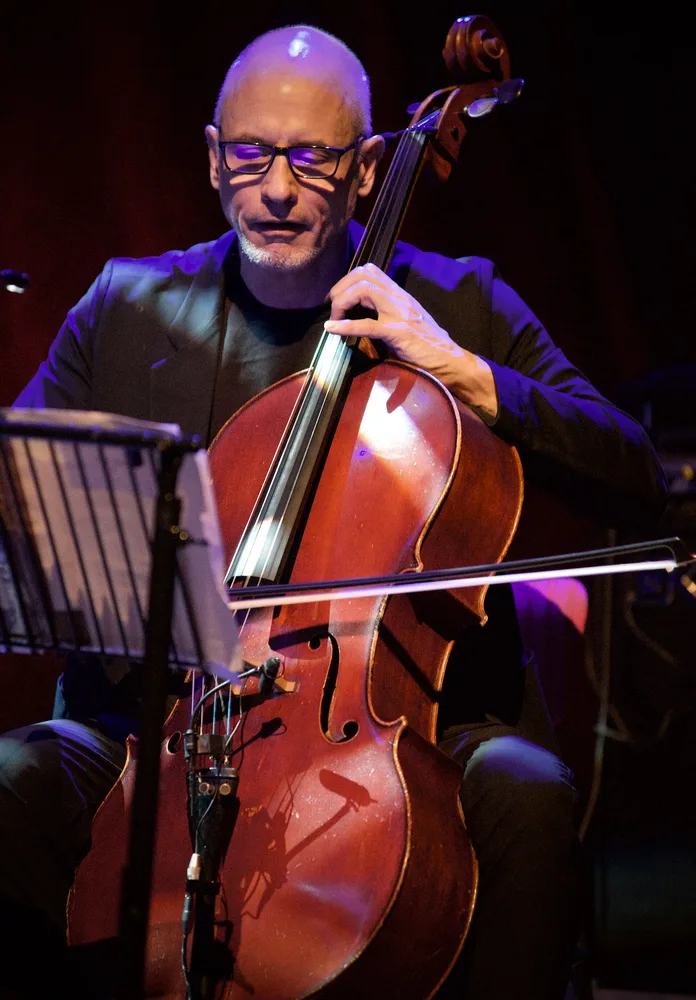
Erik Friedlander playing cello with his quartet Throw a Glass at the Transition festival, TivoliVredenburg, Utrecht, Netherlands, April 6, 2019 CC BY 2.0 — Wikimedia Commons — https://commons.wikimedia.org/wiki/File:Erik_Friedlander%27s_Throw_a_Glass,_6_april_2019_Transition_Tivoli_Vredenburg_-_Erik_Friedlander_(51488074399).jpg (originally from Flickr photographer Dirk Neven, https://www.flickr.com/photos/146907430@N03/51488074399/; the Commons file page carries a passed FlickreviewR 2 bot review dated January 30, 2022 recording reviewlicense=cc-by-2.0 verified at that Flickr URL, and the Flickr page still resolves HTTP 200 today, now carrying an even more permissive Public Domain Mark 1.0 declaration from the same photographer)
.jpg)
Erik Friedlander was born in New York City on July 1, 1960 and grew up in Rockland County, north of the city, in a house where music played constantly. His father is the photographer Lee Friedlander, a MacArthur fellow whose street work hangs in the Museum of Modern Art and who shot album covers for Atlantic Records through the 1950s and 1960s; his mother is Maria Friedlander, and he has a younger sister, Anna. His father's habit of making mix tapes, heavy on rhythm and blues and jazz, was the son's first musical education. He began on folk guitar at five and took up the cello at eight through his public elementary school's music program. Every summer the family loaded into a 1966 Chevy pickup with a camper on the back and drove west for two or three months, following his father's photographic assignments and teaching jobs through national parks, small towns, diners and parades. Those trips became the subject of a record he made almost forty years later.
He entered Columbia University in 1978 and graduated in 1982, studying in the music department with the cellist Mark Shulman, playing in the University Orchestra and in student-run groups, and spending summers at the Aspen Music Festival. He was on the basketball team until he dropped it halfway through to declare a music major. His first commercial recording came while he was still an undergraduate: the bassist Harvie S, then billed as Harvie Swartz, put him in the cello chair for Underneath It All, cut at 39th Street Sound on March 1 and 2, 1980 and issued by Gramavision in 1982, with a front cover photograph by his father. What followed was not a straight line. By his own account he was not yet good enough to keep up with the jazz players he had been sitting in with, so he spent years dismantling and rebuilding his technique while paying the rent as a classical freelancer in pick-up orchestras, recording studios and Broadway pits. Only when the rebuild was finished did he return to improvising, at the Knitting Factory and the other downtown rooms of the late 1980s.
The 1990s put him at the centre of the New York downtown scene. He co-led the collective trio Framework with the drummer Kevin Norton and the violinist Laura Seaton, whose sole album appeared on Newport Classic in 1991, and the same year he played on eleven of the fourteen tracks of Fred Hersch's Forward Motion for Chesky. Dave Douglas built a string group around him, Mark Feldman, Mark Dresser and Michael Sarin for Parallel Worlds (Soul Note, 1993) and again for Five (Soul Note, 1996), and he worked steadily with Marty Ehrlich's Dark Woods Ensemble, Ned Rothenberg, Andy Laster and Myra Melford. The association that defined the decade was with John Zorn, who first recorded him on Redbird in 1995 and then made him the cellist of the Masada String Trio, with Mark Feldman on violin and Greg Cohen on bass, and of the six-piece Bar Kokhba. Those two ensembles carried Zorn's Masada songbooks across two decades of Tzadik records, from the double Bar Kokhba (1996) and The Circle Maker (1998) to the Book of Angels volumes Azazel (2005), Lucifer (2008) and Haborym (2010). Zorn also produced Friedlander's own first two leader dates, Chimera (Avant, 1995) and The Watchman (Tzadik, 1996), both by a chamber quartet of cello, clarinet, bass clarinet and bass with Chris Speed, Andrew D'Angelo and Drew Gress.
In 1997 he formed Topaz, a working quartet with Andy Laster on alto saxophone, Stomu Takeishi on electric bass and Satoshi Takeishi on percussion, which recorded four albums across a decade: Topaz (1998) and Skin (2000) for Siam, then Quake (2003) and Prowl (2006) for Cryptogramophone. Grains of Paradise (Tzadik, 2002) set him against a string section with Bryce Dessner on guitar and Trevor Dunn on bass, and Maldoror (Brassland, 2003), recorded in a single day at Teldex Studios in Berlin, was solo cello against readings from Lautréamont. In 2007 he started his own label, Skipstone Records, and gave it two catalogue numbers in three months. The first, Block Ice & Propane, was the road-trip record: solo cello played almost entirely without a bow, in altered tunings, using a finger-picking technique adapted from the guitar. The New York Times called it "the avant-cello album of the summer" and profiled him at length on the day of its Joe's Pub premiere; The New Yorker called it a magnificent solo album. Skipstone's second release, Eiger, followed in October with a large rotating cast including Ralph Alessi and Marty Ehrlich. The same year Tzadik issued Volac, an entire volume of Zorn's Book of Angels arranged by Friedlander for unaccompanied cello, and Anat Cohen put him in the three-cello section of The Anzic Orchestra for Noir. Broken Arm Trio (Skipstone, 2008), a pizzicato cello, bass and drums group with Trevor Dunn and Michael Sarin, took its cue from Oscar Pettiford's cello recordings and from Herbie Nichols.
His wife of twenty-two years, the choreographer and writer Lynn Shapiro, passed away in November 2011 after a decade with breast cancer. Days later he tore a ligament in his thumb in a bicycle accident and could not play for months. He came back with Claws and Wings (Skipstone, 2013), an album-length elegy for her and the most unusual instrumentation he had used to that point, a trio with Sylvie Courvoisier on piano and spinet and Ikue Mori on laptop percussion. Around it he ran two other bands. Bonebridge, with Doug Wamble on slide guitar, Trevor Dunn and Michael Sarin, made Bonebridge (2011) and Nighthawks (2014), the second conceived during the blackout that Hurricane Sandy brought to lower Manhattan. Black Phebe, with Shoko Nagai on piano and accordion and Satoshi Takeishi on percussion, made Nothing on Earth (2014) and Rings (2016). Oscalypso (2015) returned to Oscar Pettiford, this time playing his compositions with Michael Blake on saxophone, and Illuminations (2015) was solo cello again. In 2017 he assembled Throw a Glass, a quartet with Uri Caine on piano, Mark Helias on bass and Ches Smith on drums, which recorded Artemisia (2018) and A Queens' Firefly (2022).
Alongside the leader catalogue he has become a working film and television composer, scoring Cory Finley's Thoroughbreds (2017), Atsuko Hirayanagi's Oh Lucy! (2017), Matthew Weiner's Amazon series The Romanoffs (2018) and Bess Wohl's Baby Ruby (2022), as well as the documentary Nothing on Earth, about the photographer Murray Fredericks on the Greenland icecap. Between 2018 and 2021 he released a self-produced piece of music every month, roughly fifty tracks in four years, later collected as four "Tracks of the Month" albums. More recent records have taken him further from the acoustic quartet: Sentinel (2020) and She Sees (2023), the latter cut at Sony Studios in Mexico City, pair him with the guitarist Ava Mendoza and the drummer Diego Espinosa Cruz, while the double album Dirty Boxing / Floating City (2024) sets the Throw a Glass quartet on one disc against a group with Sara Serpa's voice and Wendy Eisenberg's guitar on the other. Origami (2025) rebuilds the Floating City sessions into new pieces through repitching, spectral filtering and granular looping. Tzadik's The Bagatelles Vol. 2, a two-cello reading of Zorn's Bagatelles book with Michael Nicolas, appeared in 2025. Critics have voted for him in the miscellaneous instrument category of the DownBeat Critics Poll, where he took 41 votes in 2019, one of three cellists on that year's list.
Friedlander's defining move was to stop treating the cello as a bowed instrument that could occasionally be plucked. On Block Ice & Propane, Broken Arm Trio and Oscalypso he plays predominantly pizzicato, using a finger-picking approach carried over from the guitar he started on at five and a set of altered tunings that let open strings ring, and he has said he understands how to shape a line with the plucking hand in a way he does not with the bow. The model for that is explicit and it is a jazz one: Oscar Pettiford, the bassist who recorded on cello in the 1950s, plus the pizzicato of Herbie Nichols's rhythmic writing. The bowed side of his playing runs the other way, toward long sustained lines and a chamber-music sense of voicing, which is why the phrase "chamber jazz" attaches to him so readily, and why reviewers keep pointing out that it undersells what he does. Pitchfork wrote that he could sound "Rostropovich one second and Rottweiler the next," and John Corbett, reviewing Block Ice & Propane in DownBeat, placed it among great American road albums. His compositional habit is programmatic: almost every record is built on an external subject, whether a family road trip, Lautréamont's prose poem, Oscar Pettiford's catalogue, Edward Hopper's paintings, absinthe, or the death of his wife. The result is a body of work that reads as a series of discrete projects rather than a single evolving band sound, and it has made him, by a wide margin, the most recorded improvising cellist of his generation.
- Block Ice & Propane (2007, Skipstone Records) - Solo cello, almost all pizzicato, reconstructing the American summer road trips of his childhood; the record that made his name outside the downtown scene. Spotify - Block Ice & Propane Listen
- Broken Arm Trio (2008, Skipstone Records) - A pizzicato cello, bass and drums trio with Trevor Dunn and Michael Sarin, taking its premise from Oscar Pettiford's cello records and Herbie Nichols's writing. Spotify - Broken Arm Listen
- Chimera (1995, Avant) - His first album as a leader, a chamber quartet of cello, clarinet, bass clarinet and bass with Chris Speed, Andrew D'Angelo and Drew Gress, produced by John Zorn. Spotify - Chimera Listen
- Quake (2003, Cryptogramophone) - The strongest studio document of Topaz, his long-running quartet with Andy Laster, Stomu Takeishi and Satoshi Takeishi. Spotify - Quake Listen
- Claws and Wings (2013, Skipstone Records) - An album-length elegy for his wife Lynn Shapiro, with Sylvie Courvoisier on piano and spinet and Ikue Mori on laptop, and the only electro-acoustic record in his catalogue. Spotify - Claws and Wings Listen
- Oscalypso (2015, Skipstone Records) - Oscar Pettiford's own compositions played by a quartet with Michael Blake, Trevor Dunn and Michael Sarin. Spotify - Oscalypso Listen
- Artemisia (2018, Skipstone Records) - The debut of Throw a Glass, his quartet with Uri Caine, Mark Helias and Ches Smith, issued as a limited 10-inch box set. Spotify - Artemisia Listen
- Bar Kokhba (1996, Tzadik) with John Zorn's Masada Chamber Ensembles - The record that established the Masada String Trio and the Bar Kokhba sextet, the two Zorn groups he has played in ever since; he appears on nine of its twenty-five pieces.
Erik Friedlander: Full Discography
Identity confirmed via the live Discogs API: artist ID 146031, whose profile text reads "American cellist and composer born 1 July 1960 in New York City" and names the photographer Lee Friedlander as his father, and whose listed external links are erikfriedlander.com, music.erikfriedlander.com and the English Wikipedia article. That ID carries 421 catalogue entries, 72 of them tagged as leader billings. The tag is not a reliable measure in either direction here: it counts The Watchman and the Broken Arm Trio album as appearances even though he leads both, and it counts several dozen one-track digital singles as full leader releases.
The leader and co-leader table below is comprehensive for albums, and deliberately omits the roughly fifty single-track digital pieces Friedlander self-released monthly between 2017 and 2021, which are collected on the four "Tracks of the Month" albums on his Bandcamp page. The sideman table that follows is a selected set of the most significant credits out of more than three hundred remaining entries, and does not itemize the compilation and various-artists appearances.
Every row was fetched from the Discogs releases endpoint individually rather than characterized from the coarse artist-releases listing, and each entry the listing returned as a Discogs master was resolved through its main_release id before any label, catalogue number or personnel was written down. Where a release carries no track restriction on a credit, that is recorded as unrestricted only when a second source confirms it; where nothing confirms it, the cell says so.
As Leader / Co-Leader
| Album Title | Recording Date(s) | Release Date | Label | Catalog Number | Format(s) | Personnel | Role | Reissue History | Spotify | Buy | Notes |
|---|---|---|---|---|---|---|---|---|---|---|---|
| Framework | Acme Sound, Mamaroneck, New York, April 1990 | 1991 | Newport Classic | NPD 85522 | CD, Album | Billed to the collective trio Framework: Erik Friedlander (cello, vocals), Laura Seaton (violin, vocals), Kevin Norton (drums, percussion, samples, synthesizer, vocals); produced by the trio with Rory Young | Co-leader | None found | — | — | His first record as a co-leader, made at 29. Total playing time 55:49 |
| Chimera | Tedesco Studios, New Jersey, April 17 and 18, 1995; mixed April 27, 1995 | 1995 | Avant | AVAN 057 | CD, Album | Erik Friedlander (cello), Chris Speed (clarinet), Andrew D'Angelo (bass clarinet), Drew Gress (bass); executive producer John Zorn; cover art by Eric Fischl; design by Ikue Mori | Leader | None found | Spotify - Chimera | — | Japanese pressing on Zorn's Avant imprint. Seven of the eight pieces are Friedlander's; track 6 is by Randy Weston |
| The Watchman | Seltzer Sound, New York, January 30, 1996 | 1996 | Tzadik | TZ 7107 | CD, Album | Billed to Erik Friedlander's Chimera: the same quartet as above; Friedlander composed the whole record and produced it; executive producer John Zorn; cover art by Egon Schiele | Leader | None found | — | — | Friedlander's sleeve note credits Mark Helprin's story collections A Dove of the East and Ellis Island as the inspiration for the writing |
| Topaz | Clinton Recording Studios, New York City, December 29 and 30, 1997 | 1998 | Siam Records | SMD-50003 | CD, HDCD, Album, Stereo | Erik Friedlander (cello), Andy Laster (alto saxophone), Stomu Takeishi (bass), Satoshi Takeishi (percussion) | Leader | None found | Spotify - Topaz | — | The debut of the Topaz quartet. Friedlander wrote most of the programme; the remainder is by Miles Davis and Eric Dolphy. Cover photography by Lee Friedlander, art direction by Ikue Mori |
| Skin | Clinton Recording Studios, New York City, June 8 and 9 (year not printed on the release; mixed July 1999) | 2000 | Siam Records | SMD-50008 | CD, Album | Topaz, with Alexander Fedoriouk (cimbalom) and the Atlas Cello Quartet (Bruce Wang, Christine Gummere, Karl R. Derricho, Peter Sanders) credited as special guests | Leader | None found | — | — | The programme mixes Friedlander originals with pieces by Charles Mingus, Julius Hemphill, Henry Mancini, Carlos Santana and the Iranian singer Googoosh |
| Grains of Paradise | Context Studios, June 18 and 19, 2001 | 2001 | Tzadik | TZ 7154 | CD, Album | Erik Friedlander (cello, all compositions, producer, mixing), Trevor Dunn (bass), Satoshi Takeishi (percussion), Bryce Dessner (guitar), Joyce Hammann, Karen Milne and Peter Rovit (violins); executive producer John Zorn | Leader | None found | — | — | Ed Hazell in The Boston Phoenix called it "one of the most distinctive jazz-with-strings albums ever made" |
| Maldoror | Teldex Studios, Berlin, April 25, 2002 | 2003 | Brassland | HWY-005 | CD, Album | Erik Friedlander, solo cello, with spoken excerpts from the Comte de Lautréamont's Les Chants de Maldoror; produced by Michael Montes | Leader | None found | Spotify - Maldoror | — | Recorded in a single day |
| Quake | New York City, January 15 and 16, 2002 | 2003 | Cryptogramophone | CG118 | CD, Album, Digipak | Topaz: Friedlander (cello, producer), Andy Laster (alto saxophone), Stomu Takeishi (bass guitar), Satoshi Takeishi (percussion) | Leader | None found | Spotify - Quake | — | Ten of the twelve pieces are Friedlander's; the others are by Googoosh and Lata Mangeshkar |
| Schio Duemilaquattro | Recorded live in the church of San Francesco, Schio (Vicenza), Italy, November 5, 2004 | 2005 | CSC / stella*nera | None printed | CD, Album | Erik Friedlander (cello, digital remastering, editing), Roberto Dani (drums); five of the nine pieces are Friedlander's and four are Dani's | Co-leader | None found | — | — | A live cello and drums duo, issued in Italy with liner notes and photographs by Emiliano Neri. Wikipedia dates it 2006 and titles it Schio Duomilaquatro; the release itself is dated 2005 |
| Giorni Rubati | Arconomics, New York, and The Basement, Pordenone, 2005 and 2006, with live tracks recorded at the Ospedale dei Battuti, San Vito, November 2005 and the Knitting Factory, New York, July 2005 | 2006 | BiP_HOp | Bleep 34 | CD, Album, Digipak | Erik Friedlander and Teho Teardo, both credited with recording, mixing and production; Scott McCloud (vocals on one track); spoken words by Daniele Della Vedova and Lawrence Ferlinghetti | Co-leader | None found | — | — | Music inspired by the poems of Pier Paolo Pasolini. Released in France |
| Block Ice & Propane | Pueblo Street, San Francisco, August 22 and 23, 2005; mixed at Tiny Telephone, September 7, 2005 | August 14, 2007 | Skipstone Records | #001 | CD, Album | Erik Friedlander (cello, tuning forks, all compositions, liner notes, producer); Scott Solter (producer, engineer, live processing); executive producers Friedlander and Dick Connette | Leader | None found | Spotify - Block Ice & Propane | — | The first release on Friedlander's own Skipstone label. Two titles are taken from Cormac McCarthy's Child of God and Blood Meridian. Family photographs on the sleeve by Lee Friedlander, Maria Friedlander and Oscar Bailey |
| Eiger | Arconomics, New York | October 1, 2007 | Skipstone Records | #002 | CD, Album | Erik Friedlander (cello on 14 of 15 tracks, guitar, keyboards, programming), with a rotating cast credited track by track: Marty Ehrlich (clarinet, tracks 1 and 10), Sato Moughalian (flute, 1 and 10), Ralph Alessi (trumpet, 2, 4 and 7), Jennifer Choi and Joyce Hammann (violins), Ronald E. Carbone (viola, 2), Meg Okura (violin, 11), Brad Shepik (guitar, 8), Jon Madof (guitar, 14), Kurt Gellersted (guitar, 6 and 7), Teho Teardo (electronics and keyboards, 3 and 12), Matt Darriau (winds, 8 and 13), Satoshi Takeishi (percussion, 9 and 11), Lucia Pulido (voice, 5) | Leader | None found | Spotify - Eiger | — | Wikipedia dates this album 2006; the release itself carries an October 1, 2007 date and is Skipstone's second catalogue number, issued seven weeks after the first |
| Volac: Book of Angels Volume 8 | Legacy Sound, with additional engineering at Orange Sound | 2007 | Tzadik | TZ 7363 | CD, Album, Digipak | Erik Friedlander, solo cello, arranging music composed by John Zorn; produced by Zorn | Leader | None found | — | — | Volume 8 of Zorn's Book of Angels series, and the only entry in it scored for unaccompanied cello |
| Broken Arm Trio | Excello Studios, January 24 and 25, 2008; mixed at Tiny Telephone, February 15 and 16, 2008 | October 22, 2008 | Skipstone Records | #003 | CD, Album, Digipak | Billed to the Broken Arm Trio: Erik Friedlander (cello, all music, producer), Trevor Dunn (bass), Michael Sarin (drums); engineered and mixed by Scott Solter | Leader | Preceded by the self-released The Broken Arm: Live in New York (CDr, 2005) | Spotify - Broken Arm | — | The sleeve states that the music is inspired by Oscar Pettiford and Herbie Nichols. The New York Times called it "effervescent small-group jazz executed with wit and soul" |
| Alchemy | Not stated on the release | 2010 | Hrönir | Not confirmed | 10", Limited Edition | Erik Friedlander, solo cello | Leader | Also issued as a self-released CDr in 2010 | Spotify - Alchemy | — | A 10-inch LP of solo works issued in Germany |
| 50 Miniatures for Improvising Quintet | Campo Studios | 2010 | Skipstone Records | SR 006 | CD, Album | Erik Friedlander (cello), Jennifer Choi (violin), Sylvie Courvoisier (piano), Trevor Dunn (bass), Michael Sarin (percussion) | Leader | None found | Spotify - Fifty | — | Columbia College Today called this a quartet in 2011; the release credits five players and the title says quintet |
| Bonebridge | Excello Studios | 2011 | Skipstone Records | SR 010 | CD, Album | Erik Friedlander (cello, all music, producer), Doug Wamble (slide guitar), Trevor Dunn (bass), Michael Sarin (drums); recorded and mixed by Scott Solter | Leader | None found | Spotify - Bonebridge | — | The first record by the Bonebridge band |
| American Power | Performed live at Les Rencontres d'Arles, France, July 7, 2011 | January 23, 2012 | Skipstone Records | #011 | Vinyl, LP, Limited Edition, Numbered | Erik Friedlander (cello, all music, producer, liner notes) with photographs by Mitch Epstein; performance production by Olivier Koechlin and Ryan Spencer; mastered by Steve Berson | Co-leader | None found | Spotify - American Power | — | Edition of 500 hand-numbered 180-gram copies signed by both artists, with a two-sided 24 by 36 inch poster reproducing Epstein's photographs and Friedlander's handwritten score. Played on a Luis & Clark carbon-fibre cello with a circa-1950 Louis Gillet bow |
| Claws and Wings | 2nd Story Sound, New York City | October 1, 2013 | Skipstone Records | SR016 | CD, Album | Erik Friedlander (cello, producer), Sylvie Courvoisier (piano, spinet), Ikue Mori (laptop); engineered and mixed by Scott Solter | Co-leader | Preceded by the trio's Haunted (2013) | Spotify - Claws and Wings | — | An album-length elegy for Friedlander's wife, the choreographer Lynn Shapiro, who passed away in November 2011 |
| Nighthawks | The Bunker, Brooklyn, May 21 and 22, 2013 | May 20, 2014 | Skipstone Records | SSR018 | CD, Album, Stereo | The Bonebridge band: Erik Friedlander (cello, all music and arrangements, producer), Doug Wamble (guitar), Trevor Dunn (bass), Michael Sarin (drums); recorded and mixed by Scott Solter; inside photograph by Lee Friedlander | Leader | None found | Spotify - Nighthawks | — | Conceived during the blackout Hurricane Sandy brought to lower Manhattan in October 2012 |
| Nothing on Earth | 2nd Story Sound, New York City | July 1, 2014 | Skipstone Records | SSR017 | CD, Album | Erik Friedlander (cello, producer, mixing), Shoko Nagai (accordion, piano, mini-xylophone), Satoshi Takeishi (percussion) | Leader | None found | Spotify - Nothing on Earth Soundtrack | — | Music from and inspired by the documentary Nothing on Earth, about the photographer Murray Fredericks on the Greenland icecap |
| Illuminations | Let Em In Studios, Brooklyn, April 14, 2014 | April 21, 2015 | Skipstone Records | SSR20 | CD, Album | Erik Friedlander, solo cello, producer and mixing; recorded by Scott Solter, mastered by Silas Brown | Leader | None found | Spotify - Illuminations | — | His third unaccompanied solo album, after Maldoror and Block Ice & Propane |
| Oscalypso | Not stated on the release | October 22, 2015 | Skipstone Records | SSR22 | CD, Album | Erik Friedlander (cello, producer), Michael Blake (saxophone), Trevor Dunn (bass), Michael Sarin (drums); recorded and mixed by Scott Solter | Leader | None found | Spotify - Oscalypso | — | A programme of Oscar Pettiford's own compositions, issued in a gatefold sleeve |
| Rings | Story Sound, New York City; mixed in Durham, North Carolina | June 10, 2016 | Skipstone Records | SKPST 023 | CD, Album | Billed to the ensemble Black Phebe: Erik Friedlander (cello, all compositions, producer), Shoko Nagai (piano, accordion, electronics), Satoshi Takeishi (percussion) | Leader | None found | Spotify - Rings | — | The second and final Black Phebe record |
| Artemisia | Bunker Studios, New York City, May 25 and 26, 2017; mixed at Orient Street, Durham, August 2017 | April 13, 2018 | Skipstone Records | SKST 024 | 10", Box Set, Album, Deluxe Edition, Limited Edition | Performed by Throw a Glass: Erik Friedlander (cello, all compositions, producer), Uri Caine (piano), Mark Helias (bass), Ches Smith (drums); original artwork by Akino Kondoh | Leader | None found | Spotify - Artemisia | — | Edition of 250. The record's organising subject is absinthe |
| Thoroughbreds: Original Motion Picture Soundtrack | Not stated on the release | May 23, 2018 (LP); March 9, 2018 (digital) | Mondo | MOND-131 | Vinyl, LP, Album, Limited Edition | Erik Friedlander (score), alongside licensed songs by Tanya Tagaq with Jesse Zubot, A Tribe Called Red, King Harvest and others | Leader (score) | None found | Spotify - Thoroughbreds | — | Limited to 600 copies on black-and-white "chessboard" quad vinyl. The Discogs release carries no credits block at all; the personnel above comes from the tracklist artists and the film's own credits |
| Sentinel | Not stated on the release | October 2, 2020 | Skipstone Records | SKST 072 | CD, Album, Limited Edition | Erik Friedlander (cello, producer), Ava Mendoza (guitar), Diego Espinosa Cruz (drums, percussion); engineered and mixed by Scott Solter; artwork by Rohner Segnitz | Leader | None found | Spotify - Sentinel | — | The first record by the trio he later took to Mexico City for She Sees |
| A Queens' Firefly | Not stated on the release | April 29, 2022 | Skipstone Records | SKST 028 | CD, Album, Stereo | Throw a Glass: Erik Friedlander (cello, all compositions, producer), Uri Caine (piano), Mark Helias (bass), Ches Smith (drums); cover artwork by Akino Kondoh | Leader | None found | Spotify - A Queens' firefly | — | The label credit is misprinted as "Skiptone Records" on the disc face and back cover |
| She Sees | Sony Studios, Mexico City | May 26, 2023 | Skipstone Records | SKST 029 | CD, Album | Erik Friedlander (cello, all music, producer), Ava Mendoza (guitar), Stomu Takeishi (bass), Diego Espinosa Cruz (drums, percussion); engineered and mixed by Scott Solter | Leader | None found | Spotify - She Sees | — | The printed track times on the back cover are wrong and the release notes give the corrected ones |
| Dirty Boxing / Floating City | Disc 1 at The Bunker, Brooklyn, February 27 and 28, 2024; disc 2 at Studio G, Brooklyn, February 7 and 8, 2024; both mixed at Orient Street, Durham, March 2024 | June 28, 2024 | Not On Label (self-released) | none | 2 x CD, Album | Erik Friedlander (cello, all music, producer) throughout. Disc 1 (Dirty Boxing): Uri Caine (piano), Mark Helias (bass), Ches Smith (drums). Disc 2 (Floating City): Sara Serpa (voice), Wendy Eisenberg (guitar), Mark Helias (bass) | Leader | None found | Spotify - Dirty Boxing and Spotify - Floating City | — | Two distinct bands on one release, issued separately on streaming services. The Dirty Boxing half takes the vocabulary of mixed martial arts as its subject |
| Origami | Built at ArconomX Labs from the Floating City sessions (Studio G, Brooklyn, February 2024) | 2025 | Not On Label (self-released) | none | Digital | Source performances by Sara Serpa (voice), Wendy Eisenberg (guitar), Mark Helias (bass) and Erik Friedlander (cello), reworked by Friedlander; mastered by Oscar Zambrano | Leader | None found | Spotify - Origami | — | Eight pieces rebuilt from the Floating City stems by repitching, layering, spectral filtering and granular looping. Bandcamp dates the release October 10, 2025 and Spotify September 19, 2025; neither has been reconciled |
| The Bagatelles Vol. 2 | Not stated on the release | 2025 | Tzadik | TZ 5212 | CD, Album, Reissue | Erik Friedlander and Michael Nicolas (two cellos); Friedlander arranged, produced and wrote the liner notes; music composed by John Zorn, who is also executive producer | Co-leader | Reissue; the date of the original issue is not stated on this pressing | — | — | Zorn's Bagatelles book scored for a cello duo. Discogs describes the release as chamber music |
As Sideman (selected major credits)
| Year | Project (Leader) | Title | Label | Catalog | Role | Notes |
|---|---|---|---|---|---|---|
| 1982 | Harvie S (as Harvie Swartz) | Underneath It All | Gramavision | GR-8202 | Cello | His first commercial recording, made at 19 while an undergraduate. Recorded at 39th Street Sound Studios on March 1 and 2, 1980, with John D'earth (flugelhorn), Ben Aronov (piano), Peter Grant (drums) and David Charles (percussion). Front cover photograph by Lee Friedlander |
| 1991 | The Fred Hersch Group | Forward Motion | Chesky Records | JD55 | Cello | Recorded at RCA Studio A, New York, July 22 and 23, 1991. The track-level credits put Friedlander on 11 of the 14 pieces, alongside Rich Perry, Scott Colley and Tom Rainey |
| 1993 | Dave Douglas | Parallel Worlds | Soul Note | 121226-2 | Cello | Recorded at Sear Sound, New York, March 17 and 18, 1993. Douglas's first string group, with Mark Feldman, Mark Dresser and Michael Sarin; co-produced by Tim Berne, with liner notes by Gunther Schuller |
| 1995 | John Zorn | Redbird (For Agnes Martin) | Tzadik | TZ 7008 | Cello | Friedlander plays on the second of the album's two pieces, with Carol Emanuel (harp), Jill Jaffe (viola) and Jim Pugliese (percussion). His first recording for Zorn |
| 1995 | Marty Ehrlich's Dark Woods Ensemble | Just Before the Dawn | New World Records / CounterCurrents | 80474-2 | Cello | Recorded at Sound on Sound, New York, April 10 and 11, 1995, with Mark Helias and Vincent Chancey; produced by Wayne Horvitz |
| 1995 | Ned Rothenberg | Power Lines | New World Records | 80476-2 | Cello | Recorded August 24 and 25, 1995. A ten-piece Rothenberg commission with Dave Douglas, Mark Feldman, Mark Dresser, Michael Sarin and Glen Velez; produced by Marty Ehrlich |
| 1996 | John Zorn / Masada Chamber Ensembles | Bar Kokhba | Tzadik | TZ 7108-2 | Cello | Recorded August 1994, December 1995 and March 1996 at Baby Monster Studios. Friedlander appears on 9 of the 25 pieces, in the string group with Mark Feldman and Greg Cohen; the album that established both the Masada String Trio and Bar Kokhba |
| 1996 | Dave Douglas | Five | Soul Note | 121276-2 | Cello | Recorded July 31 and August 1, 1995, at East Side Sound. Douglas's string quintet with Mark Feldman, Drew Gress and Michael Sarin; liner notes by John Zorn |
| 1996 | Myra Melford | The Same River, Twice | Gramavision | GCD 79513 | Cello | Recorded at Sorcerer Sound, New York, January 25 and 26, 1996, with Dave Douglas, Chris Speed and Michael Sarin; co-produced by Melford and Douglas |
| 1997 | Richard Wagner / Uri Caine Ensemble | Wagner e Venezia | Winter & Winter | 910 013-2 | Cello | Recorded live at the Gran Caffè Quadri on the Piazza San Marco and the Hotel Metropole, Venice, June 6 to 9, 1997, with Mark Feldman, Joyce Hammann, Drew Gress and Dominic Cortese |
| 1998 | John Zorn | The Circle Maker | Tzadik | TZ 7122 | Cello | A double album recorded at Avatar Studios, December 6 and 7, 1997: disc one (Issachar) by the Masada String Trio, disc two (Zevulun) by the Bar Kokhba sextet with Marc Ribot, Joey Baron and Cyro Baptista |
| 1999 | John Zorn | The String Quartets | Tzadik | TZ 7047 | Cello | Recorded at Avatar, December 1998 to May 1999. The Zorn Quartet with Joyce Hammann, Mark Feldman and Lois Martin, playing four quartets, three of them Kronos Quartet commissions |
| 2001 | Laurie Anderson | Life on a String | Nonesuch | 79539-2 | Cello | Cello on 4 of the 12 tracks, in a cast that includes Bill Frisell, Joey Baron, Greg Cohen, Chris Speed and Lou Reed; produced by Anderson and Hal Willner |
| 2001 | Benny Golson | One Day, Forever | Arkadia Jazz | 70744 | Cello | One of eleven cellists in the Benny Golson Orchestra on tracks 1 and 5 only, the two Shirley Horn features, recorded at Avatar Studios on September 22, 1999. A string-section credit rather than an improvising role |
| 2001 | Mark Feldman | Book of Tells (Five Pieces for String Quartet) | Enja Nova | ENJ-9385 2 | Cello | The opening piece, recorded at System Two, Brooklyn, August 20, 1999, and produced by Sylvie Courvoisier. The remaining five movements are a different quartet recorded in Winterthur in 1998 |
| 2002 | John Zorn | Filmworks XI: Secret Lives | Tzadik | TZ 7339 | Cello | The Masada String Trio, featured throughout, scoring Aviva Slesin's documentary on hidden children of the Second World War |
| 2003 | Sylvie Courvoisier | Abaton | ECM Records | ECM 1838/39 | Cello | Recorded at Rainbow Studio, Oslo, September 2002, produced by Manfred Eicher. A double album: disc one is four Courvoisier compositions for the violin, cello and piano trio, disc two is nineteen collective improvisations by Courvoisier, Mark Feldman and Friedlander |
| 2004 | Masada String Trio | 50th Birthday Celebration Volume 1 | Tzadik | TZ 5001 | Cello | Recorded live at Tonic, New York, on September 4, 2003, the opening volume of Zorn's fifty-first-birthday concert series |
| 2004 | Wadada Leo Smith | Lake Biwa | Tzadik | TZ 8008 | Cello | Smith's Silver Orchestra, a large ensemble including John Zorn, Marc Ribot, Craig Taborn, Anthony Coleman, Susie Ibarra and Gerald Cleaver |
| 2005 | The Mountain Goats | The Sunset Tree | 4AD | CAD 2508 CD | Cello | Recorded at Prairie Sun, Cotati, California, November 4 to 15, 2004, produced by John Vanderslice and engineered by Scott Solter, who became Friedlander's own engineer soon afterwards. The first of five Mountain Goats records he plays on |
| 2005 | John Zorn / Masada String Trio | Azazel: Book of Angels Volume 2 | Tzadik | TZ 7351 | Cello | Recorded June 14, 2005, at Pilot Recording; Zorn conducts, Jamie Saft engineers |
| 2007 | Anat Cohen & The Anzic Orchestra | Noir | Anzic Records | Anzic 1201 | Cello | Recorded by Dave O'Donnell at Avatar Studios on August 29 and 30, 2006, released April 3, 2007. Friedlander is one of three cellists, with Robert P. Burkhart and Greg Heffernan, in a nineteen-piece band arranged and conducted by Oded Lev-Ari. The label's own credits attach track restrictions to the three drum chairs and to none of the cellos, so the cello section plays the whole record |
| 2007 | Ned Rothenberg's Sync | Inner Diaspora | Tzadik | TZ 8114 | Cello | Recorded at Acoustic Recording, Brooklyn, June 19 and 20, 2006, with Mark Feldman, Jerome Harris and the tabla player Samir Chatterjee |
| 2008 | John Zorn / Bar Kokhba Sextet | Lucifer: Book of Angels Volume 10 | Tzadik | TZ 7367 | Cello | Recorded and mixed at Avatar Studios, with Marc Ribot, Greg Cohen, Mark Feldman, Joey Baron and Cyro Baptista |
| 2009 | Marty Ehrlich Rites Quartet | Things Have Got to Change | Clean Feed | CF150CD | Cello | Recorded in Portugal, October 26, 2008, with James Zollar and Pheeroan akLaff. Three of the eight pieces are by Julius Hemphill |
| 2010 | John Zorn / Masada String Trio | Haborym: Book of Angels Volume 16 | Tzadik | TZ 7384 | Cello | Recorded and mixed at Eastside Sound, March 2010 |
| 2010 | Jamie Saft | A Bag of Shells | Tzadik | TZ 7520 | Cello | Cello on track 6 only, in a collection of Saft's documentary scores |
| 2016 | Nels Cline | Lovers | Blue Note | 00602547899392 | Cello | One of two cellists in the 23-piece ensemble Michael Leonhart arranged and conducted for Cline's Blue Note double album |
| 2018 | Michael Leonhart Orchestra | The Painted Lady Suite | Sunnyside | SSC 1519 | Cello | The string chair in Leonhart's big band, alongside Nels Cline, Donny McCaslin and Sara Schoenbeck |
| 2018 | Sara Serpa | Close Up | Clean Feed | CF467CD | Cello | A voice, saxophone and cello trio with Ingrid Laubrock, recorded live in Brooklyn on June 15, 2017 |
| 2018 | Marc Ribot | Songs of Resistance 1942-2018 | Anti- | 87604-2 | Cello | Cello on tracks 6 and 11 of Ribot's protest-song album |
| 2024 | Sara Serpa | Encounters & Collisions | Biophilia Records | none | Cello | A quartet with Angelica Sanchez and Ingrid Laubrock, all compositions and lyrics by Serpa |
Beyond these, Friedlander appears on a long run of John Zorn's Filmworks volumes (IV, VI, VIII, X, XII, XIII, XIX and XX), on Zorn's Music for Children, Madness, Love and Mysticism, Cobra, The Big Gundown anniversary edition, What Thou Wilt, The Concealed and Fragmentations, Prayers and Interjections, on three Cyro Baptista records for Tzadik, on further dates for Fred Hersch, Ellery Eskelin, Andy Laster and Myra Melford, and on pop and indie-rock sessions for Alanis Morissette, Dar Williams, Courtney Love and Mike Patton, not itemized exhaustively here.
Tzadik keeps most of its catalogue off streaming services, so no Spotify link is asserted for the Zorn releases, for Volac or for Grains of Paradise. Every Spotify link above was confirmed against the live Spotify catalogue, and note that Friedlander's albums are split across three separate Spotify artist entries: one holds almost everything, a second holds only Topaz and a third only Eiger.
- John Zorn - the central association of his career, running from Redbird (1995) to The Bagatelles Vol. 2 (2025). Friedlander is the cellist of the Masada String Trio and of the Bar Kokhba sextet, and Zorn produced his first two leader albums and Grains of Paradise.
- Mark Feldman and Greg Cohen - the other two thirds of the Masada String Trio since 1996, and his bandmates on Bar Kokhba, The Circle Maker, the Book of Angels volumes and Zorn's Filmworks scores.
- Trevor Dunn and Michael Sarin - his rhythm section across four bands and roughly a decade: the Broken Arm Trio, the 50 Miniatures quintet, Bonebridge and the Oscalypso quartet.
- Andy Laster, Stomu Takeishi and Satoshi Takeishi - Topaz, the quartet he led from 1997 to 2006 across four albums; Satoshi Takeishi later returned in Black Phebe and Stomu Takeishi on She Sees (2023).
- Uri Caine, Mark Helias and Ches Smith - Throw a Glass, formed in 2017, on Artemisia, A Queens' Firefly and the Dirty Boxing half of the 2024 double album. Friedlander had earlier played cello in Caine's ensemble for Wagner e Venezia, recorded live in Venice in June 1997.
- Sylvie Courvoisier and Ikue Mori - the Claws and Wings trio (2013) and its predecessor Haunted; Courvoisier had also played piano in the 50 Miniatures quintet, and Friedlander is the cellist of her ECM trio record Abaton (2003).
- Dave Douglas - four records across eight years, from the string group of Parallel Worlds (1993) and Five (1996) through Convergence (Soul Note) to Witness (Bluebird, 2001), the last recorded at Avatar Studios on December 13 and 14, 2000.
- Marty Ehrlich - the Dark Woods Ensemble from Just Before the Dawn (1995) onward, and later the Rites Quartet, whose Things Have Got to Change (Clean Feed, 2009) is built around Julius Hemphill's compositions.
- Doug Wamble - the slide guitarist of Bonebridge, on Bonebridge (2011) and Nighthawks (2014).
- Shoko Nagai - the pianist and accordionist of Black Phebe, on Nothing on Earth (2014) and Rings (2016).
- Sara Serpa - the Floating City disc of Dirty Boxing / Floating City (2024) and the source material he rebuilt into Origami (2025); he had earlier played in her trio with Ingrid Laubrock on Close Up (2018) and appears on Encounters & Collisions (2024).
- Anat Cohen - one of the three cellists on Noir (Anzic Records, 2007), recorded at Avatar Studios on August 29 and 30, 2006 with The Anzic Orchestra under Oded Lev-Ari's arrangements.
- Fred Hersch - a run of early-1990s dates beginning with the Fred Hersch Group's Forward Motion (Chesky, 1991), on which Friedlander plays eleven of the fourteen tracks.
- Cyro Baptista - cello in Beat the Donkey and Banquet of the Spirits across three Tzadik records, Beat the Donkey (2002), Banquet of the Spirits (2008) and Infinito (2009).
- Laurie Anderson, Courtney Love, Alanis Morissette, The Mountain Goats and Dar Williams - the non-jazz half of his session career, from four tracks of Anderson's Life on a String (Nonesuch, 2001) to five Mountain Goats albums beginning with The Sunset Tree (4AD, 2005).
- Mitch Epstein and Teho Teardo - two collaborations outside the band format: the limited vinyl edition American Power (2012) with Epstein's photographs, first performed at Les Rencontres d'Arles on July 7, 2011, and the Pasolini-inspired Giorni Rubati (BiP_HOp, 2006) with the Italian composer Teardo.
- Wikipedia: Erik Friedlander
- Discogs: Erik Friedlander (artist 146031)
- All About Jazz: Erik Friedlander
- Ben Sisario, "An Avant-Gardist's View of America, as Seen From the Back Seat," The New York Times, July 17, 2007 (archived)
- Maryam Parhizkar, "Cellist Erik Friedlander '82 Plays an Uncommon Tune," Columbia College Today, March/April 2011 (archived)
- Troy Collins, "Erik Friedlander: Claws & Wings," All About Jazz, October 8, 2013
- New York Institute for the Humanities: Erik Friedlander
- DownBeat, 67th Annual Critics Poll results, August 2019 (PDF)
- Erik Friedlander, official site: About
- Erik Friedlander on Bandcamp
- Anat Cohen, Noir, label credits on Bandcamp