 JAZZPROFILES lives in the music 1,002 Jazz Artists fully Profiled!
 Uriel Herman
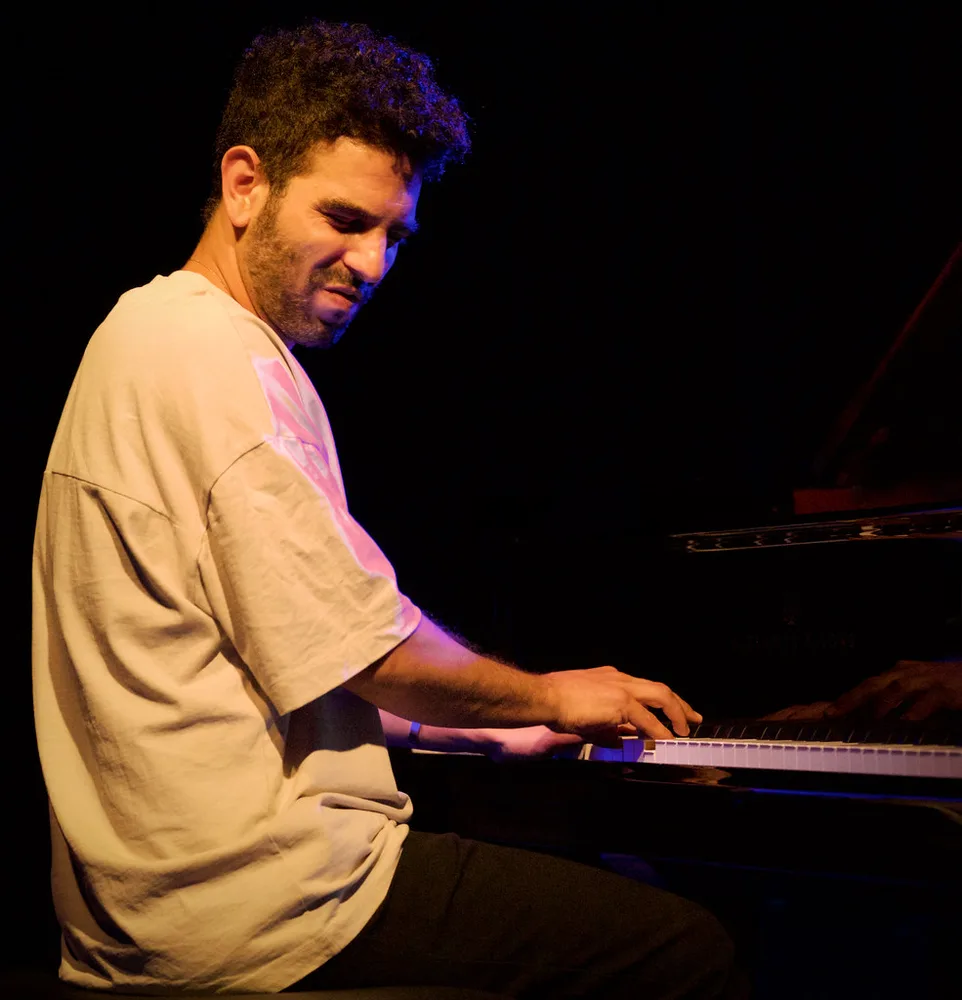
Uriel Herman at the piano with the Uriel Herman Quartet, BIMhuis, Amsterdam, June 16, 2022. Photograph by Dirk Neven, released under the Creative Commons Public Domain Mark 1.0. Public Domain Mark 1.0 (CC PDM 1.0), declared by the photographer on his own Flickr upload. — Flickr, "Uriel Herman Quartet 16 juni 2022 BIM Amsterdam - Uriel Herman" by dirkneven1966 (Dirk Neven) - https://www.flickr.com/photos/146907430@N03/52153506920 - image file https://live.staticflickr.com/65535/52153506920_253bc551b7_b.jpg

Uriel Ze'ev Herman was born in Jerusalem on April 13, 1987 and grew up in Katamon, on the city's south-western side. He started piano at seven and went through the Israeli Arts and Science Academy, graduating in 2005, then the Jerusalem Academy of Music and Dance, where he took his degree in 2010. His piano teachers there were Ilana Vered and Assaf Zohar; he studied composition with Andre Hajdu and Michael Wolpe. It was a classical education and he has said he was an awkward fit inside it, because he wanted to improvise. Hajdu, the Hungarian-born composer who taught him longest, encouraged exactly that, and Herman has since described him as the teacher who changed him: the man who taught him to use improvisation as a tool of composition, and then to write music difficult enough that improvising over it stayed a genuine problem.
His first record came out in the autumn of 2008, while he was still a student. Half Colors, Half Voices was a collaboration with the double bassist Ehud Ettun, setting original music to the poems of Rachel Bluwstein, and it drew in a large cast of Israeli singers and players: Eli Degibri on saxophone and voice, Zohar Fresco on percussion, Eli Magen on upright bass, Avi Singolda and Eran Weitz on guitars, with Adi Rennert producing and playing piano, keyboards and trumpet. Haaretz named it one of the fifteen best Israeli albums of the year, and Yedioth Ahronoth's reviewer compared the meeting of the two young musicians to the celebrated Israeli pairings of the 1970s. The Jerusalem Film Festival then commissioned Herman and Ettun to build an audiovisual piece around the same material, with Israeli video artists supplying images from Bluwstein's life.
Awake, released on April 17, 2014, was his first record under his own name alone, written after a journey through the jungles of Costa Rica. It mixed his own compositions with reworkings of Nirvana and Radiohead and with new melodies set to poems by Yehuda Amichai and Tirza Atar, and it pulled together most of the Israeli players he would keep working with: Ettun and Avri Borochov sharing the bass chair, Amos Hoffman on oud, Matan Assayag and Haim Peskoff on drums, Uriel Weinberger on flutes and saxophones, the singer Sivan Talmor. NRG's critic put it among the five best Israeli jazz albums of the year. Its real consequence was structural: the group he assembled to play the record live stayed together as The Uriel Herman Quartet, and that band, rather than any single album, is what carried him out of Israel. An appearance at the Red Sea Jazz Festival was followed by an invitation to play the opening of the National Taichung Theater in Taiwan, and from there the quartet worked its way through the Forbidden City Concert Hall in Beijing, Jazz sous les Pommiers, Amersfoort Jazz, Eclats d'Email in Limoges, Jarasum in South Korea and dates in more than twenty countries.
Two commissions in the second half of the decade pushed him toward the orchestra. White Night, written in 2017, is a rhapsody in eight movements for jazz quartet and orchestra, premiered and recorded with the Israel Netanya Kibbutz Orchestra and issued as a live EP in March 2018; it takes its narrative from an all-night ceremony in a jungle village, the same stretch of his life that produced Awake. In 2019 the Jenaer Philharmonie commissioned three further pieces for orchestra and quartet. He also wrote the score for Standby Painter, a 2018 Polish documentary about a man who stole a museum painting by hanging a replica in its place.
Face to Face, his second album as sole leader, came out on the French label Laborie Jazz on January 25, 2019, the year he signed to them. The record is built on the idea of an encounter that alters the person who has it, and its material follows from that: settings of Mordechai Zeira's Hebrew songs, a reading of David Bowie's "The Man Who Sold the World," a piece written for his partner, the actress Yael Shtolman, and a dedication to Hajdu, who had died in 2016. By then the quartet had settled into the line-up it has kept since: Herman at the piano, Avri Borochov on double bass and oud, Uriel Weinberger on woodwinds and Haim Peskoff on drums, with Arthur Krasnobaev's trumpet, Maayan Doari's cajón and several guest singers filling out the studio version.
Different Eyes followed on the British label Ubuntu Music on June 30, 2023, a sextet record made at the Jerusalem Music Center that turned out to be the one that travelled. It opens with "Jerusalem," a duet with the trumpeter Itamar Borochov about the city both Herman and his wife grew up in and neither could live in again, and it closes with "Yakinton," an old melody arranged for the son born to him three years earlier. In between sit Antonio Carlos Jobim's "Luiza," Eden Ahbez's "Nature Boy," a homage to Chopin's E minor prelude, Nirvana's "Polly," and "MJ," a tribute to Michael Jordan written in 23/8 for the number on the jersey. John Fordham placed it fifth in The Guardian's ten best jazz albums of 2023 and Jazzwise made it an Editor's Choice. The quartet made its British debut at Ronnie Scott's on September 19, 2023 with the Cuban trumpeter Yelfris Valdés as guest, a night Jazzwise reviewed by reaching for Cecil Taylor's left hand and McCoy Tyner's right. His most recent record, Pauses in Shades (Ubuntu Music, September 27, 2024), is something quieter: ten wholly improvised pieces for piano, cello, voice and electronics made with the cellist Maya Belsitzman, whom he had known since childhood in the Israeli classical world without ever having played with her until the pandemic cleared the calendar. He lives at Kibbutz Kaslon, west of Jerusalem, and has two children.
Herman plays like a classical pianist who refused the terms of the training. The melodic writing is the first thing anyone notices: long, singable lines delivered with what Jazzwise called Chopin-esque intensity, and a sound that reviewers in three languages keep describing as lyrical before they describe it as anything else. What sits underneath is less polite. Tom Sparo, reviewing the Ronnie Scott's debut, heard the heavy rhythmic left hand of Cecil Taylor working against the harmonically adventurous right hand of McCoy Tyner, which is an unusual pair of names to invoke about a player whose records open with lullabies. The Middle Eastern element is structural rather than decorative and comes through the band as much as the writing: an oud in the bass chair, complex additive metres, and a rhythm section that has played this repertoire together for a decade.
The repertoire itself is the argument. Herman has built four leader records out of material that is not supposed to sit together: Hebrew art song, Nirvana, Radiohead, David Bowie, Chopin, Brazilian song, poems by Yehuda Amichai and Rachel Bluwstein, and his own compositions, all treated as one body of song rather than as a novelty programme. He is explicit that the covers are not tributes; the version of "Smells Like Teen Spirit" on Awake is a full reimagining, and he credits it with the touring offers that followed. The other consistent feature is how little of the live performance is fixed. He has said that in a good show ninety per cent is improvised, and that by the third night of a tour a piece can be entirely so, which is a working method inherited directly from Hajdu's insistence that a player should become part of the piece. Fordham's summary in The Guardian, writing about Different Eyes, put the whole project as a rebuttal to the complaint that jazz prizes technique over feeling.
- Different Eyes (2023, Ubuntu Music) - The sextet record made at the Jerusalem Music Center that John Fordham ranked fifth in The Guardian's ten best jazz albums of 2023, with Itamar Borochov guesting on trumpet. Spotify - Different Eyes Listen
- Face to Face (2019, Laborie Jazz) - His first record for a European label and the album on which the quartet's line-up settled, built around Zeira settings and a reading of "The Man Who Sold the World." Spotify - Face to Face Listen
- Awake (2014) - The debut under his own name, written after a journey in Costa Rica, and the record that produced The Uriel Herman Quartet. Apple Music - Awake Listen
- Half Colors, Half Voices (2008, with Ehud Ettun) - His first release, setting Rachel Bluwstein's poems for a large cast of Israeli singers and players, named by Haaretz one of the fifteen best Israeli albums of its year. Spotify - Half Colors, Half Voices
- Pauses in Shades (2024, Ubuntu Music) - Ten improvised duo pieces with the cellist Maya Belsitzman for piano, cello, voice and electronics, his most recent album. Apple Music - Pauses in Shades Listen
- White Night: Rhapsody for Jazz Quartet and Orchestra (2018) - The live EP of his 2017 orchestral commission, premiered with the Israel Netanya Kibbutz Orchestra, and the clearest single statement of the orchestral side of his writing. Apple Music - White Night Listen
Uriel Herman: Full Discography
Uriel Herman is a bandleader first: every commercially issued record carrying his name is one he leads or co-leads, and no sideman date on anyone else's album has been found. There is therefore no "As Sideman" table below, only a short section for the compilation and orchestral appearances that sit outside the album catalogue.
Discogs is a thin source on this artist and cannot be used as the spine of the discography. He holds two artist entries there, 7299815 for his own name and 8238025 for the band, and between them they carry only Face to Face and the two pressings of Different Eyes. His first two albums, the orchestral EP and the 2024 duo record have no Discogs entry of any kind. Those rows were built from the artist's own album pages, which reproduce the printed credits in full, and cross-checked against the iTunes Lookup API for dates and track counts. Each row names the source it rests on.
The Buy column is — throughout: no affiliate programme is in place.
As Leader / Co-Leader
| Album Title | Recording Date(s) | Release Date | Label | Catalog Number | Format(s) | Personnel | Role | Reissue History | Spotify | Buy | Notes |
|---|---|---|---|---|---|---|---|---|---|---|---|
| Half Colors, Half Voices (with Ehud Ettun) | Not documented. Recorded at Luna and ZaZa studios, Israel | Autumn 2008 | Self-released | None assigned | CD, digital | Uriel Herman (piano), Ehud Ettun (upright bass); singers Lianne Aharony, Ayala Engedeshet, Avi Belleli, Eli Degibri, Sivan Talmor, Eli Magen, Liora Itzhak, Nathalie Rosental; Pnini Grubner (flute), Eli Degibri (saxophone), Eran Weitz and Avi Singolda (guitars), Eli Magen (upright bass), Rea Mochiach (drums), Zohar Fresco and Asaf Roth (percussion), Dan Tzuker (violin), Peter Roth (electric bass), Gidi Raz (electric guitar and effects), Adi Rennert (piano, keyboards, trumpet, glockenspiel) | Co-leader, composer, arranger | None | Spotify | — | Twelve tracks, original music set to poems by Rachel Bluwstein. Music produced by Adi Rennert; arrangements by Rennert, Ettun, Herman and Degibri; recorded by Roy Nadel, Tomer Naamani, Dano Visocar and Gay Labiush; mixed by Liron Sheffer and Nadel. Named by Haaretz one of the fifteen best Israeli albums of its year. Absent from Discogs; personnel from the artist's own album page |
| Awake | Not documented. Recorded at Luna Studios, Pluto Studio and Sach HaKol Studio by Guy Lebiush and Roy Nadel | April 17, 2014 | Self-released | None assigned | CD, digital | Uriel Herman (piano, music production); vocals Sivan Talmor, Mika Sade, David Lavi and Herman; Adi Rennert (second piano); Ehud Ettun and Avri Borochov (contrabass); Amos Hoffman (oud); Matan Assayag and Haim Peskoff (drums); Erez Mounk and Gabriel Aizenman (percussion); Arad Yeini (trumpet); Uriel Weinberger (flutes and saxophones); Gal Raviv (horns); Leat Sabbah (cello) | Leader, composer, arranger, producer | None | — | — | Seven tracks. His first album under his own name alone, written after a journey in the jungles of Costa Rica. Original compositions plus arrangements of Nirvana ("Smells Like Teen Spirit") and Radiohead ("Lucky") and new settings of poems by Yehuda Amichai and Tirza Atar. Mixed by Liron Sheffer, mastered by Aran Lavi at TanTan Studio, sleeve design by Tom Hendler. The record from which The Uriel Herman Quartet was formed. Absent from Discogs; personnel from the artist's own album page, release date corroborated by the iTunes Lookup API. Apple Music |
| White Night: Rhapsody for Jazz Quartet and Orchestra (Live) | 2017, live, with the Israel Netanya Kibbutz Orchestra | March 28, 2018 | Self-released | None assigned | Digital EP | Uriel Herman (piano, composer) with his quartet and the Israel Netanya Kibbutz Orchestra. Individual orchestral credits not published | Composer, leader | None | — | — | A single continuous work in eight movements: Gathering; First Glass "Sundawn"; Passage; Second Glass "Trees Revive"; Polydance; Third Glass "Glowing"; East Calls; Defuse. Roughly twenty-one minutes. Absent from Discogs; release date from the iTunes Lookup API, movement titles from the artist's own site. Apple Music |
| Face to Face (billed to the Uriel Herman Quartet) | Not documented. Recorded by Barak Yechezkeli and Jonathan Jacobi at Pluto Studio and Jaffa Sound Art | January 25, 2019 | Laborie Records (Laborie Jazz) | LJ55 | CD, digital | Uriel Herman (piano, arrangements), Avri Borochov (double bass, oud), Uriel Weinberger (woodwind), Haim Peskoff (drums), Arthur Krasnobaev (trumpet), Ilan Bar-Lavi (electric guitar), Maayan Doari (cajón), Aviv Bahar (voice, kopuz, electric guitar), Yehuda Shuki Shveiky (voice, guitar), Daniel Krief (voice) | Leader, composer, arranger, co-producer | None | Spotify | — | Eight tracks: Hayu Leylot; The Man Who Sold The World; Ballad For Yael; Shva Esre; I Shall Not Die, But Live; Winter Light; Hour Of The Wolf; Shirat Hachalil. Original music with arrangements of David Bowie and Mordechai Zeira. Dedicated to his teacher Andre Hajdu. Music produced by Herman and Borochov, produced by Yonatan Strier, mixed by Borochov and Liron Sheffer, mastered by Jonathan Jacobi at Jaffa Sound Art. Verified at Discogs release level (release 16143004), reached through master 4230366 and title-checked against the tracklist before use. Discogs country: France. No credit on that release carries any track restriction, so the data cannot separate core band from guest, and none is asserted here. Apple Music |
| Different Eyes | Recorded at the Jerusalem Music Center by Liron Sheffer and Zvika Hirshler | June 30, 2023 | Ubuntu Music | UBU0136 (CD); UBU0136LP (vinyl) | CD, 12" vinyl, digital | Uriel Herman (piano, music), Itamar Borochov (trumpet), Avri Borochov (double bass), Uriel Weinberger (woodwind), Haim Peskoff (drums), Maayan Doari (percussion) | Leader, composer, arranger | None | Spotify | — | Nine tracks: Jerusalem; Nature Boy; MJ; Luiza; Fantasy; Paris; Homage To Chopin Prelude No 4; Polly; Yakinton. The vinyl pressing swaps the order of "Paris" and "Fantasy." Mixed by Sheffer, mastered by Jonathan Jacobi. Ranked fifth in The Guardian's ten best jazz albums of 2023 and an Editor's Choice in Jazzwise. Both Discogs pressings (releases 29392852 and 29560168) carry an entirely empty credits block, listing only Herman himself; the personnel above comes from the artist's own album page. Apple Music |
| Pauses in Shades (with Maya Belsitzman) | Not documented | September 27, 2024 | Ubuntu Music | UBU0184CD | CD, digital | Maya Belsitzman (cello, voice), Uriel Herman (piano); overdubs, synths, field recordings and delays used throughout | Co-leader, co-improviser | None | — | — | Ten tracks, roughly thirty-one minutes: Dew (Tal); Homage to Chopin; On A Boat; First Step {nur}; The Naked Streets; Dance of the Blinds; Not Alone; Echo of Regrets; Sandbox; Shades. A wholly improvised suite; the two had known each other since childhood in Israeli classical music and first played together during the pandemic. Absent from Discogs; catalogue number from the retail listing, release date and track list from the iTunes Lookup API. Apple Music |
Other appearances
| Year | Project | Title | Label | Catalog | Role | Notes |
|---|---|---|---|---|---|---|
| 2017 | Various artists | Jazz Sous Les Pommiers, 36è Édition | Jazz Sous Les Pommiers | — | Track appearance | Promotional CD compilation for the Coutances festival, which the quartet played that year. Discogs release 13958021, the only compilation credit on his artist page |
| 2019 | Jenaer Philharmonie | Three dialogues for orchestra and jazz quartet | — | — | Composer | Commissioned works, performed in Jena in November 2019. No commercial recording has been issued |
Screen work
| Year | Title | Director / production | Role | Notes |
|---|---|---|---|---|
| 2018 | Standby Painter | Polish documentary | Composer, original score | About a man who stole a painting from a museum by hanging a replica in its place. No soundtrack album was released |
- Avri Borochov - double bass and oud in The Uriel Herman Quartet, the longest continuous relationship in the band. He plays on Awake (2014), Face to Face (2019) and Different Eyes (2023), co-produced the music on Face to Face and shares its mixing credit with Liron Sheffer.
- Uriel Weinberger - woodwinds in the quartet since Awake, credited variously with flutes, tenor saxophone and reeds; the second melodic voice on every quartet record.
- Haim Peskoff - the quartet's drummer, on Awake, Face to Face and Different Eyes.
- Ehud Ettun - double bassist and co-leader of Half Colors, Half Voices (2008), Herman's first record, and back in the bass chair for part of Awake six years later.
- Itamar Borochov - trumpet on Different Eyes (2023), including the opening duet "Jerusalem," and Avri Borochov's younger brother.
- Maya Belsitzman - cellist and singer, his duo partner on Pauses in Shades (2024). The two grew up in the same Israeli classical circles and first played together during the pandemic.
- Amos Hoffman - oud on Awake (2014).
- Matan Assayag - one of the two drummers on Awake, alongside Peskoff.
- Eli Degibri and Zohar Fresco - saxophone and voice, and percussion, on Half Colors, Half Voices (2008).
- Maayan Doari - percussion and cajón on Face to Face and Different Eyes.
- Arthur Krasnobaev - trumpet on Face to Face (2019).
- Adi Rennert - producer of Half Colors, Half Voices, and a second keyboard and trumpet player on both that record and Awake.
- Yelfris Valdés - the Cuban trumpeter who guested with the quartet at Ronnie Scott's in September 2023.
- Israel Netanya Kibbutz Orchestra and Jenaer Philharmonie - the two orchestras that premiered his large-scale writing, the first with White Night in 2017 and the second with three commissioned dialogues for orchestra and quartet in 2019.
- Andre Hajdu and Ilana Vered - his composition and piano teachers at the Jerusalem Academy of Music and Dance, alongside Michael Wolpe and Assaf Zohar. Face to Face is dedicated to Hajdu.
- Wikipedia: Uriel Herman, source for the April 13, 1987 birth, the 2005 and 2010 graduations, the named teachers, the NRG placing for Awake, the White Night and Jenaer Philharmonie commissions, the Standby Painter score and the touring record
- Hebrew Wikipedia: אוריאל הרמן, source for the Katamon childhood, the residence at Kibbutz Kaslon, the marriage to the actress Yael Shtolman and the four-album discography
- Wikidata: Uriel Herman (Q20205062), which independently carries the April 13, 1987 birth date and Jerusalem as the birthplace
- Uriel Herman: Biography and his own album pages for Half colors, half voices, Awake, Face to Face, Different Eyes and White Night, which carry the full personnel, production credits, release dates and his own written notes on each record. These are the only source for the Awake and Half Colors personnel
- John Fordham, "The 10 best jazz albums of 2023," The Guardian, December 26, 2023, which places Different Eyes at number five and is the source for the description of its programme
- Tom Sparo, "The Uriel Herman Quartet dazzle at Ronnie Scott's," Jazzwise, source for the September 2023 London line-up, the Yelfris Valdés guest appearance and the Cecil Taylor and McCoy Tyner comparisons
- John Bungey, "Uriel Herman (new album 'Different Eyes' + Ronnie Scott's debut)," UK Jazz News, July 4, 2023, an interview and the source for the Jerusalem Music Academy years, the account of "Jerusalem," "MJ" and "Yakinton," and his statement about how much of a concert is improvised
- Troy Dostert, "Maya Belsitzman and Uriel Herman: Pauses in Shades," All About Jazz, October 13, 2024, reached through his All About Jazz musician page, which files him under jazz piano
- Discogs: Uriel Herman (artist 7299815) and Uriel Herman Quartet (artist 8238025), read at release level for the Face to Face and Different Eyes labels, catalogue numbers, formats and credits
- iTunes Lookup API, checked album by album for the release dates of Awake (April 17, 2014), White Night (March 28, 2018), Face to Face (January 25, 2019), Different Eyes (June 30, 2023) and Pauses in Shades (September 27, 2024)
- Jazzfuel: Maya Belsitzman and Uriel Herman, Pauses in Shades, source for the September 27, 2024 release on Ubuntu Music, the ten improvised pieces, and the account of a duo who met as children on the Israeli classical scene and reconnected in 2020
- Avri Borochov on JazzProfiles.com and Haim Peskoff on JazzProfiles.com, both of which document the quartet's personnel from the sidemen's side