 JAZZPROFILES lives in the music 1,146 Jazz Artists fully Profiled!
 Stu Hacohen
Last updated September 13, 2026
Listen on Spotify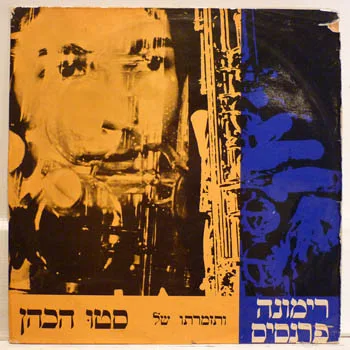
Cover art of *Rimona Francis With Stu Hacohen's Orchestra* (Israphon AP 335, 1969), marketed as "Jazz Vocalise" and the release most closely associated with Hacohen's own arranging and bandleading. No CC-licensed or public-domain photograph of Hacohen could be found; this cover is used as the only available image connected to him, per the site's disclosed album-cover fallback convention. Saved locally as `portrait.jpg`. Album cover art (not a CC-licensed artist photo), used as the only available image connected to the artist. Copyright is held by Israphon and/or the release's uncredited designer. This is an honestly disclosed editorial stand-in, not a free-licensed image. — Retrieved from the Discogs master release's image asset via the public Discogs API, https://api.discogs.com/masters/1206454. Release page: https://www.discogs.com/master/1206454-Rimona-Francis-With-Stu-Hacohens-Orchestra-Rimona-Francis-With-Stu-Hacohens-Orchestra.
Stu Hacohen was born in 1929 in Pernik, Bulgaria, where he learned accordion on his older brother's instrument and played with a local Romani ensemble, absorbing rhythmic vocabulary — Bulgarian meters in 9/8 and 13/8 — that later became a signature of his arranging. He immigrated to Israel in 1949 at twenty and was taken in by conductor Erich Teich as a multi-instrumentalist in the Israeli Air Force Orchestra, adding contrabass, saxophone and piano to the accordion he already played. In the early-to-mid 1950s he played in Maurice "Pisi" Osherowitz's house orchestra at Tel Aviv's Dan Hotel, becoming self-taught in jazz through records and literature; fellow jazz veteran Albert Piamenta later called him "one of the Jews who really did play jazz here."
He built a long career as an Israeli arranger and conductor: music for Shimon Israeli's 1960 one-man show, the Armored Corps entertainment troupe's 1961 program, the orchestra on Arik Einstein's 1966 debut album Shar Bishvilcha, Georges Brassens adaptations for Yossi Banai's 1969 show Ein Ahavot Smechot — Banai became a close personal friend, and Hacohen served as that show's musical director — and Aliza Azikri's 1970 record. Around 1967 he met vocalist Rimona Francis; they married and became a lasting musical partnership. Their first joint recording, a Kol Israel radio version of Mattityahu Shelem's song "Shibolet BaSade," had Francis singing vocalise — using her voice as an instrument to recreate jazz horn solos by Charlie Parker and Clifford Brown note for note, well enough that friends nicknamed her "the trumpet." That approach became the basis of two 1969 LPs: Rimona Francis With Stu Hacohen's Orchestra (Israphon), marketed explicitly as "Jazz Vocalise" and drawing on the same Bulgarian-meets-jazz fusion Hacohen had carried since Pernik, and Badabada... (Hed-Arzi), a second, more Latin/Afro-Cuban-facing record from the same year.
Dizzy Gillespie met the couple during a visit to Israel and reportedly encouraged their mid-1970s move to the United States, where Hacohen arranged Francis's self-titled 1978 album for the respected German jazz label MPS, recorded in New York with a band including pianist Jasper van't Hof, guitarist Barry Finnerty and saxophonist Leszek Żądło, and produced by Joachim Ernst Berendt. They returned to Israel in the late 1980s, and Hacohen devoted himself primarily to teaching, becoming an influential figure in Israeli jazz education — his most prominent student, saxophonist Eli Degibri, played at his funeral. In his final years, as a severe degenerative neuromuscular illness made playing difficult, he turned to painting portraits of jazz icons — Coltrane, Sonny Stitt, Dizzy Gillespie. He died on August 13, 2006, at 77, and was buried at Kibbutz Einat; Francis has said his last words concerned seeing his late friend Yossi Banai again soon.
Hacohen's defining move was importing Bulgarian and Romani folk rhythm — odd meters like 9/8 and 13/8 — directly into a jazz big-band arranging vocabulary, at a time when Israeli jazz was still finding its own voice separate from American models. The vocalise concept he built around Rimona Francis's voice, using it as a horn substitute rather than a conventional lyric instrument, was a genuine and specific innovation for the Israeli scene of 1969, and it's the single idea his recorded work is most remembered for.
- Rimona Francis With Stu Hacohen's Orchestra (1969, Israphon) — marketed as "Jazz Vocalise," the record most closely identified with the Hacohen/Francis vocalise concept.
- Badabada... (1969, Hed-Arzi) — a second 1969 LP with Francis, leaning more toward Latin and Afro-Cuban jazz-funk material.
- Rimona Francis (1978, MPS) — his arranging work on Francis's self-titled German-label album, recorded in New York with an international band.
Stu Hacohen: Full Discography
Verified against the live Discogs API. Discogs artist ID 636329. Name variations on file: S. Hacohen, Stu Hacohen's Orchestra, ס. הכהן, סטו הכהן, סטו כהן. Exactly three master releases are credited to him, all jointly with Rimona Francis (her own Discogs artist ID is 41404).
As Arranger/Bandleader (with Rimona Francis)
| Year | Title | Label | Catalog | Notes |
|---|---|---|---|---|
| 1969 | Rimona Francis With Stu Hacohen's Orchestra | Israphon (Israel) | AP 335 | Marketed as "Jazz Vocalise" (ג'ז וקאליזה). Tracks include "Shibolet Basade," "Take 5," "Dodi Li," "Joy Spring." Reissued as CD, Helicon HL 02-94136 (Israel, 2000). |
| 1969 | Badabada... | Hed-Arzi (Israel) | BAN 14170 | Latin/Afro-Cuban-facing material including "Take the 'A' Train," "Walk Tall," "Balkan Song." Reissued 2024 (Hed-Arzi 814170-1). |
| 1978 | Rimona Francis (self-titled) | MPS (Germany) | 0068.187 / MPS 15.508 | Recorded New York, Oct 24-27, 1977. Hacohen: Arranged By. Full band: Rimona Francis (vocals, piano), Frank Tusa (bass), Buddy Williams (drums), Barry Finnerty (guitar), Jasper van't Hof (piano/keyboards/synthesizer), Leszek Żądło (tenor/soprano sax, flute). Producer: Joachim Ernst Berendt. Further pressings: EMI Netherlands 1978, MPS Japan 1978 (KUX-91-P), MPS Japan CD 1998 (POCJ-2622), Speakers Corner 180g reissue 2001, Solid Records/MPS Japan remaster 2025 (CDSOL-3509). |
Spotify
Confirmed artist page "Stu Ha'Cohen's Orchestra": open.spotify.com/artist/68jo93E37KEsszlax5Oget, with tracks matching the 1969 Israphon LP. No separate Spotify presence found under a Hacohen-credited name for the MPS 1978 album or Badabada.
Data hazards
- Correction to an earlier lead: Stu Hacohen did not collaborate directly with bassist Miroslav Vitous. The actual connection is that Rimona Francis (not Hacohen) guested — vocals, ARP Solina synthesizer, electric piano — on Vitous's own 1976 album Majesty Music (Arista Records, US, catalog AL 4099), a separate release with no Hacohen involvement and no MPS connection. This earlier lead appears to have conflated two different facts; see Rimona Francis's own discography file for the Vitous credit.
- German Wikipedia states Hacohen recorded "an early album under his own name" in the 1950s. This claim is single-sourced, appears nowhere else (not in Hebrew Wikipedia, not in the detailed 2007 Haaretz profile, not on Discogs), and is not included in this profile.
- No exact birth day/month beyond the year 1929 was found in any source.
- Rimona Francis — his wife and primary musical collaborator from around 1967 until his death; the two are inseparable in his recorded output.
- Maurice "Pisi" Osherowitz — bandleader of the Dan Hotel house orchestra Hacohen played in during the early-to-mid 1950s.
- Eli Degibri — his most prominent teaching-era student, who played at his funeral.
- Ori Kaplan — an earlier student, who began his jazz study under Hacohen in Israel before moving to New York in 1991.
- Yossi Banai — close friend and collaborator; Hacohen was musical director of Banai's show Ein Ahavot Smechot.
- Arik Einstein — arranged the orchestra on Einstein's 1966 debut album.
More Jazz Fusion Artists
See all 221 Jazz Fusion artists →- Ben Shalev, "Rest Comes to the Weary," Haaretz, Aug 8, 2007 — a first-person interview with Rimona Francis one year after his death, the richest single source for his final illness, career narrative and personal relationships
- Hebrew Wikipedia: סטו הכהן
- Ynet, obituary, 2006, source for the funeral date/location
- Discogs: Stu Hacohen, artist 636329, checked at release level for all three credited albums
- Discogs: Rimona Francis With Stu Hacohen's Orchestra, master 1206454, Badabada..., master 3448157, Rimona Francis, master 368269
- MPS Records: Rimona Francis, confirming the 1978 album's personnel and production credits
- German Wikipedia's Stu Hacohen article gives a death date of "July 2006," conflicting with four independent sources (Hebrew Wikipedia, Ynet, Discogs, Zemereshet) that agree on August 13, 2006 — the majority date is used here