 JAZZPROFILES lives in the music 1,002 Jazz Artists fully Profiled!
 Albert Piamenta
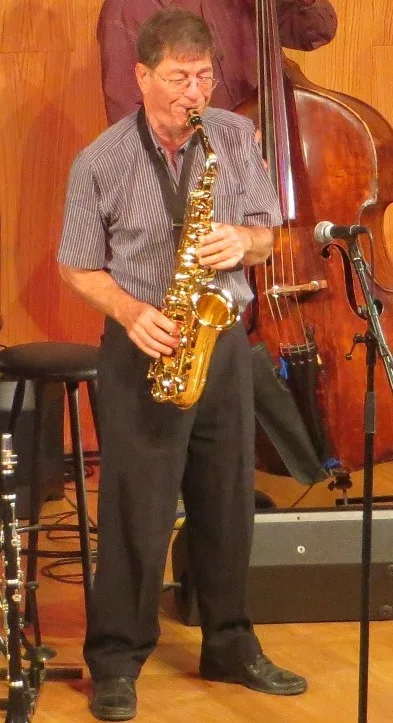
Albert Piamenta performing with the Israeli Saxophone Quartet, June 2013 CC BY 2.5 — Wikimedia Commons, photograph by Yehudit Garinkol via the PikiWiki Israel free image collection project (image 32383), File:PikiWiki Israel 32383 Israeli jazz musicians - Albert Piamenta (cropped).JPG, https://commons.wikimedia.org/wiki/File:PikiWiki_Israel_32383_Israeli_jazz_musicians_-_Albert_Piamenta_(cropped).JPG
Albert Piamenta led the quartet that made the first instrumental jazz album ever recorded in Israel, and he had to talk a record label into paying for it.
He was born on July 6, 1938 in Nachlat Zvi, a Jerusalem neighborhood, the youngest of ten children of Yosef Piamenta, a public health inspector, and Rachel née Cohen-Sit. His father loved music and played the oud and the qanun at home. As a small boy Albert built himself a rough mandolin and worked out how to play it. His parents bought him an accordion when he was 12 and he learned it entirely by ear. He picked up a saxophone at 15, moved to clarinet at 16, and began formal study with Yehuda Polchak of the Jerusalem police orchestra, who taught him free of charge early in the morning before school.
Jazz reached him just before his military service, through Mel Keller, an immigrant teacher who had started giving lessons in the idiom in Israel; Piamenta was among his first students. He formed an amateur jazz trio with Nechemia and Chaim Chayon that played dances in clubs and at balls. From 1957 to 1959 he served as a clarinet player in the IDF Orchestra under Shalom Ronly-Riklis, then spent about a year in the Israel Police orchestra while beginning to play clubs in Jerusalem and Tel Aviv alongside the pianist Dan Gottfried, who would later found the Red Sea Jazz Festival in Eilat.
The 1960s were his apprenticeship in every direction at once. In 1960 he joined the dance orchestra of Moriz "P.C." Ushrowitz, resident at the Dan Hotel in Tel Aviv, whose book was built mainly on jazz. In 1963 he and Gottfried formed the Carmel Quartet with Joe Israel and the drummer Yossi "Papo" Levy; the group toured Holland and Sweden with real success before breaking up in 1965. In 1964 he spent over a year with Los Cinco Amigos, a salsa band from the Dominican Republic touring Israel. He also began an eight-year course of composition study with Dr. Zvi Keren. In 1967 he formed the Albert Piamenta Quartet with Avi Farin, Valerio Segal and Stu Hacohen, playing Aris San's Tel Aviv club, and renamed it Piamenta's Guys. When Arale Kaminsky brought him into the band at the Bar-Barim club in 1968, Kaminsky recommended the group to Arik Einstein, who used them live and on the album Mazal Gdi.
By 1971 Piamenta had become one of the busiest arrangers in Israeli popular music. He wrote two songs for the 1968 evening of Rachel the Poetess settings performed by Chava Alberstein and Danny Granott. He arranged five songs on Cilla Dagan's 1970 debut, Ilana Rovina's 1971 hit "Lech Ita," Shlomo Artzi's second album Al Anashim in 1971 with David Krivoshei, and four songs on Artzi's third in 1972.
That same year he did the thing he is remembered for. He persuaded Avshalom Rubin, the head of the label Isradisc, to fund an instrumental jazz record, something no Israeli label had ever released. The budget was 3,000 lira. Piamenta reassembled the Jazz Work Shop quartet he had formed with Gottfried in 1971, booked Koliner Studios in Tel Aviv, and cut the whole album in a single day: Piamenta on alto and soprano saxophone, Gottfried on piano, Teddy Kling of the Israel Philharmonic on bass, Jerry Garval on drums.
Mezare Israel Yekabtzenu takes its title from Jeremiah, "He that scattered Israel will gather him." Its six tracks are built from Arab maqamat, Druze rhythms and Hasidic melody, deliberately, with the stated aim of freeing Israeli musicians from the American songbook. Piamenta had absorbed the Middle Eastern material in the clubs of Jaffa before the Six Day War. In 1972 the combination of ethnic music and jazz was an unusual thing to attempt anywhere, and in Israel it was unprecedented on record.
Around the same time he and the choreographer Sara Levi-Tanai assembled Finjazz, a group pairing Dudu Elharar and Aliza Azikri with a nine-piece jazz orchestra, presenting familiar Israeli songs in new jazz arrangements and touring nationally under the Omanut La'am public arts scheme. Audiences did not take to it and the group folded quickly.
In 1974 he scored Nissim Dayan's film Or Min Hahefker, and then left for New York, where he stayed until the end of 1979. With Stu Hacohen's help he found work in a club playing Armenian and Arabic music. He arranged and produced for Israeli singers living in the city, among them Ran Eliran and Samir Shukry, and performed with the orchestras of Don Pinto and Tito Puente. In parallel he studied electronic music in Manhattan and classical Arabic music on Long Island, and composed for documentary film. In 1977 the cantor David Avichzer commissioned a set of arrangements; Piamenta recorded them on a trip back to Israel, was pleased enough with the instrumental tracks to keep them, and released them as Improvisation (also known as Mawal Improvisation) on CBS Israel in 1981. It closes out his New York period and mixes New York jazz with Mediterranean, Ladino, Greek and Turkish material, including a track called "Tel Aviv New York Tel Aviv."
The decade after his return went into building institutions rather than a catalogue. He became director of the Tel Aviv-Jaffa Music Center, where roughly 500 teenagers study, and started a Dixieland ensemble and a big band inside it. From the mid-1980s he was musical director and conductor of the representative youth orchestras of Tel Aviv and Jerusalem. In 1983 he founded the Israeli Saxophone Quartet with three of his own students, Noah Rosenzweig, Ilan Berkovich and Gan Lev; it recorded two albums for MCI in 1990, one of classical and contemporary repertoire and one of jazz and ethnic music. He was musical director of the Safed Klezmer Festival in 1986, and he has taught at the Jerusalem Academy of Music and Dance. He also produced arrangements for well-known singers throughout the decade and served as musical director of the Mizrahi song festivals.
In the 1990s he formed the Chamber Trio and the band Kamun, active from 1997 to 2001, with Yossi "Papo" Levy on drums, Ezra Barhoum on oud, Leonid Ptashka on piano and Shai Marom on keyboards, joined later by Amir Masrik on double bass and Amit Lissai on percussion. He arranged "Ah Ya Zen" for Bustan Abraham's Abadai in 1996 and guested on clarinet and bass clarinet on "Black Seagull" from their 1997 album Fanar. In 1998 he contributed two compositions, "Amman Amman" and "Wared," and an adaptation, "Shortwave," to the Israel Philharmonic's Arab-Jewish ensemble SheshBesh for their album on the German jazz label Enja. He has been a frequent performer at the Red Sea Jazz Festival, and in 2006 he received the Minister of Education and Culture Prize for 2005.
In 2014, forty-one years after it came out and vanished, the 1973 album returned twice over. The British reissue label Jazzman put its title track on Spiritual Jazz 5: The World, a survey of modal and deep jazz recorded anywhere between 1961 and 1979, placing an Israeli record from Isradisc alongside Hideo Shiraki, Tete Mbambisa, Paul Winter and Louis Banks. The same year Fortuna Records remastered and reissued the whole album on vinyl for the first time.
He is 88, and in a March 2023 interview with Maariv he described still playing with the same appetite he had at the beginning.
Piamenta's playing sits at the meeting point of three trainings that rarely occur in the same musician: European classical woodwind technique from Yehuda Polchak and eight years of composition with Zvi Keren; American jazz from Mel Keller and then from working New York clubs; and Arabic classical music, absorbed first in the Jaffa clubs of the 1960s and later studied formally on Long Island.
What he did with that combination was directional rather than decorative. The 1972 album's premise is that Israeli jazz musicians should stop proving themselves against American standards and build from the material actually around them, which in his case meant Arab maqamat, Druze rhythms, Hasidic niggunim, Ladino song and Greek and Turkish forms. Discogs files Mezare Israel Yekabtzenu as avant-garde jazz; the crate-digging reissue market later filed it as spiritual and modal jazz. Both readings fit a record that treats liturgical and folk melody as raw material for extended improvisation rather than as local color.
His versatility is documented in the shape of his career rather than claimed for him. He is a reeds player who has worked in jazz, classical, Arabic and Mediterranean settings, led a Dixieland band and a big band, conducted youth orchestras, founded a saxophone quartet playing contemporary classical repertoire, and arranged for mainstream Israeli pop singers across five decades.
- Mezare Israel Yekabtzenu (1973, Jazz Work Shop, Isradisc) - The first instrumental jazz album recorded in Israel, cut in one day with Dan Gottfried, Teddy Kling and Jerry Garval. Reissued by Fortuna Records in 2014. This is the record. Full album on YouTube · Fortuna Records on Bandcamp Listen
- Improvisation / Mawal Improvisation (1981, CBS Israel) - His first instrumental album under his own name, closing out five years in New York, with Ladino, Greek and Turkish material sitting beside a track called "Tel Aviv New York Tel Aviv." Spotify - מאוואל - אימפרוביזציה Listen
- "Mezare Israel," on Spiritual Jazz 5: The World (2014, Jazzman) - The 1973 title track as international collectors met it, four decades later, on a compilation spanning Japan, South Africa, Turkey, India and Argentina. Spotify - Mezare Israel Listen
- "Black Seagull," on Fanar (1997, Bustan Abraham, Nada Productions) - Guest clarinet and bass clarinet with the Arab-Jewish ensemble, on the album where Zakir Hussain and Hariprasad Chaurasia also appear. Fanar is the one Bustan Abraham album absent from Spotify; four others are there. Bustan Abraham on Spotify Listen
- "Zanuba," on Tel Aviv Got Soul (2018, rec. 1969, Piamenta's Guys) - The funk-band side of him, four years before the jazz record, reissued on a compilation of Tel Aviv recordings from 1969 to 1971. YouTube Listen
Albert Piamenta: Full Discography
Albert Piamenta (born July 6, 1938, Jerusalem), Israeli saxophonist, clarinetist, composer and arranger. Alto and soprano saxophone, clarinet, bass clarinet.
Discogs artist: 1455042. Spotify artist: Albert Piamenta.
Name variations recorded on Discogs: A. Piamenta, Albert Piammenta, Albert Piemente, Piamenta, and four Hebrew-script variants (א. פיאמנטה, א.פיאמנטה, אלברט פאמנטה, אלברט פיאמנטה, פיאמנטה).
Group entities: Jazz Work Shop (Discogs 3988118), Piamenta's Guys / הברנשים של פיאמנטה (Discogs 2997060).
Totals under the Piamenta artist entity: 182 releases, of which 1 is a Main (leader) credit, 4 are producer credits, 176 are album appearances and 1 is a track appearance. The two group entities carry a further 13 releases between them, including Mezare Israel Yekabtzenu, which is filed under the band name Jazz Work Shop rather than his own.
Leader and band leader
| Album | Year | Label | Personnel | Notes | Listen | Buy |
|---|---|---|---|---|---|---|
| Mezare Israel Yekabtzenu (as Jazz Work Shop) | 1973 | Isradisc (SI 31028), Israel | Albert Piamenta (alto and soprano saxophone), Dan Gottfried (piano), Teddy Kling (bass), Jerry Garval (drums) | The first instrumental jazz album recorded in Israel. Six tracks: "Mezare Israel Yekabtzenu" (7:42), "Rabbi Elimelech" (6:30), "Sha Shtil Harabbi Ba" (5:38), "Ala Dal'ona" (6:41), "Ken Yovdu Kol Oyvecha" (7:07), "Hamichtav" (6:01). Recorded in one day at Koliner Studios, Tel Aviv, on a 3,000 lira budget from Isradisc. Discogs genre: Jazz, style Avant-garde Jazz. Reissued on vinyl by Fortuna Records (FTNLP002) in December 2014, its first reissue. Title track licensed to Jazzman Records for Spiritual Jazz 5: The World the same year. | YouTube (full album) · Bandcamp | Amazon |
| Improvisation (מאוואל - אימפרוביזציה, "Mawal Improvisation") | 1981 | CBS Israel (85589) | Albert Piamenta and ensemble; photography Tzachi Ostrovsky, design Dennis Jones | His first instrumental album under his own name. Ten tracks on the LP: "Im Nin'alu," "Ke Yo Phorti" (Ladino), "Dirlada" (Greek), "Adio" (Ladino), "Ishkadra" (Turkish), "Bab El Amud," "Um Musa," "Dror Yikra," "Tel Aviv New York Tel Aviv," "Yemin Moshe." Grew out of arrangements commissioned in 1977 by the cantor David Avichzer and recorded on a trip home from New York. Discogs genres: Jazz, Funk / Soul, Folk World & Country. | Spotify | Amazon |
| Classical and contemporary music, with the Israeli Saxophone Quartet | 1990 | MCI, Israel | Israeli Saxophone Quartet: Albert Piamenta, Noah Rosenzweig, Ilan Berkovich, Gan Lev | One of two albums the quartet recorded for MCI in 1990, this one of classical and contemporary repertoire. | not found | Amazon |
| Jazz and ethnic music (Arabic, Judeo-Spanish, standards and originals), with the Israeli Saxophone Quartet | 1990 | MCI, Israel | Israeli Saxophone Quartet: Albert Piamenta, Noah Rosenzweig, Ilan Berkovich, Gan Lev | One of two albums the quartet recorded for MCI in 1990, this one of jazz and ethnic material. | not found | Amazon |
Piamenta's Guys (הברנשים של פיאמנטה), Discogs 2997060
The band Piamenta formed in 1967 as the Albert Piamenta Quartet with Avi Farin, Valerio Segal and Stu Hacohen, house band at Aris San's Tel Aviv club, and renamed shortly after. Its own releases are 7-inch singles.
| Release | Year | Label | Format | Notes | Listen | Buy |
|---|---|---|---|---|---|---|
| Eize Ba'al Ben Bliyaal (איזה בעל בן בליעל) | 1969 | Hed-Arzi | 7", EP | Discogs release 11924900. | not found | Amazon |
| Badad (בדד) | 1969 | Hed-Arzi | 7", EP | Discogs release 11924967. | not found | Amazon |
| "Ob-La-Di, Ob-La-Da" / "Beit Ha'Arava," with Arik Einstein | 1969 | CBS | 7", single | Billed as "Arik Einstein With Piamenta And His Boys." Discogs release 12425102. | not found | Amazon |
| "Zanuba," on Tel Aviv Got Soul (Rare Jems From Funky Tel Aviv 1969-1971) | 2018 (rec. 1969) | האחים (BROTHERS001) | LP, compilation | Track B1. The instrumental side of the band, reissued 49 years later. | YouTube | Amazon |
Jazz Work Shop (Discogs 3988118), other releases
| Release | Year | Label | Notes | Listen | Buy |
|---|---|---|---|---|---|
| "Mezare Israel," on Spiritual Jazz 5: The World (Esoteric, Modal And Deep Jazz From Around The World 1961-79) | 2014 | Jazzman (JMANCD067 / JMANLP067) | Track A4 of 17, between Oladepo Ogomodede's "Take Five" and the Erol Pekcan / Tuna Ötenel / Kudret Öztoprak trio's "Köy Yolu." Also on the record: Hideo Shiraki, Tete Mbambisa, Paul Winter, Louis Banks, Charlie Munro. | Spotify · Jazzman | Amazon |
| "Mezare Israel Yekabtzenu," on il Dramma 06 - The Joker | 2007 | Poor Mixed Discos | DJ ilD mixtape; track appearance. Discogs release 28544695. | not found | not found |
Producer
| Release | Year | Artist | Label | Notes | Listen | Buy |
|---|---|---|---|---|---|---|
| Songs To Jerusalem | 1978 | Joshua Tenne | Windblown | LP, album. Discogs release 21426460. Piamenta also appears as a performer. | not found | Amazon |
| The International Sound of The Leaders | 1979 | The Leaders (19) | Not On Label | LP. Discogs release 32487420. Piamenta also appears as a performer. | not found | not found |
| Joshua Tenne | 1980 | Joshua Tenne | Discogs master 3281632 | Piamenta also appears as a performer. | not found | Amazon |
| Eastern Soul | 2018 | Tsvia Abarbanel | Discogs master 1701278 | Reissue of the 1970 Shirei Levav / Soul Of The East material. | not found | Amazon |
Selected guest and composer credits
| Release | Year | Artist | Label | Piamenta's credit | Listen | Buy |
|---|---|---|---|---|---|---|
| Abadai | 1996 | Bustan Abraham | Nada Productions (NADA 9) | Arranged by, on track 3, "Ah Ya Zen." Ross Daly guests on the album. | Bustan Abraham on Spotify | Amazon |
| Fanar | 1997 | Bustan Abraham | Nada Productions (NADA 13) | Guest, clarinet and bass clarinet, on track 7, "Black Seagull." Zakir Hussain (tabla) and Hariprasad Chaurasia (bansuri) guest on track 2; Achinoam Nini sings on track 6; Zohar Fresco plays percussion throughout. | Fanar is not on Spotify; four other Bustan Abraham albums are. Bustan Abraham on Spotify | Amazon |
| SheshBesh | 1998 | SheshBesh | Enja Records (TIP-888 830 2) | Composed by, on track 6 "Amman Amman" and track 8 "Wared"; adapted by, on track 10 "Shortwave." SheshBesh is the Israel Philharmonic's Arab-Jewish ensemble. Recorded at Galkol Studios, Bnei Brak. | AllMusic entry | Amazon |
| Songs By Rachel (שירי רחל) | 1969 | Chava Alberstein, Danny Granott | Discogs master 4022320 | Composer of two songs, "Rak Al Atzmi" and "Ishto," written for the 1968 evening of Rachel the Poetess settings. | Chava Alberstein on Spotify | Amazon |
| Al Anashim (על אנשים) | 1971 | Shlomo Artzi | Discogs master 3796899 | Arranger, with David Krivoshei. Artzi's second album. | Shlomo Artzi on Spotify | Amazon |
| Pitom Achar Yamim Rabim (פתאום אחר ימים רבים) | 1972 | Shlomo Artzi | Discogs master 1442470 | Arranger on four songs, including "Derech Shtei Nekudot" and "Ahava (Shnei Dagim)." | Shlomo Artzi on Spotify | Amazon |
| Cilla Dagan (צילה דגן) | 1970 | Cilla Dagan | Discogs master 3315940 (2023 reissue) | Arranger on five songs, including "Ve'lo Haya Beineinu Ela Zohar," "Yom Bo Yakum," "Nachal Sheli," "Le'Tmunat Ima" and "Kochavim Bidli." Her debut album. | not found | Amazon |
| Voice In The Wind (original soundtrack) | 1980 | Aris San | Lion (18) | Album appearance. Piamenta's quartet had been the house band at Aris San's club in the late 1960s. | not found | Amazon |
Complete appearance list
Every release carrying Piamenta's name as a performer, in chronological order. This is session and compilation work: Israeli popular music, song festivals, soundtracks, children's records and later anthologies, spanning 1962 to 2025. Releases with no year on file are listed under Undated.
1960s
- 1962 Mary Soriano, Mary Soriano. Discogs 1078098
- 1964 The "Carmel Cuartete„, Wooly Bully (A.Z.R.). Discogs 8945519
- 1969 Arik Einstein With Piamenta And His Boys = אריק אינשטיין, תזמורת הברנשים של פיאמנטה, אוב-לה-די אוב-לה-דה / בית הערבה = Ob-la-di Ob-la-da / Beit Ha'Arava (CBS). Discogs 12425102
- 1969 Various, מצעד הפזמונים 7 = Hit Parade 7 (Hed-Arzi). Discogs 13450161
- 1969 הברנשים של פיאמנטה, איזה בעל בן בליעל (Hed-Arzi). Discogs 11924900
- 1969 הברנשים של פיאמנטה, בדד (Hed-Arzi). Discogs 11924967
- 1969 הפנינים הכחולות = The Blue Pearls, הפנינים הכחולות = The Blue Pearls (Hed-Arzi). Discogs 16672899
- 1969 חוה אלברשטיין, דני גרנות = Chava Alberstein, Danny Granott, Songs By Rachel = שירי רחל. Discogs 4022320
- 1969 חיים רוטר, חיים רוטר = Haim Roter (Hed-Arzi). Discogs 29965387
- 1969 יפה ירקוני = Yaffa Yarkoni, שנינו מאותו הכפר/ רות המואביה (CBS). Discogs 33937194
- 1969 תזמורת סי בי אס ישראל המנצח: אלכס וייס = CBS Israel Dance Orchestra Conducted By Alex Weiss (2), Mazel Tov - Wedding - Jewish Style. Discogs 2201344
1970s
- 1970 Aliza Azikri, עליזה עזיקרי, לא לוקחת ללב. Discogs 1122821
- 1970 Oded Zamir = עודד זמיר, שירים מגוילי אש (Hed-Arzi). Discogs 31492613
- 1970 Tsvia Abarbanel = צביה אברבנאל, שירי לבב = Soul Of The East. Discogs 2395273
- 1970 Various, שירים בצבעים טבעיים (Hed-Arzi, Agfa Gevaert). Discogs 4686932
- 1970 Various, פסטיבל הזמר תש"ל = Israel Song Festival 1970 (CBS). Discogs 5017511
- 1970 Various, This Year's Hits - מצעד להיטי השנה (Hed-Arzi). Discogs 6353431
- 1970 Various, פסטיבל הזמר תש"ל = Israel Song Festival 1970 (Hed-Arzi). Discogs 9427389
- 1970 Various, The Tel Aviv Song Festival = פסטיבל הזמר תל אביב (Hed-Arzi). Discogs 16162704
- 1970 Various, פסטיבל שירי ילדים. Discogs 1368984
- 1970 Various, קרוסל = Carousel. Discogs 2458078
- 1970 לא אכפת להם = They Don’t Care, לא אכפת להם = They Don’t Care. Discogs 1694214
- 1971 Chava Alberstein, Chava Alberstein Live 2 = בתכנית יחיד. Discogs 1624735
- 1971 Ilana Rovina, Love Story = סיפור אהבה (Hed-Arzi). Discogs 20233549
- 1971 Ilana Rovina, שני הצדדים / Both Sides. Discogs 2461495
- 1971 Various, פסטיבל הזמר תשל"א = Israel Song Festival 1971 (Hed-Arzi). Discogs 6894527
- 1971 Various, Chasidic Song Festival 1971 - פסטיבל הזמר החסידי תשל״ב (Hed-Arzi). Discogs 10639826
- 1971 Various, פסטיבל שירי ילדים מס. 2 = Israel Children Song Festival (Amir & Efrath). Discogs 10991683
- 1971 Various, "Lamenatseah Shir Mizmor" Oriental Song Competiton 1971 = למנצח שיר מזמור: תחרות שירים ופזמונים בסגנון עדות המזרח תשל"א (Hed-Arzi). Discogs 12804490
- 1971 Various, ניחוחי חציר 1971 - בלדה לקיבוצניק = A Ballad For A Kibbutznik (Hed-Arzi). Discogs 19864540
- 1971 Various, 12 הנבחרים תשל״א (Hed-Arzi). Discogs 29848804
- 1971 Various, Songs Of Israel, זמרת הארץ. Discogs 877655
- 1971 דליה עמיהוד, בשירים ים־תיכוניים = Mediterranean Songs (Hed-Arzi). Discogs 20081185
- 1971 הפרברים = The Parvarim, אני אוהב אותך) בשקט, כמעט בסוד ) = (I Love You) Quietly, Almost Secretly (CBS). Discogs 13108659
- 1971 פופיק ארנון, כל אחד = Kol Echad. Discogs 1086111
- 1971 שובבי ציון = Shovevey Zion, שובבי ציון. Discogs 3460931
- 1971 שלמה ארצי, על אנשים. Discogs 3796899
- 1971 תיקי דיין, מוטי ברקן, פרפרים הם חפשיים (Phonodor). Discogs 15089362
- 1972 Ilan & Ilanit, ישראל שלי חוגגת = Israel Sheli Chogeget. Discogs 1155606
- 1972 Various, Chasidic Song Festival 1972 (Hed-Arzi). Discogs 6348940
- 1972 Various, מנגינות למילים "שירי משוררים" = Poets In Song (CBS). Discogs 14924155
- 1972 Various, "Lamenatseah Shir Mizmor" Oriental Song Competition 1972 = למנצח שיר מזמור: פסטיבל הזמר והפיזמון בסגנון עדות המזרח תשל"ב (Hed-Arzi). Discogs 15598253
- 1972 Various, Israel Children Song Festival 3 = 3 .פסטיבל שירי ילדים מס. Discogs 3180351
- 1972 Various, טיול בישראל = A Tour Of Israel In Song. Discogs 3791567
- 1972 Various, (לילה טוב (שירי ערש לגיל הרך = Good Night (Songs For Tots). Discogs 2309206
- 1972 בעז = Boaz, Mama Malbey / I Wish I Were (Hataklit Ltd.). Discogs 27590850
- 1972 גבי ברלין, מחר אחר / הירח אשם (Phonodor). Discogs 22466440
- 1972 שלמה ארצי, פתאום אחר ימים רבים. Discogs 1442470
- 1973 Boaz = בֹעז, Boaz = בֹעז (התקליט). Discogs 5691576
- 1973 Ilanit, אי שם. Discogs 1147171
- 1973 Jazz Work Shop, Mezare Israel Yekabtzenu. Discogs 764646
- 1973 Various, ערב שירי משוררים תשל"ג 1973 (Isradisc). Discogs 7173159
- 1973 Various, 13 Hits = להיטים נבחרים (Hed-Arzi). Discogs 7549058
- 1973 Various, Festival Of Yiddish Songs = פסטיבל פון יידישע לידער 1973 (Galton). Discogs 13945413
- 1973 Various, להיטון מציג: תקליט הזהב 73 = Israel's Golden Hits 73 (Isradisc). Discogs 14618971
- 1973 Various, Stars of the Chart = כוכבי המצעד (Koliphone). Discogs 26152103
- 1973 Yaffa Yarkoni, "Live" At The Jaffa "Cave" = "במועדון "המערה. Discogs 1832763
- 1973 אילנית ו "אילן ואילנית" = Ilanit And "Ilan And Ilanit", הלהיטים הגדולים של אילנית ו"אילן ואילנית = The Best Of Ilanit And "Ilan And Ilanit" (Hed-Arzi). Discogs 5830542
- 1973 הדודאים, צריך לשמור על כושר. Discogs 3340111
- 1973 שלמה ארצי = Shlomo Artzi, They Say There Is A Land = אומרים ישנה ארץ (Isradisc). Discogs 9756628
- 1974 Various, פסטיבל הזמר והפזמון תשל"ד = Israel Song Festival 1974 (Hed-Arzi). Discogs 6877002
- 1974 Yigal Bashan, Navah Baruchin, מבחר להיטים מהסרט הישראלי שרית (Hed-Arzi). Discogs 14346991
- 1974 יגאל בשן = Igal Bashan, קפה אצל ברטה = Coffee With Bertha (Hed-Arzi). Discogs 9755677
- 1975 Various, 30 Tots' Greatest Hits = 30 להיטים לפעוטות. Discogs 1742447
- 1976 Moshiko, Dance With Moshiko (M.I.H. Records). Discogs 6511047
- 1976 Shlomo Artzi = שלמה ארצי, השירים היפים = Beautiful Songs. Discogs 2650349
- 1976 Various, שירים וסיפורים לילדי הגנון (CBS). Discogs 17087442
- 1976 Various, שָׁלוֹם כִּתָּה א׳ (Embassy, Embassy). Discogs 37177530
- 1978 Joshua Tenne, Songs To Jerusalem (Windblown). Discogs 21426460
- 1978 Moti Peleg, Songs From Home (M.P.A. (3)). Discogs 6870996
- 1978 Various, השפן הקטן - 30 שירי חיות לפעוטות = Little Rabbit - 30 Animal Songs For Tots (CBS, CBS). Discogs 26974244
- 1978 אילנית = Ilanit, רגשות מעורבים (Hed-Arzi). Discogs 16206545
- 1979 Ilan & Ilanit, Shuly Nathan, Helena Hendel, Ilana Rovina, Amranim Duo, Giora Feidman, Shalom - Folklore Und Neue Songs Aus Israel. Discogs 977562
- 1979 The Leaders (19), The International Sound of The Leaders (Not On Label). Discogs 32487420
1980s
- 1980 Aris San, Voice In The Wind (Original Soundtrack From The Motion Picture) (Lion (18)). Discogs 13775055
- 1980 Joshua Tenne, Joshua Tenne. Discogs 3281632
- 1981 Various, 100 שירים ראשונים. Discogs 1626775
- 1982 Mitch Hiller, Fish Out Of Water (Phonokol). Discogs 14946390
- 1982 Raya Mehemna, Songs For A Brother Vol. 1. Discogs 2311597
- 1982 Various, "Dror" Lamenatseach Shir Mizmor Oriental Song Festival 1982 = "דרור" למנצח שיר מזמור תשמ"ב - חגיגת הזמר הישראלי (Hed-Arzi). Discogs 14405966
- 1982 Various, שירי נעמי שמר = Naomi Shemer Songs. Discogs 2188225
- 1983 Ofra Haza = עפרה חזה, Shirey Moledet = שירי מולדת. Discogs 2914264
- 1983 Various, The Pre-Eurovision Contest 1983 = לקראת אירוויזיון 1983 (Hed-Arzi, Israel Broadcasting Authority). Discogs 4013812
- 1983 חוה אלברשטיין, נמל בית = At Home. Discogs 711792
- 1984 Gali Atari = גלי עטרי, ממריאה ברוח = Riding On The Wind (CBS). Discogs 10083473
- 1984 Gali Atari = גלי עטרי, I Would Have Told Him = הייתי אומרת (CBS). Discogs 37187964
- 1984 Shlomo Haviv, Sings His Own (Haviv Music). Discogs 10582334
- 1984 הראלה בר = Harella Ber, Velvet = קטיפה (CBS). Discogs 10126431
- 1985 Viktor Klimenko, Jerusalem... Minun Silmäteräni. Discogs 677625
- 1985 אילנית, עכשיו כולם ביחד = All Together Now. Discogs 1739332
- 1985 חיים משה = Chaim Moshe, צעד תימני - חפלה ״שירי כיף ומצב רוח״ חלק ד' = Yemenite Step Hafla. Discogs 1446620
- 1986 Jerry & Friends, Reggae For Jerusalem (Not On Label). Discogs 7190206
- 1988 Various, מעורב ים תיכוני (חלק א') = Mediterranean Mix (Reuveni Bros.). Discogs 33085524
1990s
- 1990 Various, מעורב ים תיכוני (חלק ז') = Mediterranean Mix (Reuveni Bros.). Discogs 33138504
- 1991 Ilanit, Lets Start From The Beginning = בוא נתחיל מבראשית. Discogs 1783607
- 1991 אילנית ו "אילן ואילנית" = Ilanit And "Ilan And Ilanit", 21 The Best Of Ilanit (Included The Hits Of "Ilan & Ilanit") (התקליט). Discogs 14330388
- 1993 Boaz Sharaabi = בועז שרעבי, At Li Laila = את לי לילה. Discogs 1777703
- 1994 Various, פזמון חוזר (להיטי שנות ה-70) = Hits Of The 70's (NMC (2)). Discogs 16844946
- 1994 Various, שירת הסירנה (Hed-Arzi). Discogs 23117264
- 1994 אומנים שונים, Gan Na'ul - The Seventies = גן נעול - שנות השבעים 1 (התקליט). Discogs 12451069
- 1994 אומנים שונים, Chofshi Veme'ushar - The Seventies 3 = חופשי ומאושר - שנות השבעים 3 (התקליט). Discogs 12628458
- 1996 Bustan Abraham • Ross Daly, Abadai (Nada Productions). Discogs 4591319
- 1996 Various, קרוב ורחוק – השירים היפים מסרטיו של ג'ורג' עובדיה (Hed-Arzi). Discogs 11030194
- 1996 Various, תקוע בפקק: מסיבה בראש אחר (Phonokol). Discogs 11158641
- 1996 Various, בָּרךְ עלינו (אוסף שירים חסידיים) (Hed-Arzi). Discogs 35251444
- 1996 בֹעז = Boaz, פמלה (Super Disc (4)). Discogs 33988590
- 1996 משה הלל, המטאדור. Discogs 3229699
- 1997 Amir Ben Alon, Azalaf (קטע מרובע) (Not On Label). Discogs 10730800
- 1997 Bustan Abraham, Fanar (Nada Productions). Discogs 4593325
- 1997 Various, Ani Ashir Lach Shir Beautiful Songs From The 70's (Vol 5) = (אני אשיר לך שיר השירים היפים של שנות ה-70 (מס' 5 (התקליט). Discogs 12354076
- 1997 Various, החברים של קישקשתא (Hed-Arzi). Discogs 13647032
- 1997 אושיק לוי / נפתלי אלטר = Oshik Levi / Naftaly Alter, איפה טעינו? = Where Did We Go Wrong?. Discogs 1261070
- 1998 SheshBesh, SheshBesh (Enja Records). Discogs 3571415
- 1998 Various, אוסף מהסרטים: הקטעים הניצחיים והלהיטים הגדולים של הקולנוע הישראלי = Movie Hits (מדיה דיירקט). Discogs 12246231
- 1998 Various, ד״ש עם שיר עברי - להיטי שנות ה-70 (NMC Gold). Discogs 21572899
- 1998 Various, The Best Of The Israel Song Festivals = פסטיבל הזמר והפזמון (NMC Gold). Discogs 21585544
- 1998 Various, 50 Original Israeli - Mediterranean Hits = 50 לזמר הים תיכוני (התקליט). Discogs 33236709
- 1998 חוה אלברשטיין = Chava Alberstein, האוסף = The Collection (מדיה דיירקט). Discogs 11609605
- 1998 צמד דרום, צמד דרום / מה יש לך קזנובה (NMC (2)). Discogs 11184594
- 1999 Various, יעלה ויבוא: מיטב השירים של פסטיבלי הזמר (Hed-Arzi). Discogs 11187857
- 1999 Various, עוד שבת של כדורגל (Phonokol). Discogs 21131125
- 1999 אילנית = Ilanit, כך היה כך יהיה (האוסף של אילנית) = Ilanit - Greatest Hits (Hed-Arzi, צח הפקות). Discogs 15520088
2000s
- 2000 Rimona Francis, Stu Hacohen = רימונה פרנסיס, סטו הכהן, Rimona Francis With Stu HaCohens Orchestra = רימונה פרנסיס עם תזמורתו של סטו הכהן. Discogs 1206454
- 2000 חַוָה אַלְבֶּרְשְׁטֵיין = Chava Alberstein, שָרָה לִילָדִים = For Children (NMC (2)). Discogs 26197154
- 2001 הפרברים = The Parvarim, 40 שנות זמר (ההקלטות המקוריות) = 40th Anniversary (NMC (2)). Discogs 13511175
- 2001 יגאל בשן, האוסף: ציפור קטנה בלב (Hed-Arzi). Discogs 12021002
- 2002 צילה דגן = Cilla Dagan, האוסף = The Collection (NMC (2)). Discogs 7920228
- 2003 Chava Alberstein, The Early Years = השנים הראשונות (NMC (2)). Discogs 6129113
- 2003 Viktor Klimenko, Ajomies - Viimeisen Emigrantin Rakastetuimmat Laulut (Capitol Records). Discogs 8450766
- 2003 בּוֹעז שרעבּי, 70 השירים הגדולים של כל הזמנים (מדיה דיירקט). Discogs 16951014
- 2003 לאה גולדברג, שרות לֵאָה גוֹלְדְבֶּרְג (Nana Disc, NMC (2)). Discogs 11263798
- 2003 שלישיית התאומים, בתכניתם רבותי פצצה. Discogs 4244589
- 2005 Aliza Azikri, עליזה עזיקרי, לא לוקחת ללב (להיטי זהב) (Koliphone). Discogs 33488174
- 2005 Various, ארבע אחרי הצהריים = Four Afternoon. Discogs 2970133
- 2006 Various, יש עוד מסיבה ישראלית (NMC (2)). Discogs 20315209
- 2006 Various, בלי מילים (מיטב הנעימות והקטעים האינסטרומנטלים הישראלים). Discogs 3730536
- 2006 אהוד מנור, יליד הארץ (Hed-Arzi). Discogs 32108655
- 2006 אריק לביא = Aric Lavie, A Portrait = דיוקן (NMC (2)). Discogs 11331335
- 2006 חנן יובל = Hanan Yovel, המיטב = The Best Of (NMC (2)). Discogs 12649222
- 2007 Adamai Ensemble featuring Shlomo Gronich & Lubna Salame, Adamai Ensemble (Not On Label). Discogs 22320790
- 2007 דודו ברק, לך עוד אשיר אלפיים (משיריו היפים של דודו ברק) (Hed-Arzi). Discogs 30473639
- 2008 Ilanit = אילנית, The Best Of Ilanit = המיטב (NMC United). Discogs 4526335
- 2008 Various, הפסקול של המדינה: 40 שנות יצירה בטלוויזיה הישראלית = The Soundtrack Of Israel: 40 Years Of The Israeli Television (Israel Broadcasting Authority, The Eighth Note). Discogs 13221736
- 2008 Various, שירת התנ"ך: שירים בהשראת המקורות = Songs Of The Bible: Songs Inspired By The Tanakh (The Eighth Note). Discogs 23685419
- 2008 יורם טהרלב, אין כבר דרך חזרה (Hed-Arzi). Discogs 12680880
- 2008 שלמה ארצי, השנים הראשונות (Hed-Arzi). Discogs 11263487
- 2009 הדודאים, הדודאים (Hed-Arzi). Discogs 14578825
- 2009 טיפקס = Teapacks, דיסקו מנאייק = Disco Menayek. Discogs 1433800
2010s
- 2010 Gali Atari = גלי עטרי, האלבומים המקוריים = Original Albums (NMC United). Discogs 12398663
- 2010 Various, אגדת דשא: אוסף שירי ארץ ישראל מהווי הקיבוץ והמושב... = Lawn Legend (Skyton, Skyton). Discogs 24714641
- 2010 Various, לכל אחד ירושלים (62 משיריה היפים של העיר) = 62 Beautiful Songs Of Jerusalem (NMC United). Discogs 31499492
- 2013 Ami Shavit (2) = עמי שביט, הפרח הלבן / יום ועוד יום (התקליט). Discogs 14031769
- 2013 Boaz Sharabi = בעז שרעבי, האלבום הראשון / האלבום השני. Discogs 4115890
- 2013 אילנית, שירים ליום חולין - 45 שנות זמר (Phonokol Hachadasha 2012 Ltd.). Discogs 36768229
- 2013 נירה גל, עוד חוזר הניגון, האוסף (Not On Label). Discogs 13204937
- 2014 Various, Spiritual Jazz 5 (Esoteric, Modal And Deep Jazz From Around The World 1961-79). Discogs 740573
- 2017 Various, קול ישראל מירושלים (הרגעים הגדולים של הרדיו) (Helicon Music). Discogs 31143098
- 2017 יעל בדיחי, שרה רחל (Not On Label). Discogs 37168770
2020s
- 2020 Various, צו השעה – צו שלישי (Nana Disc). Discogs 16622349
- 2023 Various, כשהמהירות היתה 45 (אוסף תקליטונים ישראלים של שנות ה-60 וה-70 חלק ב') (Skyton). Discogs 27477576
- 2023 Various, כשהמהירות היתה 45 (אוסף תקליטונים ישראלים של שנות ה-60 וה-70 חלק ג') (Skyton). Discogs 27477927
- 2023 צילה דגן, צילה דגן. Discogs 3315940
- 2025 ענר, מחפש אהבה (Pele Recordz). Discogs 37054977
- 2025 ענר, מארז מוזיקלי (Pele Recordz). Discogs 37415052
Undated
- n.d. Haparvarim, Greatest Hits. Discogs 1978780
- n.d. Ilanit, Israel International Hits = שירי היצוג של ישראל (Hed-Arzi). Discogs 14260491
- n.d. Shlomo Haviv, Israel Sheli (Harp Records (8)). Discogs 11674393
- n.d. Shlomo Haviv, Adam Boded / Running (Harp Records (8)). Discogs 13681504
- n.d. Soulico, Archeology: A Deep Dig Into Israeli Grooves (JDUB Records). Discogs 1930693
- n.d. The Fremis, The Fremis (Atlantis (8)). Discogs 14633750
- n.d. Various, Rosh Hashana (Songs And Legends) = שנה טובה! (שירים ואגדות לרוש השנה) (CBS, CBS). Discogs 5207217
- n.d. Various, מצעד החיות. Discogs 2675789
- n.d. Various, Lovely Israel - Songs By Shayke Paikov = ארץ ישראל יפה - משירי שייקה פייקוב. Discogs 1563102
- n.d. Various, שלום לך שבת. Discogs 3699963
- n.d. Yaffa Yarkoni, Rumania (CBS). Discogs 34920467
- n.d. דודו ברק, ארץ שבעת המינים (לקט משיריו של דודו ברק) (טריטונוס הפקות מוסיקה בע"מ, Hed-Arzi, T.R.T תקליטי נחום היימן). Discogs 29818369
- n.d. יהורם גאון, חוה אלברשטין, דליה פרידלנד, שושיק שני, שולה חן, צחי ויעל, אסנת פז, מצעד הצעצועים = The March Of The Toys (CBS). Discogs 34707357
- Jazz Work Shop (formed 1971) - Albert Piamenta (alto and soprano saxophone), Dan Gottfried (piano), Teddy Kling (bass), Jerry Garval (drums). The quartet on Mezare Israel Yekabtzenu.
- Carmel Quartet (1963-1965) - with Dan Gottfried, Joe Israel and drummer Yossi "Papo" Levy. Toured Holland and Sweden.
- Albert Piamenta Quartet / Piamenta's Guys (from 1967) - with Avi Farin, Valerio Segal and Stu Hacohen. House band at Aris San's club; backed Arik Einstein live and on record.
- Israeli Saxophone Quartet (founded 1983) - with his students Noah Rosenzweig, Ilan Berkovich and Gan Lev. Two MCI albums in 1990.
- Kamun (1997-2001) - with Yossi "Papo" Levy (drums), Ezra Barhoum (oud), Leonid Ptashka (piano), Shai Marom (keyboards), later Amir Masrik (double bass) and Amit Lissai (percussion).
- Bustan Abraham - arranger on Abadai (1996), guest clarinet and bass clarinet on Fanar (1997).
- SheshBesh - composer of "Amman Amman" and "Wared" and adapter of "Shortwave" on their 1998 Enja album.
- Tito Puente Orchestra - performed with during his New York years, 1974-1979, along with the orchestra of Don Pinto.
- Arranging and session work - Chava Alberstein and Danny Granott (Songs By Rachel, 1969), Aliza Azikri, Cilla Dagan, Ilana Rovina, Shlomo Artzi (Al Anashim, 1971; Pitom Achar Yamim Rabim, 1972), Arik Einstein, Ilanit, Yaffa Yarkoni, Yigal Bashan, Boaz Sharabi, Gali Atari, Ofra Haza, Aris San and others across 176 appearance credits on Discogs.
.JPG)
- Albert Piamenta on Spotify
- Albert Piamenta on Apple Music
- Albert Piamenta on Discogs
- Fortuna Records reissue of Mezare Israel Yekabtzenu
- Jazzman Records, Spiritual Jazz 5: The World
- Filmed interview with Yoav Kutner, Israeli music documentation project, December 2016
- Albert Piamenta on JazzProfiles
- r/IsraelJazz
- Hebrew Wikipedia, "אלברט פיאמנטה" (article text retrieved via the MediaWiki API, 2026-08-30).
- Discogs API: artist 1455042; group entities Jazz Work Shop (3988118) and Piamenta's Guys (2997060); releases 6351150 (Mezare Israel Yekabtzenu, Isradisc SI 31028), 12580038 (Improvisation, CBS 85589), 4591319 (Abadai), 4593325 (Fanar), 3571415 (SheshBesh), 11911737 (Tel Aviv Got Soul); masters 764646 and 740573.
- Fortuna Records, product page and Bandcamp listing for the 2014 reissue of Mezare Israel Yekabtzenu.
- Jazzman Records, release page for Spiritual Jazz 5: The World (JMANCD067).
- Yaakov Bar-On, Maariv, interview with Albert Piamenta, March 23, 2023.
- Haaretz, report on the 2005 Minister of Education and Culture Prize recipients, March 21, 2006.
- Wikimedia Commons, File:PikiWiki Israel 32383 Israeli jazz musicians - Albert Piamenta (cropped).JPG, photograph by Yehudit Garinkol, CC BY 2.5.